Visual-fidelity edition: source-page equations, diagrams and charts are preserved as page images. Text transcripts are provided where extractable. The original source may contain markings within the artwork.
MAASBinomial Expansion
© MAAS. All rights reserved.Page 1 / 30
Extracted text · page 1
Binomial Theorem
“Obvious” is the most dangerous word in mathematics......... Bell, Eric Temple
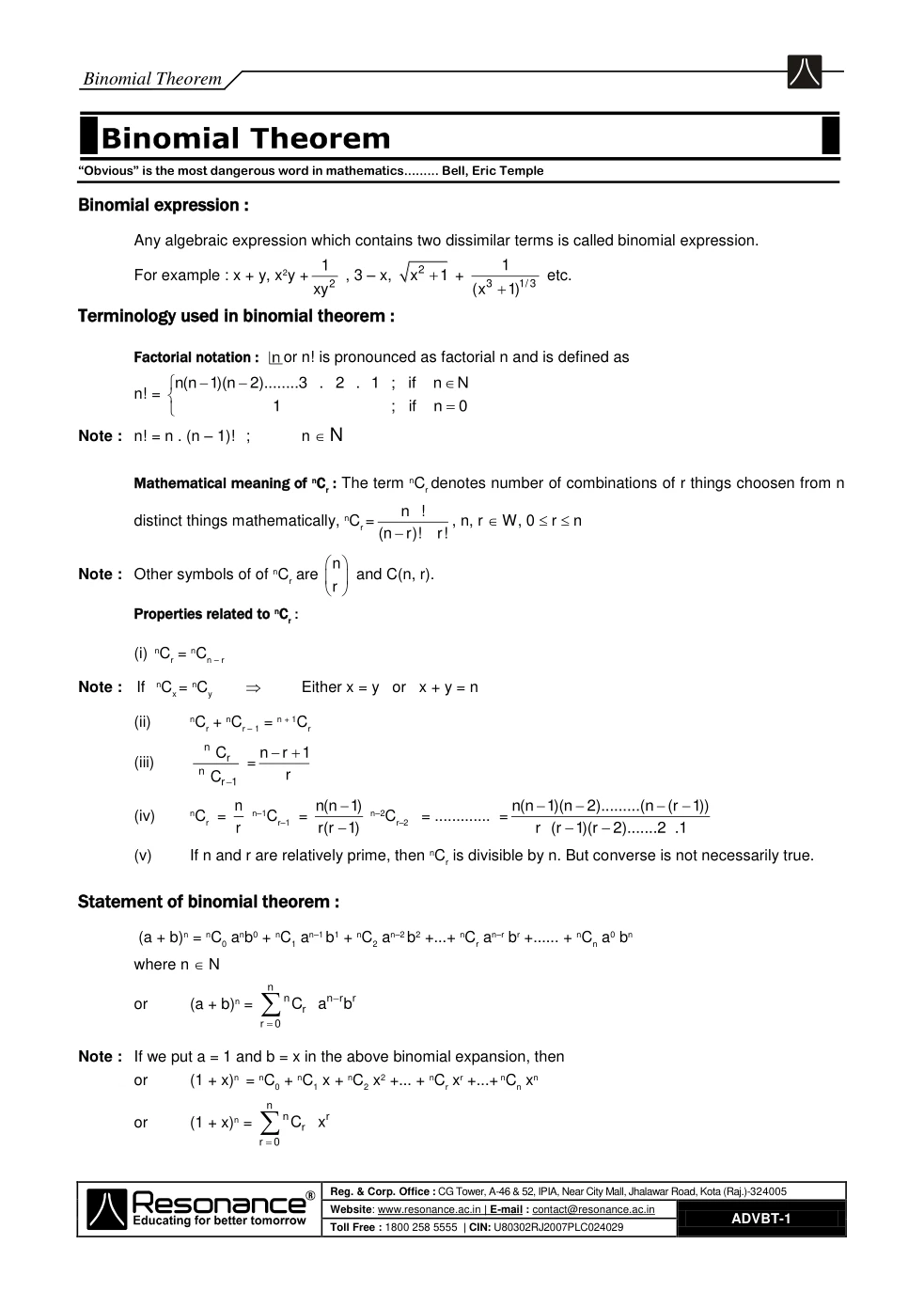
Binomial expression :
Any algebraic expression which contains two dissimilar terms is called binomial expression.
1 2 1 For example : x + y, x2y + , 3 – x, x 1 + etc.
xy 2 (x 3 1)1/ 3
Terminology used in binomial theorem :
Factorial notation : or n! is pronounced as factorial n and is defined as
n(n 1)(n 2)........3 . 2 . 1 ; if n N
n! =
1 ; if n 0
Note : n! = n . (n – 1)! ; n N
Mathematical meaning of nCr : The term nCr denotes number of combinations of r things choosen from n
n !
distinct things mathematically, nCr = , n, r W, 0 r n (n r)! r!
n
Note : Other symbols of of nCr are and C(n, r).
r
Properties related to nCr :
(i) nCr = nCn – r
Note : If nCx = nCy Either x = y or x + y = n
(ii) nCr + nCr – 1 = n + 1Cr
n Cr n r 1 (iii) =
n Cr 1 r
n n(n 1) n(n 1)(n 2).........(n (r 1))
(iv) nCr = n–1Cr–1 = n–2Cr–2 = ............. = r r(r 1) r (r 1)(r 2).......2 .1
(v) If n and r are relatively prime, then nCr is divisible by n. But converse is not necessarily true.
Statement of binomial theorem :
(a + b)n = nC0 anb0 + nC1 an–1 b1 + nC2 an–2 b2 +...+ nCr an–r br +...... + nCn a0 bn
where n N
n
or (a + b)n = n Cr an r b r r0
Note : If we put a = 1 and b = x in the above binomial expansion, then
or (1 + x)n = nC0 + nC1 x + nC2 x2 +... + nCr xr +...+ nCn xn
n
or (1 + x)n = n Cr x r r0
ADVBT-1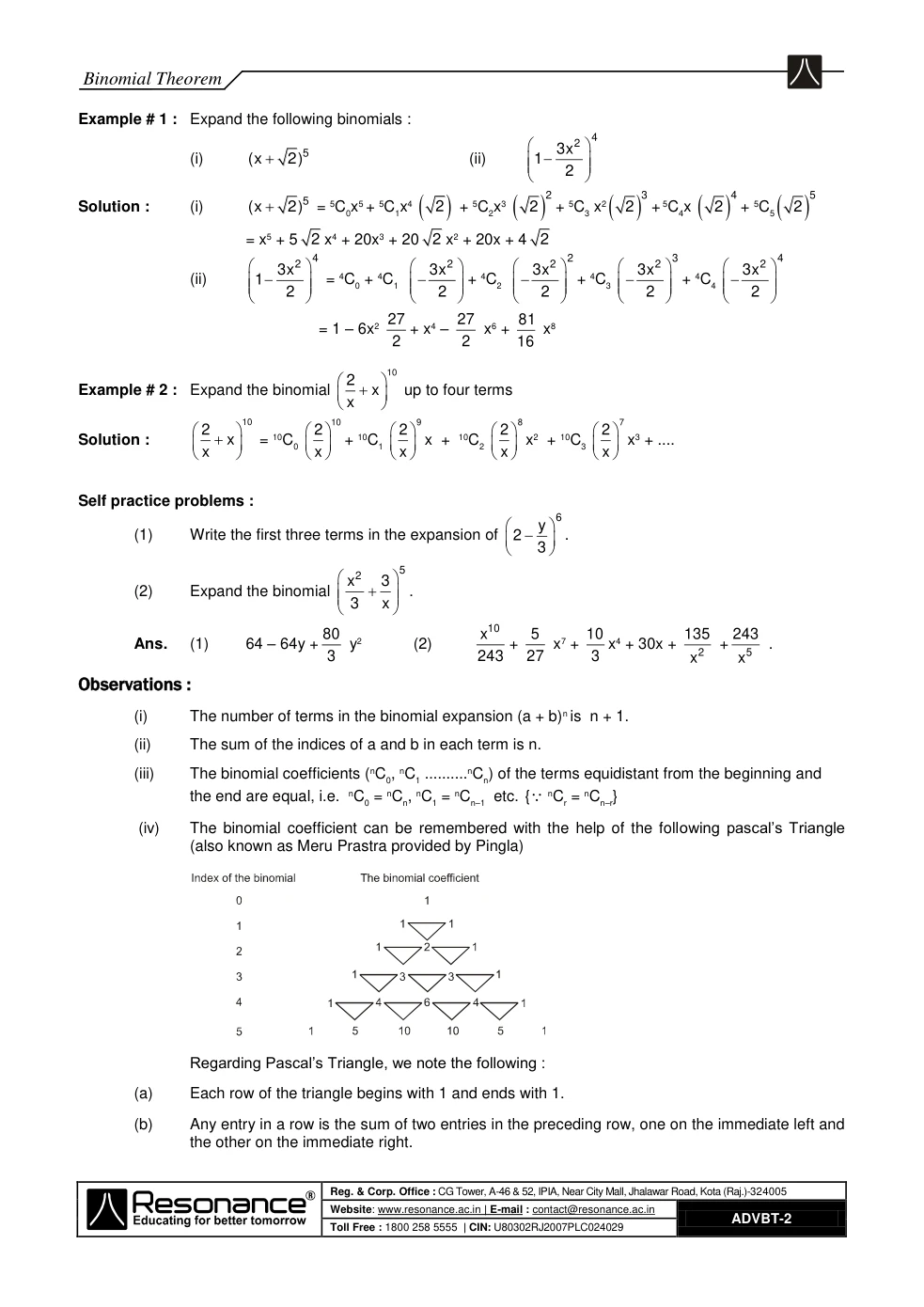
MAASBinomial Expansion
© MAAS. All rights reserved.Page 2 / 30
Extracted text · page 2
Binomial Theorem
Example # 1 : Expand the following binomials :
4
5 3x 2 (i) (x 2) (ii) 1 2
2 3 4 5
+ 2 2 2 2 2Solution : (i) (x 2)5 = 5C0x5 + 5C1x4 + 5C2x3 + 5C3 x2 + 5C4x 5C5
= x5 + 5 2 x4 + 20x3 + 20 2 x2 + 20x + 4 2
3x 4 2 3 4 2 3x 2 3x 2 3x 2 3x 2
(ii) 1 = 4C0 + 4C1 + 4C2 + 4C3 + 4C4 2 2 2 2 2
27 27 81
= 1 – 6x2 + x4 – x6 + x8
2 2 16
2 10
Example # 2 : Expand the binomial x up to four terms
x
2 10 2 10 2 9 2 8 2 7
Solution : x = 10C0 + 10C1 x + 10C2 x2 + 10C3 x3 + ....
x x x x x
Self practice problems :
y 6 (1) Write the first three terms in the expansion of 2 . 3
x 5 2 3
(2) Expand the binomial . 3 x
80 x10 5 10 135 243
Ans. (1) 64 – 64y + y2 (2) + x7 + x4 + 30x + + .
3 243 27 3 x 2 x 5
Observations :
(i) The number of terms in the binomial expansion (a + b)n is n + 1.
(ii) The sum of the indices of a and b in each term is n.
(iii) The binomial coefficients (nC0, nC1 ..........nCn) of the terms equidistant from the beginning and
the end are equal, i.e. nC0 = nCn, nC1 = nCn–1 etc. { nCr = nCn–r}
(iv) The binomial coefficient can be remembered with the help of the following pascal’s Triangle
(also known as Meru Prastra provided by Pingla)
Regarding Pascal’s Triangle, we note the following :
(a) Each row of the triangle begins with 1 and ends with 1.
(b) Any entry in a row is the sum of two entries in the preceding row, one on the immediate left and
the other on the immediate right.
ADVBT-2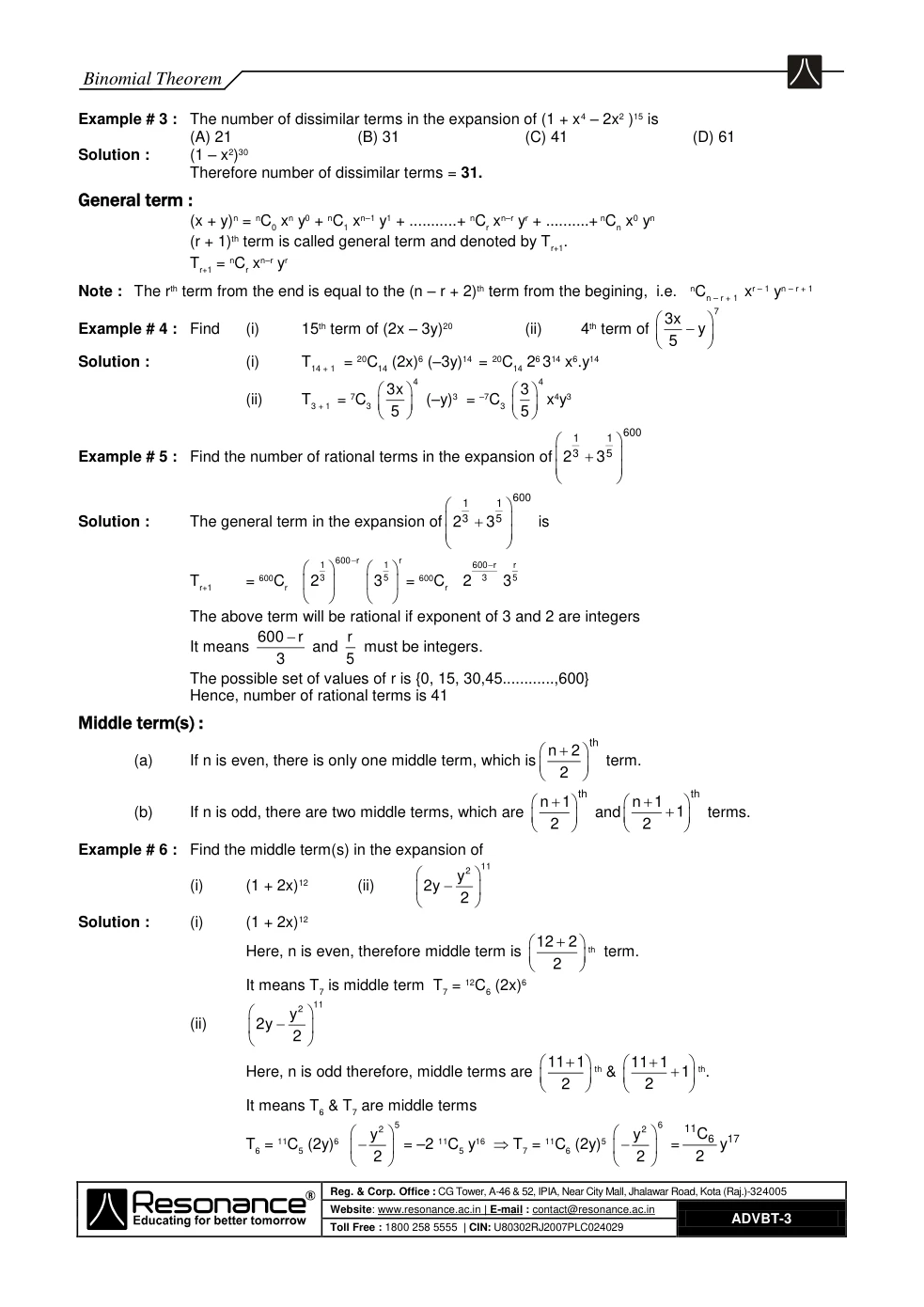
MAASBinomial Expansion
© MAAS. All rights reserved.Page 3 / 30
Extracted text · page 3
Binomial Theorem
Example # 3 : The number of dissimilar terms in the expansion of (1 + x4 – 2x2 )15 is
(A) 21 (B) 31 (C) 41 (D) 61
Solution : (1 – x2)30
Therefore number of dissimilar terms = 31.
General term :
(x + y)n = nC0 xn y0 + nC1 xn–1 y1 + ...........+ nCr xn–r yr + ..........+ nCn x0 yn
(r + 1)th term is called general term and denoted by Tr+1.
Tr+1 = nCr xn–r yr
Note : The rth term from the end is equal to the (n – r + 2)th term from the begining, i.e. nCn – r + 1 xr – 1 yn – r + 1
3x 7
Example # 4 : Find (i) 15th term of (2x – 3y)20 (ii) 4th term of y
5
Solution : (i) T14 + 1 = 20C14 (2x)6 (–3y)14 = 20C14 26 314 x6.y14
3x 4 3 4
(ii) T3 + 1 = 7C3 (–y)3 = –7C3 x4y3
5 5
600 1 1
Example # 5 : Find the number of rational terms in the expansion of 2 3 3 5
600 1 1
Solution : The general term in the expansion of 2 3 3 5 is
1 600 r 1 r 600 r r
Tr+1 = 600Cr 2 3 3 5 = 600Cr 2 3 3 5
The above term will be rational if exponent of 3 and 2 are integers
600 r r
It means and must be integers.
3 5
The possible set of values of r is {0, 15, 30,45............,600}
Hence, number of rational terms is 41
Middle term(s) :
n 2 th
(a) If n is even, there is only one middle term, which is term.
2
n 1 th n 1 th (b) If n is odd, there are two middle terms, which are and 1 terms.
2 2
Example # 6 : Find the middle term(s) in the expansion of
y 2 11
(i) (1 + 2x)12 (ii) 2y
2
Solution : (i) (1 + 2x)12
12 2 th Here, n is even, therefore middle term is term.
2
It means T7 is middle term T7 = 12C6 (2x)6
y 2 11
(ii) 2y
2
11 1 th 11 1 Here, n is odd therefore, middle terms are & 1 th.
2 2
It means T6 & T7 are middle terms
y 2 5 y 2 6 11 C6 17 T6 = 11C5 (2y)6 = –2 11C5 y16 T7 = 11C6 (2y)5 = y
2 2 2
ADVBT-3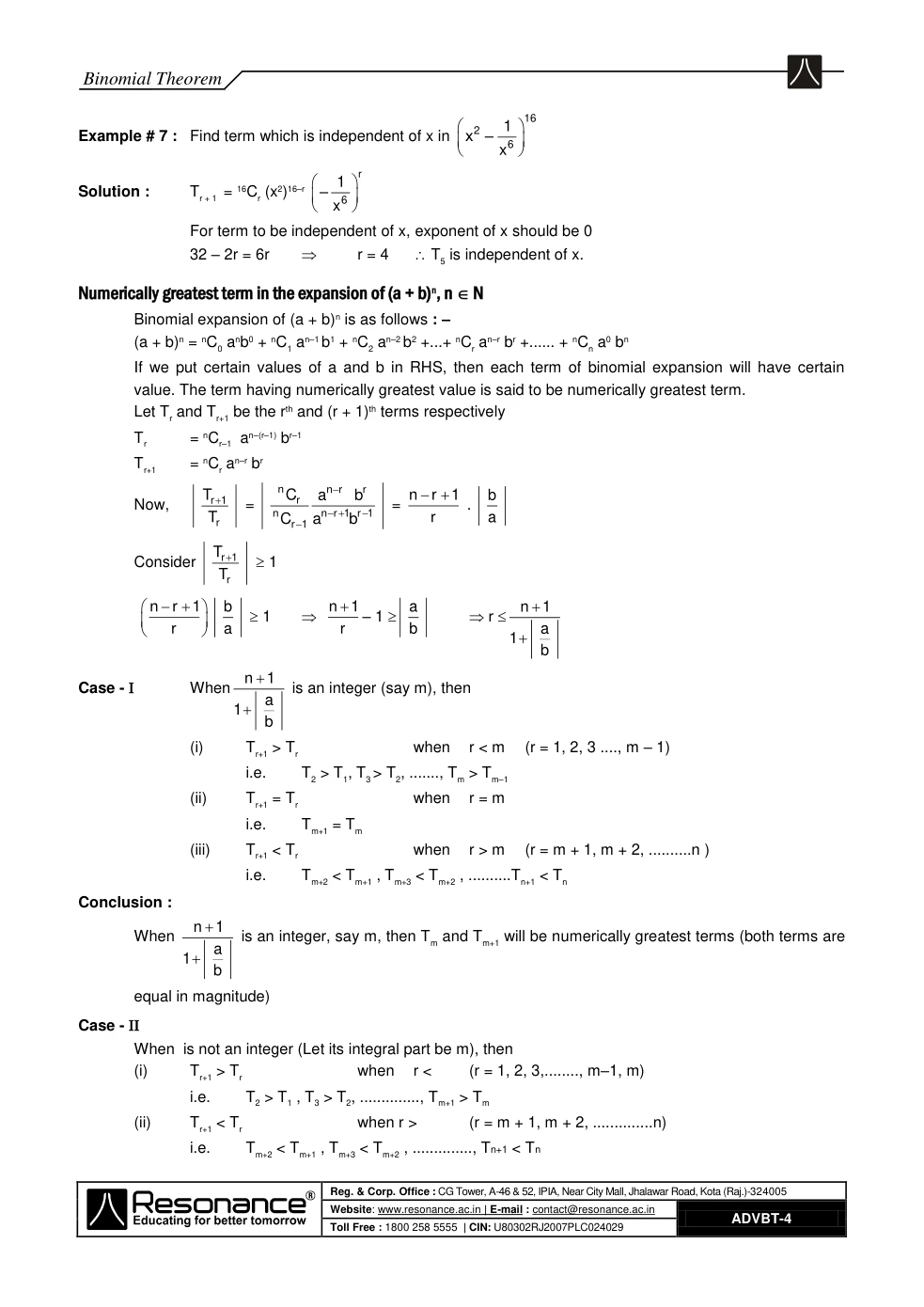
MAASBinomial Expansion
© MAAS. All rights reserved.Page 4 / 30
Extracted text · page 4
Binomial Theorem
2 1 16
Example # 7 : Find term which is independent of x in x – 6 x
1 r
Solution : Tr + 1 = 16Cr (x2)16–r – 6 x
For term to be independent of x, exponent of x should be 0
32 – 2r = 6r r = 4 T5 is independent of x.
Numerically greatest term in the expansion of (a + b)n, n N
Binomial expansion of (a + b)n is as follows : –
(a + b)n = nC0 anb0 + nC1 an–1 b1 + nC2 an–2 b2 +...+ nCr an–r br +...... + nCn a0 bn
If we put certain values of a and b in RHS, then each term of binomial expansion will have certain
value. The term having numerically greatest value is said to be numerically greatest term.
Let Tr and Tr+1 be the rth and (r + 1)th terms respectively
Tr = nCr–1 an–(r–1) br–1
Tr+1 = nCr an–r br
Tr 1 n Cr an r br n r 1 b Now, = = .
Tr n Cr 1 an r 1br 1 r a
Tr 1 Consider 1
Tr
n r 1 b n 1 a n 1 1 – 1 r
r a r b a 1
b
n 1
Case - When is an integer (say m), then
a
1
b
(i) Tr+1 > Tr when r < m (r = 1, 2, 3 ...., m – 1)
i.e. T2 > T1, T3 > T2, ......., Tm > Tm–1
(ii) Tr+1 = Tr when r = m
i.e. Tm+1 = Tm
(iii) Tr+1 < Tr when r > m (r = m + 1, m + 2, ..........n )
i.e. Tm+2 < Tm+1 , Tm+3 < Tm+2 , ..........Tn+1 < Tn
Conclusion :
n 1
When is an integer, say m, then Tm and Tm+1 will be numerically greatest terms (both terms are
a
1
b
equal in magnitude)
Case -
When is not an integer (Let its integral part be m), then
(i) Tr+1 > Tr when r < (r = 1, 2, 3,........, m–1, m)
i.e. T2 > T1 , T3 > T2, .............., Tm+1 > Tm
(ii) Tr+1 < Tr when r > (r = m + 1, m + 2, ..............n)
i.e. Tm+2 < Tm+1 , Tm+3 < Tm+2 , .............., Tn+1 < Tn
ADVBT-4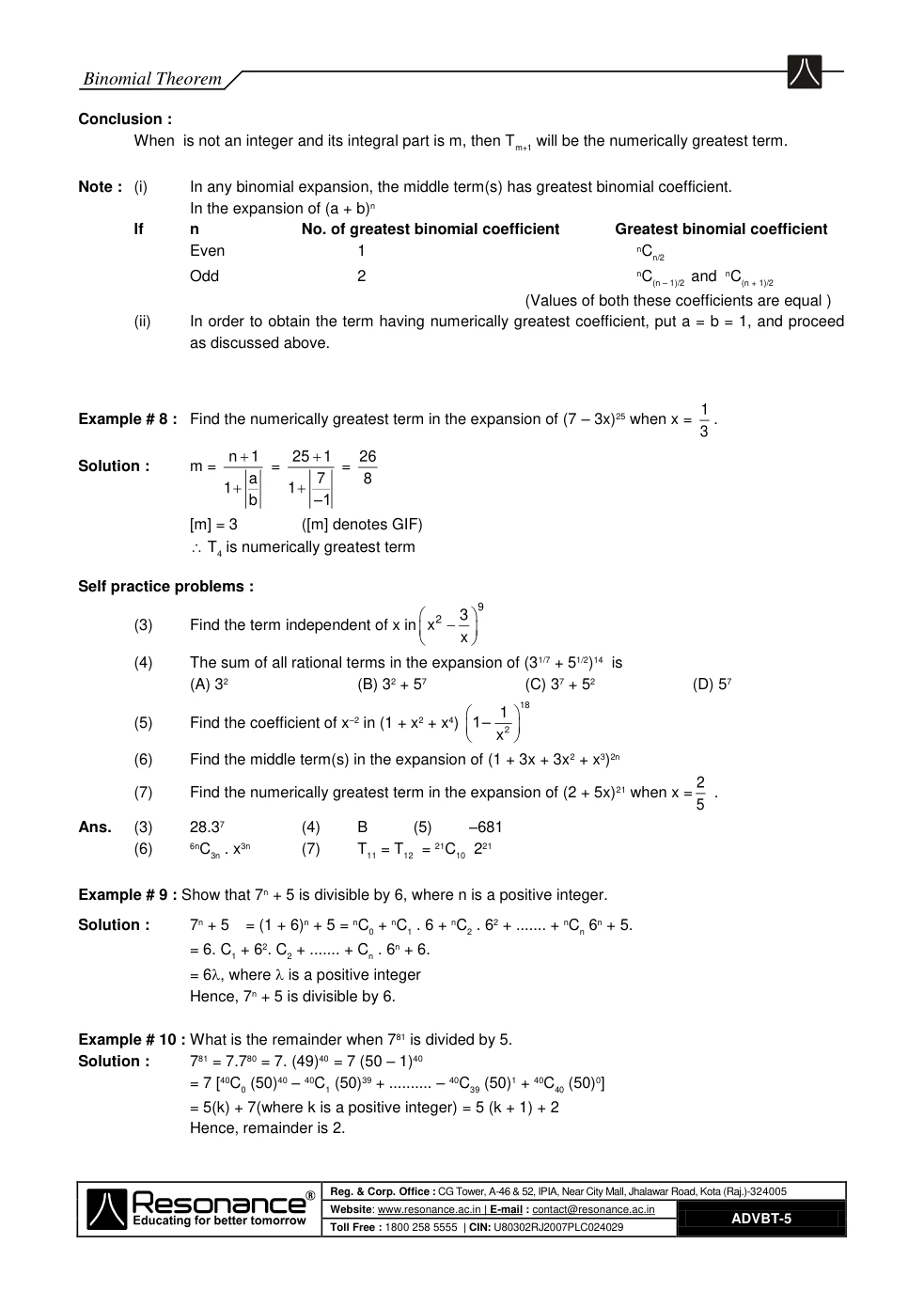
MAASBinomial Expansion
© MAAS. All rights reserved.Page 5 / 30
Extracted text · page 5
Binomial Theorem
Conclusion :
When is not an integer and its integral part is m, then Tm+1 will be the numerically greatest term.
Note : (i) In any binomial expansion, the middle term(s) has greatest binomial coefficient.
In the expansion of (a + b)n
If n No. of greatest binomial coefficient Greatest binomial coefficient
Even 1 nCn/2
Odd 2 nC(n – 1)/2 and nC(n + 1)/2
(Values of both these coefficients are equal )
(ii) In order to obtain the term having numerically greatest coefficient, put a = b = 1, and proceed
as discussed above.
1
Example # 8 : Find the numerically greatest term in the expansion of (7 – 3x)25 when x = .
3
n 1 25 1 26
Solution : m = = =
a 7 8
1 1
b –1
[m] = 3 ([m] denotes GIF)
T4 is numerically greatest term
Self practice problems :
2 3 9 (3) Find the term independent of x in x
x
(4) The sum of all rational terms in the expansion of (31/7 + 51/2)14 is
(A) 32 (B) 32 + 57 (C) 37 + 52 (D) 57
1 18
(5) Find the coefficient of x–2 in (1 + x2 + x4) 1– 2
x
(6) Find the middle term(s) in the expansion of (1 + 3x + 3x2 + x3)2n
2
(7) Find the numerically greatest term in the expansion of (2 + 5x)21 when x = .
5
Ans. (3) 28.37 (4) B (5) –681
(6) 6nC3n . x3n (7) T11 = T12 = 21C10 221
Example # 9 : Show that 7n + 5 is divisible by 6, where n is a positive integer.
Solution : 7n + 5 = (1 + 6)n + 5 = nC0 + nC1 . 6 + nC2 . 62 + ....... + nCn 6n + 5.
= 6. C1 + 62. C2 + ....... + Cn . 6n + 6.
= 6, where is a positive integer
Hence, 7n + 5 is divisible by 6.
Example # 10 : What is the remainder when 781 is divided by 5.
Solution : 781 = 7.780 = 7. (49)40 = 7 (50 – 1)40
= 7 [40C0 (50)40 – 40C1 (50)39 + .......... – 40C39 (50)1 + 40C40 (50)0]
= 5(k) + 7(where k is a positive integer) = 5 (k + 1) + 2
Hence, remainder is 2.
ADVBT-5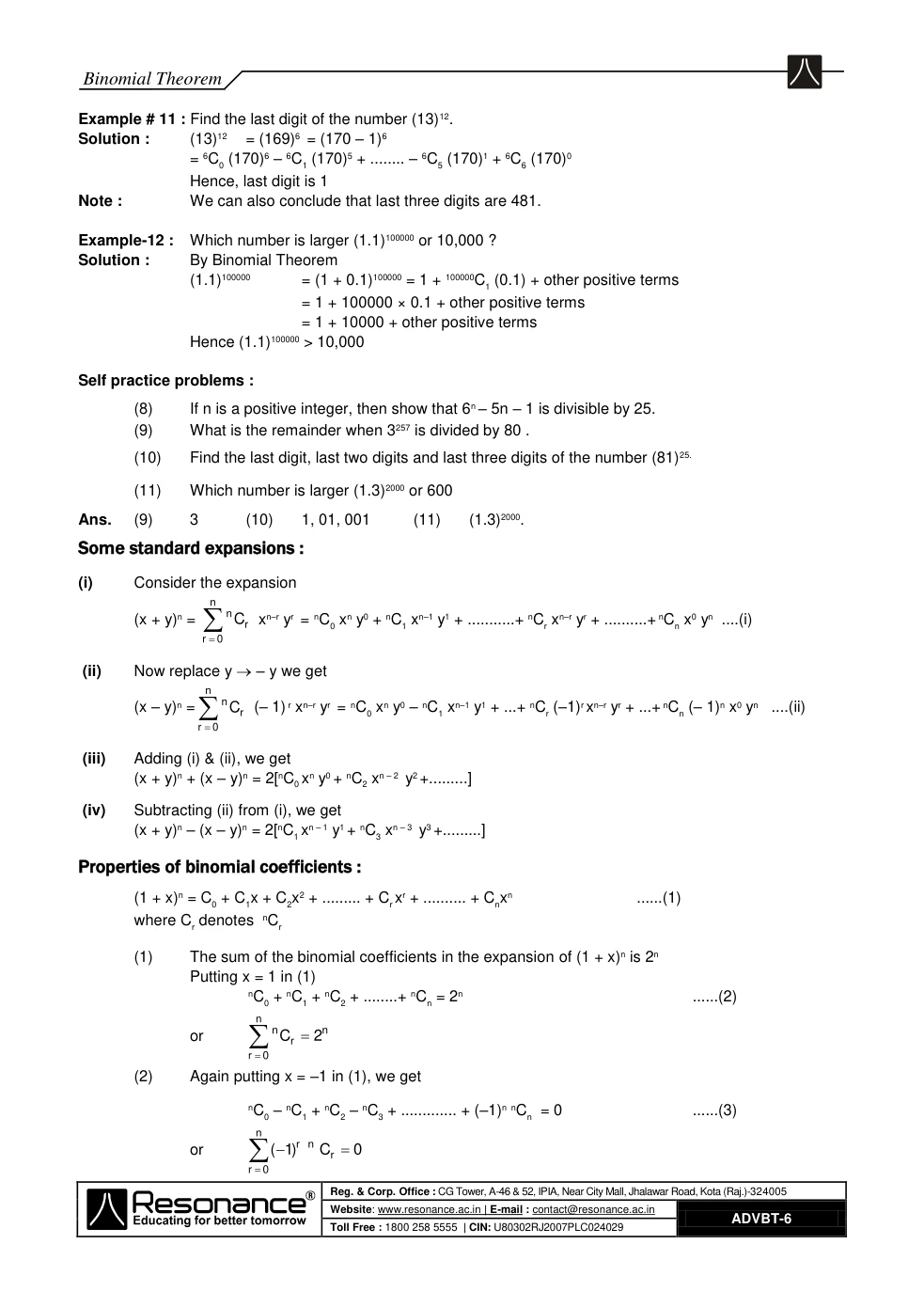
MAASBinomial Expansion
© MAAS. All rights reserved.Page 6 / 30
Extracted text · page 6
Binomial Theorem
Example # 11 : Find the last digit of the number (13)12.
Solution : (13)12 = (169)6 = (170 – 1)6
= 6C0 (170)6 – 6C1 (170)5 + ........ – 6C5 (170)1 + 6C6 (170)0
Hence, last digit is 1
Note : We can also conclude that last three digits are 481.
Example-12 : Which number is larger (1.1)100000 or 10,000 ?
Solution : By Binomial Theorem
(1.1)100000 = (1 + 0.1)100000 = 1 + 100000C1 (0.1) + other positive terms
= 1 + 100000 × 0.1 + other positive terms
= 1 + 10000 + other positive terms
Hence (1.1)100000 > 10,000
Self practice problems :
(8) If n is a positive integer, then show that 6n – 5n – 1 is divisible by 25.
(9) What is the remainder when 3257 is divided by 80 .
(10) Find the last digit, last two digits and last three digits of the number (81)25.
(11) Which number is larger (1.3)2000 or 600
Ans. (9) 3 (10) 1, 01, 001 (11) (1.3)2000.
Some standard expansions :
(i) Consider the expansion
n
(x + y)n = n Cr xn–r yr = nC0 xn y0 + nC1 xn–1 y1 + ...........+ nCr xn–r yr + ..........+ nCn x0 yn ....(i) r0
(ii) Now replace y – y we get
n
(x – y)n = n Cr (– 1) r xn–r yr = nC0 xn y0 – nC1 xn–1 y1 + ...+ nCr (–1)r xn–r yr + ...+ nCn (– 1)n x0 yn ....(ii) r0
(iii) Adding (i) & (ii), we get
(x + y)n + (x – y)n = 2[nC0 xn y0 + nC2 xn – 2 y2 +.........]
(iv) Subtracting (ii) from (i), we get
(x + y)n – (x – y)n = 2[nC1 xn – 1 y1 + nC3 xn – 3 y3 +.........]
Properties of binomial coefficients :
(1 + x)n = C0 + C1x + C2x2 + ......... + Cr xr + .......... + Cnxn ......(1)
where Cr denotes nCr
(1) The sum of the binomial coefficients in the expansion of (1 + x)n is 2n
Putting x = 1 in (1)
nC0 + nC1 + nC2 + ........+ nCn = 2n ......(2)
n
or n Cr 2n
r 0
(2) Again putting x = –1 in (1), we get
nC0 – nC1 + nC2 – nC3 + ............. + (–1)n nCn = 0 ......(3)
n
or ( 1)r n Cr 0
r 0
ADVBT-6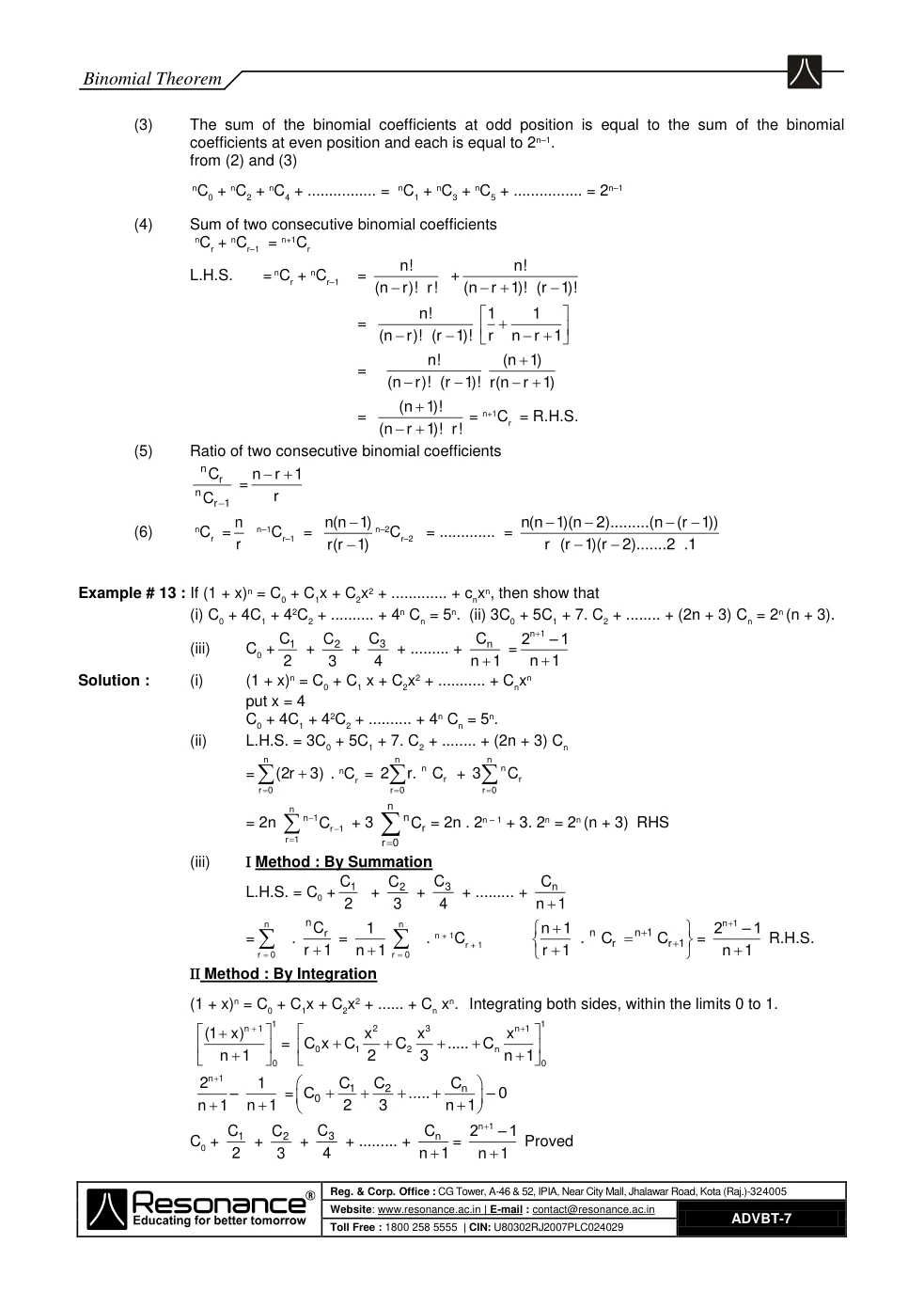
MAASBinomial Expansion
© MAAS. All rights reserved.Page 7 / 30
Extracted text · page 7
Binomial Theorem
(3) The sum of the binomial coefficients at odd position is equal to the sum of the binomial
coefficients at even position and each is equal to 2n–1.
from (2) and (3)
nC0 + nC2 + nC4 + ................ = nC1 + nC3 + nC5 + ................ = 2n–1
(4) Sum of two consecutive binomial coefficients
nCr + nCr–1 = n+1Cr
n! n!
L.H.S. = nCr + nCr–1 = + (n r)! r! (n r 1)! (r 1)!
n! 1 1 = (n r)! (r 1)! r n r 1
n! (n 1)
=
(n r)! (r 1)! r(n r 1)
(n 1)!
= = n+1Cr = R.H.S. (n r 1)! r!
(5) Ratio of two consecutive binomial coefficients
n Cr n r 1 =
n Cr 1 r
n n(n 1) n(n 1)(n 2).........(n (r 1))
(6) nCr = n–1Cr–1 = n–2Cr–2 = ............. = r r(r 1) r (r 1)(r 2).......2 .1
Example # 13 : If (1 + x)n = C0 + C1x + C2x2 + ............. + cnxn, then show that
(i) C0 + 4C1 + 42C2 + .......... + 4n Cn = 5n. (ii) 3C0 + 5C1 + 7. C2 + ........ + (2n + 3) Cn = 2n (n + 3).
C1 C 2 C 3 Cn 2n 1 – 1
(iii) C0 + + + + ......... + = 2 3 4 n 1 n 1
Solution : (i) (1 + x)n = C0 + C1 x + C2x2 + ........... + Cnxn
put x = 4
C0 + 4C1 + 42C2 + .......... + 4n Cn = 5n.
(ii) L.H.S. = 3C0 + 5C1 + 7. C2 + ........ + (2n + 3) Cn
n n n
= (2r 3) . nCr = 2 r. n Cr + 3 n Cr r 0 r 0 r 0
n n
= 2n r 1 n 1 Cr 1 + 3 r 0 n Cr = 2n . 2n – 1 + 3. 2n = 2n (n + 3) RHS
(iii) Method : By Summation
C1 C 2 C 3 Cn
L.H.S. = C0 + + + + ......... + 2 3 4 n 1
n n Cr 1 n n + n 1 n n 1 2n 1 – 1 = . = . 1Cr + 1 . Cr Cr 1 = R.H.S. r0 r 1 n 1 r0 r 1 n 1
Method : By Integration
(1 + x)n = C0 + C1x + C2x2 + ...... + Cn xn. Integrating both sides, within the limits 0 to 1.
(1 x)n 1 1 x 2 x 3 x n 1 1
= C0 x C1 C 2 ..... C n
n 1 0 2 3 n 1 0
2n 1 1 C1 C2 Cn
= C0 ..... – 0 n –1 n 1 2 3 n 1
C1 C 2 C 3 Cn 2n 1 – 1
C0 + + + + ......... + = Proved 2 3 4 n 1 n 1
ADVBT-7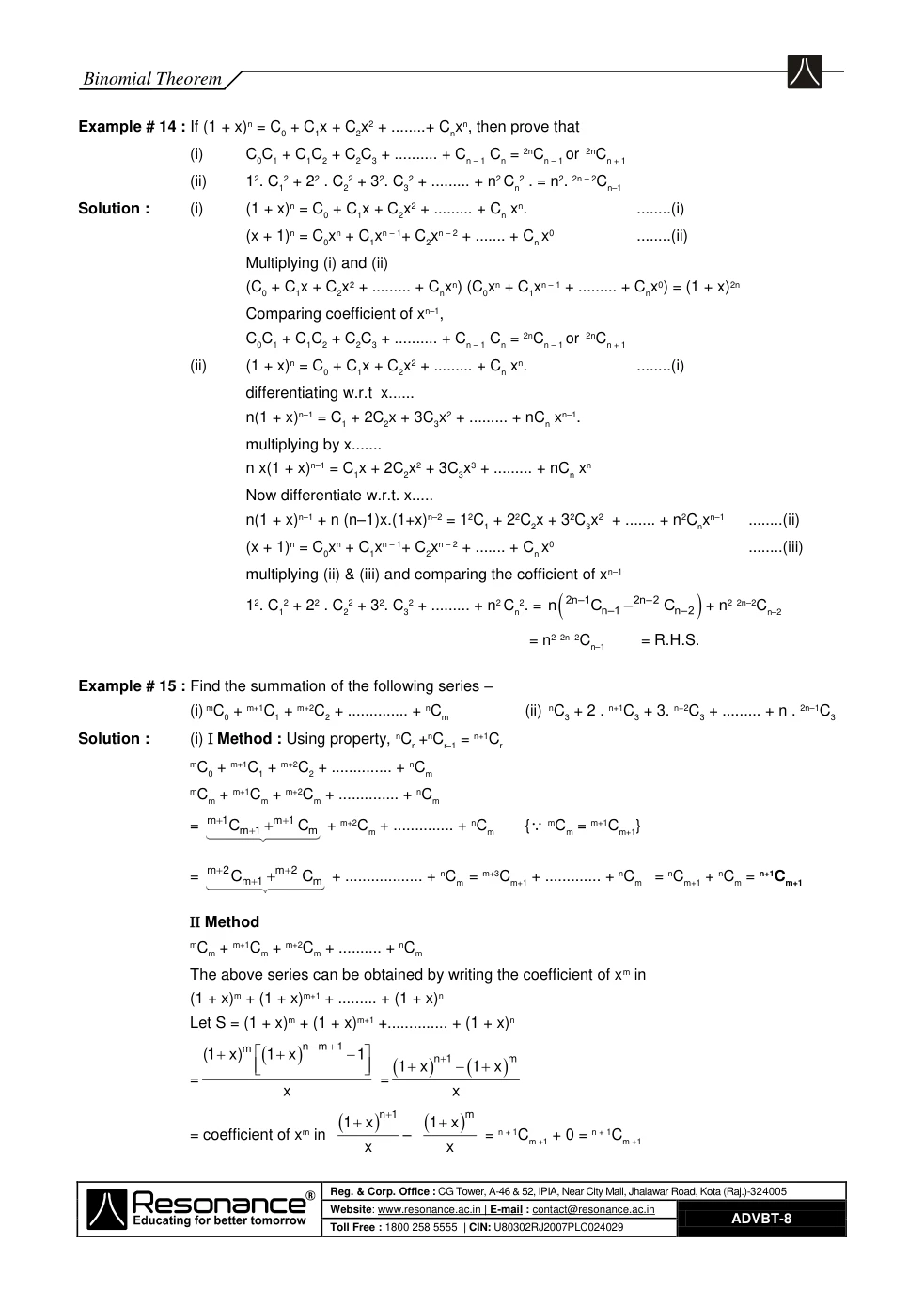
MAASBinomial Expansion
© MAAS. All rights reserved.Page 8 / 30
Extracted text · page 8
Binomial Theorem
Example # 14 : If (1 + x)n = C0 + C1x + C2x2 + ........+ Cnxn, then prove that
(i) C0C1 + C1C2 + C2C3 + .......... + Cn – 1 Cn = 2nCn – 1 or 2nCn + 1
(ii) 12. C1 2 + 22 . C2 2 + 32. C3 2 + ......... + n2 Cn 2 . = n2. 2n – 2Cn–1
Solution : (i) (1 + x)n = C0 + C1x + C2x2 + ......... + Cn xn. ........(i)
(x + 1)n = C0xn + C1xn – 1+ C2xn – 2 + ....... + Cn x0 ........(ii)
Multiplying (i) and (ii)
(C0 + C1x + C2x2 + ......... + Cnxn) (C0xn + C1xn – 1 + ......... + Cnx0) = (1 + x)2n
Comparing coefficient of xn–1,
C0C1 + C1C2 + C2C3 + .......... + Cn – 1 Cn = 2nCn – 1 or 2nCn + 1
(ii) (1 + x)n = C0 + C1x + C2x2 + ......... + Cn xn. ........(i)
differentiating w.r.t x......
n(1 + x)n–1 = C1 + 2C2x + 3C3x2 + ......... + nCn xn–1.
multiplying by x.......
n x(1 + x)n–1 = C1x + 2C2x2 + 3C3x3 + ......... + nCn xn
Now differentiate w.r.t. x.....
n(1 + x)n–1 + n (n–1)x.(1+x)n–2 = 12C1 + 22C2x + 32C3x2 + ....... + n2Cnxn–1 ........(ii)
(x + 1)n = C0xn + C1xn – 1+ C2xn – 2 + ....... + Cn x0 ........(iii)
multiplying (ii) & (iii) and comparing the cofficient of xn–1
+ n2 2n–2Cn–2 12. C1 2 + 22 . C2 2 + 32. C3 2 + ......... + n2 Cn 2. = n 2n–1 Cn–1 – 2n–2 Cn–2
= n2 2n–2Cn–1 = R.H.S.
Example # 15 : Find the summation of the following series –
(i) mC0 + m+1C1 + m+2C2 + .............. + nCm (ii) nC3 + 2 . n+1C3 + 3. n+2C3 + ......... + n . 2n–1C3
Solution : (i) Method : Using property, nCr +nCr–1 = n+1Cr
mC0 + m+1C1 + m+2C2 + .............. + nCm
mCm + m+1Cm + m+2Cm + .............. + nCm
= m 1 Cm 1 m 1 Cm + m+2Cm + .............. + nCm { mCm = m+1Cm+1}
= m 2 Cm 1 m 2 Cm + .................. + nCm = m+3Cm+1 + ............. + nCm = nCm+1 + nCm = n+1Cm+1
Method
mCm + m+1Cm + m+2Cm + .......... + nCm
The above series can be obtained by writing the coefficient of xm in
(1 + x)m + (1 + x)m+1 + ......... + (1 + x)n
Let S = (1 + x)m + (1 + x)m+1 +.............. + (1 + x)n
(1 x)m 1 x n m 1 1 n 1 m 1 x 1 x
= =
x x
1 x n 1 1 x m n + n + = coefficient of xm in – = 1Cm +1 + 0 = 1Cm +1
x x
ADVBT-8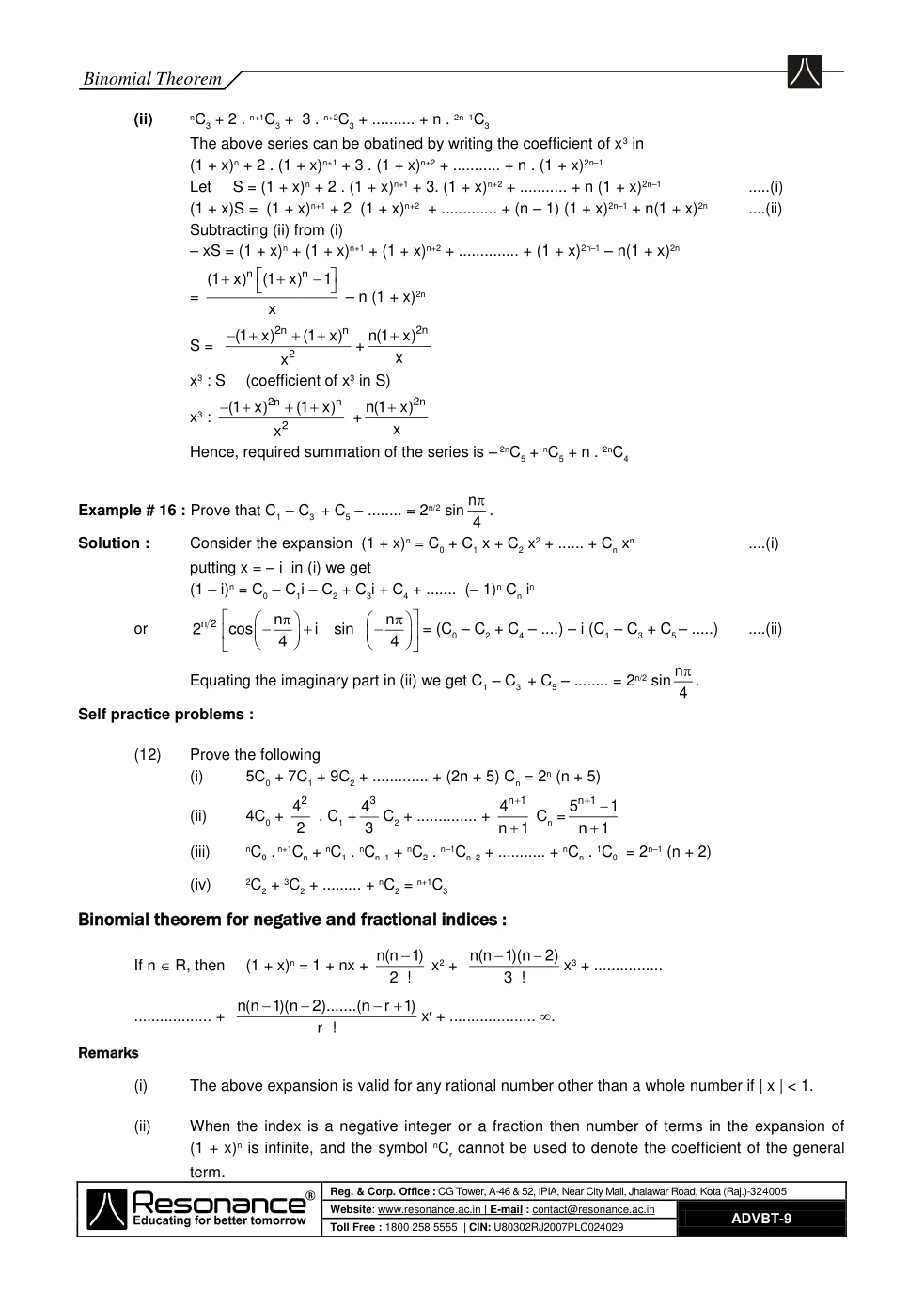
MAASBinomial Expansion
© MAAS. All rights reserved.Page 9 / 30
Extracted text · page 9
Binomial Theorem
(ii) nC3 + 2 . n+1C3 + 3 . n+2C3 + .......... + n . 2n–1C3
The above series can be obatined by writing the coefficient of x3 in
(1 + x)n + 2 . (1 + x)n+1 + 3 . (1 + x)n+2 + ........... + n . (1 + x)2n–1
Let S = (1 + x)n + 2 . (1 + x)n+1 + 3. (1 + x)n+2 + ........... + n (1 + x)2n–1 .....(i)
(1 + x)S = (1 + x)n+1 + 2 (1 + x)n+2 + ............. + (n – 1) (1 + x)2n–1 + n(1 + x)2n ....(ii)
Subtracting (ii) from (i)
– xS = (1 + x)n + (1 + x)n+1 + (1 + x)n+2 + .............. + (1 + x)2n–1 – n(1 + x)2n
(1 x)n (1 x)n 1
= – n (1 + x)2n
x
(1 x)2n (1 x)n n(1 x)2n
S = +
x 2 x
x3 : S (coefficient of x3 in S)
(1 x)2n (1 x)n n(1 x)2n
x3 : +
x 2 x
Hence, required summation of the series is – 2nC5 + nC5 + n . 2nC4
nExample # 16 : Prove that C1 – C3 + C5 – ........ = 2n/2 sin .
4
Solution : Consider the expansion (1 + x)n = C0 + C1 x + C2 x2 + ...... + Cn xn ....(i)
putting x = – i in (i) we get
(1 – i)n = C0 – C1i – C2 + C3i + C4 + ....... (– 1)n Cn in
n 2 n n
or 2 cos i sin = (C0 – C2 + C4 – ....) – i (C1 – C3 + C5 – .....) ....(ii)
4 4
n Equating the imaginary part in (ii) we get C1 – C3 + C5 – ........ = 2n/2 sin .
4
Self practice problems :
(12) Prove the following
(i) 5C0 + 7C1 + 9C2 + ............. + (2n + 5) Cn = 2n (n + 5)
4 2 4 3 4n 1 5n 1 1
(ii) 4C0 + . C1 + C2 + .............. + Cn = 2 3 n 1 n 1
(iii) nC0 . n+1Cn + nC1 . nCn–1 + nC2 . n–1Cn–2 + ........... + nCn . 1C0 = 2n–1 (n + 2)
(iv) 2C2 + 3C2 + ......... + nC2 = n+1C3
Binomial theorem for negative and fractional indices :
n(n 1) n(n 1)(n 2)
If n R, then (1 + x)n = 1 + nx + x2 + x3 + ................
2 ! 3 !
n(n 1)(n 2).......(n r 1)
.................. + xr + .................... .
r !
Remarks
(i) The above expansion is valid for any rational number other than a whole number if | x | < 1.
(ii) When the index is a negative integer or a fraction then number of terms in the expansion of
(1 + x)n is infinite, and the symbol nCr cannot be used to denote the coefficient of the general
term.
ADVBT-9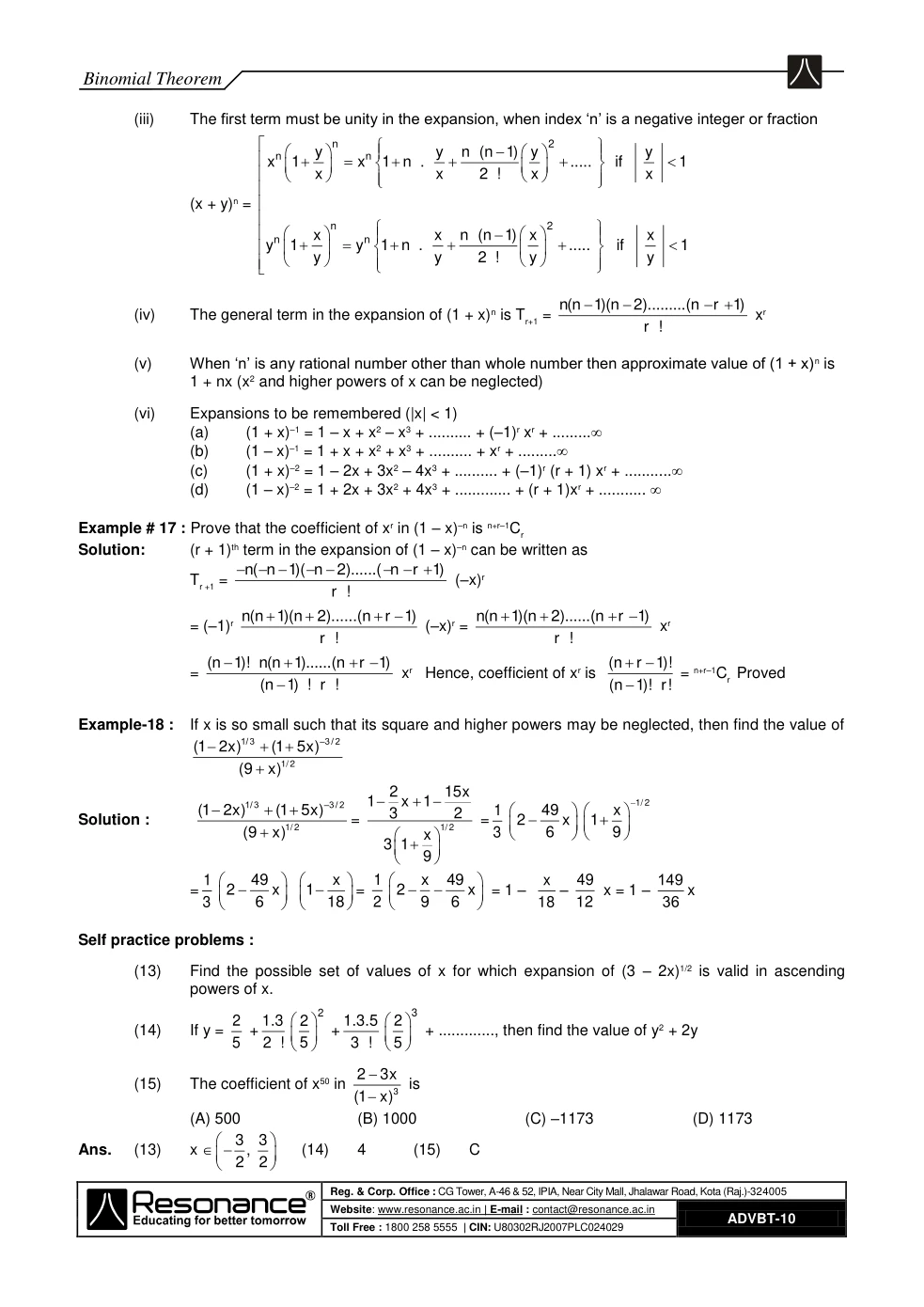
MAASBinomial Expansion
© MAAS. All rights reserved.Page 10 / 30
Extracted text · page 10
Binomial Theorem
(iii) The first term must be unity in the expansion, when index ‘n’ is a negative integer or fraction
n 2 n y n y n (n 1) y y x 1 x 1 n . ..... if 1
x x 2 ! x x
(x + y)n =
n 2 n x n x n (n 1) x x
y 1 y 1 n . ..... if 1
y y 2 ! y y
n(n 1)(n 2).........(n r 1)
(iv) The general term in the expansion of (1 + x)n is Tr+1 = xr
r !
(v) When ‘n’ is any rational number other than whole number then approximate value of (1 + x)n is
1 + nx (x2 and higher powers of x can be neglected)
(vi) Expansions to be remembered (|x| < 1)
(a) (1 + x)–1 = 1 – x + x2 – x3 + .......... + (–1)r xr + .........
(b) (1 – x)–1 = 1 + x + x2 + x3 + .......... + xr + .........
(c) (1 + x)–2 = 1 – 2x + 3x2 – 4x3 + .......... + (–1)r (r + 1) xr + ...........
(d) (1 – x)–2 = 1 + 2x + 3x2 + 4x3 + ............. + (r + 1)xr + ...........
Example # 17 : Prove that the coefficient of xr in (1 – x)–n is n+r–1Cr
Solution: (r + 1)th term in the expansion of (1 – x)–n can be written as
n( n 1)( n 2)......( n r 1)
Tr +1 = (–x)r
r !
n(n 1)(n 2)......(n r 1) n(n 1)(n 2)......(n r 1)
= (–1)r (–x)r = xr
r ! r !
(n 1)! n(n 1)......(n r 1) (n r 1)!
= xr Hence, coefficient of xr is = n+r–1Cr Proved (n 1) ! r ! (n 1)! r!
Example-18 : If x is so small such that its square and higher powers may be neglected, then find the value of
(1 2x)1/3 (1 5x) –3/ 2
(9 x)1/ 2
2 15x
1/3 –3/ 2 1 x 1 1/ 2
(1 2x) (1 5x) 3 2 1 49 x Solution : 1/ 2 = 1/ 2 = 2 x 1
(9 x) x 3 6 9
3 1
9
1 49 x 1 x 49 x 49 149
= 2 x 1 = 2 x = 1 – – x = 1 – x 3 6 18 2 9 6 18 12 36
Self practice problems :
(13) Find the possible set of values of x for which expansion of (3 – 2x)1/2 is valid in ascending
powers of x.
2 3
2 1.3 2 1.3.5 2
(14) If y = + + + ............., then find the value of y2 + 2y
5 2 ! 5 3 ! 5
2 3x
(15) The coefficient of x50 in 3 is (1 x)
(A) 500 (B) 1000 (C) –1173 (D) 1173
3 3
Ans. (13) x , (14) 4 (15) C
2 2
ADVBT-10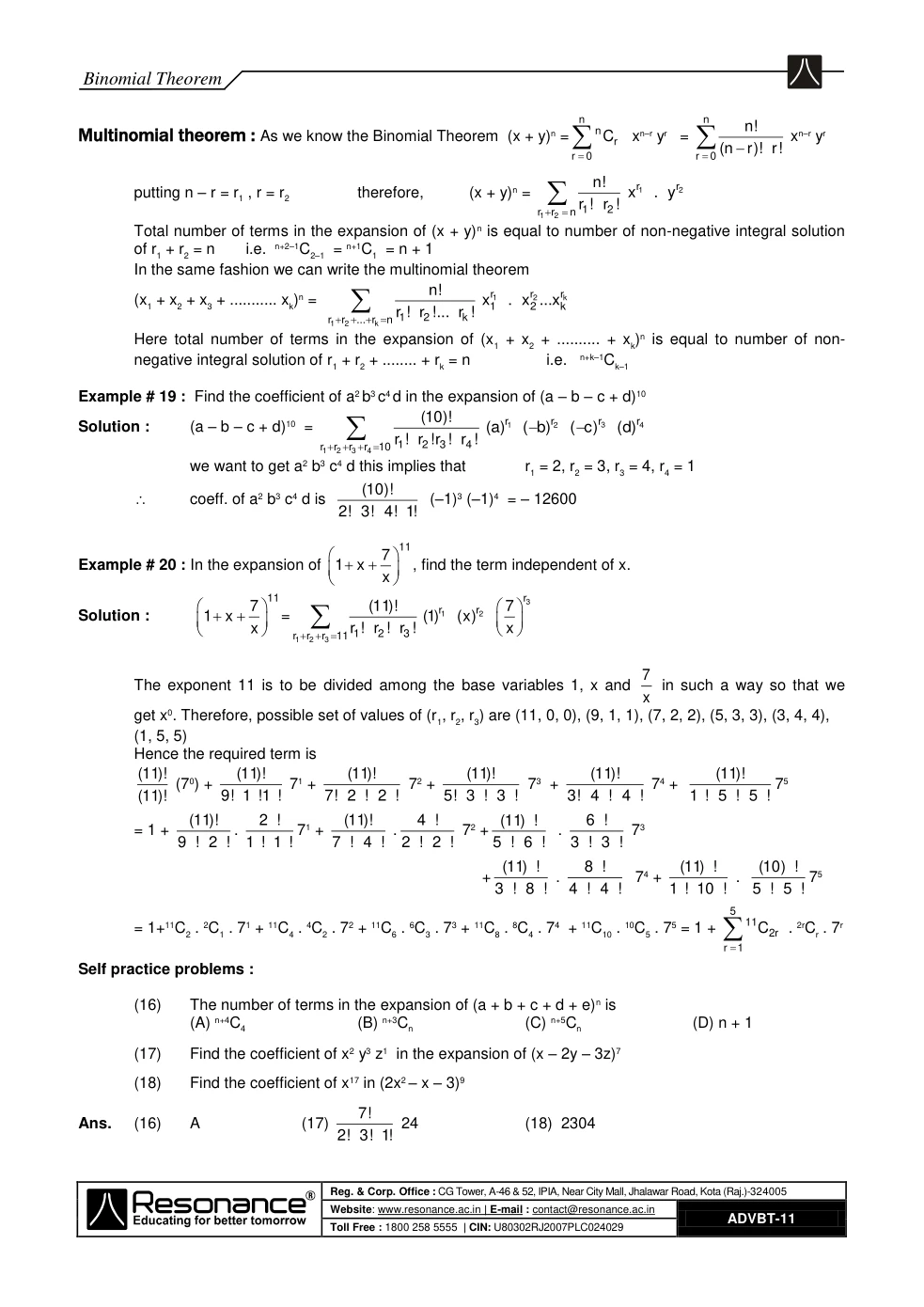
MAASBinomial Expansion
© MAAS. All rights reserved.Page 11 / 30
Extracted text · page 11
Binomial Theorem
n n n! nMultinomial theorem : As we know the Binomial Theorem (x + y)n = Cr xn–r yr = xn–r yr (n r)! r! r0 r 0
n! r1 r2 putting n – r = r1 , r = r2 therefore, (x + y)n = x . y
r1 ! r2 ! r1 r2 n
Total number of terms in the expansion of (x + y)n is equal to number of non-negative integral solution
of r1 + r2 = n i.e. n+2–1C2–1 = n+1C1 = n + 1
In the same fashion we can write the multinomial theorem
n! r1 r2 rk (x1 + x2 + x3 + ........... xk)n = x1 . x 2 ...x k r1 ! r2 !... rk ! r1 r2 ... rk n
Here total number of terms in the expansion of (x1 + x2 + .......... + xk)n is equal to number of non-
negative integral solution of r1 + r2 + ........ + rk = n i.e. n+k–1Ck–1
Example # 19 : Find the coefficient of a2 b3 c4 d in the expansion of (a – b – c + d)10
(10)! r1 r2 r3 r4Solution : (a – b – c + d)10 = (a) ( b) ( c) (d) r1 ! r2 !r3 ! r4 ! r1 r2 r3 r4 10
we want to get a2 b3 c4 d this implies that r1 = 2, r2 = 3, r3 = 4, r4 = 1
(10)!
coeff. of a2 b3 c4 d is (–1)3 (–1)4 = – 12600
2! 3! 4! 1!
7 11Example # 20 : In the expansion of 1 x , find the term independent of x.
x
7 11 (11)! r1 r2 7 r3Solution : 1 x = (1) (x) x x r1 ! r2 ! r3 ! r1 r2 r3 11
7
The exponent 11 is to be divided among the base variables 1, x and in such a way so that we
x
get x0. Therefore, possible set of values of (r1, r2, r3) are (11, 0, 0), (9, 1, 1), (7, 2, 2), (5, 3, 3), (3, 4, 4),
(1, 5, 5)
Hence the required term is
(11)! (11)! (11)! (11)! (11)! (11)!
(70) + 71 + 72 + 73 + 74 + 75
(11)! 9! 1 !1 ! 7! 2 ! 2 ! 5! 3 ! 3 ! 3! 4 ! 4 ! 1 ! 5 ! 5 !
(11)! 2 ! (11)! 4 ! (11) ! 6 !
= 1 + . 71 + . 72 + . 73
9 ! 2 ! 1 ! 1 ! 7 ! 4 ! 2 ! 2 ! 5 ! 6 ! 3 ! 3 !
(11) ! 8 ! (11) ! (10) !
+ . 74 + . 75
3 ! 8 ! 4 ! 4 ! 1 ! 10 ! 5 ! 5 !
5
= 1+11C2 . 2C1 . 71 + 11C4 . 4C2 . 72 + 11C6 . 6C3 . 73 + 11C8 . 8C4 . 74 + 11C10 . 10C5 . 75 = 1 + 11 C 2r . 2rCr . 7r r 1
Self practice problems :
(16) The number of terms in the expansion of (a + b + c + d + e)n is
(A) n+4C4 (B) n+3Cn (C) n+5Cn (D) n + 1
(17) Find the coefficient of x2 y3 z1 in the expansion of (x – 2y – 3z)7
(18) Find the coefficient of x17 in (2x2 – x – 3)9
7!
Ans. (16) A (17) 24 (18) 2304
2! 3! 1!
ADVBT-11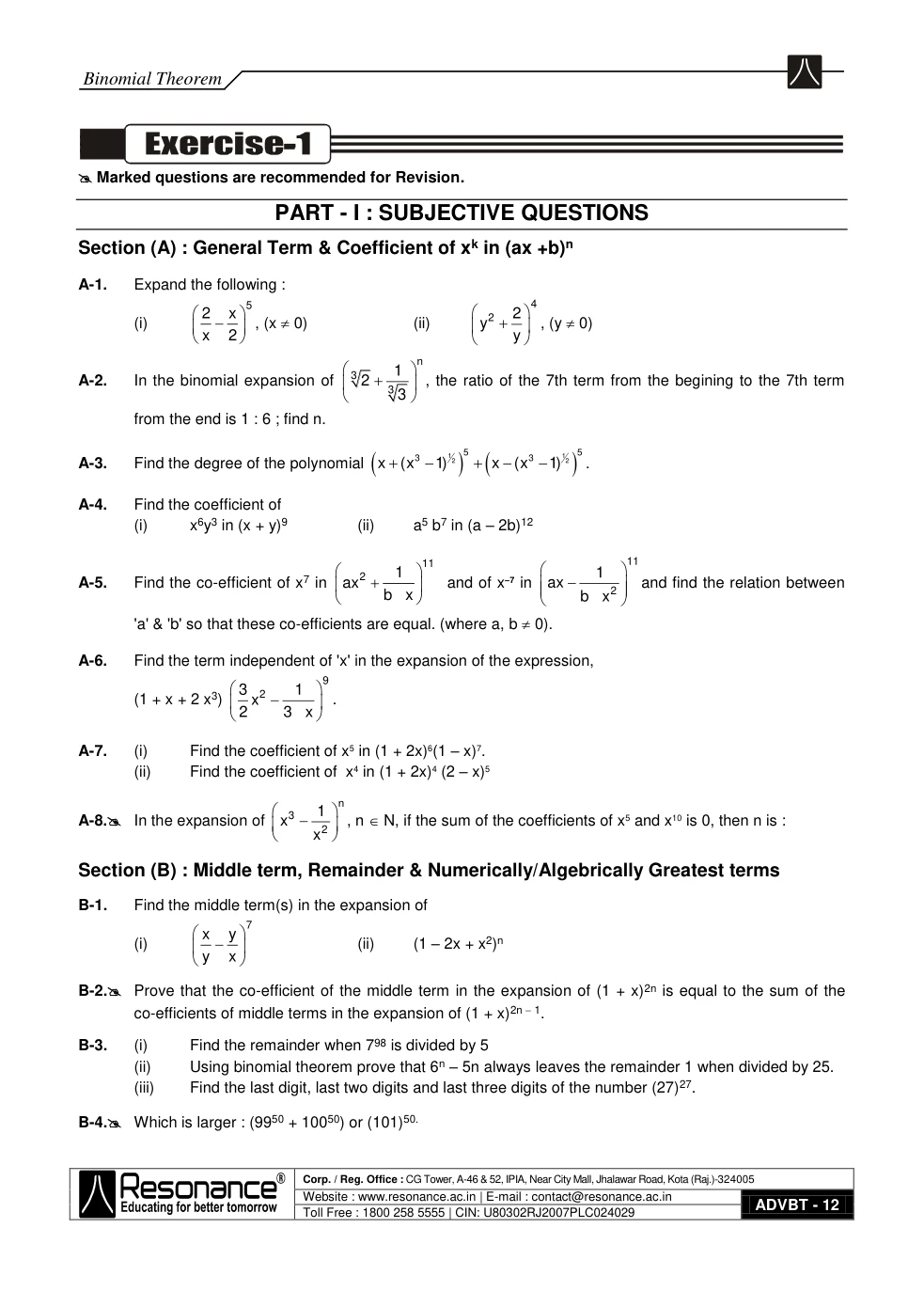
MAASBinomial Expansion
© MAAS. All rights reserved.Page 12 / 30
Extracted text · page 12
Binomial Theorem
Marked questions are recommended for Revision.
PART - I : SUBJECTIVE QUESTIONS
Section (A) : General Term & Coefficient of xk in (ax +b)n
A-1. Expand the following :
2 x 5 2 2 4
(i) , (x 0) (ii) y , (y 0)
x 2 y
3 1 n
A-2. In the binomial expansion of 2 3 , the ratio of the 7th term from the begining to the 7th term 3
from the end is 1 : 6 ; find n.
5 5
3 12 3 12A-3. Find the degree of the polynomial x (x 1) x (x 1) .
A-4. Find the coefficient of
(i) x6y3 in (x + y)9 (ii) a5 b7 in (a – 2b)12
2 1 11 1 11 and find the relation between ax ax and of x–7 in A-5. Find the co-efficient of x7 in b x b x 2
'a' & 'b' so that these co-efficients are equal. (where a, b 0).
A-6. Find the term independent of 'x' in the expansion of the expression,
3 2 1 9
(1 + x + 2 x3) x .
2 3 x
A-7. (i) Find the coefficient of x5 in (1 + 2x)6(1 – x)7.
(ii) Find the coefficient of x4 in (1 + 2x)4 (2 – x)5
3 1 nA-8. In the expansion of x , n N, if the sum of the coefficients of x5 and x10 is 0, then n is : 2 x
Section (B) : Middle term, Remainder & Numerically/Algebrically Greatest terms
B-1. Find the middle term(s) in the expansion of
x y 7
(i) (ii) (1 – 2x + x2)n
y x
B-2. Prove that the co-efficient of the middle term in the expansion of (1 + x)2n is equal to the sum of the
co-efficients of middle terms in the expansion of (1 + x)2n 1.
B-3. (i) Find the remainder when 798 is divided by 5
(ii) Using binomial theorem prove that 6n – 5n always leaves the remainder 1 when divided by 25.
(iii) Find the last digit, last two digits and last three digits of the number (27)27.
B-4. Which is larger : (9950 + 10050) or (101)50.
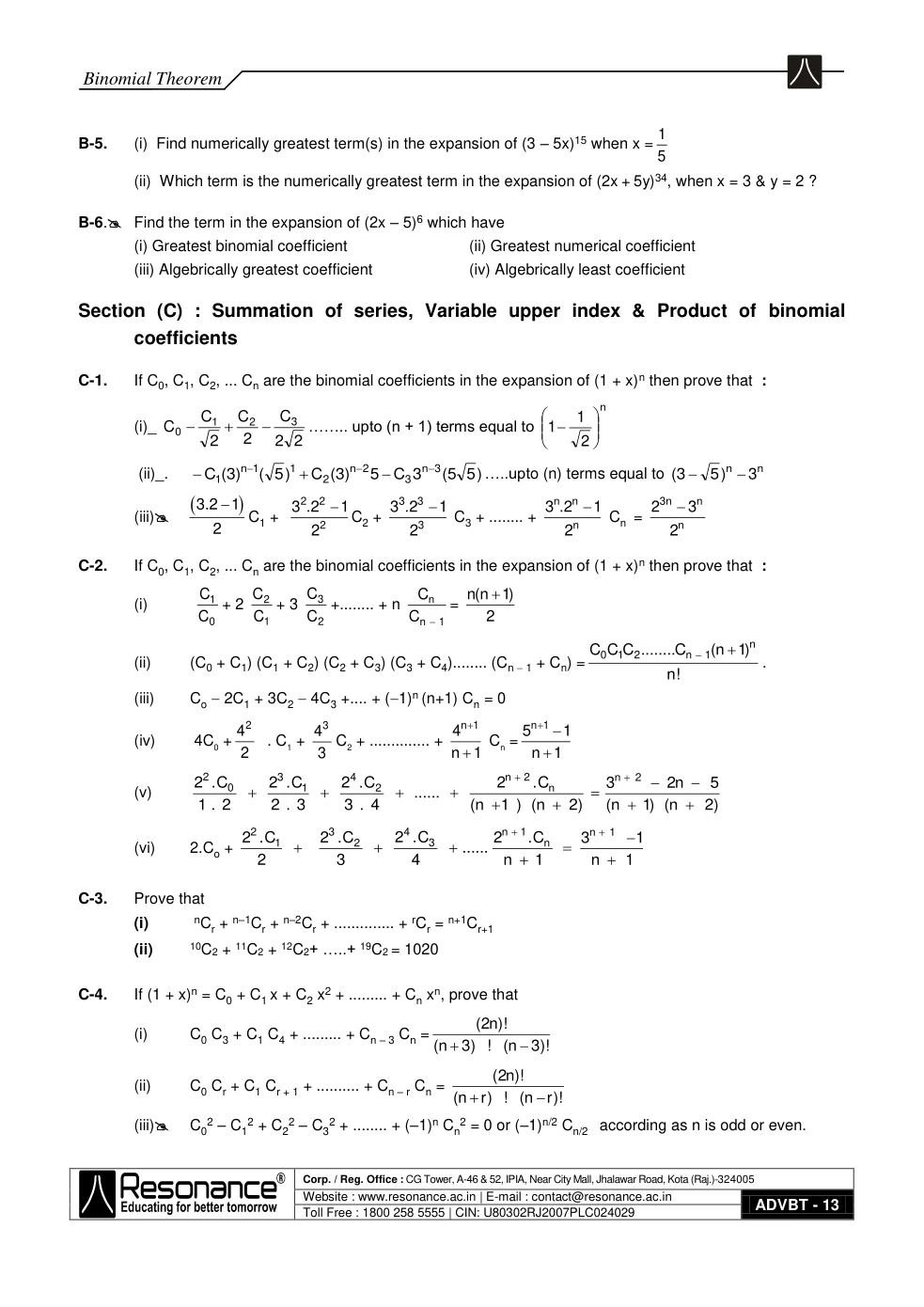
MAASBinomial Expansion
© MAAS. All rights reserved.Page 13 / 30
Extracted text · page 13
Binomial Theorem
1
B-5. (i) Find numerically greatest term(s) in the expansion of (3 – 5x)15 when x =
5
(ii) Which term is the numerically greatest term in the expansion of (2x + 5y)34, when x = 3 & y = 2 ?
B-6. Find the term in the expansion of (2x – 5)6 which have
(i) Greatest binomial coefficient (ii) Greatest numerical coefficient
(iii) Algebrically greatest coefficient (iv) Algebrically least coefficient
Section (C) : Summation of series, Variable upper index & Product of binomial
coefficients
C-1. If C0, C1, C2, ... Cn are the binomial coefficients in the expansion of (1 + x)n then prove that :
C1 C 2 C 3 1 n (i)_ C 0 …….. upto (n + 1) terms equal to 1 2 2 2 2 2
(ii)_. C1(3)n 1( 5 )1 C 2 (3)n 2 5 C3 3 n 3 (5 5 ) …..upto (n) terms equal to (3 5 )n 3 n
2.22 1 33.23 1 3n.2n 1 23n 3n 3.2 1 3
(iii) C1 + 2 C2 + 3 C3 + ........ + n Cn = n 2 2 2 2 2
C-2. If C0, C1, C2, ... Cn are the binomial coefficients in the expansion of (1 + x)n then prove that :
C1 C 2 C 3 Cn n(n 1) (i) + 2 + 3 +........ + n =
C 0 C1 C 2 Cn 1 2
C0 C1C2 ........Cn 1(n 1)n
(ii) (C0 + C1) (C1 + C2) (C2 + C3) (C3 + C4)........ (Cn 1 + Cn) = . n!
(iii) Co 2C1 + 3C2 4C3 +.... + (1)n (n+1) Cn = 0
4 2 4 3 4n 1 5n 1 1
(iv) 4C0 + . C1 + C2 + .............. + Cn = 2 3 n 1 n 1
22 .C0 23 .C1 24 .C2 2n 2 .Cn 3n 2 2n 5 (v) ......
1 . 2 2 . 3 3 . 4 (n 1 ) (n 2) (n 1) (n 2)
22 .C1 23 .C2 24 .C3 2n 1 .Cn 3n 1 1 (vi) 2.Co + ...... 2 3 4 n 1 n 1
C-3. Prove that
(i) nCr + n–1Cr + n–2Cr + .............. + rCr = n+1Cr+1
(ii) 10C2 + 11C2 + 12C2+ …..+ 19C2 = 1020
C-4. If (1 + x)n = C0 + C1 x + C2 x2 + ......... + Cn xn, prove that
(2n)!
(i) C0 C3 + C1 C4 + ......... + Cn – 3 Cn = (n 3) ! (n 3)!
(2n)!
(ii) C0 Cr + C1 Cr + 1 + .......... + Cn – r Cn = (n r) ! (n r)!
(iii) C02 – C1 2 + C2 2 – C3 2 + ........ + (–1)n Cn2 = 0 or (–1)n/2 Cn/2 according as n is odd or even.
MAASBinomial Expansion
© MAAS. All rights reserved.Page 14 / 30
Extracted text · page 14
Binomial Theorem
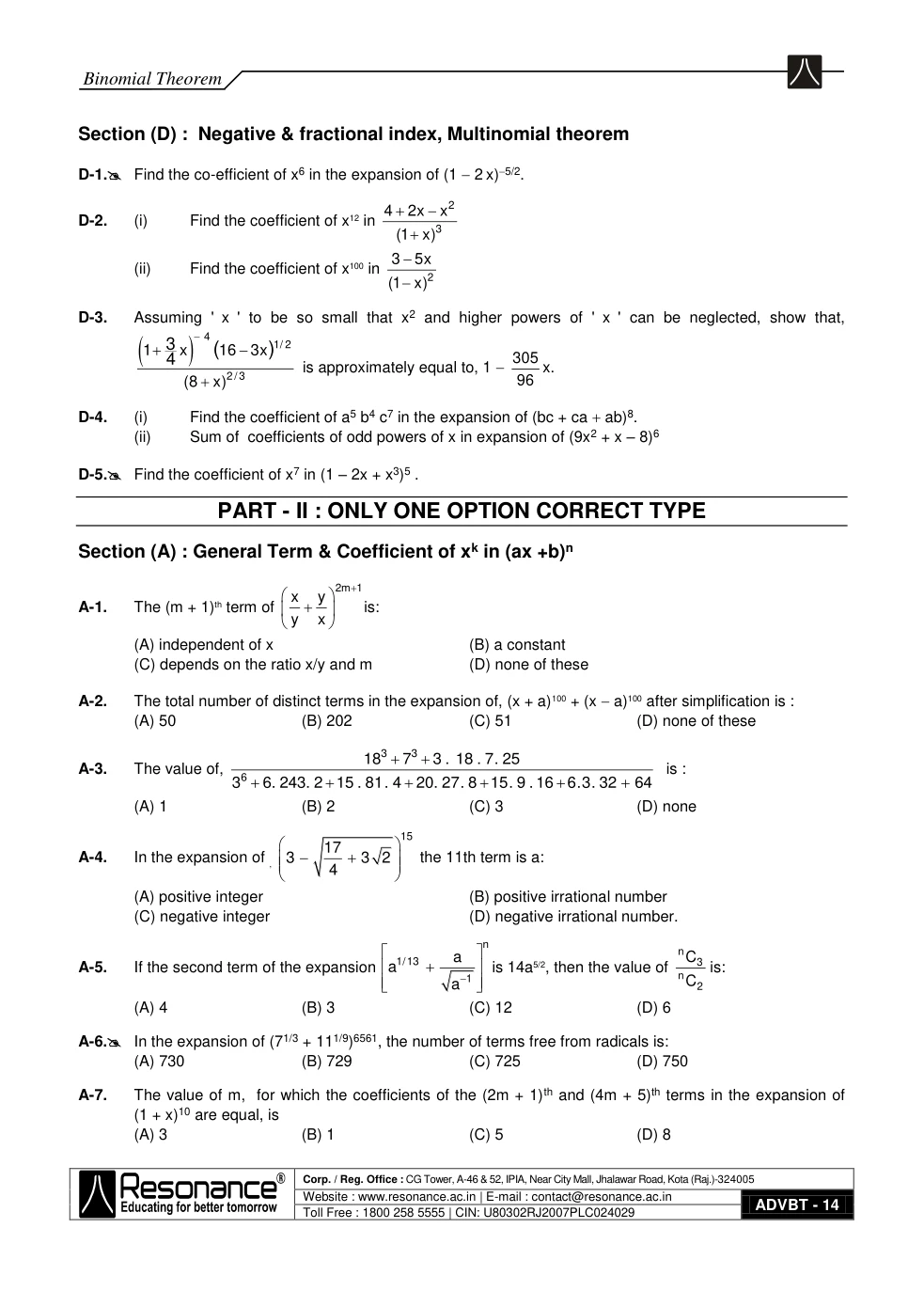
Section (D) : Negative & fractional index, Multinomial theorem
D-1. Find the co-efficient of x6 in the expansion of (1 2 x)5/2.
4 2x x 2
D-2. (i) Find the coefficient of x12 in
(1 x)3
3 5x
(ii) Find the coefficient of x100 in
(1 x)2
D-3. Assuming ' x ' to be so small that x2 and higher powers of ' x ' can be neglected, show that,
4
3 1/ 2 1 x (16 3x ) 4 305 is approximately equal to, 1 x.
(8 x)2/ 3 96
D-4. (i) Find the coefficient of a5 b4 c7 in the expansion of (bc + ca ab)8.
(ii) Sum of coefficients of odd powers of x in expansion of (9x2 + x – 8)6
D-5. Find the coefficient of x7 in (1 – 2x + x3)5 .
PART - II : ONLY ONE OPTION CORRECT TYPE
Section (A) : General Term & Coefficient of xk in (ax +b)n
2m 1
x y
A-1. The (m + 1)th term of is:
y x
(A) independent of x (B) a constant
(C) depends on the ratio x/y and m (D) none of these
A-2. The total number of distinct terms in the expansion of, (x + a)100 + (x a)100 after simplification is :
(A) 50 (B) 202 (C) 51 (D) none of these
183 73 3 . 18 . 7. 25
A-3. The value of, is :
36 6. 243. 2 15 . 81. 4 20. 27. 8 15. 9 . 16 6.3. 32 64
(A) 1 (B) 2 (C) 3 (D) none
17 15
A-4. In the expansion of , 3 3 2 the 11th term is a: 4
(A) positive integer (B) positive irrational number
(C) negative integer (D) negative irrational number.
n 1/13 a n C 3A-5. If the second term of the expansion a is 14a5/2, then the value of is:
a1 n C 2
(A) 4 (B) 3 (C) 12 (D) 6
A-6. In the expansion of (71/3 + 111/9)6561, the number of terms free from radicals is:
(A) 730 (B) 729 (C) 725 (D) 750
A-7. The value of m, for which the coefficients of the (2m + 1)th and (4m + 5)th terms in the expansion of
(1 + x)10 are equal, is
(A) 3 (B) 1 (C) 5 (D) 8
MAASBinomial Expansion
© MAAS. All rights reserved.Page 15 / 30
Extracted text · page 15
Binomial Theorem
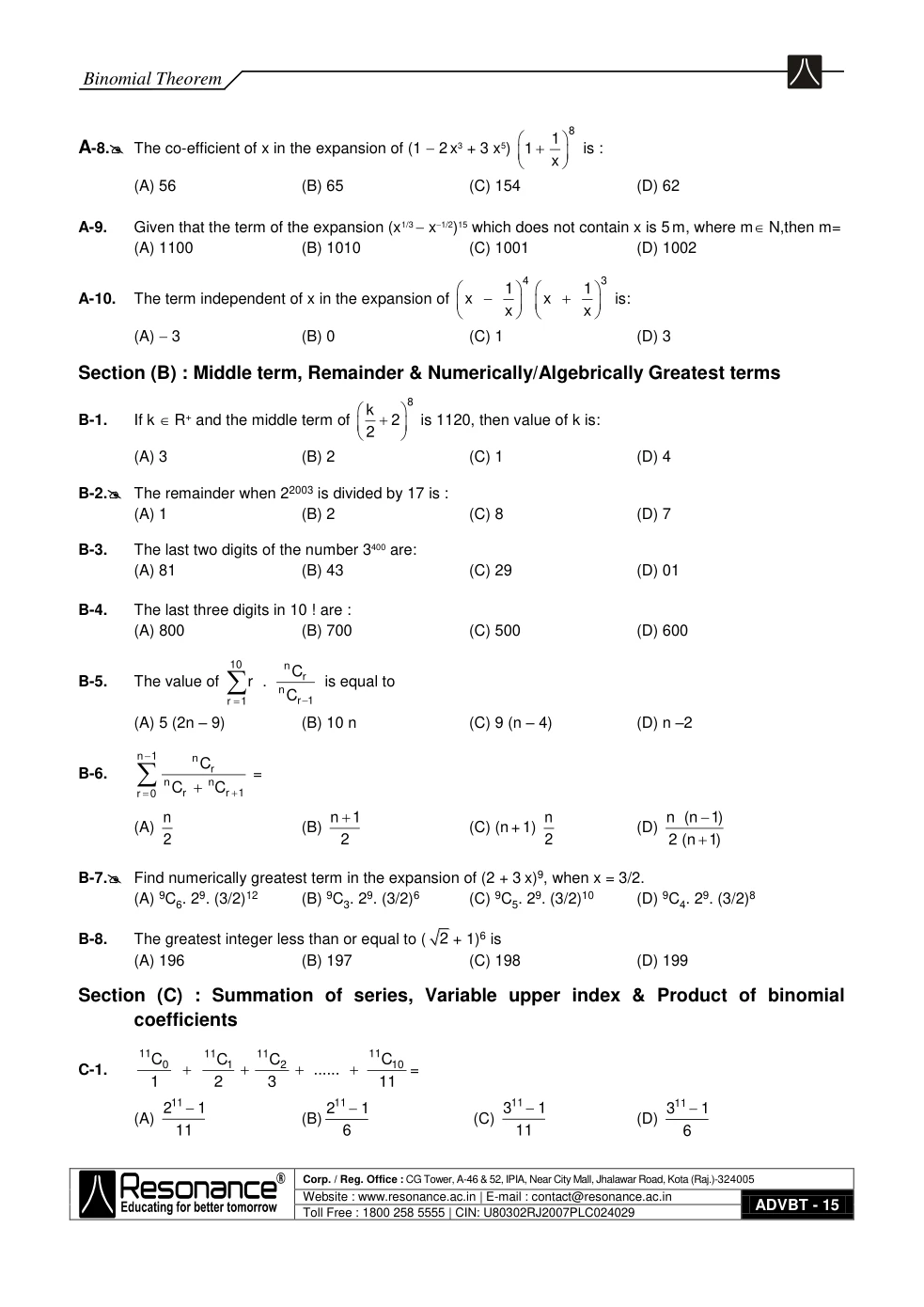
1 8
A-8. The co-efficient of x in the expansion of (1 2 x3 + 3 x5) 1 is : x
(A) 56 (B) 65 (C) 154 (D) 62
A-9. Given that the term of the expansion (x1/3 x1/2)15 which does not contain x is 5 m, where m N,then m=
(A) 1100 (B) 1010 (C) 1001 (D) 1002
1 4 1 3A-10. The term independent of x in the expansion of x x is: x x
(A) 3 (B) 0 (C) 1 (D) 3
Section (B) : Middle term, Remainder & Numerically/Algebrically Greatest terms
k 8B-1. If k R+ and the middle term of 2 is 1120, then value of k is: 2
(A) 3 (B) 2 (C) 1 (D) 4
B-2. The remainder when 22003 is divided by 17 is :
(A) 1 (B) 2 (C) 8 (D) 7
B-3. The last two digits of the number 3400 are:
(A) 81 (B) 43 (C) 29 (D) 01
B-4. The last three digits in 10 ! are :
(A) 800 (B) 700 (C) 500 (D) 600
10 n CrB-5. The value of r . is equal to
n Cr 1 r 1
(A) 5 (2n – 9) (B) 10 n (C) 9 (n – 4) (D) n –2
n 1 n
CrB-6. = n n r 0 Cr Cr 1
n n 1 n n (n 1)
(A) (B) (C) (n + 1) (D)
2 2 2 2 (n 1)
B-7. Find numerically greatest term in the expansion of (2 + 3 x)9, when x = 3/2.
(A) 9C6. 29. (3/2)12 (B) 9C3. 29. (3/2)6 (C) 9C5. 29. (3/2)10 (D) 9C4. 29. (3/2)8
B-8. The greatest integer less than or equal to ( 2 + 1)6 is
(A) 196 (B) 197 (C) 198 (D) 199
Section (C) : Summation of series, Variable upper index & Product of binomial
coefficients
11 C0 11 C1 11 C2 11 C10C-1. ...... =
1 2 3 11
211 1 211 1 311 1 311 1
(A) (B) (C) (D)
11 6 11 6
MAASBinomial Expansion
© MAAS. All rights reserved.Page 16 / 30
Extracted text · page 16
Binomial Theorem
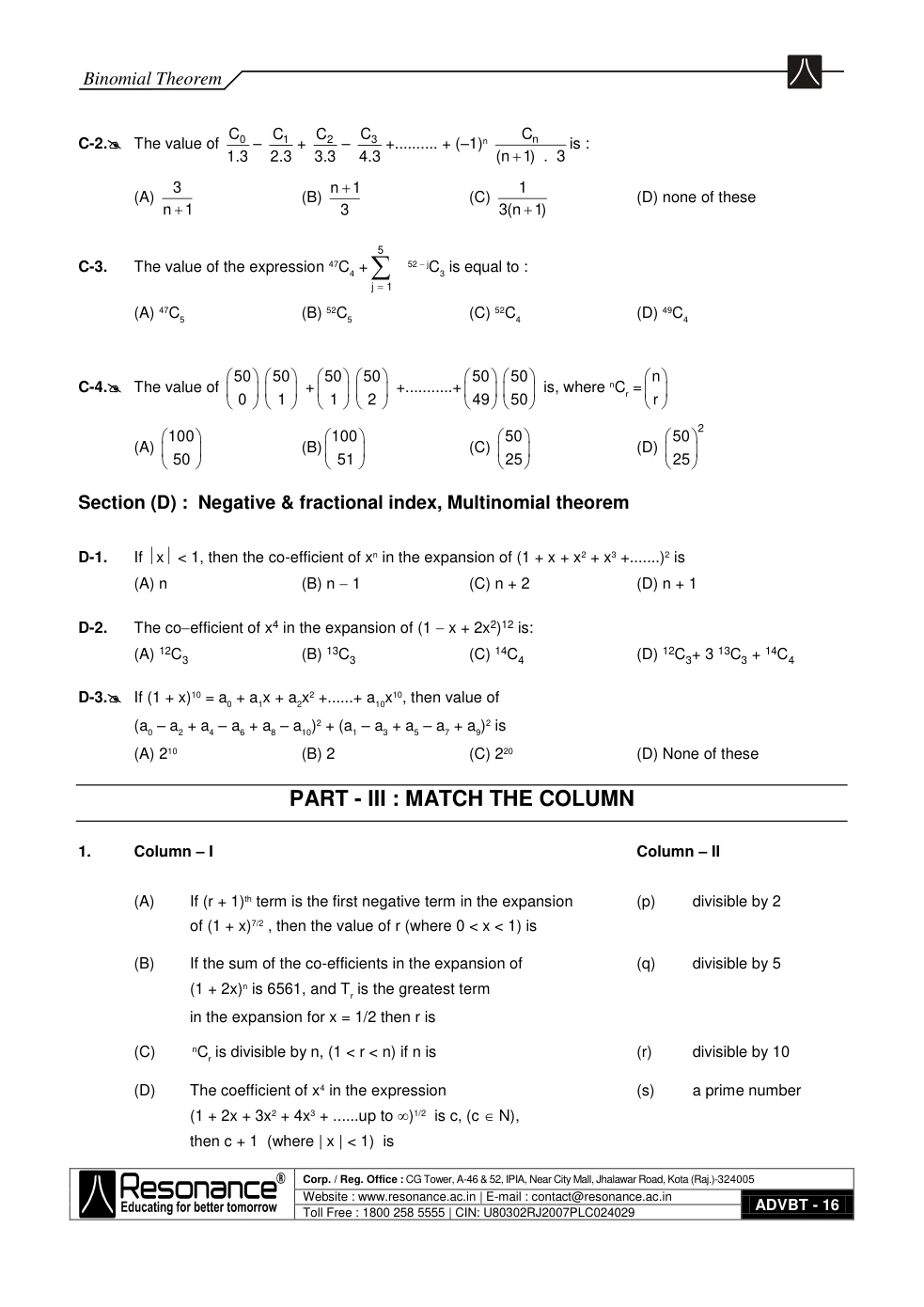
C 0 C1 C 2 C 3 CnC-2. The value of – + – +.......... + (–1)n is :
1.3 2.3 3.3 4.3 (n 1) . 3
3 n 1 1
(A) (B) (C) (D) none of these
n 1 3 3(n 1)
5
C-3. The value of the expression 47C4 + 52 jC3 is equal to : j 1
(A) 47C5 (B) 52C5 (C) 52C4 (D) 49C4
50 50 50 50 50 50 n
C-4. The value of + +...........+ is, where nCr =
0 1 1 2 49 50 r
100 100 50 50 2
(A) (B) (C) (D)
50 51 25 25
Section (D) : Negative & fractional index, Multinomial theorem
D-1. If x < 1, then the co-efficient of xn in the expansion of (1 + x + x2 + x3 +.......)2 is
(A) n (B) n 1 (C) n + 2 (D) n + 1
D-2. The coefficient of x4 in the expansion of (1 x + 2x2)12 is:
(A) 12C3 (B) 13C3 (C) 14C4 (D) 12C3+ 3 13C3 + 14C4
D-3. If (1 + x)10 = a0 + a1x + a2x2 +......+ a10x10, then value of
(a0 – a2 + a4 – a6 + a8 – a10)2 + (a1 – a3 + a5 – a7 + a9)2 is
(A) 210 (B) 2 (C) 220 (D) None of these
PART - III : MATCH THE COLUMN
1. Column – I Column – II
(A) If (r + 1)th term is the first negative term in the expansion (p) divisible by 2
of (1 + x)7/2 , then the value of r (where 0 < x < 1) is
(B) If the sum of the co-efficients in the expansion of (q) divisible by 5
(1 + 2x)n is 6561, and Tr is the greatest term
in the expansion for x = 1/2 then r is
(C) nCr is divisible by n, (1 < r < n) if n is (r) divisible by 10
(D) The coefficient of x4 in the expression (s) a prime number
(1 + 2x + 3x2 + 4x3 + ......up to )1/2 is c, (c N),
then c + 1 (where | x | < 1) is
MAASBinomial Expansion
© MAAS. All rights reserved.Page 17 / 30
Extracted text · page 17
Binomial Theorem
Marked questions are recommended for Revision.
PART - I : ONLY ONE OPTION CORRECT TYPE
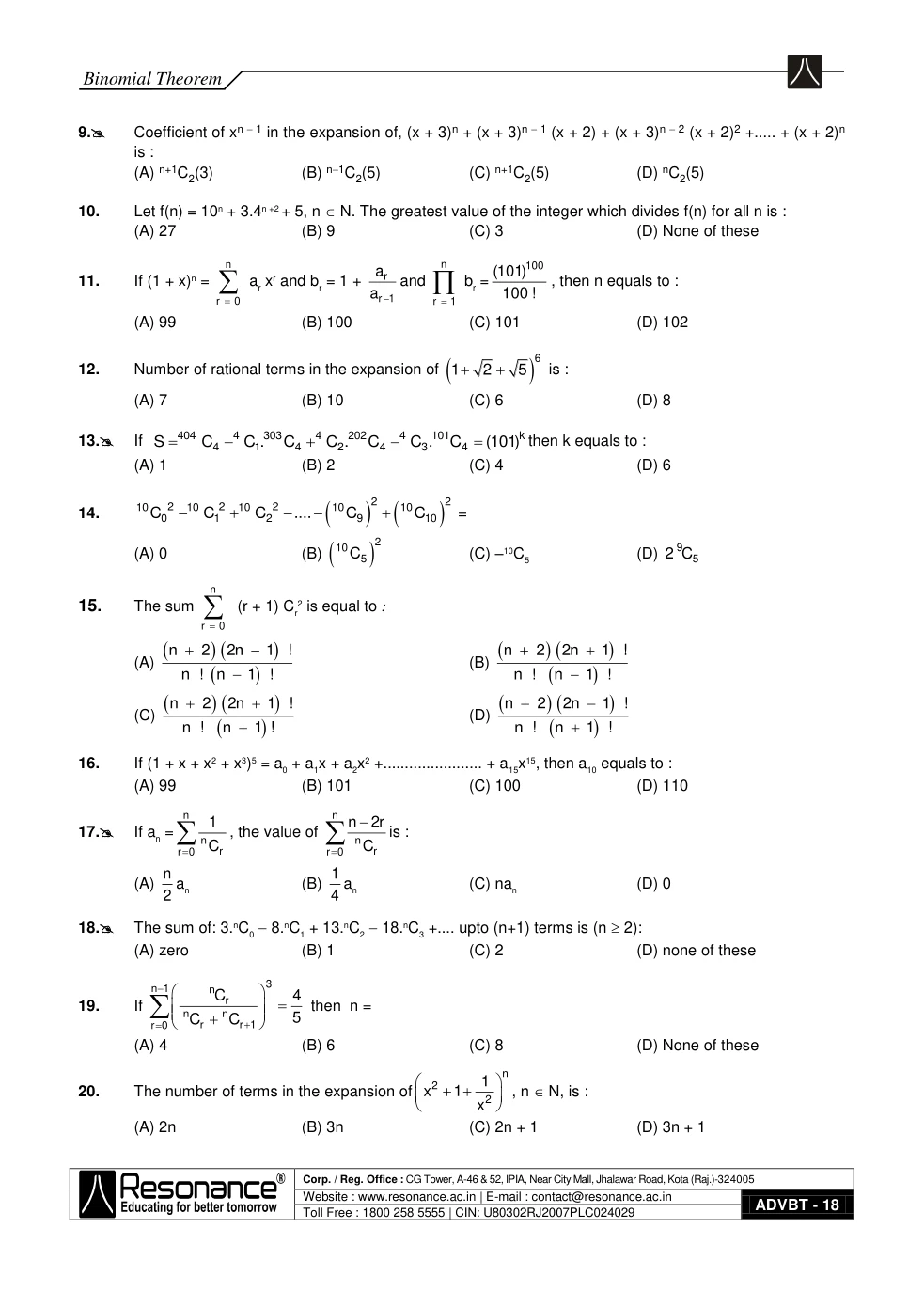
1. In the expansion of
a b 21
3 3 , the term containing same powers of a & b is b a
(A) 11th term (B) 13th term (C) 12th term (D) 6th term
2. Consider the following statements :
S1 : Number of dissimilar terms in the expansion of (1 + x + x2 + x3)n is 3n + 1
S2 : (1 + x) (1 + x + x2) (1 + x + x2 + x3)...... (1 + x + x2 +...... + x100) when written in the ascending
power of x then the highest exponent of x is 5000.
n r
S3 : n kCr = nCr+1 k1
3n 1
S4 : If (1 + x + x2)n = a0 + a1x + a2 x2 + ...... + a2n x2n, then a0 + a2 + a4 + ....... + a2n = 2
State, in order, whether S1, S2, S3, S4 are true or false
(A) TFTF (B) TTTT (C) FFFF (D) FTFT
n Cr 4 nCr 1 6 n Cr 2 4 n Cr 3 n Cr 4 n k3. If then the value of k is :
nCr 3 n Cr 1 3 n Cr 2 n Cr 3 r k
(A) 1 (B) 2 (C) 4 (D) 5
4. The co-efficient of x5 in the expansion of (1 + x)21 + (1 + x)22 +....... + (1 + x)30 is :
(A) 51C5 (B) 9C5 (C) 31C6 21C6 (D) 30C5 + 20C5
100
5. The coefficient of x52 in the expansion 100 Cm (x – 3)100–m. 2m is : m0
(A) 100C47 (B) 100C48 (C) –100C52 (D) –100C100
40
6. The sum of the coefficients of all the integral powers of x in the expansion of 1 2 x is :
1 1
(A) 340 + 1 (B) 340 – 1 (C) (340 – 1) (D) (340 + 1)
2 2
n
r n (1 r n10)7. ( 1) Cr . n r r 0 (1 n10 )
(A) 0 (B) 1/2 (C) 1 (D) None of these
10
x 1 x 1 8. The coefficient of the term independent of x in the expansion of is : 2 1 1
3 3 2 x x 1 x x
(A) 70 (B) 112 (C) 105 (D) 210
MAASBinomial Expansion
© MAAS. All rights reserved.Page 18 / 30
Extracted text · page 18
Binomial Theorem
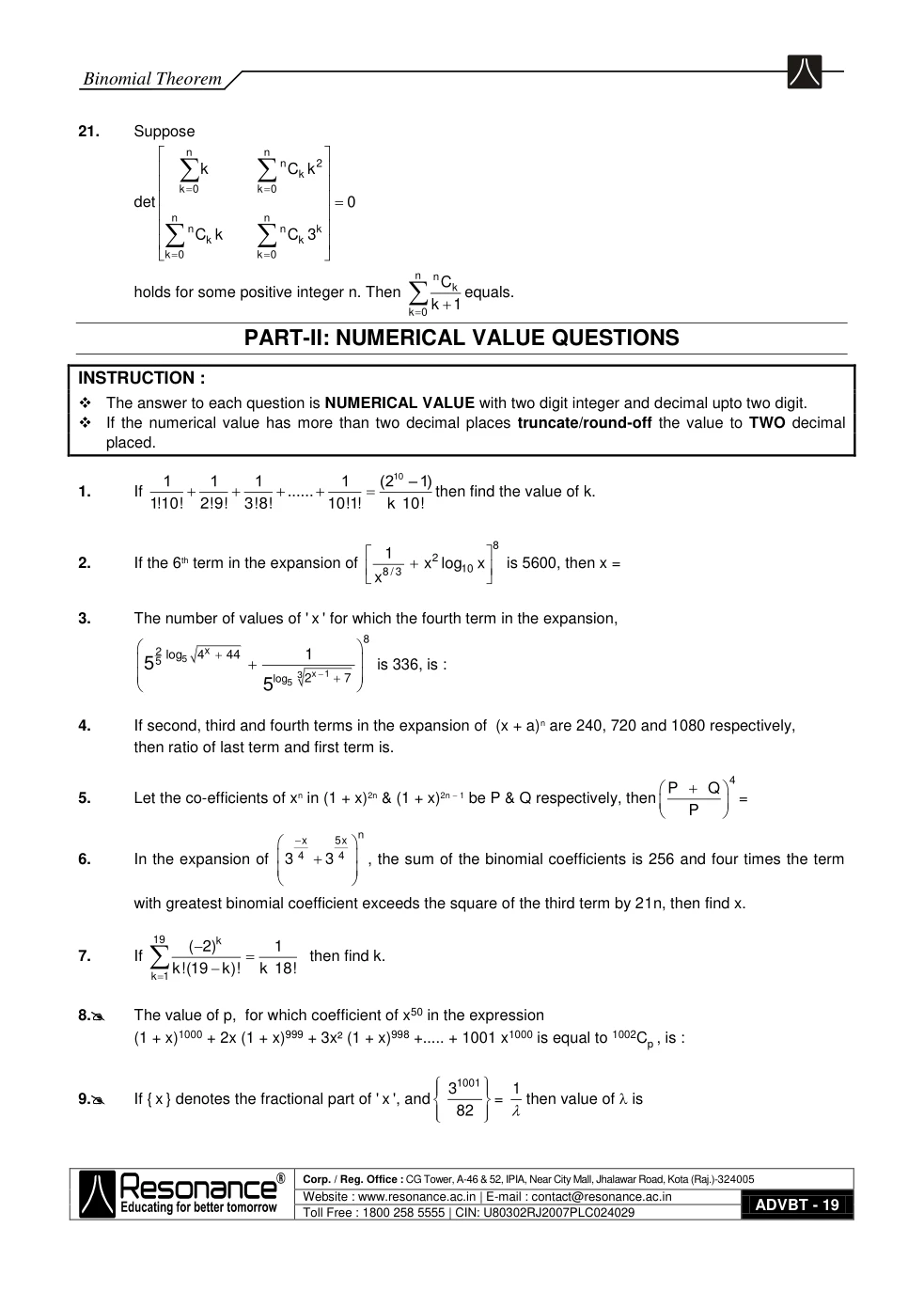
9. Coefficient of xn 1 in the expansion of, (x + 3)n + (x + 3)n 1 (x + 2) + (x + 3)n 2 (x + 2)2 +..... + (x + 2)n
is :
(A) n+1C2(3) (B) n1C2(5) (C) n+1C2(5) (D) nC2(5)
10. Let f(n) = 10n + 3.4n +2 + 5, n N. The greatest value of the integer which divides f(n) for all n is :
(A) 27 (B) 9 (C) 3 (D) None of these
n ar n (101)100
11. If (1 + x)n = xr and br = 1 + and = , then n equals to :
100 ! rar0 ar 1 brr 1
(A) 99 (B) 100 (C) 101 (D) 102
6
12. Number of rational terms in the expansion of 1 2 5 is :
(A) 7 (B) 10 (C) 6 (D) 8
13. If S 404 C4 4 C1.303 C4 4 C2 .202 C4 4 C3 .101C4 (101)k then k equals to :
(A) 1 (B) 2 (C) 4 (D) 6
2 2
= 14. 10 C0 2 10 C12 10 C2 2 .... 10 C9 10 C10
2
(A) 0 (B) (C) –10C5 (D) 2 9C5 10 C5
n
15. The sum (r + 1) Cr2 is equal to : r0
n 2 2n 1 ! n 2 2n 1 !
(A) (B)
n ! n 1 ! n ! n 1 !
n 2 2n 1 ! n 2 2n 1 !
(C) (D)
n ! n 1 ! n ! n 1 !
16. If (1 + x + x2 + x3)5 = a0 + a1x + a2x2 +....................... + a15x15, then a10 equals to :
(A) 99 (B) 101 (C) 100 (D) 110
n 1 n n 2r
is :17. If an = n , the value of n r 0 Cr r 0 Cr
n 1
(A) an (B) an (C) nan (D) 0
2 4
18. The sum of: 3.nC0 8.nC1 + 13.nC2 18.nC3 +.... upto (n+1) terms is (n 2):
(A) zero (B) 1 (C) 2 (D) none of these
3
n 1 nCr 419. If then n = 5 r 0 nCr n Cr 1
(A) 4 (B) 6 (C) 8 (D) None of these
2 1 n
20. The number of terms in the expansion of x 1 2 , n N, is : x
(A) 2n (B) 3n (C) 2n + 1 (D) 3n + 1
MAASBinomial Expansion
© MAAS. All rights reserved.Page 19 / 30
Extracted text · page 19
Binomial Theorem
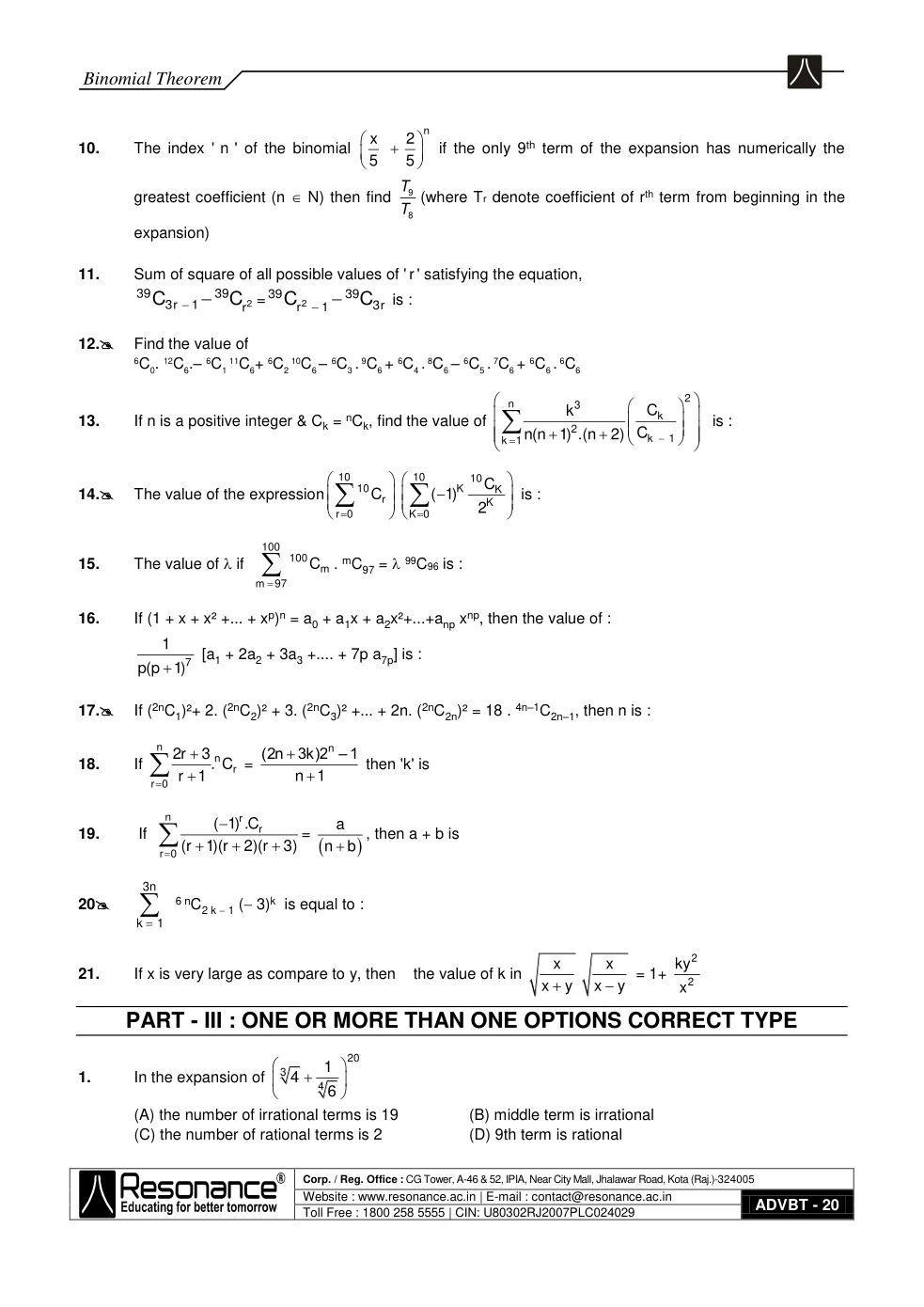
21. Suppose
n n
k n Ck k 2 k 0 k 0
det 0
n n
n n k Ck k Ck 3
k 0 k 0
n n C k holds for some positive integer n. Then equals. k 1 k 0
PART-II: NUMERICAL VALUE QUESTIONS
INSTRUCTION :
The answer to each question is NUMERICAL VALUE with two digit integer and decimal upto two digit.
If the numerical value has more than two decimal places truncate/round-off the value to TWO decimal
placed.
1 1 1 1 (210 –1)
1. If ...... then find the value of k.
1!10! 2!9! 3!8! 10!1! k 10!
1 2 8
2. If the 6th term in the expansion of 8 / 3 x log10 x is 5600, then x = x
3. The number of values of ' x ' for which the fourth term in the expansion,
8
1 2 log5 4 x 44 is 336, is : 5 5
log5 3 2 x 1 7 5
4. If second, third and fourth terms in the expansion of (x + a)n are 240, 720 and 1080 respectively,
then ratio of last term and first term is.
4
1 P Q 5. Let the co-efficients of xn in (1 + x)2n & (1 + x)2n be P & Q respectively, then =
P
n x 5x
6. In the expansion of 3 4 3 4 , the sum of the binomial coefficients is 256 and four times the term
with greatest binomial coefficient exceeds the square of the third term by 21n, then find x.
19 ( 2)k 1
7. If then find k. k!(19 k)! k 18! k 1
8. The value of p, for which coefficient of x50 in the expression
(1 + x)1000 + 2x (1 + x)999 + 3x² (1 + x)998 +..... + 1001 x1000 is equal to 1002Cp , is :
31001 1
9. If { x } denotes the fractional part of ' x ', and = value of is then 82
MAASBinomial Expansion
© MAAS. All rights reserved.Page 20 / 30
Extracted text · page 20
Binomial Theorem
x 2 n10. The index ' n ' of the binomial if the only 9th term of the expansion has numerically the 5 5
T9 greatest coefficient (n N) then find (where Tr denote coefficient of rth term from beginning in the
T8
expansion)
11. Sum of square of all possible values of ' r ' satisfying the equation,
2 = 39 C 39 C3r 1 39 Cr r 2 1 39 C3r is :
12. Find the value of
6C0. 12C6.– 6C1 11C6+ 6C2 10C6 – 6C3 . 9C6 + 6C4 . 8C6 – 6C5 . 7C6 + 6C6 . 6C6
n k 3 Ck 2 is : 13. If n is a positive integer & Ck = nCk, find the value of Ck 1 k 1 n(n 1)2 .(n 2)
10 10 10 K 10 CK is : ( 1)14. The value of the expression Cr 2K 0 r 0 K
100
15. The value of if 100 Cm . mC97 = 99C96 is : m97
16. If (1 + x + x² +... + xp)n = a0 + a1x + a2x²+...+anp xnp, then the value of :
1
7 [a1 + 2a2 + 3a3 +.... + 7p a7p] is : p(p 1)
17. If (2nC1)²+ 2. (2nC2)² + 3. (2nC3)² +... + 2n. (2nC2n)² = 18 . 4n–1C2n–1, then n is :
n 2r n (2n 3k)2 n –118. If then 'k' is Cr = n 1 r 13. r 0
n ( 1)r .Cr a19. If = , then a + b is (r 1)(r 2)(r 3) n b r 0
3n
20 6 nC2 k 1 ( 3)k is equal to : k1
x x ky 2
21. If x is very large as compare to y, then the value of k in = 1+
x y x y x 2
PART - III : ONE OR MORE THAN ONE OPTIONS CORRECT TYPE
3 1 20
1. In the expansion of 4 4 6
(A) the number of irrational terms is 19 (B) middle term is irrational
(C) the number of rational terms is 2 (D) 9th term is rational
MAASBinomial Expansion
© MAAS. All rights reserved.Page 21 / 30
Extracted text · page 21
Binomial Theorem
1 x 2
2. The coefficient of x4 in , | x | < 1, is 1 x
(A) 4 (B) –4 (C) 10 + 4C2 (D) 16
3. 79 + 97 is divisible by :
(A) 16 (B) 24 (C) 64 (D) 72
n
4. The sum of the series ( 1)r 1. n Cr (a r) is equal to :
r 1
(A) 5 if a = 5 (B) –5 if a = 5 (C) –5 if a = –5 (D) 5 if a = –5
1000n
5. Let an for n N, then an is greatest, when
n!
(A) n = 997 (B) n = 998 (C) n = 999 (D) n = 1000
6. nC0 – 2.3 nC1 + 3.32 nC2 – 4.33 nC3 +..........+ (–1)n (n +1) nCn 3n is equal to
n 3n n 3 (A) 2 1 if n is even (B) 2 n if n is even
2 2
n 3n n 3 (C) – 2 1 if n is odd (D) 2 n if n is odd
2 2
7. Element in set of values of r for which, 18Cr 2 + 2. 18Cr 1 + 18Cr 20C13 is :
(A) 9 (B) 5 (C) 7 (D) 10
8. The expansion of (3x + 2)–1/2 is valid in ascending powers of x, if x lies in the interval.
(A) (0, 2/3) (B) (–3/2, 3/2) (C) (–2/3, 2/3) (D) (–, –3/2) (3/2, )
9. If (1 + 2x + 3x2)10 = a0 + a1x + a2x2 +.... + a20x20, then :
(A) a1 = 20 (B) a2 = 210
(C) a4 = 8085 (D) a20 = 22. 37. 7
10. In the expansion of (x + y + z)25
(A) every term is of the form 25Cr. rCk. x25 – r. yr – k. zk (B) the coefficient of x8 y9 z9 is 0
(C) the number of terms is 325 (D) none of these
11. If (1 + x + 2x2)20 = a0 + a1x + a2x2 +......... + a40x40, then a0 + a2 + a4.......+ a38 is equal to :
(A) 219 (230 + 1) (B) 219(220 – 1) (C) 239 – 219 (D) 239 + 219
2n
n n 1
12. n is (n N)
2
n 1 3 n 1 3
(A) Less than (B) Greater than or equal to
2 2
(C) Less than (n!)3 (D) Greater than or equal to (n!)3.
13. If recursion polynomials Pk(x) are defined as P1(x) = (x – 2)2, P2 (x) = ((x – 2)2 – 2)2
P3 (x) = ((x – 2)2 – 2)2 – 2)2 .......... (In general Pk (x) = (Pk – 1 (x) – 2)2, then the constant term in Pk (x) is
(A) 4 (B) 2 (C) 16 (D) a perfect square
MAASBinomial Expansion
© MAAS. All rights reserved.Page 22 / 30
Extracted text · page 22
Binomial Theorem
PART - IV : COMPREHENSION
Comprehension # 1 (Q. No. 1 to 3)
Consider, sum of the series f(i) f(j)
0 i j n
In the given summation, i and j are not independent.
n n n n
In the sum of series i and j are independent. In this summation, f(i) f(j) = f(i) f(j)
i 1 j 1 i 1 j 1
three types of terms occur, those when i < j, i > j and i = j.
Also, sum of terms when i < j is equal to the sum of the terms when i > j if f(i) and f(j) are symmetrical.
So, in that case
n n
f(i)f(j) = f(i)f(j)
i 1 j 1 0 i j n
+ f(i)f(j) + f(i)f(j)
0 i j n i j
= 2 f(i)f(j) + f(i)f(j)
0 i j n i j
n n
f(i)f(j) – f(i)f(j)
f(i)f(j) = i 0 j 0 2 i j 0 i j n
When f(i) and f(j) are not symmetrical, we find the sum by listing all the terms.
1. n Ci n C j is equal to
0 i j n
22n – 2n Cn 22n 2n Cn 22n – n Cn 22n n Cn (A) (B) (C) (D)
2 2 2 2
n m
2. Let 0C0 = 1, then n Cm . m Cp is equal to
m 0 p 0
(A) 2n–1 (B) 3n (C) 3n–1 (D) 2n
3. n Ci n C j
0 i j n
(A) (n + 2)2n (B) (n + 1)2n (C) (n – 1)2n (D) (n + 1)2n–1
Comprehension # 2 (Q. No. 4 to 6)
Let P be a product given by P = (x + a1) (x + a2) ......... (x + an)
n
ai .a j .ak and so on, and Let S1 = a1 + a2 + ....... + an = ai , S2 = ai .a j , S3 = i 1 i j i j k
then it can be shown that
P = xn + S1 xn – 1 + S2 xn – 2 + ......... + Sn.
4. The coefficient of x8 in the expression (2 + x)2 (3 + x)3 (4 + x)4 must be
(A) 26 (B) 27 (C) 28 (D) 29
MAASBinomial Expansion
© MAAS. All rights reserved.Page 23 / 30
Extracted text · page 23
Binomial Theorem
5. The coefficient of x203 in the expression (x – 1) (x2 – 2) (x3 – 3) .......... (x20 – 20) must be
(A) 11 (B) 12 (C) 13 (D) 15
6. The coefficient of x98 in the expression of (x – 1) (x – 2) ......... (x – 100) must be
(A) 12 + 22 + 32 + ....... + 1002
(B) (1 + 2 + 3 + ....... + 100)2 – (12 + 22 + 32 + ....... + 1002)
1
(C) [(1 + 2 + 3 + ....... + 100)2 – (12 + 22 + 32 + ....... + 1002)]
2
(D) None of these
Comprehension # 3 (Q.No. 7 to 9)
Let (7 + 4 3 )n = + f = nC0.7n + nC1.7n – 1 .(4 3 )1 + ....... .............(i)
where & f are its integral and fractional parts respectively.
It means 0 < f < 1
Now, 0 < 7 – 4 3 < 1 0 < (7 – 4 3 )n < 1
Let (7 – 4 3 )n = f= nC0.7n – nC1.7n – 1 .(4 3 )1 + ....... .............(ii)
0 < f < 1
Adding (i) and (ii) (so that irrational terms cancelled out)
+ f + f = (7 + 4 3 )n + (7 – 4 3 )n
= 2 [nC0 7n + nC2 7n – 2 (4 3 )2 + ..........]
+ f + f = even integer (f + f must be an integer)
0 < f + f < 2 f + f = 1
with help of above analysis answer the following questions
n
7. If 3 3 5 = p + f, where p is an integer and f is a proper fraction, then find the value of
n
3 3 5 , n N, is
(A) 1 – f, if n is even (B) f, if n is even (C) 1 – f, if n is odd (D) f, if n is odd
n
8. If 9 80 = + f, where , n are integers and 0 < f < 1, then :
(A) is an odd integer (B) is an even integer
n
(C) ( + f) (1 – f) = 1 (D) 1 f 9 80 =
9. The integer just above ( 3 + 1)2n is, for all n N.
(A) divisible by 2n (B) divisible by 2n + 1 (C) divisible by 8 (D) divisible by 16
Marked questions are recommended for Revision.
* Marked Questions may have more than one correct option.
PART - I : JEE (ADVANCED) / IIT-JEE PROBLEMS (PREVIOUS YEARS)
1. Coefficient of t24 in (1 + t2)12 (1 + t12) (1 + t24) is: [IIT-JEE-2003, Scr, (3, – 1), 84]
(A) 12C6 + 3 (B) 12C6 + 1 (C) 12C6 (D) 12C6 + 2
n n k 1 n n 1 k 2 n n 2 n n k n
2. Prove that 2k – 2 + 2 –...... + (– 1)k = .
0 k 1 k 1 2 k 2 k 0 k
[IIT-JEE-2003, Main, (2, 0), 60]
MAASBinomial Expansion
© MAAS. All rights reserved.Page 24 / 30
Extracted text · page 24
Binomial Theorem
3. If (n – 1)Cr = (k2 – 3) nCr+1, then an interval in which k lies is [IIT-JEE-2004, Scr, (3, – 1), 84]
(A) (2, ) (B) (– , – 2) (C) 3, 3 (D)3,2
4. The value of [IIT-JEE-2005, Scr, (3, – 1), 84]
30 30 30 30 30 30 30 30
– + – .......... + is :
0 10 1 11 2 12 20 30
60 30 30
(A) (B) (C) (D) None of these 20 10 15
5. For r = 0, 1, ...., 10, let Ar, Br and Cr denote, respectively, the coefficient of xr in the expansions of
10
(1 + x)10 , (1 + x)20 and (1 + x)30 . Then A r (B10Br C10 A r ) is equal to
r 1
[IIT-JEE 2010, Paper-2, (5, –2)/79]
(A) B10 – C10 (B) A10 (B2 10 – C10 A10) (C) 0 (D) C10 – B10
6. The coefficients of three consecutive terms of (1 + x)n+5 are in the ratio 5 : 10 : 14. Then n =
[JEE (Advanced) 2013, Paper-1, (4, – 1)/60]
7. Coefficient of x11 in the expansion of (1 + x2)4 (1 + x3)7 (1 + x4)12 is
[JEE (Advanced) 2014, Paper-2, (3, –1)/60]
(A) 1051 (B) 1106 (C) 1113 (D) 1120
8. The coefficient of x9 in the expansion of (1 + x) (1 + x2) (1 + x3) ......(1 + x100) is
[JEE (Advanced) 2015, P-2 (4, 0) / 80]
9. Let m be the smallest positive integer such that the coefficient of x2 in the expansion of
(1 + x)2 + (1 + x)3 +........+ (1 + x)49 + (1 + mx)50 is (3n + 1) 51C3 for some positive integer n. Then the
value of n is [JEE (Advanced) 2016, Paper-1, (3, 0)/62]
10. Let X = (10C1)2 + 2(10C2)2 + 3(10C3)2 + ....... + 10(10C10)2 where 10Cr, r {1, 2, ......., 10} denote binomial
1
coefficients. Then the value of X is _______ . [JEE (Advanced) 2018, Paper-1, (3, 0)/60]
1430
PART - II : JEE (MAIN) / AIEEE PROBLEMS (PREVIOUS YEARS)
10 10 10
1. Let S1 = j (j –1) 10Cj , S2 = j 10Cj and S3 = j2 10Cj. [AIEEE 2009, (4, –1), 144] j1 j1 j1
Statement -1 : S3 = 55 × 29 .
Statement -2 : S1 = 90 × 28 and S2 = 10 × 28.
(1) Statement -1 is true, Statement-2 is true ; Statement -2 is not a correct explanation for Statement 1.
(2) Statement-1 is true, Statement-2 is false.
(3) Statement -1 is false, Statement -2 is true.
(4) Statement -1 is true, Statement -2 is true; Statement-2 is a correct explanation for Statement-1.
2. The coefficient of x7 in the expansion of (1 – x – x2 + x3)6 is : [AIEEE 2011, (4, –1), 120]
(1) 144 (2) – 132 (3) – 144 (4) 132
2n 2n
3. If n is a positive integer, then 3 1 3 1 is : [AIEEE 2012, (4, –1), 120] –
(1) an irrational number (2) an odd positive integer
(3) an even positive integer (4) a rational number other than positive integers
MAASBinomial Expansion
© MAAS. All rights reserved.Page 25 / 30
Extracted text · page 25
Binomial Theorem
x 1 x 1 104. The term independent of x in expansion of is : 2/ 3 1/ 3 1/ 2 x x 1 x x
[AIEEE - 2013, (4, –1),120]
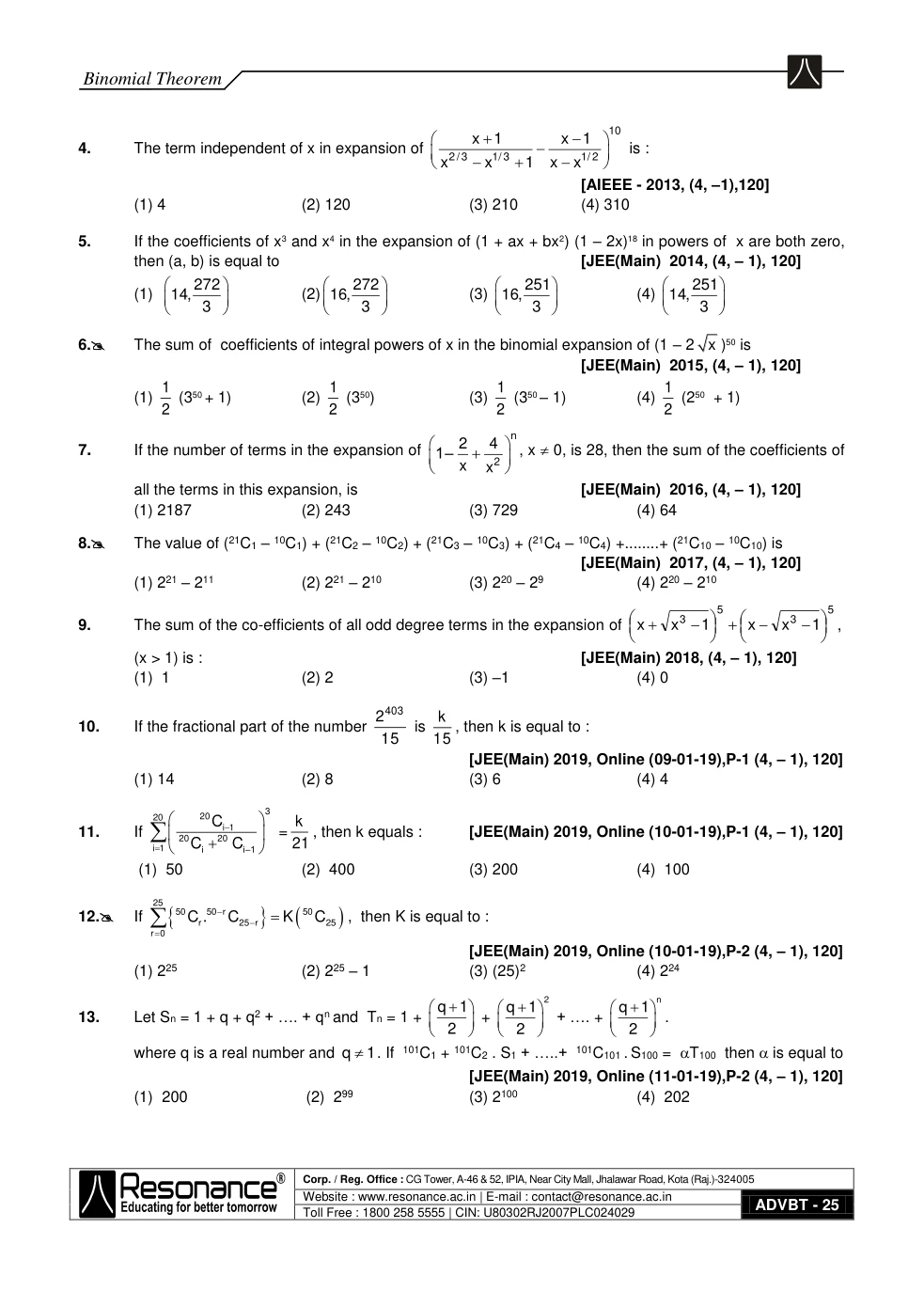
(1) 4 (2) 120 (3) 210 (4) 310
5. If the coefficients of x3 and x4 in the expansion of (1 + ax + bx2) (1 – 2x)18 in powers of x are both zero,
then (a, b) is equal to [JEE(Main) 2014, (4, – 1), 120]
272 272 251 251
(1) 14, (2) 16, (3) 16, (4) 14,
3 3 3 3
6. The sum of coefficients of integral powers of x in the binomial expansion of (1 – 2 x )50 is
[JEE(Main) 2015, (4, – 1), 120]
1 1 1 1
(1) (350 + 1) (2) (350) (3) (350 – 1) (4) (250 + 1)
2 2 2 2
2 4 n7. If the number of terms in the expansion of 1– , x 0, is 28, then the sum of the coefficients of 2 x x
all the terms in this expansion, is [JEE(Main) 2016, (4, – 1), 120]
(1) 2187 (2) 243 (3) 729 (4) 64
8. The value of (21C1 – 10C1) + (21C2 – 10C2) + (21C3 – 10C3) + (21C4 – 10C4) +........+ (21C10 – 10C10) is
[JEE(Main) 2017, (4, – 1), 120]
(1) 221 – 211 (2) 221 – 210 (3) 220 – 29 (4) 220 – 210
3 5 3 5
9. The sum of the co-efficients of all odd degree terms in the expansion of x x 1 x x 1 ,
(x > 1) is : [JEE(Main) 2018, (4, – 1), 120]
(1) 1 (2) 2 (3) –1 (4) 0
2403 k
10. If the fractional part of the number is , then k is equal to :
15 15
[JEE(Main) 2019, Online (09-01-19),P-1 (4, – 1), 120]
(1) 14 (2) 8 (3) 6 (4) 4
3
20 20 Ci 1 k11. If = , then k equals : [JEE(Main) 2019, Online (10-01-19),P-1 (4, – 1), 120] 20 20 i 1 Ci Ci–1 21
(1) 50 (2) 400 (3) 200 (4) 100
25
12. If 50 Cr .50 r C25 r K 50 C25 , then K is equal to :
r 0
[JEE(Main) 2019, Online (10-01-19),P-2 (4, – 1), 120]
(1) 225 (2) 225 – 1 (3) (25)2 (4) 224
q 1 q 1 2 q 1 n
13. Let Sn = 1 + q + q2 + …. + qn and Tn = 1 + + + …. + . 2 2 2
where q is a real number and q 1 . If 101C1 + 101C2 . S1 + …..+ 101C101 . S100 = T100 then is equal to
[JEE(Main) 2019, Online (11-01-19),P-2 (4, – 1), 120]
(1) 200 (2) 299 (3) 2100 (4) 202
MAASBinomial Expansion
© MAAS. All rights reserved.Page 26 / 30
Extracted text · page 26
Binomial Theorem
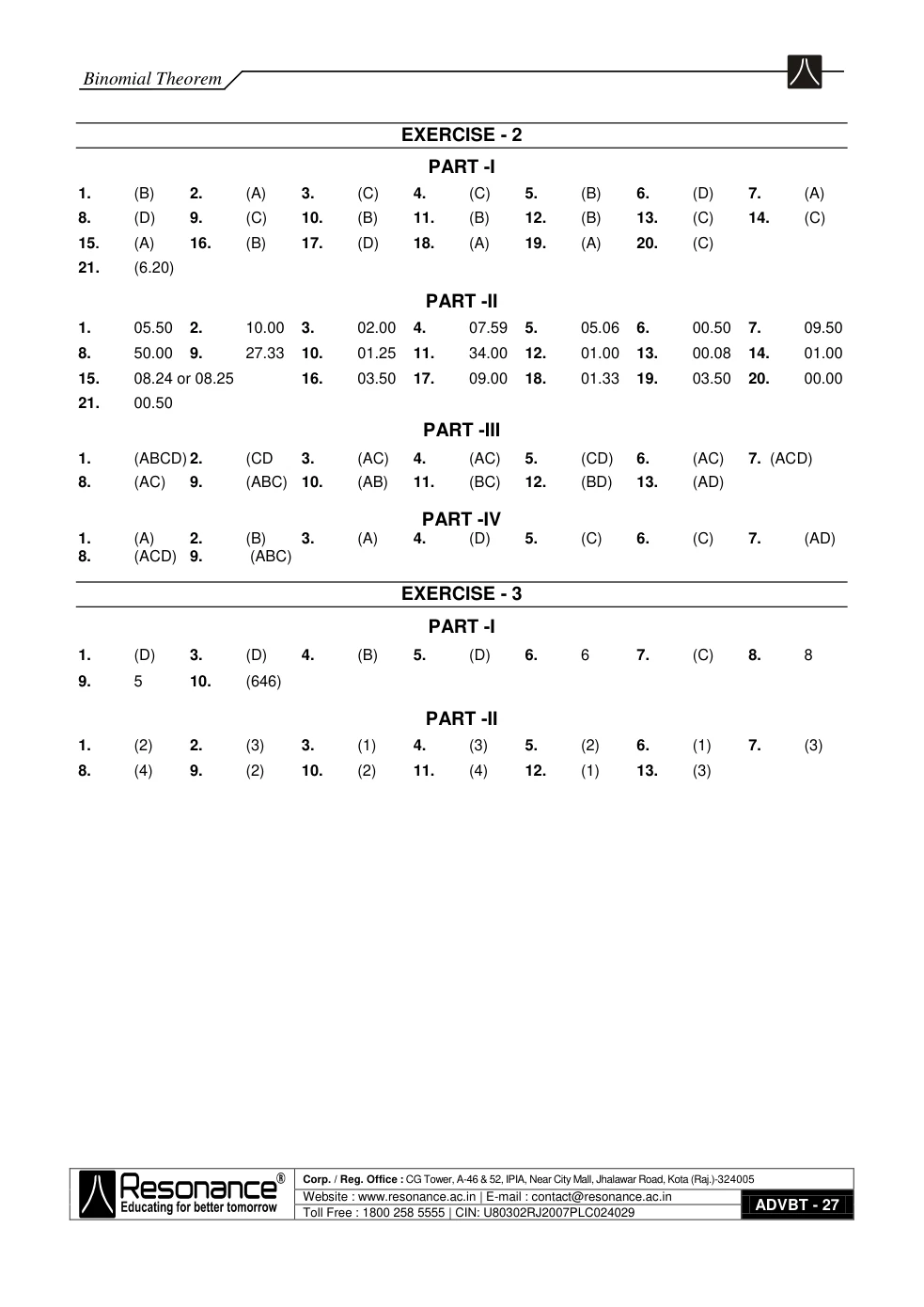
EXERCISE - 1
PART -I
Section (A) :
2 5 2 3 2 x x 3 x 5
A-1. (i) – 5 + 10 – 10 + 5 – x x x 2 2 2
32 16
(ii) y8 + 8y5 + 24y2 + +
y y 4
A-2. n = 9 A-3. 7 A-4. (i) 9C3 (ii) – 27 . 12C7
a 6 a 5 17
A-5. 11C5 5 , 11C6 6 , a b = 1 A-6. . A-7. (i) 171 (ii) –438 b b 54
A-8. 15
Section (B) :
35x 35y (2n)!
B-1. (i) – , (ii) (–1)n xn
y x n! n!
B-3. (i) 4 (iii) 3, 03, 803
B-4. 10150
B-5. (i) T4 = – 455 312 and T5 = 455 × 312 (ii) 22
B-6. (i) T4 (ii) T5, T6 (iii) T5 (iv) T6
Section (D) :
15015
D-1. D-2. (i) 142 (ii) – 197 D-4. (i) 280 (ii) 25
16
D-5. 20
PART -II
Section (A) :
A-1. (C) A-2. (C) A-3. (A) A-4. (B) A-5. (A) A-6. (A) A-7. (B)
A -8. (C) A-9. (C) A-10. (B)
Section (B) :
B-1. (B) B-2. (C) B-3. (D) B-4. (A) B-5. (A) B-6. (A) B-7. (A)
B-8. (B)
Section (C) :
C-1. (B) C-2. (C) C-3. (C) C-4. (B)
Section (D) :
D-1. (D) D-2. (D) D-3. (A)
PART -III
1. (A) (q, s), (B) (q,s), (C) (s), (D) (p, s)
MAASBinomial Expansion
© MAAS. All rights reserved.Page 27 / 30
Extracted text · page 27
 Binomial Theorem


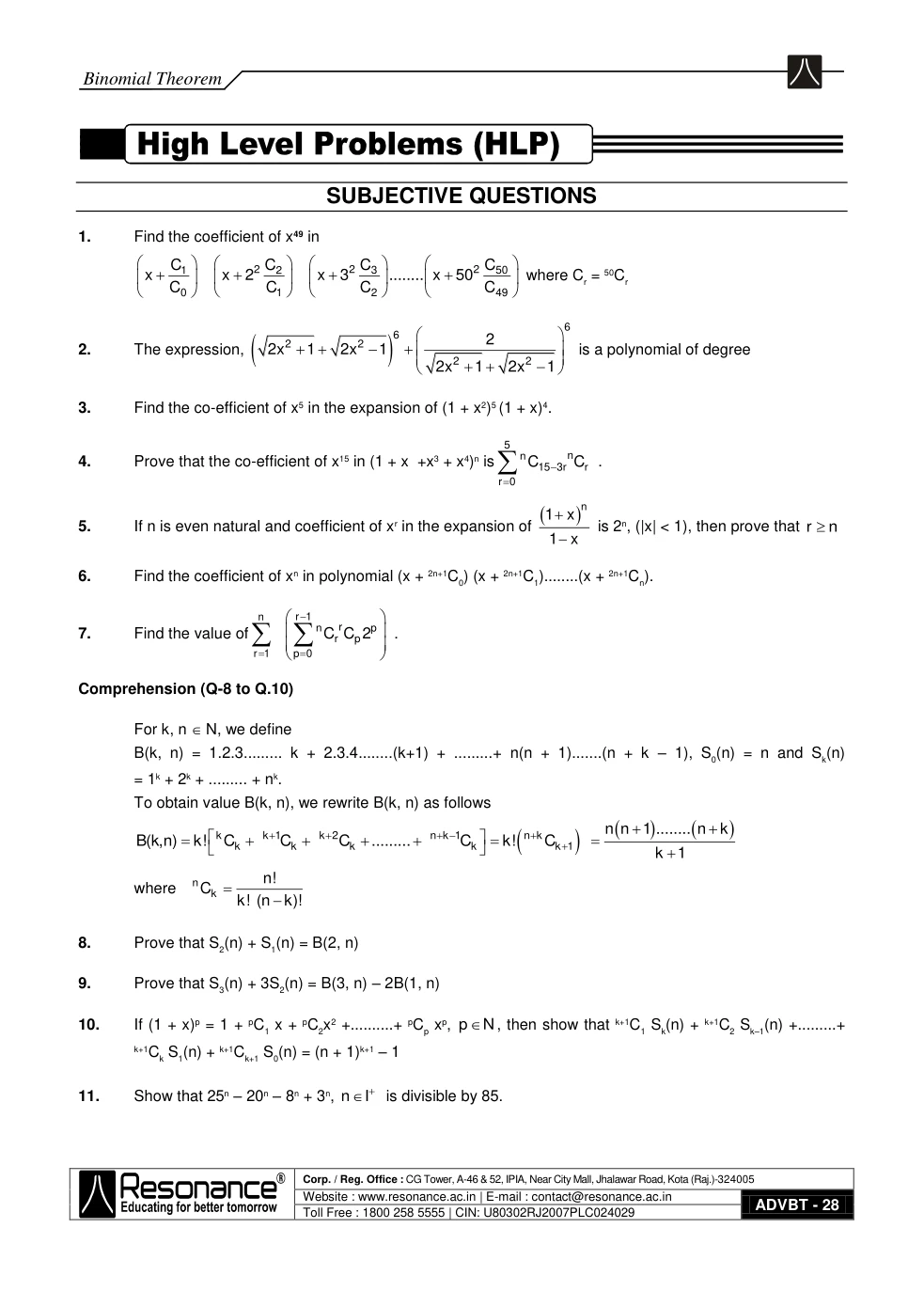
                           EXERCISE - 2

                            PART -I
1.      (B)     2.      (A)     3.      (C)     4.      (C)     5.      (B)     6.      (D)     7.      (A)
8.      (D)     9.      (C)     10.     (B)     11.     (B)     12.     (B)     13.     (C)     14.     (C)
15.     (A)     16.     (B)     17.     (D)     18.     (A)     19.     (A)     20.     (C)
21.     (6.20)

                            PART -II
1.      05.50   2.      10.00   3.      02.00   4.      07.59   5.      05.06   6.      00.50   7.      09.50
8.      50.00   9.      27.33  10.    01.25  11.    34.00  12.    01.00  13.    00.08  14.    01.00
15.    08.24 or 08.25         16.    03.50  17.    09.00  18.    01.33  19.    03.50  20.    00.00
21.    00.50
                           PART -III

1.     (ABCD) 2.     (CD    3.     (AC)    4.     (AC)    5.     (CD)    6.     (AC)    7. (ACD)
8.     (AC)    9.     (ABC)  10.    (AB)    11.    (BC)   12.    (BD)   13.    (AD)

                           PART -IV
1.      (A)     2.      (B)     3.      (A)     4.      (D)     5.      (C)     6.      (C)     7.     (AD)
8.     (ACD)  9.      (ABC)

                           EXERCISE - 3

                            PART -I

1.      (D)     3.      (D)     4.      (B)     5.      (D)     6.     6       7.      (C)     8.     8

9.     5       10.     (646)

                            PART -II
1.       (2)      2.       (3)      3.       (1)      4.       (3)      5.       (2)      6.       (1)      7.       (3)
8.       (4)      9.       (2)     10.     (2)     11.     (4)     12.     (1)     13.     (3)
MAASBinomial Expansion
© MAAS. All rights reserved.Page 28 / 30
Extracted text · page 28
Binomial Theorem
SUBJECTIVE QUESTIONS
1. Find the coefficient of x49 in
C1 2 C2 2 C3 2 C50 x x 2 x 3 ........ x 50 where Cr = 50Cr
C0 C1 C2 C 49
6
6 2 2 22. The expression, 2x 1 2x 1 is a polynomial of degree 2 2 2x 1 2x 1
3. Find the co-efficient of x5 in the expansion of (1 + x2)5 (1 + x)4.
5
4. Prove that the co-efficient of x15 in (1 + x +x3 + x4)n is n C15 3r n Cr . r 0
1 x n
5. If n is even natural and coefficient of xr in the expansion of is 2n, (|x| < 1), then prove that r n
1 x
6. Find the coefficient of xn in polynomial (x + 2n+1C0) (x + 2n+1C1)........(x + 2n+1Cn).
n r 1
7. Find the value of n Cr r Cp 2p . r 1 p 0
Comprehension (Q-8 to Q.10)
For k, n N, we define
B(k, n) = 1.2.3......... k + 2.3.4........(k+1) + .........+ n(n + 1).......(n + k – 1), S0(n) = n and Sk(n)
= 1k + 2k + ......... + nk.
To obtain value B(k, n), we rewrite B(k, n) as follows
k k 1 k 2 n k 1 n k n n 1 ........ n k B(k,n) k! k! Ck Ck Ck ......... Ck Ck 1 k 1
n n! where Ck k! (n k)!
8. Prove that S2(n) + S1(n) = B(2, n)
9. Prove that S3(n) + 3S2(n) = B(3, n) – 2B(1, n)
10. If (1 + x)p = 1 + pC1 x + pC2x2 +..........+ pCp xp, p N , then show that k+1C1 Sk(n) + k+1C2 Sk–1(n) +.........+
k+1Ck S1(n) + k+1Ck+1 S0(n) = (n + 1)k+1 – 1
11. Show that 25n – 20n – 8n + 3n, n I is divisible by 85.
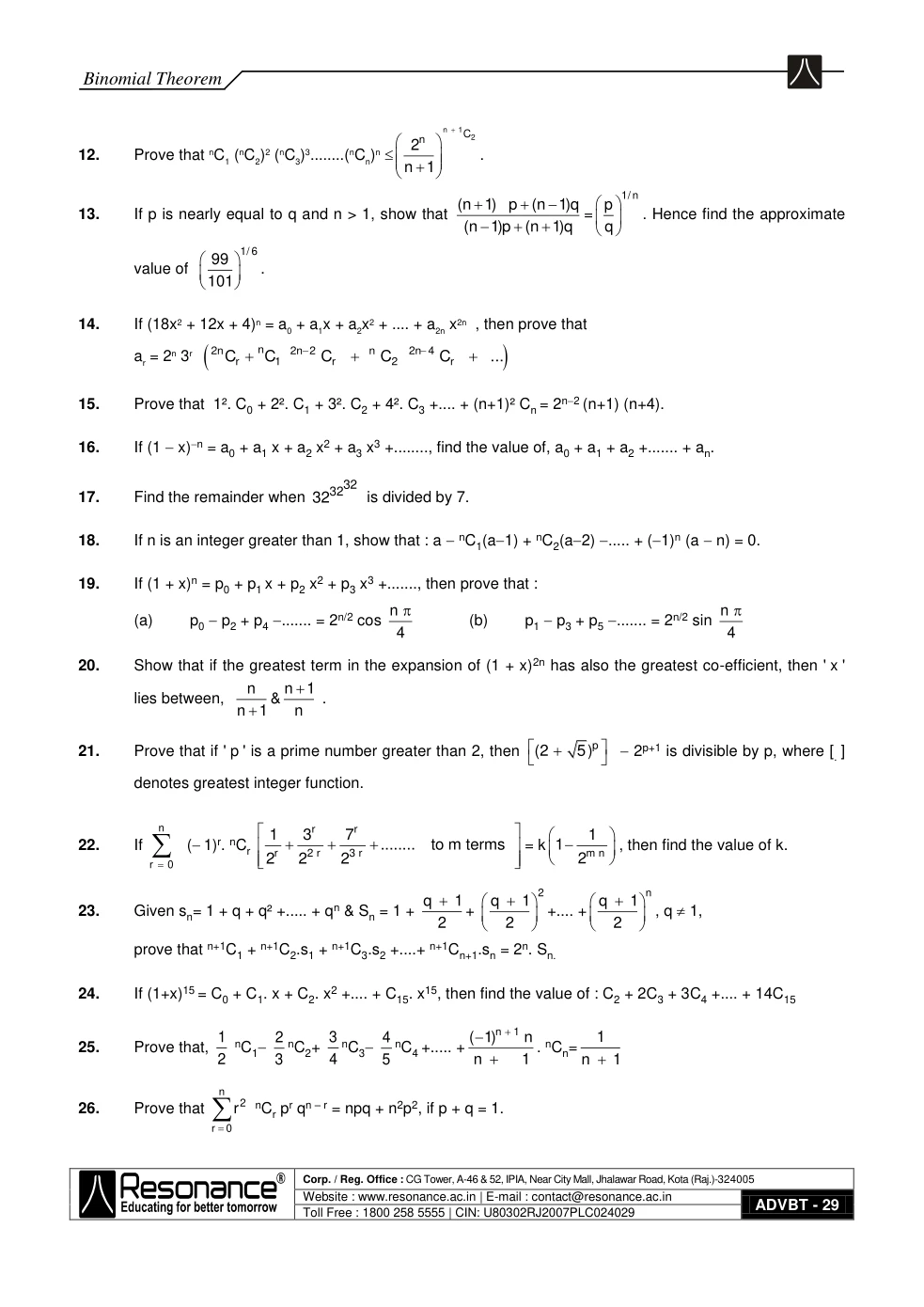
MAASBinomial Expansion
© MAAS. All rights reserved.Page 29 / 30
Extracted text · page 29
Binomial Theorem
n 1 C2 n 2
12. Prove that nC1 (nC2)2 (nC3)3........(nCn)n . n 1
(n 1) p (n 1)q p 1/ n
13. If p is nearly equal to q and n > 1, show that = . Hence find the approximate
(n 1)p (n 1)q q
99 1/ 6
value of . 101
14. If (18x2 + 12x + 4)n = a0 + a1x + a2x2 + .... + a2n x2n , then prove that
ar = 2n 3r 2n Cr n C1 2n 2 Cr n C2 2n 4 Cr ...
15. Prove that 1². C0 + 2². C1 + 3². C2 + 4². C3 +.... + (n+1)² Cn = 2n2 (n+1) (n+4).
16. If (1 x)n = a0 + a1 x + a2 x2 + a3 x3 +........, find the value of, a0 + a1 + a2 +....... + an.
32
17. Find the remainder when 3232 is divided by 7.
18. If n is an integer greater than 1, show that : a nC1(a1) + nC2(a2) ..... + (1)n (a n) = 0.
19. If (1 + x)n = p0 + p1 x + p2 x2 + p3 x3 +......., then prove that :
n n
(a) p0 p2 + p4 ....... = 2n/2 cos (b) p1 p3 + p5 ....... = 2n/2 sin 4 4
20. Show that if the greatest term in the expansion of (1 + x)2n has also the greatest co-efficient, then ' x '
n n 1
lies between, & .
n 1 n
21. Prove that if ' p ' is a prime number greater than 2, then (2 5)p 2p+1 is divisible by p, where [. ]
denotes greatest integer function.
n 1 3r 7r 1
22. If ( 1)r. nCr r 2 r 3 r ........ to m terms = k 1 m n , then find the value of k. r0 2 2 2 2
2 n
q 1 q 1 q 1
23. Given sn= 1 + q + q² +..... + qn & Sn = 1 + + +.... + , q 1, 2 2 2
prove that n+1C1 + n+1C2.s1 + n+1C3.s2 +....+ n+1Cn+1.sn = 2n. Sn.
24. If (1+x)15 = C0 + C1. x + C2. x2 +.... + C15. x15, then find the value of : C2 + 2C3 + 3C4 +.... + 14C15
1 2 3 4 ( 1)n 1 n 1
25. Prove that, nC1 nC2+ nC3 nC4 +..... + . nCn= 2 3 4 5 n 1 n 1
n
26. Prove that r 2 nCr pr qn – r = npq + n2p2, if p + q = 1. r0
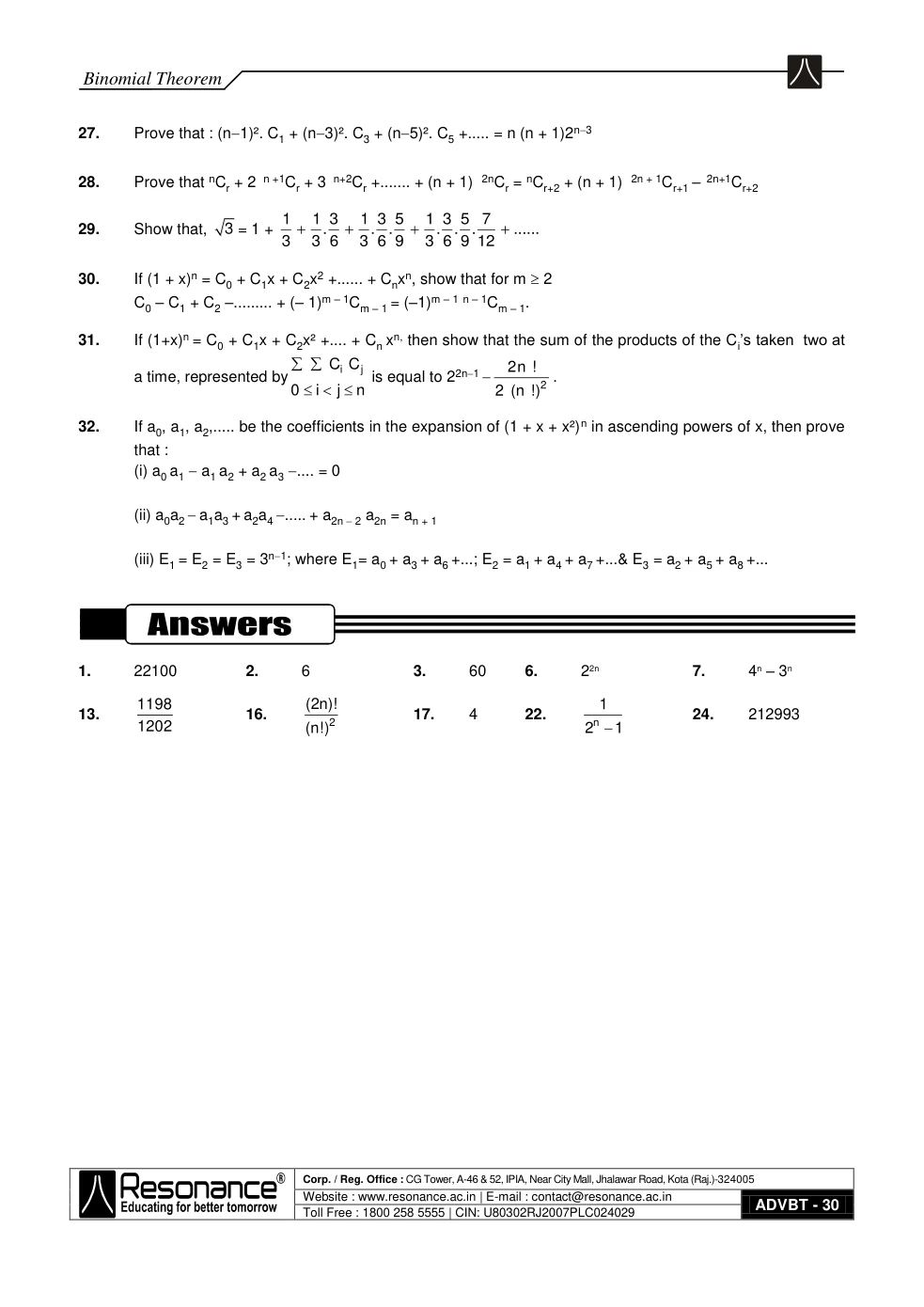
MAASBinomial Expansion
© MAAS. All rights reserved.Page 30 / 30
Extracted text · page 30
Binomial Theorem
27. Prove that : (n1)². C1 + (n3)². C3 + (n5)². C5 +..... = n (n + 1)2n3
28. Prove that nCr + 2 n +1Cr + 3 n+2Cr +....... + (n + 1) 2nCr = nCr+2 + (n + 1) 2n + 1Cr+1 – 2n+1Cr+2
1 1 3 1 3 5 1 3 5 7
29. Show that, 3 = 1 + . . . . . . ......
3 3 6 3 6 9 3 6 9 12
30. If (1 + x)n = C0 + C1x + C2x2 +...... + Cnxn, show that for m 2
C0 – C1 + C2 –......... + (– 1)m – 1Cm – 1 = (–1)m – 1 n – 1Cm – 1.
31. If (1+x)n = C0 + C1x + C2x² +.... + Cn xn, then show that the sum of the products of the Ci’s taken two at
Ci C j 2n !
a time, represented by is equal to 22n1 .
0 i j n 2 (n !)2
32. If a0, a1, a2,..... be the coefficients in the expansion of (1 + x + x²)n in ascending powers of x, then prove
that :
(i) a0 a1 a1 a2 + a2 a3 .... = 0
(ii) a0a2 a1a3 + a2a4 ..... + a2n 2 a2n = an + 1
(iii) E1 = E2 = E3 = 3n1; where E1= a0 + a3 + a6 +...; E2 = a1 + a4 + a7 +...& E3 = a2 + a5 + a8 +...
1. 22100 2. 6 3. 60 6. 22n 7. 4n – 3n
1198 (2n)! 1
13. 16. 17. 4 22. 24. 212993
1202 (n!)2 2n 1