Visual-fidelity edition: source-page equations, diagrams and charts are preserved as page images. Text transcripts are provided where extractable. The original source may contain markings within the artwork.

MAASPermutation & Combination
© MAAS. All rights reserved.Page 1 / 33
Extracted text · page 1
Target : JEE (Main + Advanced) Permutation & Combination
MAASPermutation & Combination
© MAAS. All rights reserved.Page 2 / 33
Extracted text · page 2
CONTENTS
PERMUTATION & COMBINATION
Topic Page No.
Theory 01 – 09
Exercise # 1 Part - I : Subjective Question 10 – 17
Part - II : Only one option correct type
Part – III : Match the column
Exercise - 2 Part - I : Only one option correct type 17 – 23
Part - II : Numerical value questions
Part - III : One or More than one options correct type
Part - IV : Comprehension
Exercise - 3 23 – 26
Part - I : JEE(Advanced) / IIT-JEE Problems (Previous Years)
Part - II : JEE(Main) / AIEEE Problems (Previous Years)
Answer Key 27 – 28
High Level Problems (HLP) 29 – 31
Answer Key (HLP) 31 – 31
JEE (ADVANCED) SYLLABUS
Permutation and Combination
JEE (MAIN) SYLLABUS
Fundamental principle of counting, permutation as an arrangement and combination as selection, Meaning of P
(n,r) and C (n,r), simple applications.
MAASPermutation & Combination
© MAAS. All rights reserved.Page 3 / 33
Extracted text · page 3
Permutation & Combination
There can never be surprises in logic...Wittgenstein, Ludwig
The most fundamental application of mathematics is counting. There are many natural methods used
for counting
This chapter is dealing with various known techniques those are much faster than the usual counting
methods.
We mainly focus, our methods, on counting the number of arrangements (Permutations) and the
number of selections (combinations), even although we may use these techniques for counting in some
other situations also .
Let us start with a simple problem
A group G1 of 3 circles C1, C2, C3 having different centers are situated in such a way that C2 lie entirely
inside C1 ; C3 lie entirely inside C2. Another group G2 of 4 circles C1, C2, C3, C4 are also situated in a
similar fashion. The two groups of circles are in such a way that each member of G1 intersect with every
member of G2, as shown in the following figure
(i) How many centres the circles altogether has ?
(ii) How many common chords are obtained ?
The answer to the first part is "3 + 4 = 7" and answer to the second part is "3 × 4 = 12" . The method in
which we calculated first part of the problem is called as "addition rule" and the method we used to
calculate its second part is called as the "multiplication rule". These rules altogether are the most
important tools in counting, popularly known as "the fundamental counting principle".
Fundamental counting principle :
Suppose that an operation O1 can be done in m different ways and another operation O2 can be done in
n different ways.
(i) Addition rule : The number of ways in which we can do exactly one of the operations O1, O2
is m + n
(ii) Multiplication rule : The number of ways in which we can do both the operations O1, O2 is mn.
Note : The addition rule is true only when O1 & O2 are mutually exclusive and multiplication rule is true only
when O1 & O2 are independent (The reader will understand the concepts of mutual exclusiveness and
independence, in the due course)
Example # 1 : There are 8 buses running from Kota to Jaipur and 10 buses running from Jaipur to Delhi. In
how many ways a person can travel from Kota to Delhi via Jaipur by bus?
Solution : Let E1 be the event of travelling from Kota to Jaipur & E2 be the event of travelling from Jaipur
to
Delhi by the person.
E1 can happen in 8 ways and E2 can happen in 10 ways.
Since both the events E1 and E2 are to be happened in order, simultaneously,
the number of ways = 8 × 10 = 80.
Example # 2 : How many numbers between 10 and 10,000 can be formed by using the digits 1, 2, 3, 4, 5 if
(i) No digit is repeated in any number. (ii) Digits can be repeated.
Solution : (i) Number of two digit numbers = 5 × 4 = 20
Number of three digit numbers = 5 × 4 × 3 = 60
Number of four digit numbers = 5 × 4 × 3 × 2 = 120
Total = 200
(ii) Number of two digit numbers = 5 × 5 = 25
ADVPC-1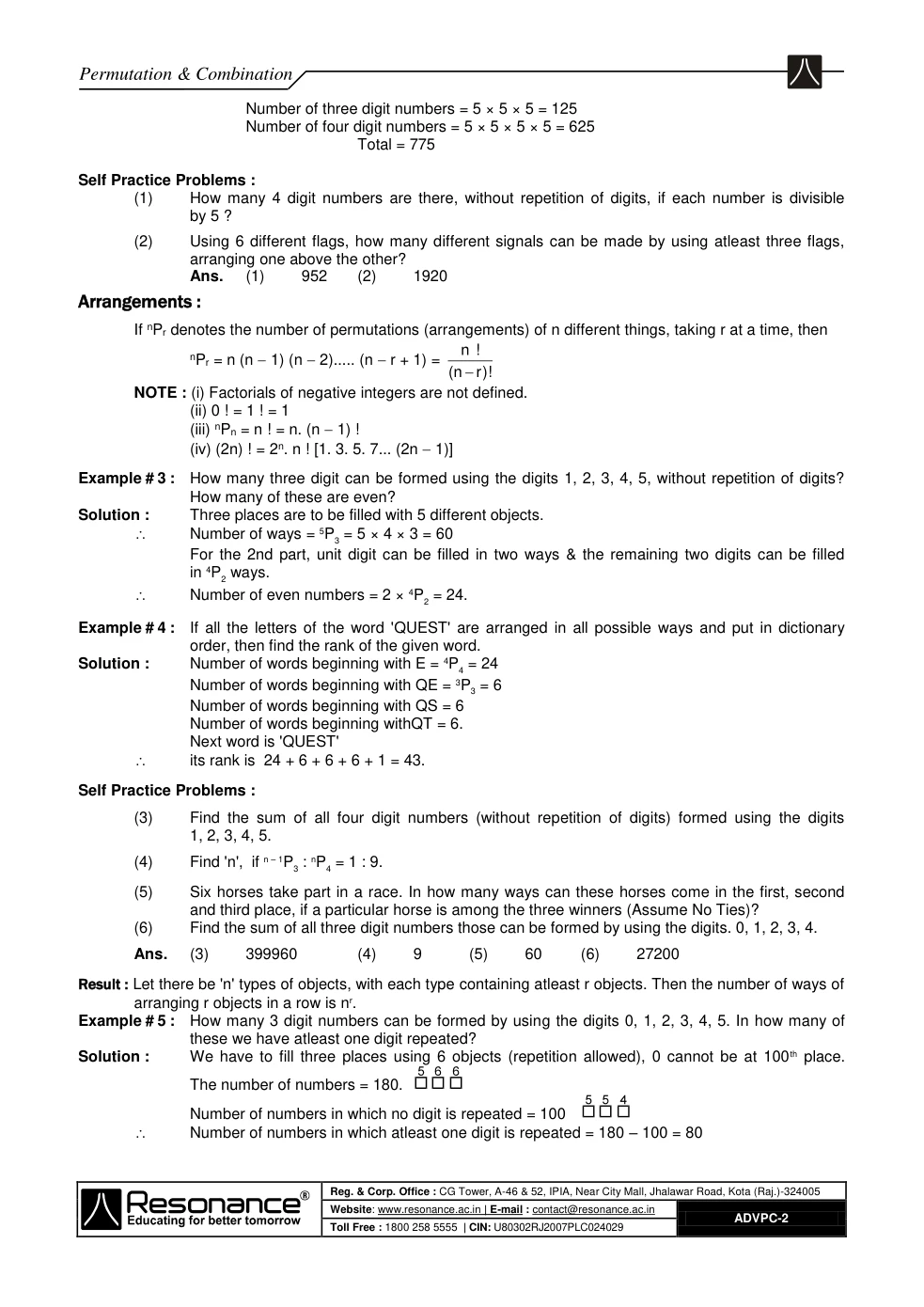
MAASPermutation & Combination
© MAAS. All rights reserved.Page 4 / 33
Extracted text · page 4
Permutation & Combination
Number of three digit numbers = 5 × 5 × 5 = 125
Number of four digit numbers = 5 × 5 × 5 × 5 = 625
Total = 775
Self Practice Problems :
(1) How many 4 digit numbers are there, without repetition of digits, if each number is divisible
by 5 ?
(2) Using 6 different flags, how many different signals can be made by using atleast three flags,
arranging one above the other?
Ans. (1) 952 (2) 1920
Arrangements :
If nPr denotes the number of permutations (arrangements) of n different things, taking r at a time, then
n !
nPr = n (n 1) (n 2)..... (n r + 1) =
(n r)!
NOTE : (i) Factorials of negative integers are not defined.
(ii) 0 ! = 1 ! = 1
(iii) nPn = n ! = n. (n 1) !
(iv) (2n) ! = 2n. n ! [1. 3. 5. 7... (2n 1)]
Example # 3 : How many three digit can be formed using the digits 1, 2, 3, 4, 5, without repetition of digits?
How many of these are even?
Solution : Three places are to be filled with 5 different objects.
Number of ways = 5P3 = 5 × 4 × 3 = 60
For the 2nd part, unit digit can be filled in two ways & the remaining two digits can be filled
in 4P2 ways.
Number of even numbers = 2 × 4P2 = 24.
Example # 4 : If all the letters of the word 'QUEST' are arranged in all possible ways and put in dictionary
order, then find the rank of the given word.
Solution : Number of words beginning with E = 4P4 = 24
Number of words beginning with QE = 3P3 = 6
Number of words beginning with QS = 6
Number of words beginning withQT = 6.
Next word is 'QUEST'
its rank is 24 + 6 + 6 + 6 + 1 = 43.
Self Practice Problems :
(3) Find the sum of all four digit numbers (without repetition of digits) formed using the digits
1, 2, 3, 4, 5.
(4) Find 'n', if n – 1P3 : nP4 = 1 : 9.
(5) Six horses take part in a race. In how many ways can these horses come in the first, second
and third place, if a particular horse is among the three winners (Assume No Ties)?
(6) Find the sum of all three digit numbers those can be formed by using the digits. 0, 1, 2, 3, 4.
Ans. (3) 399960 (4) 9 (5) 60 (6) 27200
Result : Let there be 'n' types of objects, with each type containing atleast r objects. Then the number of ways of
arranging r objects in a row is nr.
Example # 5 : How many 3 digit numbers can be formed by using the digits 0, 1, 2, 3, 4, 5. In how many of
these we have atleast one digit repeated?
Solution : We have to fill three places using 6 objects (repetition allowed), 0 cannot be at 100th place.
The number of numbers = 180.
Number of numbers in which no digit is repeated = 100
Number of numbers in which atleast one digit is repeated = 180 – 100 = 80
ADVPC-2
MAASPermutation & Combination
© MAAS. All rights reserved.Page 5 / 33
Extracted text · page 5
Permutation & Combination
Example # 6 : How many functions can be defined from a set A containing 5 elements to a set B having 3
elements? How many of these are surjective functions?
Solution : Image of each element of A can be taken in 3 ways.
Number of functions from A to B = 35 = 243.
Number of into functions from A to B = 25 + 25 + 25 – 3 = 93.
Number of onto functions = 150.
Self Practice Problems :
(7) How many functions can be defined from a set A containing 4 elements to a set B containing 5
elements? How many of these are injective functions?
(8) In how many ways 5 persons can enter into a auditorium having 4 entries?
Ans. (7) 625, 120 (8) 1024.
Combination :
If nCr denotes the number of combinations (selections) of n different things taken r at a time, then
n ! n rP nCr = = where r n ; n N and r W.
r! (n r)! r!
NOTE : (i) nCr = nCn – r
(ii) nCr + nCr – 1 = n + 1Cr
(iii) nCr = 0 if r {0, 1, 2, 3........, n}
Example # 7 : There are fifteen players for a cricket match.
(i) In how many ways the 11 players can be selected?
(ii) In how many ways the 11 players can be selected including a particular player?
(iii) In how many ways the 11 players can be selected excluding two particular players?
Solution : (i) 11 players are to be selected from 15
Number of ways = 15C11 = 1365.
(ii) Since one player is already included, we have to select 10 from the remaining 14
Number of ways = 14C10 = 1001.
(iii) Since two players are to be excluded, we have to select 11 from the remaining 13.
Number of ways = 13C11 = 78.
Example # 8 : If 49C3r – 2 = 49C2r + 1, find 'r'.
Solution : nCr = nCs if either r = s or r + s = n.
Thus 3r – 2 = 2r + 1 r = 3
or 3r – 2 + 2r + 1 = 49 5r – 1 = 49 r = 10
r = 3, 10
Example # 9 : A regular polygon has 20 sides. How many triangles can be drawn by using the vertices, but
not using the sides?
Solution : The first vertex can be selected in 20 ways. The remaining two are to be selected from 17
vertices so that they are not consecutive. This can be done in 17C2 – 16 ways.
The total number of ways = 20 × (17C2 – 16)
But in this method, each selection is repeated thrice.
20 (17 C2 16) Number of triangles = = 800.
3
Example # 10 : 15 persons are sitting in a row. In how many ways we can select three of them if adjacent
persons are not selected ?
Solution : Let P1, P2, P3, P4, P5, P6, P7, P8, P9, P10 ,P11 , P12 , P13 ,P14 ,P15 be the persons sitting in this order.
If three are selected (non consecutive) then 12 are left out.
Let P,P,P,P,P,P,P,P,P,P,P,P be the left out & q, q, q be the selected. The number of ways in
which these 3 q's can be placed into the 13 positions between the P's (including extremes) is
the number ways of required selection.
Thus number of ways = 13C3 = 286.
ADVPC-3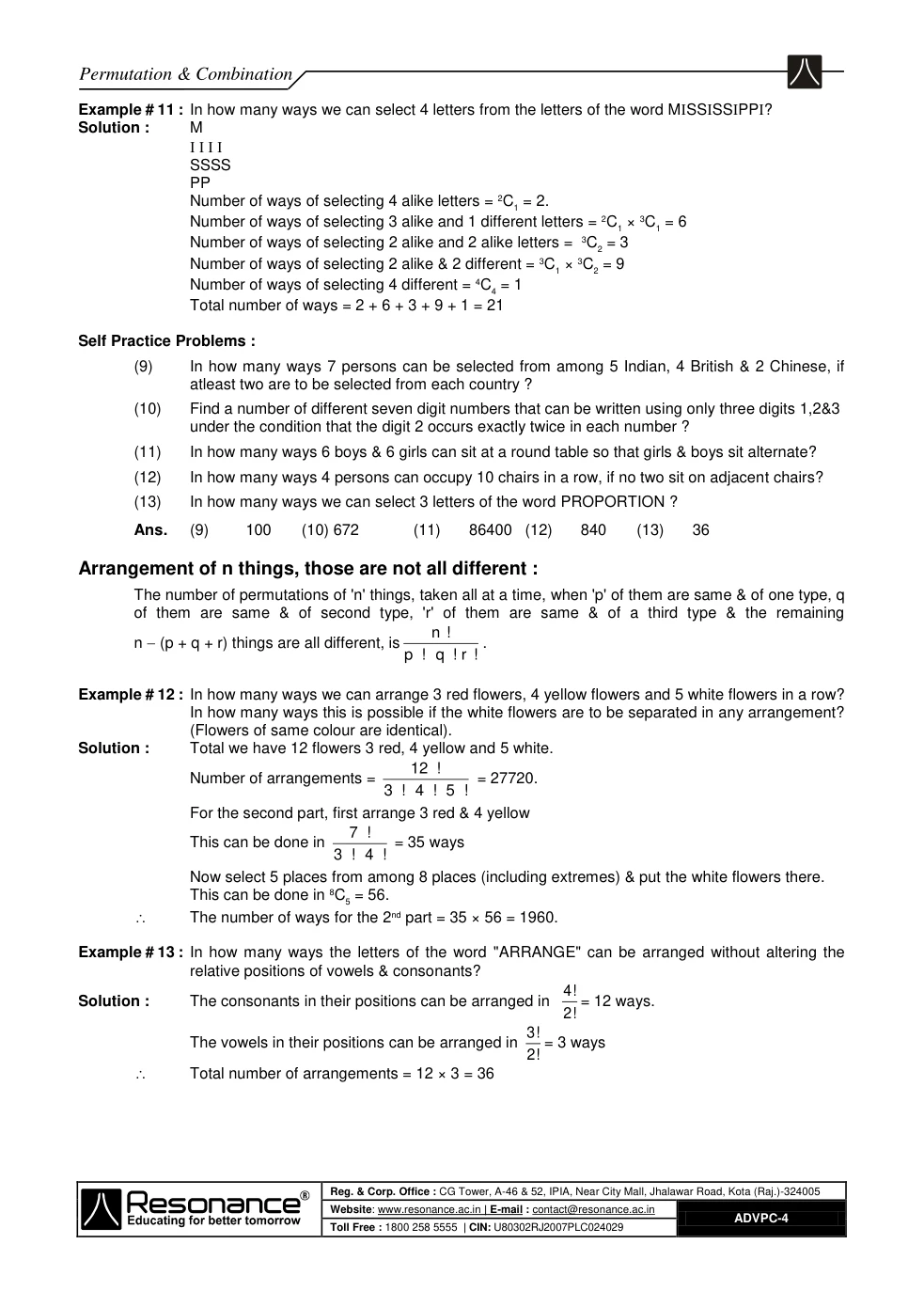
MAASPermutation & Combination
© MAAS. All rights reserved.Page 6 / 33
Extracted text · page 6
Permutation & Combination
Example # 11 : In how many ways we can select 4 letters from the letters of the word MSSSSPP?
Solution : M
SSSS
PP
Number of ways of selecting 4 alike letters = 2C1 = 2.
Number of ways of selecting 3 alike and 1 different letters = 2C1 × 3C1 = 6
Number of ways of selecting 2 alike and 2 alike letters = 3C2 = 3
Number of ways of selecting 2 alike & 2 different = 3C1 × 3C2 = 9
Number of ways of selecting 4 different = 4C4 = 1
Total number of ways = 2 + 6 + 3 + 9 + 1 = 21
Self Practice Problems :
(9) In how many ways 7 persons can be selected from among 5 Indian, 4 British & 2 Chinese, if
atleast two are to be selected from each country ?
(10) Find a number of different seven digit numbers that can be written using only three digits 1,2&3
under the condition that the digit 2 occurs exactly twice in each number ?
(11) In how many ways 6 boys & 6 girls can sit at a round table so that girls & boys sit alternate?
(12) In how many ways 4 persons can occupy 10 chairs in a row, if no two sit on adjacent chairs?
(13) In how many ways we can select 3 letters of the word PROPORTION ?
Ans. (9) 100 (10) 672 (11) 86400 (12) 840 (13) 36
Arrangement of n things, those are not all different :
The number of permutations of 'n' things, taken all at a time, when 'p' of them are same & of one type, q
of them are same & of second type, 'r' of them are same & of a third type & the remaining
n !
n (p + q + r) things are all different, is .
p ! q ! r !
Example # 12 : In how many ways we can arrange 3 red flowers, 4 yellow flowers and 5 white flowers in a row?
In how many ways this is possible if the white flowers are to be separated in any arrangement?
(Flowers of same colour are identical).
Solution : Total we have 12 flowers 3 red, 4 yellow and 5 white.
12 !
Number of arrangements = = 27720.
3 ! 4 ! 5 !
For the second part, first arrange 3 red & 4 yellow
7 !
This can be done in = 35 ways
3 ! 4 !
Now select 5 places from among 8 places (including extremes) & put the white flowers there.
This can be done in 8C5 = 56.
The number of ways for the 2nd part = 35 × 56 = 1960.
Example # 13 : In how many ways the letters of the word "ARRANGE" can be arranged without altering the
relative positions of vowels & consonants?
4!
Solution : The consonants in their positions can be arranged in = 12 ways.
2!
3!
The vowels in their positions can be arranged in = 3 ways
2!
Total number of arrangements = 12 × 3 = 36
ADVPC-4
MAASPermutation & Combination
© MAAS. All rights reserved.Page 7 / 33
Extracted text · page 7
Permutation & Combination
Self Practice Problems :
(14) How many words can be formed using the letters of the word ASSESSMENT if each word
begin with A and end with T?
(15) If all the letters of the word ARRANGE are arranged in all possible ways, in how many of words
we will have the A's not together and also the R's not together?
(16) How many arrangements can be made by taking four letters of the word MISSISSIPPI?
Ans. (14) 840 (15) 660 (16) 176.
Formation of Groups :
Number of ways in which (m + n + p) different things can be divided into three different groups
m n p !
containing m, n & p things respectively is ,
m ! n ! p !
If m = n = p and the groups have identical qualitative characteristic then the number of groups
(3n)!
= .
n! n! n! 3!
(3n)!
Note : If 3n different things are to be distributed equally among three people then the number of ways = .
n! 3
Example # 14 : 12 different toys are to be distributed to three children equally. In how many ways this can be
done ?
Solution : The problem is to divide 12 different things into three different groups.
12!
Number of ways = = 34650.
4! 4! 4!
Example # 15 : In how many ways 10 persons can be divided into 5 pairs?
Solution : We have each group having 2 persons and the qualitative characteristic are same (Since there
is no purpose mentioned or names for each pair).
10!
Thus the number of ways = = 945.
(2!)5 5!
Self Practice Problems :
(17) 9 persons enter a lift from ground floor of a building which stops in 10 floors (excluding ground
floor), if it is known that persons will leave the lift in groups of 2, 3, & 4 in different floors. In how
many ways this can happen?
(18) In how many ways one can make four equal heaps using a pack of 52 playing cards?
(19) In how many ways 11 different books can be parcelled into four packets so that three of the
packets contain 3 books each and one of 2 books, if all packets have the same destination?
52! 11!
Ans. (17) 907200 (18) (19)
(13!)4 4! (3!) 4 2
Circular Permutation :
The number of circular permutations of n different things taken all at a time is (n 1) !.
(n 1)!
If clockwise & anticlockwise circular permutations are considered to be same, then it is .
2
Note : Number of circular permutations of n things when p are alike and the rest are different, taken all at a
(n 1) !
time, distinguishing clockwise and anticlockwise arrangement is .
p!
ADVPC-5
MAASPermutation & Combination
© MAAS. All rights reserved.Page 8 / 33
Extracted text · page 8
Permutation & Combination
Example # 16 : In how many ways can we arrange 6 different flowers in a circle? In how many ways we
can form a garland using these flowers?
Solution : The number of circular arrangements of 6 different flowers = (6 – 1)! = 120
When we form a garland, clockwise and anticlockwise arrangements are similar. Therefore, the
1
number of ways of forming garland = (6 – 1) ! = 60.
2
Example # 17 : In how many ways 6 persons can sit at a round table, if two of them prefer to sit together?
Solution : Let P1, P2, P3, P4, P5, P6 be the persons, where P1, P2 want to sit together.
Regard these person as 5 objects. They can be arranged in a circle in (5 – 1)! = 24 ways. Now
P1, P2 can be arranged in 2! ways. Thus the total number of ways = 24 × 2 = 48.
Self Practice Problems :
(20) In how many ways letters of the word 'MONDAY' can be written around a circle, if vowels
are to be separated in any arrangement ?
(21) In how many ways we can form a garland using 3 different red flowers,5 different yellow flowers
and 4 different blue flowers, if flowers of same colour must be together?
Ans. (20) 72 (21) 17280
Selection of one or more objects
(a) Number of ways in which atleast one object may be selected out of 'n' distinct objects, is
nC1 + nC2 + nC3 +...............+ nCn = 2n – 1
(b) Number of ways in which atleast one object may be selected out of 'p' alike objects of one
type, 'q' alike objects of second type and 'r' alike objects of third type, is
(p + 1) (q + 1) (r + 1) – 1
(c) Number of ways in which atleast one object may be selected from 'n' objects where 'p' alike of
one type, 'q' alike of second type and 'r' alike of third type and rest n – (p + q + r) are different,
is (p + 1) (q + 1) (r + 1) 2n – (p + q + r) – 1
Example # 18 : There are 12 different books in a shelf. In how many ways we can select atleast one of them?
Solution : We may select 1 book, 2 books,........, 12 books.
The number of ways = 12C1 + 12C2 + ....... + 12C12 = 212 – 1. = 4095
Example # 19 : There are 11 fruits in a basket of which 6 are apples, 3 mangoes and 2 bananas (fruits of same
species are identical). How many ways are there to select atleast one fruit?
Solution : Let x be the number of apples being selected
y be the number of mangoes being selected and
z be the number of bananas being selected.
Then x = 0, 1, 2, 3, 4, 5,6
y = 0, 1, 2, 3
z = 0, 1, 2
Total number of triplets (x, y, z) is 7 × 4 × 3 = 84
Exclude (0, 0, 0)
Number of combinations = 84 – 1 = 83.
Self Practice Problems
(22) In a shelf there are 6 physics, 4 chemistry and 3 mathematics books. How many combinations
are there if (i) books of same subject are different? (ii) books of same subject are identical?
(23) From 5 apples, 4 mangoes & 3 bananas, in how many ways we can select atleast two fruits of
each variety if (i) fruits of same species are identical? (ii) fruits of same species are different?
Ans. (22) (i) 8191 (ii) 139 (23) (i) 24 (ii) 212 – 4
Results : Let N = pa. qb. rc...... where p, q, r...... are distinct primes & a, b, c..... are natural numbers then:
(a) The total numbers of divisors of N including 1 & N is = (a + 1) (b + 1) (c + 1)........
(b) The sum of these divisors is =
(p0 + p1 + p2 +.... + pa) (q0 + q1 + q2 +.... + qb) (r0 + r1 + r2 +.... + rc)........
ADVPC-6
MAASPermutation & Combination
© MAAS. All rights reserved.Page 9 / 33
Extracted text · page 9
Permutation & Combination
(c) Number of ways in which N can be resolved as a product of two factors is
1 (a 1) (b 1) (c 1) .... if N is not a perfect square 2 = 1
2 (a 1) (b 1) (c 1) .... 1 if N is a perfect square
(d) Number of ways in which a composite number N can be resolved into two factors which are
relatively prime (or coprime) to each other is equal to 2n1 where n is the number of different
prime factors in N.
Example # 20 : Find the number of divisors of 1350. Also find the sum of all divisors.
Solution : 1350 = 2 × 33 × 52
Number of divisors = (1+ 1) (3 + 1) (2 + 1) = 24
sum of divisors = (1 + 2) (1 + 3 + 32 + 33) (1 + 5 + 52) = 3720.
Example # 21 : In how many ways 8100 can be resolved into product of two factors?
Solution : 8100 = 22 × 34 × 52
1
Number of ways = [(2 + 1) (4 + 1) (2 + 1) + 1] = 23
2
Self Practice Problems :
(24) How many divisors of 9000 are even but not divisible by 4? Also find the sum of all such
divisors.
(25) In how many ways the number 8100 can be written as product of two coprime factors?
Ans. (24) 12, 4056 (25) 4
Negative binomial expansion :
(1 – x)– n = 1 + nC1x + n + 1C2 x2 + n + 2C3x3 + ........ to , if – 1 < x < 1.
Coefficient of xr in this expansion = n+r1Cr (n N)
Result : Number of ways in which it is possible to make a selection from m + n + p = N things, where p are
alike of one kind, m alike of second kind & n alike of third kind, taken r at a time is given by coefficient
of xr in the expansion of
(1 + x + x2 +...... + xp) (1 + x + x2 +...... + xm) (1 + x + x2 +...... + xn).
For example the number of ways in which a selection of four letters can be made from the letters of the
word PROPORTION is given by coefficient of x4 in
(1 + x + x2 + x3) (1 + x + x2) (1 + x + x2) (1 + x) (1 + x) (1 + x).
Method of fictious partition :
Number of ways in which n identical things may be distributed among p persons if each person may
receive none, one or more things is n+p1Cn.
Example # 22 : Find the number of solutions of the equation x + y + z = 6, where x, y, z W.
Solution : Number of solutions = coefficient of x6 in (1 + x + x2 + ....... x6)3
= coefficient of x6 in (1 – x7)3 (1 – x)–3
= coefficient of x6 in (1 – x)–3
= 3+6–1C6 = 8C2 = 28.
Example # 23 : In a bakery four types of biscuits are available. In how many ways a person can buy 10
biscuits if he decide to take atleast one biscuit of each variety?
Solution : Let the person select x biscuits from first variety, y from the second, z from the third and w
from the fourth variety. Then the number of ways = number of solutions of the equation
x + y + z + w = 10.
where x = 1, 2, .........,7
y = 1, 2, .........,7
z = 1, 2, .........,7
w = 1, 2, .........,7
So, number of ways = coefficient of x10 in (x + x2 + ...... + x7)4
ADVPC-7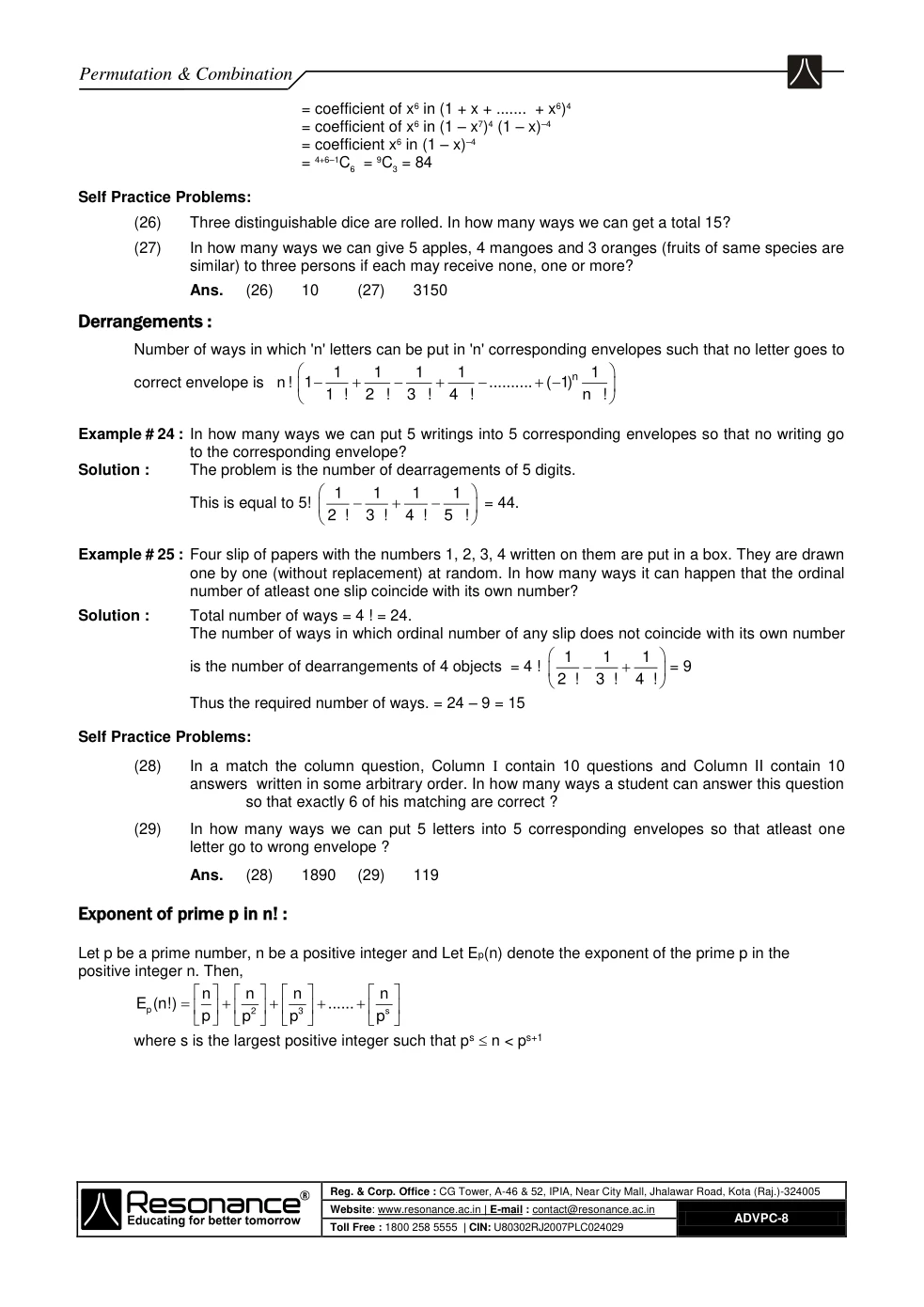
MAASPermutation & Combination
© MAAS. All rights reserved.Page 10 / 33
Extracted text · page 10
Permutation & Combination
= coefficient of x6 in (1 + x + ....... + x6)4
= coefficient of x6 in (1 – x7)4 (1 – x)–4
= coefficient x6 in (1 – x)–4
= 4+6–1C6 = 9C3 = 84
Self Practice Problems:
(26) Three distinguishable dice are rolled. In how many ways we can get a total 15?
(27) In how many ways we can give 5 apples, 4 mangoes and 3 oranges (fruits of same species are
similar) to three persons if each may receive none, one or more?
Ans. (26) 10 (27) 3150
Derrangements :
Number of ways in which 'n' letters can be put in 'n' corresponding envelopes such that no letter goes to
1 1 1 1 n 1
correct envelope is n ! 1 .......... ( 1)
1 ! 2 ! 3 ! 4 ! n !
Example # 24 : In how many ways we can put 5 writings into 5 corresponding envelopes so that no writing go
to the corresponding envelope?
Solution : The problem is the number of dearragements of 5 digits.
1 1 1 1
This is equal to 5! = 44.
2 ! 3 ! 4 ! 5 !
Example # 25 : Four slip of papers with the numbers 1, 2, 3, 4 written on them are put in a box. They are drawn
one by one (without replacement) at random. In how many ways it can happen that the ordinal
number of atleast one slip coincide with its own number?
Solution : Total number of ways = 4 ! = 24.
The number of ways in which ordinal number of any slip does not coincide with its own number
1 1 1
is the number of dearrangements of 4 objects = 4 ! = 9
2 ! 3 ! 4 !
Thus the required number of ways. = 24 – 9 = 15
Self Practice Problems:
(28) In a match the column question, Column contain 10 questions and Column II contain 10
answers written in some arbitrary order. In how many ways a student can answer this question
so that exactly 6 of his matching are correct ?
(29) In how many ways we can put 5 letters into 5 corresponding envelopes so that atleast one
letter go to wrong envelope ?
Ans. (28) 1890 (29) 119
Exponent of prime p in n! :
Let p be a prime number, n be a positive integer and Let Ep(n) denote the exponent of the prime p in the
positive integer n. Then,
n n n n
Ep (n!) 2 3 ...... s
p p p p
where s is the largest positive integer such that ps n < ps+1
ADVPC-8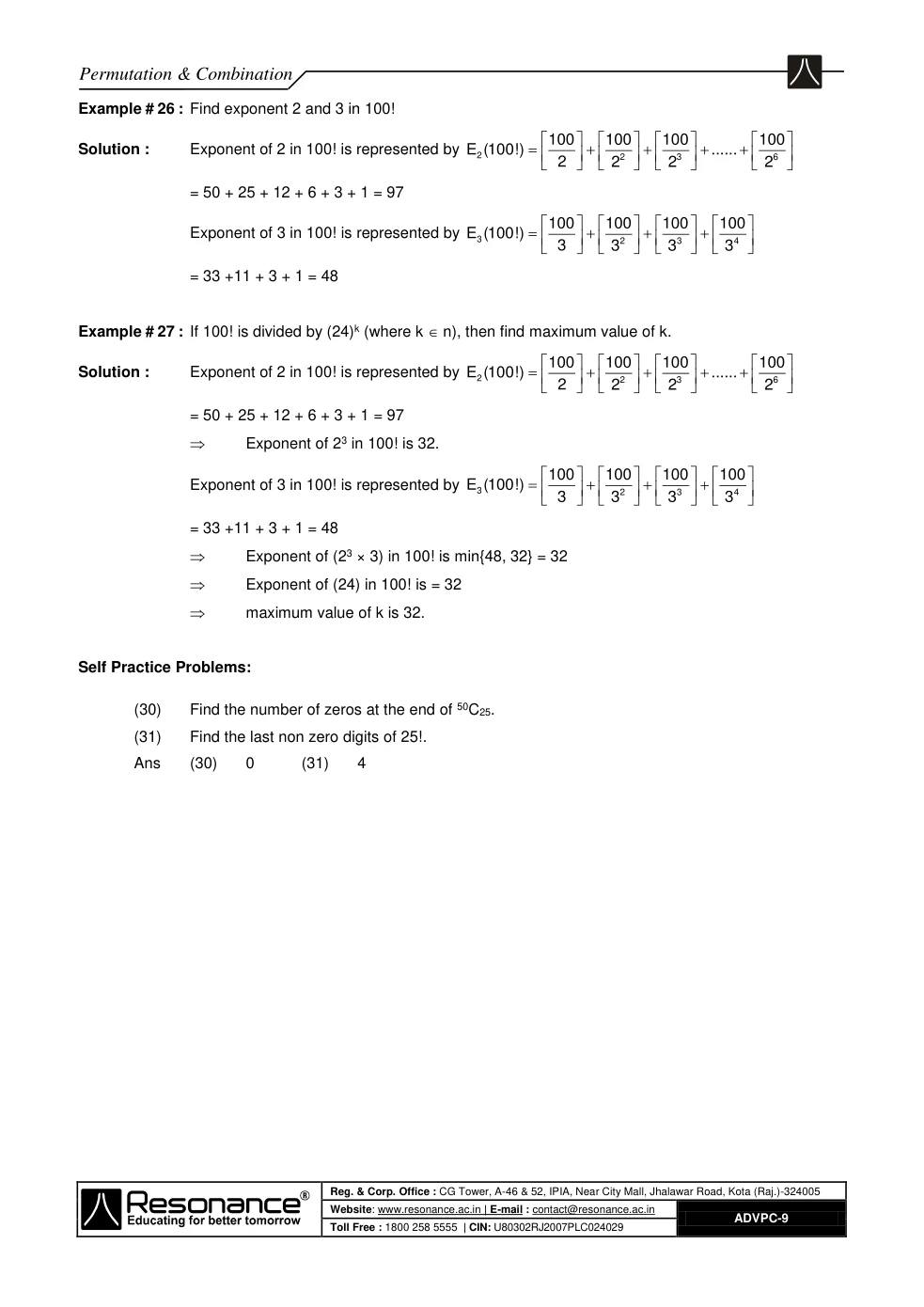
MAASPermutation & Combination
© MAAS. All rights reserved.Page 11 / 33
Extracted text · page 11
Permutation & Combination
Example # 26 : Find exponent 2 and 3 in 100!
100 100 100 100
Solution : Exponent of 2 in 100! is represented by E 2 (100!) 2 3 ...... 6 2 2 2 2
= 50 + 25 + 12 + 6 + 3 + 1 = 97
100 100 100 100
Exponent of 3 in 100! is represented by E3 (100!) 2 3 4 3 3 3 3
= 33 +11 + 3 + 1 = 48
Example # 27 : If 100! is divided by (24)k (where k n), then find maximum value of k.
100 100 100 100
Solution : Exponent of 2 in 100! is represented by E 2 (100!) 2 3 ...... 6 2 2 2 2
= 50 + 25 + 12 + 6 + 3 + 1 = 97
Exponent of 23 in 100! is 32.
100 100 100 100
Exponent of 3 in 100! is represented by E3 (100!) 2 3 4 3 3 3 3
= 33 +11 + 3 + 1 = 48
Exponent of (23 × 3) in 100! is min{48, 32} = 32
Exponent of (24) in 100! is = 32
maximum value of k is 32.
Self Practice Problems:
(30) Find the number of zeros at the end of 50C25.
(31) Find the last non zero digits of 25!.
Ans (30) 0 (31) 4
ADVPC-9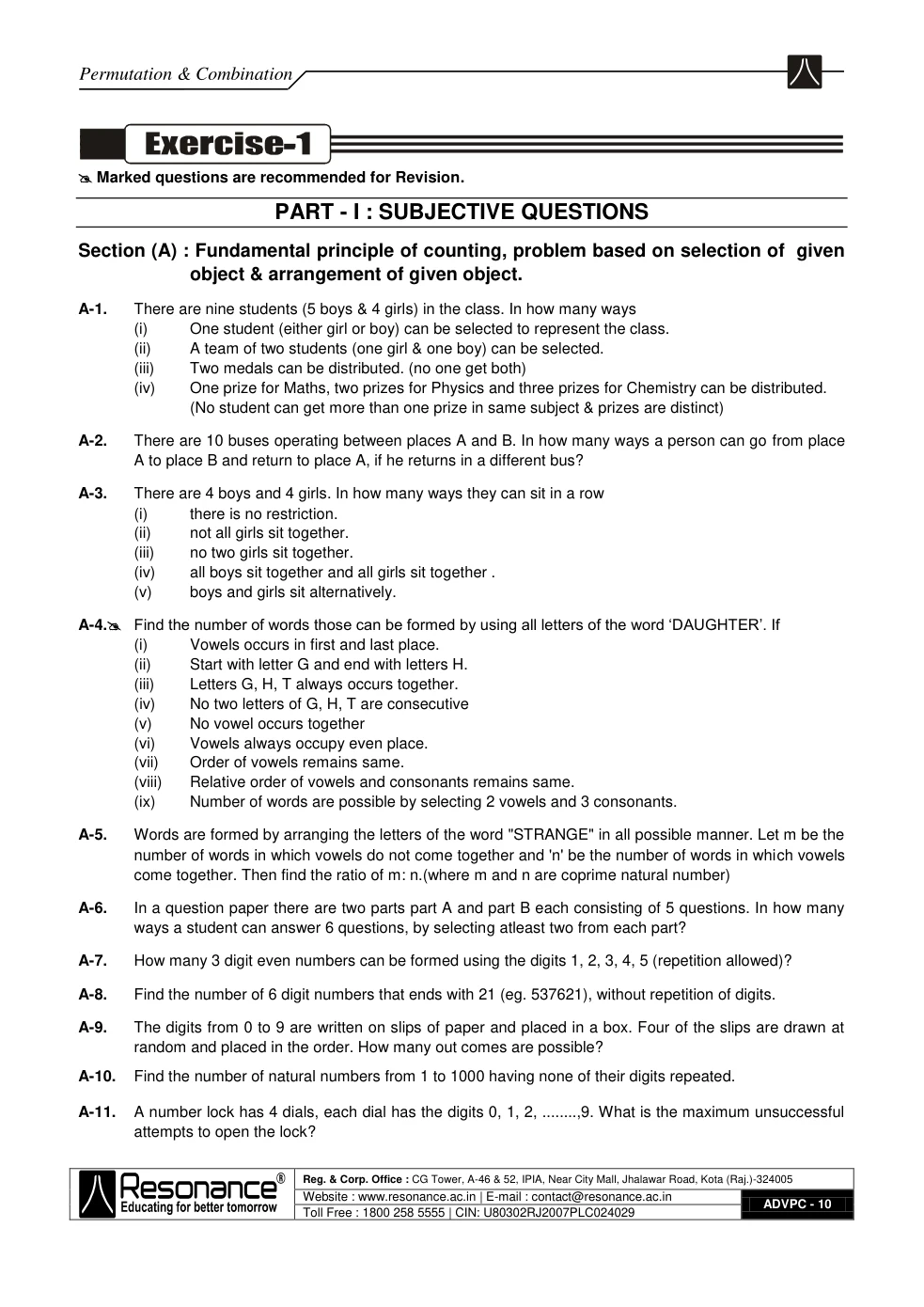
MAASPermutation & Combination
© MAAS. All rights reserved.Page 12 / 33
Extracted text · page 12
Permutation & Combination
Marked questions are recommended for Revision.
PART - I : SUBJECTIVE QUESTIONS
Section (A) : Fundamental principle of counting, problem based on selection of given
object & arrangement of given object.
A-1. There are nine students (5 boys & 4 girls) in the class. In how many ways
(i) One student (either girl or boy) can be selected to represent the class.
(ii) A team of two students (one girl & one boy) can be selected.
(iii) Two medals can be distributed. (no one get both)
(iv) One prize for Maths, two prizes for Physics and three prizes for Chemistry can be distributed.
(No student can get more than one prize in same subject & prizes are distinct)
A-2. There are 10 buses operating between places A and B. In how many ways a person can go from place
A to place B and return to place A, if he returns in a different bus?
A-3. There are 4 boys and 4 girls. In how many ways they can sit in a row
(i) there is no restriction.
(ii) not all girls sit together.
(iii) no two girls sit together.
(iv) all boys sit together and all girls sit together .
(v) boys and girls sit alternatively.
A-4. Find the number of words those can be formed by using all letters of the word ‘DAUGHTER’. If
(i) Vowels occurs in first and last place.
(ii) Start with letter G and end with letters H.
(iii) Letters G, H, T always occurs together.
(iv) No two letters of G, H, T are consecutive
(v) No vowel occurs together
(vi) Vowels always occupy even place.
(vii) Order of vowels remains same.
(viii) Relative order of vowels and consonants remains same.
(ix) Number of words are possible by selecting 2 vowels and 3 consonants.
A-5. Words are formed by arranging the letters of the word "STRANGE" in all possible manner. Let m be the
number of words in which vowels do not come together and 'n' be the number of words in which vowels
come together. Then find the ratio of m: n.(where m and n are coprime natural number)
A-6. In a question paper there are two parts part A and part B each consisting of 5 questions. In how many
ways a student can answer 6 questions, by selecting atleast two from each part?
A-7. How many 3 digit even numbers can be formed using the digits 1, 2, 3, 4, 5 (repetition allowed)?
A-8. Find the number of 6 digit numbers that ends with 21 (eg. 537621), without repetition of digits.
A-9. The digits from 0 to 9 are written on slips of paper and placed in a box. Four of the slips are drawn at
random and placed in the order. How many out comes are possible?
A-10. Find the number of natural numbers from 1 to 1000 having none of their digits repeated.
A-11. A number lock has 4 dials, each dial has the digits 0, 1, 2, ........,9. What is the maximum unsuccessful
attempts to open the lock?
ADVPC - 10
MAASPermutation & Combination
© MAAS. All rights reserved.Page 13 / 33
Extracted text · page 13
Permutation & Combination
A-12. In how many ways we can select a committee of 6 persons from 6 boys and 3 girls, if atleast two boys
& atleast two girls must be there in the committee ?
A-13. In how many ways 11 players can be selected from 15 players, if only 6 of these players can bowl and
the 11 players must include atleast 4 bowlers?
A-14. A committee of 6 is to be chosen from 10 persons with the condition that if a particular person 'A' is
chosen, then another particular person B must be chosen.
A-15. In how many ways we can select 5 cards from a deck of 52 cards, if each selection must include atleast
one king.
A-16. How many four digit natural numbers not exceeding the number 4321 can be formed using the digits 1,
2, 3, 4, if repetition is allowed ?
A-17. How many different permutations are possible using all the letters of the word MISSISSIPPI, if no two
's are together?
A-18. If A = {1, 2, 3, 4 .....n} and B A ; C A, then the find number of ways of selecting
(i) Sets B and C
(ii) Order pair of B and C such that B C =
(iii) Unordered pair of B and C such that B C =
(iv) Ordered pair of B and C such that B C = A and B C =
(v) Unordered pair of B and C such that B C = A, B C =
(vi) Ordered pair of B and C such that B C is singleton
A-19. For a set of six true or false statements, no student in a class has written all correct answers and no
two students in the class have written the same sequence of answers. What is the maximum number of
students in the class, for this to be possible.
A-20. How many arithmetic progressions with 10 terms are there, whose first term is in the set {1, 2, 3, 4}
and whose common difference is in the set {3, 4, 5, 6, 7} ?
A-21. Find the number of all five digit numbers which have atleast one digit repeated.
A-22. There are 3 white, 4 blue and 1 red flowers. All of them are taken out one by one and arranged in a row
in the order. How many different arrangements are possible (flowers of same colurs are similar)?
Section (B) : Grouping and Circular Permutation
B-1. In how many ways 18 different objects can be divided into 7groups such that four groups contains
3 objects each and three groups contains 2 objects each.
B-2. In how many ways fifteen different items may be given to A, B, C such that A gets 3, B gets 5 and
remaining goes to C.
B-3. Find number of ways of distributing 8 different items equally among two children.
B-4. (a) In how many ways can five people be divided into three groups?
(b) In how many ways can five people be distributed in three different rooms if no room must be
empty?
(c) In how many ways can five people be arranged in three different rooms if no room must be
empty and each room has 5 seats in a single row.
200!
B-5. Prove that : is an integer
(10!)20 19!
ADVPC - 11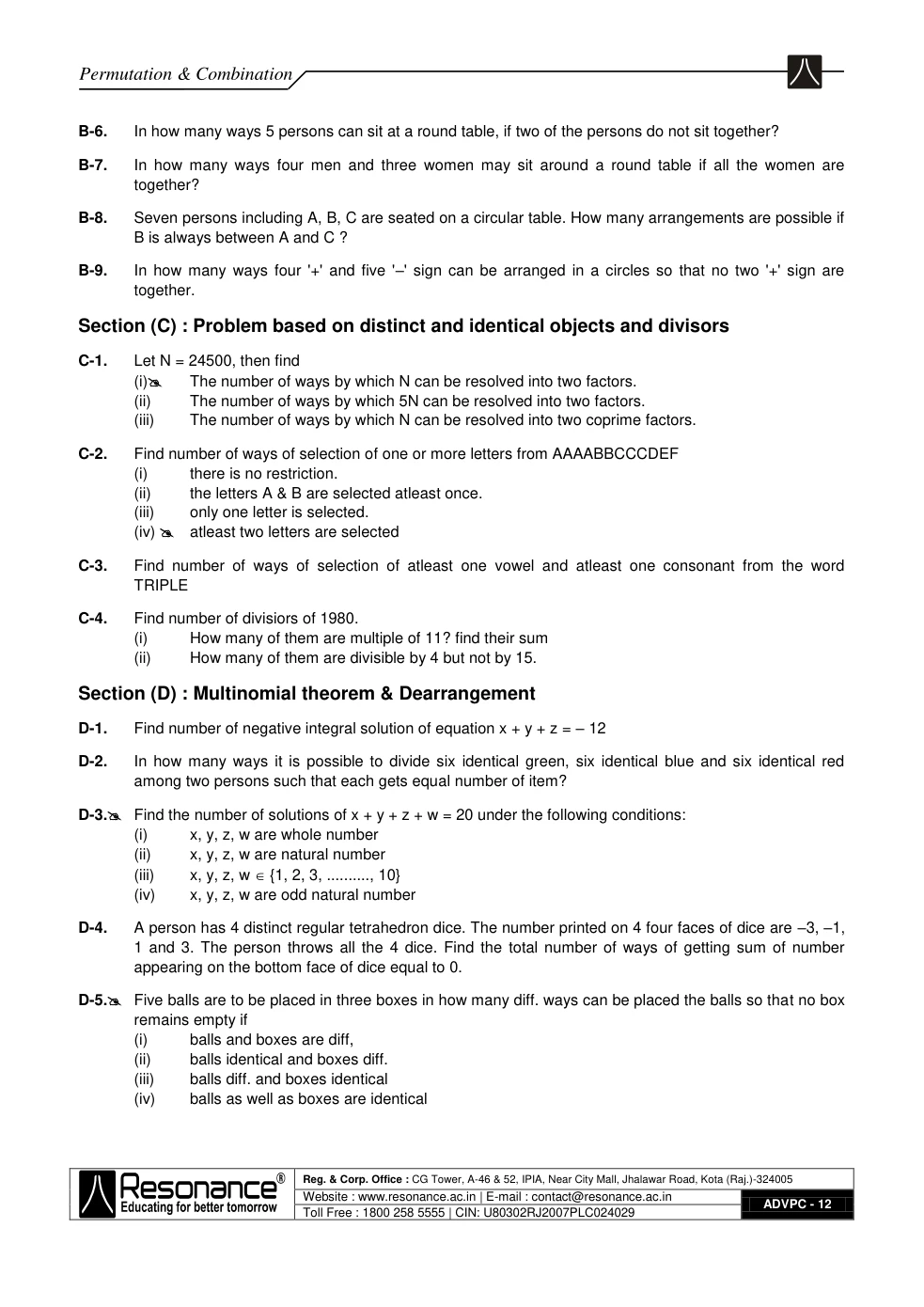
MAASPermutation & Combination
© MAAS. All rights reserved.Page 14 / 33
Extracted text · page 14
Permutation & Combination
B-6. In how many ways 5 persons can sit at a round table, if two of the persons do not sit together?
B-7. In how many ways four men and three women may sit around a round table if all the women are
together?
B-8. Seven persons including A, B, C are seated on a circular table. How many arrangements are possible if
B is always between A and C ?
B-9. In how many ways four '+' and five '–' sign can be arranged in a circles so that no two '+' sign are
together.
Section (C) : Problem based on distinct and identical objects and divisors
C-1. Let N = 24500, then find
(i) The number of ways by which N can be resolved into two factors.
(ii) The number of ways by which 5N can be resolved into two factors.
(iii) The number of ways by which N can be resolved into two coprime factors.
C-2. Find number of ways of selection of one or more letters from AAAABBCCCDEF
(i) there is no restriction.
(ii) the letters A & B are selected atleast once.
(iii) only one letter is selected.
(iv) atleast two letters are selected
C-3. Find number of ways of selection of atleast one vowel and atleast one consonant from the word
TRIPLE
C-4. Find number of divisiors of 1980.
(i) How many of them are multiple of 11? find their sum
(ii) How many of them are divisible by 4 but not by 15.
Section (D) : Multinomial theorem & Dearrangement
D-1. Find number of negative integral solution of equation x + y + z = – 12
D-2. In how many ways it is possible to divide six identical green, six identical blue and six identical red
among two persons such that each gets equal number of item?
D-3. Find the number of solutions of x + y + z + w = 20 under the following conditions:
(i) x, y, z, w are whole number
(ii) x, y, z, w are natural number
(iii) x, y, z, w {1, 2, 3, .........., 10}
(iv) x, y, z, w are odd natural number
D-4. A person has 4 distinct regular tetrahedron dice. The number printed on 4 four faces of dice are –3, –1,
1 and 3. The person throws all the 4 dice. Find the total number of ways of getting sum of number
appearing on the bottom face of dice equal to 0.
D-5. Five balls are to be placed in three boxes in how many diff. ways can be placed the balls so that no box
remains empty if
(i) balls and boxes are diff,
(ii) balls identical and boxes diff.
(iii) balls diff. and boxes identical
(iv) balls as well as boxes are identical
ADVPC - 12
MAASPermutation & Combination
© MAAS. All rights reserved.Page 15 / 33
Extracted text · page 15
Permutation & Combination
b
D-6. Let Dn represents derangement of 'n' objects. If Dn+2 = a Dn+1 + b Dn n N, then find
a
D-7. A person writes letters to five friends and addresses on the corresponding envelopes. In how many
ways can the letters be placed in the envelopes so that
(a) all letters are in the wrong envelopes?
(b) at least three of them are in the wrong envelopes?
Section (E) : Miscellaneous
E-1. (i) Find exponent of 3 in 20 !
(ii) Find number of zeros at the end of 45!.
E-2. Find the total number of ways of selecting two number from the set of first 100 natural number such that
difference of their square is divisible by 3
E-3. A four digit number plate of car is said to be lucky if sum of first two digit is equal to sum of last two
digit. Then find the total number of such lucky plate. (Assume 0000, 0011, 0111, ......... all are four digit
number)
E-4. Let each side of smallest square of chess board is one unit in length.
(i) Find the total number of squares of side length equal to 3 and whose side parallel to side of
chess board.
(ii) Find the sum of area of all possible squares whose side parallel to side of chess board.
(iii) Find the total number of rectangles (including squares) whose side parallel to side of chess
board.
E-5. A person is to walk from A to B. However, he is restricted to walk only to the right of A or upwards of A.
but not necessarily in the order shown in the figure. Then find the number of paths from A to B.
B
A
PART - II : ONLY ONE OPTION CORRECT TYPE
Section (A) : Fundamental principle of counting, problem based on selection of given
object & arrangement of given object, rank of word
A-1. The number of signals that can be made with 3 flags each of different colour by hoisting 1 or 2 or 3
above the other, is:
(A) 3 (B) 7 (C) 15 (D) 16
A-2. 8 chairs are numbered from 1 to 8. Two women & 3 men wish to occupy one chair each. First the
women choose the chairs from amongst the chairs marked 1 to 4, then the men select the chairs from
among the remaining. The number of possible arrangements is:
(A) 6C3. 4C4 (B) P2. 4P3 (C) 4C3. 4P3 (D) 4P2. 6P3
A-3. Number of words that can be made with the letters of the word "GENIUS" if each word neither begins
with G nor ends in S, is:
(A) 24 (B) 240 (C) 480 (D) 504
ADVPC - 13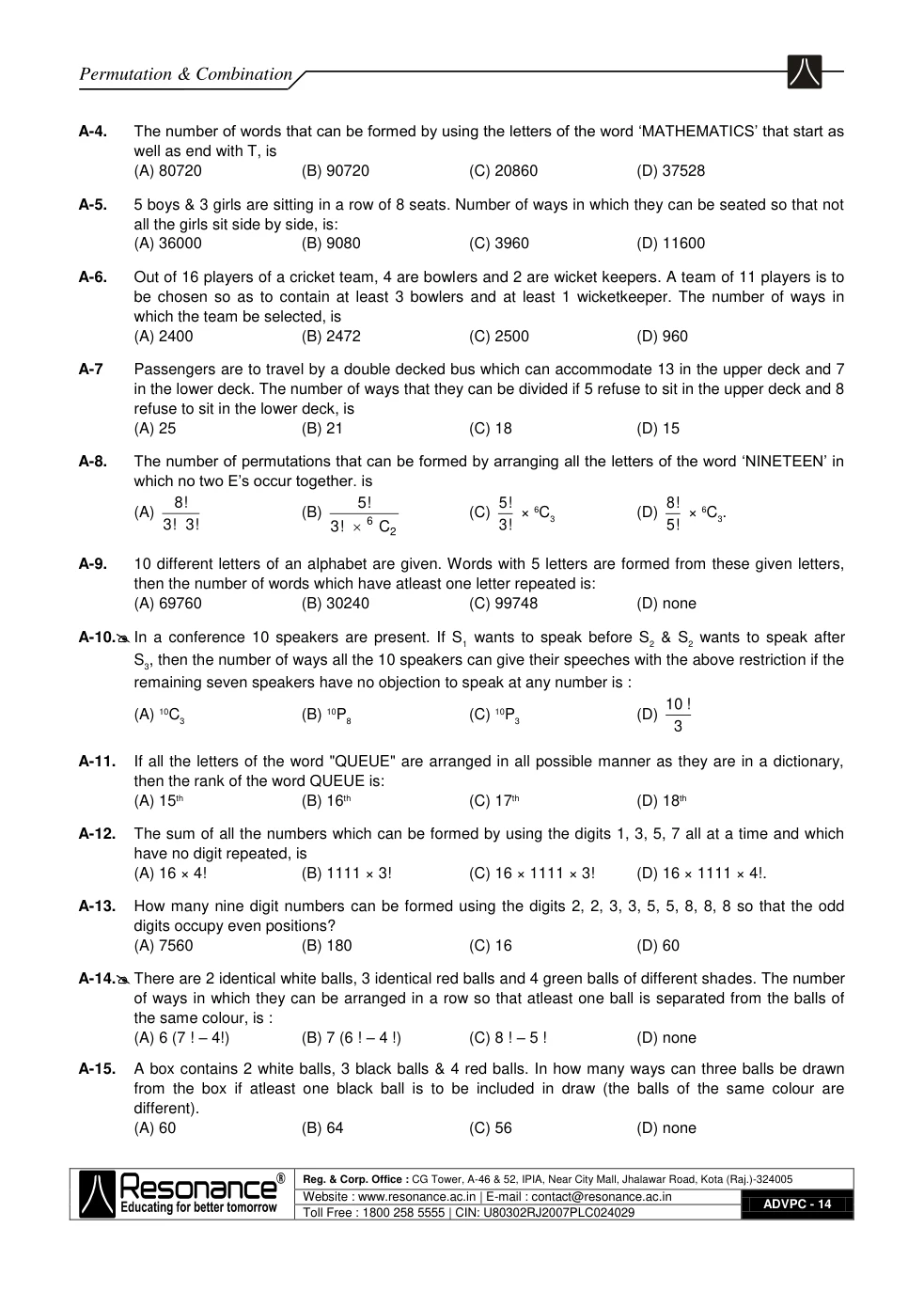
MAASPermutation & Combination
© MAAS. All rights reserved.Page 16 / 33
Extracted text · page 16
Permutation & Combination
A-4. The number of words that can be formed by using the letters of the word ‘MATHEMATICS’ that start as
well as end with T, is
(A) 80720 (B) 90720 (C) 20860 (D) 37528
A-5. 5 boys & 3 girls are sitting in a row of 8 seats. Number of ways in which they can be seated so that not
all the girls sit side by side, is:
(A) 36000 (B) 9080 (C) 3960 (D) 11600
A-6. Out of 16 players of a cricket team, 4 are bowlers and 2 are wicket keepers. A team of 11 players is to
be chosen so as to contain at least 3 bowlers and at least 1 wicketkeeper. The number of ways in
which the team be selected, is
(A) 2400 (B) 2472 (C) 2500 (D) 960
A-7 Passengers are to travel by a double decked bus which can accommodate 13 in the upper deck and 7
in the lower deck. The number of ways that they can be divided if 5 refuse to sit in the upper deck and 8
refuse to sit in the lower deck, is
(A) 25 (B) 21 (C) 18 (D) 15
A-8. The number of permutations that can be formed by arranging all the letters of the word ‘NINETEEN’ in
which no two E’s occur together. is
8! 5! 5! 8!
(A) (B) (C) × 6C3 (D) × 6C3. 6 3! 3! 3! C2 3! 5!
A-9. 10 different letters of an alphabet are given. Words with 5 letters are formed from these given letters,
then the number of words which have atleast one letter repeated is:
(A) 69760 (B) 30240 (C) 99748 (D) none
A-10. In a conference 10 speakers are present. If S1 wants to speak before S2 & S2 wants to speak after
S3, then the number of ways all the 10 speakers can give their speeches with the above restriction if the
remaining seven speakers have no objection to speak at any number is :
10 !
(A) 10C3 (B) 10P8 (C) 10P3 (D)
3
A-11. If all the letters of the word "QUEUE" are arranged in all possible manner as they are in a dictionary,
then the rank of the word QUEUE is:
(A) 15th (B) 16th (C) 17th (D) 18th
A-12. The sum of all the numbers which can be formed by using the digits 1, 3, 5, 7 all at a time and which
have no digit repeated, is
(A) 16 × 4! (B) 1111 × 3! (C) 16 × 1111 × 3! (D) 16 × 1111 × 4!.
A-13. How many nine digit numbers can be formed using the digits 2, 2, 3, 3, 5, 5, 8, 8, 8 so that the odd
digits occupy even positions?
(A) 7560 (B) 180 (C) 16 (D) 60
A-14. There are 2 identical white balls, 3 identical red balls and 4 green balls of different shades. The number
of ways in which they can be arranged in a row so that atleast one ball is separated from the balls of
the same colour, is :
(A) 6 (7 ! – 4!) (B) 7 (6 ! – 4 !) (C) 8 ! – 5 ! (D) none
A-15. A box contains 2 white balls, 3 black balls & 4 red balls. In how many ways can three balls be drawn
from the box if atleast one black ball is to be included in draw (the balls of the same colour are
different).
(A) 60 (B) 64 (C) 56 (D) none
ADVPC - 14
MAASPermutation & Combination
© MAAS. All rights reserved.Page 17 / 33
Extracted text · page 17
Permutation & Combination
A-16. Eight cards bearing number 1, 2, 3, 4, 5, 6, 7, 8 are well shuffled. Then in how many cases the top 2
cards will form a pair of twin prime equals
(A) 720 (B) 1440 (C) 2880 (D) 2160
A-17. Number of natural number upto one lakh, which contains 1,2,3, exactly once and remaining digits any
time is -
(A) 2940 (B) 2850 (C) 2775 (D) 2680
A-18. The sum of all the four digit numbers which can be formed using the digits 6,7,8,9 (repetition is allowed)
(A) 2133120 (B) 2133140 (C) 2133150 (D) 2133122
A-19. If the different permutations of the word ‘EXAMINATION’ are listed as in a dictionary, then how many
words (with or without meaning) are there in this list before the first word starting with M.
(A) 2268000 (B) 870200 (C) 807400 (D) 839440
A-20. The number of ways in which a mixed double tennis game can be arranged from amongst 9 married
couple if no husband & wife plays in the same game is:
(A) 756 (B) 3024 (C) 1512 (D) 6048
Section (B) : Grouping and circular Permutation
B-1. Number of ways in which 9 different toys be distributed among 4 children belonging to different age
groups in such a way that distribution among the 3 elder children is even and the youngest one is to
receive one toy more, is:
5 ! 2 9 ! 9 !
(A) (B) (C) (D) none
8 2 3 ! 2 ! 3
B-2. In an eleven storeyed building (Ground floor + ten floor), 9 people enter a lift cabin from ground floor. It
is know that they will leave the lift in groups of 2, 3 and 4 at different residential storeys. Find the
number of ways in which they can get down.
9 9! 8 9! 2 10! 10!
(A) (B) (C) (D)
4 4 9 4
B-3. The number of ways in which 8 different flowers can be strung to form a garland so that 4 particulars
flowers are never separated, is:
8 !
(A) 4 !. 4 ! (B) (C) 288 (D) none
4 !
B-4. The number of ways in which 6 red roses and 3 white roses (all roses different) can form a garland so
that all the white roses come together, is
(A) 2170 (B) 2165 (C) 2160 (D) 2155
B-5. The number of ways in which 4 boys & 4 girls can stand in a circle so that each boy and each girl is one
after the other, is:
(A) 3!. 4! (B) 4!. 4! (C) 8! (D) 7!
B-6. The number of ways in which 5 beads, chosen from 8 different beads be threaded on to a ring, is:
(A) 672 (B) 1344 (C) 336 (D) none
B-7. Number of ways in which 2 Indians, 3 Americans, 3 Italians and 4 Frenchmen can be seated on a
circle, if the people of the same nationality sit together, is:
(A) 2. (4 !)2 (3 !)2 (B) 2. (3 !)3. 4 ! (C) 2. (3 !) (4 !)3 (D) 2. (3 !)2 (4 !)3
ADVPC - 15
MAASPermutation & Combination
© MAAS. All rights reserved.Page 18 / 33
Extracted text · page 18
Permutation & Combination
Section (C) : Problem based on distinct and identical objects and divisors
C-1. The number of proper divisors of apbqcrds where a, b, c, d are primes & p, q, r, s N, is
(A) p q r s (B) (p + 1) (q + 1) (r + 1) (s + 1) 4
(C) p q r s 2 (D) (p + 1) (q + 1) (r + 1) (s + 1) 1
C-2. N is a least natural number having 24 divisors. Then the number of ways N can be resolved into two
factors is
(A) 12 (B) 24 (C) 6 (D) None of these
C-3. How many divisors of 21600 are divisible by 10 but not by 15?
(A) 10 (B) 30 (C) 40 (D) none
C-4. The number of ways in which the number 27720 can be split into two factors which are co-primes, is:
(A) 15 (B) 16 (C) 25 (D) 49
C-5. The number of words of 5 letters that can be made with the letters of the word
(A) 6890 (B) 7000 (C) 6800 (D) 6900
C-6. Let fruits of same kind are identical then how many ways can atleast 2 fruit be selected out of 5
Mangoes, 4 Apples, 3 Bananas and three different fruits.
(A) 959 (B) 953 (C) 960 (D) 954
Section (D) : Multinomial theorem and Dearrangement
D-1. The number of ways in which 10 identical apples can be distributed among 6 children so that each child
receives atleast one apple is :
(A) 126 (B) 252 (C) 378 (D) none of these
D-2. Number of ways in which 3 persons throw a normal die to have a total score of 11, is
(A) 27 (B) 25 (C) 29 (D) 18
D-3. If chocolates of a particular brand are all identical then the number of ways in which we can choose
6 chocolates out of 8 different brands available in the market, is:.
(A) 13C6 (B) 13C8 (C) 86 (D) none
D-4. Number of positive integral solutions of x1 . x2 . x3 = 30, is
(A) 25 (B) 26 (C) 27 (D) 28
D-5. There are six letters L1, L2 , L3, L4, L5, L6 and their corresponding six envelopes E1, E2, E3,
E4, E5, E6. Letters having odd value can be put into odd value envelopes and even value
letters can be put into even value envelopes, so that no letter go into the right envelopes, then
number of arrangement equals.
(A) 6 (B) 9 (C) 44 (D) 4
D-6. Seven cards and seven envelopes are numbered 1, 2, 3, 4, 5, 6, 7 and cards are to be placed in
envelopes so that each envelope contains exactly one card and no card is placed in the envelope
bearing the same number and moreover the card number 1 is always placed in envelope number 2 and
2 is always placed in envelope numbered 3, then the number of ways it can be done is
(A) 53 (B) 44 (C) 9 (D) 62
Section (E) : Miscellaneous
E-1. The number of ways of choosing triplets (x, y, z) such that z max {x, y} and
x, y, z {1, 2, 3 ......, n} is
n n(n 1)2 2 (A) t (B) n+1C3 – n+2C3 (C) 2 (n+2C3) + n+1C2 (D) 2 t 1
ADVPC - 16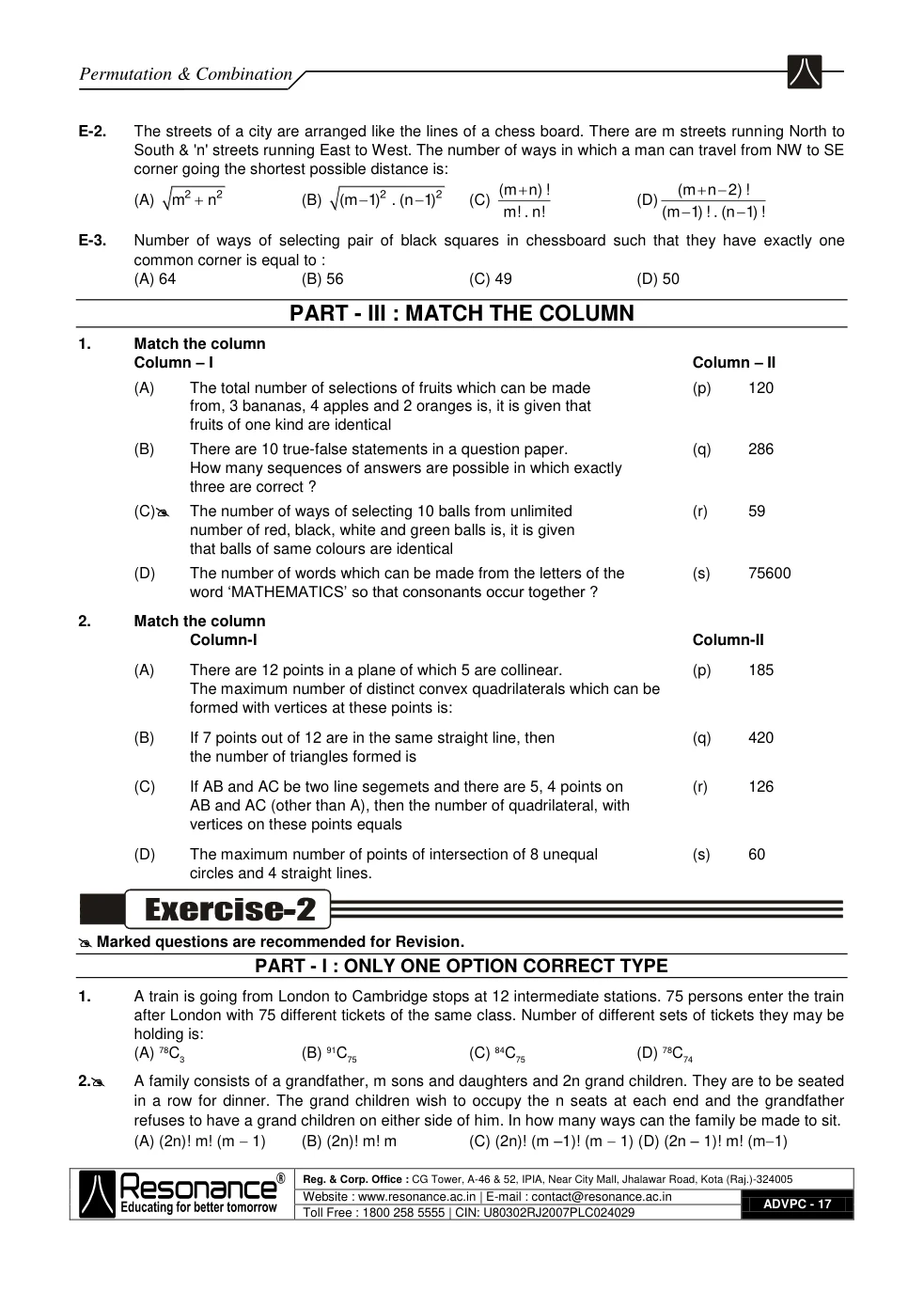
MAASPermutation & Combination
© MAAS. All rights reserved.Page 19 / 33
Extracted text · page 19
Permutation & Combination
E-2. The streets of a city are arranged like the lines of a chess board. There are m streets running North to
South & 'n' streets running East to West. The number of ways in which a man can travel from NW to SE
corner going the shortest possible distance is:
2 2 2 2 (m n) ! (m n 2) ! (A) m n (B) (m 1) . (n 1) (C) (D)
m! . n! (m 1) ! . (n 1) !
E-3. Number of ways of selecting pair of black squares in chessboard such that they have exactly one
common corner is equal to :
(A) 64 (B) 56 (C) 49 (D) 50
PART - III : MATCH THE COLUMN
1. Match the column
Column – I Column – II
(A) The total number of selections of fruits which can be made (p) 120
from, 3 bananas, 4 apples and 2 oranges is, it is given that
fruits of one kind are identical
(B) There are 10 true-false statements in a question paper. (q) 286
How many sequences of answers are possible in which exactly
three are correct ?
(C) The number of ways of selecting 10 balls from unlimited (r) 59
number of red, black, white and green balls is, it is given
that balls of same colours are identical
(D) The number of words which can be made from the letters of the (s) 75600
word ‘MATHEMATICS’ so that consonants occur together ?
2. Match the column
Column-I Column-II
(A) There are 12 points in a plane of which 5 are collinear. (p) 185
The maximum number of distinct convex quadrilaterals which can be
formed with vertices at these points is:
(B) If 7 points out of 12 are in the same straight line, then (q) 420
the number of triangles formed is
(C) If AB and AC be two line segemets and there are 5, 4 points on (r) 126
AB and AC (other than A), then the number of quadrilateral, with
vertices on these points equals
(D) The maximum number of points of intersection of 8 unequal (s) 60
circles and 4 straight lines.
Marked questions are recommended for Revision.
PART - I : ONLY ONE OPTION CORRECT TYPE
1. A train is going from London to Cambridge stops at 12 intermediate stations. 75 persons enter the train
after London with 75 different tickets of the same class. Number of different sets of tickets they may be
holding is:
(A) 78C3 (B) 91C75 (C) 84C75 (D) 78C74
2. A family consists of a grandfather, m sons and daughters and 2n grand children. They are to be seated
in a row for dinner. The grand children wish to occupy the n seats at each end and the grandfather
refuses to have a grand children on either side of him. In how many ways can the family be made to sit.
(A) (2n)! m! (m 1) (B) (2n)! m! m (C) (2n)! (m –1)! (m 1) (D) (2n – 1)! m! (m1)
ADVPC - 17
MAASPermutation & Combination
© MAAS. All rights reserved.Page 20 / 33
Extracted text · page 20
Permutation & Combination
3. A bouquet from 11 different flowers is to be made so that it contains not less than three flowers. Then
then number of different ways of selecting flowers to form the bouquet.
(A) 1972 (B) 1952 (C) 1981 (D) 1947
4. If = x1 x2 x3 and = y1 y2 y3 be two three digit numbers, then the number of pairs of and that can
be formed so that can be subtracted from without borrowing.
(A) 55 . (45)2 (B) 45 . (55)2 (C) 36 . (45)2 (D) 553
5. 'n' digits positive integers formed such that each digit is 1, 2, or 3. How many of these contain all three
of the digits 1, 2 and 3 atleast once ?
(A) 3(n –1) (B) 3n – 2.2n + 3 (C) 3n – 3.2n – 3 (D) 3n – 3.2n + 3
6. There are ' n ' straight line in a plane, no two of which are parallel and no three pass through the same
point. Their points of intersection are joined. Then the maximum number of fresh lines thus introduced
is
1 (A) n (n 1)2 (n 3) (B) 1 n (n 1) (n 2) (n 3)
12 8
1 (C) n (n 1) (n 2) (n 3) (D) 1 n (n 1) (n 2) (n 3)
8 8
7. X = {1, 2, 3, 4, ...... 2017} and A X ; B X ; A B X here P Q denotes that P is subset of Q(P
Q). Then number of ways of selecting unordered pair of sets A and B such that A B X.
(4 2017 3 2017 ) (22017 1) (4 2017 3 2017 )
(A) (B)
2 2
4 2017 3 2017 22017
(C) (D) None of these
2
8. The number of ways in which 15 identical apples & 10 identical oranges can be distributed among three
persons, each receiving none, one or more is:
(A) 5670 (B) 7200 (C) 8976 (D) 7296
9. Two variants of a test paper are distributed among 12 students. Number of ways of seating of the
students in two rows so that the students sitting side by side do not have identical papers & those
sitting in the same column have the same paper is:
12! (12)!
(A) (B) (C) (6!)2. 2 (D) 12! × 2
6! 6! 25 . 6!
10. How many ways are there to invite one of three friends for dinner on 6 successive nights such that no
friend is invited more than three times ?
6 6! 6! 6! 6 6! 6! 6!
(A) + 3 + (B) + 6 +
1!2!3! 3!3! 2!2!2! 1!2!3! 3!3! 2!2!2!
6 6! 6! 6! 3 6! 6! 6!
(C) + + (D) + 3 +
1!2!3! 3!3! 2!2!2! 1!2!3! 3!3! 2!2!2!
11. If n identical dice are rolled, then number of possible out comes are.
6 n (n 5)
(A) 6n (B) (C) c 5 (D) None of these
n!
12. Number of ways in which a pack of 52 playing cards be distributed equally among four players so that
each have the Ace, King, Queen and Jack of the same suit, is
36 ! . 4 ! 36 ! 52 ! . 4 ! 52 !
(A) (B) (C) (D)
9 ! 4 9 ! 4 13 ! 4 13 ! 4
ADVPC - 18
MAASPermutation & Combination
© MAAS. All rights reserved.Page 21 / 33
Extracted text · page 21
Permutation & Combination
13. Find total number of positive integral solutions of 15 < x1 + x2 + x3 20.
(A) 685 (B) 1140 (C) 455 (D) 1595
14. Seven person P1, P2, ........., P7 initially seated at chairs C1, C2 ........ ,C7 respectively. They all left their
chairs symultaneously for hand wash. Now in how many ways they can again take seats such that no
one sits on his own seat and P1 sits on C2 and P2 sits on C3 ?
(A) 52 (B) 53 (C) 54 (D) 55
15. Given six line segments of length 2, 3, 4, 5, 6, 7 units, the number of triangles that can be formed by
these segments is
(A) 6C3 – 7 (B) 6C3 – 6 (C) 6C3 – 5 (D) 6C3 – 4
16. There are m apples and n oranges to be placed in a line such that the two extreme fruits being both
oranges. Let P denotes the number of arrangements if the fruits of the same species are different and
Q the corresponding figure when the fruits of the same species are alike, then the ratio P/Q has the
value equal to :
(A) nP2. mPm. (n 2) ! (B) mP2. nPn. (n 2) ! (C) nP2. nPn. (m 2) ! (D) none
17. The number of intersection points of diagonals of 2009 sides regular polygon, which lie inside the
polygon.
(A) 2009C4 (B) 2009C2 (C) 2008C4 (D) 2008C2
18. A rectangle with sides 2m – 1 and 2n – 1 is divided into squares of unit length by drawing parallel lines
as shown in the diagram, then the number of rectangles possible with odd side lengths is
(A) (m + n – 1)2 (B) 4m+n–1 (C) m2 n2 (D) m(m + 1)n(n + 1)
m
19. Find the number of all rational number such that
n
m
(i) 0 < < 1, (ii) m and n are relatively prime (iii) m n = 25!
n
(A) 256 (B) 128 (C) 512 (D) None of these
PART-II: NUMERICAL VALUE QUESTIONS
INSTRUCTION :
The answer to each question is NUMERICAL VALUE with two digit integer and decimal upto two digit.
If the numerical value has more than two decimal places truncate/round-off the value to TWO decimal
placed.
1. Number of five digits numbers divisible by 3 and divisible by 4 that can be formed using the digits 0, 1,
M
2, 3, 4, 7 and 8 if, each digit is to be used atmost one is M and N are respectively then value of is
N
2. The sides AB, BC & CA of a triangle ABC have 3, 4 & 5 interior points respectively on them. If the
number of triangles that can be constructed using these interior points as vertices is k and number of
k
lines segments including sides of triangle is p then is
p
ADVPC - 19
MAASPermutation & Combination
© MAAS. All rights reserved.Page 22 / 33
Extracted text · page 22
Permutation & Combination
3. Shubham has to make a telephone call to his friend Nisheeth, Unfortunately he does not remember the
7 digit phone number. But he remembers that the first three digits are 635 or 674, the number is odd
and there is exactly one 9 in the number. The maximum number of trials that Shubham has to make to
N
be successful is N then is equal to
100
4. Seven different coins are to be divided amongst three persons. If no two of the persons receive the
same number of coins but each receives atleast one coin & none is left over, then the number of ways
in which the division may be made is k, then number of ways in which k can be resolve as a product of
two coprime number is
5. Number of ways in which five vowels of English alphabets and ten decimal digits can be placed
in a row such that between any two vowels odd number of digits are placed and both end
places are occupied by vowels is 20(b!)(5!) then b equals to
6. The number of integers which lie between 1 and 106 have the sum of the digits equal to 12 is A and
A
number of such 6 digit integer which have the sum of the digits equal to 12 is B then =
B
7. The number of ways in which 8 non-identical apples can be distributed among 3 boys such that every
N
boy should get atleast 1 apple & atmost 4 apples is N then is equal to
100
8. In a hockey series between team X and Y, they decide to play till a team wins ‘10’ match. If N is number
of ways in which team X wins and if M is number of ways in which team X win while first match is win by
N
team X then =
M
9. Three ladies have brought one chlid each for admission to a school. The principal wants to
interview the six persons one by one subject to the condition that no mother is interviewed
before her chlid. Then find the number of ways in which interviews can be arranged
10. In a shooting competition a man can score 0, 2 or 4 points for each shot. Then the number of different
ways in which he can score 14 points in 5 shots is
11. Six persons A, B, C, D, E and F are to be seated at a circular table. The number of ways this can be
done if A must have either B or C on his right and B must have either C or D on his right is
12. The number of permutations and combination which can be formed out of the letters of the word
a
"SERIES" taking three letters together is a & b respectively then find
b
13. A box contains 6 balls which may be all of different colours or three each of two colours or two each of
three different colours. The number of ways of selecting 3 balls from the box (if ball of same colour are
identical) is
14. Five friends F1, F2, F3, F4, F5 book five seats C1, C2 , C3 ,C4 , C5 respectively of movie KABIL
independently (i.e. F1 books C1, F2 books C2 and so on). In how many different ways can they sit on
these seats if no one wants to sit on his booked seat, more over F1 and F2 want to sit adjacent to each
other.
ADVPC - 20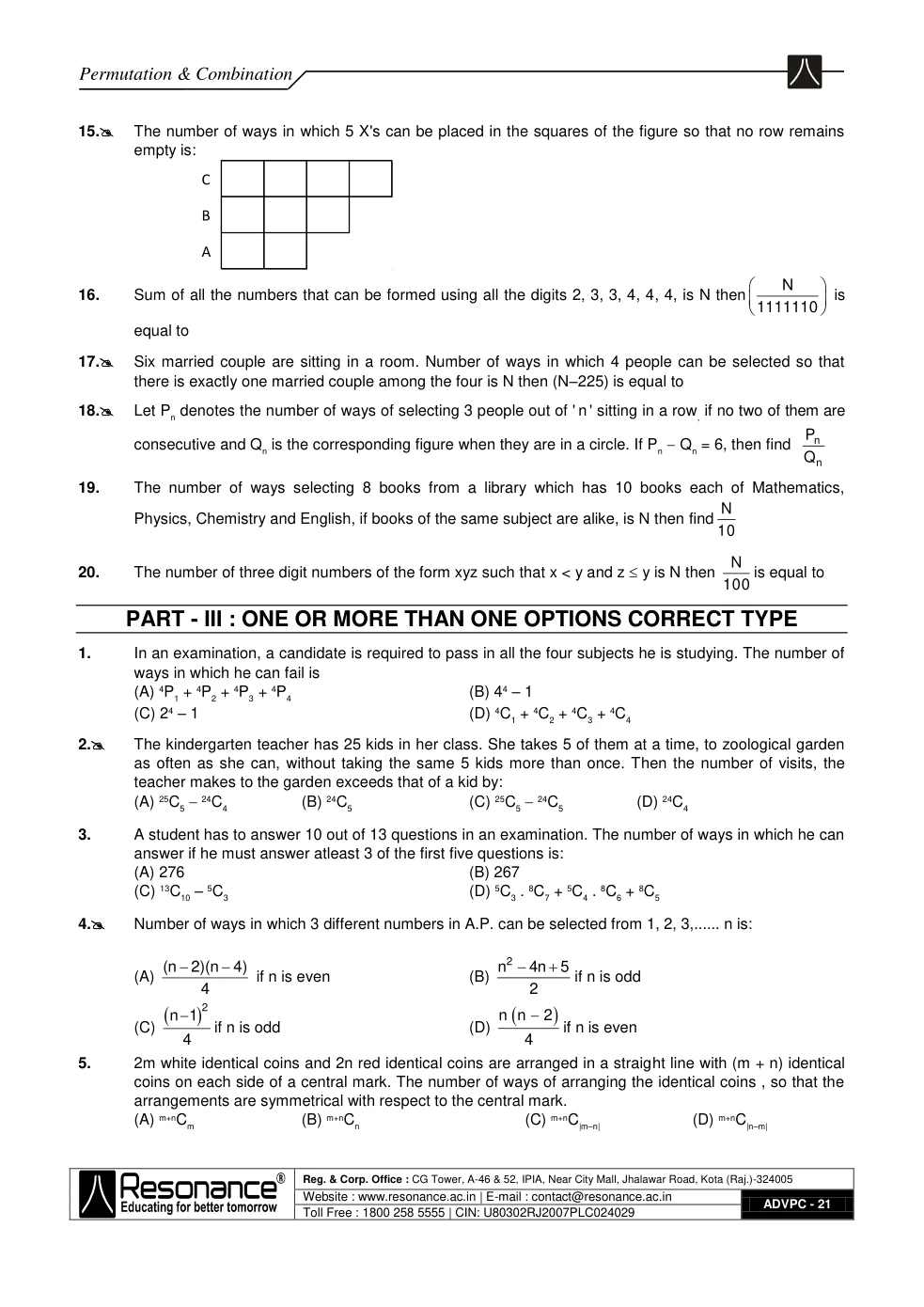
MAASPermutation & Combination
© MAAS. All rights reserved.Page 23 / 33
Extracted text · page 23
Permutation & Combination
15. The number of ways in which 5 X's can be placed in the squares of the figure so that no row remains
empty is:
C
B
A
N
16. Sum of all the numbers that can be formed using all the digits 2, 3, 3, 4, 4, 4, is N then is
1111110
equal to
17. Six married couple are sitting in a room. Number of ways in which 4 people can be selected so that
there is exactly one married couple among the four is N then (N–225) is equal to
18. Let Pn denotes the number of ways of selecting 3 people out of ' n ' sitting in a row, if no two of them are
Pn consecutive and Qn is the corresponding figure when they are in a circle. If Pn Qn = 6, then find
Q n
19. The number of ways selecting 8 books from a library which has 10 books each of Mathematics,
N
Physics, Chemistry and English, if books of the same subject are alike, is N then find
10
N
20. The number of three digit numbers of the form xyz such that x < y and z y is N then is equal to
100
PART - III : ONE OR MORE THAN ONE OPTIONS CORRECT TYPE
1. In an examination, a candidate is required to pass in all the four subjects he is studying. The number of
ways in which he can fail is
(A) 4P1 + 4P2 + 4P3 + 4P4 (B) 44 – 1
(C) 24 – 1 (D) 4C1 + 4C2 + 4C3 + 4C4
2. The kindergarten teacher has 25 kids in her class. She takes 5 of them at a time, to zoological garden
as often as she can, without taking the same 5 kids more than once. Then the number of visits, the
teacher makes to the garden exceeds that of a kid by:
(A) 25C5 24C4 (B) 24C5 (C) 25C5 24C5 (D) 24C4
3. A student has to answer 10 out of 13 questions in an examination. The number of ways in which he can
answer if he must answer atleast 3 of the first five questions is:
(A) 276 (B) 267
(C) 13C10 – 5C3 (D) 5C3 . 8C7 + 5C4 . 8C6 + 8C5
4. Number of ways in which 3 different numbers in A.P. can be selected from 1, 2, 3,...... n is:
(n 2)(n 4) n2 4n 5
(A) if n is even (B) if n is odd
4 2
n 1 2 n n 2
(C) if n is odd (D) if n is even
4 4
5. 2m white identical coins and 2n red identical coins are arranged in a straight line with (m + n) identical
coins on each side of a central mark. The number of ways of arranging the identical coins , so that the
arrangements are symmetrical with respect to the central mark.
(A) m+nCm (B) m+nCn (C) m+nC|m–n| (D) m+nC|n–m|
ADVPC - 21
MAASPermutation & Combination
© MAAS. All rights reserved.Page 24 / 33
Extracted text · page 24
Permutation & Combination
6. The number of ways in which 10 students can be divided into three teams, one containing 4 and others
3 each, is
10 ! 10 ! 1
(A) (B) 2100 (C) 10C4 . 5C3 (D) .
4 ! 3 ! 3 ! 6 ! 3 ! 3 ! 2
7. If all the letters of the word 'AGAIN' are arranged in all possible ways & put in dictionary order, then
(A) The 50th word is NAAIG (B) The 49th word is NAAGI
(C) The 51st word is NAGAI (D) The 47th word is INAGA
8. You are given 8 balls of different colour (black, white,...). The number of ways in which these balls can
be arranged in a row so that the two balls of particular colour (say red & white) may never come
together is:
(A) 8 ! 2.7 ! (B) 6. 7 ! (C) 2. 6 !. 7C2 (D) none
9. Consider the word 'MULTIPLE' then in how many other ways can the letters of the word 'MULTIPLE' be
arranged ;
(A) without changing the order of the vowels equals 3359
(B) keeping the position of each vowel fixed equals 59
(C) without changing the relative order/position of vowels & consonants is 359
(D) using all the letters equals 47! – 1
10. The number of ways of arranging the letters AAAAA, BBB, CCC, D, EE & F in a row if the letter C are
separated from one another is:
12! 13! 14! 13!
(A) 13C3. (B) (C) (D) 11.
5! 3! 2! 5 ! 3! 3 ! 2 ! 3 ! 3! 2 ! 6!
11. The number of non-negative integral solutions of x1 + x2 + x3 + x4 n (where n is a positive integer) is
(A) n+3C3 (B) n+4C4 (C) n+5C5 (D) n+4Cn
12. There are 10 seats in the first row of a theatre of which 4 are to be occupied. The number of ways of
arranging 4 persons so that no two persons sit side by side is:
(A) 7C4 (B) 4. 7P3 (C) 7C3. 4 ! (D) 840
13. 50C36 is divisible by
(A) 19 (B) 52 (C) 192 (D) 53
14. 2nPn is equal to
(A) (n + 1) ( n + 2) ..... (2n) (B) 2n [1 . 3 . 5 .....(2n – 1)]
(C) (2) . (6) . (10) .... (4n – 2) (D) n! (2nCn)
15. The number of ways in which 200 different things can be divided into groups of 100 pairs, is:
200 ! 101 102 103 200
(A) (B) .... 100 2 2 2 2 2
200 !
(C) (D) (1. 3. 5...... 199)
2100 (100) !
ADVPC - 22
MAASPermutation & Combination
© MAAS. All rights reserved.Page 25 / 33
Extracted text · page 25
Permutation & Combination
PART - IV : COMPREHENSION
Comprehension # 1
There are 8 official and 4 non-official members, out of these 12 members a committee of 5 members is
to be formed, then answer the following questions.
1. Number of committees consisting of at least two non-official members, are
(A) 456 (B) 546 (C) 654 (D) 466
2. Number of committees in which a particular official member is never included, are
(A) 264 (B) 642 (C) 266 (D) 462
Comprehenssion # 2
the following questions.
3. The value of n is
(A) 360 (B) 720 (C) 240 (D) 840
4. The value of m is
(A) 3780 (B) 3870 (C) 3670 (D) 3760
Comprehension # 3
A mega pizza is to be sliced n times, and Sn denotes maximum possible number of pieces.
5. Relation between Sn & Sn– 1
(A) Sn = Sn–1 + n + 3 (B) Sn = Sn–1 + n + 2 (C) Sn = Sn–1 + n + 2 (D) Sn = Sn–1 + n
6. If the mega pizza is to be distributed among 60 person, each one of them get atleast one piece then
minimum number of ways of slicing the mega pizza is :
(A) 10 (B) 9 (C) 8 (D) 11
Marked questions are recommended for Revision.
* Marked Questions may have more than one correct option.
PART - I : JEE (ADVANCED) / IIT-JEE PROBLEMS (PREVIOUS YEARS)
1. Let S = {1, 2, 3, 4}. The total number of unordered pairs of disjoint subsets of S is equal to
(A) 25 (B) 34 (C) 42 (D) 41
[IIT-JEE-2010, Paper-2, (5, –2), 79]
2. The total number of ways in which 5 balls of different colours can be distributed among 3 persons so
that each person gets at least one ball is [IIT-JEE 2012, Paper-1, (3, –1), 70]
(A) 75 (B) 150 (C) 210 (D) 243
ADVPC - 23
MAASPermutation & Combination
© MAAS. All rights reserved.Page 26 / 33
Extracted text · page 26
Permutation & Combination
Paragraph for Question Nos. 3 to 4
Let an denote the number of all n-digit positive integers formed by the digits 0,1 or both such that no
consecutive digits in them are 0. Let bn = the number of such n-digit integers ending with digit 1 and cn =
the number of such n-digit integers ending with digit 0.
3. Which of the following is correct ? [IIT-JEE 2012, Paper-2, (3, –1), 66]
(A) a17 = a16 + a15 (B) c17 c16 + c15 (C) b17 b16 + c16 (D) a17 = c17 + b16
4. The value of b6 is
(A) 7 (B) 8 (C) 9 (D) 11
5. Let n1 < n2 < n3 < n4 < n5 be positive integers such that n1 + n2 + n3 + n4 + n5 = 20. Then the number of
such distinct arrangements (n1, n2, n3, n4, n5) is [JEE (Advanced) 2014, Paper-1, (3, 0)/60]
6. Let n 2 be an integer. Take n distinct points on a circle and join each pair of points by a line segment.
Colour the line segment joining every pair of adjacent points by blue and the rest by red. If the number
of red and blue line segments are equal, then the value of n is
[JEE (Advanced) 2014, Paper-1, (3, 0)/60]
7. Six cards and six envelopes are numbered 1, 2, 3, 4, 5, 6 and cards are to be placed in envelopes so
that each envelope contains exactly one card and no card is placed in the envelope bearing the same
number and moreover the card numbered 1 is always placed in envelope numbered 2. Then the
number of ways it can be done is [JEE (Advanced) 2014, Paper-2, (3, –1)/60]
(A) 264 (B) 265 (C) 53 (D) 67
8. Let n be the number of ways in which 5 boys and 5 girls can stand in a queue in such a way that all the
girls stand consecutively in the queue. Let m be the number of ways in which 5 boys and 5 girls can
stand in a queue in such a way that exactly four girls stand consecutively in the queue. Then the value
m
of is [JEE (Advanced) 2015, P-1 (4, 0) /88]
n
9. A debate club consists of 6 girls and 4 boys. A team of 4 members is to be selected from this club
including the selection of a captain (from among these 4 members) for the team. If the team has to
include at most one boy. Then the number of ways of selecting the team is
[JEE (Advanced) 2016, Paper-1, (3, –1)/62]
(A) 380 (B) 320 (C) 260 (D) 95
10. Words of length 10 are formed using the letters A, B, C, D, E, F, G, H, I, J. Let x be the number of such
words where no letter is repeated; and let y be the number of such words where exactly one letter is
y
repeated twice and no other letter is repeated. Then, = [JEE(Advanced) 2017, Paper-1,(3, 0)/61]
9x
11. Let S = {1, 2, 3, ......, 9}. For k = 1, 2,......,5, let Nk be the number of subsets of S, each containing five
elements out of which exactly k are odd. Then N1 + N2 + N3 + N4 + N5 =
[JEE(Advanced) 2017, Paper-2,(3, –1)/61]
(A) 210 (B) 252 (C) 126 (D) 125
12. The number of 5 digit numbers which are divisible by 4, with digits from the set {1, 2, 3, 4, 5} and the
repetition of digits is allowed, is _______. [JEE(Advanced) 2018, Paper-1,(3, 0)/60]
ADVPC - 24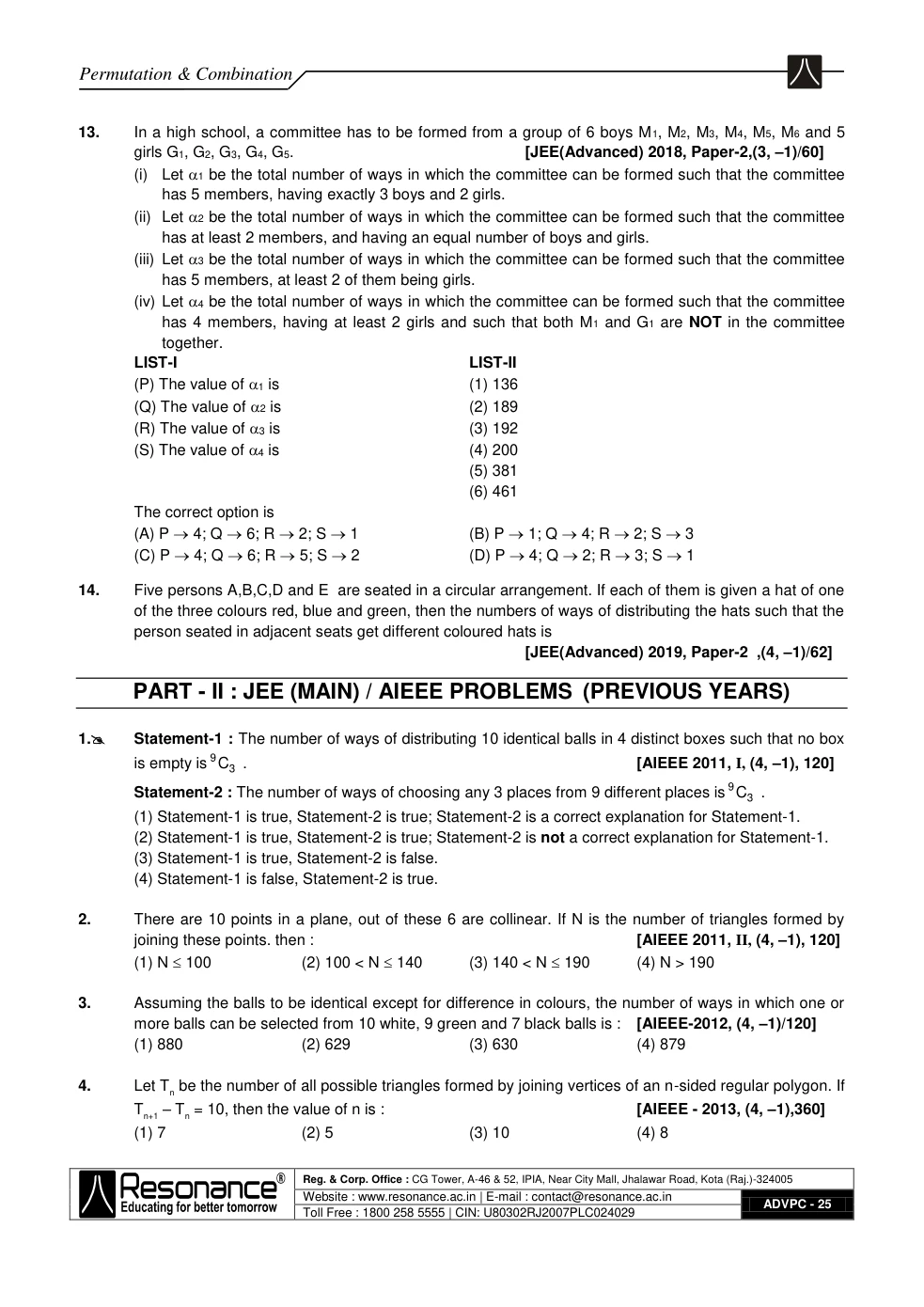
MAASPermutation & Combination
© MAAS. All rights reserved.Page 27 / 33
Extracted text · page 27
Permutation & Combination
13. In a high school, a committee has to be formed from a group of 6 boys M1, M2, M3, M4, M5, M6 and 5
girls G1, G2, G3, G4, G5. [JEE(Advanced) 2018, Paper-2,(3, –1)/60]
(i) Let 1 be the total number of ways in which the committee can be formed such that the committee
has 5 members, having exactly 3 boys and 2 girls.
(ii) Let 2 be the total number of ways in which the committee can be formed such that the committee
has at least 2 members, and having an equal number of boys and girls.
(iii) Let 3 be the total number of ways in which the committee can be formed such that the committee
has 5 members, at least 2 of them being girls.
(iv) Let 4 be the total number of ways in which the committee can be formed such that the committee
has 4 members, having at least 2 girls and such that both M1 and G1 are NOT in the committee
together.
LIST-I LIST-II
(P) The value of 1 is (1) 136
(Q) The value of 2 is (2) 189
(R) The value of 3 is (3) 192
(S) The value of 4 is (4) 200
(5) 381
(6) 461
The correct option is
(A) P 4; Q 6; R 2; S 1 (B) P 1; Q 4; R 2; S 3
(C) P 4; Q 6; R 5; S 2 (D) P 4; Q 2; R 3; S 1
14. Five persons A,B,C,D and E are seated in a circular arrangement. If each of them is given a hat of one
of the three colours red, blue and green, then the numbers of ways of distributing the hats such that the
person seated in adjacent seats get different coloured hats is
[JEE(Advanced) 2019, Paper-2 ,(4, –1)/62]
PART - II : JEE (MAIN) / AIEEE PROBLEMS (PREVIOUS YEARS)
1. Statement-1 : The number of ways of distributing 10 identical balls in 4 distinct boxes such that no box
is empty is 9 C3 . [AIEEE 2011, I, (4, –1), 120]
Statement-2 : The number of ways of choosing any 3 places from 9 different places is 9 C3 .
(1) Statement-1 is true, Statement-2 is true; Statement-2 is a correct explanation for Statement-1.
(2) Statement-1 is true, Statement-2 is true; Statement-2 is not a correct explanation for Statement-1.
(3) Statement-1 is true, Statement-2 is false.
(4) Statement-1 is false, Statement-2 is true.
2. There are 10 points in a plane, out of these 6 are collinear. If N is the number of triangles formed by
joining these points. then : [AIEEE 2011, II, (4, –1), 120]
(1) N 100 (2) 100 < N 140 (3) 140 < N 190 (4) N > 190
3. Assuming the balls to be identical except for difference in colours, the number of ways in which one or
more balls can be selected from 10 white, 9 green and 7 black balls is : [AIEEE-2012, (4, –1)/120]
(1) 880 (2) 629 (3) 630 (4) 879
4. Let Tn be the number of all possible triangles formed by joining vertices of an n-sided regular polygon. If
Tn+1 – Tn = 10, then the value of n is : [AIEEE - 2013, (4, –1),360]
(1) 7 (2) 5 (3) 10 (4) 8
ADVPC - 25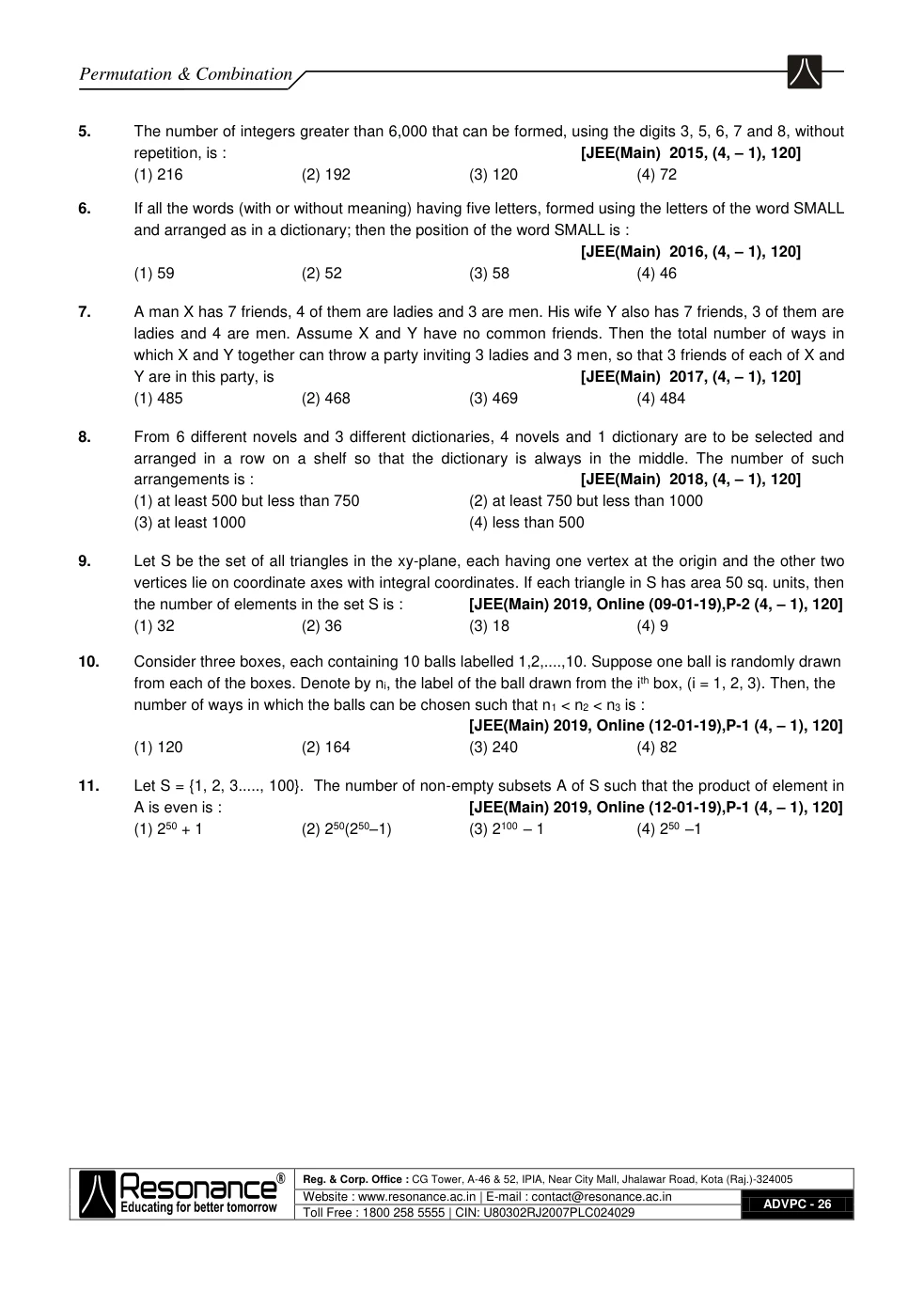
MAASPermutation & Combination
© MAAS. All rights reserved.Page 28 / 33
Extracted text · page 28
Permutation & Combination


5.     The number of integers greater than 6,000 that can be formed, using the digits 3, 5, 6, 7 and 8, without
         repetition, is :                                            [JEE(Main) 2015, (4, – 1), 120]
         (1) 216                   (2) 192                   (3) 120                   (4) 72

6.          If all the words (with or without meaning) having five letters, formed using the letters of the word SMALL
       and arranged as in a dictionary; then the position of the word SMALL is :
                                                               [JEE(Main) 2016, (4, – 1), 120]
         (1) 59                    (2) 52                    (3) 58                    (4) 46


7.    A man X has 7 friends, 4 of them are ladies and 3 are men. His wife Y also has 7 friends, 3 of them are
        ladies and 4 are men. Assume X and Y have no common friends. Then the total number of ways in
       which X and Y together can throw a party inviting 3 ladies and 3 men, so that 3 friends of each of X and
     Y are in this party, is                                      [JEE(Main) 2017, (4, – 1), 120]
         (1) 485                   (2) 468                   (3) 469                   (4) 484


8.     From 6 different novels and 3 different dictionaries, 4 novels and 1 dictionary are to be selected and
       arranged in a row on a shelf so that the dictionary is always in the middle. The number of such
       arrangements is :                                         [JEE(Main) 2018, (4, – 1), 120]
         (1) at least 500 but less than 750                 (2) at least 750 but less than 1000
         (3) at least 1000                                   (4) less than 500

9.      Let S be the set of all triangles in the xy-plane, each having one vertex at the origin and the other two
        vertices lie on coordinate axes with integral coordinates. If each triangle in S has area 50 sq. units, then
        the number of elements in the set S is :        [JEE(Main) 2019, Online (09-01-19),P-2 (4, – 1), 120]
         (1) 32                    (2) 36                    (3) 18                    (4) 9

10.    Consider three boxes, each containing 10 balls labelled 1,2,....,10. Suppose one ball is randomly drawn
       from each of the boxes. Denote by ni, the label of the ball drawn from the ith box, (i = 1, 2, 3). Then, the
      number of ways in which the balls can be chosen such that n1 < n2 < n3 is :
                                                 [JEE(Main) 2019, Online (12-01-19),P-1 (4, – 1), 120]
         (1) 120                   (2) 164                   (3) 240                   (4) 82

11.     Let S = {1, 2, 3....., 100}. The number of non-empty subsets A of S such that the product of element in
     A is even is :                               [JEE(Main) 2019, Online (12-01-19),P-1 (4, – 1), 120]
         (1) 250 + 1                (2) 250(250–1)            (3) 2100 – 1               (4) 250 –1


                                                                               ADVPC - 26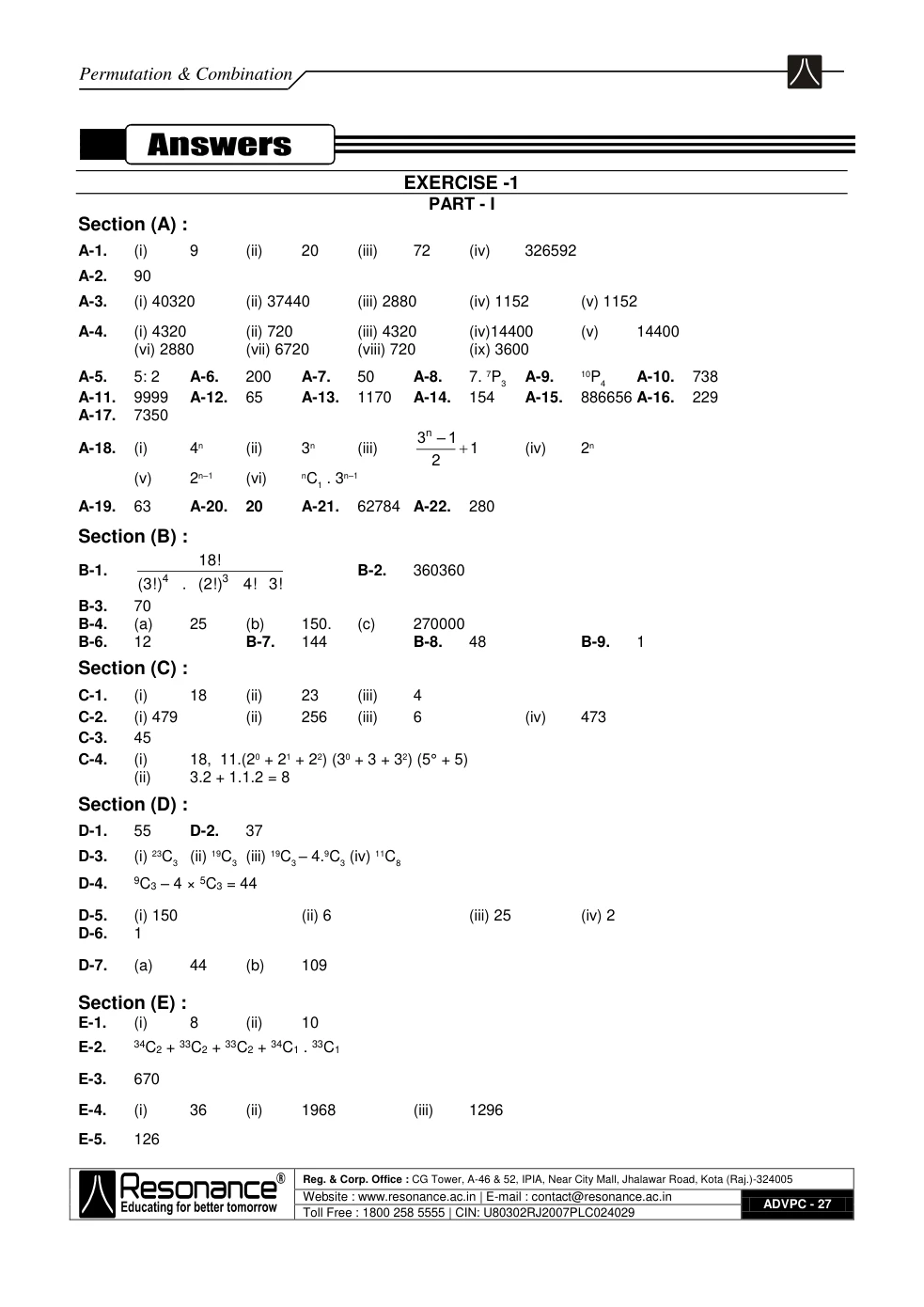
MAASPermutation & Combination
© MAAS. All rights reserved.Page 29 / 33
Extracted text · page 29
Permutation & Combination
EXERCISE -1
PART - I
Section (A) :
A-1. (i) 9 (ii) 20 (iii) 72 (iv) 326592
A-2. 90
A-3. (i) 40320 (ii) 37440 (iii) 2880 (iv) 1152 (v) 1152
A-4. (i) 4320 (ii) 720 (iii) 4320 (iv)14400 (v) 14400
(vi) 2880 (vii) 6720 (viii) 720 (ix) 3600
A-5. 5: 2 A-6. 200 A-7. 50 A-8. 7. 7P3 A-9. 10P4 A-10. 738
A-11. 9999 A-12. 65 A-13. 1170 A-14. 154 A-15. 886656 A-16. 229
A-17. 7350
3n – 1A-18. (i) 4n (ii) 3n (iii) 1 (iv) 2n
2
(v) 2n–1 (vi) nC1 . 3n–1
A-19. 63 A-20. 20 A-21. 62784 A-22. 280
Section (B) :
18!
B-1. B-2. 360360
(3!)4 . (2!)3 4! 3!
B-3. 70
B-4. (a) 25 (b) 150. (c) 270000
B-6. 12 B-7. 144 B-8. 48 B-9. 1
Section (C) :
C-1. (i) 18 (ii) 23 (iii) 4
C-2. (i) 479 (ii) 256 (iii) 6 (iv) 473
C-3. 45
C-4. (i) 18, 11.(20 + 21 + 22) (30 + 3 + 32) (5° + 5)
(ii) 3.2 + 1.1.2 = 8
Section (D) :
D-1. 55 D-2. 37
D-3. (i) 23C3 (ii) 19C3 (iii) 19C3 – 4.9C3 (iv) 11C8
D-4. 9C3 – 4 × 5C3 = 44
D-5. (i) 150 (ii) 6 (iii) 25 (iv) 2
D-6. 1
D-7. (a) 44 (b) 109
Section (E) :
E-1. (i) 8 (ii) 10
E-2. 34C2 + 33C2 + 33C2 + 34C1 . 33C1
E-3. 670
E-4. (i) 36 (ii) 1968 (iii) 1296
E-5. 126
ADVPC - 27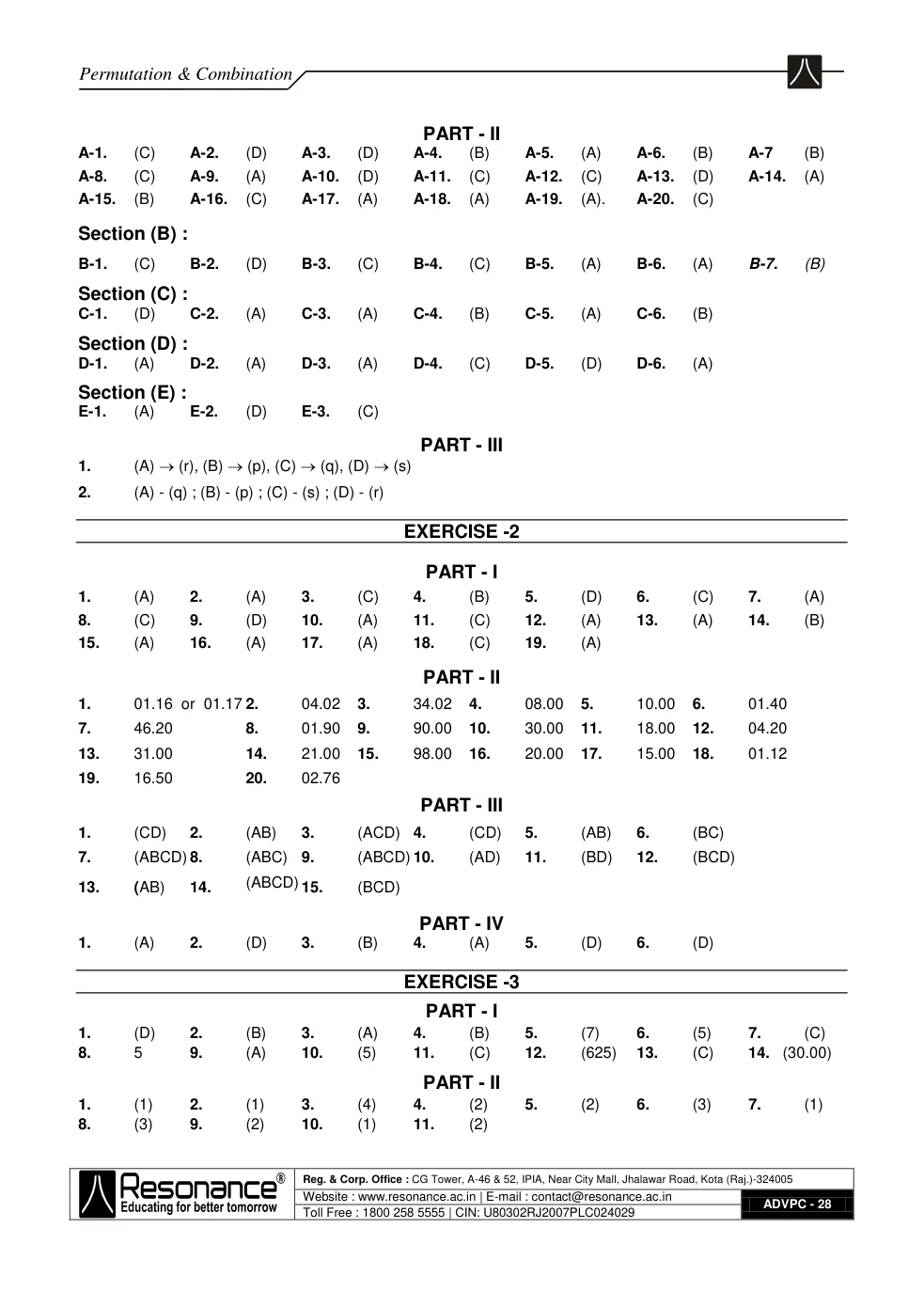
MAASPermutation & Combination
© MAAS. All rights reserved.Page 30 / 33
Extracted text · page 30
Permutation & Combination
PART - II
A-1. (C) A-2. (D) A-3. (D) A-4. (B) A-5. (A) A-6. (B) A-7 (B)
A-8. (C) A-9. (A) A-10. (D) A-11. (C) A-12. (C) A-13. (D) A-14. (A)
A-15. (B) A-16. (C) A-17. (A) A-18. (A) A-19. (A). A-20. (C)
Section (B) :
B-1. (C) B-2. (D) B-3. (C) B-4. (C) B-5. (A) B-6. (A) B-7. (B)
Section (C) :
C-1. (D) C-2. (A) C-3. (A) C-4. (B) C-5. (A) C-6. (B)
Section (D) :
D-1. (A) D-2. (A) D-3. (A) D-4. (C) D-5. (D) D-6. (A)
Section (E) :
E-1. (A) E-2. (D) E-3. (C)
PART - III
1. (A) (r), (B) (p), (C) (q), (D) (s)
2. (A) - (q) ; (B) - (p) ; (C) - (s) ; (D) - (r)
EXERCISE -2
PART - I
1. (A) 2. (A) 3. (C) 4. (B) 5. (D) 6. (C) 7. (A)
8. (C) 9. (D) 10. (A) 11. (C) 12. (A) 13. (A) 14. (B)
15. (A) 16. (A) 17. (A) 18. (C) 19. (A)
PART - II
1. 01.16 or 01.17 2. 04.02 3. 34.02 4. 08.00 5. 10.00 6. 01.40
7. 46.20 8. 01.90 9. 90.00 10. 30.00 11. 18.00 12. 04.20
13. 31.00 14. 21.00 15. 98.00 16. 20.00 17. 15.00 18. 01.12
19. 16.50 20. 02.76
PART - III
1. (CD) 2. (AB) 3. (ACD) 4. (CD) 5. (AB) 6. (BC)
7. (ABCD) 8. (ABC) 9. (ABCD) 10. (AD) 11. (BD) 12. (BCD)
13. (AB) 14. (ABCD) 15. (BCD)
PART - IV
1. (A) 2. (D) 3. (B) 4. (A) 5. (D) 6. (D)
EXERCISE -3
PART - I
1. (D) 2. (B) 3. (A) 4. (B) 5. (7) 6. (5) 7. (C)
8. 5 9. (A) 10. (5) 11. (C) 12. (625) 13. (C) 14. (30.00)
PART - II
1. (1) 2. (1) 3. (4) 4. (2) 5. (2) 6. (3) 7. (1)
8. (3) 9. (2) 10. (1) 11. (2)
ADVPC - 28
MAASPermutation & Combination
© MAAS. All rights reserved.Page 31 / 33
Extracted text · page 31
Permutation & Combination
1. How many positive integers are there such that n is a divisor of one of the numbers 1040, 2030?
2. Six cards are drawn one by one from a set of unlimited number of cards, each card is marked with
numbers 1, 0 or 1. Number of different ways in which they can be drawn if the sum of the numbers
shown by them vanishes, is:
3. A five letter word is to be formed such that the letters appearing in the odd numbered positions are
taken from the letters which appear without repetition in the word "MATHEMATICS". Further the letters
appearing in the even numbered positions are taken from the letters which appear with repetition in the
same word "MATHEMATICS". The number of ways in which the five letter word can be formed is:
4. In how many ways 4 square are can be chosen on a chess-board, such that all the squares lie in a
diagonal line.
5. Find the number of functions f : A B where n(A) = m , n(B) = t , which are non decreasing,
6. Find the number of ways of selecting 3 vertices from a regular polygon of sides ‘2n+1’ with vertices
A1, A2, A3 ,......, A2n+1 such that centre of polygon lie inside the triangle.
7. A operation * on a set A is said to be binary, if x * y A , for all x, y A, and it is said to be
commutative ,
if x * y = y * x for all x, y A. Now if A = {a1, a2, ......, an}, then find the following -
(i) Total number of binary operations of A
(ii) Total number of binary operation on A such that
ai * aj ai * ak, if j k.
(iii) Total number of binary operations on A such that ai * aj < ai * aj + 1 i, j
8. The integers from 1 to 1000 are written in order around a circle. Starting at 1, every fifteenth number is
marked (that is 1, 16, 31, .... etc.). This process in continued untill a number is reached which has
already been marked, then find number of unmarked numbers.
9. Find the number of ways in which n ‘1’ and n ‘2’ can be arranged in a row so that upto any point in the
row no. of ‘1’ is more than or equal to no. of ‘2’
10. Find the number of positive integers less than 2310 which are relatively prime with 2310.
11. In maths paper there is a question on "Match the column" in which column A contains 6 entries & each
entry of column A corresponds to exactly one of the 6 entries given in column B (and vice versa) written
randomly. 2 marks are awarded for each correct matching & 1 mark is deducted from each incorrect
matching. A student having no subjective knowledge decides to match all the 6 entries randomly. Find
the number of ways in which he can answer, to get atleast 25 % marks in this question.
ADVPC - 29
MAASPermutation & Combination
© MAAS. All rights reserved.Page 32 / 33
Extracted text · page 32
Permutation & Combination
12. Find the number of positive unequal integral solution of the equation x + y + z = 20.
13. If we have 3 identical white flowers and 6m identical red flowers. Find the number of ways in which a
garland can be made using all the flowers.
14. Number of times is the digit 5 written when listing all numbers from 1 to 105?
15. The number of combinations of n letters together out of 3n letters of which n are a and n are b and the
rest unlike.
16. In a row, there are 81 rooms, whose door no. are 1,2,.......,81, initially all the door are closed. A person
takes 81 round of the row, numbers as 1st round, 2nd round ........ 81th round. In each round, he
interchage the position of those door number, whose number is multiple of the round number. Find out
after 81st round,How many doors will be open.
17. Mr. Sibbal walk up 16 steps, going up either 1 or 2 steps with each stride there is explosive material on
the 8th step so he cannot step there. Then number of ways in which Mr. Sibbal can go up.
18. Number of numbers of the form xxyy which are perfect squares of a natural number.
19. A batsman scores exactly a century by hitting fours and sixes in twenty consecutive balls. In how many
different ways can he hit either six or four or play a dot ball?
20. In how many ways can two distinct subsets of the set A of k(k 2) elements be selected so that they
have exactly two common elements.
21. How many 5 digit numbers can be made having exactly two identical digit.
22. Find the number of 3-digit numbers. (including all numbers) which have any one digit is the average of
the other two digits.
23. In how many ways can(2n + 1) identical balls be placed in 3 distinct boxes so that any two boxes
together will contain more balls than the third box.
24. Let f(n) denote the number of different ways in which the positive integer 'n' can be expressed as sum
of 1s and 2s.
for example f(4) = 5 {2 + 2, 2 + 1 + 1, 1 + 2 + 1, 1 + 1 + 2, 1 + 1 + 1 + 1}. Now that order of 1s and 2s is
important. Then determine f(f(6))
25. Prove that (n!)! is divisible by (n!)(n–1)!
26. A user of facebook which is two or more days older can send a friend request to some one to join
facebook.
If initially there is one user on day one then find a recurrence relation for an where an is number of users
after n days.
ADVPC - 30
MAASPermutation & Combination
© MAAS. All rights reserved.Page 33 / 33
Extracted text · page 33
Permutation & Combination
27. Let X = {1, 2, 3,.....,10}. Find the the number of pairs {A, B} such AX. B X. A B and A B = {5,7,8}.
28. Consider a 20-sided convex polygon K, with vertices A1, A2, . . . . , A20 in that order. Find the number of
ways in which three sides of K can be chosen so that every pair among them has at least two sides of
K between them. (For example (A1A2, A4A5, A11A12) is an admissible triple while (A1A2, A4A5, A19A20) is
not).
29. Find the number of 4-digit numbers (in base 10) having non-zero digits and which are divisible by 4 but
not by 8.
30. Find the number of all integer-sided isosceles obtuse-angled triangles with perimeter 2008.
31. Let ABC be a triangle. An interior point P of ABC is said to be good if we can find exactly 27 rays
emanating from P intersecting the sides of the triangle ABC such that the triangle is divided by these
rays into 27 smaller triangles of equal area. Determine the number of good points for a given triangle
32. Let = (a1, a2, a3, ..., an) be a permutation of (1, 2, 3, ..., n). A pair (ai,aj) is said to correspond to an
inversion of , if i < j but ai > aj. (Example : In the permutation (2, 4, 5, 3, 1), there are 6 inversions
corresponding to the pairs (2, 1), (4, 3), (4, 1), (5, 3) (5, 1), (3, 1) . ) How many permutations of
(1, 2, 3, ... n), (n 3), have exactly two inversions.?
1. 2301 2. 141 3. 540 4. 364
2 2n 1 n5. (t m 1)c m ways 6. (2nC2 – 3.nC2) 7. (i) n (ii) (n!)n (iii) 1
3
2n Cn8. 800 9. 10. 480 11. 56 ways
n 1
12. 144 13. 3m2 + 3m + 1 14. 50000 15. (n + 2). 2n 1
16. 9 17. 441 18. 1
20! 20! 20! 20! k k 1
19. + + + 20. ((3)k–2 –1)
10! 10! 7! 12! 4! 14! 2! 16! 3! 4
n n 1
21. 45360 22. 121 23.
2
24. 377 26. an = an – 1 + an – 2 27. 2186
28. 520 29. 729 30. 86
(n 1)(n 2)
31. 26C2 32.
2
.
ADVPC - 31