Visual-fidelity edition: source-page equations, diagrams and charts are preserved as page images. Text transcripts are provided where extractable. The original source may contain markings within the artwork.
MAASQuadratic Equation
© MAAS. All rights reserved.Page 1 / 34
Extracted text · page 1
Quadratic Equation
A man is like a fraction whose numerator is what he is and whose denominator is what he thinks of himself. The larger the denominator the
smaller the fraction......... Tolstoy, Count Lev Nikolgevich
1. Polynomial :
A function f defined by f(x) = anxn + an – 1xn – 1 + .......+ a1x + a0
where a0, a1, a2, ......, an R is called a polynomial of degree n with real coefficients (an 0, n W).
If a0, a1, a2, ....., an C, it is called a polynomial with complex coefficients.
2. Quadratic polynomial & Quadratic equation :
A polynomial of degree 2 is known as quadratic polynomial. Any equation f(x) = 0, where f is a
quadratic polynomial, is called a quadratic equation. The general form of a quadratic equation is
ax2 + bx + c = 0 .......(i)
Where a, b, c are real numbers, a 0.
If a = 0, then equation (i) becomes linear equation.
3. Difference between equation & identity :
If a statement is true for all the values of the variable, such statements are called as identities. If the
statement is true for some or no values of the variable, such statements are called as equations.
Example : (i) (x + 3)2 = x2 + 6x + 9 is an identity
(ii) (x + 3)2 = x2 + 6x + 8, is an equation having no root.
(iii) (x + 3)2 = x2 + 5x + 8, is an equation having – 1 as its root.
A quadratic equation has exactly two roots which may be real (equal or unequal) or imaginary.
a x2 + b x + c = 0 is:
a quadratic equation if a 0 Two Roots
a linear equation if a = 0, b 0 One Root
a contradiction if a = b = 0, c 0 No Root
an identity if a = b = c = 0 Infinite Roots
If ax2 + bx + c = 0 is satisfied by three distinct values of ' x ', then it is an identity.
Example # 1 : (i) 3x2 + 2x – 1 = 0 is a quadratic equation here a = 3.
(ii) (x + 1)2 = x2 + 2x + 1 is an identity in x.
Solution : Here highest power of x in the given relation is 2 and this relation is satisfied by three different
values x = 0, x = 1 and x = – 1 and hence it is an identity because a polynomial equation of nth
degree cannot have more than n distinct roots.
4. Relation Between Roots & Co-efficients:
(i) The solutions of quadratic equation, a x2 + b x + c = 0, (a 0) is given by
b b 2 4ac
x =
2a
The expression, b2 4 a c D is called discriminant of quadratic equation.
(ii) If , are the roots of quadratic equation,
a x2 + b x + c = 0 .......(i)
then equation (i) can be written as
a(x – ) (x – ) = 0 or ax2 – a( + )x + a = 0 ......(ii)
equations (i) and (ii) are identical,
b coefficient of x
by comparing the coefficients sum of the roots, + = – = –
a coefficient of x 2
c constant term
and product of the roots, = =
a coefficient of x 2
ADVQE-1
MAASQuadratic Equation
© MAAS. All rights reserved.Page 2 / 34
Extracted text · page 2
Quadratic Equation
b c
(iii) Dividing the equation (i) by a, x2 + x + = 0
a a
b c
x2 – x + = 0 x2 – ( + )x + = 0 a a
x2 – (sum of the roots) x + (product of the roots) = 0
Hence we conclude that the quadratic equation whose roots are & is x2 – ( + )x + = 0
Example # 2 : If and are the roots of ax2 + bx + c = 0, find the equation whose roots are +2 and +2.
Solution : Replacing x by x – 2 in the given equation, the required equation is
a(x – 2)2 + b(x – 2) + c = 0 i.e., ax2 – (4a – b)x + (4a – 2b + c) = 0.
Example # 3 : The coefficient of x in the quadratic equation x2 + px + q = 0 was taken as 17 in place of 13, its
roots were found to be – 2 and – 15. Find the roots of the original equation.
Solution : Here q = (– 2) × (– 15) = 30, correct value of p = 13. Hence original equation is
x2 + 13x + 30 = 0 as (x + 10) (x + 3) = 0
roots are – 10, – 3
Self practice problems :
(1) If , are the roots of the quadratic equation cx2 – 2bx + 4a = 0 then find the quadratic equation
whose roots are
(i) , (ii) 2, 2 (iii) + 1, + 1
2 2
1 1
(iv) , (v) 1 1 ,
(r 1)2 b 2
(2) If r be the ratio of the roots of the equation ax2 + bx + c = 0, show that = .
r ac
Answers : (1) (i) cx2 – bx + a = 0
(ii) c2x2 + 4(b2 – 2ac)x + 16a2 = 0
(iii) cx2 – 2x(b + c) + (4a + 2b + c) = 0
(iv) (c – 2b + 4a)x2 + 2(4a – c) x + (c + 2b + 4a) = 0
(v) 4acx2 + 4(b2 – 2ac) x + 4ac = 0
5. Theory Of Equations :
If 1, 2, 3,......n are the roots of the equation;
f(x) = a0xn + a1xn-1 + a2xn-2 +.... + an-1x + an = 0 where a0, a1,....,an are all real & a0 0 then,
a1 a 2 a 3 a n 1 = , 1 2 = + , 1 2 3 = ,....., 1 2 3........n = (1)n
a 0 a 0 a 0 a 0
Note : (i) If is a root of the equation f(x) = 0, then the polynomial f(x) is exactly divisible by (x ) or
(x ) is a factor of f(x) and conversely.
(ii) Every equation of nth degree (n 1) has exactly n roots & if the equation has more than n roots,
it is an identity.
(iii) If the coefficients of the equation f(x) = 0 are all real and + i is its root, then i is also a
root. i.e. imaginary roots occur in conjugate pairs.
(iv) An equation of odd degree will have odd number of real roots and an equation of even degree
will have even numbers of real roots.
(v) If the coefficients in the equation are all rational & + is one of its roots, then
is also a root where , Q & is not square of a rational number.
(vi) If there be any two real numbers 'a' & 'b' such that f(a) & f(b) are of opposite signs, then
f(x) = 0 must have odd number of real roots (also atleast one real root) between ' a ' and ' b '.
(vii) Every equation f(x) = 0 of degree odd has atleast one real root of a sign opposite to that of its
last term. (If coefficient of highest degree term is positive).
ADVQE-2
MAASQuadratic Equation
© MAAS. All rights reserved.Page 3 / 34
Extracted text · page 3
Quadratic Equation
Example # 4 : If 2x3 + 3x2 + 5x + 6 = 0 has roots , , then find + + , + + and .
Solution : Using relation between roots and coefficients, we get
3 5 6
+ + = = – , + + = , = – = – 3.
2 2 2
Self practice problems :
(3) If 2p3 – 9pq + 27r = 0 then prove that the roots of the equations rx3 – qx2 + px – 1 = 0 are in
H.P.
(4) If , , are the roots of the equation x3 + qx + r = 0 then find the equation whose roots are
(a) + 2, + ,
r r r
(b) , ,
(c) 2, 2, 2
(d) 3, 3, 3
Answers : (4) (a) x3 + qx – r = 0 (b) x3 – qx2 – r2 = 0
(c) x3 + 2qx2 + q2 x – r2 = 0 (d) x3 – 3x2r + (3r2 + q3) x – r3 = 0
6. Nature of Roots:
Consider the quadratic equation, a x2 + b x + c = 0 having , as its roots;
D b2 4 a c
D = 0 D 0
Roots are equal i.e. = = b/2a Roots are unequal
& the quadratic expression can be expressed
as a perfect square of a linear polynomial
a, b, c R & D > 0 a, b, c R & D < 0
Roots are real Roots are imaginary = p + i q, = p i q
a, b, c Q & a, b, c Q &
D is square of a rational number D is not square of a rational number
Roots are rational Roots are irrational
i.e. = p + q , = p q
a = 1, b, c & D is square of an integer
Roots are integral.
Example # 5 : For what values of m the equation (1 + m) x2 – 2(1 + 3m)x + (1 + 8m) = 0 has equal roots.
Solution : Given equation is (1 + m) x2 – 2(1 + 3m)x + (1 + 8m) = 0 ........(i)
Let D be the discriminant of equation (i).
Roots of equation (i) will be equal if D = 0.
or 4(1 + 3m)2 – 4(1 + m) (1 + 8m) = 0
or 4(1 + 9m2 + 6m – 1 – 9m – 8m2) = 0
or m2 – 3m = 0 or, m(m – 3) = 0
m = 0, 3.
ADVQE-3
MAASQuadratic Equation
© MAAS. All rights reserved.Page 4 / 34
Extracted text · page 4
Quadratic Equation
Example # 6 : Find all the integral values of a for which the quadratic equation (x – a) (x – 10) + 1 = 0 has
integral roots.
Solution : Here the equation is x2 – (a + 10)x + 10a + 1 = 0. Since integral roots will always be rational it
means D should be a perfect square.
From (i) D = a2 – 20a + 96.
D = (a – 10)2 – 4 4 = (a – 10)2 – D
If D is a perfect square it means we want difference of two perfect square as 4 which is
possible
only when (a – 10)2 = 4 and D = 0.
(a – 10) = ± 2 a = 12, 8
Example # 7 : If the roots of the equation (x – a) (x – b) – k = 0 be c and d, then prove that the roots of the
equation (x – c) (x – d) + k = 0, are a and b.
Solution : By given condition (x – a) (x – b) – k (x – c) (x – d)
or (x – c) (x – d) + k (x – a) (x – b)
Above shows that the roots of (x – c) (x – d) + k = 0 are a and b.
Example # 8 : Determine 'a' such that x2 – 11x + a and x2 – 14x + 2a may have a common factor.
Solution : Let x – be a common factor of x2 – 11x + a and x2 – 14x + 2a.
Then x = will satisfy the equations x2 – 11x + a = 0 and x2 – 14x + 2a = 0.
2 – 11 + a = 0 and 2 – 14 + 2a = 0
Solving (i) and (ii) by cross multiplication method, we get a = 0, 24.
Example # 9 : Show that the expression x2 + 2(a + b + c)x + 3(bc + ca + ab) will be a perfect square
if a = b = c.
Solution : Given quadratic expression will be a perfect square if the discriminant of its corresponding
equation is zero.
i.e. 4(a + b + c)2 – 4.3 (bc + ca + ab) = 0
or (a + b + c)2 – 3(bc + ca + ab) = 0
1
or ((a – b)2 + (b – c)2 + (c – a)2) = 0
2
which is possible only when a = b = c.
Self practice problems :
(5) For what values of 'k' the expression (4 – k)x2 + 2(k + 2)x + 8k + 1 will be a perfect square ?
(6) If (x – ) be a factor common to a1x2 + b1x + c and a2x2 + b2x + c, then prove that
(a1 – a2) = b2 – b1.
(7) If 3x2 + 2xy + 2y2 + 2ax – 4y + 1 can be resolved into two linear factors, Prove that '' is a root
of the equation x2 + 4ax + 2a2 + 6 = 0.
(8) Let 4x2 – 4( – 2)x + – 2 = 0 ( R) be a quadratic equation. Find the values of '' for which
(i) Both roots are real and distinct.
(ii) Both roots are equal.
(iii) Both roots are imaginary
(iv) Both roots are opposite in sign.
(v) Both roots are equal in magnitude but opposite in sign.
(9) If P(x) = ax2 + bx + c, and Q(x) = – ax2 + dx + c, ac 0 then prove that P(x) . Q(x) = 0 has
atleast two real roots.
Answers. (5) 0, 3
(8) (i) (– , 2) (3, ) (ii) {2, 3} (iii) (2, 3) (iv) (– , 2) (v)
ADVQE-4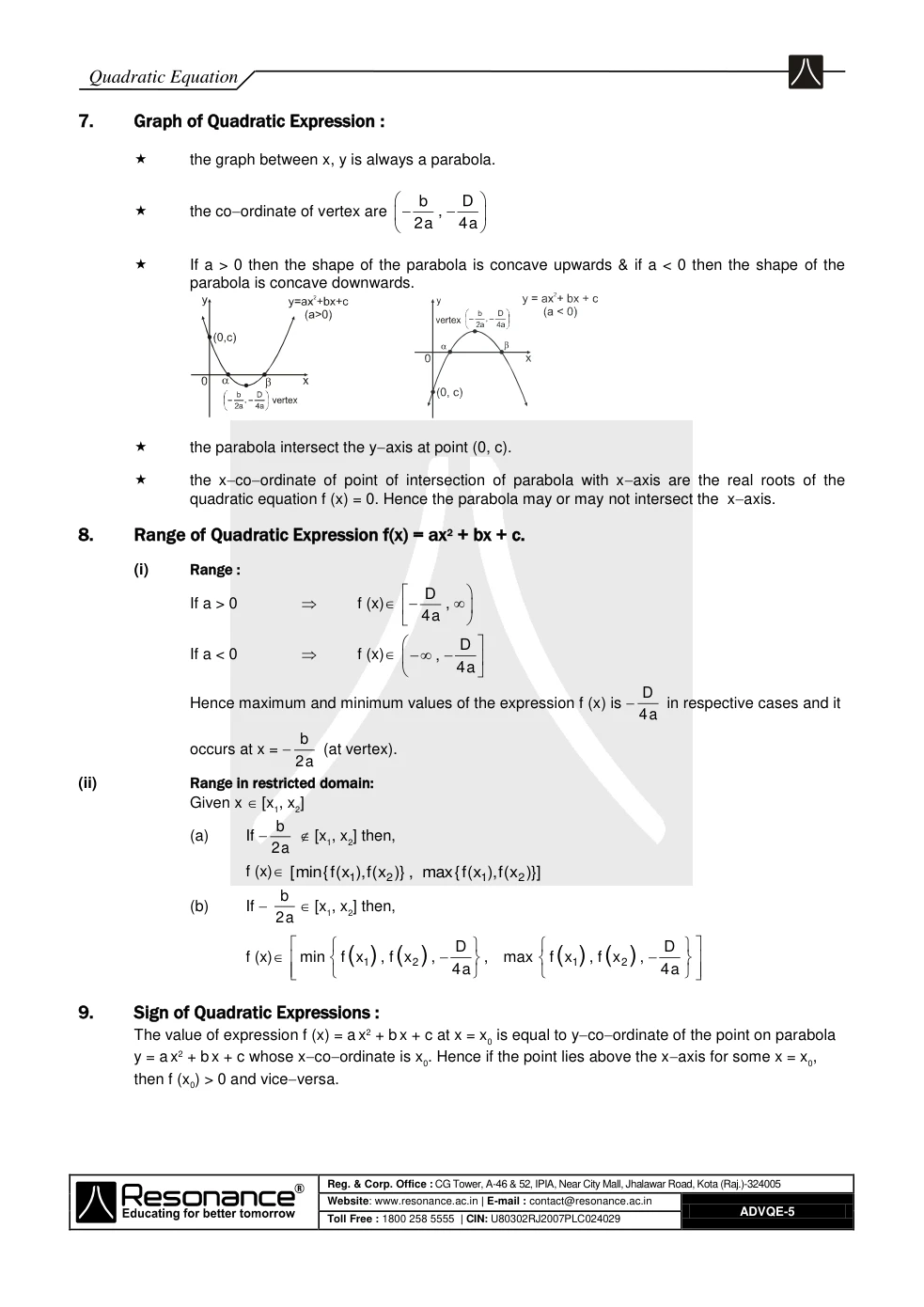
MAASQuadratic Equation
© MAAS. All rights reserved.Page 5 / 34
Extracted text · page 5
Quadratic Equation
7. Graph of Quadratic Expression :
the graph between x, y is always a parabola.
b D
the coordinate of vertex are ,
2a 4a
If a > 0 then the shape of the parabola is concave upwards & if a < 0 then the shape of the
parabola is concave downwards.
the parabola intersect the yaxis at point (0, c).
the xcoordinate of point of intersection of parabola with xaxis are the real roots of the
quadratic equation f (x) = 0. Hence the parabola may or may not intersect the xaxis.
8. Range of Quadratic Expression f(x) = ax2 + bx + c.
(i) Range :
D
If a > 0 f (x) 4a ,
D
If a < 0 f (x) ,
4a
Hence maximum and minimum values of the expression f (x) is D in respective cases and it
4a
occurs at x = b (at vertex).
2a
(ii) Range in restricted domain:
Given x [x1, x2]
(a) If b [x1, x2] then,
2a
f (x) [min{f(x1 ),f(x 2 )} , max{f(x1 ),f(x 2 )}]
b
(b) If [x1, x2] then, 2a
D D f (x) min f ( x1 ) , f ( x 2 ) , , max f ( x1 ) , f ( x 2 ) ,
4a 4a
9. Sign of Quadratic Expressions :
The value of expression f (x) = a x2 + b x + c at x = x0 is equal to ycoordinate of the point on parabola
y = a x2 + b x + c whose xcoordinate is x0. Hence if the point lies above the xaxis for some x = x0,
then f (x0) > 0 and viceversa.
ADVQE-5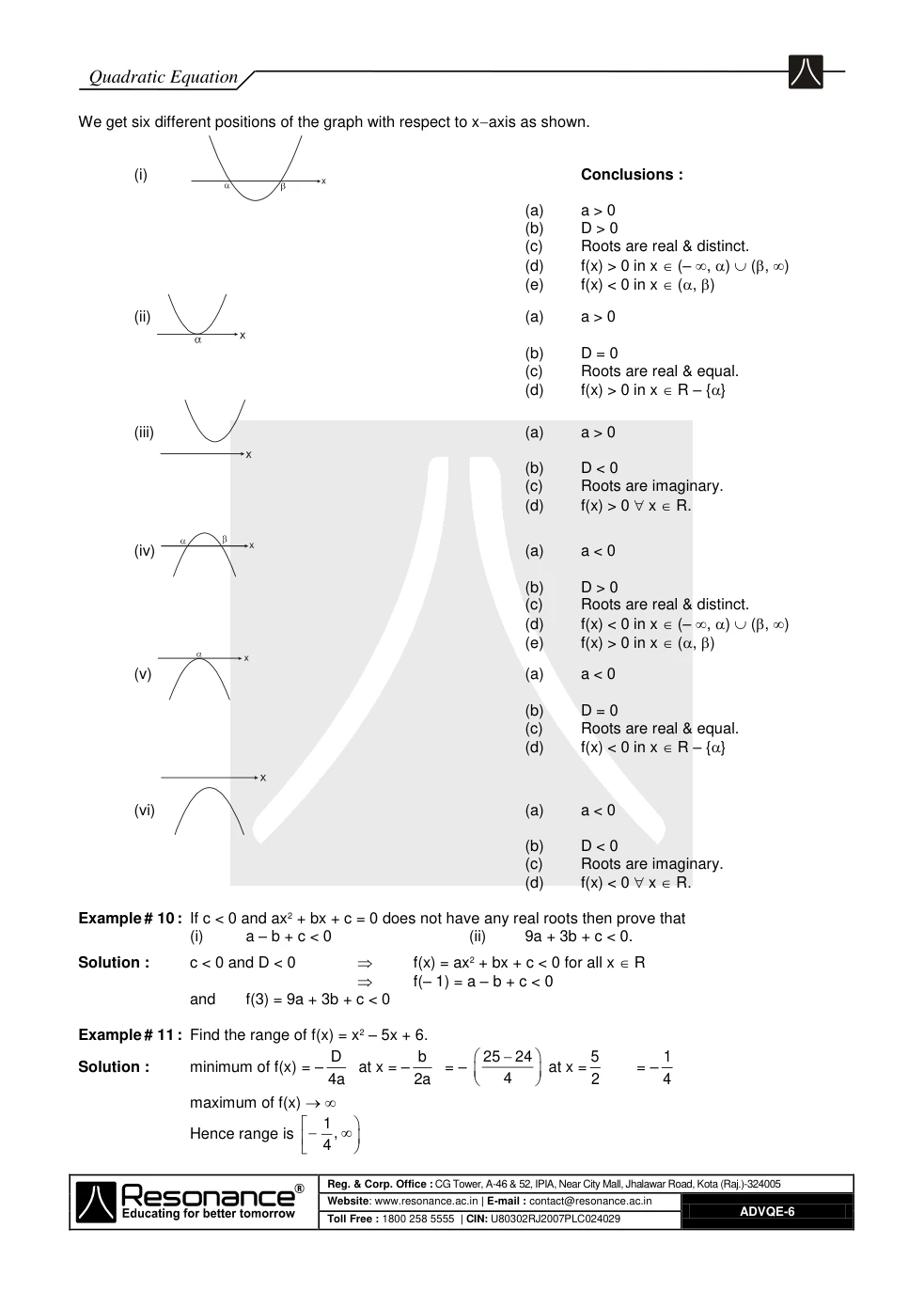
MAASQuadratic Equation
© MAAS. All rights reserved.Page 6 / 34
Extracted text · page 6
Quadratic Equation
We get six different positions of the graph with respect to xaxis as shown.
(i) Conclusions :
(a) a > 0
(b) D > 0
(c) Roots are real & distinct.
(d) f(x) > 0 in x (– , ) (, )
(e) f(x) < 0 in x (, )
(ii) (a) a > 0
(b) D = 0
(c) Roots are real & equal.
(d) f(x) > 0 in x R – {}
(iii) (a) a > 0
(b) D < 0
(c) Roots are imaginary.
(d) f(x) > 0 x R.
(iv) (a) a < 0
(b) D > 0
(c) Roots are real & distinct.
(d) f(x) < 0 in x (– , ) (, )
(e) f(x) > 0 in x (, )
(v) (a) a < 0
(b) D = 0
(c) Roots are real & equal.
(d) f(x) < 0 in x R – {}
(vi) (a) a < 0
(b) D < 0
(c) Roots are imaginary.
(d) f(x) < 0 x R.
Example # 10 : If c < 0 and ax2 + bx + c = 0 does not have any real roots then prove that
(i) a – b + c < 0 (ii) 9a + 3b + c < 0.
Solution : c < 0 and D < 0 f(x) = ax2 + bx + c < 0 for all x R
f(– 1) = a – b + c < 0
and f(3) = 9a + 3b + c < 0
Example # 11 : Find the range of f(x) = x2 – 5x + 6.
D b 25 24 5 1
Solution : minimum of f(x) = – at x = – = – at x = = – 4a 2a 4 2 4
maximum of f(x)
Hence range is 1, 4
ADVQE-6
MAASQuadratic Equation
© MAAS. All rights reserved.Page 7 / 34
Extracted text · page 7
Quadratic Equation
x 2 x 4
Example # 12 : Find the range of rational expression y = if x is real.
x 2 x 4
x 2 x 4
Solution : y = (y – 1)x2 + (y + 1) x + 4(y – 1) = 0 ........(i)
x 2 x 4
case- : if y 1, then equation (i) is quadratic in x
and x is real
D 0 (y + 1)2 – 16(y – 1)2 0 (5y – 3) (3y – 5) 0
5 y 3 , – {1} 5 3
case- : if y = 1, then equation becomes
2x = 0 x = 0 which is possible as x is real.
3 5
Rangec , 5 3
x 3
Example # 13 : Find the range of y = , if x is real.
2x 2 3x 9
x 3
Solution : y =
2x 2 3x 9
2yx2 + (3y – 1)x + 3(3y – 1) = 0 .......(i)
case- : if y 0, then equation (i) is quadratic in x
x is real
D 0
(3y – 1)2 – 24y (3y – 1) 0
(3y – 1) (21y + 1) 0
1 1 y , – {0} 21 3
case- : if y = 0, then equation becomes
x = –3 which is possible as x is real
1 1
Range y , 21 3
Self practice problems :
(10) If c > 0 and ax2 + 2bx + 3c = 0 does not have any real roots then prove that
(i) 4a – 4b + 3c > 0 (ii) a + 6b + 27c > 0 (iii) a + 2b + 6c > 0
(a b)2
(11) If f(x) = (x – a) (x – b), then show that f(x) – .
4
(12) Find the least integral value of 'k' for which the quadratic polynomial
(k – 1) x2 + 8x + k + 5 > 0 x R.
x 2 34x 71
(13) Find the range of the expression , if x is a real.
x 2 2x 7
mx 2 3x 4
(14) Find the interval in which 'm' lies so that the expression can take all real
4x 2 3x m
values,x R.
Answers : (12) k = 4 (13) (– , 5] [9, ) (14) m (1, 7)
ADVQE-7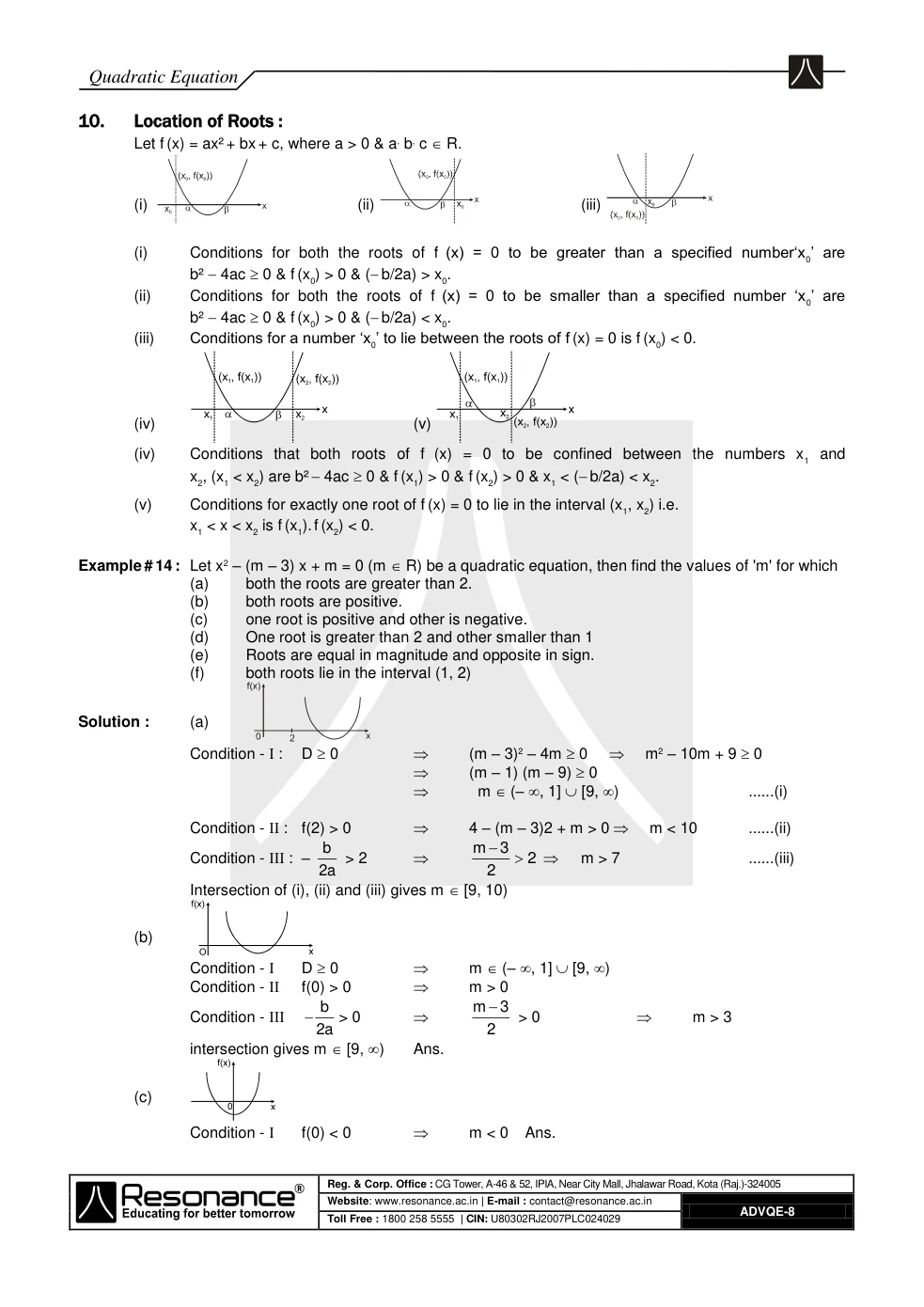
MAASQuadratic Equation
© MAAS. All rights reserved.Page 8 / 34
Extracted text · page 8
Quadratic Equation
10. Location of Roots :
Let f (x) = ax² + bx + c, where a > 0 & a, b, c R.
(i) (ii) (iii)
(i) Conditions for both the roots of f (x) = 0 to be greater than a specified number‘x0’ are
b² 4ac 0 & f (x0) > 0 & ( b/2a) > x0.
(ii) Conditions for both the roots of f (x) = 0 to be smaller than a specified number ‘x0’ are
b² 4ac 0 & f (x0) > 0 & ( b/2a) < x0.
(iii) Conditions for a number ‘x0’ to lie between the roots of f (x) = 0 is f (x0) < 0.
(iv) (v)
(iv) Conditions that both roots of f (x) = 0 to be confined between the numbers x1 and
x2, (x1 < x2) are b² 4ac 0 & f (x1) > 0 & f (x2) > 0 & x1 < ( b/2a) < x2.
(v) Conditions for exactly one root of f (x) = 0 to lie in the interval (x1, x2) i.e.
x1 < x < x2 is f (x1). f (x2) < 0.
Example # 14 : Let x2 – (m – 3) x + m = 0 (m R) be a quadratic equation, then find the values of 'm' for which
(a) both the roots are greater than 2.
(b) both roots are positive.
(c) one root is positive and other is negative.
(d) One root is greater than 2 and other smaller than 1
(e) Roots are equal in magnitude and opposite in sign.
(f) both roots lie in the interval (1, 2)
Solution : (a)
Condition - : D 0 (m – 3)2 – 4m 0 m2 – 10m + 9 0
(m – 1) (m – 9) 0
m (– , 1] [9, ) ......(i)
Condition - : f(2) > 0 4 – (m – 3)2 + m > 0 m < 10 ......(ii)
b m 3
Condition - : – > 2 2 m > 7 ......(iii)
2a 2
Intersection of (i), (ii) and (iii) gives m [9, 10)
(b)
Condition - D 0 m (– , 1] [9, )
Condition - f(0) > 0 m > 0
b m 3
Condition - > 0 > 0 m > 3
2a 2
intersection gives m [9, ) Ans.
(c)
Condition - f(0) < 0 m < 0 Ans.
ADVQE-8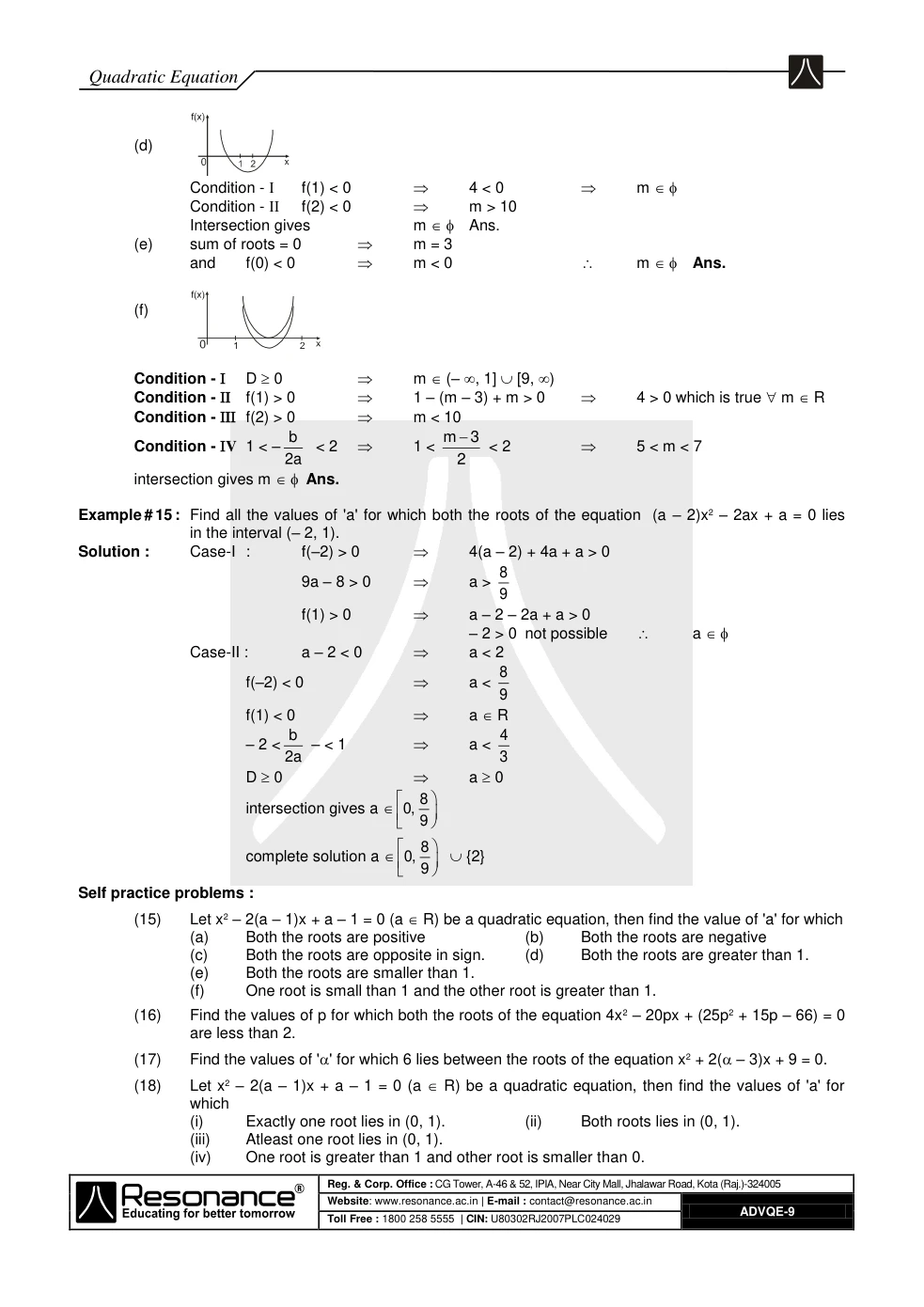
MAASQuadratic Equation
© MAAS. All rights reserved.Page 9 / 34
Extracted text · page 9
Quadratic Equation
(d)
Condition - f(1) < 0 4 < 0 m
Condition - f(2) < 0 m > 10
Intersection gives m Ans.
(e) sum of roots = 0 m = 3
and f(0) < 0 m < 0 m Ans.
(f)
Condition - D 0 m (– , 1] [9, )
Condition - f(1) > 0 1 – (m – 3) + m > 0 4 > 0which is true m R
Condition - f(2) > 0 m < 10
b m 3
Condition - V1 < – < 2 1 < < 2 5 < m < 7
2a 2
intersection gives m Ans.
Example # 15 : Find all the values of 'a' for which both the roots of the equation (a – 2)x2 – 2ax + a = 0 lies
in the interval (– 2, 1).
Solution : Case-I : f(–2) > 0 4(a – 2) + 4a + a > 0
8
9a – 8 > 0 a >
9
f(1) > 0 a – 2 – 2a + a > 0
– 2 > 0 not possible a
Case-II : a – 2 < 0 a < 2
8
f(–2) < 0 a <
9
f(1) < 0 a R
b 4
– 2 < – < 1 a <
2a 3
D 0 a 0
8
intersection gives a 0, 9
8
complete solution a 0, {2} 9
Self practice problems :
(15) Let x2 – 2(a – 1)x + a – 1 = 0 (a R) be a quadratic equation, then find the value of 'a' for which
(a) Both the roots are positive (b) Both the roots are negative
(c) Both the roots are opposite in sign. (d) Both the roots are greater than 1.
(e) Both the roots are smaller than 1.
(f) One root is small than 1 and the other root is greater than 1.
(16) Find the values of p for which both the roots of the equation 4x2 – 20px + (25p2 + 15p – 66) = 0
are less than 2.
(17) Find the values of '' for which 6 lies between the roots of the equation x2 + 2( – 3)x + 9 = 0.
(18) Let x2 – 2(a – 1)x + a – 1 = 0 (a R) be a quadratic equation, then find the values of 'a' for
which
(i) Exactly one root lies in (0, 1). (ii) Both roots lies in (0, 1).
(iii) Atleast one root lies in (0, 1).
(iv) One root is greater than 1 and other root is smaller than 0.
ADVQE-9
MAASQuadratic Equation
© MAAS. All rights reserved.Page 10 / 34
Extracted text · page 10
Quadratic Equation
(19) Find the values of a, for which the quadratic expression ax2 + (a – 2) x – 2 is negative for
exactly two integral values of x.
Answers : (15) (a) [2, ) (b) (c) (– , 1) (d) (e) (– , 1] (f) (2, )
3
(16) (– , –1) (17) , 4
(18) (i) (– , 1) (2, ) (ii) (iii) ( – , 1) (2, ) (iv)
(19) [1, 2)
11. Common Roots:
Consider two quadratic equations, a1 x2 + b1 x + c1 = 0 & a2 x2 + b2 x + c2 = 0.
(i) If two quadratic equations have both roots common, then the equations are identical and their
co-efficient are in proportion.
a1 b1 c 1 i.e. = =
a 2 b 2 c 2
(ii) If only one root is common, then the common root ' ' will be :
c1 a 2 c 2 a1 b1 c 2 b 2 c1 = =
a1 b 2 a 2 b1 c1 a 2 c 2 a1
Hence the condition for one common root is :
c1 a2 c 2 a1 2 = a1 b2 a2 b1 b1 c 2 b2 c1
Note : If f(x) = 0 & g(x) = 0 are two polynomial equation having some common root(s) then those common
root(s) is/are also the root(s) of h(x) a f(x) + bg (x) = 0.
Example # 16 : If x2 – ax + b = 0 and x2 – px + q = 0 have a root in common and the second equation has
ap
equal roots, show that b + q = .
2
Solution : Given equations are : x2 – ax + b= 0 ........ (i)
and x2 – px + q = 0. ........ (ii)
Let be the common root. Then roots of equation (ii) will be and . Let be the other root of
equation (i). Thus roots of equation (i) are , and those of equation (ii) are , .
Now + = a ........ (iii)
= b ........ (iv)
2 = p ........ (v)
2 = q ........ (vi)
L.H.S. = b + q = + 2 = ( + ) ........ (vii)
ap ( ) 2 and R.H.S. = = = ( + ) ........ (viii)
2 2
from (vii) and (viii), L.H.S. = R.H.S.
Example # 17 : If a, b, c R and equations ax2 + bx + c = 0 and x2 + 2x + 9 = 0 have a common root, show that
a : b : c = 1 : 2 : 9.
Solution : Given equations are : x2 + 2x + 9 = 0 ........(i)
and ax2 + bx + c = 0 ........(ii)
Clearly roots of equation (i) are imaginary since equation (i) and (ii) have a common root,
therefore common root must be imaginary and hence both roots will be common.
Therefore equations (i) and (ii) are identical
a b c
= =
1 2 9
a : b : c = 1 : 2 : 9
ADVQE-10
MAASQuadratic Equation
© MAAS. All rights reserved.Page 11 / 34
Extracted text · page 11
Quadratic Equation
Self practice problems :
(20) If the equations ax2 + bx + c = 0 and x3 + x – 2 = 0 have two common roots then show that
2a = 2b = c.
a b c
(21) If ax2 + 2bx + c = 0 and a1x2 + 2b1x + c1 = 0 have a common root and , , are in A.P.
a 1 b 1 c 1
show that a1, b1, c1 are in G.P.
12. Graphs of Polynomials
y = anxn + ............ + a1x + a0. The points where y' = 0 are called turning points which are critical in
plotting the graph.
Example # 18 : Draw the graph of y = 2x3 – 15x2 + 36x + 1
Solution. y = 6x2 – 30x + 36 = 6(x – 3) (x – 2)
x 2 3 –
y 29 28 –
Example # 19 : Draw the graph of y = –3x4 + 4x3 + 3,
Solution. y = –12x3 + 12x
y = –12x2 (x – 1)
x 0 1 –
y 3 4 – –
ADVQE-11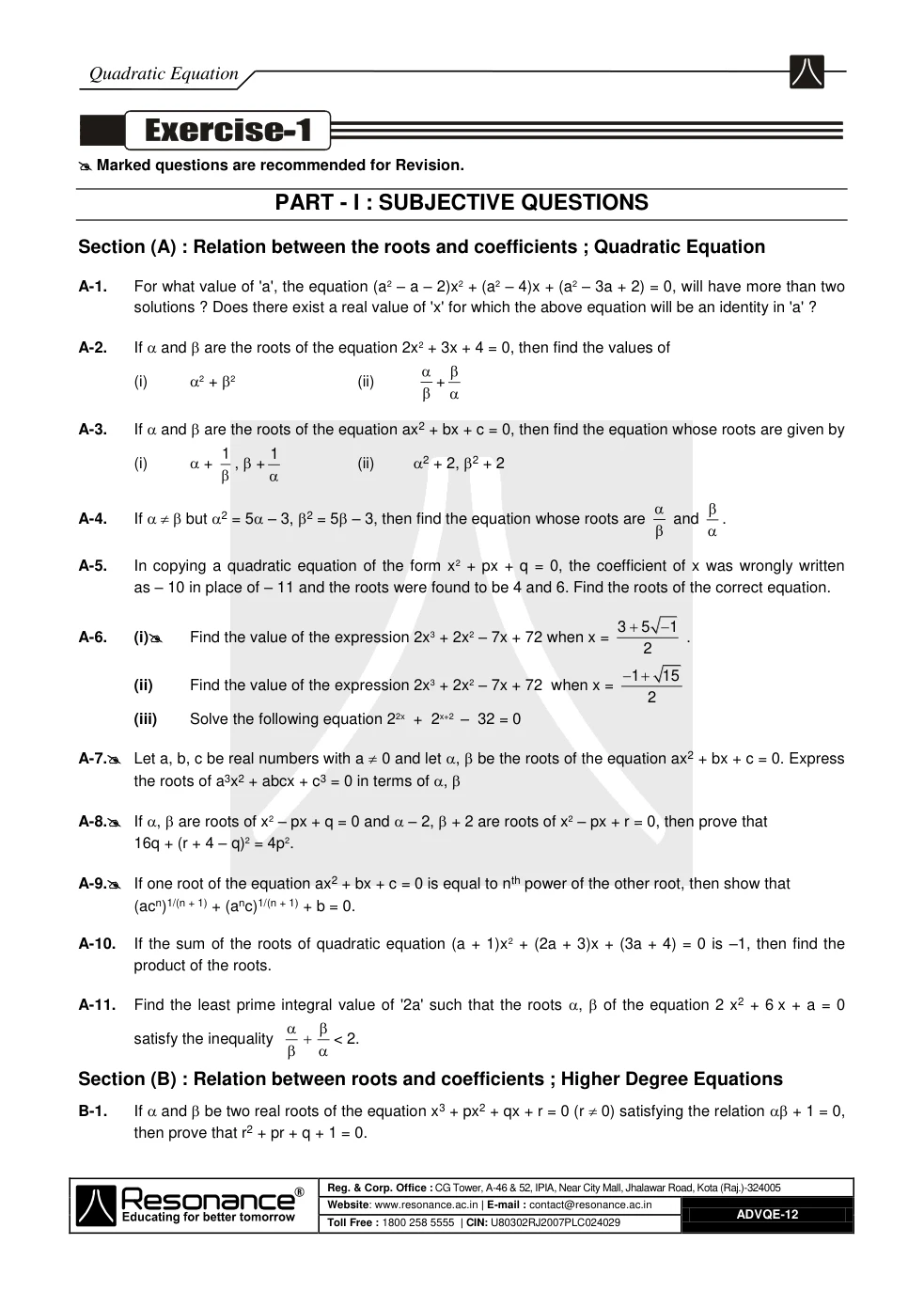
MAASQuadratic Equation
© MAAS. All rights reserved.Page 12 / 34
Extracted text · page 12
Quadratic Equation
Marked questions are recommended for Revision.
PART - I : SUBJECTIVE QUESTIONS
Section (A) : Relation between the roots and coefficients ; Quadratic Equation
A-1. For what value of 'a', the equation (a2 – a – 2)x2 + (a2 – 4)x + (a2 – 3a + 2) = 0, will have more than two
solutions ? Does there exist a real value of 'x' for which the above equation will be an identity in 'a' ?
A-2. If and are the roots of the equation 2x2 + 3x + 4 = 0, then find the values of
(i) 2 + 2 (ii) +
A-3. If and are the roots of the equation ax2 + bx + c = 0, then find the equation whose roots are given by
1 1
(i) + , + (ii) 2 + 2, 2 + 2
A-4. If but 2 = 5 – 3, 2 = 5 – 3, then find the equation whose roots are and .
A-5. In copying a quadratic equation of the form x2 + px + q = 0, the coefficient of x was wrongly written
as – 10 in place of – 11 and the roots were found to be 4 and 6. Find the roots of the correct equation.
3 5 1
A-6. (i) Find the value of the expression 2x3 + 2x2 – 7x + 72 when x = .
2
1 15
(ii) Find the value of the expression 2x3 + 2x2 – 7x + 72 when x =
2
(iii) Solve the following equation 22x + 2x+2 – 32 = 0
A-7. Let a, b, c be real numbers with a 0 and let , be the roots of the equation ax2 + bx + c = 0. Express
the roots of a3x2 + abcx + c3 = 0 in terms of ,
A-8. If , are roots of x2 – px + q = 0 and – 2, + 2 are roots of x2 – px + r = 0, then prove that
16q + (r + 4 – q)2 = 4p2.
A-9. If one root of the equation ax2 + bx + c = 0 is equal to nth power of the other root, then show that
(acn)1/(n + 1) + (anc)1/(n + 1) + b = 0.
A-10. If the sum of the roots of quadratic equation (a + 1)x2 + (2a + 3)x + (3a + 4) = 0 is –1, then find the
product of the roots.
A-11. Find the least prime integral value of '2a' such that the roots , of the equation 2 x2 + 6 x + a = 0
satisfy the inequality 2. <
Section (B) : Relation between roots and coefficients ; Higher Degree Equations
B-1. If and be two real roots of the equation x3 + px2 + qx + r = 0 (r 0) satisfying the relation + 1 = 0,
then prove that r2 + pr + q + 1 = 0.
ADVQE-12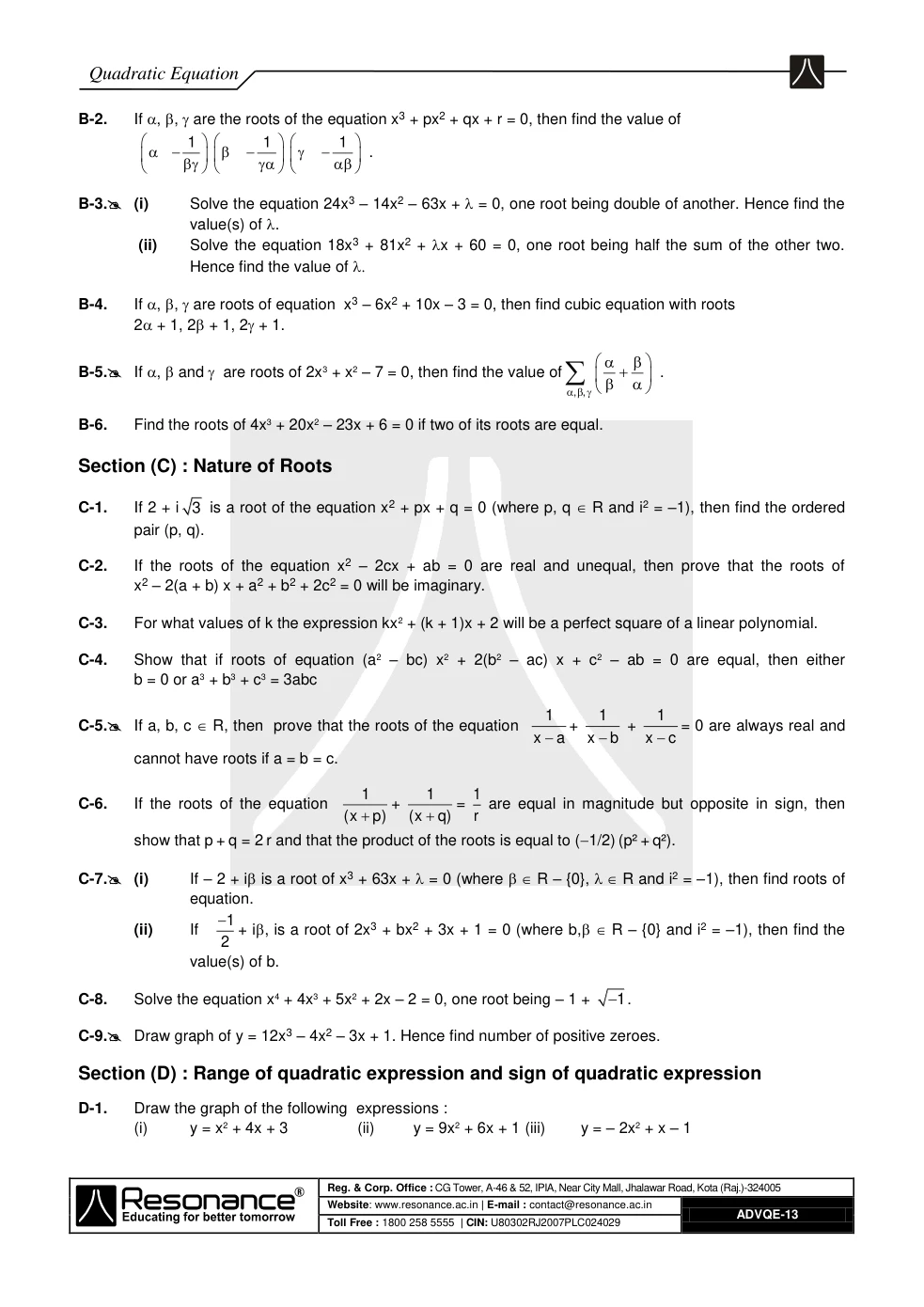
MAASQuadratic Equation
© MAAS. All rights reserved.Page 13 / 34
Extracted text · page 13
Quadratic Equation
B-2. If , , are the roots of the equation x3 + px2 + qx + r = 0, then find the value of
1 1 1
.
B-3. (i) Solve the equation 24x3 – 14x2 – 63x + = 0, one root being double of another. Hence find the
value(s) of .
(ii) Solve the equation 18x3 + 81x2 + x + 60 = 0, one root being half the sum of the other two.
Hence find the value of
B-4. If , , are roots of equation x3 – 6x2 + 10x – 3 = 0, then find cubic equation with roots
2 + 1, 2 + 1, 2 + 1.
.B-5. If , and are roots of 2x3 + x2 – 7 = 0, then find the value of , ,
B-6. Find the roots of 4x3 + 20x2 – 23x + 6 = 0 if two of its roots are equal.
Section (C) : Nature of Roots
C-1. If 2 + i 3 is a root of the equation x2 + px + q = 0 (where p, q R and i2 = –1), then find the ordered
pair (p, q).
C-2. If the roots of the equation x2 – 2cx + ab = 0 are real and unequal, then prove that the roots of
x2 – 2(a + b) x + a2 + b2 + 2c2 = 0 will be imaginary.
C-3. For what values of k the expression kx2 + (k + 1)x + 2 will be a perfect square of a linear polynomial.
C-4. Show that if roots of equation (a2 – bc) x2 + 2(b2 – ac) x + c2 – ab = 0 are equal, then either
b = 0 or a3 + b3 + c3 = 3abc
1 1 1
C-5. If a, b, c R, then prove that the roots of the equation + + = 0 are always real and
x a x b x c
cannot have roots if a = b = c.
1 1 1
C-6. If the roots of the equation + = are equal in magnitude but opposite in sign, then
(x p) (x q) r
show that p + q = 2 r and that the product of the roots is equal to (1/2) (p² + q²).
C-7. (i) If – 2 + i is a root of x3 + 63x + = 0 (where R – {0}, R and i2 = –1), then find roots of
equation.
1 (ii) If + i, is a root of 2x3 + bx2 + 3x + 1 = 0 (where b, R – {0} and i2 = –1), then find the
2
value(s) of b.
C-8. Solve the equation x4 + 4x3 + 5x2 + 2x – 2 = 0, one root being – 1 + .1
C-9. Draw graph of y = 12x3 – 4x2 – 3x + 1. Hence find number of positive zeroes.
Section (D) : Range of quadratic expression and sign of quadratic expression
D-1. Draw the graph of the following expressions :
(i) y = x2 + 4x + 3 (ii) y = 9x2 + 6x + 1 (iii) y = – 2x2 + x – 1
ADVQE-13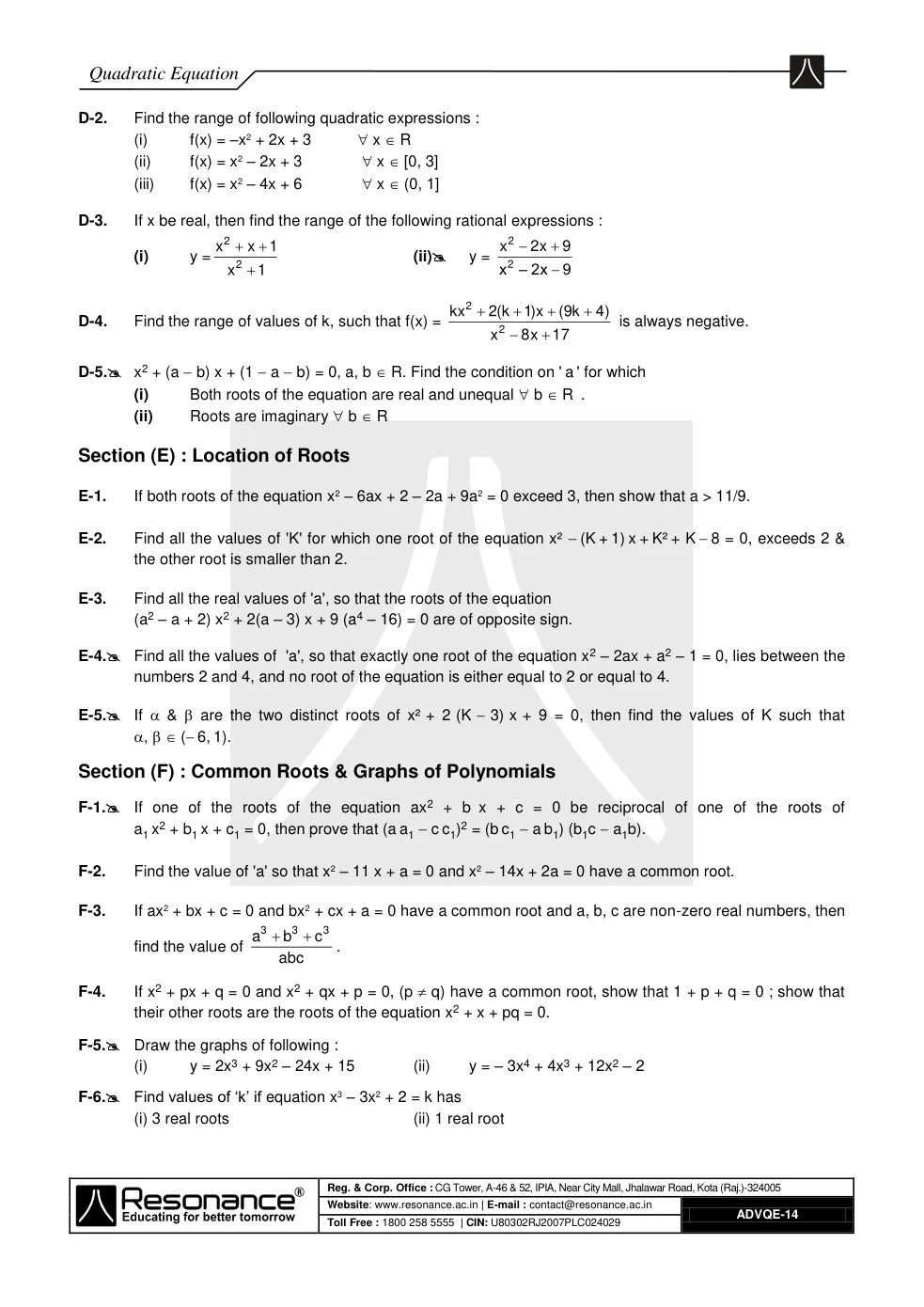
MAASQuadratic Equation
© MAAS. All rights reserved.Page 14 / 34
Extracted text · page 14
Quadratic Equation
D-2. Find the range of following quadratic expressions :
(i) f(x) = –x2 + 2x + 3 x R
(ii) f(x) = x2 – 2x + 3 x [0, 3]
(iii) f(x) = x2 – 4x + 6 x (0, 1]
D-3. If x be real, then find the range of the following rational expressions :
x 2 x 1 x 2 2x 9
(i) y = (ii) y =
x 2 1 x 2 – 2x 9
kx 2 2(k 1)x (9k 4)
D-4. Find the range of values of k, such that f(x) = is always negative.
x 2 8x 17
D-5. x2 + (a b) x + (1 a b) = 0, a, b R. Find the condition on ' a ' for which
(i) Both roots of the equation are real and unequal b R .
(ii) Roots are imaginary b R
Section (E) : Location of Roots
E-1. If both roots of the equation x2 – 6ax + 2 – 2a + 9a2 = 0 exceed 3, then show that a > 11/9.
E-2. Find all the values of 'K' for which one root of the equation x² (K + 1) x + K² + K 8 = 0, exceeds 2 &
the other root is smaller than 2.
E-3. Find all the real values of 'a', so that the roots of the equation
(a2 – a + 2) x2 + 2(a – 3) x + 9 (a4 – 16) = 0 are of opposite sign.
E-4. Find all the values of 'a', so that exactly one root of the equation x2 – 2ax + a2 – 1 = 0, lies between the
numbers 2 and 4, and no root of the equation is either equal to 2 or equal to 4.
E-5. If & are the two distinct roots of x² + 2 (K 3) x + 9 = 0, then find the values of K such that
, ( 6, 1).
Section (F) : Common Roots & Graphs of Polynomials
F-1. If one of the roots of the equation ax2 + b x + c = 0 be reciprocal of one of the roots of
a1 x2 + b1 x + c1 = 0, then prove that (a a1 c c1)2 = (b c1 a b1) (b1c a1b).
F-2. Find the value of 'a' so that x2 – 11 x + a = 0 and x2 – 14x + 2a = 0 have a common root.
F-3. If ax2 + bx + c = 0 and bx2 + cx + a = 0 have a common root and a, b, c are non-zero real numbers, then
a 3 b 3 c 3
find the value of .
abc
F-4. If x2 + px + q = 0 and x2 + qx + p = 0, (p q) have a common root, show that 1 + p + q = 0 ; show that
their other roots are the roots of the equation x2 + x + pq = 0.
F-5. Draw the graphs of following :
(i) y = 2x3 + 9x2 – 24x + 15 (ii) y = – 3x4 + 4x3 + 12x2 – 2
F-6. Find values of ‘k’ if equation x3 – 3x2 + 2 = k has
(i) 3 real roots (ii) 1 real root
ADVQE-14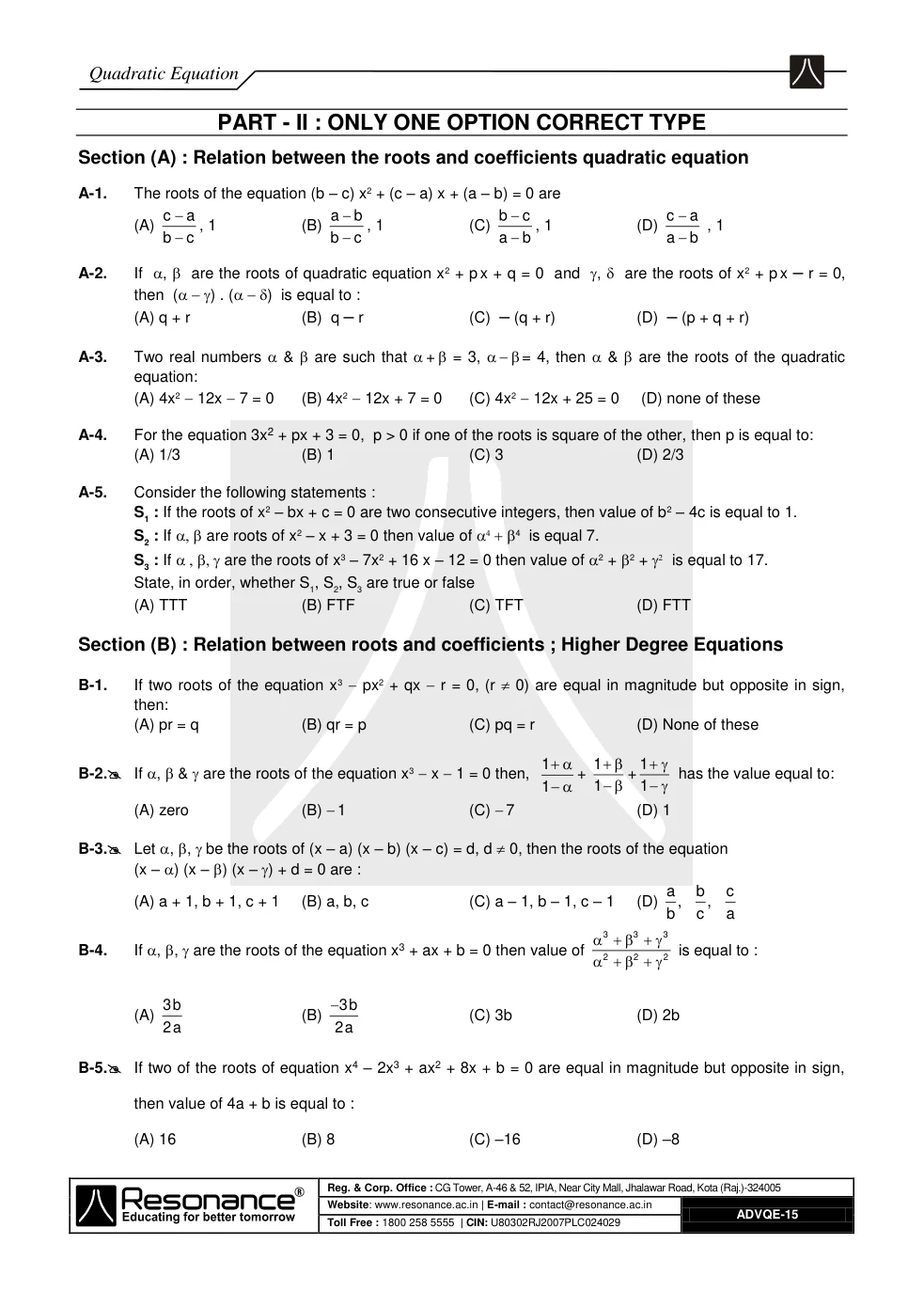
MAASQuadratic Equation
© MAAS. All rights reserved.Page 15 / 34
Extracted text · page 15
Quadratic Equation
PART - II : ONLY ONE OPTION CORRECT TYPE
Section (A) : Relation between the roots and coefficients quadratic equation
A-1. The roots of the equation (b – c) x2 + (c – a) x + (a – b) = 0 are
c a a b b c c a
(A) , 1 (B) , 1 (C) , 1 (D) , 1
b c b c a b a b
A-2. If , are the roots of quadratic equation x2 + p x + q = 0 and , are the roots of x2 + p x – r = 0,
then () . () is equal to :
(A) q + r (B) q – r (C) – (q + r) (D) – (p + q + r)
A-3. Two real numbers & are such that + = 3, = 4, then & are the roots of the quadratic
equation:
(A) 4x2 12x 7 = 0 (B) 4x2 12x + 7 = 0 (C) 4x2 12x + 25 = 0 (D) none of these
A-4. For the equation 3x2 + px + 3 = 0, p > 0 if one of the roots is square of the other, then p is equal to:
(A) 1/3 (B) 1 (C) 3 (D) 2/3
A-5. Consider the following statements :
S1 : If the roots of x2 – bx + c = 0 are two consecutive integers, then value of b2 – 4c is equal to 1.
S2 : If are roots of x2 – x + 3 = 0 then value of 4 is equal 7.
S3 : If are the roots of x3 – 7x2 + 16 x – 12 = 0 then value of 2 + 2 + is equal to 17.
State, in order, whether S1, S2, S3 are true or false
(A) TTT (B) FTF (C) TFT (D) FTT
Section (B) : Relation between roots and coefficients ; Higher Degree Equations
B-1. If two roots of the equation x3 px2 + qx r = 0, (r 0) are equal in magnitude but opposite in sign,
then:
(A) pr = q (B) qr = p (C) pq = r (D) None of these
1 1 1
B-2. If , & are the roots of the equation x3 x 1 = 0 then, + has the value equal to: 1 1 + 1
(A) zero (B) 1 (C) 7 (D) 1
B-3. Let , , be the roots of (x – a) (x – b) (x – c) = d, d 0, then the roots of the equation
(x – ) (x – ) (x – ) + d = 0 are :
a b c
(A) a + 1, b + 1, c + 1 (B) a, b, c (C) a – 1, b – 1, c – 1 (D) , ,
b c a
3 3 3
B-4. If , , are the roots of the equation x3 + ax + b = 0 then value of 2 2 2 is equal to :
3b 3b
(A) (B) (C) 3b (D) 2b
2a 2a
B-5. If two of the roots of equation x4 – 2x3 + ax2 + 8x + b = 0 are equal in magnitude but opposite in sign,
then value of 4a + b is equal to :
(A) 16 (B) 8 (C) –16 (D) –8
ADVQE-15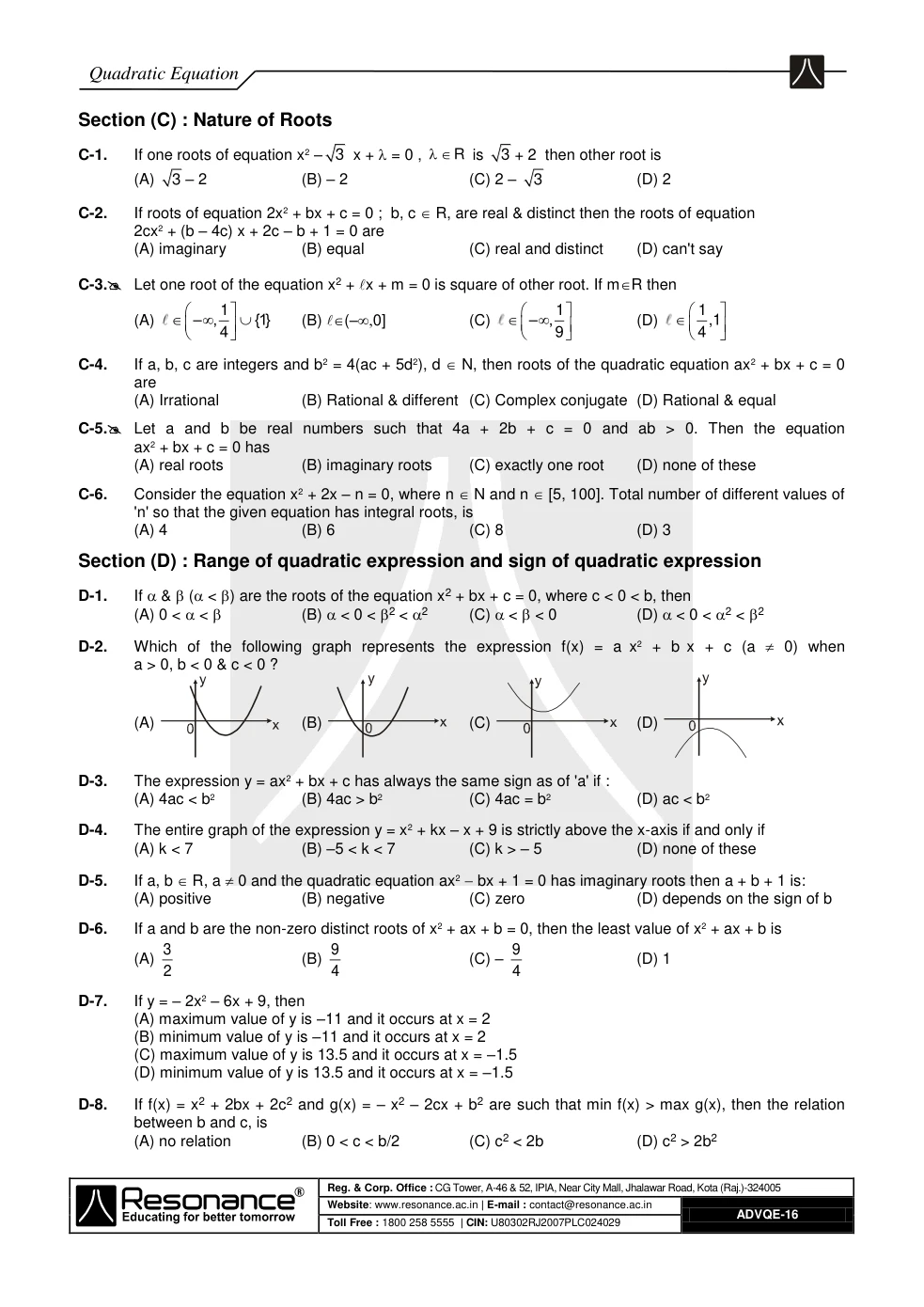
MAASQuadratic Equation
© MAAS. All rights reserved.Page 16 / 34
Extracted text · page 16
Quadratic Equation
Section (C) : Nature of Roots
C-1. If one roots of equation x2 – 3 x + = 0 , R is 3 + 2 then other root is
(A) 3 – 2 (B) – 2 (C) 2 – 3 (D) 2
C-2. If roots of equation 2x2 + bx + c = 0 ; b, c R, are real & distinct then the roots of equation
2cx2 + (b – 4c) x + 2c – b + 1 = 0 are
(A) imaginary (B) equal (C) real and distinct (D) can't say
C-3. Let one root of the equation x2 + x + m = 0 is square of other root. If mR then
1 1 1,1 (A) – , {1} (B) (–0] (C) – (D) 4 ,9 4
C-4. If a, b, c are integers and b2 = 4(ac + 5d2), d N, then roots of the quadratic equation ax2 + bx + c = 0
are
(A) Irrational (B) Rational & different (C) Complex conjugate (D) Rational & equal
C-5. Let a and b be real numbers such that 4a + 2b + c = 0 and ab > 0. Then the equation
ax2 + bx + c = 0 has
(A) real roots (B) imaginary roots (C) exactly one root (D) none of these
C-6. Consider the equation x2 + 2x – n = 0, where n N and n [5, 100]. Total number of different values of
'n' so that the given equation has integral roots, is
(A) 4 (B) 6 (C) 8 (D) 3
Section (D) : Range of quadratic expression and sign of quadratic expression
D-1. If & ( < ) are the roots of the equation x2 + bx + c = 0, where c < 0 < b, then
(A) 0 < < (B) < 0 < 2< 2 (C) < < 0 (D) < 0 < 2 < 2
D-2. Which of the following graph represents the expression f(x) = a x2 + b x + c (a 0) when
a > 0, b < 0 & c < 0 ?
(A) (B) (C) (D)
D-3. The expression y = ax2 + bx + c has always the same sign as of 'a' if :
(A) 4ac < b2 (B) 4ac > b2 (C) 4ac = b2 (D) ac < b2
D-4. The entire graph of the expression y = x2 + kx – x + 9 is strictly above the x-axis if and only if
(A) k < 7 (B) –5 < k < 7 (C) k > – 5 (D) none of these
D-5. If a, b R, a 0 and the quadratic equation ax2 bx + 1 = 0 has imaginary roots then a + b + 1 is:
(A) positive (B) negative (C) zero (D) depends on the sign of b
D-6. If a and b are the non-zero distinct roots of x2 + ax + b = 0, then the least value of x2 + ax + b is
3 9 9
(A) (B) (C) – (D) 1
2 4 4
D-7. If y = – 2x2 – 6x + 9, then
(A) maximum value of y is –11 and it occurs at x = 2
(B) minimum value of y is –11 and it occurs at x = 2
(C) maximum value of y is 13.5 and it occurs at x = –1.5
(D) minimum value of y is 13.5 and it occurs at x = –1.5
D-8. If f(x) = x2 + 2bx + 2c2 and g(x) = – x2 – 2cx + b2 are such that min f(x) > max g(x), then the relation
between b and c, is
(A) no relation (B) 0 < c < b/2 (C) c2 < 2b (D) c2 > 2b2
ADVQE-16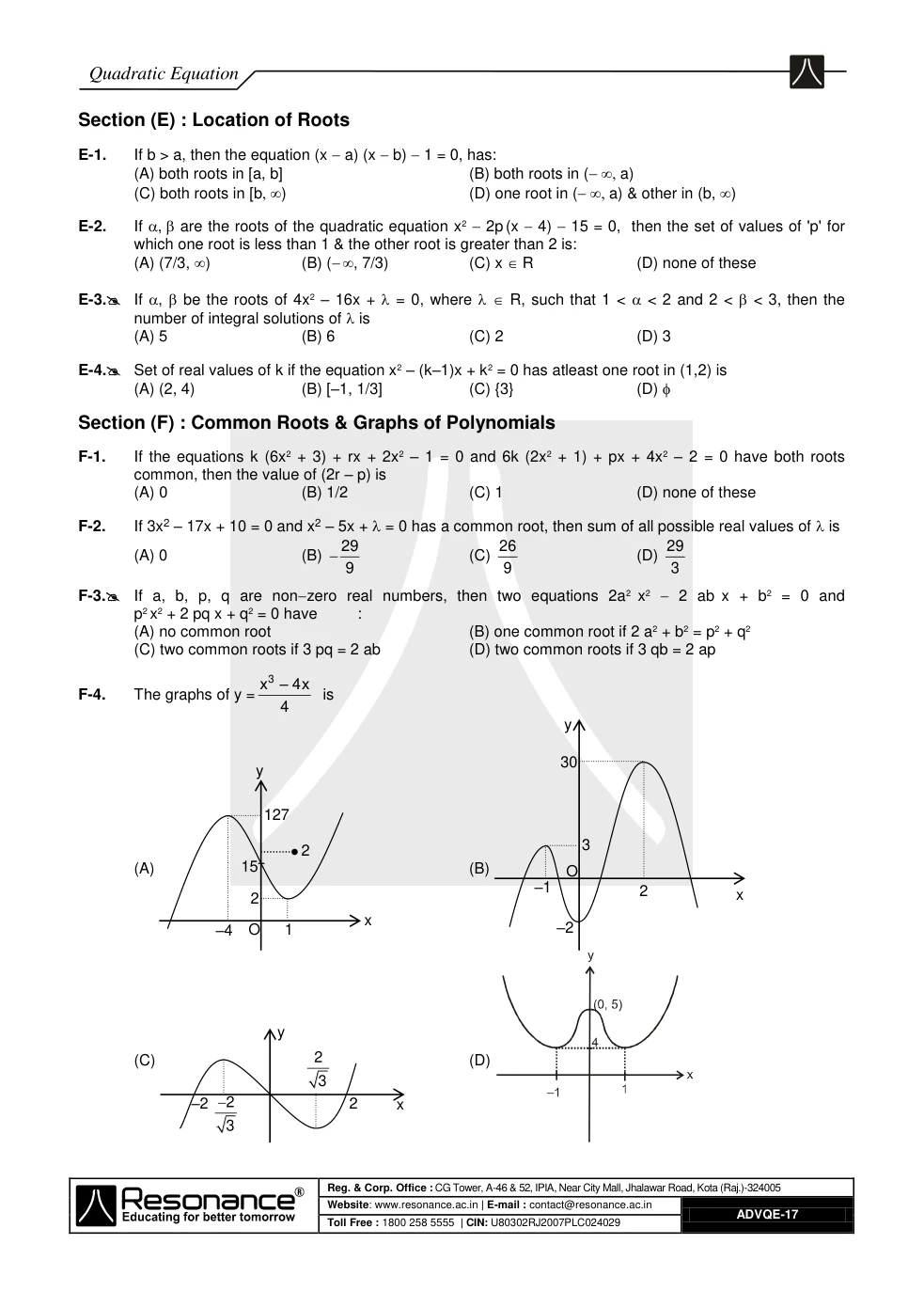
MAASQuadratic Equation
© MAAS. All rights reserved.Page 17 / 34
Extracted text · page 17
Quadratic Equation
Section (E) : Location of Roots
E-1. If b > a, then the equation (x a) (x b) 1 = 0, has:
(A) both roots in [a, b] (B) both roots in (a)
(C) both roots in [b) (D) one root in (a) & other in (b, )
E-2. If , are the roots of the quadratic equation x2 2p (x 4) 15 = 0, then the set of values of 'p' for
which one root is less than 1 & the other root is greater than 2 is:
(A) (7/3, ) (B) (, 7/3) (C) x R (D) none of these
E-3. If , be the roots of 4x2 – 16x + = 0, where R, such that 1 < < 2 and 2 < < 3, then the
number of integral solutions of is
(A) 5 (B) 6 (C) 2 (D) 3
E-4. Set of real values of k if the equation x2 – (k–1)x + k2 = 0 has atleast one root in (1,2) is
(A) (2, 4) (B) [–1, 1/3] (C) {3} (D)
Section (F) : Common Roots & Graphs of Polynomials
F-1. If the equations k (6x2 + 3) + rx + 2x2 – 1 = 0 and 6k (2x2 + 1) + px + 4x2 – 2 = 0 have both roots
common, then the value of (2r – p) is
(A) 0 (B) 1/2 (C) 1 (D) none of these
F-2. If 3x2 – 17x + 10 = 0 and x2 – 5x + = 0 has a common root, then sum of all possible real values of is
29 26 29
(A) 0 (B) (C) (D)
9 9 3
F-3. If a, b, p, q are nonzero real numbers, then two equations 2a2 x2 2 ab x + b2 = 0 and
p2 x2 + 2 pq x + q2 = 0 have :
(A) no common root (B) one common root if 2 a2 + b2 = p2 + q2
(C) two common roots if 3 pq = 2 ab (D) two common roots if 3 qb = 2 ap
x 3 – 4x
F-4. The graphs of y = is
4
y
30 y
127
3 2
(A) 15 (B) O
–1 2 x 2
x
–4 O 1 –2
y
(C) 2 (D)
3
–2 2 2 x
3
ADVQE-17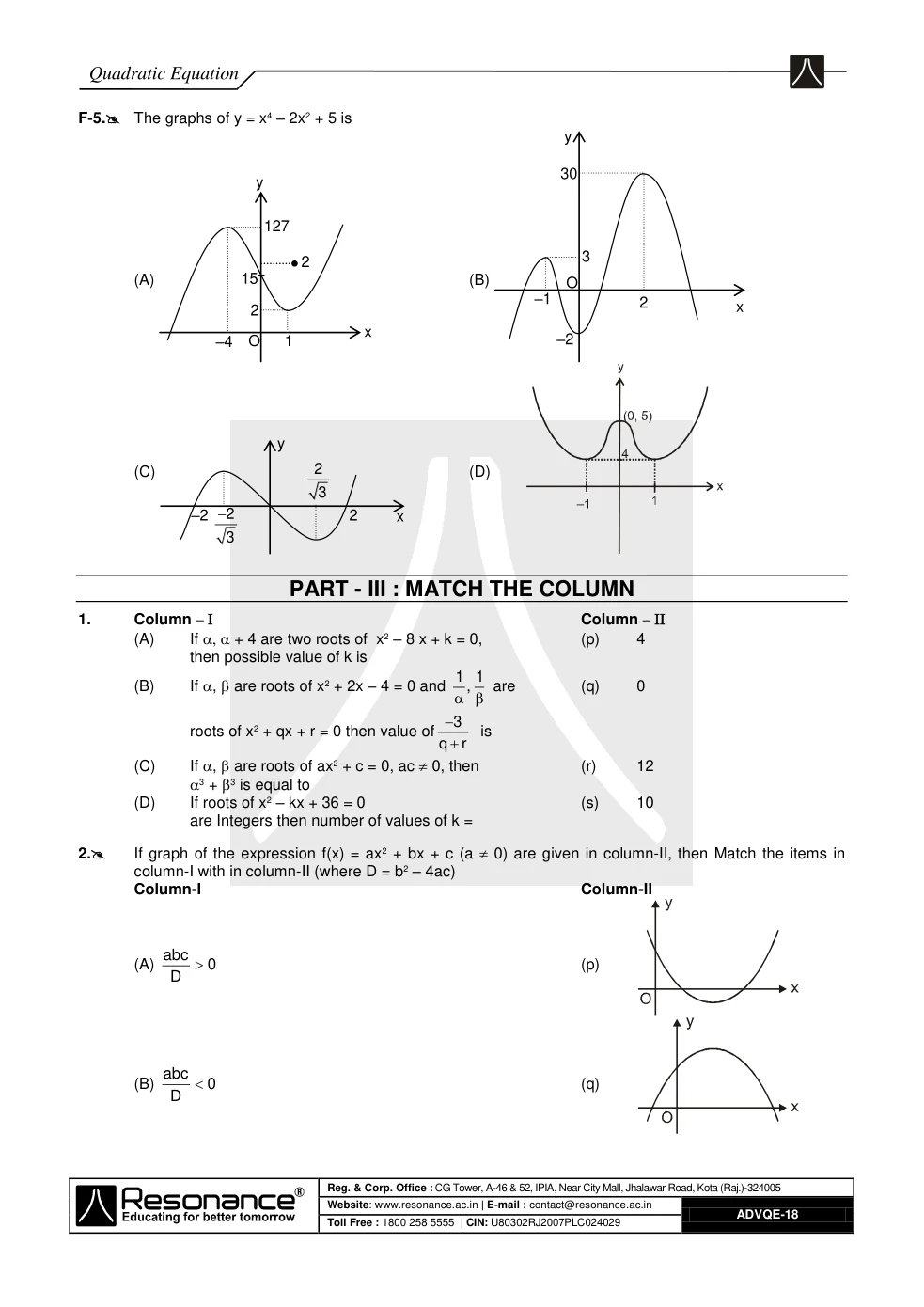
MAASQuadratic Equation
© MAAS. All rights reserved.Page 18 / 34
Extracted text · page 18
Quadratic Equation
F-5. The graphs of y = x4 – 2x2 + 5 is
y
30 y
127
3 2
(A) 15 (B) O
–1 2 x 2
x
–4 O 1 –2
y
(C) 2 (D)
3
–2 2 2 x
3
PART - III : MATCH THE COLUMN
1. Column – Column –
(A) If + 4 are two roots of x2 – 8 x + k = 0, (p) 4
then possible value of k is
1 1
(B) If , are roots of x2 + 2x – 4 = 0 and , are (q) 0
3
roots of x2 + qx + r = 0 then value of is
q r
(C) If , are roots of ax2 + c = 0, ac 0, then (r) 12
3 + 3 is equal to
(D) If roots of x2 – kx + 36 = 0 (s) 10
are Integers then number of values of k =
2. If graph of the expression f(x) = ax2 + bx + c (a 0) are given in column-II, then Match the items in
column-I with in column-II (where D = b2 – 4ac)
Column-I Column-II
abc
(A) 0 (p)
D
abc
(B) 0 (q)
D
ADVQE-18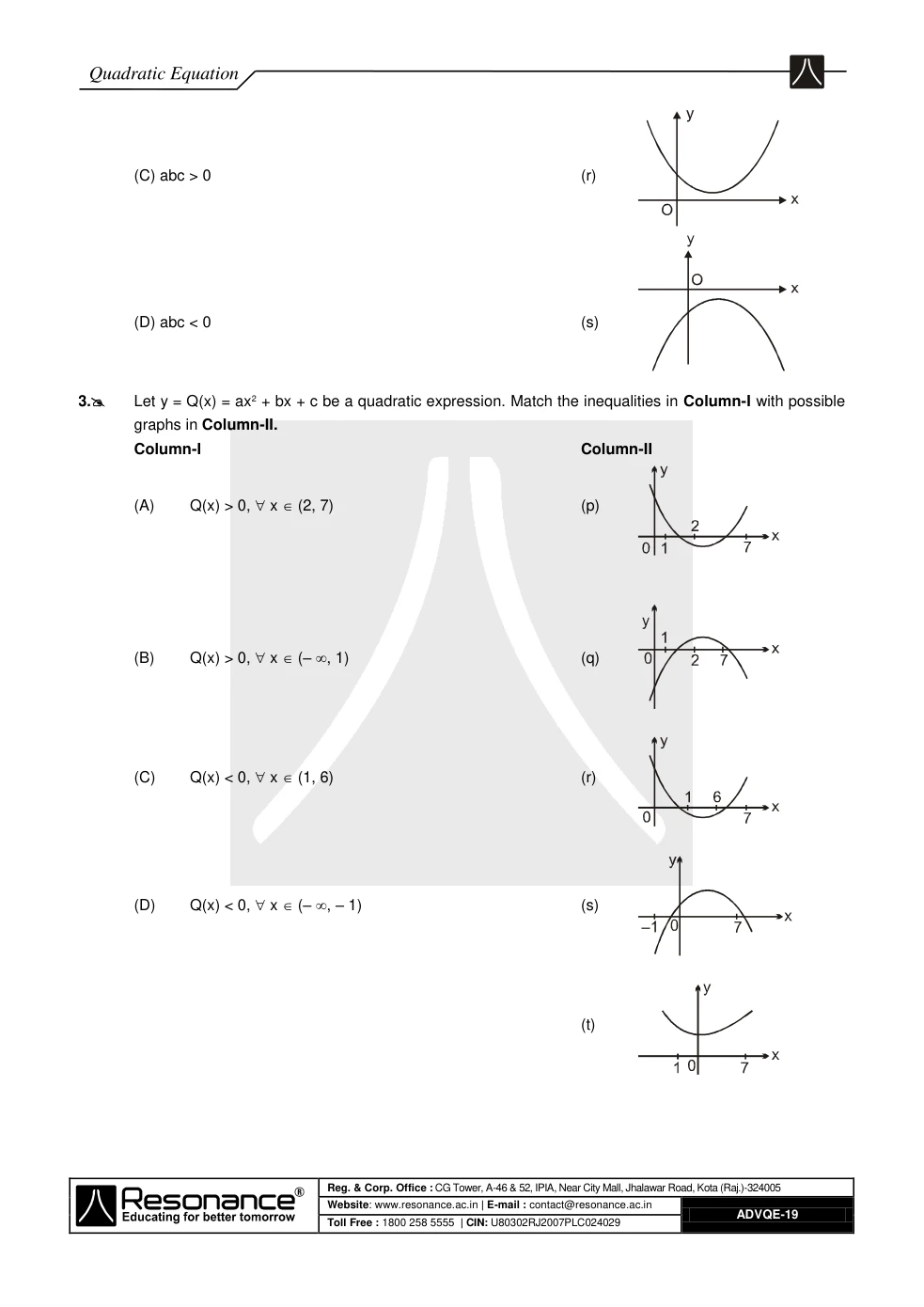
MAASQuadratic Equation
© MAAS. All rights reserved.Page 19 / 34
Extracted text · page 19
Quadratic Equation
(C) abc > 0 (r)
(D) abc < 0 (s)
3. Let y = Q(x) = ax2 + bx + c be a quadratic expression. Match the inequalities in Column-I with possible
graphs in Column-II.
Column-I Column-II
(A) Q(x) > 0, x (2, 7) (p)
(B) Q(x) > 0, x (– , 1) (q)
(C) Q(x) < 0, x (1, 6) (r)
(D) Q(x) < 0, x (– , – 1) (s)
(t)
ADVQE-19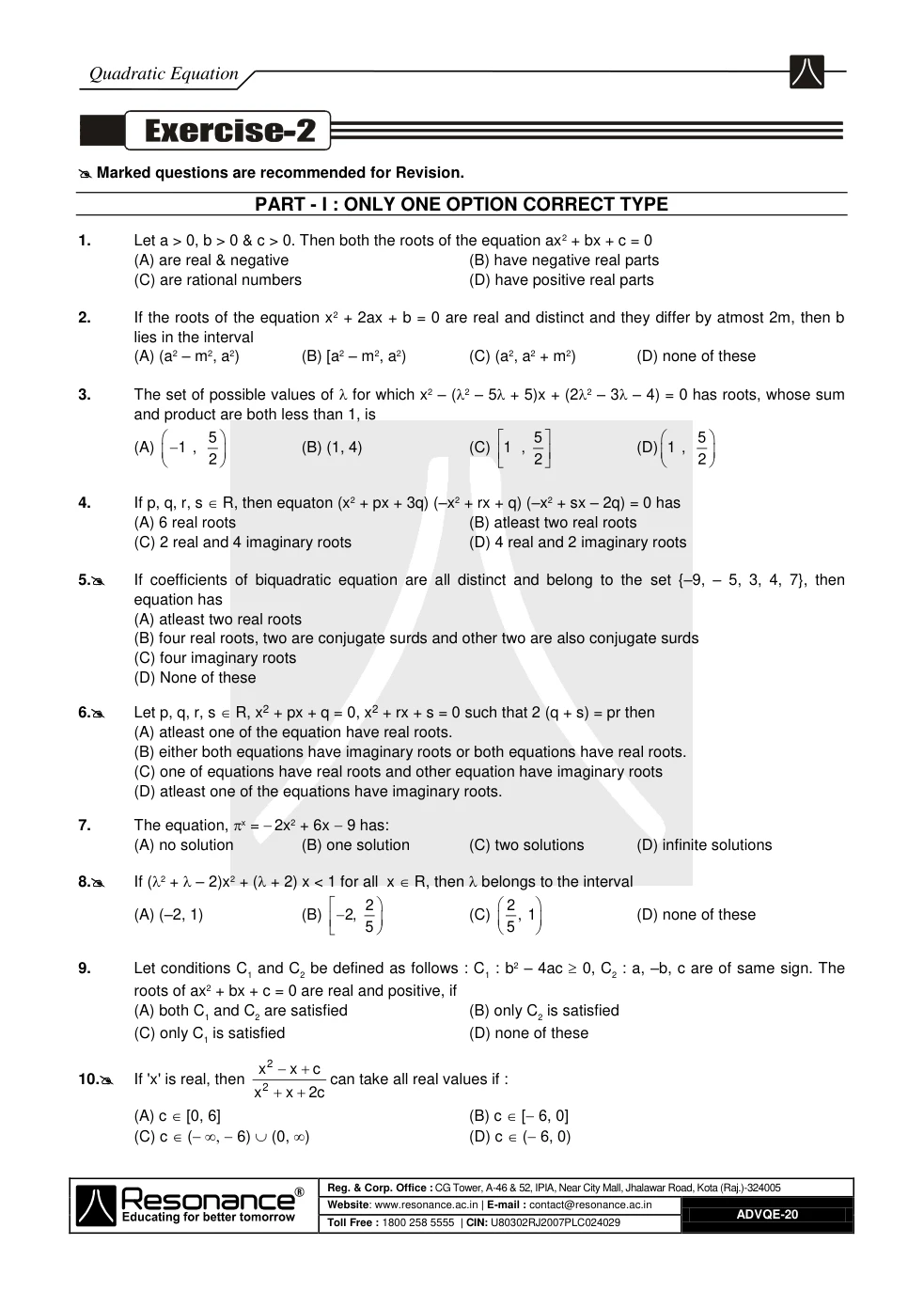
MAASQuadratic Equation
© MAAS. All rights reserved.Page 20 / 34
Extracted text · page 20
Quadratic Equation
Marked questions are recommended for Revision.
PART - I : ONLY ONE OPTION CORRECT TYPE
1. Let a > 0, b > 0 & c > 0. Then both the roots of the equation ax2 + bx + c = 0
(A) are real & negative (B) have negative real parts
(C) are rational numbers (D) have positive real parts
2. If the roots of the equation x2 + 2ax + b = 0 are real and distinct and they differ by atmost 2m, then b
lies in the interval
(A) (a2 – m2, a2) (B) [a2 – m2, a2) (C) (a2, a2 + m2) (D) none of these
3. The set of possible values of for which x2 – (2 – 5 + 5)x + (22 – 3 – 4) = 0 has roots, whose sum
and product are both less than 1, is
5 5 5
(A) 1 , (B) (1, 4) (C) 1 , (D) 1 , 2 2 2
4. If p, q, r, s R, then equaton (x2 + px + 3q) (–x2 + rx + q) (–x2 + sx – 2q) = 0 has
(A) 6 real roots (B) atleast two real roots
(C) 2 real and 4 imaginary roots (D) 4 real and 2 imaginary roots
5. If coefficients of biquadratic equation are all distinct and belong to the set {–9, – 5, 3, 4, 7}, then
equation has
(A) atleast two real roots
(B) four real roots, two are conjugate surds and other two are also conjugate surds
(C) four imaginary roots
(D) None of these
6. Let p, q, r, s R, x2 + px + q = 0, x2 + rx + s = 0 such that 2 (q + s) = pr then
(A) atleast one of the equation have real roots.
(B) either both equations have imaginary roots or both equations have real roots.
(C) one of equations have real roots and other equation have imaginary roots
(D) atleast one of the equations have imaginary roots.
7. The equation, x = 2x2 + 6x 9 has:
(A) no solution (B) one solution (C) two solutions (D) infinite solutions
8. If (2 + – 2)x2 + ( + 2) x < 1 for all x R, then belongs to the interval
2 2
(A) (–2, 1) (B) 2, (C) , 1 (D) none of these 5 5
9. Let conditions C1 and C2 be defined as follows : C1 : b2 – 4ac 0, C2 : a, –b, c are of same sign. The
roots of ax2 + bx + c = 0 are real and positive, if
(A) both C1 and C2 are satisfied (B) only C2 is satisfied
(C) only C1 is satisfied (D) none of these
x 2 x c
10. If 'x' is real, then can take all real values if :
x 2 x 2c
(A) c [0, 6] (B) c [ 6, 0]
(C) c ( 6) (0, ) (D) c ( 6, 0)
ADVQE-20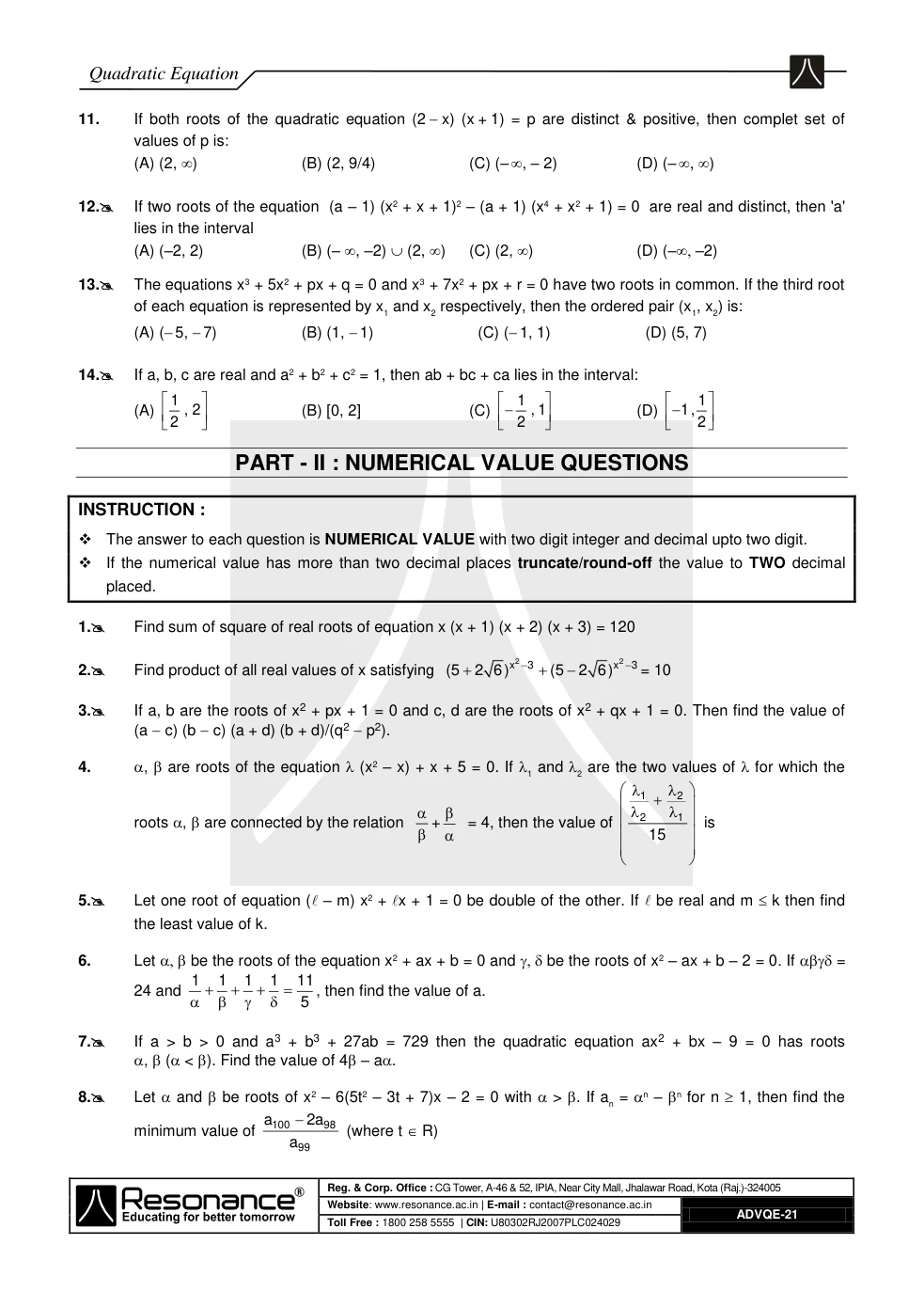
MAASQuadratic Equation
© MAAS. All rights reserved.Page 21 / 34
Extracted text · page 21
Quadratic Equation
11. If both roots of the quadratic equation (2 x) (x + 1) = p are distinct & positive, then complet set of
values of p is:
(A) (2, ) (B) (2, 9/4) (C) (– , – 2) (D) (– , )
12. If two roots of the equation (a – 1) (x2 + x + 1)2 – (a + 1) (x4 + x2 + 1) = 0 are real and distinct, then 'a'
lies in the interval
(A) (–2, 2) (B) (– , –2) (2, ) (C) (2, ) (D) (––2)
13. The equations x3 + 5x2 + px + q = 0 and x3 + 7x2 + px + r = 0 have two roots in common. If the third root
of each equation is represented by x1 and x2 respectively, then the ordered pair (x1, x2) is:
(A) ( 5, 7) (B) (1, 1) (C) ( 1, 1) (D) (5, 7)
14. If a, b, c are real and a2 + b2 + c2 = 1, then ab + bc + ca lies in the interval:
1 1 1 (A) , 2 (B) [0, 2] (C) , 1 (D) 1, 2 2 2
PART - II : NUMERICAL VALUE QUESTIONS
INSTRUCTION :
The answer to each question is NUMERICAL VALUE with two digit integer and decimal upto two digit.
If the numerical value has more than two decimal places truncate/round-off the value to TWO decimal
placed.
1. Find sum of square of real roots of equation x (x + 1) (x + 2) (x + 3) = 120
2. Find product of all real values of x satisfying (5 2 6) x 2 3 (5 2 6) x 2 3 = 10
3. If a, b are the roots of x2 + px + 1 = 0 and c, d are the roots of x2 + qx + 1 = 0. Then find the value of
(a c) (b c) (a + d) (b + d)/(q2 p2).
4. , are roots of the equation (x2 – x) + x + 5 = 0. If 1 and 2 are the two values of for which the
1 2 = 4, then the value of 2 1 is roots , are connected by the relation + 15
5. Let one root of equation ( – m) x2 + x + 1 = 0 be double of the other. If be real and m k then find
the least value of k.
6. Let be the roots of the equation x2 + ax + b = 0 and be the roots of x2 – ax + b – 2 = 0. If =
1 1 1 1 11
24 and , then find the value of a.
5
7. If a > b > 0 and a3 + b3 + 27ab = 729 then the quadratic equation ax2 + bx – 9 = 0 has roots
, ( < ). Find the value of 4 – a.
8. Let and be roots of x2 – 6(5t2 – 3t + 7)x – 2 = 0 with > . If an = n – n for n 1, then find the
a100 2a 98 minimum value of (where t R)
a 99
ADVQE-21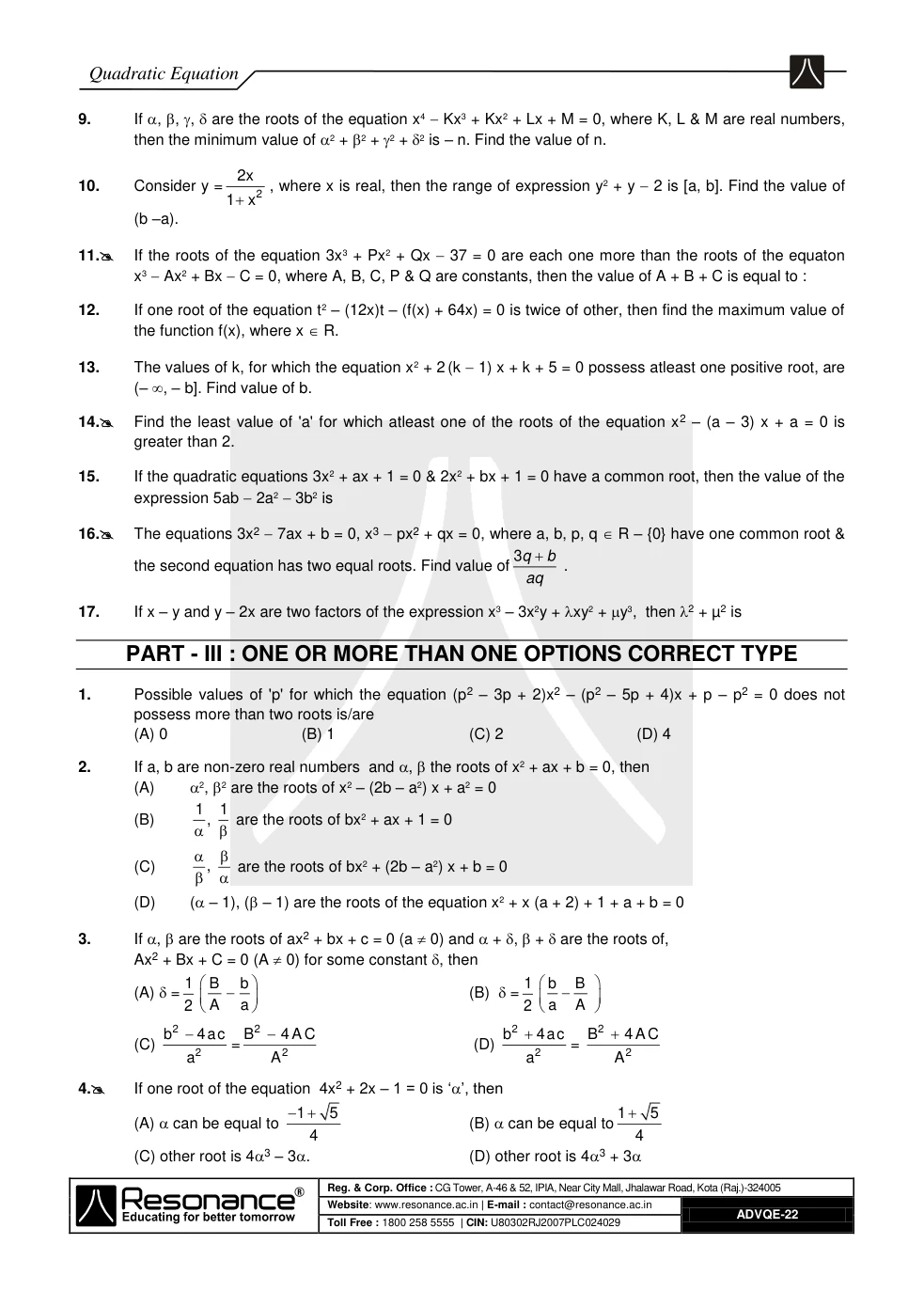
MAASQuadratic Equation
© MAAS. All rights reserved.Page 22 / 34
Extracted text · page 22
Quadratic Equation
9. If , , , are the roots of the equation x4 Kx3 + Kx2 + Lx + M = 0, where K, L & M are real numbers,
then the minimum value of 2 + 2 + 2 + 2 is – n. Find the value of n.
2x
10. Consider y = , where x is real, then the range of expression y2 + y 2 is [a, b]. Find the value of
1 x 2
(b –a).
11. If the roots of the equation 3x3 + Px2 + Qx 37 = 0 are each one more than the roots of the equaton
x3 Ax2 + Bx C = 0, where A, B, C, P & Q are constants, then the value of A + B + C is equal to :
12. If one root of the equation t2 – (12x)t – (f(x) + 64x) = 0 is twice of other, then find the maximum value of
the function f(x), where x R.
13. The values of k, for which the equation x2 + 2 (k 1) x + k + 5 = 0 possess atleast one positive root, are
(– , – b]. Find value of b.
14. Find the least value of 'a' for which atleast one of the roots of the equation x2 – (a – 3) x + a = 0 is
greater than 2.
15. If the quadratic equations 3x2 + ax + 1 = 0 & 2x2 + bx + 1 = 0 have a common root, then the value of the
expression 5ab 2a2 3b2 is
16. The equations 3x2 7ax + b = 0, x3 px2 + qx = 0, where a, b, p, q R – {0} have one common root &
3q b
the second equation has two equal roots. Find value of .
aq
17. If x – y and y – 2x are two factors of the expression x3 – 3x2y + xy2 + y3, then 2 + µ2 is
PART - III : ONE OR MORE THAN ONE OPTIONS CORRECT TYPE
1. Possible values of 'p' for which the equation (p2 – 3p + 2)x2 – (p2 – 5p + 4)x + p – p2 = 0 does not
possess more than two roots is/are
(A) 0 (B) 1 (C) 2 (D) 4
2. If a, b are non-zero real numbers and , the roots of x2 + ax + b = 0, then
(A) 2, 2 are the roots of x2 – (2b – a2) x + a2 = 0
1 1
(B) , are the roots of bx2 + ax + 1 = 0
(C) , are the roots of bx2 + (2b – a2) x + b = 0
(D) ( – 1), ( – 1) are the roots of the equation x2 + x (a + 2) + 1 + a + b = 0
3. If , are the roots of ax2 + bx + c = 0 (a 0) and + , + are the roots of,
Ax2 + Bx + C = 0 (A 0) for some constant , then
1 B b 1 b B
(A) = (B) = 2 A a 2 a A
b 2 4ac B 2 4 A C b 2 4ac B 2 4AC
(C) = (D) =
a 2 A 2 a 2 A 2
4. If one root of the equation 4x2 + 2x – 1 = 0 is ‘’, then
1 5 1 5
(A) can be equal to (B) can be equal to
4 4
(C) other root is 43 – 3. (D) other root is 43 + 3
ADVQE-22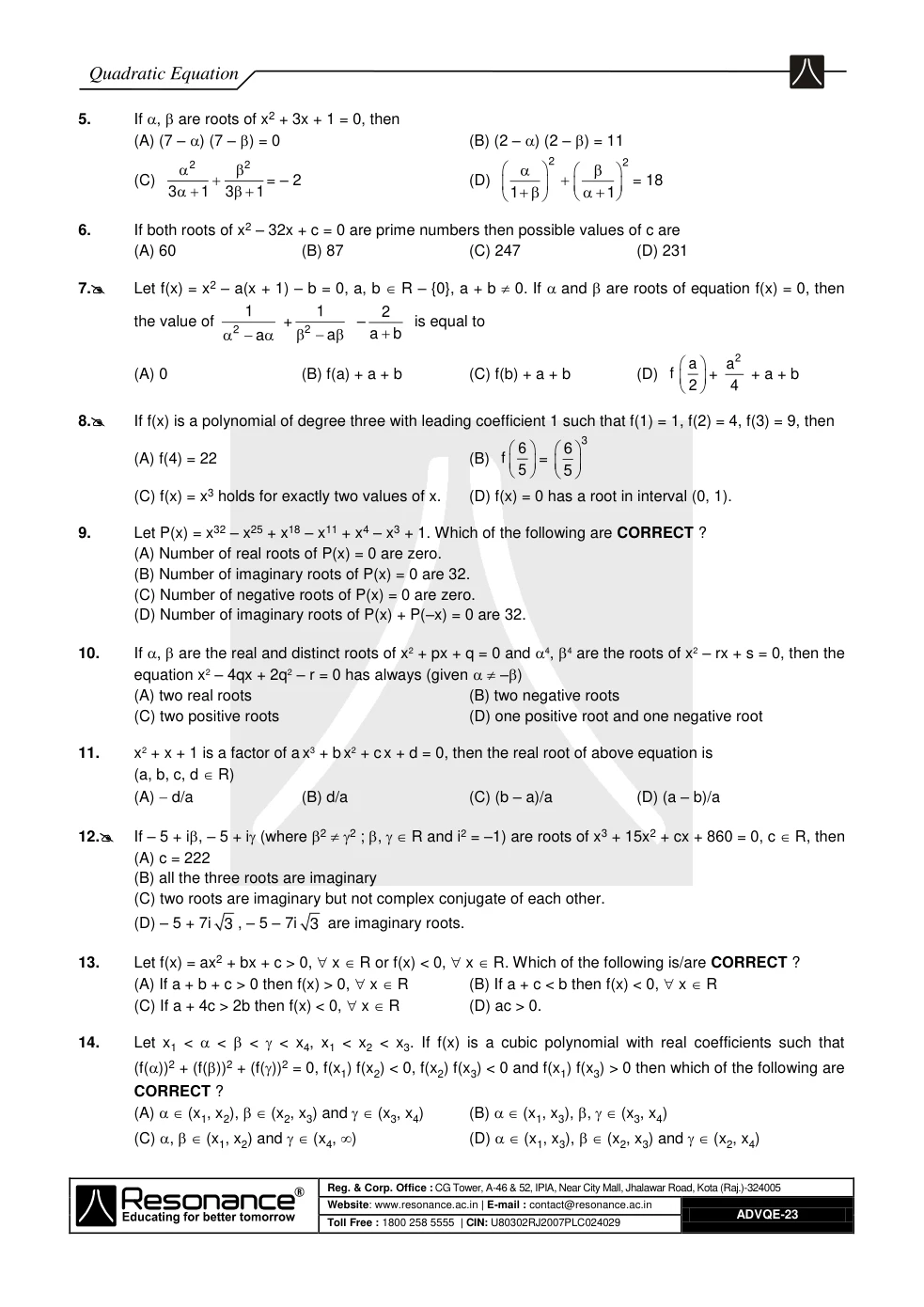
MAASQuadratic Equation
© MAAS. All rights reserved.Page 23 / 34
Extracted text · page 23
Quadratic Equation
5. If , are roots of x2 + 3x + 1 = 0, then
(A) (7 – ) (7 – ) = 0 (B) (2 – ) (2 – ) = 11
2 2 2 2
(C) = – 2 (D) = 18 3 1 3 1 1 1
6. If both roots of x2 – 32x + c = 0 are prime numbers then possible values of c are
(A) 60 (B) 87 (C) 247 (D) 231
7. Let f(x) = x2 – a(x + 1) – b = 0, a, b R – {0}, a + b 0. If and are roots of equation f(x) = 0, then
1 1 2
the value of + – is equal to
2 a 2 a a b
a a 2
(A) 0 (B) f(a) + a + b (C) f(b) + a + b (D) f + + a + b 2 4
8. If f(x) is a polynomial of degree three with leading coefficient 1 such that f(1) = 1, f(2) = 4, f(3) = 9, then
6 6 3
(A) f(4) = 22 (B) f = 5 5
(C) f(x) = x3 holds for exactly two values of x. (D) f(x) = 0 has a root in interval (0, 1).
9. Let P(x) = x32 – x25 + x18 – x11 + x4 – x3 + 1. Which of the following are CORRECT ?
(A) Number of real roots of P(x) = 0 are zero.
(B) Number of imaginary roots of P(x) = 0 are 32.
(C) Number of negative roots of P(x) = 0 are zero.
(D) Number of imaginary roots of P(x) + P(–x) = 0 are 32.
10. If , are the real and distinct roots of x2 + px + q = 0 and 4, 4 are the roots of x2 – rx + s = 0, then the
equation x2 – 4qx + 2q2 – r = 0 has always (given –)
(A) two real roots (B) two negative roots
(C) two positive roots (D) one positive root and one negative root
11. x2 + x + 1 is a factor of a x3 + b x2 + c x + d = 0, then the real root of above equation is
(a, b, c, d R)
(A) d/a (B) d/a (C) (b – a)/a (D) (a – b)/a
12. If – 5 + i, – 5 + i (where 2 2 ; , R and i2 = –1) are roots of x3 + 15x2 + cx + 860 = 0, c R, then
(A) c = 222
(B) all the three roots are imaginary
(C) two roots are imaginary but not complex conjugate of each other.
(D) – 5 + 7i 3 , – 5 – 7i 3 are imaginary roots.
13. Let f(x) = ax2 + bx + c > 0, x R or f(x) < 0, x R. Which of the following is/are CORRECT ?
(A) If a + b + c > 0 then f(x) > 0, x R (B) If a + c < b then f(x) < 0, x R
(C) If a + 4c > 2b then f(x) < 0, x R (D) ac > 0.
14. Let x1 < < < < x4, x1 < x2 < x3. If f(x) is a cubic polynomial with real coefficients such that
(f())2 + (f())2 + (f())2 = 0, f(x1) f(x2) < 0, f(x2) f(x3) < 0 and f(x1) f(x3) > 0 then which of the following are
CORRECT ?
(A) (x1, x2), (x2, x3) and (x3, x4) (B) (x1, x3), , (x3, x4)
(C) , (x1, x2) and (x4, ) (D) (x1, x3), (x2, x3) and (x2, x4)
ADVQE-23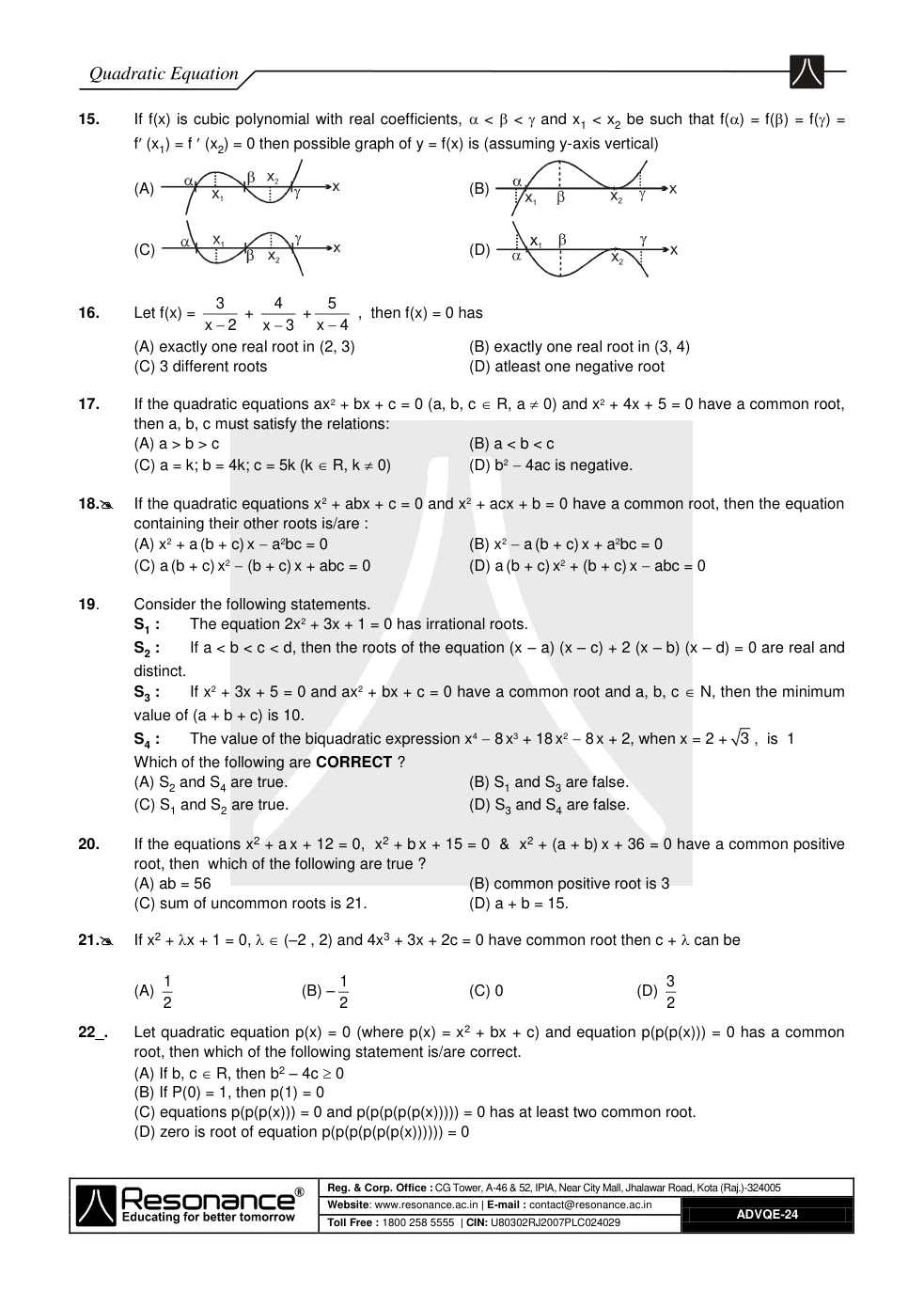
MAASQuadratic Equation
© MAAS. All rights reserved.Page 24 / 34
Extracted text · page 24
Quadratic Equation
15. If f(x) is cubic polynomial with real coefficients, < < and x1 < x2 be such that f() = f() = f() =
f(x1) = f (x2) = 0 then possible graph of y = f(x) is (assuming y-axis vertical)
(A) (B)
(C) (D)
3 4 5
16. Let f(x) = + + , then f(x) = 0 has
x 2 x 3 x 4
(A) exactly one real root in (2, 3) (B) exactly one real root in (3, 4)
(C) 3 different roots (D) atleast one negative root
17. If the quadratic equations ax2 + bx + c = 0 (a, b, c R, a 0) and x2 + 4x + 5 = 0 have a common root,
then a, b, c must satisfy the relations:
(A) a > b > c (B) a < b < c
(C) a = k; b = 4k; c = 5k (k R, k 0) (D) b2 4ac is negative.
18. If the quadratic equations x2 + abx + c = 0 and x2 + acx + b = 0 have a common root, then the equation
containing their other roots is/are :
(A) x2 + a (b + c) x a2bc = 0 (B) x2 a (b + c) x + a2bc = 0
(C) a (b + c) x2 (b + c) x + abc = 0 (D) a (b + c) x2 + (b + c) x abc = 0
19. Consider the following statements.
S1 : The equation 2x2 + 3x + 1 = 0 has irrational roots.
S2 : If a < b < c < d, then the roots of the equation (x – a) (x – c) + 2 (x – b) (x – d) = 0 are real and
distinct.
S3 : If x2 + 3x + 5 = 0 and ax2 + bx + c = 0 have a common root and a, b, c N, then the minimum
value of (a + b + c) is 10.
S4 : The value of the biquadratic expression x4 8 x3 + 18 x2 8 x + 2, when x = 2 + 3 , is 1
Which of the following are CORRECT ?
(A) S2 and S4 are true. (B) S1 and S3 are false.
(C) S1 and S2 are true. (D) S3 and S4 are false.
20. If the equations x2 + a x + 12 = 0, x2 + b x + 15 = 0 & x2 + (a + b) x + 36 = 0 have a common positive
root, then which of the following are true ?
(A) ab = 56 (B) common positive root is 3
(C) sum of uncommon roots is 21. (D) a + b = 15.
21. If x2 + x + 1 = 0, (–2 , 2) and 4x3 + 3x + 2c = 0 have common root then c + can be
1 1 3
(A) (B) – (C) 0 (D)
2 2 2
22_. Let quadratic equation p(x) = 0 (where p(x) = x2 + bx + c) and equation p(p(p(x))) = 0 has a common
root, then which of the following statement is/are correct.
(A) If b, c R, then b2 – 4c 0
(B) If P(0) = 1, then p(1) = 0
(C) equations p(p(p(x))) = 0 and p(p(p(p(p(x))))) = 0 has at least two common root.
(D) zero is root of equation p(p(p(p(p(p(x)))))) = 0
ADVQE-24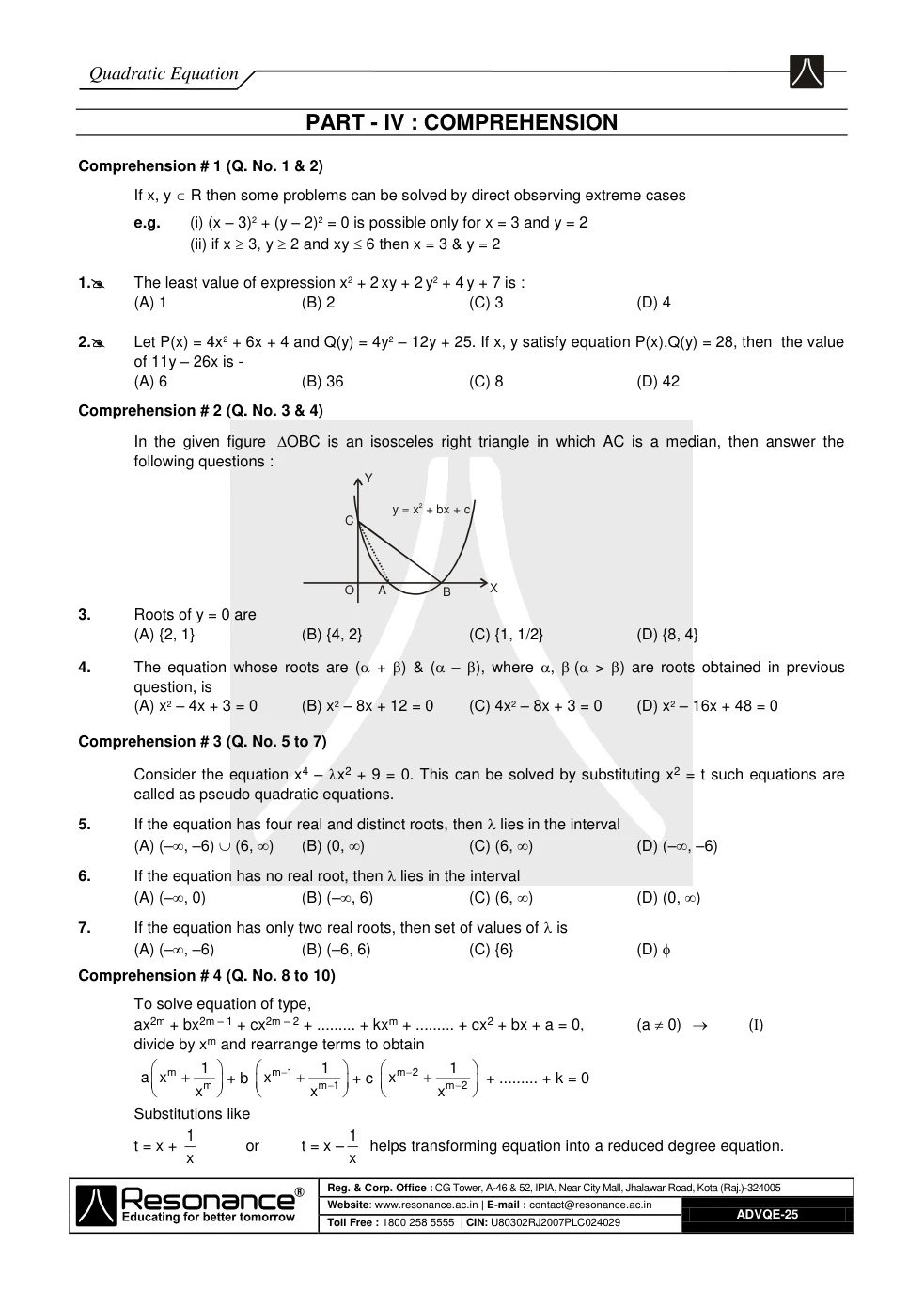
MAASQuadratic Equation
© MAAS. All rights reserved.Page 25 / 34
Extracted text · page 25
Quadratic Equation
PART - IV : COMPREHENSION
Comprehension # 1 (Q. No. 1 & 2)
If x, y R then some problems can be solved by direct observing extreme cases
e.g. (i) (x – 3)2 + (y – 2)2 = 0 is possible only for x = 3 and y = 2
(ii) if x 3, y 2 and xy 6 then x = 3 & y = 2
1. The least value of expression x2 + 2 xy + 2 y2 + 4 y + 7 is :
(A) 1 (B) 2 (C) 3 (D) 4
2. Let P(x) = 4x2 + 6x + 4 and Q(y) = 4y2 – 12y + 25. If x, y satisfy equation P(x).Q(y) = 28, then the value
of 11y – 26x is -
(A) 6 (B) 36 (C) 8 (D) 42
Comprehension # 2 (Q. No. 3 & 4)
In the given figure OBC is an isosceles right triangle in which AC is a median, then answer the
following questions :
Y
y = x2 + bx + c
C
O A B X
3. Roots of y = 0 are
(A) {2, 1} (B) {4, 2} (C) {1, 1/2} (D) {8, 4}
4. The equation whose roots are ( + ) & ( – ), where , ( > ) are roots obtained in previous
question, is
(A) x2 – 4x + 3 = 0 (B) x2 – 8x + 12 = 0 (C) 4x2 – 8x + 3 = 0 (D) x2 – 16x + 48 = 0
Comprehension # 3 (Q. No. 5 to 7)
Consider the equation x4 – x2 + 9 = 0. This can be solved by substituting x2 = t such equations are
called as pseudo quadratic equations.
5. If the equation has four real and distinct roots, then lies in the interval
(A) (–, –6) (6, ) (B) (0, ) (C) (6, ) (D) (–, –6)
6. If the equation has no real root, then lies in the interval
(A) (–, 0) (B) (–, 6) (C) (6, ) (D) (0, )
7. If the equation has only two real roots, then set of values of is
(A) (–, –6) (B) (–6, 6) (C) {6} (D)
Comprehension # 4 (Q. No. 8 to 10)
To solve equation of type,
ax2m + bx2m – 1 + cx2m – 2 + ......... + kxm + ......... + cx2 + bx + a = 0, (a 0) ()
divide by xm and rearrange terms to obtain
m 1 m 1 1 m 2 1
a x m + b x m 1 + c x m 2 + ......... + k = 0 x x x
Substitutions like
1 1
t = x + or t = x – helps transforming equation into a reduced degree equation.
x x
ADVQE-25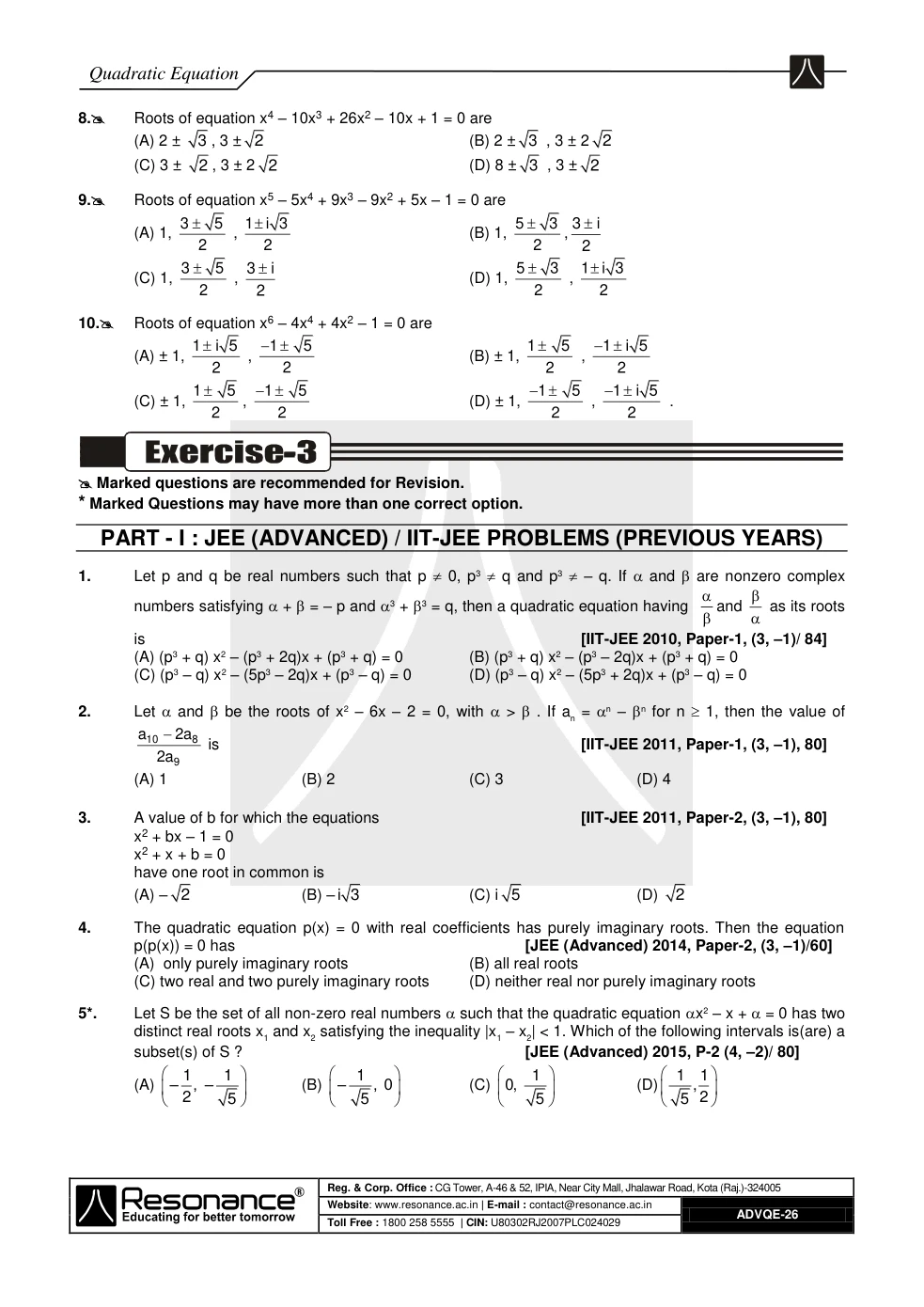
MAASQuadratic Equation
© MAAS. All rights reserved.Page 26 / 34
Extracted text · page 26
Quadratic Equation
8. Roots of equation x4 – 10x3 + 26x2 – 10x + 1 = 0 are
(A) 2 ± 3 , 3 ± 2 (B) 2 ± 3 , 3 ± 2 2
(C) 3 ± 2 , 3 ± 2 2 (D) 8 ± 3 , 3 ± 2
9. Roots of equation x5 – 5x4 + 9x3 – 9x2 + 5x – 1 = 0 are
3 5 1 i 3 5 3 3 i
(A) 1, , (B) 1, ,
2 2 2 2
3 5 3 i 5 3 1 i 3
(C) 1, , (D) 1, ,
2 2 2 2
10. Roots of equation x6 – 4x4 + 4x2 – 1 = 0 are
1 i 5 1 5 1 5 1 i 5
(A) ± 1, , (B) ± 1, ,
2 2 2 2
1 5 1 5 1 5 1 i 5
(C) ± 1, , (D) ± 1, , .
2 2 2 2
Marked questions are recommended for Revision.
* Marked Questions may have more than one correct option.
PART - I : JEE (ADVANCED) / IIT-JEE PROBLEMS (PREVIOUS YEARS)
1. Let p and q be real numbers such that p 0, p3 q and p3 – q. If and are nonzero complex
numbers satisfying + = – p and 3 + 3 = q, then a quadratic equation having and as its roots
is [IIT-JEE 2010, Paper-1, (3, –1)/ 84]
(A) (p3 + q) x2 – (p3 + 2q)x + (p3 + q) = 0 (B) (p3 + q) x2 – (p3 – 2q)x + (p3 + q) = 0
(C) (p3 – q) x2 – (5p3 – 2q)x + (p3 – q) = 0 (D) (p3 – q) x2 – (5p3 + 2q)x + (p3 – q) = 0
2. Let and be the roots of x2 – 6x – 2 = 0, with > . If an = n – n for n 1, then the value of
a10 2a 8 is [IIT-JEE 2011, Paper-1, (3, –1), 80]
2a 9
(A) 1 (B) 2 (C) 3 (D) 4
3. A value of b for which the equations [IIT-JEE 2011, Paper-2, (3, –1), 80]
x2 + bx – 1 = 0
x2 + x + b = 0
have one root in common is
(A) – 2 (B) –i 3 (C) i 5 (D) 2
4. The quadratic equation p(x) = 0 with real coefficients has purely imaginary roots. Then the equation
p(p(x)) = 0 has [JEE (Advanced) 2014, Paper-2, (3, –1)/60]
(A) only purely imaginary roots (B) all real roots
(C) two real and two purely imaginary roots (D) neither real nor purely imaginary roots
5*. Let S be the set of all non-zero real numbers such that the quadratic equation x2 – x + = 0 has two
distinct real roots x1 and x2 satisfying the inequality |x1 – x2| < 1. Which of the following intervals is(are) a
subset(s) of S ? [JEE (Advanced) 2015, P-2 (4, –2)/ 80]
1 1 1 1 1 1
(A) – , – (B) – , 0 (C) 0, (D) ,
2 5 5 5 5 2
ADVQE-26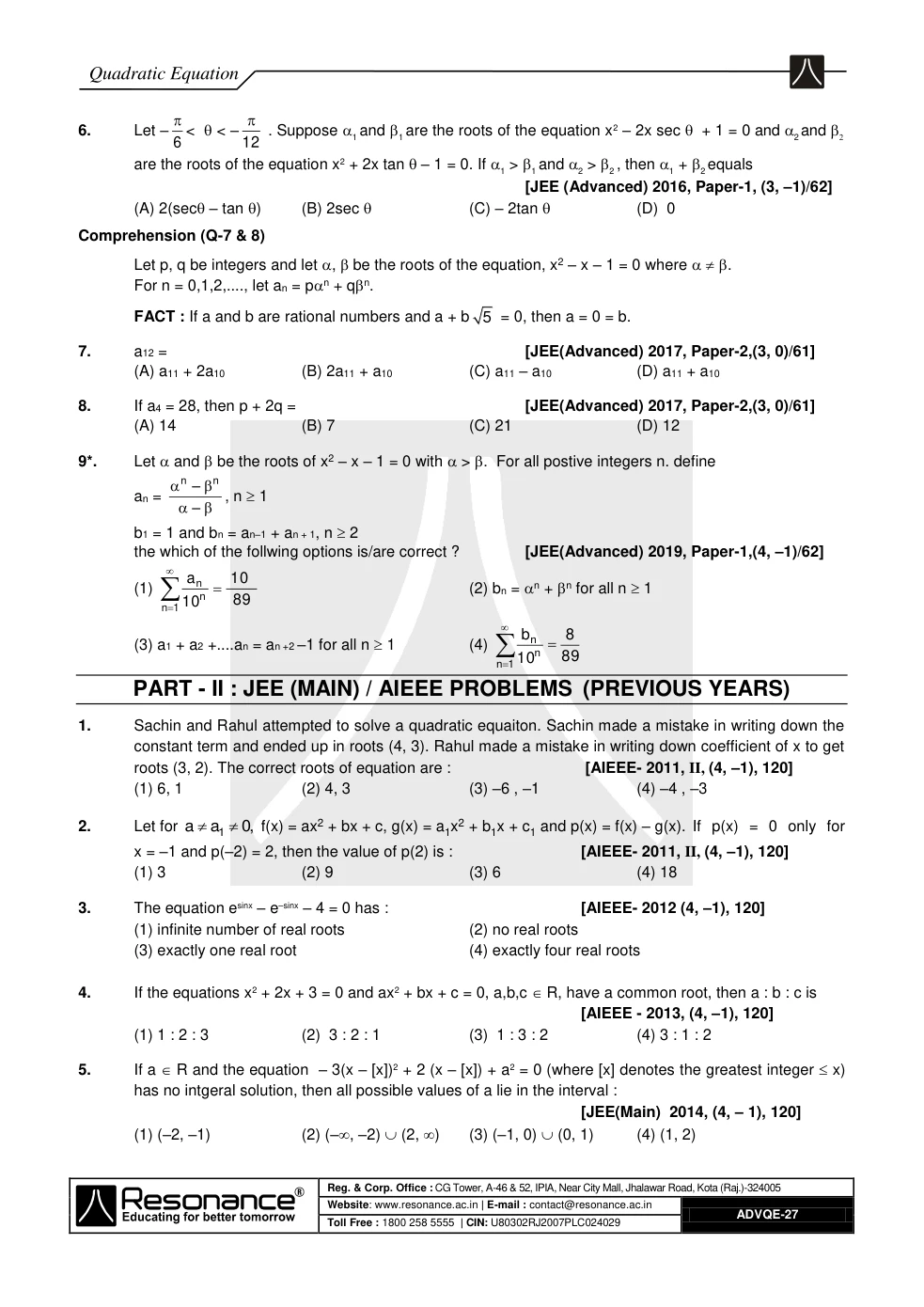
MAASQuadratic Equation
© MAAS. All rights reserved.Page 27 / 34
Extracted text · page 27
Quadratic Equation
6. Let – < < – . Suppose 1 and 1 are the roots of the equation x2 – 2x sec + 1 = 0 and 2 and
6 12
are the roots of the equation x2 + 2x tan – 1 = 0. If 1 > 1 and 2 > 2 , then 1 + 2 equals
[JEE (Advanced) 2016, Paper-1, (3, –1)/62]
(A) 2(sec – tan ) (B) 2sec (C) – 2tan (D) 0
Comprehension (Q-7 & 8)
Let p, q be integers and let , be the roots of the equation, x2 – x – 1 = 0 where .
For n = 0,1,2,...., let an = pn + qn.
FACT : If a and b are rational numbers and a + b 5 = 0, then a = 0 = b.
7. a12 = [JEE(Advanced) 2017, Paper-2,(3, 0)/61]
(A) a11 + 2a10 (B) 2a11 + a10 (C) a11 – a10 (D) a11 + a10
8. If a4 = 28, then p + 2q = [JEE(Advanced) 2017, Paper-2,(3, 0)/61]
(A) 14 (B) 7 (C) 21 (D) 12
9*. Let and be the roots of x2 – x – 1 = 0 with > . For all postive integers n. define
n – n
an = , n 1
–
b1 = 1 and bn = an–1 + an + 1, n 2
the which of the follwing options is/are correct ? [JEE(Advanced) 2019, Paper-1,(4, –1)/62]
a n 10 (1) (2) bn = n + n for all n 1 n 1 10n 89
b n 8 (3) a1 + a2 +....an = an +2 –1 for all n 1 (4) n 1 10n 89
PART - II : JEE (MAIN) / AIEEE PROBLEMS (PREVIOUS YEARS)
1. Sachin and Rahul attempted to solve a quadratic equaiton. Sachin made a mistake in writing down the
constant term and ended up in roots (4, 3). Rahul made a mistake in writing down coefficient of x to get
roots (3, 2). The correct roots of equation are : [AIEEE- 2011, II, (4, –1), 120]
(1) 6, 1 (2) 4, 3 (3) –6 , –1 (4) –4 , –3
2. Let for a a1 0, f(x) = ax2 + bx + c, g(x) = a1x2 + b1x + c1 and p(x) = f(x) – g(x). If p(x) = 0 only for
x = –1 and p(–2) = 2, then the value of p(2) is : [AIEEE- 2011, II, (4, –1), 120]
(1) 3 (2) 9 (3) 6 (4) 18
3. The equation esinx – e–sinx – 4 = 0 has : [AIEEE- 2012 (4, –1), 120]
(1) infinite number of real roots (2) no real roots
(3) exactly one real root (4) exactly four real roots
4. If the equations x2 + 2x + 3 = 0 and ax2 + bx + c = 0, a,b,c R, have a common root, then a : b : c is
[AIEEE - 2013, (4, –1), 120]
(1) 1 : 2 : 3 (2) 3 : 2 : 1 (3) 1 : 3 : 2 (4) 3 : 1 : 2
5. If a R and the equation – 3(x – [x])2 + 2 (x – [x]) + a2 = 0 (where [x] denotes the greatest integer x)
has no intgeral solution, then all possible values of a lie in the interval :
[JEE(Main) 2014, (4, – 1), 120]
(1) (–2, –1) (2) (–, –2) (2, ) (3) (–1, 0) (0, 1) (4) (1, 2)
ADVQE-27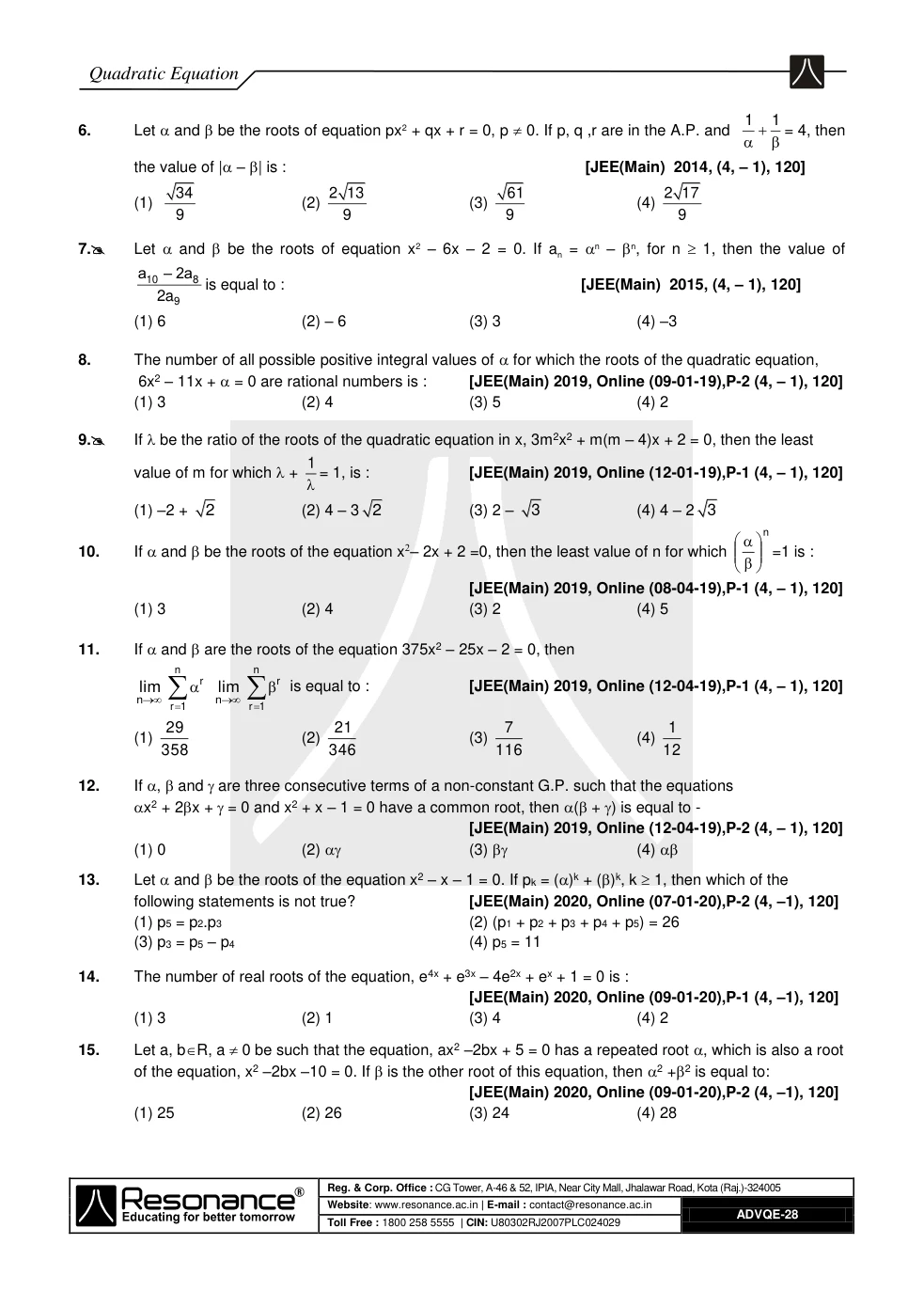
MAASQuadratic Equation
© MAAS. All rights reserved.Page 28 / 34
Extracted text · page 28
Quadratic Equation
1 1
6. Let and be the roots of equation px2 + qx + r = 0, p 0. If p, q ,r are in the A.P. and 4, then =
the value of | – | is : [JEE(Main) 2014, (4, – 1), 120]
34 2 13 61 2 17
(1) (2) (3) (4)
9 9 9 9
7. Let and be the roots of equation x2 – 6x – 2 = 0. If an = n – n, for n 1, then the value of
a10 – 2a 8 is equal to : [JEE(Main) 2015, (4, – 1), 120]
2a 9
(1) 6 (2) – 6 (3) 3 (4) –3
8. The number of all possible positive integral values of for which the roots of the quadratic equation,
6x2 – 11x + = 0 are rational numbers is : [JEE(Main) 2019, Online (09-01-19),P-2 (4, – 1), 120]
(1) 3 (2) 4 (3) 5 (4) 2
9. If be the ratio of the roots of the quadratic equation in x, 3m2x2 + m(m – 4)x + 2 = 0, then the least
1
value of m for which + = 1, is : [JEE(Main) 2019, Online (12-01-19),P-1 (4, – 1), 120]
(1) –2 + 2 (2) 4 – 3 2 (3) 2 – 3 (4) 4 – 2 3
n
10. If and be the roots of the equation x– 2x + 2 =0, then the least value of n for which =1 is :
[JEE(Main) 2019, Online (08-04-19),P-1 (4, – 1), 120]
(1) 3 (2) 4 (3) 2 (4) 5
11. If and are the roots of the equation 375x2 – 25x – 2 = 0, then
n n
nlim r nlim r is equal to : [JEE(Main) 2019, Online (12-04-19),P-1 (4, – 1), 120]
r 1 r 1
29 21 7 1
(1) (2) (3) (4)
358 346 116 12
12. If , and are three consecutive terms of a non-constant G.P. such that the equations
x2 + 2x + = 0 and x2 + x – 1 = 0 have a common root, then (+ ) is equal to -
[JEE(Main) 2019, Online (12-04-19),P-2 (4, – 1), 120]
(1) 0 (2) (3) (4)
13. Let and be the roots of the equation x2 – x – 1 = 0. If pk = ()k + ()k, k 1, then which of the
following statements is not true? [JEE(Main) 2020, Online (07-01-20),P-2 (4, –1), 120]
(1) p5 = p2.p3 (2) (p1 + p2 + p3 + p4 + p5) = 26
(3) p3 = p5 – p4 (4) p5 = 11
14. The number of real roots of the equation, e4x + e3x – 4e2x + ex + 1 = 0 is :
[JEE(Main) 2020, Online (09-01-20),P-1 (4, –1), 120]
(1) 3 (2) 1 (3) 4 (4) 2
15. Let a, bR, a 0 be such that the equation, ax2 –2bx + 5 = 0 has a repeated root , which is also a root
of the equation, x2 –2bx –10 = 0. If is the other root of this equation, then 2 +2 is equal to:
[JEE(Main) 2020, Online (09-01-20),P-2 (4, –1), 120]
(1) 25 (2) 26 (3) 24 (4) 28
ADVQE-28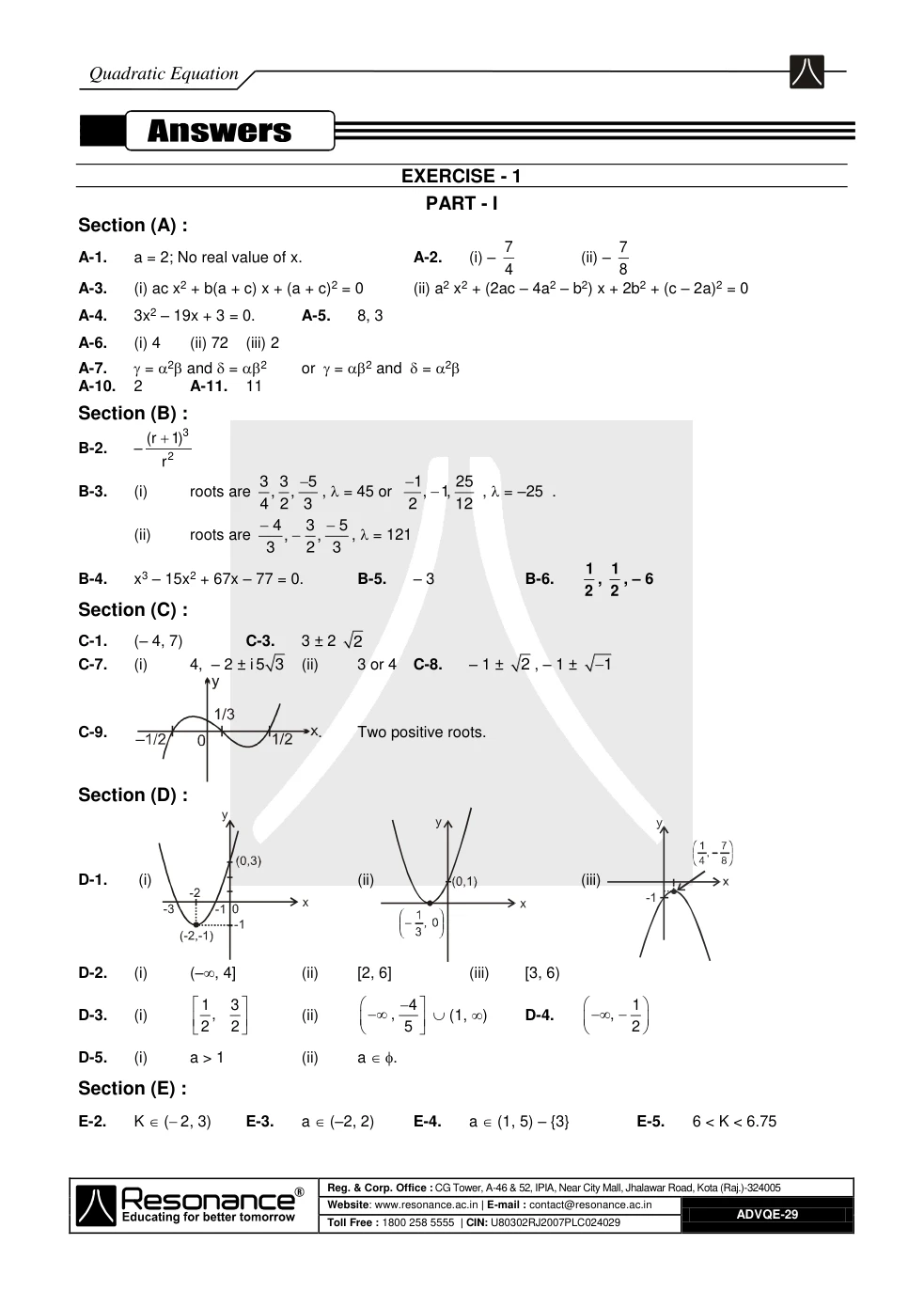
MAASQuadratic Equation
© MAAS. All rights reserved.Page 29 / 34
Extracted text · page 29
Quadratic Equation
EXERCISE - 1
PART - I
Section (A) :
7 7
A-1. a = 2; No real value of x. A-2. (i) – (ii) –
4 8
A-3. (i) ac x2 + b(a + c) x + (a + c)2 = 0 (ii) a2 x2 + (2ac – 4a2 – b2) x + 2b2 + (c – 2a)2 = 0
A-4. 3x2 – 19x + 3 = 0. A-5. 8, 3
A-6. (i) 4 (ii) 72 (iii) 2
A-7. = 2 and = 2 or = 2 and = 2
A-10. 2 A-11. 11
Section (B) :
(r 1)3
B-2. –
r 2
3 3 5 1 25
B-3. (i) roots are , , , = 45 or , 1, , = –25 .
4 2 3 2 12
4 3 5
(ii) roots are , , , = 121
3 2 3
1 1
B-4. x3 – 15x2 + 67x – 77 = 0. B-5. – 3 B-6. , , – 6
2 2
Section (C) :
C-1. (– 4, 7) C-3. 3 ± 2 2
C-7. (i) 4, – 2 ± i 5 3 (ii) 3 or 4 C-8. – 1 ± 2 , – 1 ± 1
C-9. . Two positive roots.
Section (D) :
D-1. (i) (ii) (iii)
D-2. (i) (–, 4] (ii) [2, 6] (iii) [3, 6)
1 3 4 1
D-3. (i) , (ii) , (1, ) D-4. , 2 2 5 2
D-5. (i) a > 1 (ii) a .
Section (E) :
E-2. K ( 2, 3) E-3. a (–2, 2) E-4. a (1, 5) – {3} E-5. 6 < K < 6.75
ADVQE-29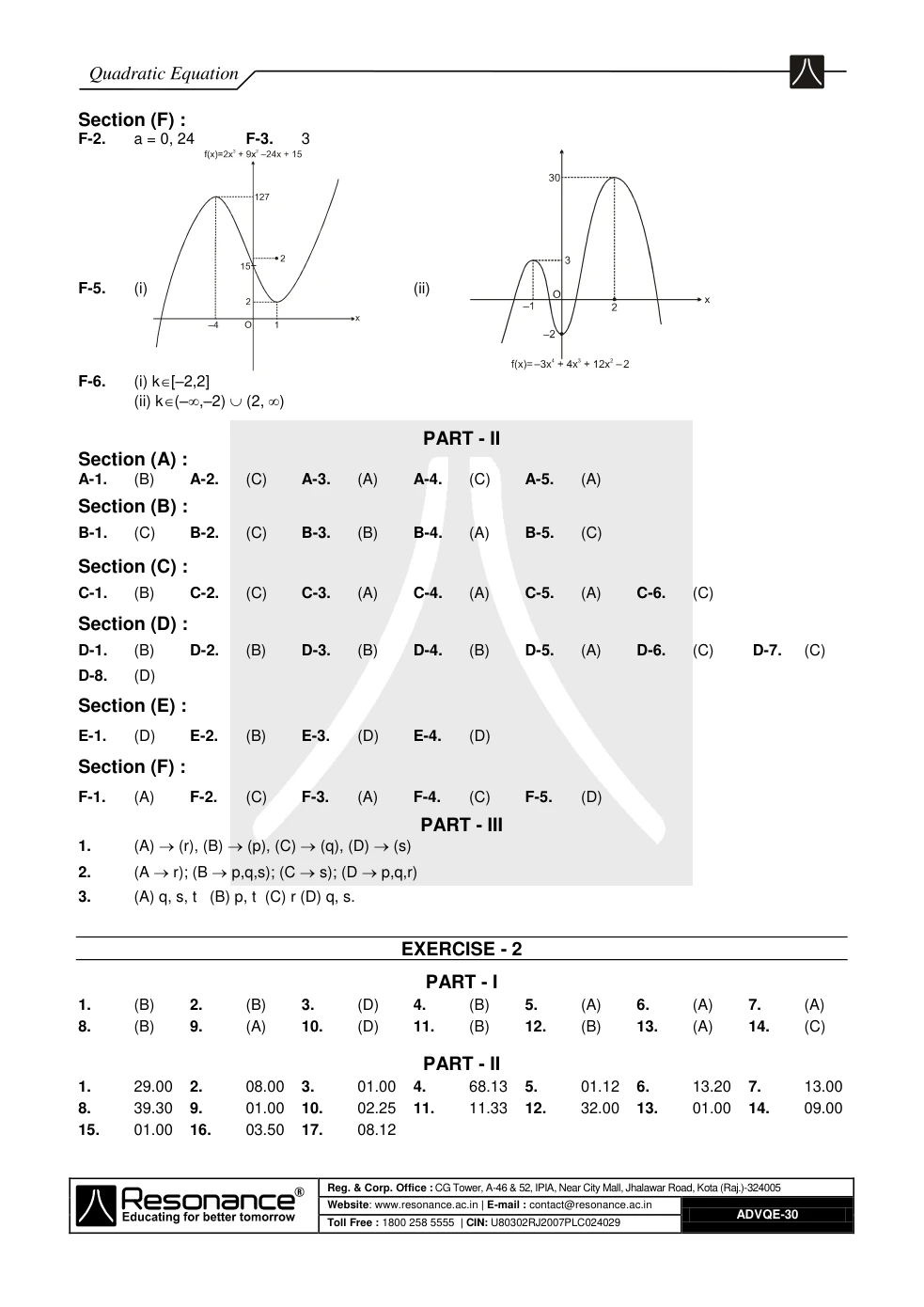
MAASQuadratic Equation
© MAAS. All rights reserved.Page 30 / 34
Extracted text · page 30
Quadratic Equation
Section (F) :
F-2. a = 0, 24 F-3. 3
F-5. (i) (ii)
F-6. (i) k[–2,2]
(ii) k(–,–2) (2,)
PART - II
Section (A) :
A-1. (B) A-2. (C) A-3. (A) A-4. (C) A-5. (A)
Section (B) :
B-1. (C) B-2. (C) B-3. (B) B-4. (A) B-5. (C)
Section (C) :
C-1. (B) C-2. (C) C-3. (A) C-4. (A) C-5. (A) C-6. (C)
Section (D) :
D-1. (B) D-2. (B) D-3. (B) D-4. (B) D-5. (A) D-6. (C) D-7. (C)
D-8. (D)
Section (E) :
E-1. (D) E-2. (B) E-3. (D) E-4. (D)
Section (F) :
F-1. (A) F-2. (C) F-3. (A) F-4. (C) F-5. (D)
PART - III
1. (A) (r), (B) (p), (C) (q), (D) (s)
2. (A r); (B p,q,s); (C s); (D p,q,r)
3. (A) q, s, t (B) p, t (C) r (D) q, s.
EXERCISE - 2
PART - I
1. (B) 2. (B) 3. (D) 4. (B) 5. (A) 6. (A) 7. (A)
8. (B) 9. (A) 10. (D) 11. (B) 12. (B) 13. (A) 14. (C)
PART - II
1. 29.00 2. 08.00 3. 01.00 4. 68.13 5. 01.12 6. 13.20 7. 13.00
8. 39.30 9. 01.00 10. 02.25 11. 11.33 12. 32.00 13. 01.00 14. 09.00
15. 01.00 16. 03.50 17. 08.12
ADVQE-30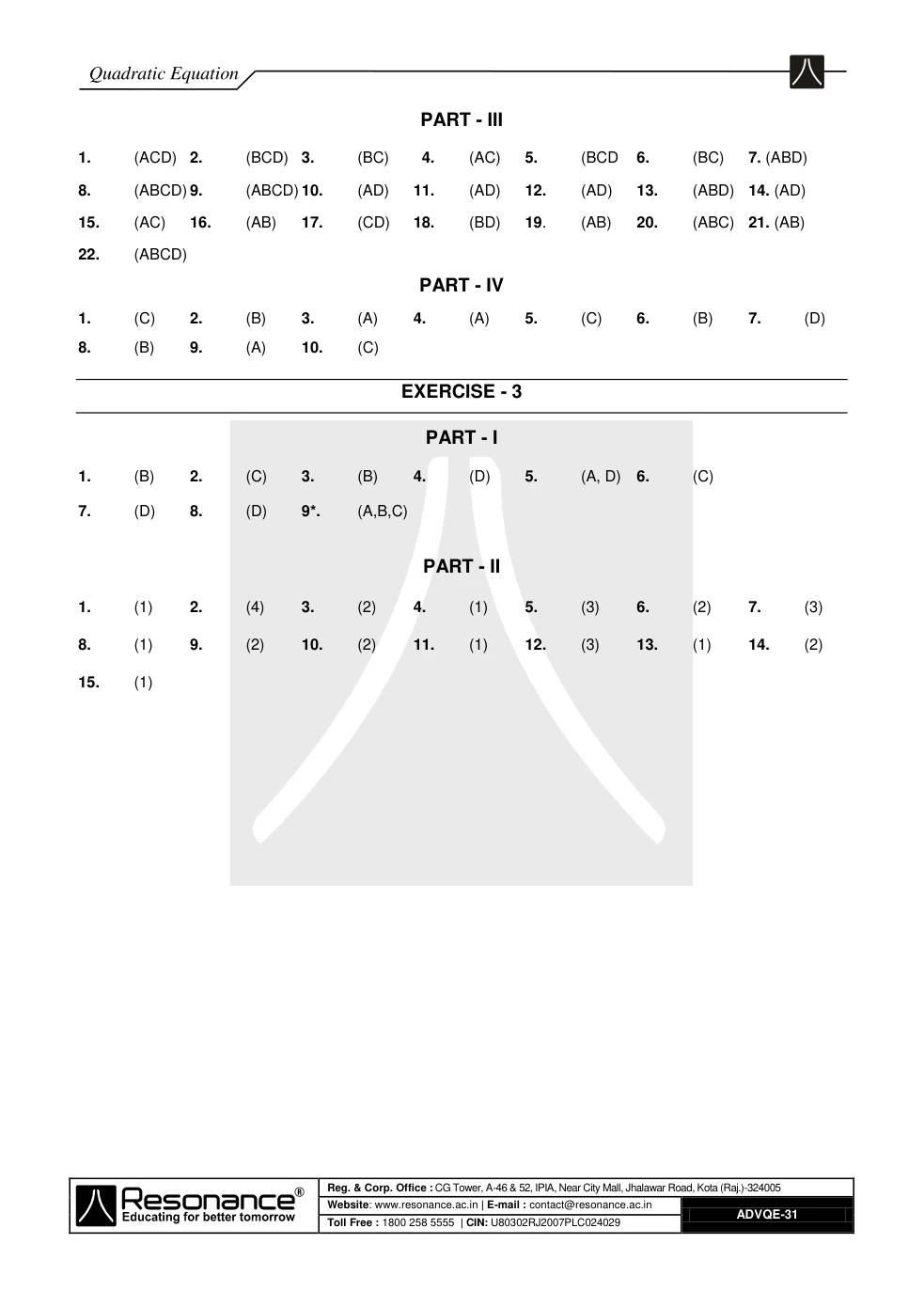
MAASQuadratic Equation
© MAAS. All rights reserved.Page 31 / 34
Extracted text · page 31
Quadratic Equation
PART - III
1. (ACD) 2. (BCD) 3. (BC) 4. (AC) 5. (BCD 6. (BC) 7. (ABD)
8. (ABCD) 9. (ABCD) 10. (AD) 11. (AD) 12. (AD) 13. (ABD) 14. (AD)
15. (AC) 16. (AB) 17. (CD) 18. (BD) 19. (AB) 20. (ABC) 21. (AB)
22. (ABCD)
PART - IV
1. (C) 2. (B) 3. (A) 4. (A) 5. (C) 6. (B) 7. (D)
8. (B) 9. (A) 10. (C)
EXERCISE - 3
PART - I
1. (B) 2. (C) 3. (B) 4. (D) 5. (A, D) 6. (C)
7. (D) 8. (D) 9*. (A,B,C)
PART - II
1. (1) 2. (4) 3. (2) 4. (1) 5. (3) 6. (2) 7. (3)
8. (1) 9. (2) 10. (2) 11. (1) 12. (3) 13. (1) 14. (2)
15. (1)
ADVQE-31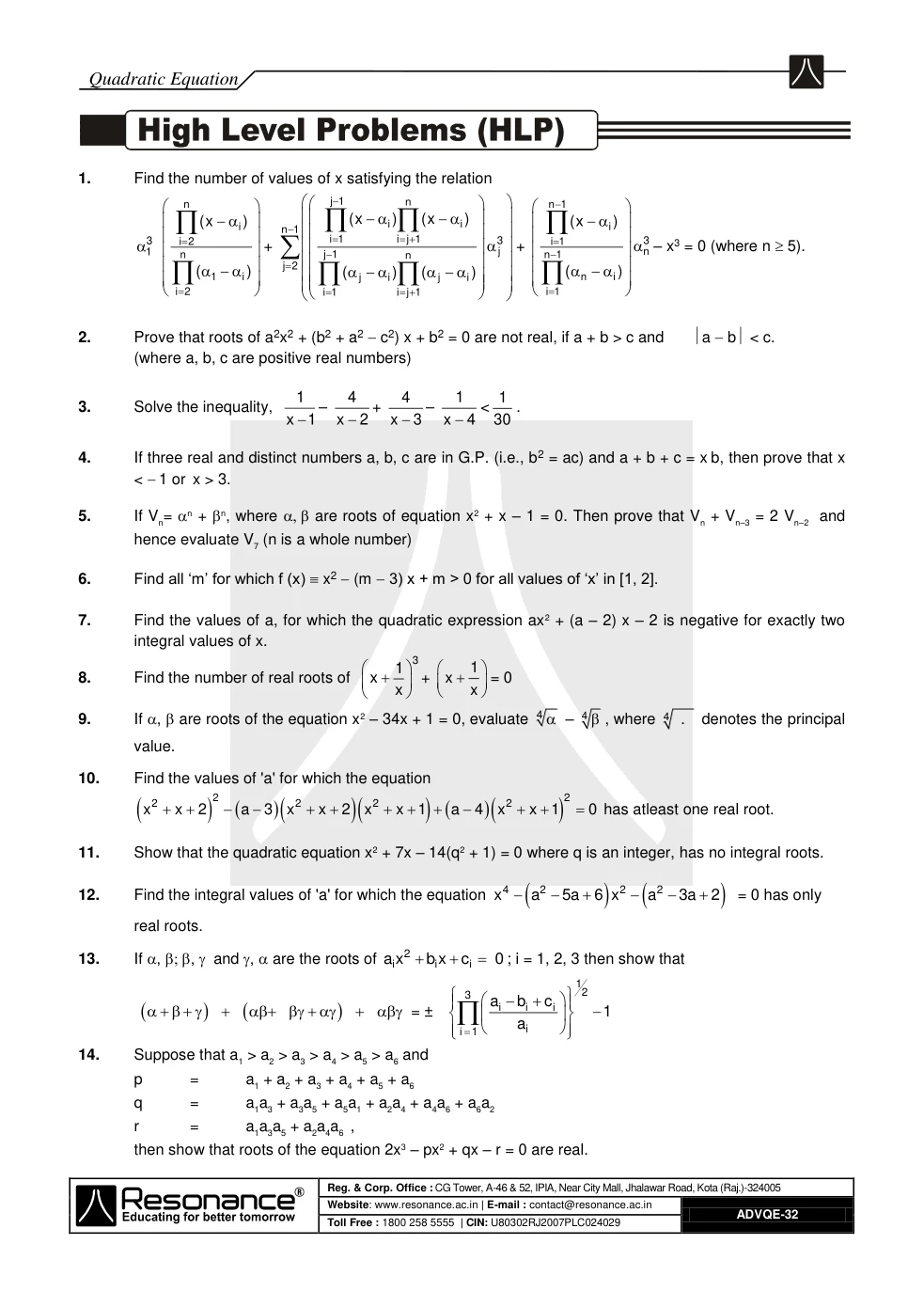
MAASQuadratic Equation
© MAAS. All rights reserved.Page 32 / 34
Extracted text · page 32
Quadratic Equation
1. Find the number of values of x satisfying the relation
j 1 n n n 1 (x i ) (x i ) (x i ) (x i ) n 1 i i 1 j 1 3 3 i 2 i 1 n – x3 = 0 (where n 5). j + n 1 j 1 n 1 n + 3 j 2 ( 1 i ) ( n i ) ( j i ) ( j i ) i 2 i 1 i i 1 j 1
2. Prove that roots of a2x2 + (b2 + a2 c2) x + b2 = 0 are not real, if a + b > c and a b < c.
(where a, b, c are positive real numbers)
1 4 4 1 1
3. Solve the inequality, – + – < .
x 1 x 2 x 3 x 4 30
4. If three real and distinct numbers a, b, c are in G.P. (i.e., b2 = ac) and a + b + c = x b, then prove that x
< 1 or x > 3.
5. If Vn= n + n, where are roots of equation x2 + x – 1 = 0. Then prove that Vn + Vn–3 = 2 Vn–2 and
hence evaluate V7 (n is a whole number)
6. Find all ‘m’ for which f (x) x2 (m 3) x + m > 0 for all values of ‘x’ in [1, 2].
7. Find the values of a, for which the quadratic expression ax2 + (a – 2) x – 2 is negative for exactly two
integral values of x.
1 3 1
8. Find the number of real roots of x + x = 0 x x
9. If , are roots of the equation x2 – 34x + 1 = 0, evaluate 4 – 4 , where 4 . denotes the principal
value.
10. Find the values of 'a' for which the equation
x 2 x 2 x 2 x 2 x 2 x 1 x 2 x 1 0 has atleast one real root. 2 2 a 3 a 4
11. Show that the quadratic equation x2 + 7x – 14(q2 + 1) = 0 where q is an integer, has no integral roots.
12. Find the integral values of 'a' for which the equation x 4 a 2 5a 6 x 2 a 2 3a 2 = 0 has only
real roots.
13. If , , and , are the roots of ai x 2 bi x c i 0 ; i = 1, 2, 3 then show that
12 3 ai bi c i 1 = ± ai i 1
14. Suppose that a1 > a2 > a3 > a4 > a5 > a6 and
p = a1 + a2 + a3 + a4 + a5 + a6
q = a1a3 + a3a5 + a5a1 + a2a4 + a4a6 + a6a2
r = a1a3a5 + a2a4a6 ,
then show that roots of the equation 2x3 – px2 + qx – r = 0 are real.
ADVQE-32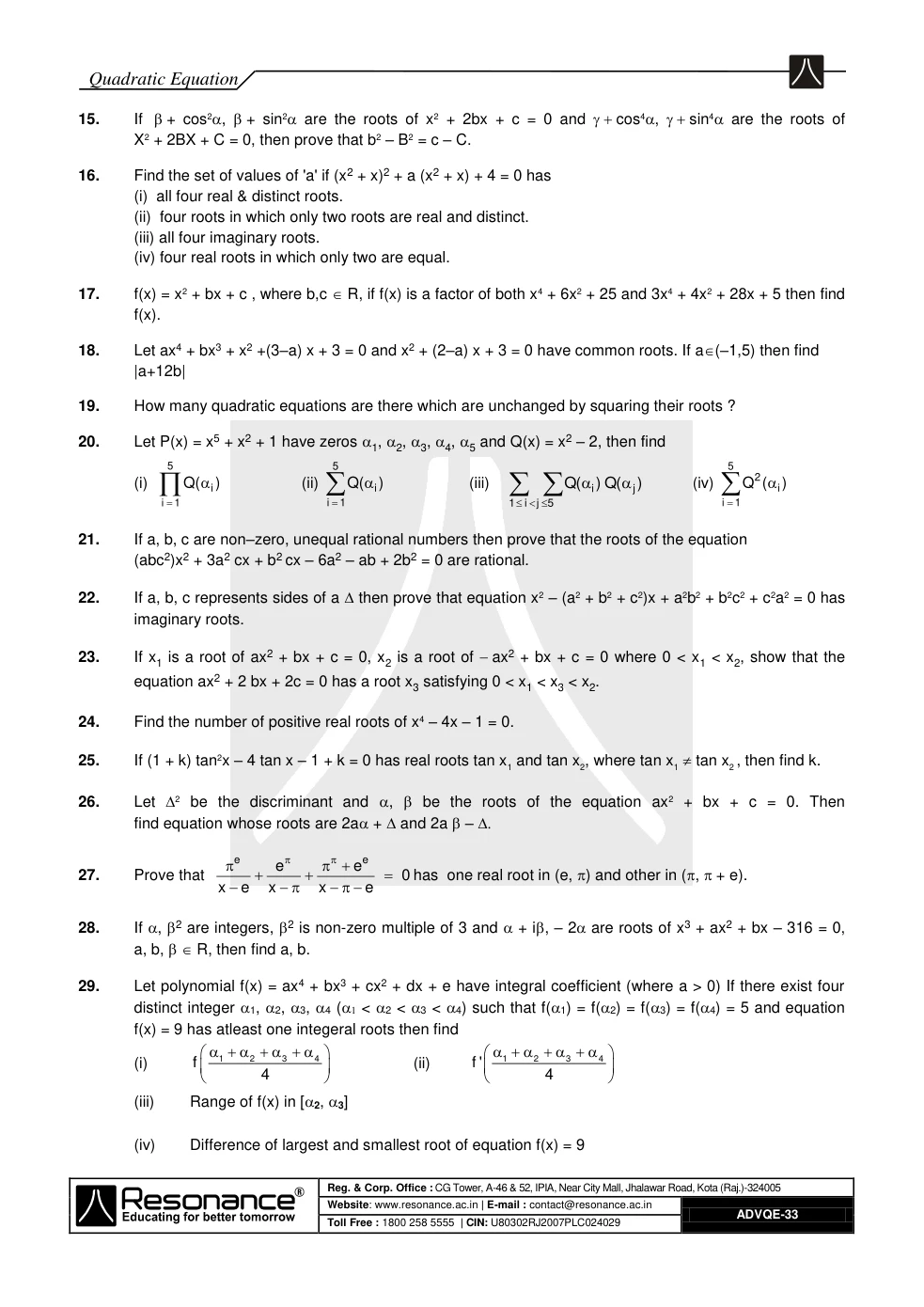
MAASQuadratic Equation
© MAAS. All rights reserved.Page 33 / 34
Extracted text · page 33
Quadratic Equation
15. If + cos2, + sin2 are the roots of x2 + 2bx + c = 0 and cos4, sin4 are the roots of
X2 + 2BX + C = 0, then prove that b2 – B2 = c – C.
16. Find the set of values of 'a' if (x2 + x)2 + a (x2 + x) + 4 = 0 has
(i) all four real & distinct roots.
(ii) four roots in which only two roots are real and distinct.
(iii) all four imaginary roots.
(iv) four real roots in which only two are equal.
17. f(x) = x2 + bx + c , where b,c R, if f(x) is a factor of both x4 + 6x2 + 25 and 3x4 + 4x2 + 28x + 5 then find
f(x).
18. Let ax4 + bx3 + x2 +(3–a) x + 3 = 0 and x2 + (2–a) x + 3 = 0 have common roots. If a(–1,5) then find
|a+12b|
19. How many quadratic equations are there which are unchanged by squaring their roots ?
20. Let P(x) = x5 + x2 + 1 have zeros 1, 2, 3, 4, 5 and Q(x) = x2 – 2, then find
5 5 5
(i) Q( i ) (ii) Q( i ) (iii) Q 2 ( i ) Q( i ) Q( j ) (iv)
i 1 i 1 1 i j 5 i 1
21. If a, b, c are non–zero, unequal rational numbers then prove that the roots of the equation
(abc2)x2 + 3a2 cx + b2 cx – 6a2 – ab + 2b2 = 0 are rational.
22. If a, b, c represents sides of a then prove that equation x2 – (a2 + b2 + c2)x + a2b2 + b2c2 + c2a2 = 0 has
imaginary roots.
23. If x1 is a root of ax2 + bx + c = 0, x2 is a root of ax2 + bx + c = 0 where 0 < x1 < x2, show that the
equation ax2 + 2 bx + 2c = 0 has a root x3 satisfying 0 < x1 < x3 < x2.
24. Find the number of positive real roots of x4 – 4x – 1 = 0.
25. If (1 + k) tan2x – 4 tan x – 1 + k = 0 has real roots tan x1 and tan x2, where tan x1 tan x2 , then find k.
26. Let 2 be the discriminant and , be the roots of the equation ax2 + bx + c = 0. Then
find equation whose roots are 2a + and 2a –
e e e e
27. Prove that 0 has one real root in (e, ) and other in (, + e).
x e x x e
28. If , 2 are integers, 2 is non-zero multiple of 3 and + i, – 2 are roots of x3 + ax2 + bx – 316 = 0,
a, b, R, then find a, b.
29. Let polynomial f(x) = ax4 + bx3 + cx2 + dx + e have integral coefficient (where a > 0) If there exist four
distinct integer 1, 2, 3, 4 ( < 2 < 3 < 4) such that f(1) = f(2) = f(3) = f(4) = 5 and equation
f(x) = 9 has atleast one integeral roots then find
1 2 3 4 1 2 3 4
(i) f (ii) f '
4 4
(iii) Range of f(x) in [2, 3]
(iv) Difference of largest and smallest root of equation f(x) = 9
ADVQE-33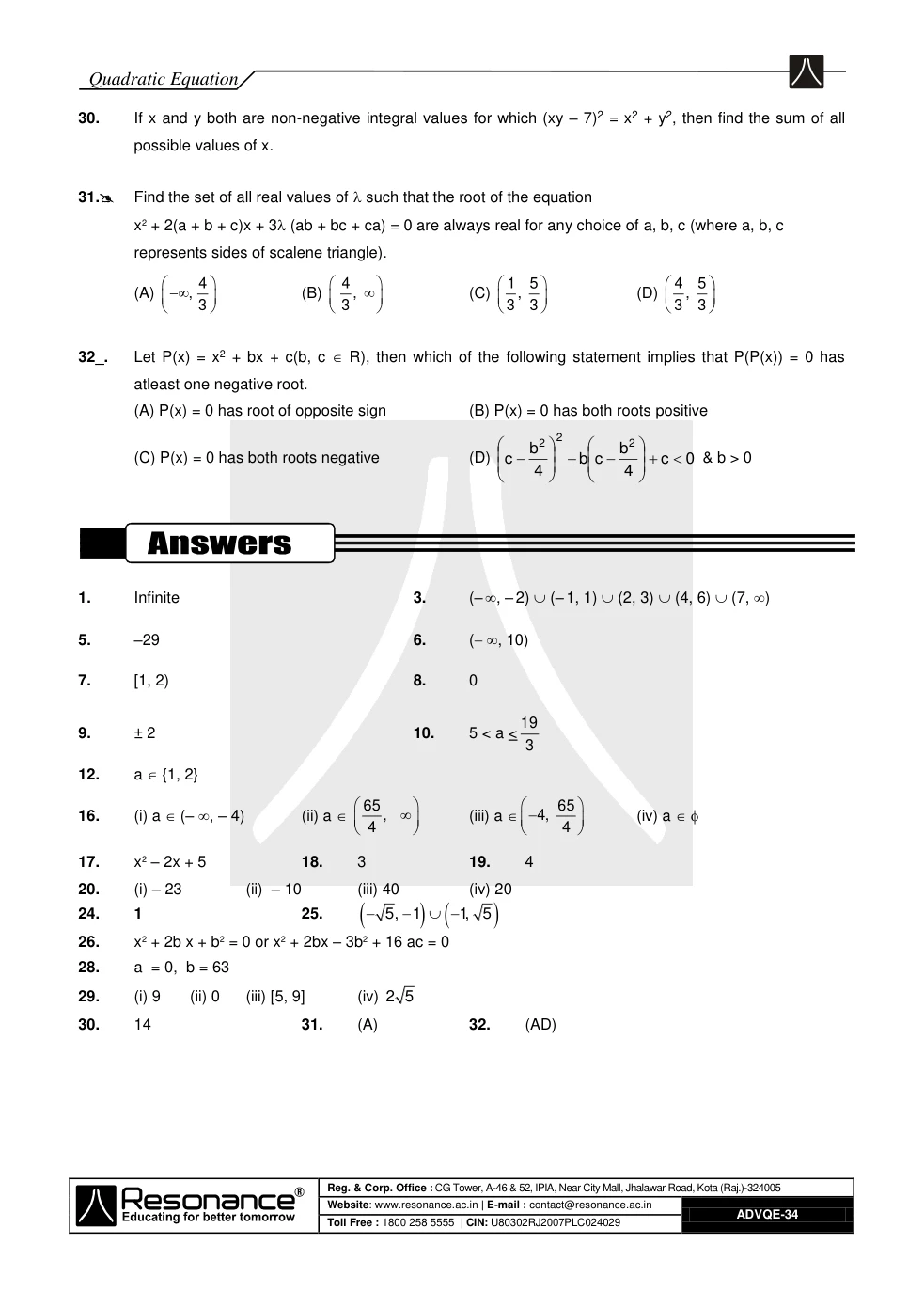
MAASQuadratic Equation
© MAAS. All rights reserved.Page 34 / 34
Extracted text · page 34
Quadratic Equation
30. If x and y both are non-negative integral values for which (xy – 7)2 = x2 + y2, then find the sum of all
possible values of x.
31. Find the set of all real values of such that the root of the equation
x2 + 2(a + b + c)x + 3 (ab + bc + ca) = 0 are always real for any choice of a, b, c (where a, b, c
represents sides of scalene triangle).
4 4 1 5 4 5
(A) , (B) , (C) , (D) , 3 3 3 3 3 3
32_. Let P(x) = x2 + bx + c(b, c R), then which of the following statement implies that P(P(x)) = 0 has
atleast one negative root.
(A) P(x) = 0 has root of opposite sign (B) P(x) = 0 has both roots positive
b 2 2 b 2
(C) P(x) = 0 has both roots negative (D) c 4 b c 4 c 0 & b > 0
1. Infinite 3. (– , – 2) (– 1, 1) (2, 3) (4, 6) (7, )
5. –29 6. (, 10)
7. [1, 2) 8. 0
19
9. ± 2 10. 5 < a <
3
12. a {1, 2}
65 65
16. (i) a (– , – 4) (ii) a , (iii) a 4, (iv) a 4 4
17. x2 – 2x + 5 18. 3 19. 4
20. (i) – 23 (ii) – 10 (iii) 40 (iv) 20
24. 1 25. 5, 1 1, 5
26. x2 + 2b x + b2 = 0 or x2 + 2bx – 3b2 + 16 ac = 0
28. a = 0, b = 63
29. (i) 9 (ii) 0 (iii) [5, 9] (iv) 2 5
30. 14 31. (A) 32. (AD)
ADVQE-34