Visual-fidelity edition: source-page equations, diagrams and charts are preserved as page images. Text transcripts are provided where extractable. The original source may contain markings within the artwork.
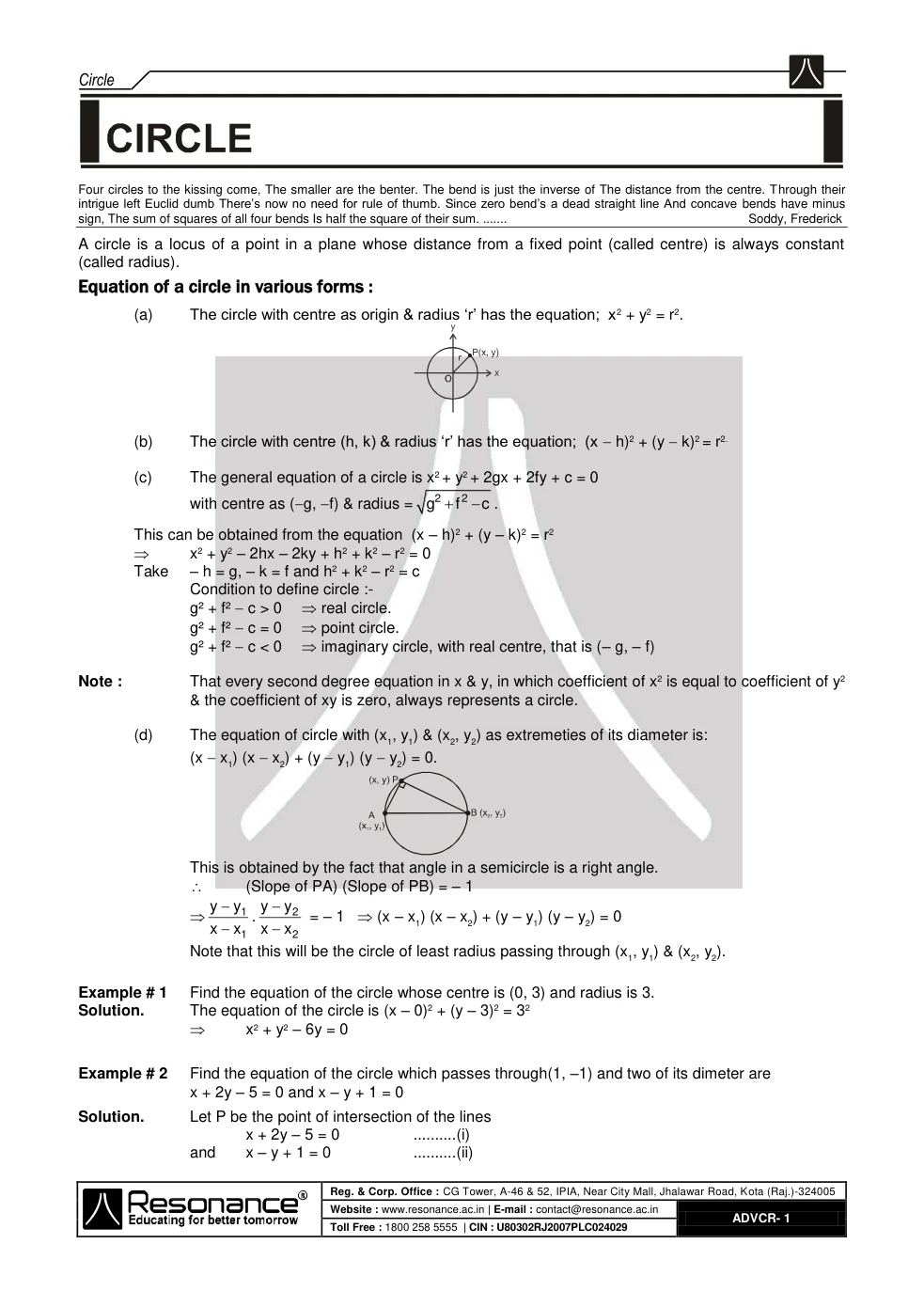
MAASCircle
© MAAS. All rights reserved.Page 1 / 31
Extracted text · page 1
Circle
Four circles to the kissing come, The smaller are the benter. The bend is just the inverse of The distance from the centre. Through their
intrigue left Euclid dumb There’s now no need for rule of thumb. Since zero bend’s a dead straight line And concave bends have minus
sign, The sum of squares of all four bends Is half the square of their sum. ....... Soddy, Frederick
A circle is a locus of a point in a plane whose distance from a fixed point (called centre) is always constant
(called radius).
Equation of a circle in various forms :
(a) The circle with centre as origin & radius ‘r’ has the equation; x2 + y2 = r2.
(b) The circle with centre (h, k) & radius ‘r’ has the equation; (x h)2 + (y k)2 = r2.
(c) The general equation of a circle is x2 + y2 + 2gx + 2fy + c = 0
with centre as (g, f) & radius = g2 f 2 c .
This can be obtained from the equation (x – h)2 + (y – k)2 = r2
x2 + y2 – 2hx – 2ky + h2 + k2 – r2 = 0
Take – h = g, – k = f and h2 + k2 – r2 = c
Condition to define circle :-
g² + f² c > 0 real circle.
g² + f² c = 0 point circle.
g² + f² c < 0 imaginary circle, with real centre, that is (– g, – f)
Note : That every second degree equation in x & y, in which coefficient of x2 is equal to coefficient of y2
& the coefficient of xy is zero, always represents a circle.
(d) The equation of circle with (x1, y1) & (x2, y2) as extremeties of its diameter is:
(x x1) (x x2) + (y y1) (y y2) = 0.
This is obtained by the fact that angle in a semicircle is a right angle.
(Slope of PA) (Slope of PB) = – 1
y y1 y y 2 . = – 1 (x – x1) (x – x2) + (y – y1) (y – y2) = 0
x x1 x x 2
Note that this will be the circle of least radius passing through (x1, y1) & (x2, y2).
Example # 1 Find the equation of the circle whose centre is (0, 3) and radius is 3.
Solution. The equation of the circle is (x – 0)2 + (y – 3)2 = 32
x2 + y2 – 6y = 0
Example # 2 Find the equation of the circle which passes through(1, –1) and two of its dimeter are
x + 2y – 5 = 0 and x – y + 1 = 0
Solution. Let P be the point of intersection of the lines
x + 2y – 5 = 0 ..........(i)
and x – y + 1 = 0 ..........(ii)
ADVCR- 1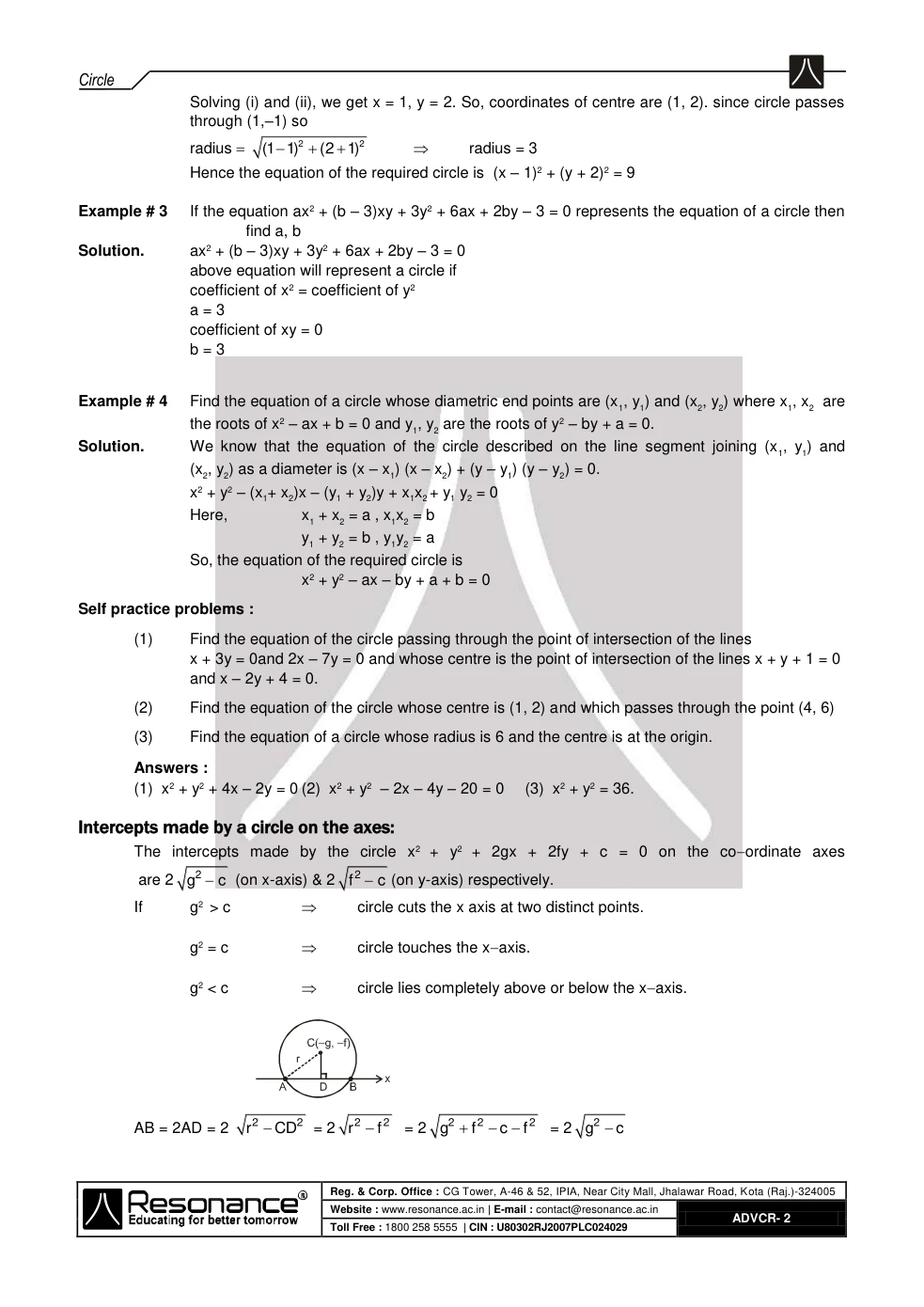
MAASCircle
© MAAS. All rights reserved.Page 2 / 31
Extracted text · page 2
Circle
Solving (i) and (ii), we get x = 1, y = 2. So, coordinates of centre are (1, 2). since circle passes
through (1,–1) so
radius (1 1)2 (2 1)2 radius = 3
Hence the equation of the required circle is (x – 1)2 + (y + 2)2 = 9
Example # 3 If the equation ax2 + (b – 3)xy + 3y2 + 6ax + 2by – 3 = 0 represents the equation of a circle then
find a, b
Solution. ax2 + (b – 3)xy + 3y2 + 6ax + 2by – 3 = 0
above equation will represent a circle if
coefficient of x2 = coefficient of y2
a = 3
coefficient of xy = 0
b = 3
Example # 4 Find the equation of a circle whose diametric end points are (x1, y1) and (x2, y2) where x1, x2 are
the roots of x2 – ax + b = 0 and y1, y2 are the roots of y2 – by + a = 0.
Solution. We know that the equation of the circle described on the line segment joining (x1, y1) and
(x2, y2) as a diameter is (x – x1) (x – x2) + (y – y1) (y – y2) = 0.
x2 + y2 – (x1+ x2)x – (y1 + y2)y + x1x2 + y1 y2 = 0
Here, x1 + x2 = a , x1x2 = b
y1 + y2 = b , y1y2 = a
So, the equation of the required circle is
x2 + y2 – ax – by + a + b = 0
Self practice problems :
(1) Find the equation of the circle passing through the point of intersection of the lines
x + 3y = 0and 2x – 7y = 0 and whose centre is the point of intersection of the lines x + y + 1 = 0
and x – 2y + 4 = 0.
(2) Find the equation of the circle whose centre is (1, 2) and which passes through the point (4, 6)
(3) Find the equation of a circle whose radius is 6 and the centre is at the origin.
Answers :
(1) x2 + y2 + 4x – 2y = 0 (2) x2 + y2 – 2x – 4y – 20 = 0 (3) x2 + y2 = 36.
Intercepts made by a circle on the axes:
The intercepts made by the circle x2 + y2 + 2gx + 2fy + c = 0 on the coordinate axes
are 2 g2 c (on x-axis) & 2 2f c (on y-axis) respectively.
If g2 > c circle cuts the x axis at two distinct points.
g2 = c circle touches the xaxis.
g2 < c circle lies completely above or below the xaxis.
AB = 2AD = 2 r 2 CD2 = 2 r 2 f 2 = 2 g2 f 2 c f 2 = 2 g2 c
ADVCR- 2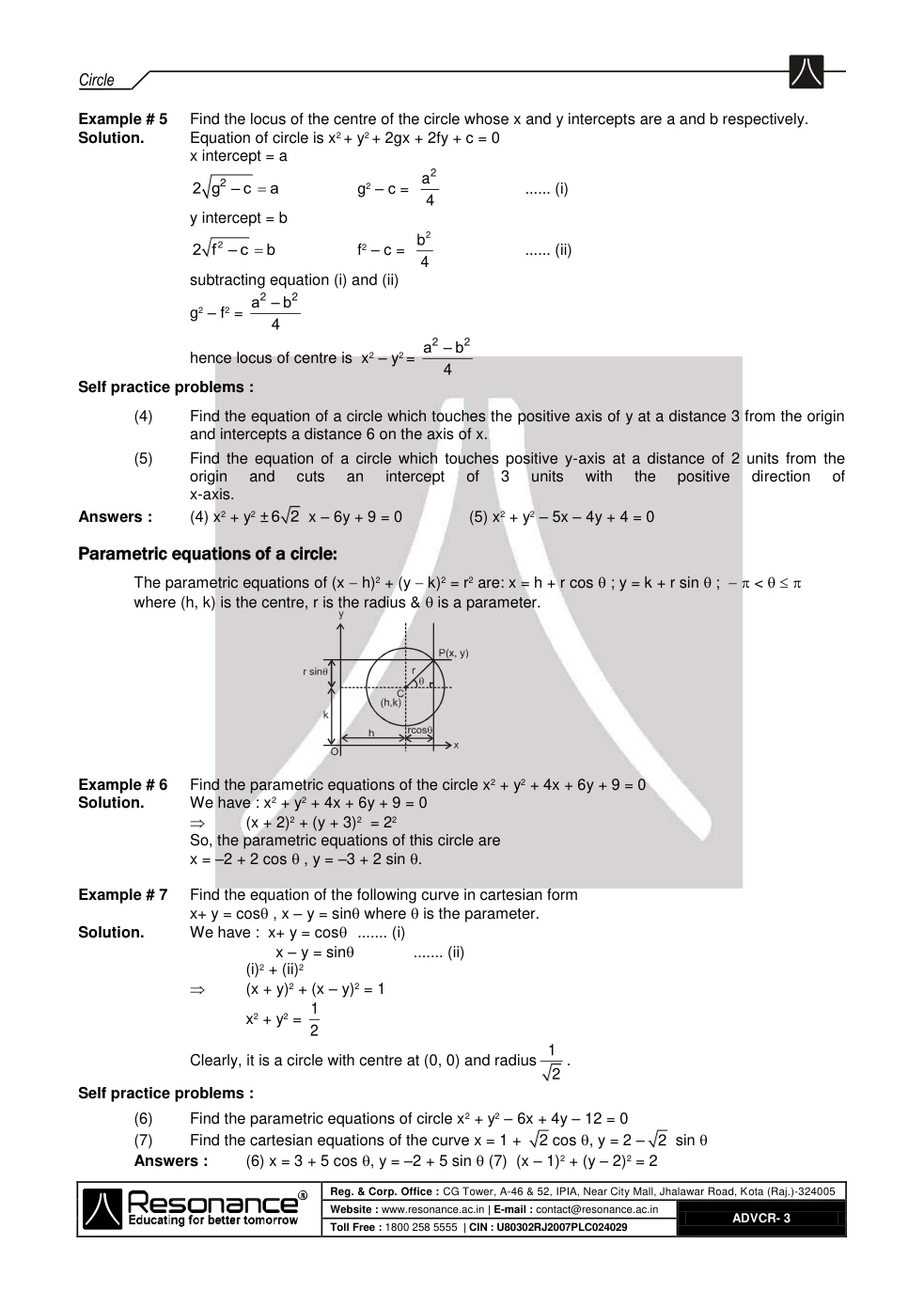
MAASCircle
© MAAS. All rights reserved.Page 3 / 31
Extracted text · page 3
Circle
Example # 5 Find the locus of the centre of the circle whose x and y intercepts are a and b respectively.
Solution. Equation of circle is x2 + y2 + 2gx + 2fy + c = 0
x intercept = a
2 a 2 2 g – c a g2 – c = ...... (i)
4
y intercept = b
2 b 2 2 f – c b f2 – c = ...... (ii)
4
subtracting equation (i) and (ii)
a 2 – b 2 g2 – f2 =
4
a 2 – b 2 hence locus of centre is x2 – y2 =
4
Self practice problems :
(4) Find the equation of a circle which touches the positive axis of y at a distance 3 from the origin
and intercepts a distance 6 on the axis of x.
(5) Find the equation of a circle which touches positive y-axis at a distance of 2 units from the
origin and cuts an intercept of 3 units with the positive direction of
x-axis.
Answers : (4) x2 + y2 ±6 2 x – 6y + 9 = 0 (5) x2 + y2 – 5x – 4y + 4 = 0
Parametric equations of a circle:
The parametric equations of (x h)2 + (y k)2 = r2 are: x = h + r cos ; y = k + r sin ; <
where (h, k) is the centre, r is the radius & is a parameter.
Example # 6 Find the parametric equations of the circle x2 + y2 + 4x + 6y + 9 = 0
Solution. We have : x2 + y2 + 4x + 6y + 9 = 0
(x + 2)2 + (y + 3)2 = 22
So, the parametric equations of this circle are
x = –2 + 2 cos , y = –3 + 2 sin .
Example # 7 Find the equation of the following curve in cartesian form
x+ y = cos , x – y = sin where is the parameter.
Solution. We have : x+ y = cos ....... (i)
x – y = sin ....... (ii)
(i)2 + (ii)2
(x + y)2 + (x – y)2 = 1
1
x2 + y2 =
2
1
Clearly, it is a circle with centre at (0, 0) and radius .
2
Self practice problems :
(6) Find the parametric equations of circle x2 + y2 – 6x + 4y – 12 = 0
(7) Find the cartesian equations of the curve x = 1 + 2 cos , y = 2 – 2 sin
Answers : (6) x = 3 + 5 cos , y = –2 + 5 sin (7) (x – 1)2 + (y – 2)2 = 2
ADVCR- 3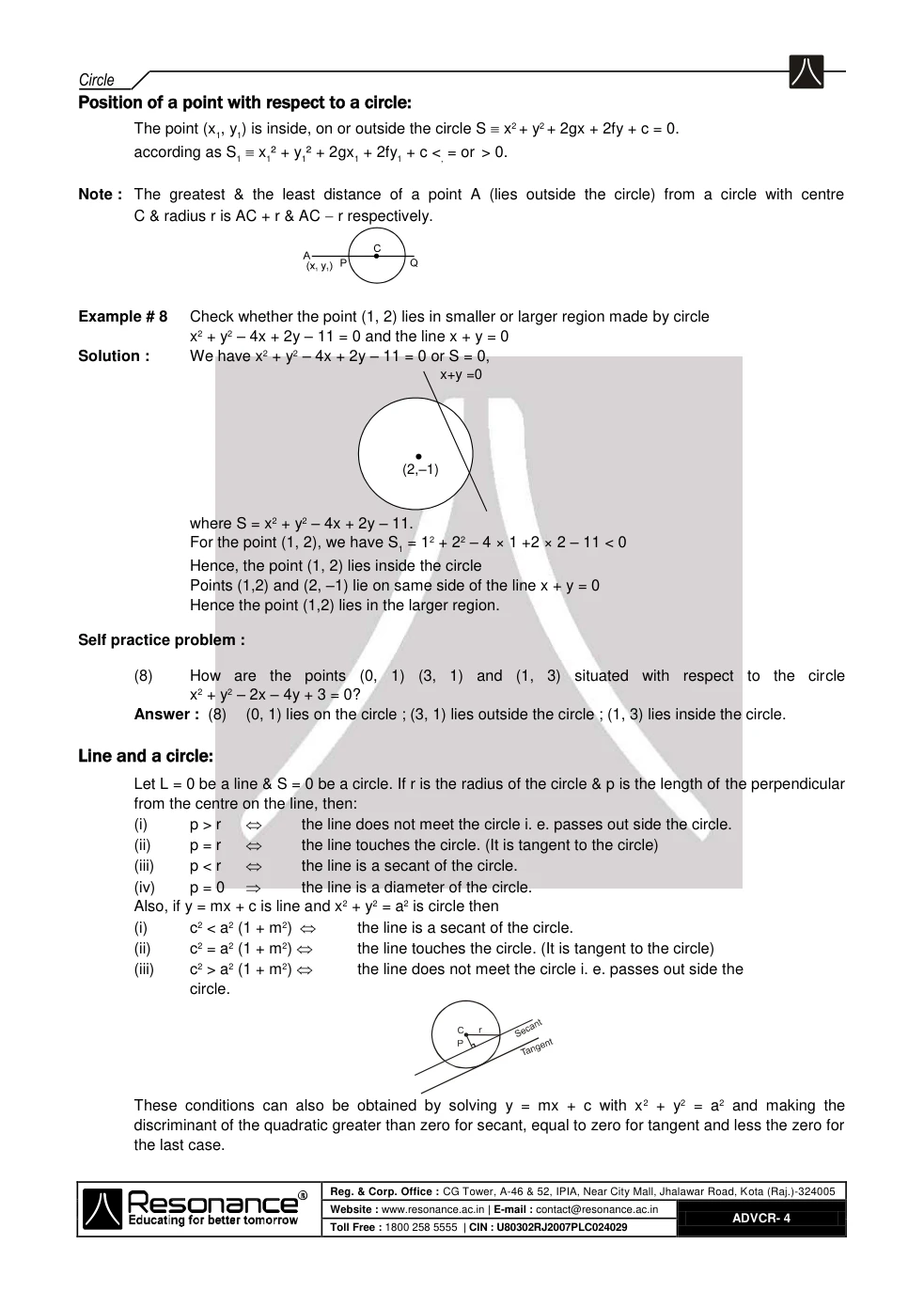
MAASCircle
© MAAS. All rights reserved.Page 4 / 31
Extracted text · page 4
Circle
Position of a point with respect to a circle:
The point (x1, y1) is inside, on or outside the circle S x2 + y2 + 2gx + 2fy + c = 0.
according as S1 x1² + y1² + 2gx1 + 2fy1 + c <, = or > 0.
Note : The greatest & the least distance of a point A (lies outside the circle) from a circle with centre
C & radius r is AC + r & AC r respectively.
Example # 8 Check whether the point (1, 2) lies in smaller or larger region made by circle
x2 + y2 – 4x + 2y – 11 = 0 and the line x + y = 0
Solution : We have x2 + y2 – 4x + 2y – 11 = 0 or S = 0,
x+y =0
• (2,–1)
where S = x2 + y2 – 4x + 2y – 11.
For the point (1, 2), we have S1 = 12 + 22 – 4 × 1 +2 × 2 – 11 < 0
Hence, the point (1, 2) lies inside the circle
Points (1,2) and (2, –1) lie on same side of the line x + y = 0
Hence the point (1,2) lies in the larger region.
Self practice problem :
(8) How are the points (0, 1) (3, 1) and (1, 3) situated with respect to the circle
x2 + y2 – 2x – 4y + 3 = 0?
Answer : (8) (0, 1) lies on the circle ; (3, 1) lies outside the circle ; (1, 3) lies inside the circle.
Line and a circle:
Let L = 0 be a line & S = 0 be a circle. If r is the radius of the circle & p is the length of the perpendicular
from the centre on the line, then:
(i) p > r the line does not meet the circle i. e. passes out side the circle.
(ii) p = r the line touches the circle. (It is tangent to the circle)
(iii) p < r the line is a secant of the circle.
(iv) p = 0 the line is a diameter of the circle.
Also, if y = mx + c is line and x2 + y2 = a2 is circle then
(i) c2 < a2 (1 + m2) the line is a secant of the circle.
(ii) c2 = a2 (1 + m2) the line touches the circle. (It is tangent to the circle)
(iii) c2 > a2 (1 + m2) the line does not meet the circle i. e. passes out side the
circle.
These conditions can also be obtained by solving y = mx + c with x2 + y2 = a2 and making the
discriminant of the quadratic greater than zero for secant, equal to zero for tangent and less the zero for
the last case.
ADVCR- 4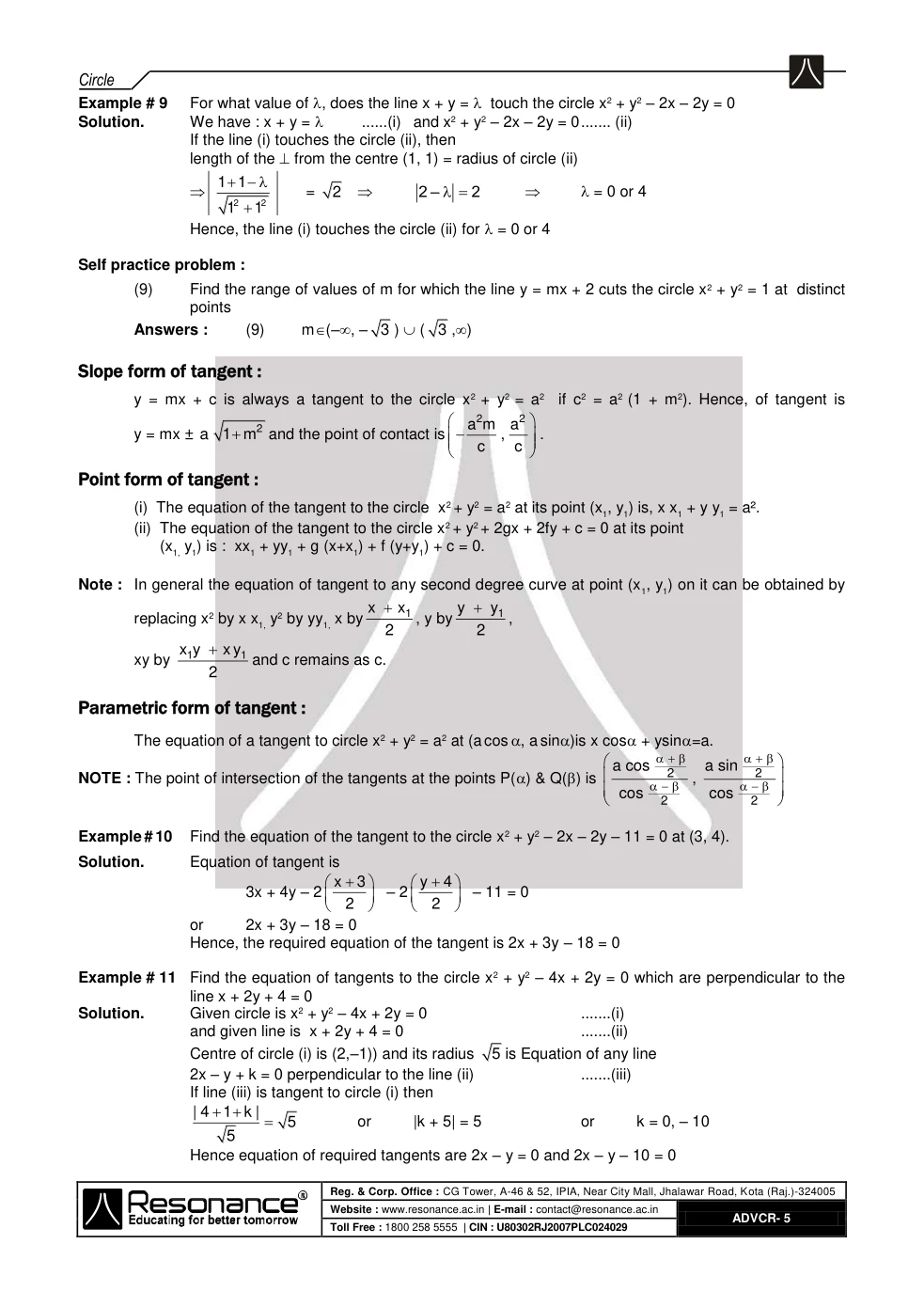
MAASCircle
© MAAS. All rights reserved.Page 5 / 31
Extracted text · page 5
Circle
Example # 9 For what value of , does the line x + y = touch the circle x2 + y2 – 2x – 2y = 0
Solution. We have : x + y = ......(i) and x2 + y2 – 2x – 2y = 0 ....... (ii)
If the line (i) touches the circle (ii), then
length of the from the centre (1, 1) = radius of circle (ii)
1 1
= 2 2 – 2 = 0 or 4
12 12
Hence, the line (i) touches the circle (ii) for = 0 or 4
Self practice problem :
(9) Find the range of values of m for which the line y = mx + 2 cuts the circle x2 + y2 = 1 at distinct
points
Answers : (9) m(–, – 3 ) ( 3 ,)
Slope form of tangent :
y = mx + c is always a tangent to the circle x2 + y2 = a2 if c2 = a2 (1 + m2). Hence, of tangent is
a 2 m a 2 2 y = mx ± a 1 m and the point of contact is , . c c
Point form of tangent :
(i) The equation of the tangent to the circle x2 + y2 = a2 at its point (x1, y1) is, x x1 + y y1 = a².
(ii) The equation of the tangent to the circle x2 + y2 + 2gx + 2fy + c = 0 at its point
(x1, y1) is : xx1 + yy1 + g (x+x1) + f (y+y1) + c = 0.
Note : In general the equation of tangent to any second degree curve at point (x1, y1) on it can be obtained by
x x1 y y1
replacing x2 by x x1, y2 by yy1, x by , y by ,
2 2
x1y x y1 xy by and c remains as c.
2
Parametric form of tangent :
The equation of a tangent to circle x2 + y2 = a2 at (a cos , a sin)is x cos + ysin=a.
a cos a sin
NOTE : The point of intersection of the tangents at the points P() & Q() is 2 , 2
cos cos 2 2
Example # 10 Find the equation of the tangent to the circle x2 + y2 – 2x – 2y – 11 = 0 at (3, 4).
Solution. Equation of tangent is
x 3 y 4
3x + 4y – 2 – 2 – 11 = 0
2 2
or 2x + 3y – 18 = 0
Hence, the required equation of the tangent is 2x + 3y – 18 = 0
Example # 11 Find the equation of tangents to the circle x2 + y2 – 4x + 2y = 0 which are perpendicular to the
line x + 2y + 4 = 0
Solution. Given circle is x2 + y2 – 4x + 2y = 0 .......(i)
and given line is x + 2y + 4 = 0 .......(ii)
Centre of circle (i) is (2,–1)) and its radius 5 is Equation of any line
2x – y + k = 0 perpendicular to the line (ii) .......(iii)
If line (iii) is tangent to circle (i) then
| 4 1 k |
5 or |k + 5| = 5 or k = 0, – 10
5
Hence equation of required tangents are 2x – y = 0 and 2x – y – 10 = 0
ADVCR- 5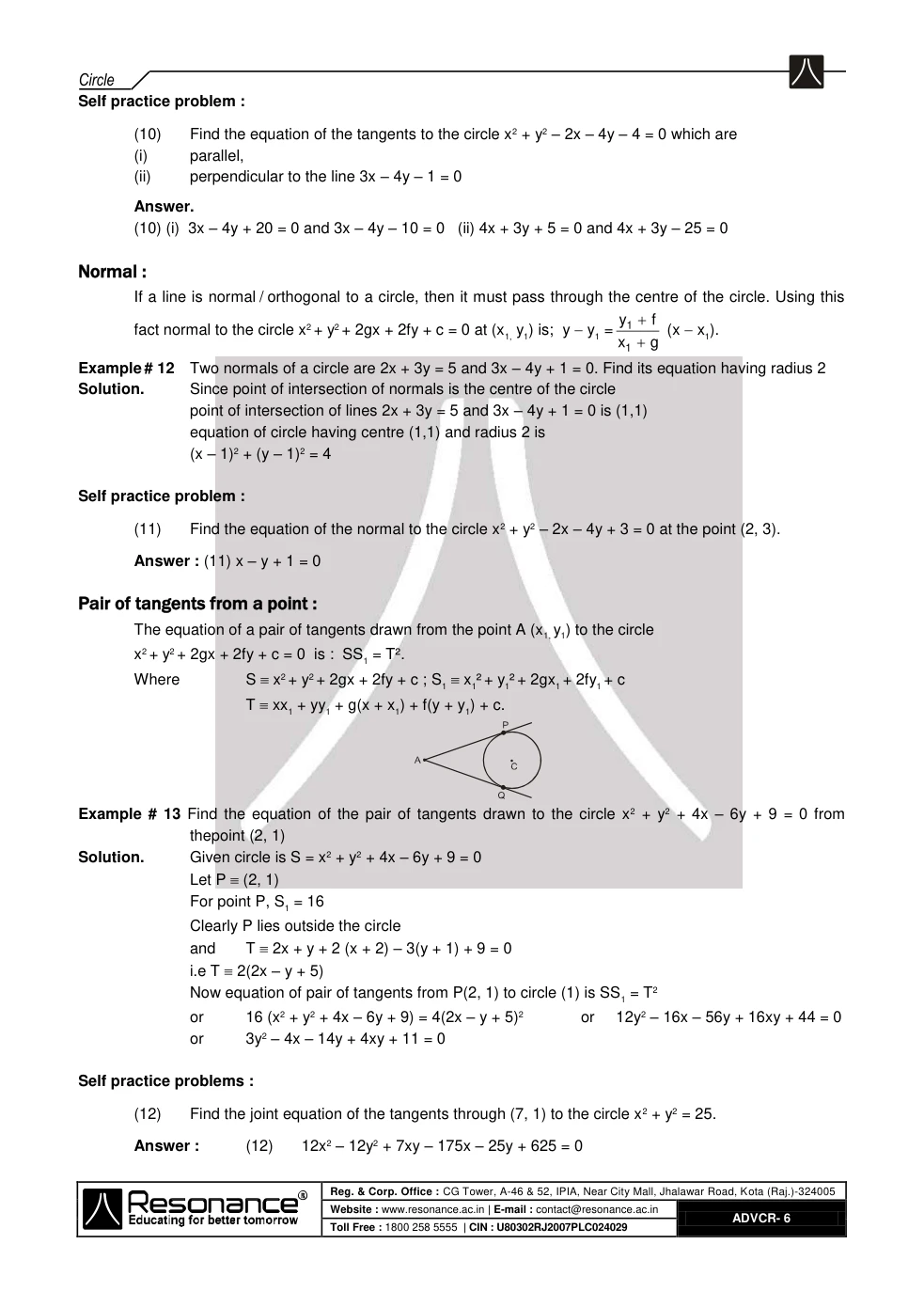
MAASCircle
© MAAS. All rights reserved.Page 6 / 31
Extracted text · page 6
Circle
Self practice problem :
(10) Find the equation of the tangents to the circle x2 + y2 – 2x – 4y – 4 = 0 which are
(i) parallel,
(ii) perpendicular to the line 3x – 4y – 1 = 0
Answer.
(10) (i) 3x – 4y + 20 = 0 and 3x – 4y – 10 = 0 (ii) 4x + 3y + 5 = 0 and 4x + 3y – 25 = 0
Normal :
If a line is normal / orthogonal to a circle, then it must pass through the centre of the circle. Using this
y1 f fact normal to the circle x2 + y2 + 2gx + 2fy + c = 0 at (x1, y1) is; y y1 = (x x1).
x1 g
Example # 12 Two normals of a circle are 2x + 3y = 5 and 3x – 4y + 1 = 0. Find its equation having radius 2
Solution. Since point of intersection of normals is the centre of the circle
point of intersection of lines 2x + 3y = 5 and 3x – 4y + 1 = 0 is (1,1)
equation of circle having centre (1,1) and radius 2 is
(x – 1)2 + (y – 1)2 = 4
Self practice problem :
(11) Find the equation of the normal to the circle x2 + y2 – 2x – 4y + 3 = 0 at the point (2, 3).
Answer : (11) x – y + 1 = 0
Pair of tangents from a point :
The equation of a pair of tangents drawn from the point A (x1, y1) to the circle
x2 + y2 + 2gx + 2fy + c = 0 is : SS1 = T².
Where S x2 + y2 + 2gx + 2fy + c ; S1 x1² + y1² + 2gx1 + 2fy1 + c
T xx1 + yy1 + g(x + x1) + f(y + y1) + c.
Example # 13 Find the equation of the pair of tangents drawn to the circle x2 + y2 + 4x – 6y + 9 = 0 from
thepoint (2, 1)
Solution. Given circle is S = x2 + y2 + 4x – 6y + 9 = 0
Let P (2, 1)
For point P, S1 = 16
Clearly P lies outside the circle
and T 2x + y + 2 (x + 2) – 3(y + 1) + 9 = 0
i.e T 2(2x – y + 5)
Now equation of pair of tangents from P(2, 1) to circle (1) is SS1 = T2
or 16 (x2 + y2 + 4x – 6y + 9) = 4(2x – y + 5)2 or 12y2 – 16x – 56y + 16xy + 44 = 0
or 3y2 – 4x – 14y + 4xy + 11 = 0
Self practice problems :
(12) Find the joint equation of the tangents through (7, 1) to the circle x2 + y2 = 25.
Answer : (12) 12x2 – 12y2 + 7xy – 175x – 25y + 625 = 0
ADVCR- 6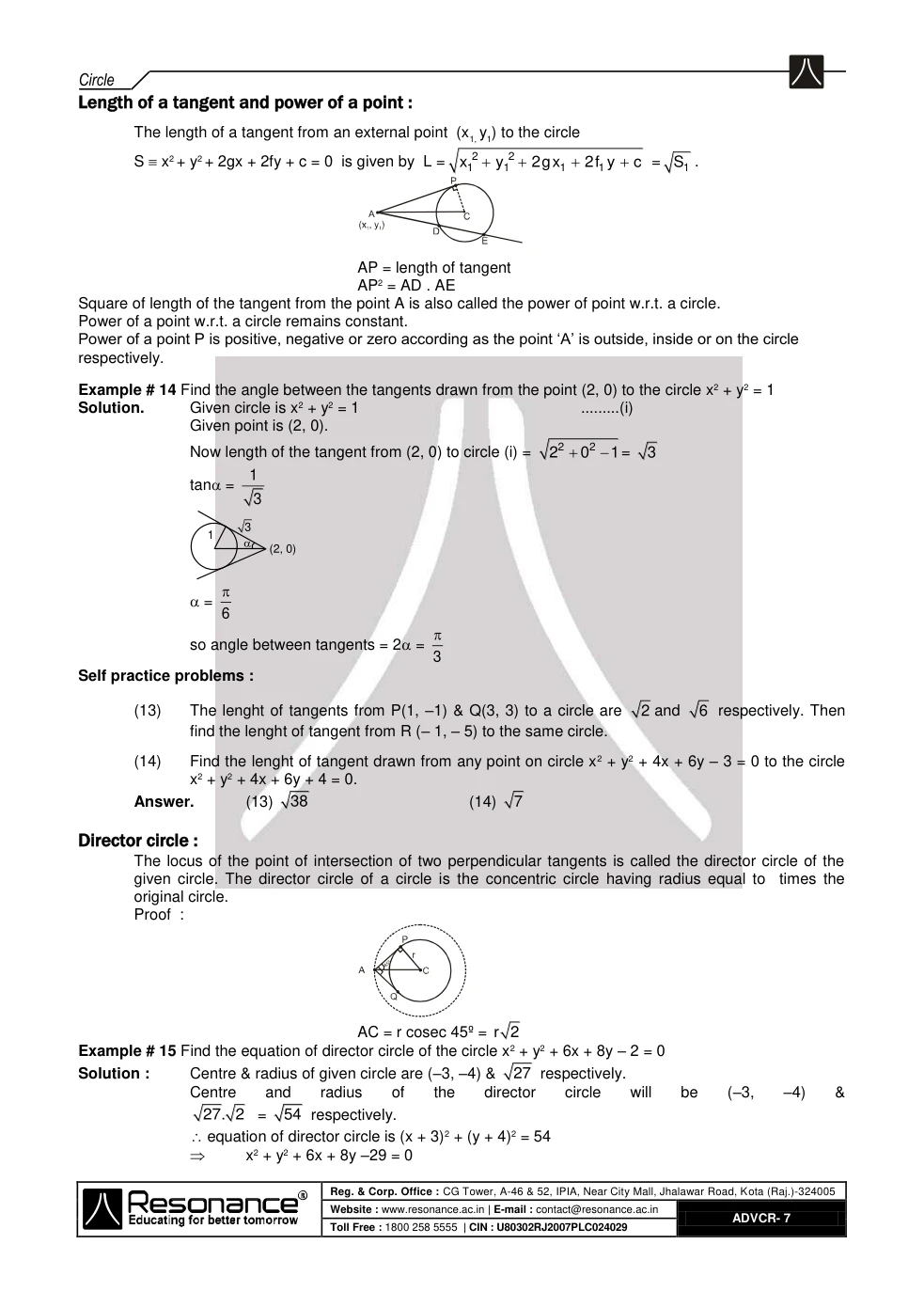
MAASCircle
© MAAS. All rights reserved.Page 7 / 31
Extracted text · page 7
Circle
Length of a tangent and power of a point :
The length of a tangent from an external point (x1, y1) to the circle
S x2 + y2 + 2gx + 2fy + c = 0 is given by L = x12 y12 2gx1 2f1 y c = S1 .
AP = length of tangent
AP2 = AD . AE
Square of length of the tangent from the point A is also called the power of point w.r.t. a circle.
Power of a point w.r.t. a circle remains constant.
Power of a point P is positive, negative or zero according as the point ‘A’ is outside, inside or on the circle
respectively.
Example # 14 Find the angle between the tangents drawn from the point (2, 0) to the circle x2 + y2 = 1
Solution. Given circle is x2 + y2 = 1 .........(i)
Given point is (2, 0).
Now length of the tangent from (2, 0) to circle (i) = 22 02 =1 3
1
tan =
3
3
1
(2, 0)
=
6
so angle between tangents = 2 =
3
Self practice problems :
(13) The lenght of tangents from P(1, –1) & Q(3, 3) to a circle are 2 and 6 respectively. Then
find the lenght of tangent from R (– 1, – 5) to the same circle.
(14) Find the lenght of tangent drawn from any point on circle x2 + y2 + 4x + 6y – 3 = 0 to the circle
x2 + y2 + 4x + 6y + 4 = 0.
Answer. (13) 38 (14) 7
Director circle :
The locus of the point of intersection of two perpendicular tangents is called the director circle of the
given circle. The director circle of a circle is the concentric circle having radius equal to times the
original circle.
Proof :
AC = r cosec 45º = r 2
Example # 15 Find the equation of director circle of the circle x2 + y2 + 6x + 8y – 2 = 0
Solution : Centre & radius of given circle are (–3, –4) & 27 respectively.
Centre and radius of the director circle will be (–3, –4) &
27. 2 = 54 respectively.
equation of director circle is (x + 3)2 + (y + 4)2 = 54
x2 + y2 + 6x + 8y –29 = 0
ADVCR- 7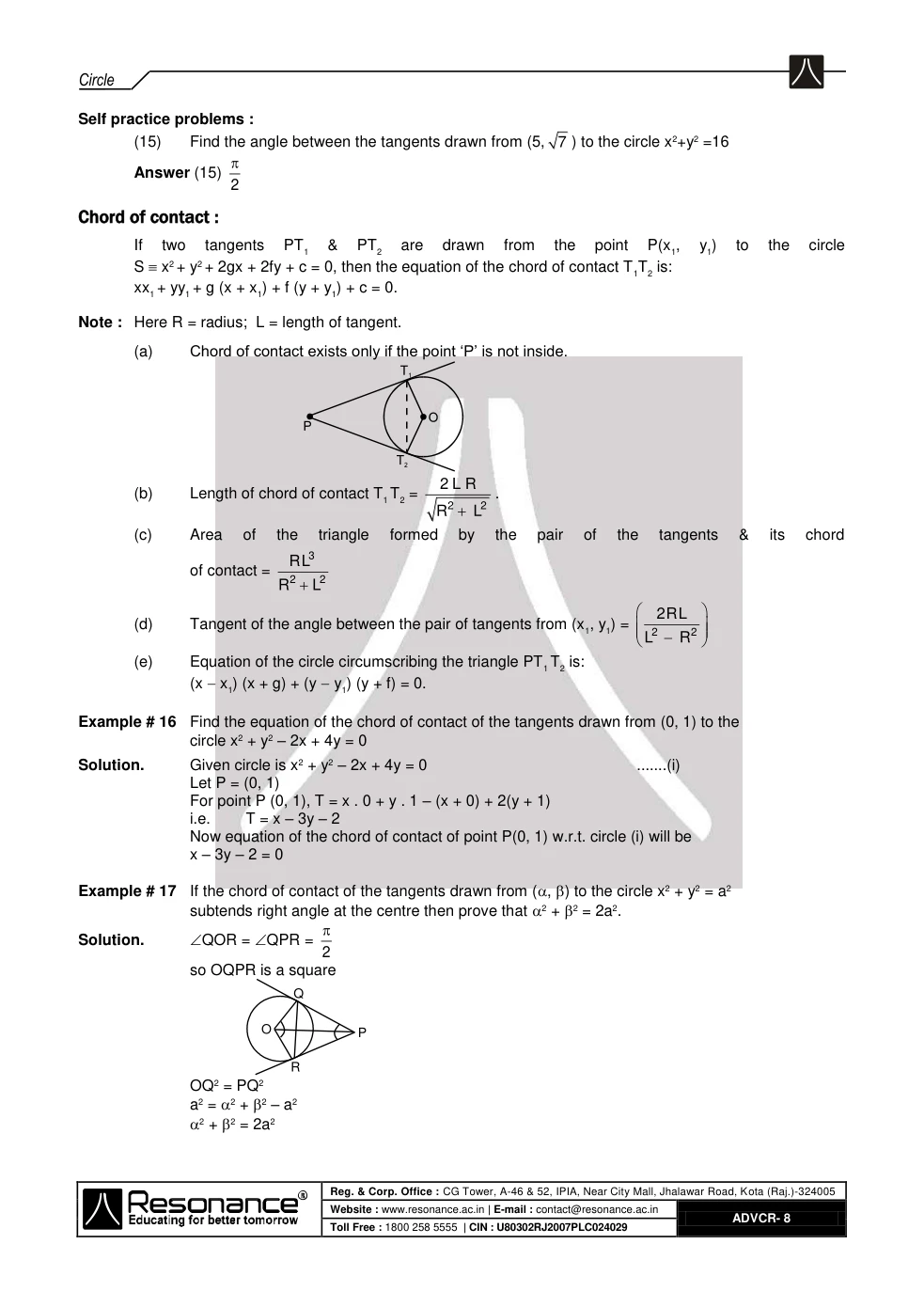
MAASCircle
© MAAS. All rights reserved.Page 8 / 31
Extracted text · page 8
Circle
Self practice problems :
(15) Find the angle between the tangents drawn from (5, 7 ) to the circle x2+y2 =16
Answer (15)
2
Chord of contact :
If two tangents PT1 & PT2 are drawn from the point P(x1, y1) to the circle
S x2 + y2 + 2gx + 2fy + c = 0, then the equation of the chord of contact T1T2 is:
xx1 + yy1 + g (x + x1) + f (y + y1) + c = 0.
Note : Here R = radius; L = length of tangent.
(a) Chord of contact exists only if the point ‘P’ is not inside.
2 L R
(b) Length of chord of contact T1 T2 = .
R 2 L2
(c) Area of the triangle formed by the pair of the tangents & its chord
RL3
of contact =
R 2 L2
2RL
(d) Tangent of the angle between the pair of tangents from (x1, y1) = 2 2 L R
(e) Equation of the circle circumscribing the triangle PT1 T2 is:
(x x1) (x + g) + (y y1) (y + f) = 0.
Example # 16 Find the equation of the chord of contact of the tangents drawn from (0, 1) to the
circle x2 + y2 – 2x + 4y = 0
Solution. Given circle is x2 + y2 – 2x + 4y = 0 .......(i)
Let P = (0, 1)
For point P (0, 1), T = x . 0 + y . 1 – (x + 0) + 2(y + 1)
i.e. T = x – 3y – 2
Now equation of the chord of contact of point P(0, 1) w.r.t. circle (i) will be
x – 3y – 2 = 0
Example # 17 If the chord of contact of the tangents drawn from (, ) to the circle x2 + y2 = a2
subtends right angle at the centre then prove that 2 + 2 = 2a2.
Solution. QOR = QPR =
2
so OQPR is a square
Q
O P
R
OQ2 = PQ2
a2 = 2 + 2 – a2
2 + 2 = 2a2
ADVCR- 8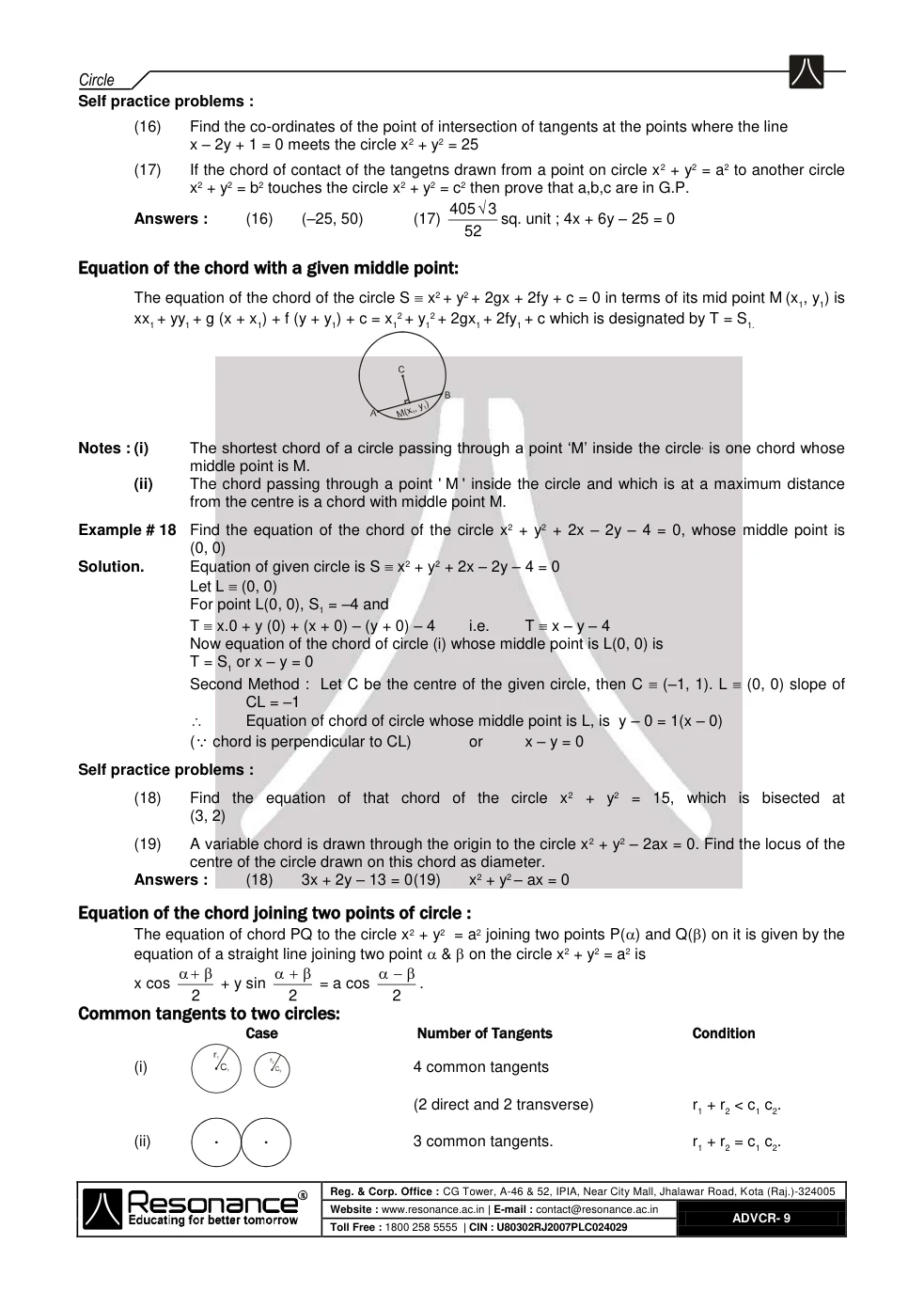
MAASCircle
© MAAS. All rights reserved.Page 9 / 31
Extracted text · page 9
Circle
Self practice problems :
(16) Find the co-ordinates of the point of intersection of tangents at the points where the line
x – 2y + 1 = 0 meets the circle x2 + y2 = 25
(17) If the chord of contact of the tangetns drawn from a point on circle x2 + y2 = a2 to another circle
x2 + y2 = b2 touches the circle x2 + y2 = c2 then prove that a,b,c are in G.P.
405 3
Answers : (16) (–25, 50) (17) sq. unit ; 4x + 6y – 25 = 0
52
Equation of the chord with a given middle point:
The equation of the chord of the circle S x2 + y2 + 2gx + 2fy + c = 0 in terms of its mid point M (x1, y1) is
xx1 + yy1 + g (x + x1) + f (y + y1) + c = x1 2 + y1 2 + 2gx1 + 2fy1 + c which is designated by T = S1.
Notes : (i) The shortest chord of a circle passing through a point ‘M’ inside the circle, is one chord whose
middle point is M.
(ii) The chord passing through a point ' M ' inside the circle and which is at a maximum distance
from the centre is a chord with middle point M.
Example # 18 Find the equation of the chord of the circle x2 + y2 + 2x – 2y – 4 = 0, whose middle point is
(0, 0)
Solution. Equation of given circle is S x2 + y2 + 2x – 2y – 4 = 0
Let L (0, 0)
For point L(0, 0), S1 = –4 and
T x.0 + y (0) + (x + 0) – (y + 0) – 4 i.e. T x – y – 4
Now equation of the chord of circle (i) whose middle point is L(0, 0) is
T = S1 or x – y = 0
Second Method : Let C be the centre of the given circle, then C (–1, 1). L (0, 0) slope of
CL = –1
Equation of chord of circle whose middle point is L, is y – 0 = 1(x – 0)
( chord is perpendicular to CL) or x – y = 0
Self practice problems :
(18) Find the equation of that chord of the circle x2 + y2 = 15, which is bisected at
(3, 2)
(19) A variable chord is drawn through the origin to the circle x2 + y2 – 2ax = 0. Find the locus of the
centre of the circle drawn on this chord as diameter.
Answers : (18) 3x + 2y – 13 = 0 (19) x2 + y2 – ax = 0
Equation of the chord joining two points of circle :
The equation of chord PQ to the circle x2 + y2 = a2 joining two points P() and Q() on it is given by the
equation of a straight line joining two point & on the circle x2 + y2 = a2 is
x cos + y sin = a cos .
2 2 2
Common tangents to two circles:
Case Number of Tangents Condition
(i) 4 common tangents
(2 direct and 2 transverse) r1 + r2 < c1 c2.
(ii) 3 common tangents. r1 + r2 = c1 c2.
ADVCR- 9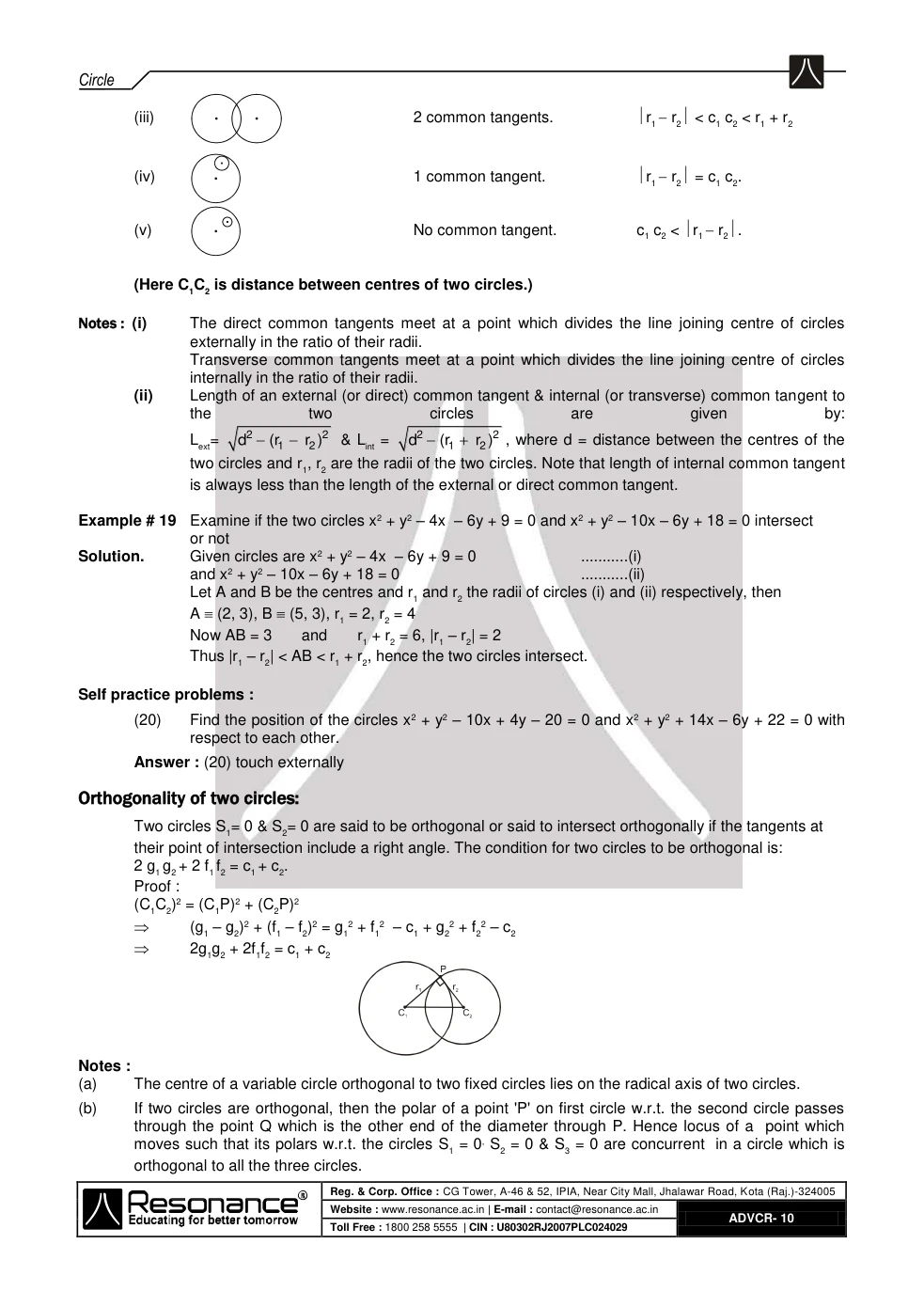
MAASCircle
© MAAS. All rights reserved.Page 10 / 31
Extracted text · page 10
Circle
(iii) 2 common tangents. r1 r2 < c1 c2 < r1 + r2
(iv) 1 common tangent. r1 r2 = c1 c2.
(v) No common tangent. c1 c2 < r1 r2.
(Here C1C2 is distance between centres of two circles.)
Notes : (i) The direct common tangents meet at a point which divides the line joining centre of circles
externally in the ratio of their radii.
Transverse common tangents meet at a point which divides the line joining centre of circles
internally in the ratio of their radii.
(ii) Length of an external (or direct) common tangent & internal (or transverse) common tangent to
the two circles are given by:
Lext= d2 (r1 r2 )2 & Lint = d2 (r1 r2 )2 , where d = distance between the centres of the
two circles and r1, r2 are the radii of the two circles. Note that length of internal common tangent
is always less than the length of the external or direct common tangent.
Example # 19 Examine if the two circles x2 + y2 – 4x – 6y + 9 = 0 and x2 + y2 – 10x – 6y + 18 = 0 intersect
or not
Solution. Given circles are x2 + y2 – 4x – 6y + 9 = 0 ...........(i)
and x2 + y2 – 10x – 6y + 18 = 0 ...........(ii)
Let A and B be the centres and r1 and r2 the radii of circles (i) and (ii) respectively, then
A (2, 3), B (5, 3), r1 = 2, r2 = 4
Now AB = 3 and r1 + r2 = 6, |r1 – r2| = 2
Thus |r1 – r2| < AB < r1 + r2, hence the two circles intersect.
Self practice problems :
(20) Find the position of the circles x2 + y2 – 10x + 4y – 20 = 0 and x2 + y2 + 14x – 6y + 22 = 0 with
respect to each other.
Answer : (20) touch externally
Orthogonality of two circles:
Two circles S1= 0 & S2= 0 are said to be orthogonal or said to intersect orthogonally if the tangents at
their point of intersection include a right angle. The condition for two circles to be orthogonal is:
2 g1 g2 + 2 f1 f2 = c1 + c2.
Proof :
(C1C2)2 = (C1P)2 + (C2P)2
(g1 – g2)2 + (f1 – f2)2 = g1 2 + f12 – c1 + g2 2 + f2 2 – c2
2g1g2 + 2f1f2 = c1 + c2
Notes :
(a) The centre of a variable circle orthogonal to two fixed circles lies on the radical axis of two circles.
(b) If two circles are orthogonal, then the polar of a point 'P' on first circle w.r.t. the second circle passes
through the point Q which is the other end of the diameter through P. Hence locus of a point which
moves such that its polars w.r.t. the circles S1 = 0, S2 = 0 & S3 = 0 are concurrent in a circle which is
orthogonal to all the three circles.
ADVCR- 10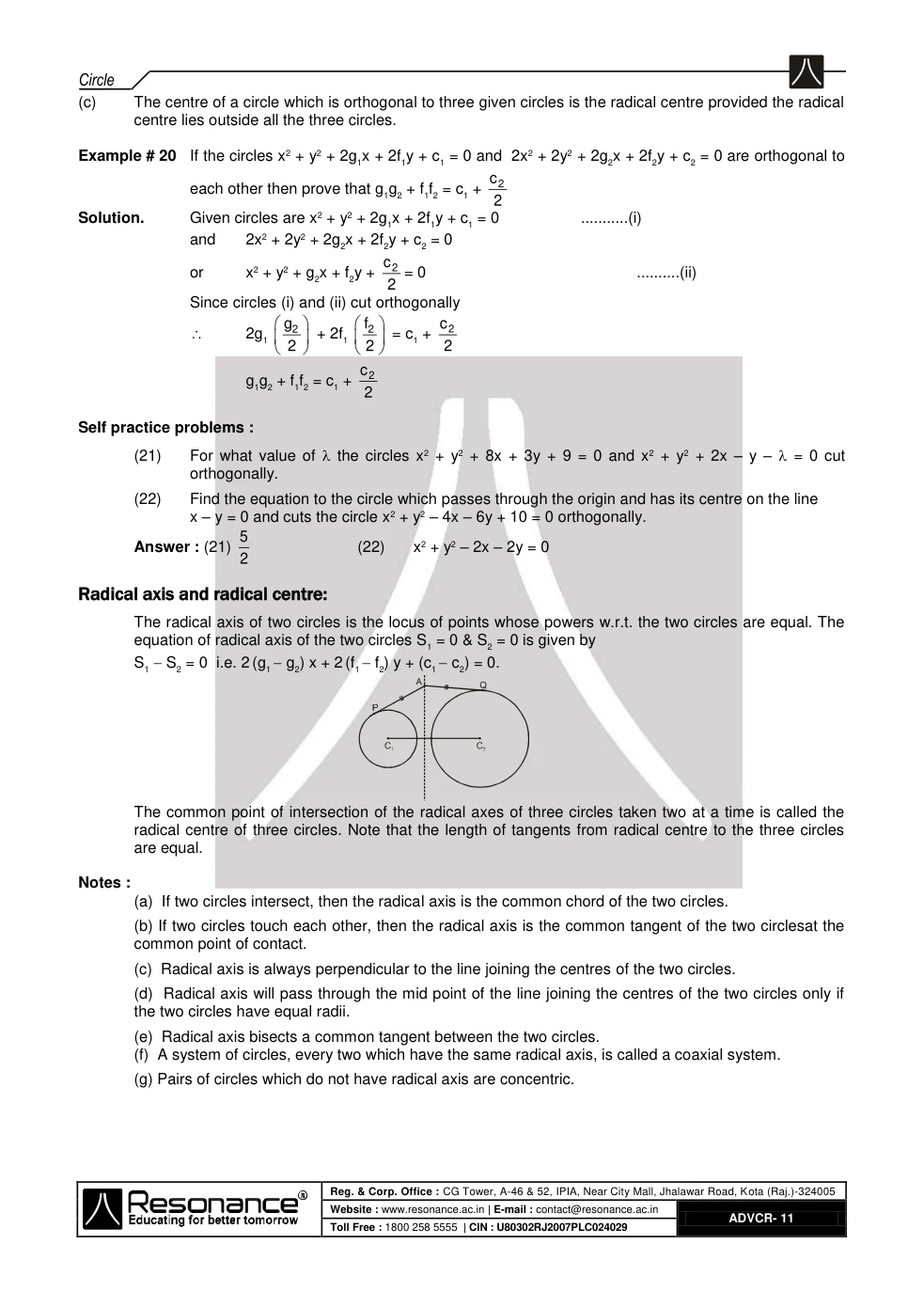
MAASCircle
© MAAS. All rights reserved.Page 11 / 31
Extracted text · page 11
Circle
(c) The centre of a circle which is orthogonal to three given circles is the radical centre provided the radical
centre lies outside all the three circles.
Example # 20 If the circles x2 + y2 + 2g1x + 2f1y + c1 = 0 and 2x2 + 2y2 + 2g2x + 2f2y + c2 = 0 are orthogonal to
c 2
each other then prove that g1g2 + f1f2 = c1 +
2
Solution. Given circles are x2 + y2 + 2g1x + 2f1y + c1 = 0 ...........(i)
and 2x2 + 2y2 + 2g2x + 2f2y + c2 = 0
c 2
or x2 + y2 + g2x + f2y + = 0 ..........(ii)
2
Since circles (i) and (ii) cut orthogonally
g2 2f c 2 2g1 + 2f1 = c1 +
2 2 2
c 2
g1g2 + f1f2 = c1 +
2
Self practice problems :
(21) For what value of the circles x2 + y2 + 8x + 3y + 9 = 0 and x2 + y2 + 2x – y – = 0 cut
orthogonally.
(22) Find the equation to the circle which passes through the origin and has its centre on the line
x – y = 0 and cuts the circle x2 + y2 – 4x – 6y + 10 = 0 orthogonally.
5
Answer : (21) (22) x2 + y2 – 2x – 2y = 0
2
Radical axis and radical centre:
The radical axis of two circles is the locus of points whose powers w.r.t. the two circles are equal. The
equation of radical axis of the two circles S1 = 0 & S2 = 0 is given by
S1 S2 = 0 i.e. 2 (g1 g2) x + 2 (f1 f2) y + (c1 c2) = 0.
The common point of intersection of the radical axes of three circles taken two at a time is called the
radical centre of three circles. Note that the length of tangents from radical centre to the three circles
are equal.
Notes :
(a) If two circles intersect, then the radical axis is the common chord of the two circles.
(b) If two circles touch each other, then the radical axis is the common tangent of the two circlesat the
common point of contact.
(c) Radical axis is always perpendicular to the line joining the centres of the two circles.
(d) Radical axis will pass through the mid point of the line joining the centres of the two circles only if
the two circles have equal radii.
(e) Radical axis bisects a common tangent between the two circles.
(f) A system of circles, every two which have the same radical axis, is called a coaxial system.
(g) Pairs of circles which do not have radical axis are concentric.
ADVCR- 11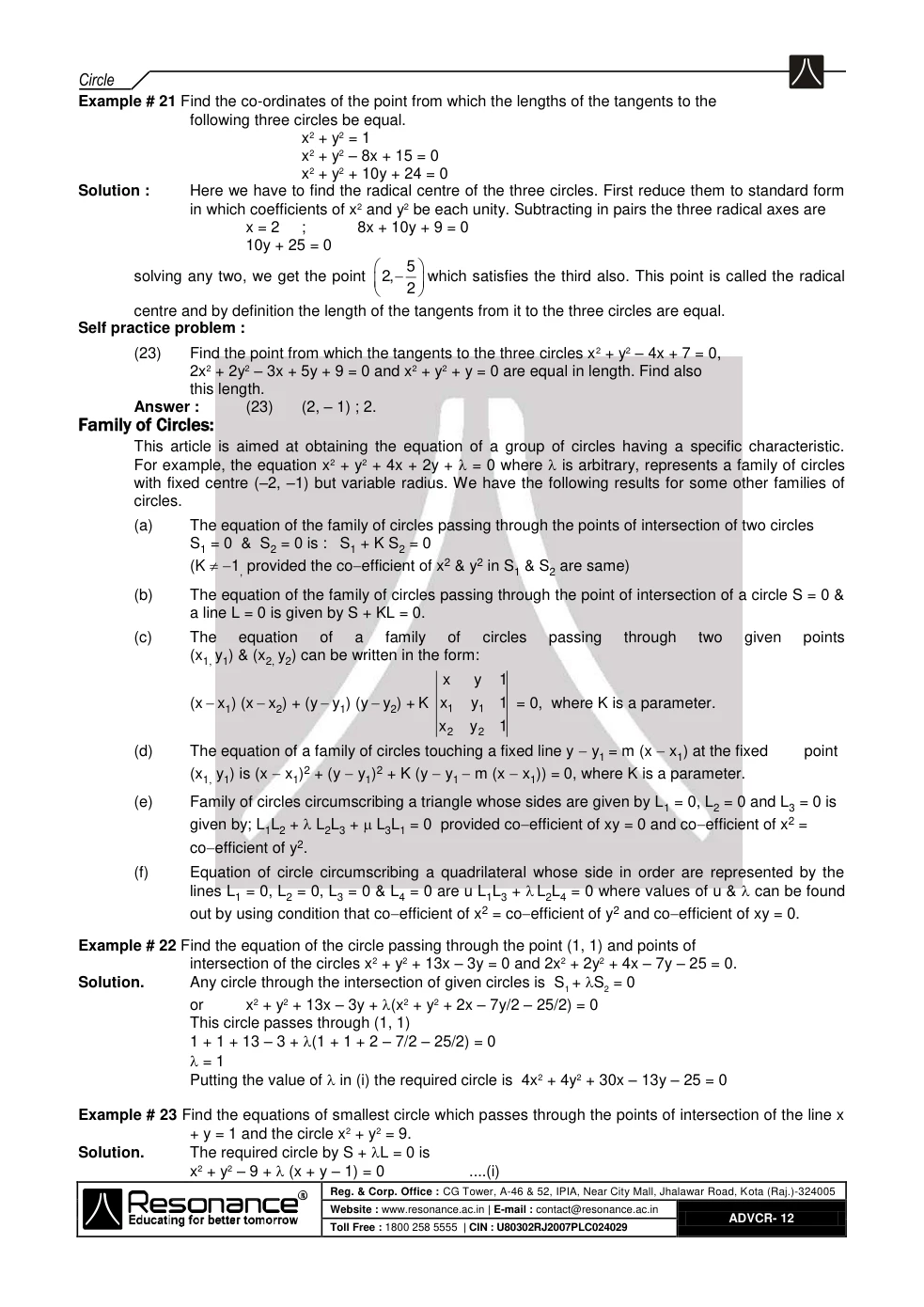
MAASCircle
© MAAS. All rights reserved.Page 12 / 31
Extracted text · page 12
Circle
Example # 21 Find the co-ordinates of the point from which the lengths of the tangents to the
following three circles be equal.
x2 + y2 = 1
x2 + y2 – 8x + 15 = 0
x2 + y2 + 10y + 24 = 0
Solution : Here we have to find the radical centre of the three circles. First reduce them to standard form
in which coefficients of x2 and y2 be each unity. Subtracting in pairs the three radical axes are
x = 2 ; 8x + 10y + 9 = 0
10y + 25 = 0
5
solving any two, we get the point 2, which satisfies the third also. This point is called the radical
2
centre and by definition the length of the tangents from it to the three circles are equal.
Self practice problem :
(23) Find the point from which the tangents to the three circles x2 + y2 – 4x + 7 = 0,
2x2 + 2y2 – 3x + 5y + 9 = 0 and x2 + y2 + y = 0 are equal in length. Find also
this length.
Answer : (23) (2, – 1) ; 2.
Family of Circles:
This article is aimed at obtaining the equation of a group of circles having a specific characteristic.
For example, the equation x2 + y2 + 4x + 2y + = 0 where is arbitrary, represents a family of circles
with fixed centre (–2, –1) but variable radius. We have the following results for some other families of
circles.
(a) The equation of the family of circles passing through the points of intersection of two circles
S1 = 0 & S2 = 0 is : S1 + K S2 = 0
(K 1, provided the coefficient of x2 & y2 in S1 & S2 are same)
(b) The equation of the family of circles passing through the point of intersection of a circle S = 0 &
a line L = 0 is given by S + KL = 0.
(c) The equation of a family of circles passing through two given points
(x1, y1) & (x2, y2) can be written in the form:
x y 1
(x x1) (x x2) + (y y1) (y y2) + K x1 y1 1 = 0, where K is a parameter.
x 2 y 2 1
(d) The equation of a family of circles touching a fixed line y y1 = m (x x1) at the fixed point
(x1, y1) is (x x1)2 + (y y1)2 + K (y y1 m (x x1)) = 0, where K is a parameter.
(e) Family of circles circumscribing a triangle whose sides are given by L1 = 0, L2 = 0 and L3 = 0 is
given by; L1L2 + L2L3 + L3L1 = 0 provided coefficient of xy = 0 and coefficient of x2 =
coefficient of y2.
(f) Equation of circle circumscribing a quadrilateral whose side in order are represented by the
lines L1 = 0, L2 = 0, L3 = 0 & L4 = 0 are u L1L3 + L2L4 = 0 where values of u & can be found
out by using condition that coefficient of x2 = coefficient of y2 and coefficient of xy = 0.
Example # 22 Find the equation of the circle passing through the point (1, 1) and points of
intersection of the circles x2 + y2 + 13x – 3y = 0 and 2x2 + 2y2 + 4x – 7y – 25 = 0.
Solution. Any circle through the intersection of given circles is S1 + S2 = 0
or x2 + y2 + 13x – 3y + (x2 + y2 + 2x – 7y/2 – 25/2) = 0
This circle passes through (1, 1)
1 + 1 + 13 – 3 + (1 + 1 + 2 – 7/2 – 25/2) = 0
= 1
Putting the value of in (i) the required circle is 4x2 + 4y2 + 30x – 13y – 25 = 0
Example # 23 Find the equations of smallest circle which passes through the points of intersection of the line x
+ y = 1 and the circle x2 + y2 = 9.
Solution. The required circle by S + L = 0 is
x2 + y2 – 9 + (x + y – 1) = 0 ....(i)
ADVCR- 12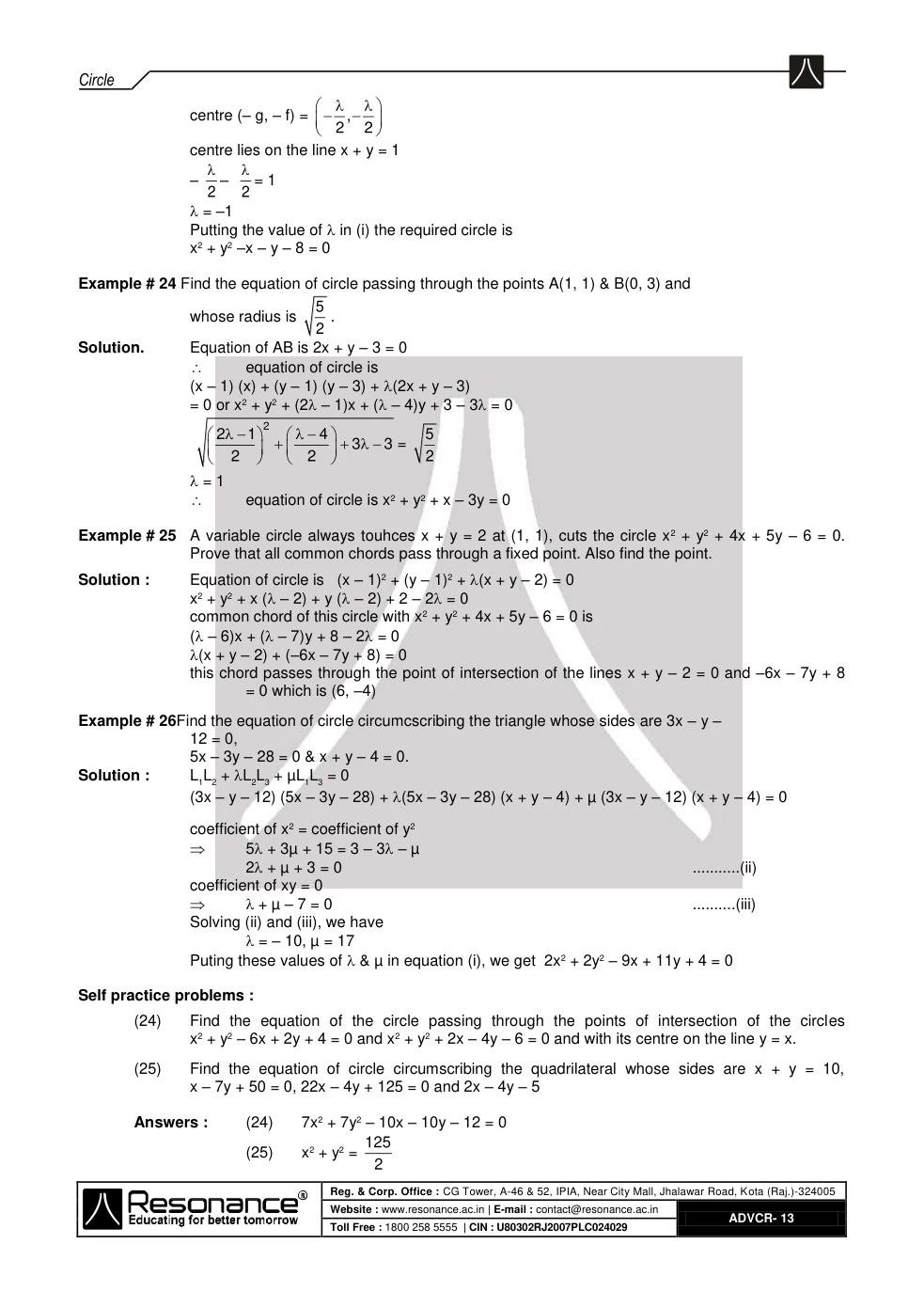
MAASCircle
© MAAS. All rights reserved.Page 13 / 31
Extracted text · page 13
Circle
centre (– g, – f) = ,
2 2
centre lies on the line x + y = 1
– – = 1
2 2
= –1
Putting the value of in (i) the required circle is
x2 + y2 –x – y – 8 = 0
Example # 24 Find the equation of circle passing through the points A(1, 1) & B(0, 3) and
5
whose radius is .
2
Solution. Equation of AB is 2x + y – 3 = 0
equation of circle is
(x – 1) (x) + (y – 1) (y – 3) + (2x + y – 3)
= 0 or x2 + y2 + (2 – 1)x + ( – 4)y + 3 – 3 = 0
2 1 2 4 5 3 3 =
2 2 2
= 1
equation of circle is x2 + y2 + x – 3y = 0
Example # 25 A variable circle always touhces x + y = 2 at (1, 1), cuts the circle x2 + y2 + 4x + 5y – 6 = 0.
Prove that all common chords pass through a fixed point. Also find the point.
Solution : Equation of circle is (x – 1)2 + (y – 1)2 + (x + y – 2) = 0
x2 + y2 + x ( – 2) + y ( – 2) + 2 – 2 = 0
common chord of this circle with x2 + y2 + 4x + 5y – 6 = 0 is
( – 6)x + ( – 7)y + 8 – 2 = 0
(x + y – 2) + (–6x – 7y + 8) = 0
this chord passes through the point of intersection of the lines x + y – 2 = 0 and –6x – 7y + 8
= 0 which is (6, –4)
Example # 26Find the equation of circle circumcscribing the triangle whose sides are 3x – y –
12 = 0,
5x – 3y – 28 = 0 & x + y – 4 = 0.
Solution : L1L2 + L2L3 + µL1L3 = 0
(3x – y – 12) (5x – 3y – 28) + (5x – 3y – 28) (x + y – 4) + µ (3x – y – 12) (x + y – 4) = 0
coefficient of x2 = coefficient of y2
5 + 3µ + 15 = 3 – 3 – µ
2 + µ + 3 = 0 ...........(ii)
coefficient of xy = 0
+ µ – 7 = 0 ..........(iii)
Solving (ii) and (iii), we have
= – 10, µ = 17
Puting these values of & µ in equation (i), we get 2x2 + 2y2 – 9x + 11y + 4 = 0
Self practice problems :
(24) Find the equation of the circle passing through the points of intersection of the circles
x2 + y2 – 6x + 2y + 4 = 0 and x2 + y2 + 2x – 4y – 6 = 0 and with its centre on the line y = x.
(25) Find the equation of circle circumscribing the quadrilateral whose sides are x + y = 10,
x – 7y + 50 = 0, 22x – 4y + 125 = 0 and 2x – 4y – 5
Answers : (24) 7x2 + 7y2 – 10x – 10y – 12 = 0
125
(25) x2 + y2 =
2
ADVCR- 13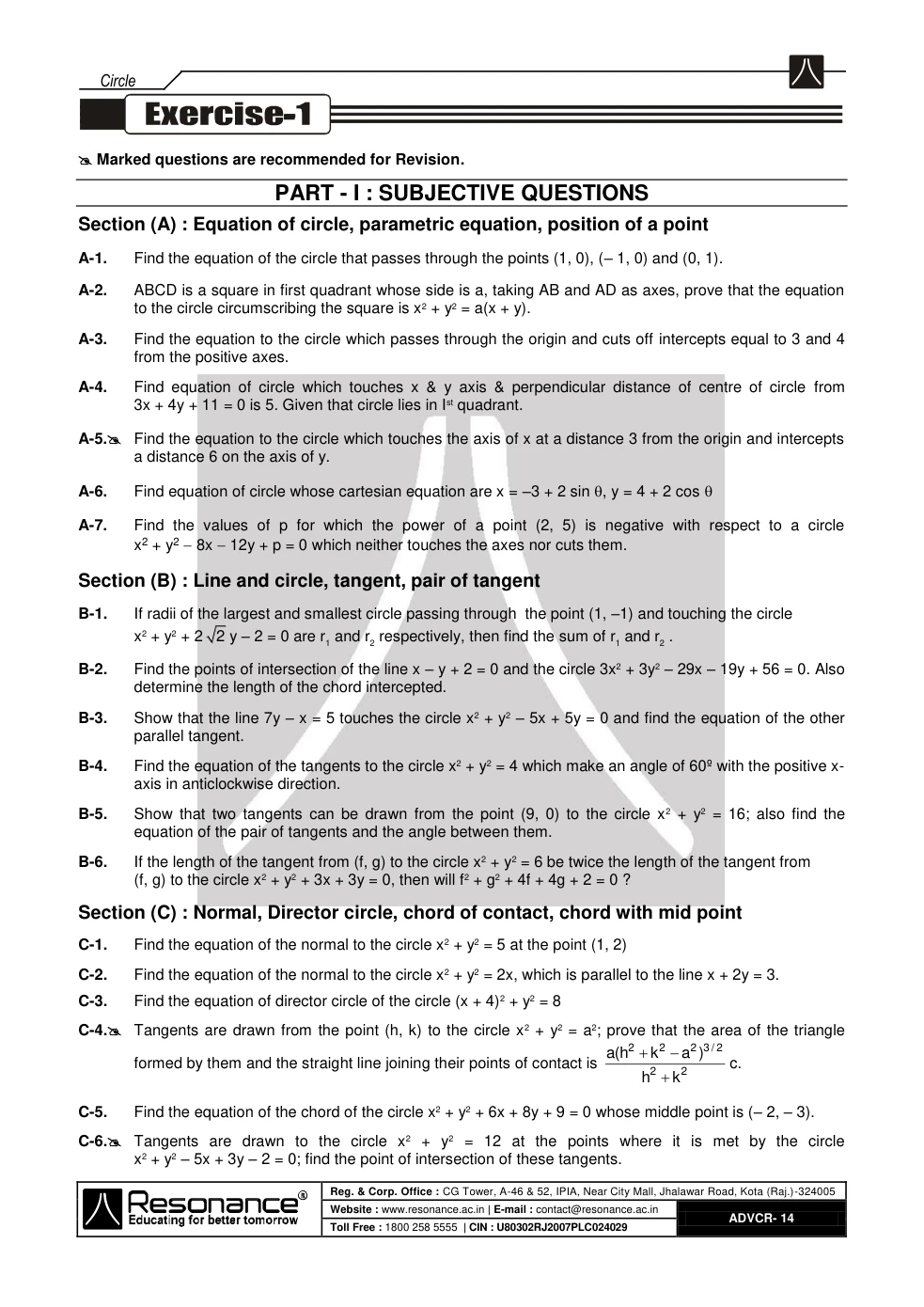
MAASCircle
© MAAS. All rights reserved.Page 14 / 31
Extracted text · page 14
Circle
Marked questions are recommended for Revision.
PART - I : SUBJECTIVE QUESTIONS
Section (A) : Equation of circle, parametric equation, position of a point
A-1. Find the equation of the circle that passes through the points (1, 0), (– 1, 0) and (0, 1).
A-2. ABCD is a square in first quadrant whose side is a, taking AB and AD as axes, prove that the equation
to the circle circumscribing the square is x2 + y2 = a(x + y).
A-3. Find the equation to the circle which passes through the origin and cuts off intercepts equal to 3 and 4
from the positive axes.
A-4. Find equation of circle which touches x & y axis & perpendicular distance of centre of circle from
3x + 4y + 11 = 0 is 5. Given that circle lies in Ist quadrant.
A-5. Find the equation to the circle which touches the axis of x at a distance 3 from the origin and intercepts
a distance 6 on the axis of y.
A-6. Find equation of circle whose cartesian equation are x = –3 + 2 sin , y = 4 + 2 cos
A-7. Find the values of p for which the power of a point (2, 5) is negative with respect to a circle
x2 + y2 8x 12y + p = 0 which neither touches the axes nor cuts them.
Section (B) : Line and circle, tangent, pair of tangent
B-1. If radii of the largest and smallest circle passing through the point (1, –1) and touching the circle
x2 + y2 + 2 2 y – 2 = 0 are r1 and r2 respectively, then find the sum of r1 and r2 .
B-2. Find the points of intersection of the line x – y + 2 = 0 and the circle 3x2 + 3y2 – 29x – 19y + 56 = 0. Also
determine the length of the chord intercepted.
B-3. Show that the line 7y – x = 5 touches the circle x2 + y2 – 5x + 5y = 0 and find the equation of the other
parallel tangent.
B-4. Find the equation of the tangents to the circle x2 + y2 = 4 which make an angle of 60º with the positive x-
axis in anticlockwise direction.
B-5. Show that two tangents can be drawn from the point (9, 0) to the circle x2 + y2 = 16; also find the
equation of the pair of tangents and the angle between them.
B-6. If the length of the tangent from (f, g) to the circle x2 + y2 = 6 be twice the length of the tangent from
(f, g) to the circle x2 + y2 + 3x + 3y = 0, then will f2 + g2 + 4f + 4g + 2 = 0 ?
Section (C) : Normal, Director circle, chord of contact, chord with mid point
C-1. Find the equation of the normal to the circle x2 + y2 = 5 at the point (1, 2)
C-2. Find the equation of the normal to the circle x2 + y2 = 2x, which is parallel to the line x + 2y = 3.
C-3. Find the equation of director circle of the circle (x + 4)2 + y2 = 8
C-4. Tangents are drawn from the point (h, k) to the circle x2 + y2 = a2; prove that the area of the triangle
a(h2 k 2 a 2 )3 / 2
formed by them and the straight line joining their points of contact is c.
h2 k 2
C-5. Find the equation of the chord of the circle x2 + y2 + 6x + 8y + 9 = 0 whose middle point is (– 2, – 3).
C-6. Tangents are drawn to the circle x2 + y2 = 12 at the points where it is met by the circle
x2 + y2 – 5x + 3y – 2 = 0; find the point of intersection of these tangents.
ADVCR- 14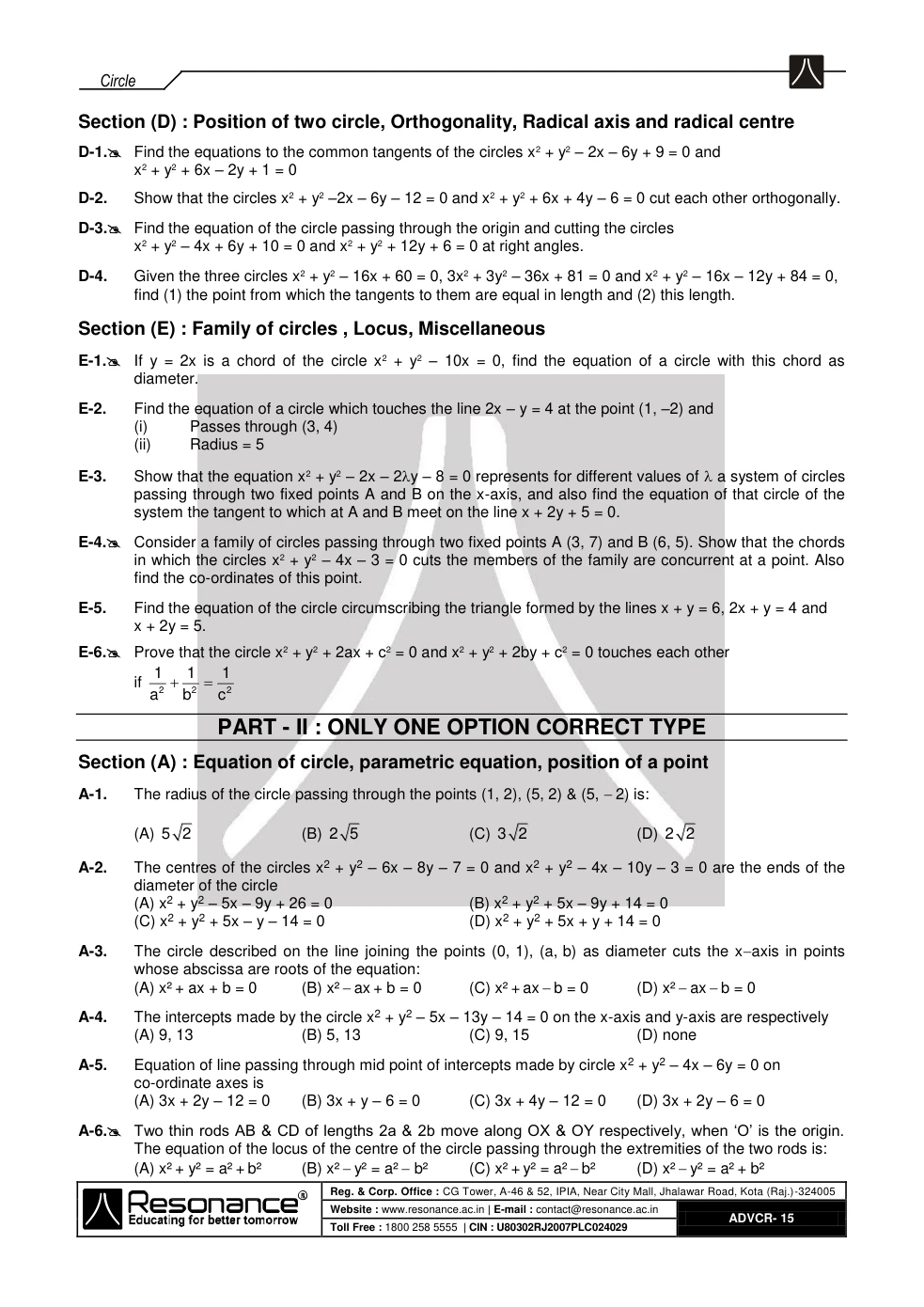
MAASCircle
© MAAS. All rights reserved.Page 15 / 31
Extracted text · page 15
Circle
Section (D) : Position of two circle, Orthogonality, Radical axis and radical centre
D-1. Find the equations to the common tangents of the circles x2 + y2 – 2x – 6y + 9 = 0 and
x2 + y2 + 6x – 2y + 1 = 0
D-2. Show that the circles x2 + y2 –2x – 6y – 12 = 0 and x2 + y2 + 6x + 4y – 6 = 0 cut each other orthogonally.
D-3. Find the equation of the circle passing through the origin and cutting the circles
x2 + y2 – 4x + 6y + 10 = 0 and x2 + y2 + 12y + 6 = 0 at right angles.
D-4. Given the three circles x2 + y2 – 16x + 60 = 0, 3x2 + 3y2 – 36x + 81 = 0 and x2 + y2 – 16x – 12y + 84 = 0,
find (1) the point from which the tangents to them are equal in length and (2) this length.
Section (E) : Family of circles , Locus, Miscellaneous
E-1. If y = 2x is a chord of the circle x2 + y2 – 10x = 0, find the equation of a circle with this chord as
diameter.
E-2. Find the equation of a circle which touches the line 2x – y = 4 at the point (1, –2) and
(i) Passes through (3, 4)
(ii) Radius = 5
E-3. Show that the equation x2 + y2 – 2x – 2y – 8 = 0 represents for different values of a system of circles
passing through two fixed points A and B on the x-axis, and also find the equation of that circle of the
system the tangent to which at A and B meet on the line x + 2y + 5 = 0.
E-4. Consider a family of circles passing through two fixed points A (3, 7) and B (6, 5). Show that the chords
in which the circles x2 + y2 – 4x – 3 = 0 cuts the members of the family are concurrent at a point. Also
find the co-ordinates of this point.
E-5. Find the equation of the circle circumscribing the triangle formed by the lines x + y = 6, 2x + y = 4 and
x + 2y = 5.
E-6. Prove that the circle x2 + y2 + 2ax + c2 = 0 and x2 + y2 + 2by + c2 = 0 touches each other
1 1 1
if 2 2 2
a b c
PART - II : ONLY ONE OPTION CORRECT TYPE
Section (A) : Equation of circle, parametric equation, position of a point
A-1. The radius of the circle passing through the points (1, 2), (5, 2) & (5, 2) is:
(A) 5 2 (B) 2 5 (C) 3 2 (D) 2 2
A-2. The centres of the circles x2 + y2 – 6x – 8y – 7 = 0 and x2 + y2 – 4x – 10y – 3 = 0 are the ends of the
diameter of the circle
(A) x2 + y2 – 5x – 9y + 26 = 0 (B) x2 + y2 + 5x – 9y + 14 = 0
(C) x2 + y2 + 5x – y – 14 = 0 (D) x2 + y2 + 5x + y + 14 = 0
A-3. The circle described on the line joining the points (0, 1), (a, b) as diameter cuts the xaxis in points
whose abscissa are roots of the equation:
(A) x² + ax + b = 0 (B) x² ax + b = 0 (C) x² + ax b = 0 (D) x² ax b = 0
A-4. The intercepts made by the circle x2 + y2 – 5x – 13y – 14 = 0 on the x-axis and y-axis are respectively
(A) 9, 13 (B) 5, 13 (C) 9, 15 (D) none
A-5. Equation of line passing through mid point of intercepts made by circle x2 + y2 – 4x – 6y = 0 on
co-ordinate axes is
(A) 3x + 2y – 12 = 0 (B) 3x + y – 6 = 0 (C) 3x + 4y – 12 = 0 (D) 3x + 2y – 6 = 0
A-6. Two thin rods AB & CD of lengths 2a & 2b move along OX & OY respectively, when ‘O’ is the origin.
The equation of the locus of the centre of the circle passing through the extremities of the two rods is:
(A) x² + y² = a² + b² (B) x² y² = a² b² (C) x² + y² = a² b² (D) x² y² = a² + b²
ADVCR- 15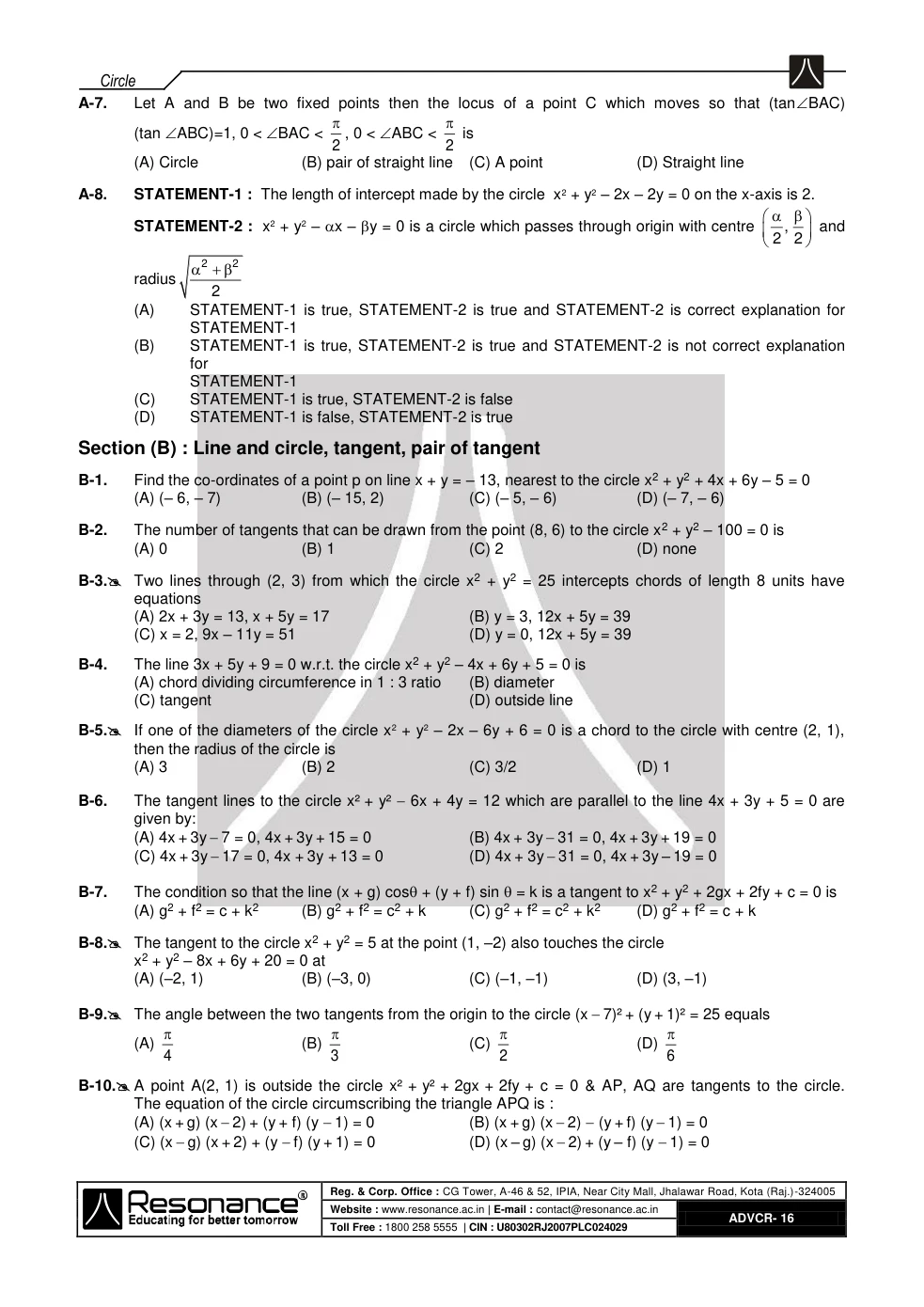
MAASCircle
© MAAS. All rights reserved.Page 16 / 31
Extracted text · page 16
Circle
A-7. Let A and B be two fixed points then the locus of a point C which moves so that (tanBAC)
(tan ABC)=1, 0 <BAC < , 0 < ABC < is
2 2
(A) Circle (B) pair of straight line (C) A point (D) Straight line
A-8. STATEMENT-1 : The length of intercept made by the circle x2 + y2 – 2x – 2y = 0 on the x-axis is 2.
STATEMENT-2 : x2 + y2 – x – y = 0 is a circle which passes through origin with centre , and
2 2
2 2
radius
2
(A) STATEMENT-1 is true, STATEMENT-2 is true and STATEMENT-2 is correct explanation for
STATEMENT-1
(B) STATEMENT-1 is true, STATEMENT-2 is true and STATEMENT-2 is not correct explanation
for
STATEMENT-1
(C) STATEMENT-1 is true, STATEMENT-2 is false
(D) STATEMENT-1 is false, STATEMENT-2 is true
Section (B) : Line and circle, tangent, pair of tangent
B-1. Find the co-ordinates of a point p on line x + y = – 13, nearest to the circle x2 + y2 + 4x + 6y – 5 = 0
(A) (– 6, – 7) (B) (– 15, 2) (C) (– 5, – 6) (D) (– 7, – 6)
B-2. The number of tangents that can be drawn from the point (8, 6) to the circle x2 + y2 – 100 = 0 is
(A) 0 (B) 1 (C) 2 (D) none
B-3. Two lines through (2, 3) from which the circle x2 + y2 = 25 intercepts chords of length 8 units have
equations
(A) 2x + 3y = 13, x + 5y = 17 (B) y = 3, 12x + 5y = 39
(C) x = 2, 9x – 11y = 51 (D) y = 0, 12x + 5y = 39
B-4. The line 3x + 5y + 9 = 0 w.r.t. the circle x2 + y2 – 4x + 6y + 5 = 0 is
(A) chord dividing circumference in 1 : 3 ratio (B) diameter
(C) tangent (D) outside line
B-5. If one of the diameters of the circle x2 + y2 – 2x – 6y + 6 = 0 is a chord to the circle with centre (2, 1),
then the radius of the circle is
(A) 3 (B) 2 (C) 3/2 (D) 1
B-6. The tangent lines to the circle x² + y² 6x + 4y = 12 which are parallel to the line 4x + 3y + 5 = 0 are
given by:
(A) 4x + 3y 7 = 0, 4x + 3y + 15 = 0 (B) 4x + 3y 31 = 0, 4x + 3y + 19 = 0
(C) 4x + 3y 17 = 0, 4x + 3y + 13 = 0 (D) 4x + 3y 31 = 0, 4x + 3y – 19 = 0
B-7. The condition so that the line (x + g) cos + (y + f) sin = k is a tangent to x2 + y2 + 2gx + 2fy + c = 0 is
(A) g2 + f2 = c + k2 (B) g2 + f2 = c2 + k (C) g2 + f2 = c2 + k2 (D) g2 + f2 = c + k
B-8. The tangent to the circle x2 + y2 = 5 at the point (1, –2) also touches the circle
x2 + y2 – 8x + 6y + 20 = 0 at
(A) (–2, 1) (B) (–3, 0) (C) (–1, –1) (D) (3, –1)
B-9. The angle between the two tangents from the origin to the circle (x 7)² + (y + 1)² = 25 equals
(A) (B) (C) (D)
4 3 2 6
B-10. A point A(2, 1) is outside the circle x² + y² + 2gx + 2fy + c = 0 & AP, AQ are tangents to the circle.
The equation of the circle circumscribing the triangle APQ is :
(A) (x + g) (x 2) + (y + f) (y 1) = 0 (B) (x + g) (x 2) (y + f) (y 1) = 0
(C) (x g) (x + 2) + (y f) (y + 1) = 0 (D) (x – g) (x 2) + (y – f) (y 1) = 0
ADVCR- 16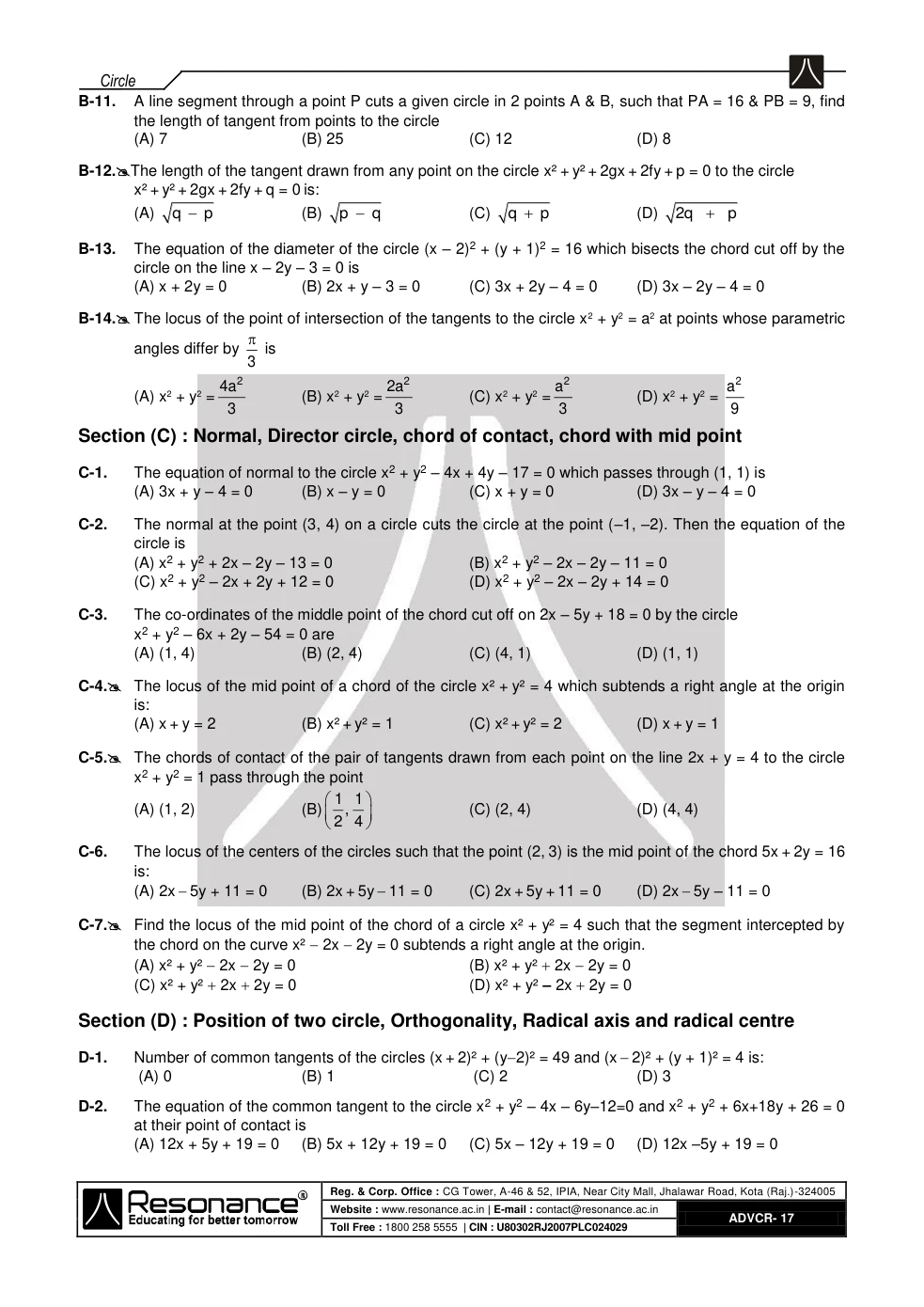
MAASCircle
© MAAS. All rights reserved.Page 17 / 31
Extracted text · page 17
Circle
B-11. A line segment through a point P cuts a given circle in 2 points A & B, such that PA = 16 & PB = 9, find
the length of tangent from points to the circle
(A) 7 (B) 25 (C) 12 (D) 8
B-12.The length of the tangent drawn from any point on the circle x² + y² + 2gx + 2fy + p = 0 to the circle
x² + y² + 2gx + 2fy + q = 0 is:
(A) q p (B) p q (C) q p (D) 2q p
B-13. The equation of the diameter of the circle (x – 2)2 + (y + 1)2 = 16 which bisects the chord cut off by the
circle on the line x – 2y – 3 = 0 is
(A) x + 2y = 0 (B) 2x + y – 3 = 0 (C) 3x + 2y – 4 = 0 (D) 3x – 2y – 4 = 0
B-14. The locus of the point of intersection of the tangents to the circle x2 + y2 = a2 at points whose parametric
angles differ by is
3
4a 2 2a 2 a 2 a 2
(A) x2 + y2 = (B) x2 + y2 = (C) x2 + y2 = (D) x2 + y2 =
3 3 3 9
Section (C) : Normal, Director circle, chord of contact, chord with mid point
C-1. The equation of normal to the circle x2 + y2 – 4x + 4y – 17 = 0 which passes through (1, 1) is
(A) 3x + y – 4 = 0 (B) x – y = 0 (C) x + y = 0 (D) 3x – y – 4 = 0
C-2. The normal at the point (3, 4) on a circle cuts the circle at the point (–1, –2). Then the equation of the
circle is
(A) x2 + y2 + 2x – 2y – 13 = 0 (B) x2 + y2 – 2x – 2y – 11 = 0
(C) x2 + y2 – 2x + 2y + 12 = 0 (D) x2 + y2 – 2x – 2y + 14 = 0
C-3. The co-ordinates of the middle point of the chord cut off on 2x – 5y + 18 = 0 by the circle
x2 + y2 – 6x + 2y – 54 = 0 are
(A) (1, 4) (B) (2, 4) (C) (4, 1) (D) (1, 1)
C-4. The locus of the mid point of a chord of the circle x² + y² = 4 which subtends a right angle at the origin
is:
(A) x + y = 2 (B) x² + y² = 1 (C) x² + y² = 2 (D) x + y = 1
C-5. The chords of contact of the pair of tangents drawn from each point on the line 2x + y = 4 to the circle
x2 + y2 = 1 pass through the point
1 1
(A) (1, 2) (B) , (C) (2, 4) (D) (4, 4)
2 4
C-6. The locus of the centers of the circles such that the point (2, 3) is the mid point of the chord 5x + 2y = 16
is:
(A) 2x 5y + 11 = 0 (B) 2x + 5y 11 = 0 (C) 2x + 5y + 11 = 0 (D) 2x 5y – 11 = 0
C-7. Find the locus of the mid point of the chord of a circle x² + y² = 4 such that the segment intercepted by
the chord on the curve x² 2x 2y = 0 subtends a right angle at the origin.
(A) x² + y² 2x 2y = 0 (B) x² + y² 2x 2y = 0
(C) x² + y² 2x 2y = 0 (D) x² + y² – 2x 2y = 0
Section (D) : Position of two circle, Orthogonality, Radical axis and radical centre
D-1. Number of common tangents of the circles (x + 2)² + (y2)² = 49 and (x 2)² + (y + 1)² = 4 is:
(A) 0 (B) 1 (C) 2 (D) 3
D-2. The equation of the common tangent to the circle x2 + y2 – 4x – 6y–12=0 and x2 + y2 + 6x+18y + 26 = 0
at their point of contact is
(A) 12x + 5y + 19 = 0 (B) 5x + 12y + 19 = 0 (C) 5x – 12y + 19 = 0 (D) 12x –5y + 19 = 0
ADVCR- 17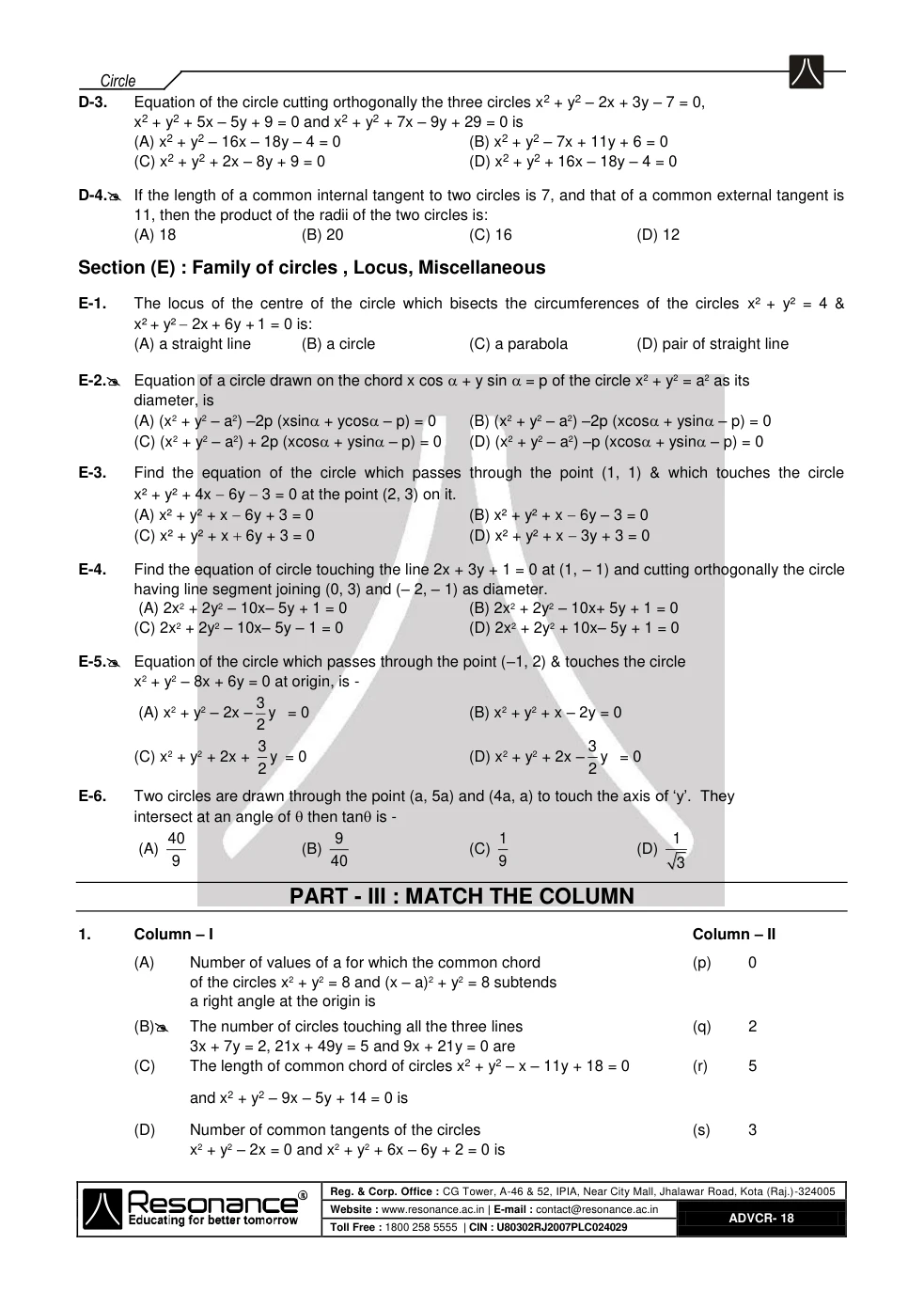
MAASCircle
© MAAS. All rights reserved.Page 18 / 31
Extracted text · page 18
Circle
D-3. Equation of the circle cutting orthogonally the three circles x2 + y2 – 2x + 3y – 7 = 0,
x2 + y2 + 5x – 5y + 9 = 0 and x2 + y2 + 7x – 9y + 29 = 0 is
(A) x2 + y2 – 16x – 18y – 4 = 0 (B) x2 + y2 – 7x + 11y + 6 = 0
(C) x2 + y2 + 2x – 8y + 9 = 0 (D) x2 + y2 + 16x – 18y – 4 = 0
D-4. If the length of a common internal tangent to two circles is 7, and that of a common external tangent is
11, then the product of the radii of the two circles is:
(A) 18 (B) 20 (C) 16 (D) 12
Section (E) : Family of circles , Locus, Miscellaneous
E-1. The locus of the centre of the circle which bisects the circumferences of the circles x² + y² = 4 &
x² + y² 2x + 6y + 1 = 0 is:
(A) a straight line (B) a circle (C) a parabola (D) pair of straight line
E-2. Equation of a circle drawn on the chord x cos + y sin = p of the circle x2 + y2 = a2 as its
diameter, is
(A) (x2 + y2 – a2) –2p (xsin + ycos – p) = 0 (B) (x2 + y2 – a2) –2p (xcos + ysin – p) = 0
(C) (x2 + y2 – a2) + 2p (xcos + ysin – p) = 0 (D) (x2 + y2 – a2) –p (xcos + ysin – p) = 0
E-3. Find the equation of the circle which passes through the point (1, 1) & which touches the circle
x² + y² + 4x 6y 3 = 0 at the point (2, 3) on it.
(A) x² + y² + x 6y + 3 = 0 (B) x² + y² + x 6y – 3 = 0
(C) x² + y² + x 6y + 3 = 0 (D) x² + y² + x 3y + 3 = 0
E-4. Find the equation of circle touching the line 2x + 3y + 1 = 0 at (1, – 1) and cutting orthogonally the circle
having line segment joining (0, 3) and (– 2, – 1) as diameter.
(A) 2x2 + 2y2 – 10x– 5y + 1 = 0 (B) 2x2 + 2y2 – 10x+ 5y + 1 = 0
(C) 2x2 + 2y2 – 10x– 5y – 1 = 0 (D) 2x2 + 2y2 + 10x– 5y + 1 = 0
E-5. Equation of the circle which passes through the point (–1, 2) & touches the circle
x2 + y2 – 8x + 6y = 0 at origin, is -
3
(A) x2 + y2 – 2x – y = 0 (B) x2 + y2 + x – 2y = 0
2
3 3
(C) x2 + y2 + 2x + y = 0 (D) x2 + y2 + 2x – y = 0
2 2
E-6. Two circles are drawn through the point (a, 5a) and (4a, a) to touch the axis of ‘y’. They
intersect at an angle of then tan is -
40 9 1 1
(A) (B) (C) (D)
9 40 9 3
PART - III : MATCH THE COLUMN
1. Column – I Column – II
(A) Number of values of a for which the common chord (p) 0
of the circles x2 + y2 = 8 and (x – a)2 + y2 = 8 subtends
a right angle at the origin is
(B) The number of circles touching all the three lines (q) 2
3x + 7y = 2, 21x + 49y = 5 and 9x + 21y = 0 are
(C) The length of common chord of circles x2 + y2 – x – 11y + 18 = 0 (r) 5
and x2 + y2 – 9x – 5y + 14 = 0 is
(D) Number of common tangents of the circles (s) 3
x2 + y2 – 2x = 0 and x2 + y2 + 6x – 6y + 2 = 0 is
ADVCR- 18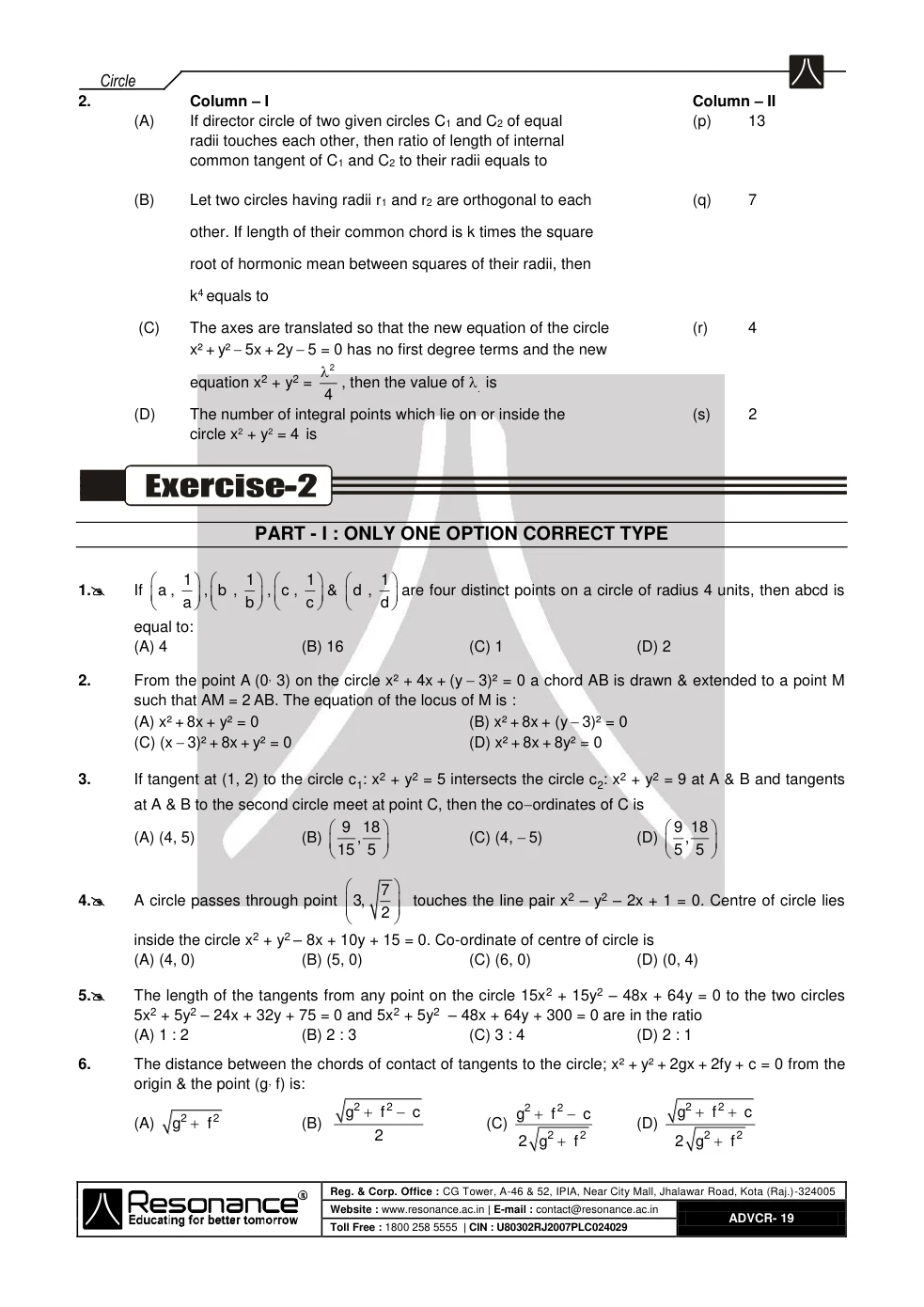
MAASCircle
© MAAS. All rights reserved.Page 19 / 31
Extracted text · page 19
Circle
2. Column – I Column – II
(A) If director circle of two given circles C1 and C2 of equal (p) 13
radii touches each other, then ratio of length of internal
common tangent of C1 and C2 to their radii equals to
(B) Let two circles having radii r1 and r2 are orthogonal to each (q) 7
other. If length of their common chord is k times the square
root of hormonic mean between squares of their radii, then
k4 equals to
(C) The axes are translated so that the new equation of the circle (r) 4
x² + y² 5x + 2y 5 = 0 has no first degree terms and the new
2
equation x2 + y2 = , then the value of is
4
(D) The number of integral points which lie on or inside the (s) 2
circle x2 + y2 = 4 is
PART - I : ONLY ONE OPTION CORRECT TYPE
1 1 1 1
1. If a , , b , , c , & d , are four distinct points on a circle of radius 4 units, then abcd is
a b c d
equal to:
(A) 4 (B) 16 (C) 1 (D) 2
2. From the point A (0, 3) on the circle x² + 4x + (y 3)² = 0 a chord AB is drawn & extended to a point M
such that AM = 2 AB. The equation of the locus of M is :
(A) x² + 8x + y² = 0 (B) x² + 8x + (y 3)² = 0
(C) (x 3)² + 8x + y² = 0 (D) x² + 8x + 8y² = 0
3. If tangent at (1, 2) to the circle c1: x2 + y2 = 5 intersects the circle c2: x2 + y2 = 9 at A & B and tangents
at A & B to the second circle meet at point C, then the coordinates of C is
9 18 9 18
(A) (4, 5) (B) , (C) (4, 5) (D) ,
15 5 5 5
7
4. A circle passes through point 3, touches the line pair x2 – y2 – 2x + 1 = 0. Centre of circle lies 2
inside the circle x2 + y2 – 8x + 10y + 15 = 0. Co-ordinate of centre of circle is
(A) (4, 0) (B) (5, 0) (C) (6, 0) (D) (0, 4)
5. The length of the tangents from any point on the circle 15x2 + 15y2 – 48x + 64y = 0 to the two circles
5x2 + 5y2 – 24x + 32y + 75 = 0 and 5x2 + 5y2 – 48x + 64y + 300 = 0 are in the ratio
(A) 1 : 2 (B) 2 : 3 (C) 3 : 4 (D) 2 : 1
6. The distance between the chords of contact of tangents to the circle; x² + y² + 2gx + 2fy + c = 0 from the
origin & the point (g, f) is:
2 2 g2 f 2 c g2 f 2 c g2 f 2 c (A) g f (B) (C) (D)
2 2 g2 f 2 2 g2 f 2
ADVCR- 19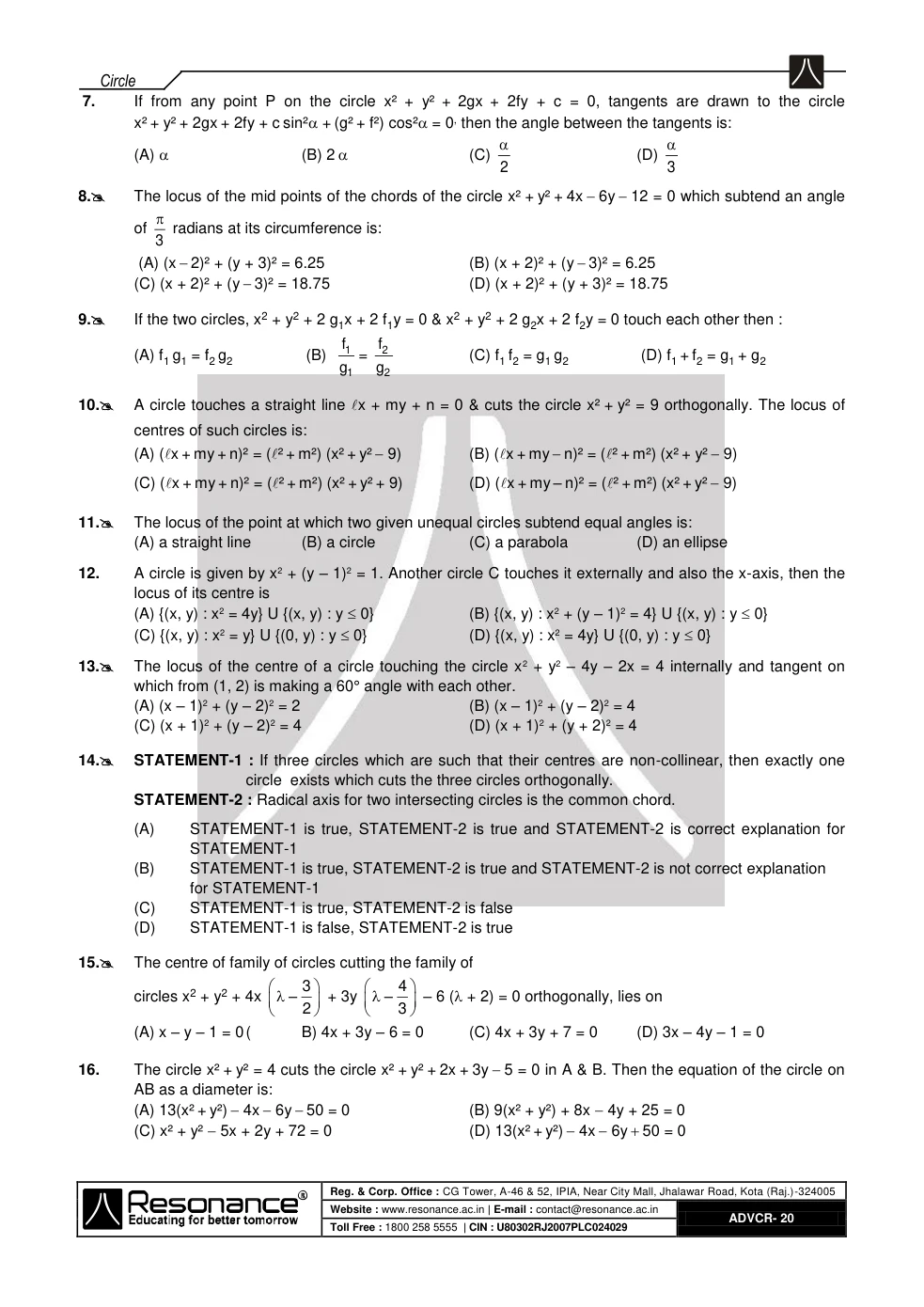
MAASCircle
© MAAS. All rights reserved.Page 20 / 31
Extracted text · page 20
Circle
7. If from any point P on the circle x² + y² + 2gx + 2fy + c = 0, tangents are drawn to the circle
x² + y² + 2gx + 2fy + c sin² + (g² + f²) cos² = 0, then the angle between the tangents is:
(A) (B) 2 (C) (D)
2 3
8. The locus of the mid points of the chords of the circle x² + y² + 4x 6y 12 = 0 which subtend an angle
of radians at its circumference is:
3
(A) (x 2)² + (y + 3)² = 6.25 (B) (x + 2)² + (y 3)² = 6.25
(C) (x + 2)² + (y 3)² = 18.75 (D) (x + 2)² + (y + 3)² = 18.75
9. If the two circles, x2 + y2 + 2 g1x + 2 f1y = 0 & x2 + y2 + 2 g2x + 2 f2y = 0 touch each other then :
f1 f2
(A) f1 g1 = f2 g2 (B) = (C) f1 f2 = g1 g2 (D) f1 + f2 = g1 + g2
g1 g 2
10. A circle touches a straight line x + my + n = 0 & cuts the circle x² + y² = 9 orthogonally. The locus of
centres of such circles is:
(A) (x + my + n)² = (² + m²) (x² + y² 9) (B) (x + my n)² = (² + m²) (x² + y² 9)
(C) (x + my + n)² = (² + m²) (x² + y² + 9) (D) (x + my – n)² = (² + m²) (x² + y² 9)
11. The locus of the point at which two given unequal circles subtend equal angles is:
(A) a straight line (B) a circle (C) a parabola (D) an ellipse
12. A circle is given by x2 + (y – 1)2 = 1. Another circle C touches it externally and also the x-axis, then the
locus of its centre is
(A) {(x, y) : x2 = 4y} U {(x, y) : y 0} (B) {(x, y) : x2 + (y – 1)2 = 4} U {(x, y) : y 0}
(C) {(x, y) : x2 = y} U {(0, y) : y 0} (D) {(x, y) : x2 = 4y} U {(0, y) : y 0}
13. The locus of the centre of a circle touching the circle x2 + y2 – 4y – 2x = 4 internally and tangent on
which from (1, 2) is making a 60° angle with each other.
(A) (x – 1)2 + (y – 2)2 = 2 (B) (x – 1)2 + (y – 2)2 = 4
(C) (x + 1)2 + (y – 2)2 = 4 (D) (x + 1)2 + (y + 2)2 = 4
14. STATEMENT-1 : If three circles which are such that their centres are non-collinear, then exactly one
circle exists which cuts the three circles orthogonally.
STATEMENT-2 : Radical axis for two intersecting circles is the common chord.
(A) STATEMENT-1 is true, STATEMENT-2 is true and STATEMENT-2 is correct explanation for
STATEMENT-1
(B) STATEMENT-1 is true, STATEMENT-2 is true and STATEMENT-2 is not correct explanation
for STATEMENT-1
(C) STATEMENT-1 is true, STATEMENT-2 is false
(D) STATEMENT-1 is false, STATEMENT-2 is true
15. The centre of family of circles cutting the family of
3 4
circles x2 + y2 + 4x – + 3y – – 6 ( + 2) = 0 orthogonally, lies on
2 3
(A) x – y – 1 = 0 ( B) 4x + 3y – 6 = 0 (C) 4x + 3y + 7 = 0 (D) 3x – 4y – 1 = 0
16. The circle x² + y² = 4 cuts the circle x² + y² + 2x + 3y 5 = 0 in A & B. Then the equation of the circle on
AB as a diameter is:
(A) 13(x² + y²) 4x 6y 50 = 0 (B) 9(x² + y²) + 8x 4y + 25 = 0
(C) x² + y² 5x + 2y + 72 = 0 (D) 13(x² + y²) 4x 6y 50 = 0
ADVCR- 20
MAASCircle
© MAAS. All rights reserved.Page 21 / 31
Extracted text · page 21
Circle
PART-II: NUMERICAL VALUE QUESTIONS
INSTRUCTION :
The answer to each question is NUMERICAL VALUE with two digit integer and decimal upto two digit.
If the numerical value has more than two decimal places truncate/round-off the value to TWO decimal
placed.
1. Find maximum number of points having integer coordinates (both x, y integer) which can lie on a circle
with centre at 2, 3 is (are)
2. If equation of smallest circle touching the circles x² + y² 2y 3 = 0 and x² + y² 8x 18y + 93 = 0 is
x2 + y2 – 4x – fy + c = 0 then value of f + c is
3. A line meets the coordinate axes in A and B. A circle is circumscribed about the triangle OAB. If
d1 and d2 are the distances of the tangent to the circle at the origin O from the points A and B
respectively and diameter of the circle is 1d1 + 2d2, then find the value of 1 + 2.
4. A circle is inscribed (i.e. touches all four sides) into a rhombous ABCD with one angle 60º. The distance
from the centre of the circle to the nearest vertex is equal to 1. If P is any point of the circle, then
PA 2 PB 2 PC 2 PD 2 is equal to :
5. Let x & y be the real numbers satisfying the equation x2 4x + y2 + 3 = 0. If the maximum and minimum
values of x2 + y2 are M & m respectively, then find the numerical value of (M m).
6. Find absolute value of 'c' for which the set,
{(x, y)x2 + y2 + 2x 1} {(x, y)5x 12y + c 0} contains only one point is common.
7. A rhombus is inscribed in the region common to the two circles x² + y² 4x 12 = 0 and
x² + y² + 4x 12 = 0 with two of its vertices on the line joining the centres of the circles then area of the
rhombus is
8. If (, ) is a point on the circle whose centre is on the x-axis and which touches the line x + y = 0 at
(2, –2), then find the greatest value of ‘’ is
9. Two circles whose radii are equal to 4 and 8 intersect at right angles, then length of their common
chord is
10. A variable circle passes through the point A (a, b) & touches the xaxis and the locus of the other end
of the diameter through A is (x a)² = by , then find the value of
11. Let A be the centre of the circle x² + y² 2x 4y 20 = 0. Suppose that the tangents at the points
B (1, 7) & D (4, 2) on the circle meet at the point C. Find the area of the quadrilateral ABCD.
12. If the complete set of values of a for which the point (2a, a + 1) is an interior point of the larger segment
of the circle x2 + y2 2x 2y 8 = 0 made by the chord whose equation is 3x 4y + 5 = 0 is (p,q) then
value of p + q is
13. The circles x2 + y2 + 2ax + cy + a = 0 and x2 + y2 – 3ax + dy – 1 = 0 intersect in two distinct points P and
Q, then find the number of values of ‘a’ for which the line 5x + by – a = 0 passes through P and Q.
14.The circumference of the circle x2 + y2 2x + 8y q = 0 is bisected by the circle
x2 + y2 + 4x + 12y + p = 0, then find p + q
15. A circle touches the line y = x at a point P such that OP = 4 2 where O is the origin. The circle
contains the point (10, 2) in its interior and the length of its chord on the line x + y = 0 is 6 2 . If the
equation of the circle x2 + y2 + 2g x 2fy + 3c = 0, then value of g + f + c is
PART - III : ONE OR MORE THAN ONE OPTIONS CORRECT TYPE
1. The equation of circles passing through (3, –6) touching both the axes is
(A) x2 + y2 – 6x + 6y + 9 = 0 (B) x2 + y2 + 6x – 6y + 9 = 0
(C) x2 + y2 + 30x – 30y + 225 = 0 (D) x2 + y2 – 30x + 30y + 225 = 0
ADVCR- 21
MAASCircle
© MAAS. All rights reserved.Page 22 / 31
Extracted text · page 22
Circle
2. Equations of circles which pass through the points (1, –2) and (3, – 4) and touch the x-axis is
(A) x2 + y2 + 6x + 2y + 9 = 0 (B) x2 + y2 + 10x + 20y + 25 = 0
(C) x2 + y2 – 6x + 4y + 9 = 0 (D) x2 + y2 + 10x + 20y – 25 = 0
3. The centre of a circle passing through the points (0, 0), (1, 0) & touching the circle x2 + y2 = 9 is :
3 1 1 1 (A) , (B) 1, 2 (C) , (D) 1, 2
2 2 2 2 2 2
x y
4. The equation of the circle which touches both the axes and the line + = 1 and lies in the first
3 4
quadrant is (x – c)2 + (y – c)2 = c2 where c is
(A) 1 (B) 2 (C) 4 (D) 6
5. Find the equations of straight lines which pass through the intersection of the lines x 2y 5 = 0, 7x
+ y = 50 & divide the circumference of the circle x² + y² = 100 into two arcs whose lengths are in the
ratio 2 : 1.
(A) 3x – 4y 25 = 0 (B) 4x 3y 25 = 0 (C) 4x 3y 25 = 0 (D) 3x + 4y 25 = 0
6. Tangents are drawn to the circle x2 + y2 = 50 from a point ‘P’ lying on the x-axis. These tangents meet
the y-axis at points ‘P1’ and ‘P2’. Possible coordinates of ‘P’ so that area of triangle PP1P2 is minimum,
is/are
(A) (10, 0) (B) (10 2 , 0) (C) (–10, 0) (D) (– 10 2 , 0)
7. If (a, 0) is a point on a diameter segment of the circle x2 + y2 = 4, then x2 – 4x – a2 = 0 has
(A) exactly one real root in (– 1, 0] (B) Exactly one real root in [2, 5]
(C) distinct roots greater than-1 (D) Distinct roots less than 5
8. The tangents drawn from the origin to the circle x2 + y2 – 2rx – 2hy + h2 = 0 are perpendicular if
(A) h = r (B) h = – r (C) r2 + h2 = 1 (D) r2 = h2
9. The equation (s) of the tangent at the point (0, 0) to the circle where circle makes intercepts of length
2a and 2b units on the coordinate axes, is (are) -
(A) ax + by = 0 (B) ax – by = 0 (C) x = y (D) bx + ay = ab
10. Consider two circles C1 : x2 + y2 – 1 = 0 and C2 : x2 + y2 – 2 = 0. Let A(1,0) be a fixed point on the circle
C1 and B be any variable point on the circle C2. The line BA meets the curve C2 again at C.
Which of the following alternative(s) is/are correct ?
(A) OA2 + OB2 + BC2 [7, 11], where O is the origin.
(B) OA2 + OB2 + BC2 [4, 7], where O is the origin.
1
(C) Locus of midpoint of AB is a circle of radius .
2
(D) Locus of midpoint of AB is a circle of area .
2
11. One of the diameter of the circle circumscribing the rectangle ABCD is x – 3y + 1 = 0.
If two verticles of rectangle are the points (– 2, 5) and (6, 5) respectively, then which of the following
hold(s) good?
(A) Area of rectangle ABCD is 64 square units.
(B) Centre of circle is (2, 1)
(C) The other two vertices of the rectangle are (– 2, – 3) and (6, – 3)
(D) Equation of sides are x = – 2, y = – 3, x = 5 and y = 6.
12. Three concentric circles of which the biggest is x2 + y2 = 1, have their radii in A.P. If the line y = x + 1
cuts all the circles in real and distinct points. The permissible values of common difference of A.P.
is/are
(A) 0.4 (B) 0.6 (C) 0.01 (D) 0.1
ADVCR- 22
MAASCircle
© MAAS. All rights reserved.Page 23 / 31
Extracted text · page 23
Circle
13. If 4² 5m² + 6 + 1 = 0. Prove that x + my + 1 = 0 touches a definite circle, then which of the following
is/are true.
(A) Centre (0, 3) (B) centre (3, 0) (C) Radius 5 (D) Radius 5
14. If the circle C1: x² + y² = 16 intersects another circle C2 of radius 5 in such a manner that the common
chord is of maximum length and has a slope equal to 3/4, then the coordinates of the centre of C2 are:
9 12 9 12 9 12 9 12
(A) , (B) , (C) , (D) ,
5 5 5 5 5 5 5 5
15. For the circles x2 + y2 – 10x + 16y + 89 – r2 = 0 and x2 + y2 + 6x – 14y + 42 = 0 which of the following
is/are true.
(A) Number of integral values of r are 14 for which circles are intersecting.
(B) Number of integral values of r are 9 for which circles are intersecting.
(C) For r equal to 13 number of common tangents are 3.
(D) For r equal to 21 number of common tangents are 2.
16. Which of the following statement(s) is/are correct with respect to the circles S1 x2 + y2 – 4 = 0 and
S2 x2 + y2 – 2x – 4y + 4 = 0 ?
(A) S1 and S2 intersect at an angle of 90°.
6 8
(B) The point of intersection of the two circle are (2, 0) and , .
5 5
4
(C) Length of the common of chord of S1 and S2 is .
5
(D) The point (2, 3) lies outside the circles S1 and S2.
17. Two circles, each of radius 5 units, touch each other at (1, 2). If the equation of their common tangent is
4x + 3y = 10. The equations of the circles are
(A) x² + y² + 6x + 2y 15 = 0 (B) x² + y² 10x 10y + 25 = 0
(C) x² + y² – 6x + 2y 15 = 0 (D) x² + y² 10x 10y + 25 = 0
18. x2 + y2 = a2 and (x – 2a)2 + y2 = a2 are two equal circles touching each other. Find the equation of circle
(or circles) of the same radius touching both the circles.
(A) x2 + y2 + 2ax + 2 3 ay + 3a2 = 0 (B) x2 + y2 – 2ax + 2 3 ay + 3a2 = 0
(C) x2 + y2 + 2ax – 2 3 ay + 3a2 = 0 (D) x2 + y2 – 2ax – 2 3 ay + 3a2 = 0
19.The circle x2 + y2 2 x 3 k y 2 = 0 passes through two fixed points, (k is the parameter)
(A) 1 3 , 0 (B) 1 3 , 0 (C) 3 1, 0 1 3 , 0 (D)
20. Curves ax2 + 2hxy + by2 – 2gx – 2fy + c = 0 and ax2 – 2hxy + (a + a – b)y2 – 2gx – 2f y + c = 0
g g f f
intersect at four concyclic point A, B, C and D. If P is the point , , then which of the a a a a
following is/are true
(A) P is also concyclic with points A, B, C, D (B) PA, PB, PC in G.P.
(C) PA2 + PB2 + PC2 = 3PD2 (D) PA, PB, PC in A.P.
PART - IV : COMPREHENSION
Comprehension # 1 (Q. No. 1 to 3)
Let S1, S2, S3 be the circles x2 + y2 + 3x + 2y + 1 = 0, x2 + y2 – x + 6y + 5 = 0
and x2 + y2 + 5x – 8y + 15 = 0, then
1. Point from which length of tangents to these three circles is same is
(A) (1, 0) (B) (3, 2) (C) (10, 5) (D) (– 2, 1)
2. Equation of circle S4 which cut orthogonally to all given circle is
(A) x2 + y2 – 6x + 4y – 14 = 0 (B) x2 + y2 + 6x + 4y – 14 = 0
(C) x2 + y2 – 6x – 4y + 14 = 0 (D) x2 + y2 – 6x – 4y – 14 = 0
ADVCR- 23
MAASCircle
© MAAS. All rights reserved.Page 24 / 31
Extracted text · page 24
Circle
3. Radical centre of circles S1, S2, & S4 is
3 8 4 3
(A) – ,– (B) (3, 2) (C) (1, 0) (D) – , –
5 5 5 2
Comprehension # 2 (Q. No. 4 to 6)
Two circles are S1 (x + 3)2 + y2 = 9
S2 (x – 5)2 + y2 = 16
with centres C1 & C2
4. A direct common tangent is drawn from a point P (on x-axis) which touches S1 & S2 at Q & R,
respectively. Find the ratio of area of PQC1 & PRC2.
(A) 3 : 4 (B) 9 : 16 (C) 16 : 9 (D) 4 : 3
5. From point 'A' on S2 which is nearest to C1, a variable chord is drawn to S1. The locus of mid point of the
chord.
(A) circle (B) Diameter of s1
(C) Arc of a circle (D) chord of s1 but not diameter
6. Locus obtained in question 5 cuts the circle S1 at B & C, then line segment BC subtends an angle on
the major arc of circle S1 is
3 4 1 3 4 (A) cos–1 (B) – tan–1 (C) – tan–1 (D) cot–1
4 2 3 2 2 4 2 3
Marked questions are recommended for Revision.
* Marked Questions may have more than one correct option.
PART - I : JEE (ADVANCED) / IIT-JEE PROBLEMS (PREVIOUS YEARS)
1. Two parallel chords of a circle of radius 2 are at a distance 3 1 apart. If the chords subtend at the
2 center, angles of and , where k > 0, then the value of [k] is
k k
[Note : [k] denotes the largest integer less than or equal to k] [IIT-JEE - 2010, Paper-2, (3, 0), 79]
2. The circle passing through the point (–1, 0) and touching the y-axis at (0, 2) also passes through the
point [IIT-JEE 2011, Paper-2, (3, –1), 80]
3 5 (A) 3, 0 (B) 5, 2 (C) , (D) (–4, 0)
2 2 2 2
3. The straight line 2x – 3y = 1 divides the circular region x2 + y2 6 into two parts.
3 5 3 1 1 1 1
If S = 2, , , , , , , , [IIT-JEE 2011, Paper-2, (4, 0), 80]
4 2 4 4 4 8 4
then the number of point(s) in S lying inside the smaller part is
4. The locus of the mid-point of the chord of contact of tangents drawn from points lying on the straight
line 4x – 5y = 20 to the circle x2 + y2 = 9 is [IIT-JEE 2012, Paper-1, (3, –1), 70]
(A) 20(x2 + y2) – 36x + 45y = 0 (B) 20(x2 + y2) + 36x – 45y = 0
(C) 36(x2 + y2) – 20x + 45y = 0 (D) 36(x2 + y2) + 20x – 45y = 0
ADVCR- 24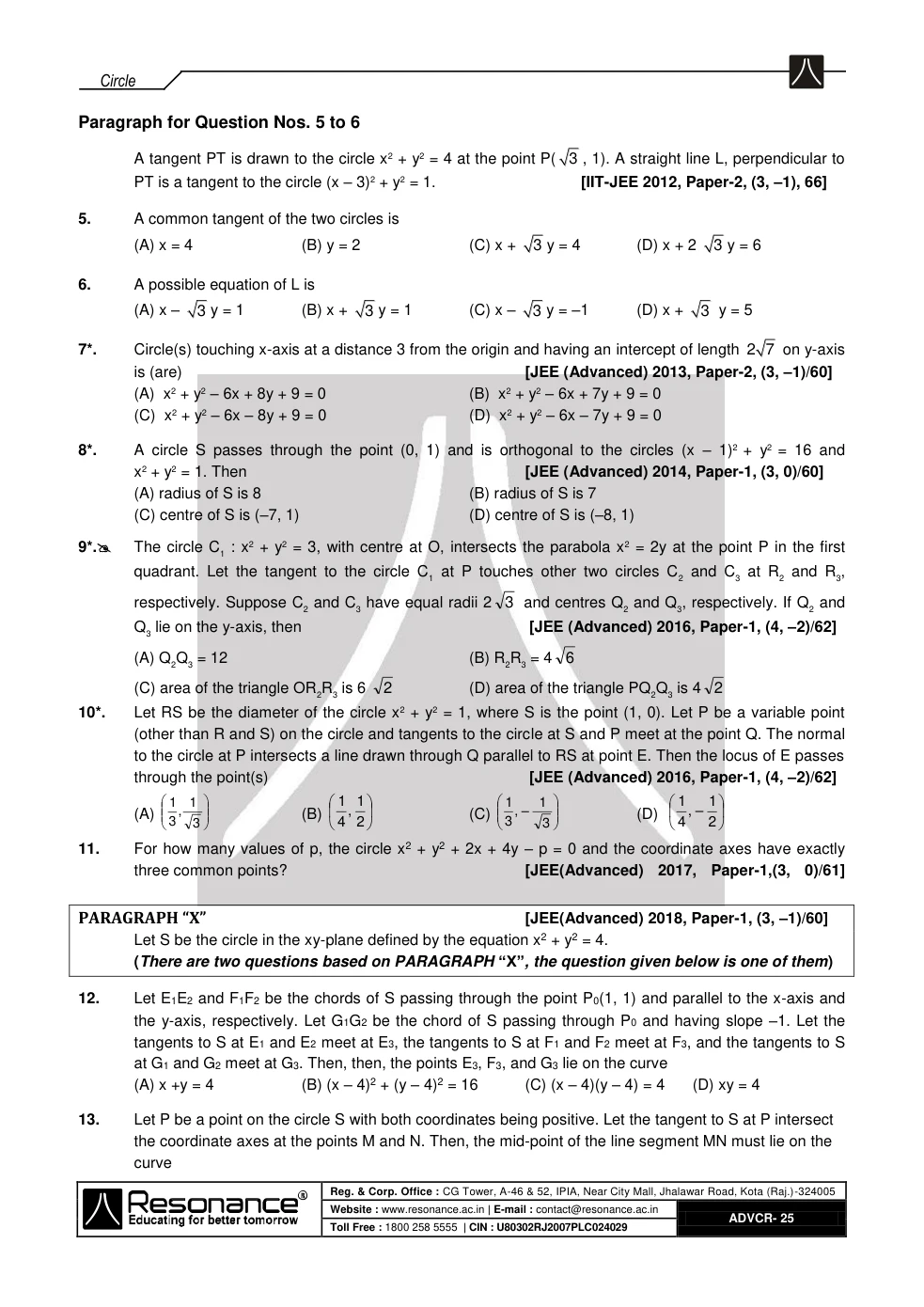
MAASCircle
© MAAS. All rights reserved.Page 25 / 31
Extracted text · page 25
Circle
Paragraph for Question Nos. 5 to 6
A tangent PT is drawn to the circle x2 + y2 = 4 at the point P( 3 , 1). A straight line L, perpendicular to
PT is a tangent to the circle (x – 3)2 + y2 = 1. [IIT-JEE 2012, Paper-2, (3, –1), 66]
5. A common tangent of the two circles is
(A) x = 4 (B) y = 2 (C) x + 3 y = 4 (D) x + 2 3 y = 6
6. A possible equation of L is
(A) x – 3 y = 1 (B) x + 3 y = 1 (C) x – 3 y = –1 (D) x + 3 y = 5
7*. Circle(s) touching x-axis at a distance 3 from the origin and having an intercept of length 2 7 on y-axis
is (are) [JEE (Advanced) 2013, Paper-2, (3, –1)/60]
(A) x2 + y2 – 6x + 8y + 9 = 0 (B) x2 + y2 – 6x + 7y + 9 = 0
(C) x2 + y2 – 6x – 8y + 9 = 0 (D) x2 + y2 – 6x – 7y + 9 = 0
8*. A circle S passes through the point (0, 1) and is orthogonal to the circles (x – 1)2 + y2 = 16 and
x2 + y2 = 1. Then [JEE (Advanced) 2014, Paper-1, (3, 0)/60]
(A) radius of S is 8 (B) radius of S is 7
(C) centre of S is (–7, 1) (D) centre of S is (–8, 1)
9*. The circle C1 : x2 + y2 = 3, with centre at O, intersects the parabola x2 = 2y at the point P in the first
quadrant. Let the tangent to the circle C1 at P touches other two circles C2 and C3 at R2 and R3,
respectively. Suppose C2 and C3 have equal radii 2 3 and centres Q2 and Q3, respectively. If Q2 and
Q3 lie on the y-axis, then [JEE (Advanced) 2016, Paper-1, (4, –2)/62]
(A) Q2Q3 = 12 (B) R2R3 = 4 6
(C) area of the triangle OR2R3 is 6 2 (D) area of the triangle PQ2Q3 is 4 2
10*. Let RS be the diameter of the circle x2 + y2 = 1, where S is the point (1, 0). Let P be a variable point
(other than R and S) on the circle and tangents to the circle at S and P meet at the point Q. The normal
to the circle at P intersects a line drawn through Q parallel to RS at point E. Then the locus of E passes
through the point(s) [JEE (Advanced) 2016, Paper-1, (4, –2)/62]
1 1 1 1 1 1 1 1
(A) , (B) , (C) , – (D) , – 3 3 4 2 3 3 4 2
11. For how many values of p, the circle x2 + y2 + 2x + 4y – p = 0 and the coordinate axes have exactly
three common points? [JEE(Advanced) 2017, Paper-1,(3, 0)/61]
PARAGRAPH “X” [JEE(Advanced) 2018, Paper-1, (3, –1)/60]
Let S be the circle in the xy-plane defined by the equation x2 + y2 = 4.
(There are two questions based on PARAGRAPH “X”, the question given below is one of them)
12. Let E1E2 and F1F2 be the chords of S passing through the point P0(1, 1) and parallel to the x-axis and
the y-axis, respectively. Let G1G2 be the chord of S passing through P0 and having slope –1. Let the
tangents to S at E1 and E2 meet at E3, the tangents to S at F1 and F2 meet at F3, and the tangents to S
at G1 and G2 meet at G3. Then, then, the points E3, F3, and G3 lie on the curve
(A) x +y = 4 (B) (x – 4)2 + (y – 4)2 = 16 (C) (x – 4)(y – 4) = 4 (D) xy = 4
13. Let P be a point on the circle S with both coordinates being positive. Let the tangent to S at P intersect
the coordinate axes at the points M and N. Then, the mid-point of the line segment MN must lie on the
curve
ADVCR- 25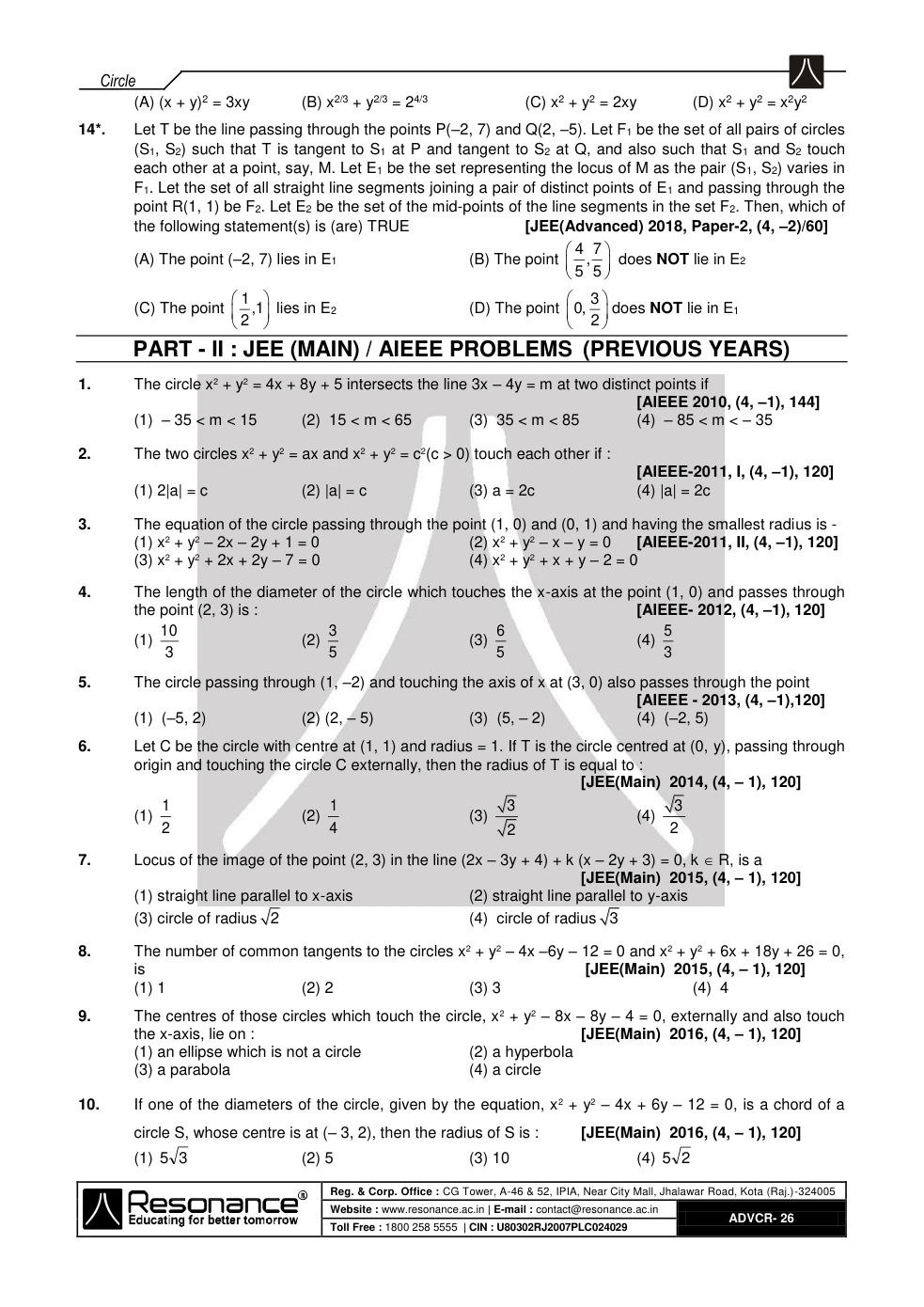
MAASCircle
© MAAS. All rights reserved.Page 26 / 31
Extracted text · page 26
Circle
(A) (x + y)2 = 3xy (B) x2/3 + y2/3 = 24/3 (C) x2 + y2 = 2xy (D) x2 + y2 = x2y2
14*. Let T be the line passing through the points P(–2, 7) and Q(2, –5). Let F1 be the set of all pairs of circles
(S1, S2) such that T is tangent to S1 at P and tangent to S2 at Q, and also such that S1 and S2 touch
each other at a point, say, M. Let E1 be the set representing the locus of M as the pair (S1, S2) varies in
F1. Let the set of all straight line segments joining a pair of distinct points of E1 and passing through the
point R(1, 1) be F2. Let E2 be the set of the mid-points of the line segments in the set F2. Then, which of
the following statement(s) is (are) TRUE [JEE(Advanced) 2018, Paper-2, (4, –2)/60]
4 7
(A) The point (–2, 7) lies in E1 (B) The point , does NOT lie in E2
5 5
3 (C) The point 1,1 lies in E2 (D) The point 0, does NOT lie in E1
2 2
PART - II : JEE (MAIN) / AIEEE PROBLEMS (PREVIOUS YEARS)
1. The circle x2 + y2 = 4x + 8y + 5 intersects the line 3x – 4y = m at two distinct points if
[AIEEE 2010, (4, –1), 144]
(1) – 35 < m < 15 (2) 15 < m < 65 (3) 35 < m < 85 (4) – 85 < m < – 35
2. The two circles x2 + y2 = ax and x2 + y2 = c2(c > 0) touch each other if :
[AIEEE-2011, I, (4, –1), 120]
(1) 2|a| = c (2) |a| = c (3) a = 2c (4) |a| = 2c
3. The equation of the circle passing through the point (1, 0) and (0, 1) and having the smallest radius is -
(1) x2 + y2 – 2x – 2y + 1 = 0 (2) x2 + y2 – x – y = 0 [AIEEE-2011, II, (4, –1), 120]
(3) x2 + y2 + 2x + 2y – 7 = 0 (4) x2 + y2 + x + y – 2 = 0
4. The length of the diameter of the circle which touches the x-axis at the point (1, 0) and passes through
the point (2, 3) is : [AIEEE- 2012, (4, –1), 120]
10 3 6 5
(1) (2) (3) (4)
3 5 5 3
5. The circle passing through (1, –2) and touching the axis of x at (3, 0) also passes through the point
[AIEEE - 2013, (4, –1),120]
(1) (–5, 2) (2) (2, – 5) (3) (5, – 2) (4) (–2, 5)
6. Let C be the circle with centre at (1, 1) and radius = 1. If T is the circle centred at (0, y), passing through
origin and touching the circle C externally, then the radius of T is equal to :
[JEE(Main) 2014, (4, – 1), 120]
1 1 3 3
(1) (2) (3) (4)
2 4 2 2
7. Locus of the image of the point (2, 3) in the line (2x – 3y + 4) + k (x – 2y + 3) = 0, k R, is a
[JEE(Main) 2015, (4, – 1), 120]
(1) straight line parallel to x-axis (2) straight line parallel to y-axis
(3) circle of radius 2 (4) circle of radius 3
8. The number of common tangents to the circles x2 + y2 – 4x –6y – 12 = 0 and x2 + y2 + 6x + 18y + 26 = 0,
is [JEE(Main) 2015, (4, – 1), 120]
(1) 1 (2) 2 (3) 3 (4) 4
9. The centres of those circles which touch the circle, x2 + y2 – 8x – 8y – 4 = 0, externally and also touch
the x-axis, lie on : [JEE(Main) 2016, (4, – 1), 120]
(1) an ellipse which is not a circle (2) a hyperbola
(3) a parabola (4) a circle
10. If one of the diameters of the circle, given by the equation, x2 + y2 – 4x + 6y – 12 = 0, is a chord of a
circle S, whose centre is at (– 3, 2), then the radius of S is : [JEE(Main) 2016, (4, – 1), 120]
(1) 5 3 (2) 5 (3) 10 (4) 5 2
ADVCR- 26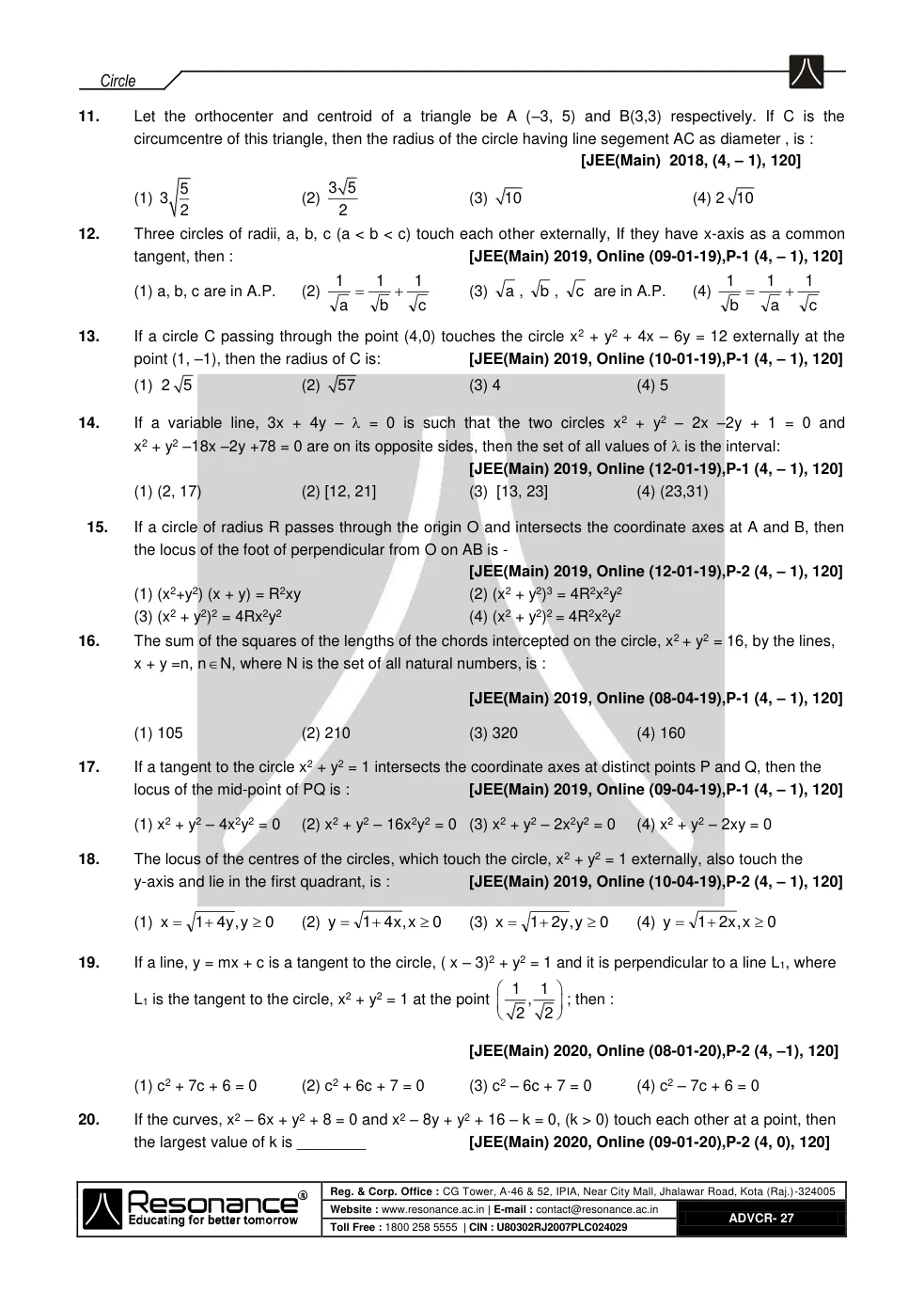
MAASCircle
© MAAS. All rights reserved.Page 27 / 31
Extracted text · page 27
Circle
11. Let the orthocenter and centroid of a triangle be A (–3, 5) and B(3,3) respectively. If C is the
circumcentre of this triangle, then the radius of the circle having line segement AC as diameter , is :
[JEE(Main) 2018, (4, – 1), 120]
5 3 5
(1) 3 (2) (3) 10 (4) 2 10
2 2
12. Three circles of radii, a, b, c (a < b < c) touch each other externally, If they have x-axis as a common
tangent, then : [JEE(Main) 2019, Online (09-01-19),P-1 (4, – 1), 120]
1 1 1 1 1 1
(1) a, b, c are in A.P. (2) (3) a , b , c are in A.P. (4)
a b c b a c
13. If a circle C passing through the point (4,0) touches the circle x2 + y2 + 4x – 6y = 12 externally at the
point (1, –1), then the radius of C is: [JEE(Main) 2019, Online (10-01-19),P-1 (4, – 1), 120]
(1) 2 5 (2) 57 (3) 4 (4) 5
14. If a variable line, 3x + 4y – = 0 is such that the two circles x2 + y2 – 2x –2y + 1 = 0 and
x2 + y2 –18x –2y +78 = 0 are on its opposite sides, then the set of all values of is the interval:
[JEE(Main) 2019, Online (12-01-19),P-1 (4, – 1), 120]
(1) (2, 17) (2) [12, 21] (3) [13, 23] (4) (23,31)
15. If a circle of radius R passes through the origin O and intersects the coordinate axes at A and B, then
the locus of the foot of perpendicular from O on AB is -
[JEE(Main) 2019, Online (12-01-19),P-2 (4, – 1), 120]
(1) (x2+y2) (x + y) = R2xy (2) (x2 + y2)3 = 4R2x2y2
(3) (x2 + y2)2 = 4Rx2y2 (4) (x2 + y2)2 = 4R2x2y2
16. The sum of the squares of the lengths of the chords intercepted on the circle, x2 + y2 = 16, by the lines,
x + y =n, nN, where N is the set of all natural numbers, is :
[JEE(Main) 2019, Online (08-04-19),P-1 (4, – 1), 120]
(1) 105 (2) 210 (3) 320 (4) 160
17. If a tangent to the circle x2 + y2 = 1 intersects the coordinate axes at distinct points P and Q, then the
locus of the mid-point of PQ is : [JEE(Main) 2019, Online (09-04-19),P-1 (4, – 1), 120]
(1) x2 + y2 – 4x2y2 = 0 (2) x2 + y2 – 16x2y2 = 0 (3) x2 + y2 – 2x2y2 = 0 (4) x2 + y2 – 2xy = 0
18. The locus of the centres of the circles, which touch the circle, x2 + y2 = 1 externally, also touch the
y-axis and lie in the first quadrant, is : [JEE(Main) 2019, Online (10-04-19),P-2 (4, – 1), 120]
(1) x 1 4 y , y 0 (2) y 1 4 x , x 0 (3) x 1 2y , y 0 (4) y 1 2x , x 0
19. If a line, y = mx + c is a tangent to the circle, ( x – 3)2 + y2 = 1 and it is perpendicular to a line L1, where
1 1
L1 is the tangent to the circle, x2 + y2 = 1 at the point , ; then :
2 2
[JEE(Main) 2020, Online (08-01-20),P-2 (4, –1), 120]
(1) c2 + 7c + 6 = 0 (2) c2 + 6c + 7 = 0 (3) c2 – 6c + 7 = 0 (4) c2 – 7c + 6 = 0
20. If the curves, x2 – 6x + y2 + 8 = 0 and x2 – 8y + y2 + 16 – k = 0, (k > 0) touch each other at a point, then
the largest value of k is ________ [JEE(Main) 2020, Online (09-01-20),P-2 (4, 0), 120]
ADVCR- 27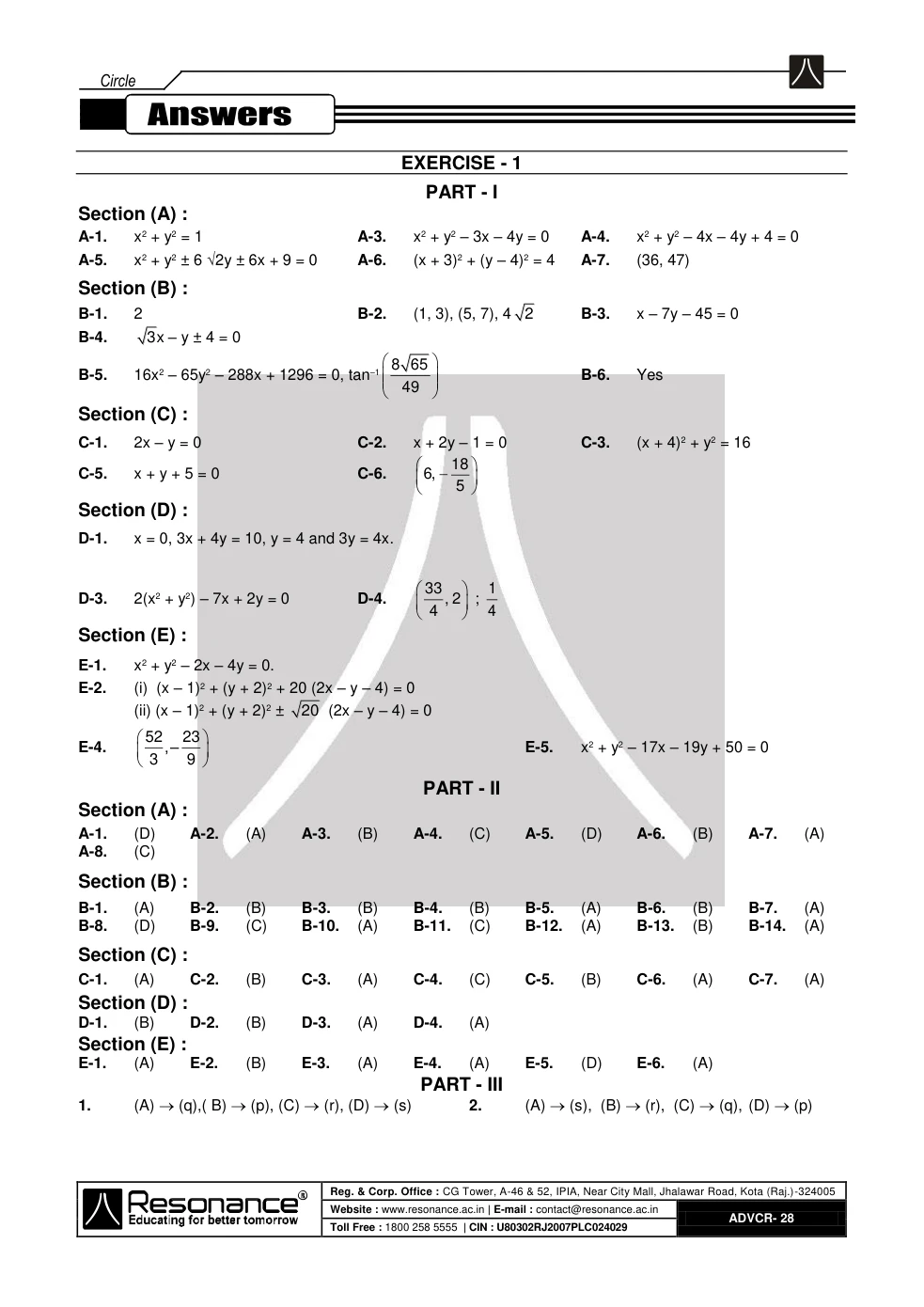
MAASCircle
© MAAS. All rights reserved.Page 28 / 31
Extracted text · page 28
Circle
EXERCISE - 1
PART - I
Section (A) :
A-1. x2 + y2 = 1 A-3. x2 + y2 – 3x – 4y = 0 A-4. x2 + y2 – 4x – 4y + 4 = 0
A-5. x2 + y2 ± 6 2y ± 6x + 9 = 0 A-6. (x + 3)2 + (y – 4)2 = 4 A-7. (36, 47)
Section (B) :
B-1. 2 B-2. (1, 3), (5, 7), 4 2 B-3. x – 7y – 45 = 0
B-4. 3x – y ± 4 = 0
8 65
B-5. 16x2 – 65y2 – 288x + 1296 = 0, tan–1 B-6. Yes 49
Section (C) :
C-1. 2x – y = 0 C-2. x + 2y – 1 = 0 C-3. (x + 4)2 + y2 = 16
18
C-5. x + y + 5 = 0 C-6. 6,
5
Section (D) :
D-1. x = 0, 3x + 4y = 10, y = 4 and 3y = 4x.
1D-3. 2(x2 + y2) – 7x + 2y = 0 D-4. 33, 2 ;
4 4
Section (E) :
E-1. x2 + y2 – 2x – 4y = 0.
E-2. (i) (x – 1)2 + (y + 2)2 + 20 (2x – y – 4) = 0
(ii) (x – 1)2 + (y + 2)2 ± 20 (2x – y – 4) = 0
52 23
E-4. ,– E-5. x2 + y2 – 17x – 19y + 50 = 0
3 9
PART - II
Section (A) :
A-1. (D) A-2. (A) A-3. (B) A-4. (C) A-5. (D) A-6. (B) A-7. (A)
A-8. (C)
Section (B) :
B-1. (A) B-2. (B) B-3. (B) B-4. (B) B-5. (A) B-6. (B) B-7. (A)
B-8. (D) B-9. (C) B-10. (A) B-11. (C) B-12. (A) B-13. (B) B-14. (A)
Section (C) :
C-1. (A) C-2. (B) C-3. (A) C-4. (C) C-5. (B) C-6. (A) C-7. (A)
Section (D) :
D-1. (B) D-2. (B) D-3. (A) D-4. (A)
Section (E) :
E-1. (A) E-2. (B) E-3. (A) E-4. (A) E-5. (D) E-6. (A)
PART - III
1. (A) (q),( B) (p), (C) (r), (D) (s) 2. (A) (s), (B) (r), (C) (q), (D) (p)
ADVCR- 28
MAASCircle
© MAAS. All rights reserved.Page 29 / 31
Extracted text · page 29
    Circle

                           EXERCISE - 2

                            PART - I

1.      (C)     2.      (B)     3.      (D)     4.      (A)     5.      (A)     6.      (C)     7.      (B)

8.      (B)     9.      (B)     10.     (A)     11.     (B)     12.     (D)     13.     (B)     14.     (D)

15.     (B)     16.     (A)

                           PART - II

1.      01.00   2.      32.88 or 32.89  3.      02.00   4.      11.00   5.      10.00   6.      13.38

7.      13.85 or 13.86                   8.      06.82 or 06.83           9.      07.15  10.    04.00

11.    75.00  12.    01.30          13.    00.00  14.    10.00  15.    18.66 or 18.67


                           PART - III

1.     (AD)    2.     (BC)    3.     (BD)    4.     (AD)    5.     (CD)    6.     (AC)

7.     (ABCD) 8.     (ABD)  9.      (AB)    10.    (ACD)  11.    (ABC)  12.    (CD)

13.    (BC)   14.    (BD)   15.    (AC)   16.    (ACD)  17.    (AB)    18.    (BD)

19.    (AD)   20.    (BCD)

                           PART - IV
1.      (B)     2.      (D)     3.      (A)     4.      (B)     5.      (C)     6.      (A)

                           EXERCISE - 3

                            PART - I

1.     3       2.      (D)     3.     2       4.      (A)     5.      (D)     6.      (A)     7.     (AC)

8.     (BC)    9.     (ABC)  10.     (A,C)   11.     (2)     12.     (A)     13.     (D)     14.    (BD)

                           PART - II

1.       (1)      2.       (2)      3.       (2)      4.       (1)      5.       (3)      6.       (2)      7.       (3)

8.       (3)      9.       (3)     10.     (1)     11.     (1)     12.     (2)     13.     (4)     14.     (2)

15.     (2)     16.     (2)     17.     (1)     18.     (4)     19.     (2)     20.    36


                                                                                 ADVCR- 29
MAASCircle
© MAAS. All rights reserved.Page 30 / 31
Extracted text · page 30
Circle
Marked Questions may have for Revision Questions.
SUBJECTIVE QUESTIONS
1. Find the equation of the circle passing through the points A(4, 3), B(2, 5) and touching the axis of
y. Also find the point P on the yaxis such that the angle APB has largest magnitude.
2. Let a circle be given by 2x (x a) + y (2y b) = 0, (a 0, b 0). Find the condition on a & b if two
b
chords, each bisected by the xaxis, can be drawn to the circle from a ,
2
3. A circle is described to pass through the origin and to touch the lines x = 1, x + y = 2. Prove that the
radius of the circle is a root of the 3 2 2 t2 2 2 t + 2 = 0. equation
4. If (a, ) lies inside the circle x2 + y2 = 9 : x2 – 4x – a2 = 0 has exactly one root in (– 1, 0), then find the
area of the region in which (a, ) lies.
5. Let S x2 + y2 + 2gx + 2fy + c = 0 be a given circle. Find the locus of the foot of the perpendicular
drawn from the origin upon any chord of S which subtends right angle at the origin.
6. A ball moving around the circle x² + y² 2x 4y 20 = 0 in anticlockwise direction leaves it
tangentially at the point P(2, 2). After getting reflected from a straight line it passes through the centre
5
of the circle. Find the equation of this straight line if its perpendicular distance from P is . You can
2
assume that the angle of incidence is equal to the angle of reflection.
7. The lines 5x + 12 y 10 = 0 and 5x 12y 40 = 0 touch a circle C1 of diameter 6 unit. If the centre of
C1 lies in the first quadrant, find the equation of the circle C2 which is concentric with C1 and cuts of
intercepts of length 8 on these lines.
8. The chord of contact of tangents drawn from a point on the circle x2 + y2 = a2 to the circle
x2 + y2 = b2 touches the circle x2 + y2 = c2. Show that a, b, c are in G.P.
9. Find the locus of the middle points of chords of a given circle x2 + y2 = a2 which subtend a right angle at
the fixed point (p, q).
10. Let a 2 bm2 + 2 d + 1 = 0, where a, b, d are fixed real numbers such that a + b = d2. If the line
x + my + 1 = 0 touches a fixed circle then find the equation of circle
11. The centre of the circle S = 0 lies on the line 2x 2y + 9 = 0 and S = 0 cuts orthogonally the circle
x² + y² = 4. Show that circle S = 0 passes through two fixed points and also find their coordinates.
12. Prove that the two circles which pass through the points (0, a), (0, a) and touch the straight line y = m
x + c will cut orthogonaly if c2 = a2 (2 + m2).
13. Consider points A ( 13, 0) and B (2 13, 0) lying on x-axis. These points are rotated in an-
2
anticlockwise direction about the origin through an angle of tan–1 . Let the new position of A and B
3
2 13
be A and B respectively. With A as centre and radius a circle C1 is drawn and with B as a
3
13
centre and radius circle C2 is drawn. Find radical axis of C1 and C2.
3
14. P(a, b) is a point in the first quadrant. If the two circles which pass through P and touch both the
coordinate axes cut at right angles, then find condition in a and b.
15. Prove that the square of the tangent that can be drawn from any point on one circle to another circle is
equal to twice the product of perpendicular distance of the point from the radical axis of two circles and
distance between their centres.
MAASCircle
© MAAS. All rights reserved.Page 31 / 31
Extracted text · page 31
Circle
16. Find the equation of the circle which cuts each of the circles, x² + y² = 4, x² + y² 6x 8y + 10 = 0
& x² + y² + 2x 4y 2 = 0 at the extremities of a diameter.
17. Show that if one of the circle x2 + y2 + 2gx + c = 0 and x2 + y2 + 2g1x + c = 0 lies within the other,
then gg1 and c are both positive.
18. Let ABCD is a rectangle. Incircle of ABD touches BD at E. Incircle of CBD toches BD at F.
If AB = 8 units, and BC = 6 units, then find length of EF.
19. Let circles S1 and S2 of radii r1 and r2 respectively (r1 > r2) touches each other externally. Circle S radii r
touches S1 and S2 externally and also their direct common tangent. Prove that the triangle formed by
joining centre of S1, S2 and S is obtuse angled triangle.
20. Circles are drawn passing through the origin O to intersect the coordinate axes at point P and Q such
that m. OP + n. OQ is a constant. Show that the circles pass through a fixed point.
21. A triangle has two of its sides along the axes, its third side touches the circle
x2 + y2 2 ax 2 ay + a2 = 0. Find the equation of the locus of the circumcentre of the triangle.
22. Let S1 be a circle passing through A(0, 1), B(–2, 2) and S2 is a circle of radius 10 units such that AB is
common chord of S1 and S2. Find the equation of S2.
23. The curves whose equations are
S = ax2 + 2hxy + by2 + 2gx + 2fy + c = 0
S = ax2 + 2hxy + by2 + 2gx + 2fy + c = 0
intersect in four concyclic points then find relation in a, b, h, a, b, h
24. A circle of constant radius ‘r’ passes through origin O and cuts the axes of coordinates in points P and
Q, then find the equation of the locus of the foot of perpendicular from O to PQ.
25. The ends A , B of a fixed straight line of length ‘a’ and ends A and B of another fixed straight line of
length ‘b’ slide upon the axis of X & the axis of Y (one end on axis of X & the other on axis of Y). Find
the locus of the centre of the circle passing through A, B, A and B.
1. x² + y² 4x 6y + 9 = 0 OR x² + y² 20x 22y + 121 = 0, P(0, 3), = 45°
9 1 2 c2. (a² > 2b²) 4. 4 5 cot 5. x2 + y2 + gx + fy + = 0
2 5 2
6. (4 3 3) x (4 + 3 3 ) y(39 2 3 ) = 0 7. x2 + y2 10 x 4 y + 4 = 0
9. 2 x2 + 2y2 2 p x 2 q y + p2 + q2 a2 = 0 10. x2 + y2 – 2dx + d2 – b = 0
1 1
11. ( 4, 4); , 13. 9x + 6y = 65
2 2
14. a2 4ab + b2 = 0 16. x² + y² 4x 6y 4 = 0
2x y
18. 2 21. 2 (x + y) a =
a
a – b a – b22. x2 + y2 + 2x – 3y + 2 ± 7 (x + 2y – 2) = 0 23.
h h
24. (x2 + y2)2 (x–2 + y–2) = 4r2 25. (2ax 2by)² + (2bx 2ay)² = (a² b²)²