Visual-fidelity edition: source-page equations, diagrams and charts are preserved as page images. Text transcripts are provided where extractable. The original source may contain markings within the artwork.
MAASFundamentals Of Mathematics I
© MAAS. All rights reserved.Page 1 / 58
Extracted text · page 1
Target : JEE (Main + Advanced) Fundamentals of Mathematics-I
MAASFundamentals Of Mathematics I
© MAAS. All rights reserved.Page 2 / 58
Extracted text · page 2
CONTENT
FUNDAMENTALS OF MATHEMATICS - I
Topic Page No.
Theory 01 – 12
Exercise # 1 13 – 20
Part - I : Subjective Question
Part - II : Only one option correct type
Part – III : Match the column
Exercise - 2 21 – 26
Part - I : Only one option correct type
Part - II : Numerical value questions
Part - III : One or More than one options correct type
Part - IV : Comprehension
Exercise - 3 26 – 27
Part - I : JEE(Advanced) / IIT-JEE Problems (Previous Years)
Part - II : JEE(Main) / AIEEE Problems (Previous Years)
Answer Key : 28 – 30
Logarithm Table : 31 – 32
Antilogarithm Table : 33 – 34
JEE (ADVANCED) SYLLABUS
Rational inequality, properties of Log, Exponential and Log equations and inequations.
JEE (MAIN) SYLLABUS
Sets : Sets and their representation; Union, intersection and complement of sets and their algebraic properties;
Power set; Rational inequality, properties of Log, Exponential and Log equations and inequations.
MAASFundamentals Of Mathematics I
© MAAS. All rights reserved.Page 3 / 58
Extracted text · page 3
Fundamentals of Mathematics-I
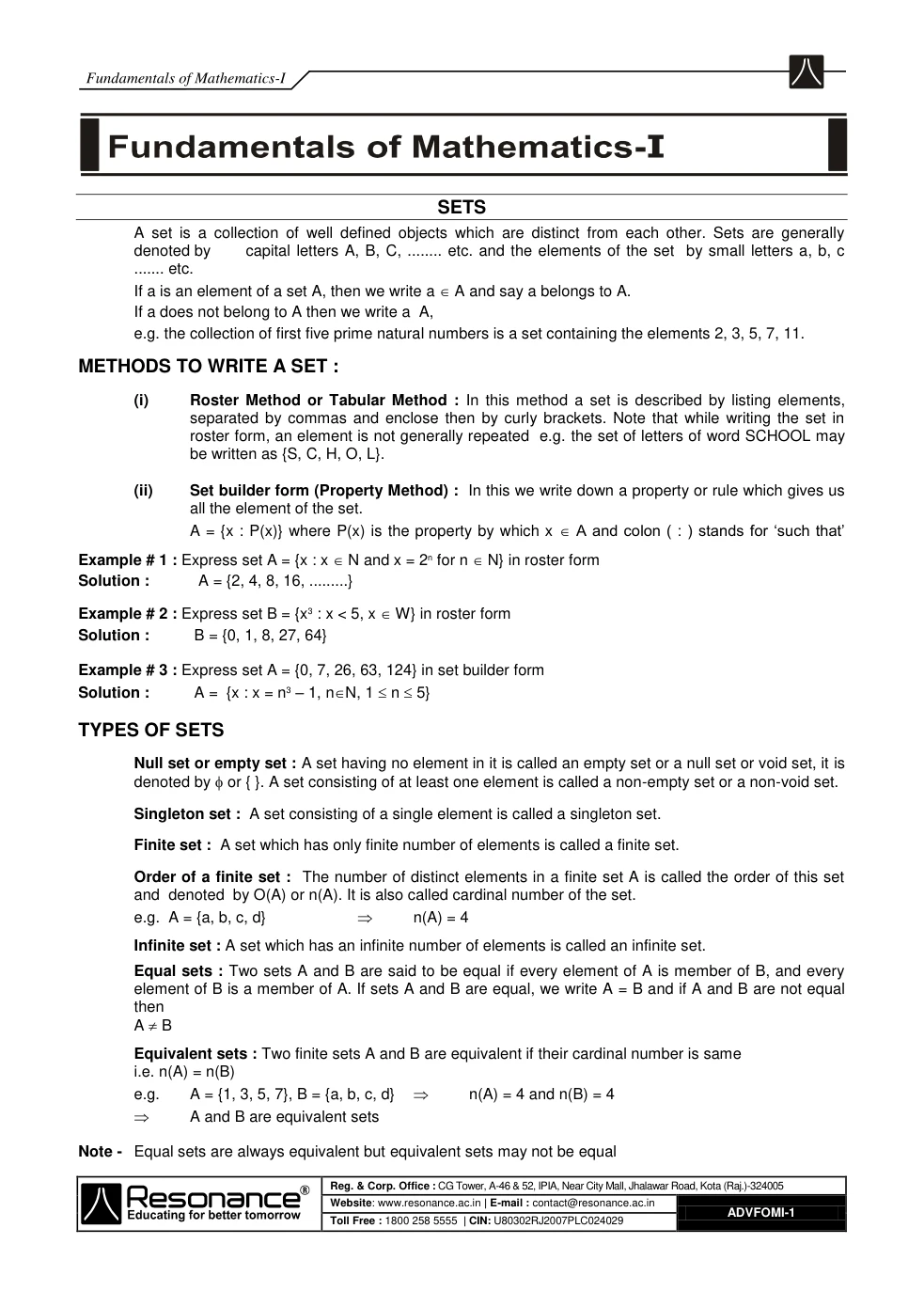
SETS
A set is a collection of well defined objects which are distinct from each other. Sets are generally
denoted by capital letters A, B, C, ........ etc. and the elements of the set by small letters a, b, c
....... etc.
If a is an element of a set A, then we write a A and say a belongs to A.
If a does not belong to A then we write a A,
e.g. the collection of first five prime natural numbers is a set containing the elements 2, 3, 5, 7, 11.
METHODS TO WRITE A SET :
(i) Roster Method or Tabular Method : In this method a set is described by listing elements,
separated by commas and enclose then by curly brackets. Note that while writing the set in
roster form, an element is not generally repeated e.g. the set of letters of word SCHOOL may
be written as {S, C, H, O, L}.
(ii) Set builder form (Property Method) : In this we write down a property or rule which gives us
all the element of the set.
A = {x : P(x)} where P(x) is the property by which x A and colon ( : ) stands for ‘such that’
Example # 1 : Express set A = {x : x N and x = 2n for n N} in roster form
Solution : A = {2, 4, 8, 16, .........}
Example # 2 : Express set B = {x3 : x < 5, x W} in roster form
Solution : B = {0, 1, 8, 27, 64}
Example # 3 : Express set A = {0, 7, 26, 63, 124} in set builder form
Solution : A = {x : x = n3 – 1, nN, 1 n 5}
TYPES OF SETS
Null set or empty set : A set having no element in it is called an empty set or a null set or void set, it is
denoted by or { }. A set consisting of at least one element is called a non-empty set or a non-void set.
Singleton set : A set consisting of a single element is called a singleton set.
Finite set : A set which has only finite number of elements is called a finite set.
Order of a finite set : The number of distinct elements in a finite set A is called the order of this set
and denoted by O(A) or n(A). It is also called cardinal number of the set.
e.g. A = {a, b, c, d} n(A) = 4
Infinite set : A set which has an infinite number of elements is called an infinite set.
Equal sets : Two sets A and B are said to be equal if every element of A is member of B, and every
element of B is a member of A. If sets A and B are equal, we write A = B and if A and B are not equal
then
A B
Equivalent sets : Two finite sets A and B are equivalent if their cardinal number is same
i.e. n(A) = n(B)
e.g. A = {1, 3, 5, 7}, B = {a, b, c, d} n(A) = 4 and n(B) = 4
A and B are equivalent sets
Note - Equal sets are always equivalent but equivalent sets may not be equal
ADVFOMI-1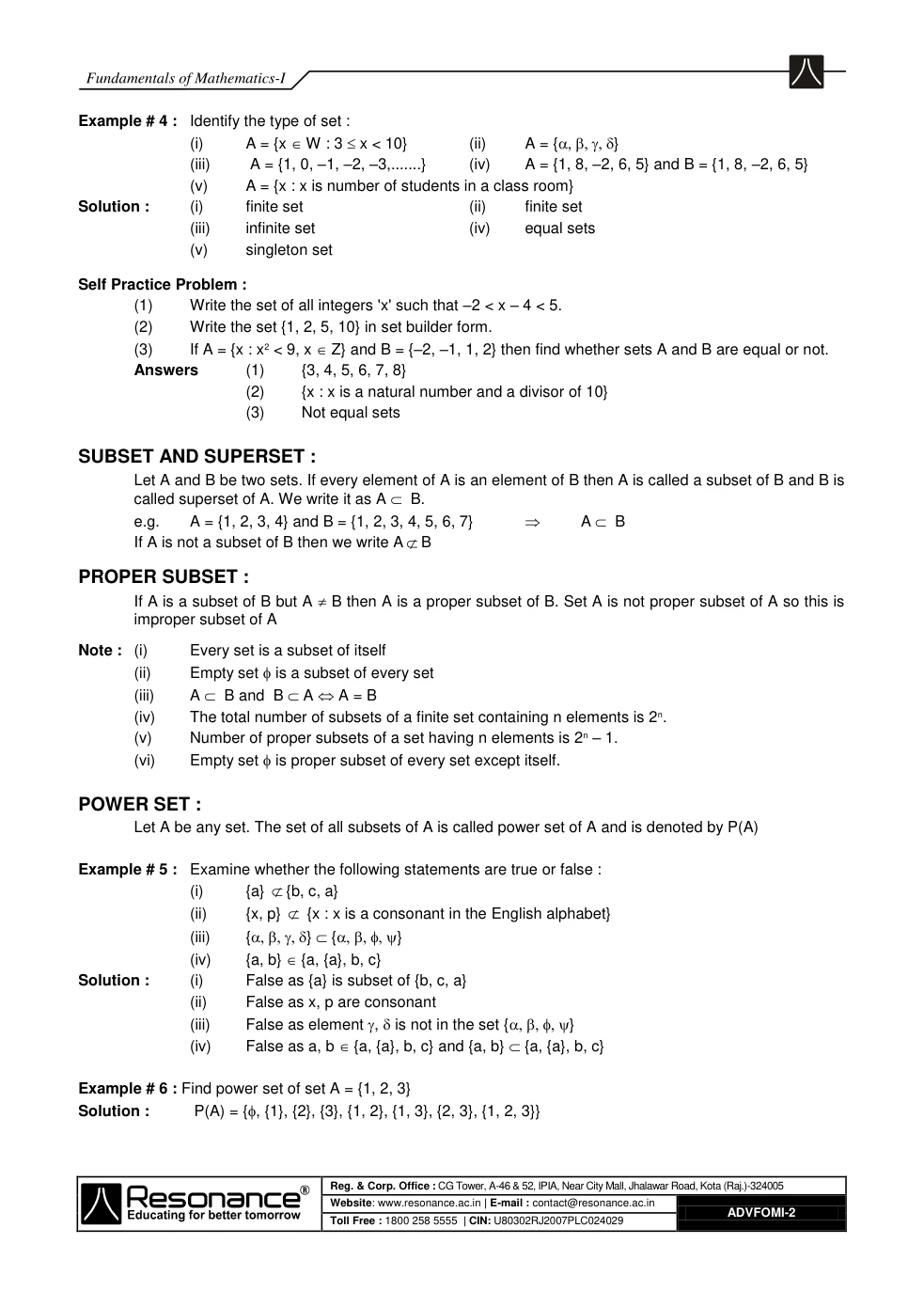
MAASFundamentals Of Mathematics I
© MAAS. All rights reserved.Page 4 / 58
Extracted text · page 4
Fundamentals of Mathematics-I
Example # 4 : Identify the type of set :
(i) A = {x W : 3 x < 10} (ii) A = {}
(iii) A = {1, 0, –1, –2, –3,.......} (iv) A = {1, 8, –2, 6, 5} and B = {1, 8, –2, 6, 5}
(v) A = {x : x is number of students in a class room}
Solution : (i) finite set (ii) finite set
(iii) infinite set (iv) equal sets
(v) singleton set
Self Practice Problem :
(1) Write the set of all integers 'x' such that –2 < x – 4 < 5.
(2) Write the set {1, 2, 5, 10} in set builder form.
(3) If A = {x : x2 < 9, x Z} and B = {–2, –1, 1, 2} then find whether sets A and B are equal or not.
Answers (1) {3, 4, 5, 6, 7, 8}
(2) {x : x is a natural number and a divisor of 10}
(3) Not equal sets
SUBSET AND SUPERSET :
Let A and B be two sets. If every element of A is an element of B then A is called a subset of B and B is
called superset of A. We write it as A B.
e.g. A = {1, 2, 3, 4} and B = {1, 2, 3, 4, 5, 6, 7} A B
If A is not a subset of B then we write A B
PROPER SUBSET :
If A is a subset of B but A B then A is a proper subset of B. Set A is not proper subset of A so this is
improper subset of A
Note : (i) Every set is a subset of itself
(ii) Empty set is a subset of every set
(iii) A B and B A A = B
(iv) The total number of subsets of a finite set containing n elements is 2n.
(v) Number of proper subsets of a set having n elements is 2n – 1.
(vi) Empty set is proper subset of every set except itself.
POWER SET :
Let A be any set. The set of all subsets of A is called power set of A and is denoted by P(A)
Example # 5 : Examine whether the following statements are true or false :
(i) {a} {b, c, a}
(ii) {x, p} {x : x is a consonant in the English alphabet}
(iii) {} {}
(iv) {a, b} {a, {a}, b, c}
Solution : (i) False as {a} is subset of {b, c, a}
(ii) False as x, p are consonant
(iii) False as element , is not in the set {}
(iv) False as a, b {a, {a}, b, c} and {a, b} {a, {a}, b, c}
Example # 6 : Find power set of set A = {1, 2, 3}
Solution : P(A) = {, {1}, {2}, {3}, {1, 2}, {1, 3}, {2, 3}, {1, 2, 3}}
ADVFOMI-2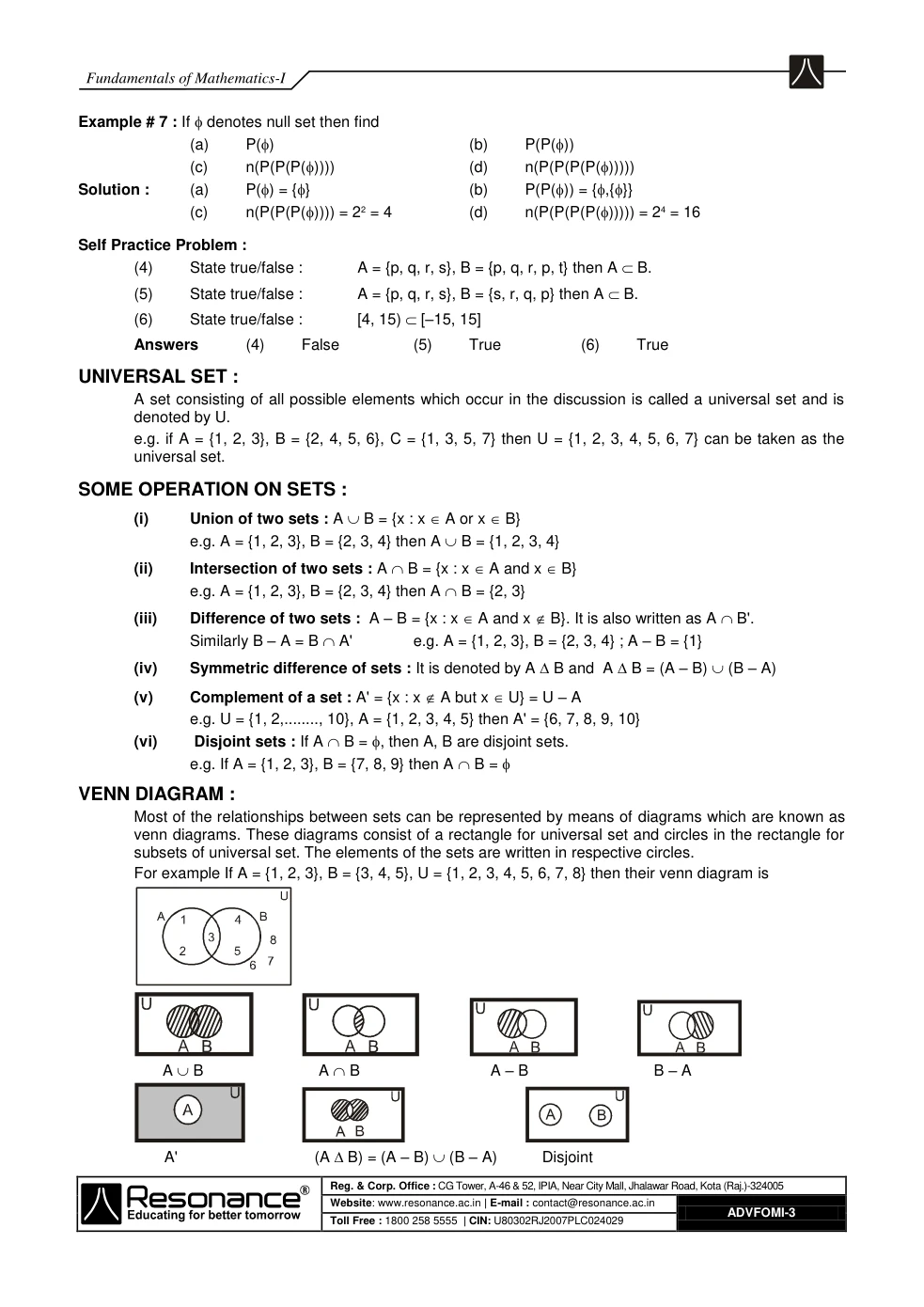
MAASFundamentals Of Mathematics I
© MAAS. All rights reserved.Page 5 / 58
Extracted text · page 5
Fundamentals of Mathematics-I
Example # 7 : If denotes null set then find
(a) P() (b) P(P())
(c) n(P(P(P()))) (d) n(P(P(P(P()))))
Solution : (a) P() = {} (b) P(P()) = {,{}}
(c) n(P(P(P()))) = 22 = 4 (d) n(P(P(P(P())))) = 24 = 16
Self Practice Problem :
(4) State true/false : A = {p, q, r, s}, B = {p, q, r, p, t} then A B.
(5) State true/false : A = {p, q, r, s}, B = {s, r, q, p} then A B.
(6) State true/false : [4, 15) [–15, 15]
Answers (4) False (5) True (6) True
UNIVERSAL SET :
A set consisting of all possible elements which occur in the discussion is called a universal set and is
denoted by U.
e.g. if A = {1, 2, 3}, B = {2, 4, 5, 6}, C = {1, 3, 5, 7} then U = {1, 2, 3, 4, 5, 6, 7} can be taken as the
universal set.
SOME OPERATION ON SETS :
(i) Union of two sets : A B = {x : x A or x B}
e.g. A = {1, 2, 3}, B = {2, 3, 4} then A B = {1, 2, 3, 4}
(ii) Intersection of two sets : A B = {x : x A and x B}
e.g. A = {1, 2, 3}, B = {2, 3, 4} then A B = {2, 3}
(iii) Difference of two sets : A – B = {x : x A and x B}. It is also written as A B'.
Similarly B – A = B A' e.g. A = {1, 2, 3}, B = {2, 3, 4} ; A – B = {1}
(iv) Symmetric difference of sets : It is denoted by A B and A B = (A – B) (B – A)
(v) Complement of a set : A' = {x : x A but x U} = U – A
e.g. U = {1, 2,........, 10}, A = {1, 2, 3, 4, 5} then A' = {6, 7, 8, 9, 10}
(vi) Disjoint sets : If A B = , then A, B are disjoint sets.
e.g. If A = {1, 2, 3}, B = {7, 8, 9} then A B =
VENN DIAGRAM :
Most of the relationships between sets can be represented by means of diagrams which are known as
venn diagrams. These diagrams consist of a rectangle for universal set and circles in the rectangle for
subsets of universal set. The elements of the sets are written in respective circles.
For example If A = {1, 2, 3}, B = {3, 4, 5}, U = {1, 2, 3, 4, 5, 6, 7, 8} then their venn diagram is
A B A B A – B B – A
A' (A B) = (A – B) (B – A) Disjoint
ADVFOMI-3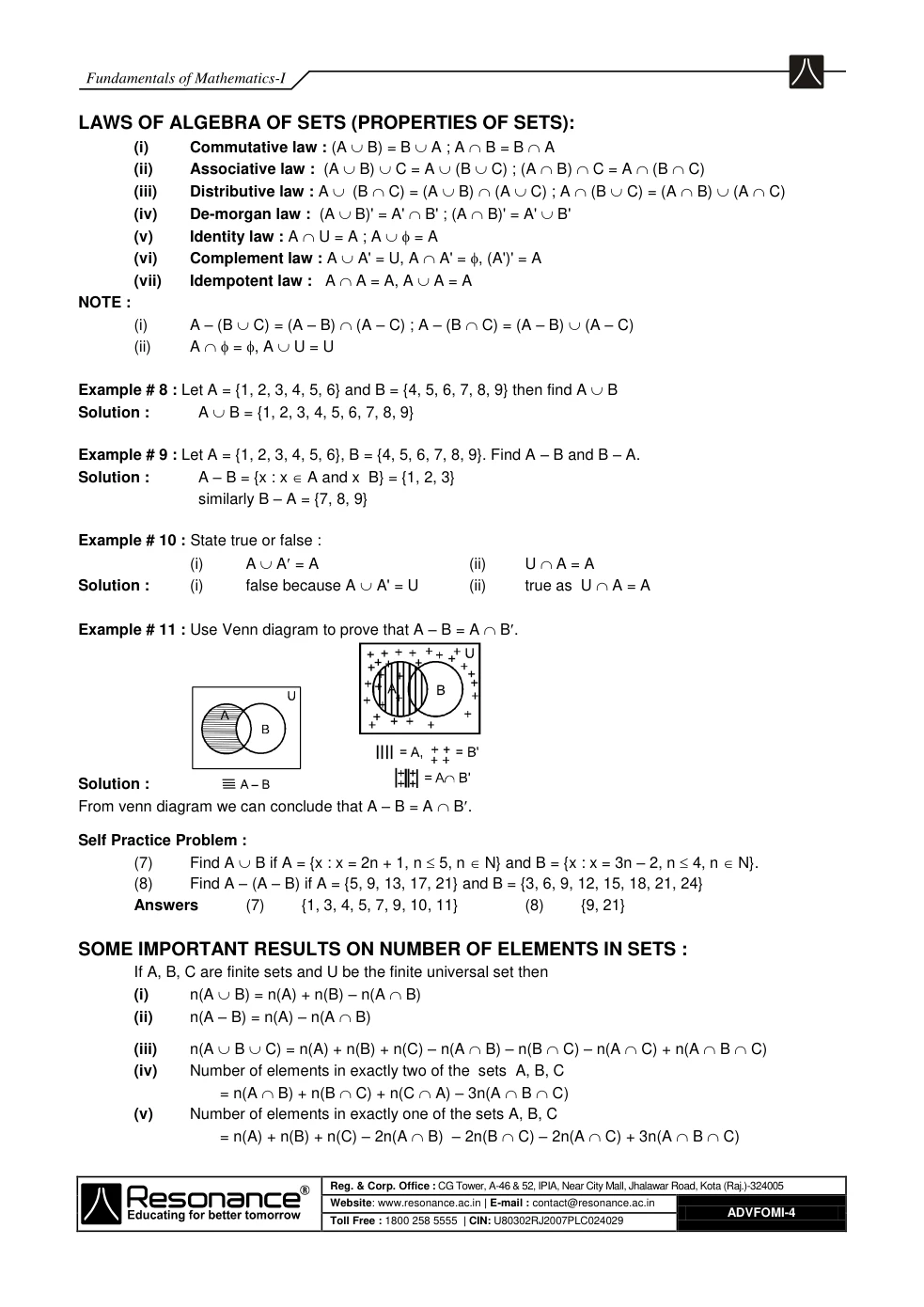
MAASFundamentals Of Mathematics I
© MAAS. All rights reserved.Page 6 / 58
Extracted text · page 6
Fundamentals of Mathematics-I
LAWS OF ALGEBRA OF SETS (PROPERTIES OF SETS):
(i) Commutative law : (A B) = B A ; A B = B A
(ii) Associative law : (A B) C = A (B C) ; (A B) C = A (B C)
(iii) Distributive law : A (B C) = (A B) (A C) ; A (B C) = (A B) (A C)
(iv) De-morgan law : (A B)' = A' B' ; (A B)' = A' B'
(v) Identity law : A U = A ; A = A
(vi) Complement law : A A' = U, A A' = , (A')' = A
(vii) Idempotent law : A A = A, A A = A
NOTE :
(i) A – (B C) = (A – B) (A – C) ; A – (B C) = (A – B) (A – C)
(ii) A = , A U = U
Example # 8 : Let A = {1, 2, 3, 4, 5, 6} and B = {4, 5, 6, 7, 8, 9} then find A B
Solution : A B = {1, 2, 3, 4, 5, 6, 7, 8, 9}
Example # 9 : Let A = {1, 2, 3, 4, 5, 6}, B = {4, 5, 6, 7, 8, 9}. Find A – B and B – A.
Solution : A – B = {x : x A and x B} = {1, 2, 3}
similarly B – A = {7, 8, 9}
Example # 10 : State true or false :
(i) A A = A (ii) U A = A
Solution : (i) false because A A' = U (ii) true as U A = A
Example # 11 : Use Venn diagram to prove that A – B = A B.
Solution :
From venn diagram we can conclude that A – B = A B.
Self Practice Problem :
(7) Find A B if A = {x : x = 2n + 1, n 5, n N} and B = {x : x = 3n – 2, n 4, n N}.
(8) Find A – (A – B) if A = {5, 9, 13, 17, 21} and B = {3, 6, 9, 12, 15, 18, 21, 24}
Answers (7) {1, 3, 4, 5, 7, 9, 10, 11} (8) {9, 21}
SOME IMPORTANT RESULTS ON NUMBER OF ELEMENTS IN SETS :
If A, B, C are finite sets and U be the finite universal set then
(i) n(A B) = n(A) + n(B) – n(A B)
(ii) n(A – B) = n(A) – n(A B)
(iii) n(A B C) = n(A) + n(B) + n(C) – n(A B) – n(B C) – n(A C) + n(A B C)
(iv) Number of elements in exactly two of the sets A, B, C
= n(A B) + n(B C) + n(C A) – 3n(A B C)
(v) Number of elements in exactly one of the sets A, B, C
= n(A) + n(B) + n(C) – 2n(A B) – 2n(B C) – 2n(A C) + 3n(A B C)
ADVFOMI-4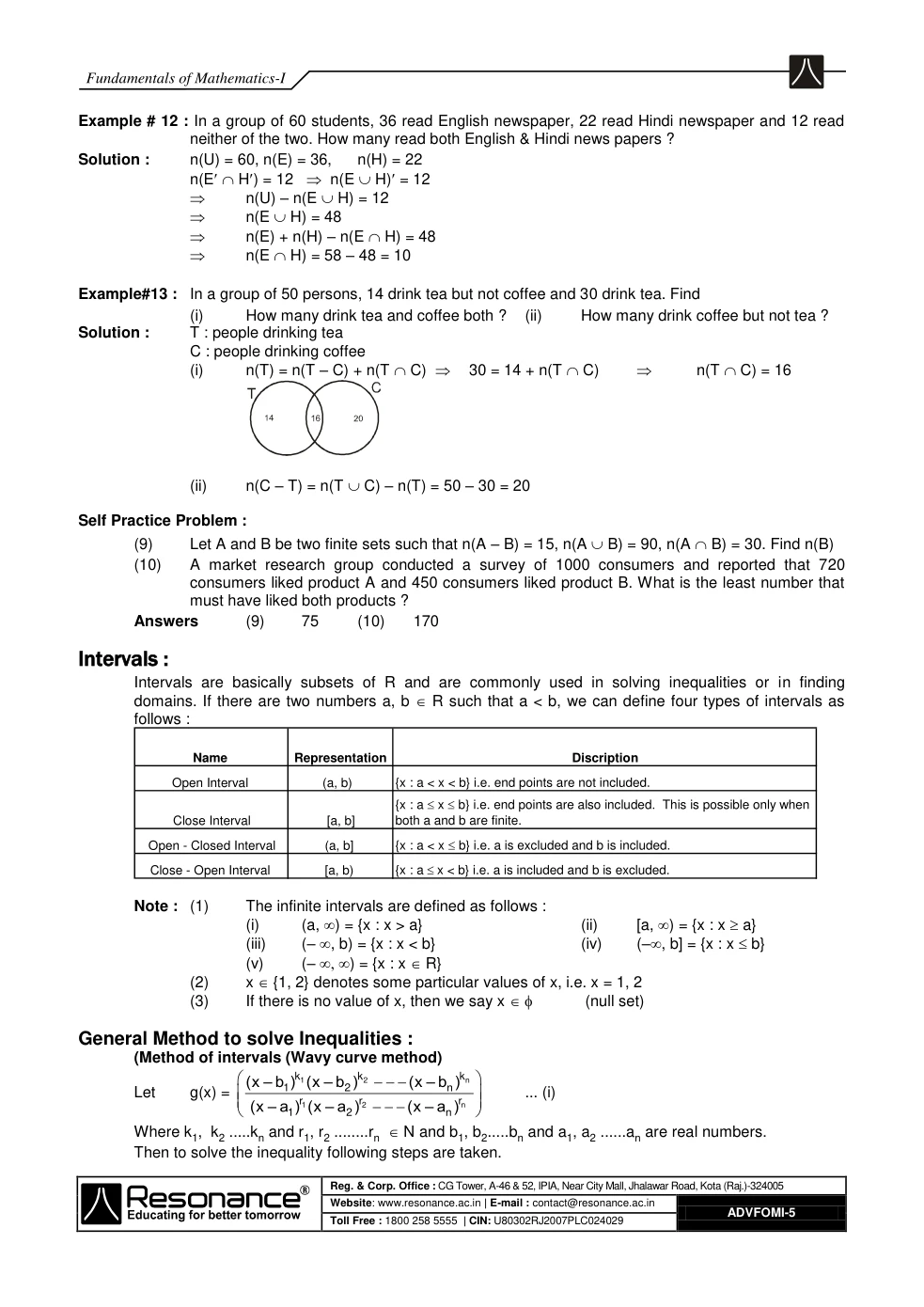
MAASFundamentals Of Mathematics I
© MAAS. All rights reserved.Page 7 / 58
Extracted text · page 7
Fundamentals of Mathematics-I
Example # 12 : In a group of 60 students, 36 read English newspaper, 22 read Hindi newspaper and 12 read
neither of the two. How many read both English & Hindi news papers ?
Solution : n(U) = 60, n(E) = 36, n(H) = 22
n(E H) = 12 n(E H) = 12
n(U) – n(E H) = 12
n(E H) = 48
n(E) + n(H) – n(E H) = 48
n(E H) = 58 – 48 = 10
Example#13 : In a group of 50 persons, 14 drink tea but not coffee and 30 drink tea. Find
(i) How many drink tea and coffee both ? (ii) How many drink coffee but not tea ?
Solution : T : people drinking tea
C : people drinking coffee
(i) n(T) = n(T – C) + n(T C) 30 = 14 + n(T C) n(T C) = 16
(ii) n(C – T) = n(T C) – n(T) = 50 – 30 = 20
Self Practice Problem :
(9) Let A and B be two finite sets such that n(A – B) = 15, n(A B) = 90, n(A B) = 30. Find n(B)
(10) A market research group conducted a survey of 1000 consumers and reported that 720
consumers liked product A and 450 consumers liked product B. What is the least number that
must have liked both products ?
Answers (9) 75 (10) 170
Intervals :
Intervals are basically subsets of R and are commonly used in solving inequalities or in finding
domains. If there are two numbers a, b R such that a < b, we can define four types of intervals as
follows :
Name Representation Discription
Open Interval (a, b) {x : a < x < b} i.e. end points are not included.
{x : a x b} i.e. end points are also included. This is possible only when
Close Interval [a, b] both a and b are finite.
Open - Closed Interval (a, b] {x : a < x b} i.e. a is excluded and b is included.
Close - Open Interval [a, b) {x : ax < b} i.e. a is included and b is excluded.
Note : (1) The infinite intervals are defined as follows :
(i) (a, ) = {x : x > a} (ii) [a, ) = {x : x a}
(iii) (– , b) = {x : x < b} (iv) (–, b] = {x : x b}
(v) (– ) = {x : x R}
(2) x {1, 2} denotes some particular values of x, i.e. x = 1, 2
(3) If there is no value of x, then we say x (null set)
General Method to solve Inequalities :
(Method of intervals (Wavy curve method)
1 2 n (x – b1 )k (x – b 2 )k (x – bn )k Let g(x) = ... (i) r1 r2 rn (x – a1 ) (x – a 2 ) (x – an )
Where k1, k2 .....kn and r1, r2 ........rn N and b1, b2.....bn and a1, a2 ......an are real numbers.
Then to solve the inequality following steps are taken.
ADVFOMI-5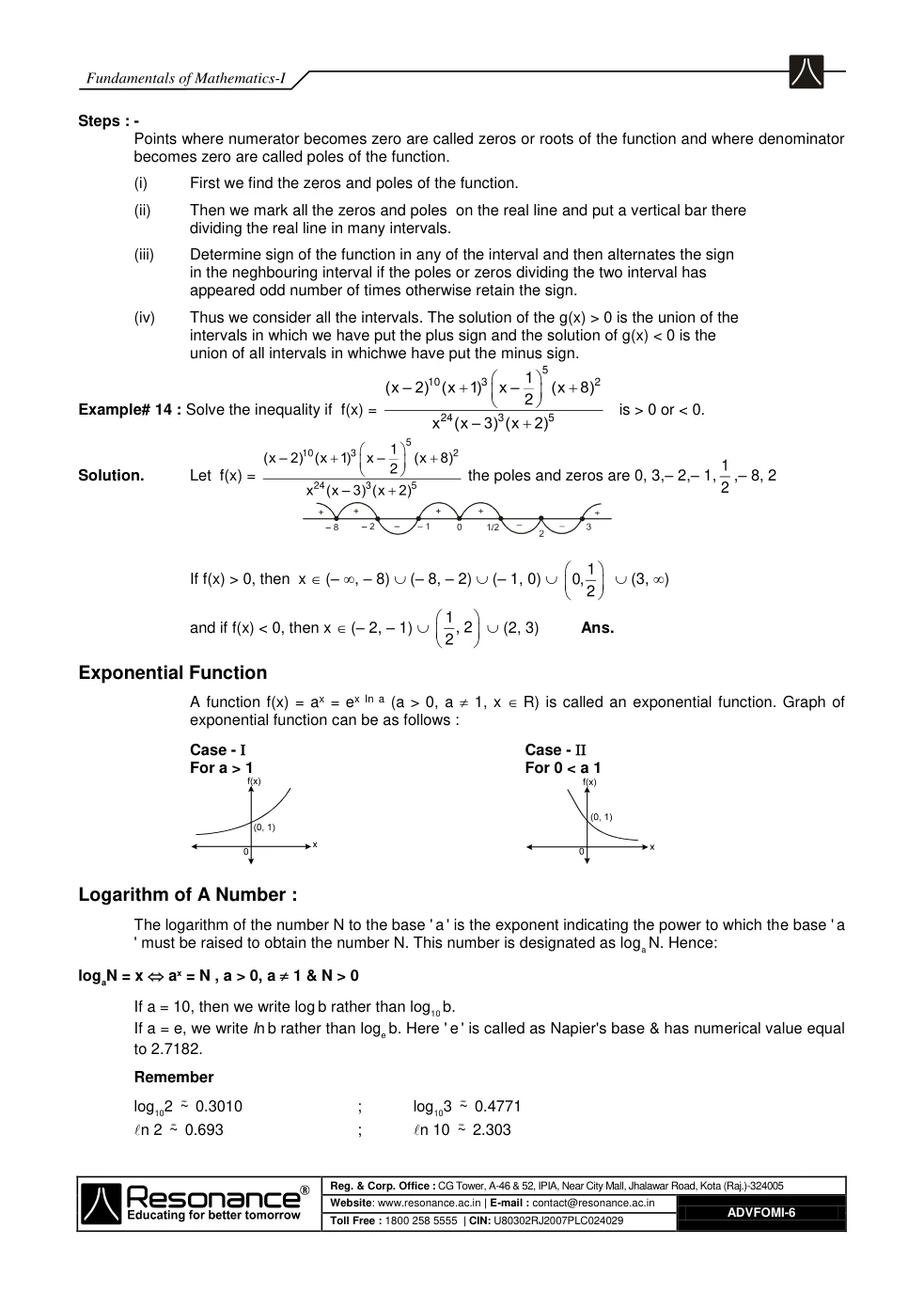
MAASFundamentals Of Mathematics I
© MAAS. All rights reserved.Page 8 / 58
Extracted text · page 8
Fundamentals of Mathematics-I
Steps : -
Points where numerator becomes zero are called zeros or roots of the function and where denominator
becomes zero are called poles of the function.
(i) First we find the zeros and poles of the function.
(ii) Then we mark all the zeros and poles on the real line and put a vertical bar there
dividing the real line in many intervals.
(iii) Determine sign of the function in any of the interval and then alternates the sign
in the neghbouring interval if the poles or zeros dividing the two interval has
appeared odd number of times otherwise retain the sign.
(iv) Thus we consider all the intervals. The solution of the g(x) > 0 is the union of the
intervals in which we have put the plus sign and the solution of g(x) < 0 is the
union of all intervals in whichwe have put the minus sign.
5
10 3 1 2
(x – 2) (x 1) x – (x 8)
2 Example# 14 : Solve the inequality if f(x) = is > 0 or < 0.
x 24 (x – 3)3 (x 2)5
5
10 3 1 2 x – (x 8) (x – 2) (x 1) 1 2 Solution. Let f(x) = the poles and zeros are 0, 3,– 2,– 1, ,– 8, 2
x 24 (x – 3)3 (x 2)5 2
1
If f(x) > 0, then x (– , – 8) (– 8, – 2) (– 1, 0) 0, (3, )
2
(2, 3) Ans. and if f(x) < 0, then x (– 2, – 1) 1, 2
2
Exponential Function
A function f(x) = ax = ex In a (a > 0, a 1, x R) is called an exponential function. Graph of
exponential function can be as follows :
Case - Case -
For a > 1 For 0 < a 1
Logarithm of A Number :
The logarithm of the number N to the base ' a ' is the exponent indicating the power to which the base ' a
' must be raised to obtain the number N. This number is designated as loga N. Hence:
logaN = x ax = N , a > 0, a 1 & N > 0
If a = 10, then we write log b rather than log10 b.
If a = e, we write ln b rather than loge b. Here ' e ' is called as Napier's base & has numerical value equal
to 2.7182.
Remember
log102 ~ 0.3010 ; log103 ~ 0.4771
n 2 ~ 0.693 ; n 10 ~ 2.303
ADVFOMI-6
MAASFundamentals Of Mathematics I
© MAAS. All rights reserved.Page 9 / 58
Extracted text · page 9
Fundamentals of Mathematics-I
Domain of Definition :
The existence and uniqueness of the number loga N can be determined with the help of set of
conditions, a > 0 & a 1 & N > 0.
The base of the logarithm ' a ' must not equal unity otherwise numbers not equal to unity will not have a
logarithm and any number will be the logarithm of unity.
Graph of Logarithmic function :
f(x) = logax is called logarithmic function where a > 0 and a 1 and x > 0. Its graph can be as follows:
Case- I Case- II
For a > 1 For 0 < a < 1
Fundamental Logarithmic Identity :
a N = N, a > 0, a 1 & N > 0 alog
The Principal Properties of Logarithm:
Let M & N are arbitrary positive numbers, a > 0, a 1, b > 0, b 1 and are any real numbers,
then :
(i) loga (M.N) = loga M + loga N ; in general loga (x1 x2 ......xn)
= logax1 + loga x2 + ........+ loga xn
(ii) loga (M/N) = loga M loga N
(iii) loga M = loga M
1
(iv) log M = logaM a
loga M
(v) logb M = (base changing theorem)
loga b
NOTE :
loga1 = 0 loga a = 1
1
log1/a a = 1 logba =
loga b
c a ax = e x n a alog c b blog
Note : (i) If the number and the base are on the same side of the unity, then the
logarithm is positive.
(ii) If the number and the base are on the opposite sides of unity, then the logarithm is
negative.
Example#15: Find the value of the followings :
32 9
(i) log272 + log2 + log2 Ans. 2
81 64
1
25 49 Ans. 5 (ii) 7 log
ADVFOMI-7
MAASFundamentals Of Mathematics I
© MAAS. All rights reserved.Page 10 / 58
Extracted text · page 10
Fundamentals of Mathematics-I
Solution. (i) log272 + ..........
3 2 25 3 2
= log2 2 .3 . 4 . 6 = log24 = 2
3 2
1 2
log7 5 log7 7 log25 49 log49 25 2 (ii) 7 = 7 = 7 = 5 = 5
Self practice problem :
(11) Find the value of the followings :
(i) log49343 (ii) 4log27243
(iii) log(1/100)1000 (iv) log(7 4 3) (7 4 3)
(v) log125625
(12) log89.log910 ......... log6364
(13) Find the value of log cot1° + log cot2° + log cot3° + .... + log cot89°
Ans. (11) (i) 3/2 (ii) 20/3 (iii) – 3/2 (iv) –1 (v) 4/3
(12) 2 (13) 0
Logarithmic Equation :
The equality loga x = loga y is possible if and only if x = y i.e.
loga x = loga y x = y
Always check validity of given equation, (x > 0, y > 0, a > 0, a 1)
Example#16 : logx(4x – 3) = 2 Ans. x = 3
Solution. Domain : x > 0, 4x – 3 > 0, x 1
Hence 4x – 3 = x2 x2 – 4x + 3 = 0
x = 3 or x = 1 (rejected as not in domain)
Exmaple#17 : log2 (log3{log5 (x2 + 4)} = 0 Ans. x = ±11
Solution. log3(log5(x2 + 4)} = 2° = 1
log5(x2 + 4) = 31 = 3
(x2 + 4) = 53 = 125 x2 = 121 x = ±11
Example#18 : log2(x2) + log2 (x + 2) = 4 Ans. x = 2
Solution. log2 (x2(x + 2) = 4 x3 + 2x2 – 16 = 0 (x – 2) (x 2 4x 8) 0
D 0
x = 2
Self practice problem
(14) 33log 3 x 27 (15) (log10x)2 – (log10x) – 6 = 0
2 (x 2) 8(x 2)2 (16) 3(log7x + logx7) = 10 (17) (x 2)log
1 3
Ans. (14) x = 3 (15) x = 103, (16) x = 343, 7 (17) x = 6 or –3/2 2
10
Logarithmic Inequality :
Let 'a' is a real number such that
(i) If a > 1, then logax > loga y x > y
(ii) If a > 1, then logax < 0 < x < a
(iii) If a > 1, then logax > x > a
(iv) If 0 < a < 1, then logax > logay 0 < x < y
(v) If 0 < a < 1, then loga x < x > a
ADVFOMI-8
MAASFundamentals Of Mathematics I
© MAAS. All rights reserved.Page 11 / 58
Extracted text · page 11
Fundamentals of Mathematics-I
Form - I : f(x) > 0, g(x) > 0, g(x) 1
Form Collection of system
f(x) 1 , g(x) 1
(a) logg(x) f(x) 0 0 f(x) 1 , 0 g(x) 1
f(x) 1 , 0 g(x) 1
(b) logg(x) f(x) 0 0 f(x) 1 , g(x) 1
f(x) (g(x))a , g(x) 1
(c) logg(x) f(x) a a
0 f(x) (g(x)) , 0 g(x) 1
0 f(x) (g(x))a , g(x) 1
(d) logg(x) f(x) a a
f(x) (g(x)) , 0 g(x) 1
From - II : When the inequality of the form
Form Collection of system
f(x) g(x), (x) 1,
(a) log(x) f(x) log(x) g(x) 0 f(x) g(x);0 (x) 1
0 f(x) g(x), (x) 1,
(b) log(x) f(x) log(x) g(x)
f(x) g(x) 0, 0 (x) 1
Example # 19 : Solve the logarithmic inequality log1/5 (2x2 + 7x + 7) 0.
Solution. Since log1/5 1 = 0, the given inequality can be written as.
log1/5 (2x2 + 7x + 7) log1/5 1
when the domain of the function is taken into account the inequality is equivalent to the system
2x 2 7x 7 0 of inequalities
2x 2 7x 7 1
–3 Solving the inequalities by using method of intervals x –2, 2
Example # 20 : Solve the inequality log1/3 (5x – 1) > 0.
Solution. by using the basic property of logarithm.
2 5x 2 x 5 5x – 1 1
5x – 1 0 1 5x 1 x
5
1 2
The solution of the inequality is given by , Ans.
5 5
ADVFOMI-9
MAASFundamentals Of Mathematics I
© MAAS. All rights reserved.Page 12 / 58
Extracted text · page 12
Fundamentals of Mathematics-I
Example # 21 : Solve the inequality log(2x + 3) x2 < log(2x + 3) (2x + 3).
Solution. The given inequality is equivalent to the collection of the systems
0 2x 3 1 (i)
2
x 2x 3
2x 3 1 (ii) 2
0 x 2x 3
Solving system (i) we obtain
–3
2 x –1
(x – 3)(x 1) 0 (iii)
System (iii) is equivalent to the collection of two systems
–3 x –1, x 3; (iv)
2
–3 x –1, x –1 (v) 2
system (iv) has no solution. The solution of system (v) is x –3, – 1 ,
2
solving system (ii) we obtain.
x –1 x –1
or x (– 1, 3)
(x – 3)(x 1) 0 –1 x 3
x–3,–1 (– 1, 3)
2
2x
> 0. log2 Example # 22 : Solve the in equation log x 2 –12x 30 5 10
Solution. This in equation is equivalent to the collection of following systems.
x 2 – 12x 30 x 2 – 12x 30 1, 0 1,
10 10 and
2x 2x 1, 1 0 log2 log2 5 5
Solving the first system we have.
x 2 – 12x 20 0
2x (x –10)(x – 2) 0 x 2 or x 10 2 x 5 x 5 5
Therefore the system has solution x > 10
Solving the second system we have.
0 x 2 – 12x 30 10 x 2 –12x 30 0 and x 2 –12x 20 0
2x 5 1 2 x 5 5 2
x 6 – 6 or x 6 6 and 2 x 10
5
2 x 5
5
The system has solutions < x < 6 – 6 combining both systems, then solution of
2
the original inequation is.
5
x ( , 6 – 6 (10, ) Ans.
2
ADVFOMI-10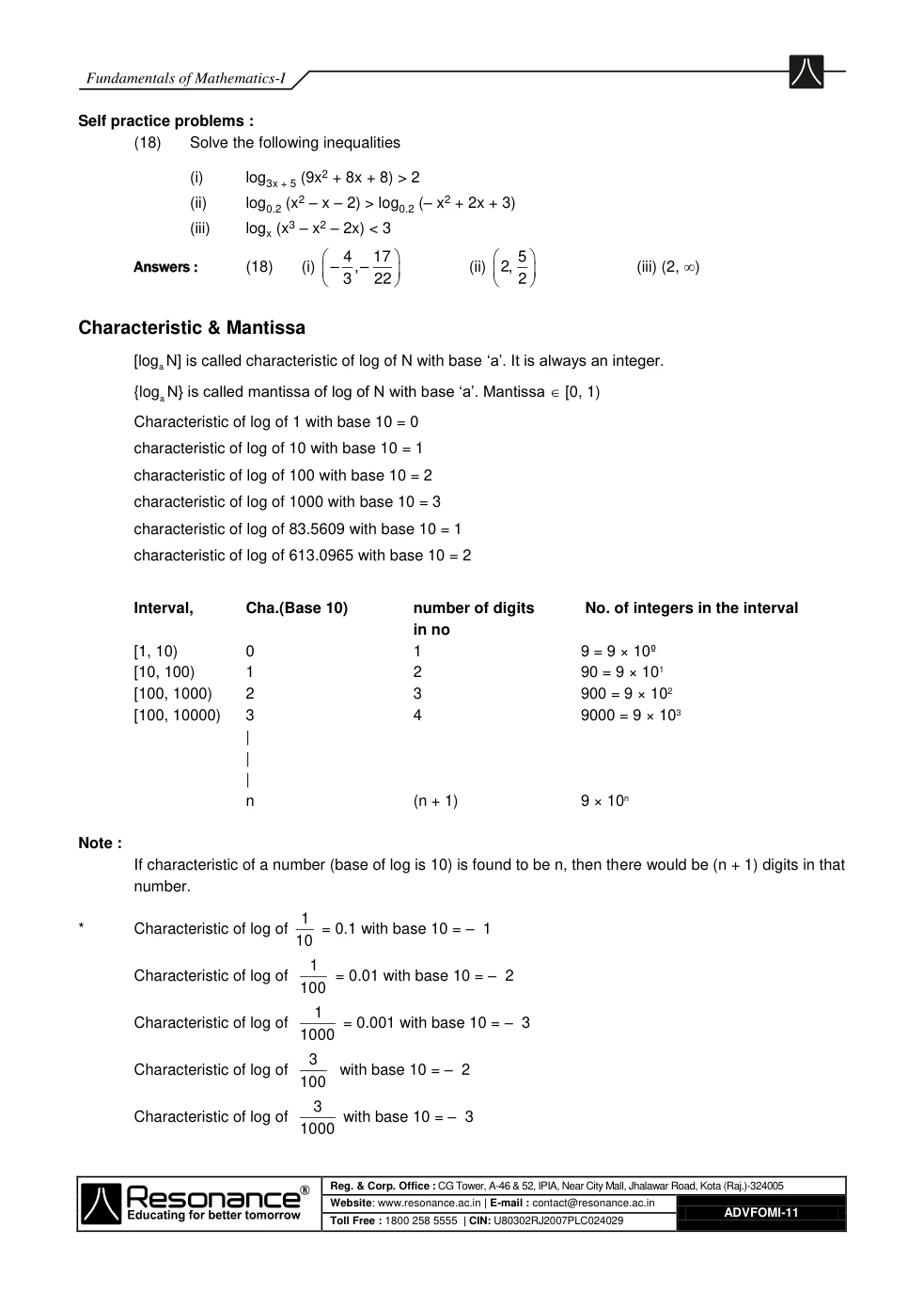
MAASFundamentals Of Mathematics I
© MAAS. All rights reserved.Page 13 / 58
Extracted text · page 13
Fundamentals of Mathematics-I
Self practice problems :
(18) Solve the following inequalities
(i) log3x + 5 (9x2 + 8x + 8) > 2
(ii) log0.2 (x2 – x – 2) > log0.2 (– x2 + 2x + 3)
(iii) logx (x3 – x2 – 2x) < 3
4 17 5
Answers : (18) (i) – ,– (ii) 2, (iii) (2, )
3 22 2
Characteristic & Mantissa
[loga N] is called characteristic of log of N with base ‘a’. It is always an integer.
{loga N} is called mantissa of log of N with base ‘a’. Mantissa [0, 1)
Characteristic of log of 1 with base 10 = 0
characteristic of log of 10 with base 10 = 1
characteristic of log of 100 with base 10 = 2
characteristic of log of 1000 with base 10 = 3
characteristic of log of 83.5609 with base 10 = 1
characteristic of log of 613.0965 with base 10 = 2
Interval, Cha.(Base 10) number of digits No. of integers in the interval
in no
[1, 10) 0 1 9 = 9 × 10º
[10, 100) 1 2 90 = 9 × 101
[100, 1000) 2 3 900 = 9 × 10²
[100, 10000) 3 4 9000 = 9 × 10³
|
|
|
n (n + 1) 9 × 10n
Note :
If characteristic of a number (base of log is 10) is found to be n, then there would be (n + 1) digits in that
number.
1
* Characteristic of log of = 0.1 with base 10 = – 1
10
1
Characteristic of log of = 0.01 with base 10 = – 2
100
1
Characteristic of log of = 0.001 with base 10 = – 3
1000
3
Characteristic of log of with base 10 = – 2
100
3
Characteristic of log of with base 10 = – 3
1000
ADVFOMI-11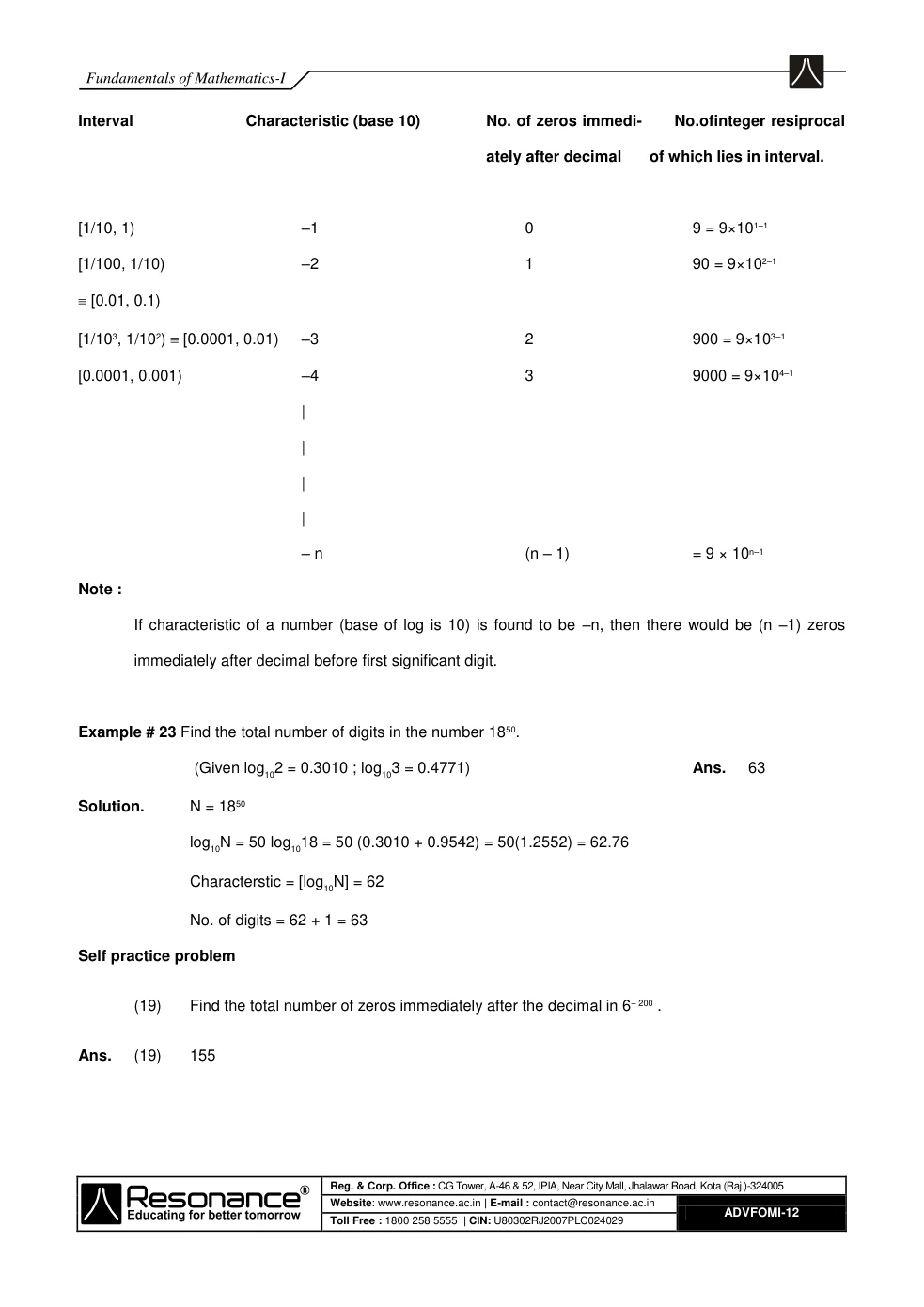
MAASFundamentals Of Mathematics I
© MAAS. All rights reserved.Page 14 / 58
Extracted text · page 14
Fundamentals of Mathematics-I
Interval Characteristic (base 10) No. of zeros immedi- No.ofinteger resiprocal
ately after decimal of which lies in interval.
[1/10, 1) –1 0 9 = 9×101–1
[1/100, 1/10) –2 1 90 = 9×10²–1
[0.01, 0.1)
[1/103, 1/102) [0.0001, 0.01) –3 2 900 = 9×10³–1
[0.0001, 0.001) –4 3 9000 = 9×10⁴–1
|
|
|
|
– n (n – 1) = 9 × 10n–1
Note :
If characteristic of a number (base of log is 10) is found to be –n, then there would be (n –1) zeros
immediately after decimal before first significant digit.
Example # 23 Find the total number of digits in the number 1850.
(Given log102 = 0.3010 ; log103 = 0.4771) Ans. 63
Solution. N = 1850
log10N = 50 log1018 = 50 (0.3010 + 0.9542) = 50(1.2552) = 62.76
Characterstic = [log10N] = 62
No. of digits = 62 + 1 = 63
Self practice problem
(19) Find the total number of zeros immediately after the decimal in 6– 200 .
Ans. (19) 155
ADVFOMI-12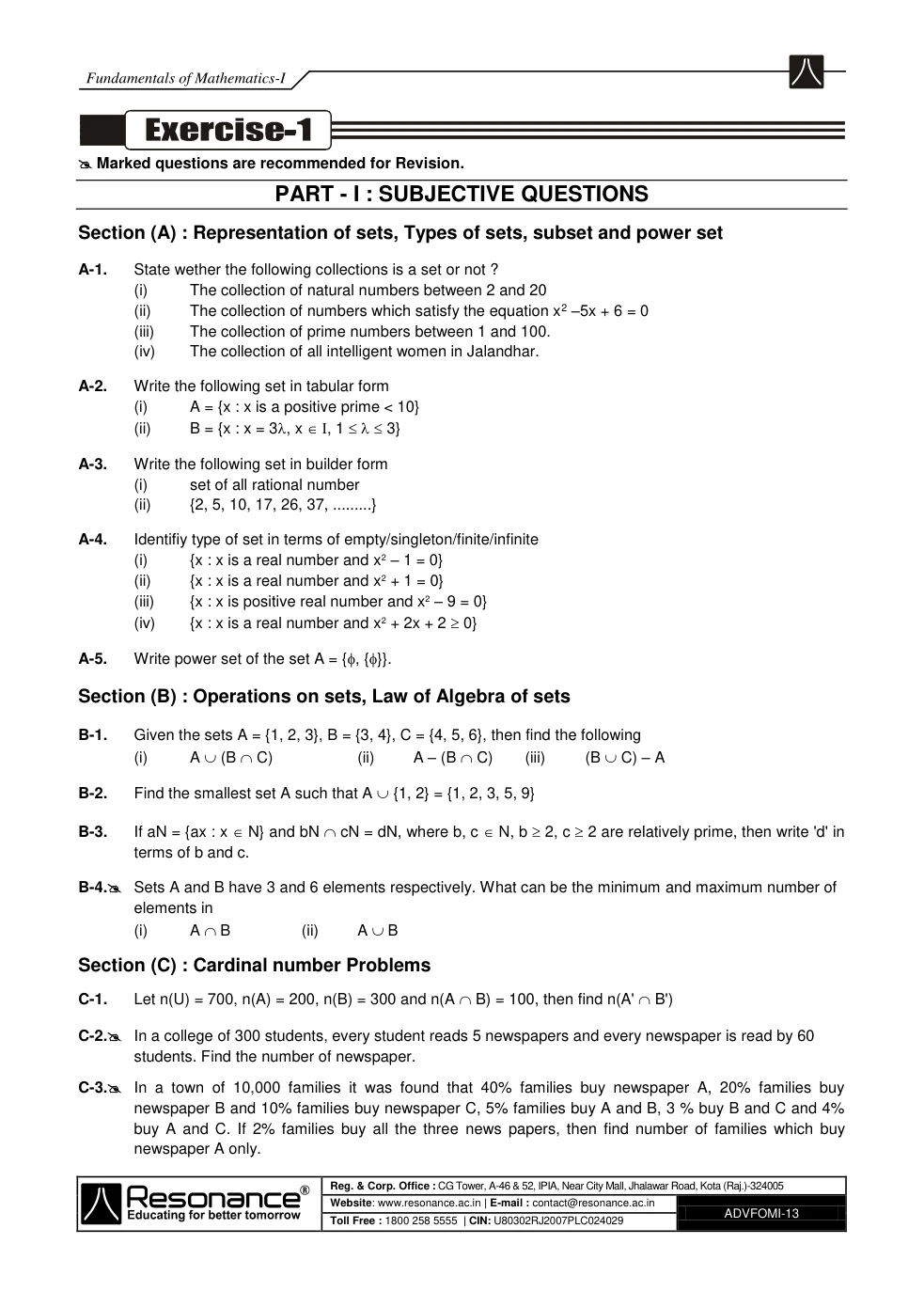
MAASFundamentals Of Mathematics I
© MAAS. All rights reserved.Page 15 / 58
Extracted text · page 15
Fundamentals of Mathematics-I
Marked questions are recommended for Revision.
PART - I : SUBJECTIVE QUESTIONS
Section (A) : Representation of sets, Types of sets, subset and power set
A-1. State wether the following collections is a set or not ?
(i) The collection of natural numbers between 2 and 20
(ii) The collection of numbers which satisfy the equation x2 –5x + 6 = 0
(iii) The collection of prime numbers between 1 and 100.
(iv) The collection of all intelligent women in Jalandhar.
A-2. Write the following set in tabular form
(i) A = {x : x is a positive prime < 10}
(ii) B = {x : x = 3, x , 1 3}
A-3. Write the following set in builder form
(i) set of all rational number
(ii) {2, 5, 10, 17, 26, 37, .........}
A-4. Identifiy type of set in terms of empty/singleton/finite/infinite
(i) {x : x is a real number and x2 – 1 = 0}
(ii) {x : x is a real number and x2 + 1 = 0}
(iii) {x : x is positive real number and x2 – 9 = 0}
(iv) {x : x is a real number and x2 + 2x + 2 0}
A-5. Write power set of the set A = {, {}}.
Section (B) : Operations on sets, Law of Algebra of sets
B-1. Given the sets A = {1, 2, 3}, B = {3, 4}, C = {4, 5, 6}, then find the following
(i) A (B C) (ii) A – (B C) (iii) (B C) – A
B-2. Find the smallest set A such that A {1, 2} = {1, 2, 3, 5, 9}
B-3. If aN = {ax : x N} and bN cN = dN, where b, c N, b 2, c 2 are relatively prime, then write 'd' in
terms of b and c.
B-4. Sets A and B have 3 and 6 elements respectively. What can be the minimum and maximum number of
elements in
(i) A B (ii) A B
Section (C) : Cardinal number Problems
C-1. Let n(U) = 700, n(A) = 200, n(B) = 300 and n(A B) = 100, then find n(A' B')
C-2. In a college of 300 students, every student reads 5 newspapers and every newspaper is read by 60
students. Find the number of newspaper.
C-3. In a town of 10,000 families it was found that 40% families buy newspaper A, 20% families buy
newspaper B and 10% families buy newspaper C, 5% families buy A and B, 3 % buy B and C and 4%
buy A and C. If 2% families buy all the three news papers, then find number of families which buy
newspaper A only.
ADVFOMI-13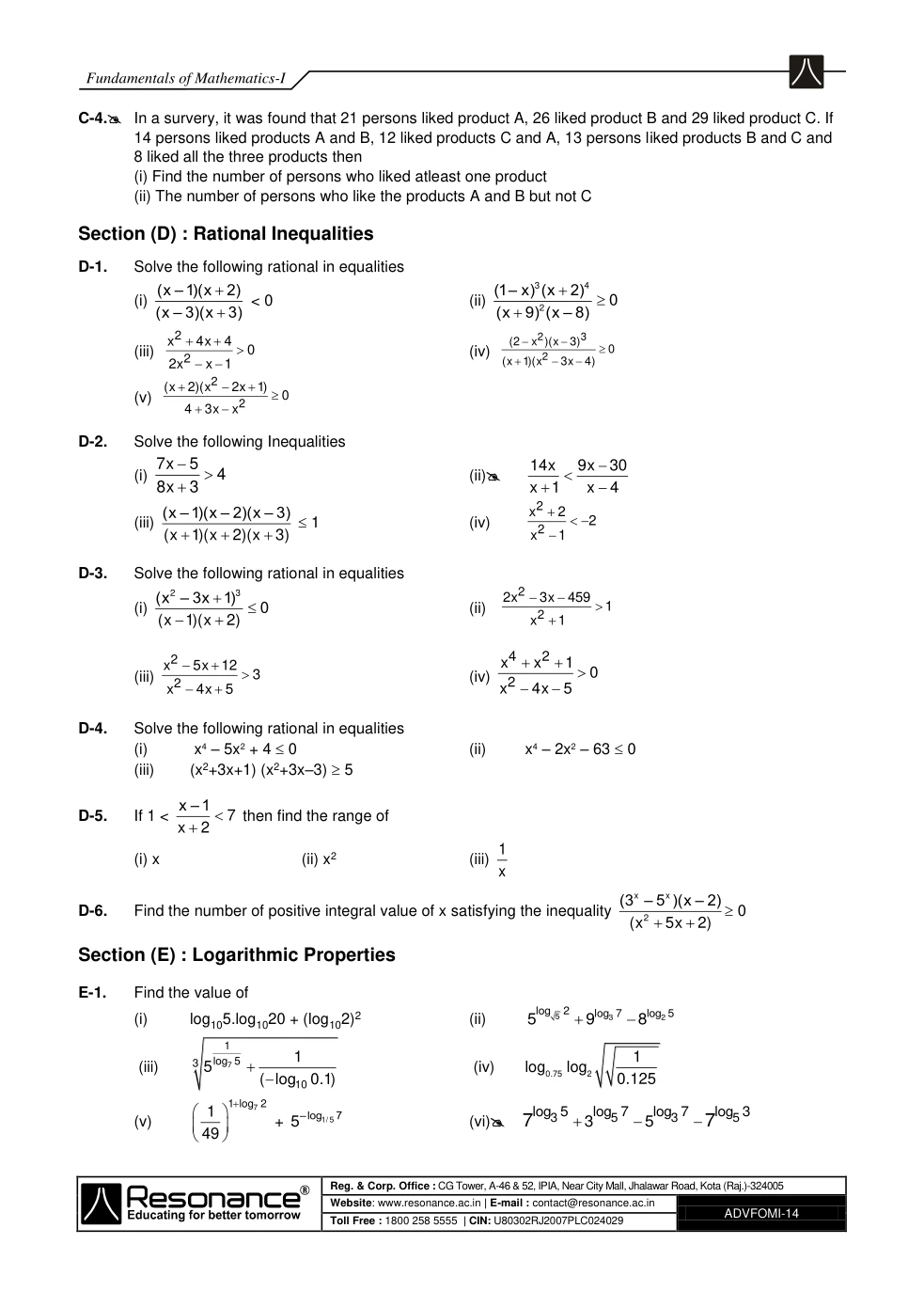
MAASFundamentals Of Mathematics I
© MAAS. All rights reserved.Page 16 / 58
Extracted text · page 16
Fundamentals of Mathematics-I
C-4. In a survery, it was found that 21 persons liked product A, 26 liked product B and 29 liked product C. If
14 persons liked products A and B, 12 liked products C and A, 13 persons liked products B and C and
8 liked all the three products then
(i) Find the number of persons who liked atleast one product
(ii) The number of persons who like the products A and B but not C
Section (D) : Rational Inequalities
D-1. Solve the following rational in equalities
(x –1)(x 2) (1– x)3 (x 2)4
(i) < 0 (ii) 2 0 (x – 3)(x 3) (x 9) (x – 8)
x 2 4 x 4 ( 2 x 2 )( x 3 ) 3 0 (iii) 0 (iv) ( x 1)( x 2 3 x 4 ) 2 x 2 x 1
( x 2)( x 2 2 x 1)
(v) 2 0 4 3 x x
D-2. Solve the following Inequalities
7 x 5 14x 9x 30 (i) 4 (ii)
8 x 3 x 1 x 4
(x –1)(x – 2)(x – 3) x 2 2 (iii) 1 (iv) 2
(x 1)(x 2)(x 3) x 2 1
D-3. Solve the following rational in equalities
(x 2 – 3x 1)3 2 x 2 3 x 459 (i) 0 (ii) 1
(x 1)(x 2) x 2 1
x 2 5 x 12 x 4 x 2 1
(iii) 3 (iv) 2 0 2 x 4 x 5 x 4 x 5
D-4. Solve the following rational in equalities
(i) x4 – 5x2 + 4 0 (ii) x4 – 2x2 – 63 0
(iii) (x2+3x+1) (x2+3x–3) 5
x – 1D-5. If 1 < 7 then find the range of
x 2
1
(i) x (ii) x2 (iii)
x
(3 x – 5 x )(x – 2)
D-6. Find the number of positive integral value of x satisfying the inequality 2 0 (x 5x 2)
Section (E) : Logarithmic Properties
E-1. Find the value of
2 5 log 5 2 9log 3 7 8log (i) log105.log1020 + (log102)2 (ii) 5
1
3 log7 5 1 1
(iii) 5 ( log10 0.1) (iv) log0.75 log2 0.125
1 log7 2
1 –log1/ 5 7 log3 5 log5 7 log3 7 log5 3 (v) + 5 (vi) 7 3 5 7
49
ADVFOMI-14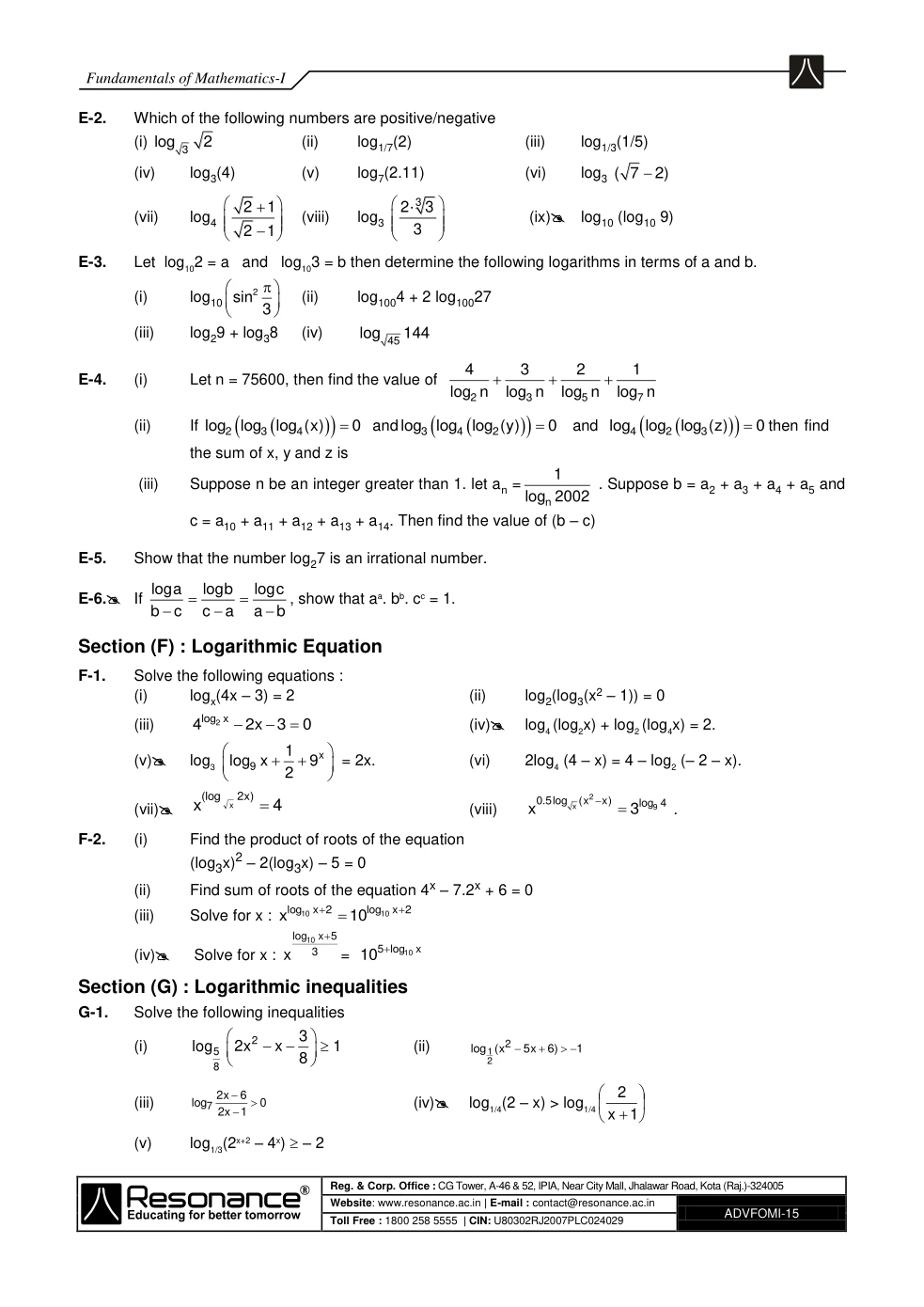
MAASFundamentals Of Mathematics I
© MAAS. All rights reserved.Page 17 / 58
Extracted text · page 17
Fundamentals of Mathematics-I
E-2. Which of the following numbers are positive/negative
(i) log 2 (ii) log1/7(2) (iii) log1/3(1/5) 3
(iv) log3(4) (v) log7(2.11) (vi) log3 ( 7 2)
2 1 2· 3 3
(ix) log10 (log10 9) (viii) log3 (vii) log4 3 2 1
E-3. Let log102 = a and log103 = b then determine the following logarithms in terms of a and b.
2
(i) log10 sin (ii) log1004 + 2 log10027
3
(iii) log29 + log38 (iv) log 45 144
4 3 2 1
E-4. (i) Let n = 75600, then find the value of
log2 n log3 n log5 n log7 n
(ii) If log2 log3 log4 (x) 0 and log3 log4 log2 (y) 0 and log4 log2 log3 (z) 0 then find
the sum of x, y and z is
1
(iii) Suppose n be an integer greater than 1. let an = . Suppose b = a2 + a3 + a4 + a5 and
logn 2002
c = a10 + a11 + a12 + a13 + a14. Then find the value of (b – c)
E-5. Show that the number log27 is an irrational number.
loga logb logc
E-6. If , show that aa. bb. cc = 1.
b c c a a b
Section (F) : Logarithmic Equation
F-1. Solve the following equations :
(i) logx(4x – 3) = 2 (ii) log2(log3(x2 – 1)) = 0
(iii) 4log 2 x 2x 3 0 (iv) log4 (log2x) + log2 (log4x) = 2.
1 x
(v) log3 log9 x 9 = 2x. (vi) 2log4 (4 – x) = 4 – log2 (– 2 – x).
2
(log
x 0.5log x (x 2 x) 9 4 . (vii) x 2 x) 4 (viii) x 3log
F-2. (i) Find the product of roots of the equation
(log3x)2 – 2(log3x) – 5 = 0
(ii) Find sum of roots of the equation 4x – 7.2x + 6 = 0
10 x 2 (iii) Solve for x : xlog 10 x 2 10log
log10 x 5
10 x (iv) Solve for x : x 3 = 105 log
Section (G) : Logarithmic inequalities
G-1. Solve the following inequalities
2 3 2 (i) log 5 2x x 1 (ii) log 1 ( x 5 x 6 ) 1
2 8 8
2 x 6 2
(iii) log7 0 (iv) log1/4(2 – x) > log1/4 2 x 1 x 1
(v) log1/3(2x+2 – 4x) – 2
ADVFOMI-15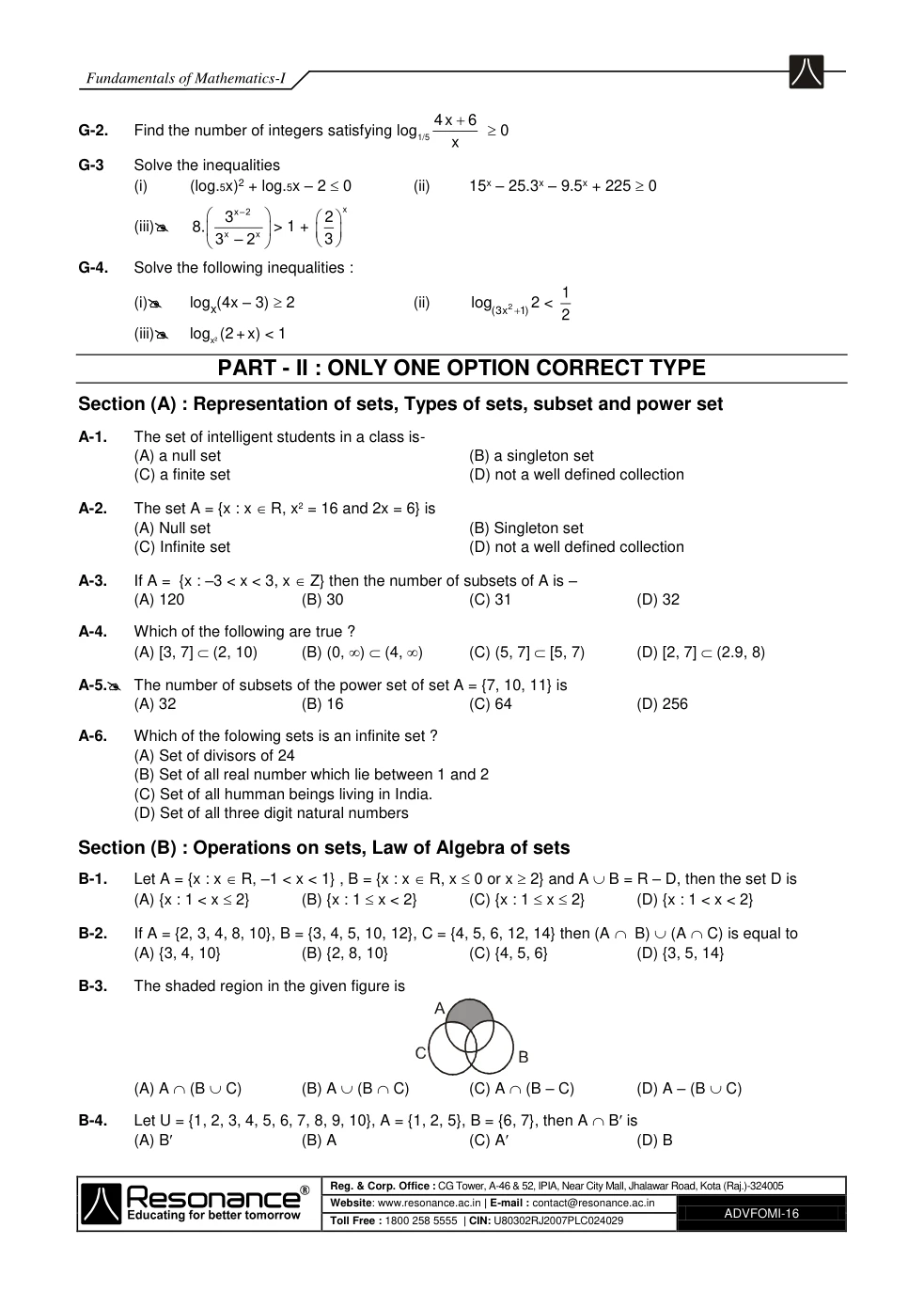
MAASFundamentals Of Mathematics I
© MAAS. All rights reserved.Page 18 / 58
Extracted text · page 18
Fundamentals of Mathematics-I
4x 6
G-2. Find the number of integers satisfying log1/5 0
x
G-3 Solve the inequalities
(i) (log.5x)2 + log.5x – 2 0 (ii) 15x – 25.3x – 9.5x + 225 0
3 x–2 2 x
(iii) 8. x x > 1 +
3 – 2 3
G-4. Solve the following inequalities :
1
2 (i) logx(4x – 3) 2 (ii) log(3x 21) < 2
(iii) logx² (2 + x) < 1
PART - II : ONLY ONE OPTION CORRECT TYPE
Section (A) : Representation of sets, Types of sets, subset and power set
A-1. The set of intelligent students in a class is-
(A) a null set (B) a singleton set
(C) a finite set (D) not a well defined collection
A-2. The set A = {x : x R, x2 = 16 and 2x = 6} is
(A) Null set (B) Singleton set
(C) Infinite set (D) not a well defined collection
A-3. If A = {x : –3 < x < 3, x Z} then the number of subsets of A is –
(A) 120 (B) 30 (C) 31 (D) 32
A-4. Which of the following are true ?
(A) [3, 7] (2, 10) (B) (0, ) (4, ) (C) (5, 7] [5, 7) (D) [2, 7] (2.9, 8)
A-5. The number of subsets of the power set of set A = {7, 10, 11} is
(A) 32 (B) 16 (C) 64 (D) 256
A-6. Which of the folowing sets is an infinite set ?
(A) Set of divisors of 24
(B) Set of all real number which lie between 1 and 2
(C) Set of all humman beings living in India.
(D) Set of all three digit natural numbers
Section (B) : Operations on sets, Law of Algebra of sets
B-1. Let A = {x : x R, –1 < x < 1} , B = {x : x R, x 0 or x 2} and A B = R – D, then the set D is
(A) {x : 1 < x 2} (B) {x : 1 x < 2} (C) {x : 1 x 2} (D) {x : 1 < x < 2}
B-2. If A = {2, 3, 4, 8, 10}, B = {3, 4, 5, 10, 12}, C = {4, 5, 6, 12, 14} then (A B) (A C) is equal to
(A) {3, 4, 10} (B) {2, 8, 10} (C) {4, 5, 6} (D) {3, 5, 14}
B-3. The shaded region in the given figure is
(A) A (B C) (B) A (B C) (C) A (B – C) (D) A – (B C)
B-4. Let U = {1, 2, 3, 4, 5, 6, 7, 8, 9, 10}, A = {1, 2, 5}, B = {6, 7}, then A Bis
(A) B (B) A (C) A (D) B
ADVFOMI-16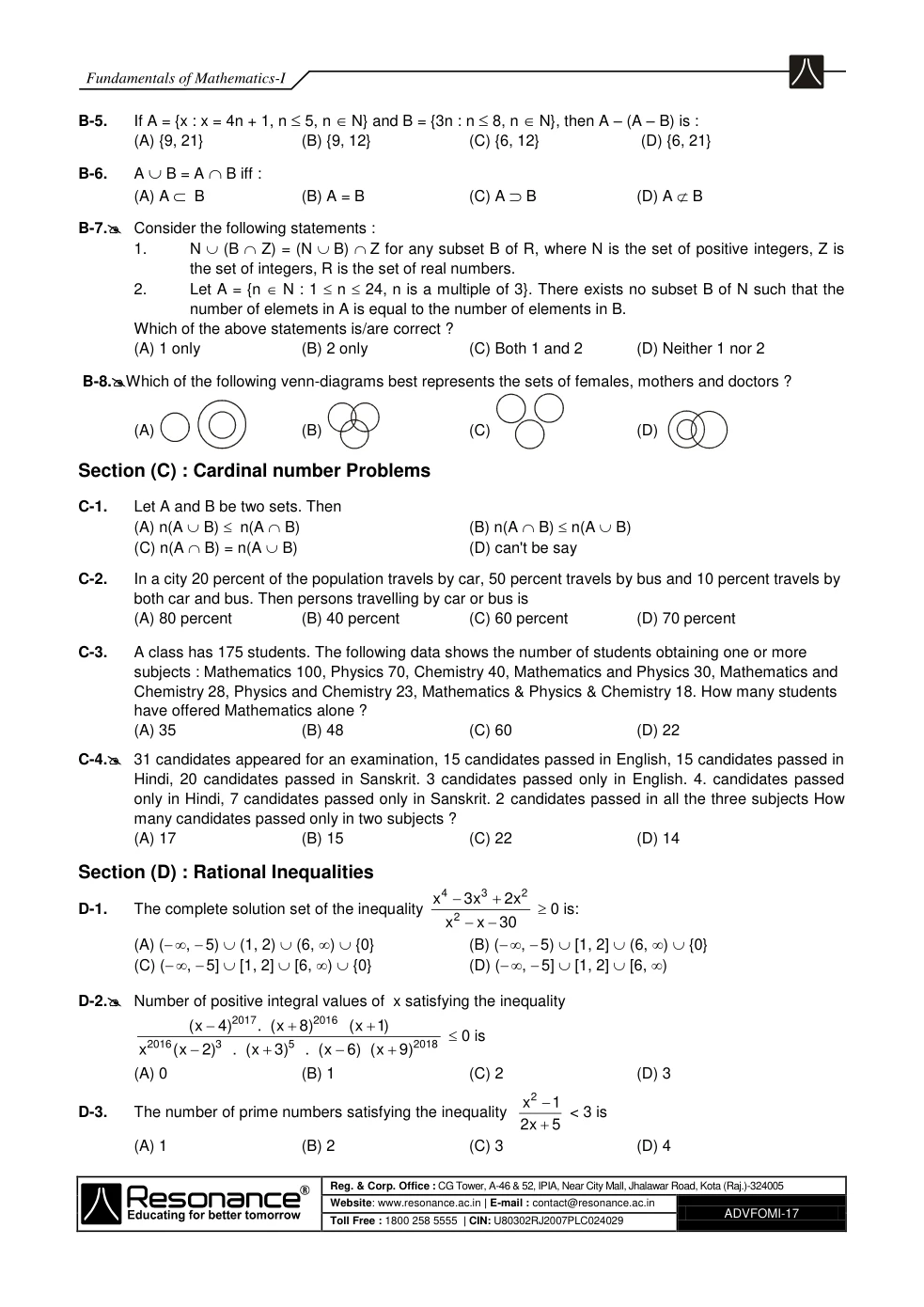
MAASFundamentals Of Mathematics I
© MAAS. All rights reserved.Page 19 / 58
Extracted text · page 19
Fundamentals of Mathematics-I
B-5. If A = {x : x = 4n + 1, n 5, n N} and B = {3n : n 8, n N}, then A – (A – B) is :
(A) {9, 21} (B) {9, 12} (C) {6, 12} (D) {6, 21}
B-6. A B = A B iff :
(A) A B (B) A = B (C) A B (D) A B
B-7. Consider the following statements :
1. N (B Z) = (N B) Z for any subset B of R, where N is the set of positive integers, Z is
the set of integers, R is the set of real numbers.
2. Let A = {n N : 1 n 24, n is a multiple of 3}. There exists no subset B of N such that the
number of elemets in A is equal to the number of elements in B.
Which of the above statements is/are correct ?
(A) 1 only (B) 2 only (C) Both 1 and 2 (D) Neither 1 nor 2
B-8.Which of the following venn-diagrams best represents the sets of females, mothers and doctors ?
(A) (B) (C) (D)
Section (C) : Cardinal number Problems
C-1. Let A and B be two sets. Then
(A) n(A B) n(A B) (B) n(A B) n(A B)
(C) n(A B) = n(A B) (D) can't be say
C-2. In a city 20 percent of the population travels by car, 50 percent travels by bus and 10 percent travels by
both car and bus. Then persons travelling by car or bus is
(A) 80 percent (B) 40 percent (C) 60 percent (D) 70 percent
C-3. A class has 175 students. The following data shows the number of students obtaining one or more
subjects : Mathematics 100, Physics 70, Chemistry 40, Mathematics and Physics 30, Mathematics and
Chemistry 28, Physics and Chemistry 23, Mathematics & Physics & Chemistry 18. How many students
have offered Mathematics alone ?
(A) 35 (B) 48 (C) 60 (D) 22
C-4. 31 candidates appeared for an examination, 15 candidates passed in English, 15 candidates passed in
Hindi, 20 candidates passed in Sanskrit. 3 candidates passed only in English. 4. candidates passed
only in Hindi, 7 candidates passed only in Sanskrit. 2 candidates passed in all the three subjects How
many candidates passed only in two subjects ?
(A) 17 (B) 15 (C) 22 (D) 14
Section (D) : Rational Inequalities
x 4 3x 3 2x 2
D-1. The complete solution set of the inequality 0 is:
x 2 x 30
(A) (, 5) (1, 2) (6, ) {0} (B) (, 5) [1, 2] (6, ) {0}
(C) (, 5] [1, 2] [6, ) {0} (D) (, 5] [1, 2] [6, )
D-2. Number of positive integral values of x satisfying the inequality
(x 4)2017 . (x 8)2016 (x 1)
0 is
x 2016 (x 2)3 . (x 3)5 . (x 6) (x 9)2018
(A) 0 (B) 1 (C) 2 (D) 3
x 2 1
D-3. The number of prime numbers satisfying the inequality < 3 is
2x 5
(A) 1 (B) 2 (C) 3 (D) 4
ADVFOMI-17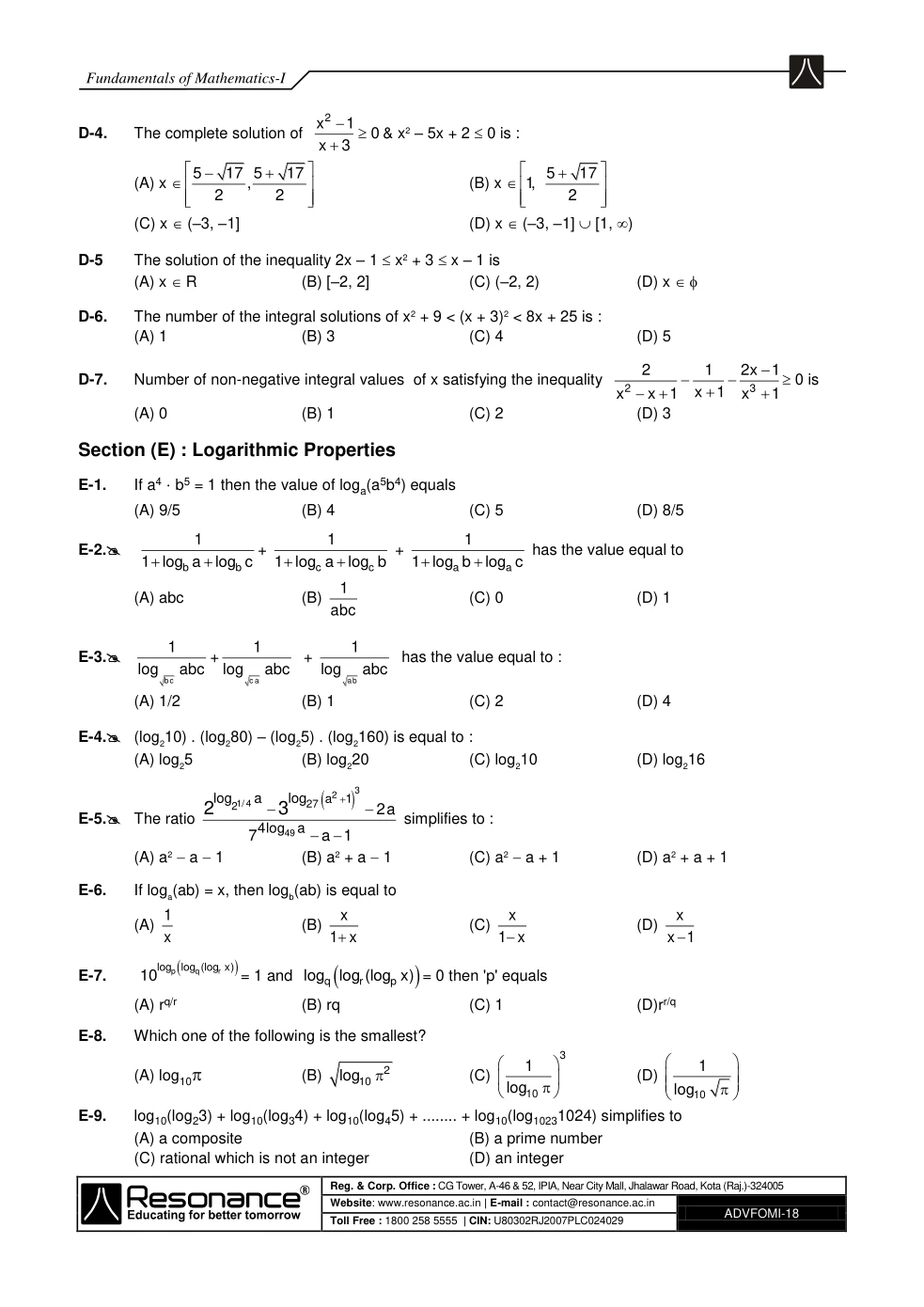
MAASFundamentals Of Mathematics I
© MAAS. All rights reserved.Page 20 / 58
Extracted text · page 20
Fundamentals of Mathematics-I
x 2 1
D-4. The complete solution of 0 & x2 – 5x + 2 0 is :
x 3
17 5 17 5 17 (A) x 5 , (B) x 1,
2 2 2
(C) x (–3, –1] (D) x (–3, –1] [1, )
D-5 The solution of the inequality 2x – 1 x2 + 3 x – 1 is
(A) x R (B) [–2, 2] (C) (–2, 2) (D) x
D-6. The number of the integral solutions of x2 + 9 < (x + 3)2 < 8x + 25 is :
(A) 1 (B) 3 (C) 4 (D) 5
2 1 2x 1
D-7. Number of non-negative integral values of x satisfying the inequality 0 is
x 2 x 1 x 1 x 3 1
(A) 0 (B) 1 (C) 2 (D) 3
Section (E) : Logarithmic Properties
E-1. If a4 · b5 = 1 then the value of loga(a5b4) equals
(A) 9/5 (B) 4 (C) 5 (D) 8/5
1 1 1
E-2. + + has the value equal to
1 logb a logb c 1 logc a logc b 1 loga b loga c
1
(A) abc (B) (C) 0 (D) 1
abc
1 1 1
E-3. + + has the value equal to :
log abc log abc log abc
bc c a ab
(A) 1/2 (B) 1 (C) 2 (D) 4
E-4. (log210) . (log280) – (log25) . (log2160) is equal to :
(A) log25 (B) log220 (C) log210 (D) log216
3
log a log27 a 2 1 21/ 4 2 3 2a
E-5. The ratio simplifies to :
7 4log49 a a 1
(A) a2 a 1 (B) a2 + a 1 (C) a2 a + 1 (D) a2 + a + 1
E-6. If loga(ab) = x, then logb(ab) is equal to
1 x x x
(A) (B) (C) (D)
x 1 x 1 x x 1
logp logq (logr x) E-7. 10 = 1 and logq logr (logp x) = 0 then 'p' equals
(A) rq/r (B) rq (C) 1 (D)rr/q
E-8. Which one of the following is the smallest?
2 1 3 1 (A) log10 (B) log10 (C) (D) log10 log10
E-9. log10(log23) + log10(log34) + log10(log45) + ........ + log10(log10231024) simplifies to
(A) a composite (B) a prime number
(C) rational which is not an integer (D) an integer
ADVFOMI-18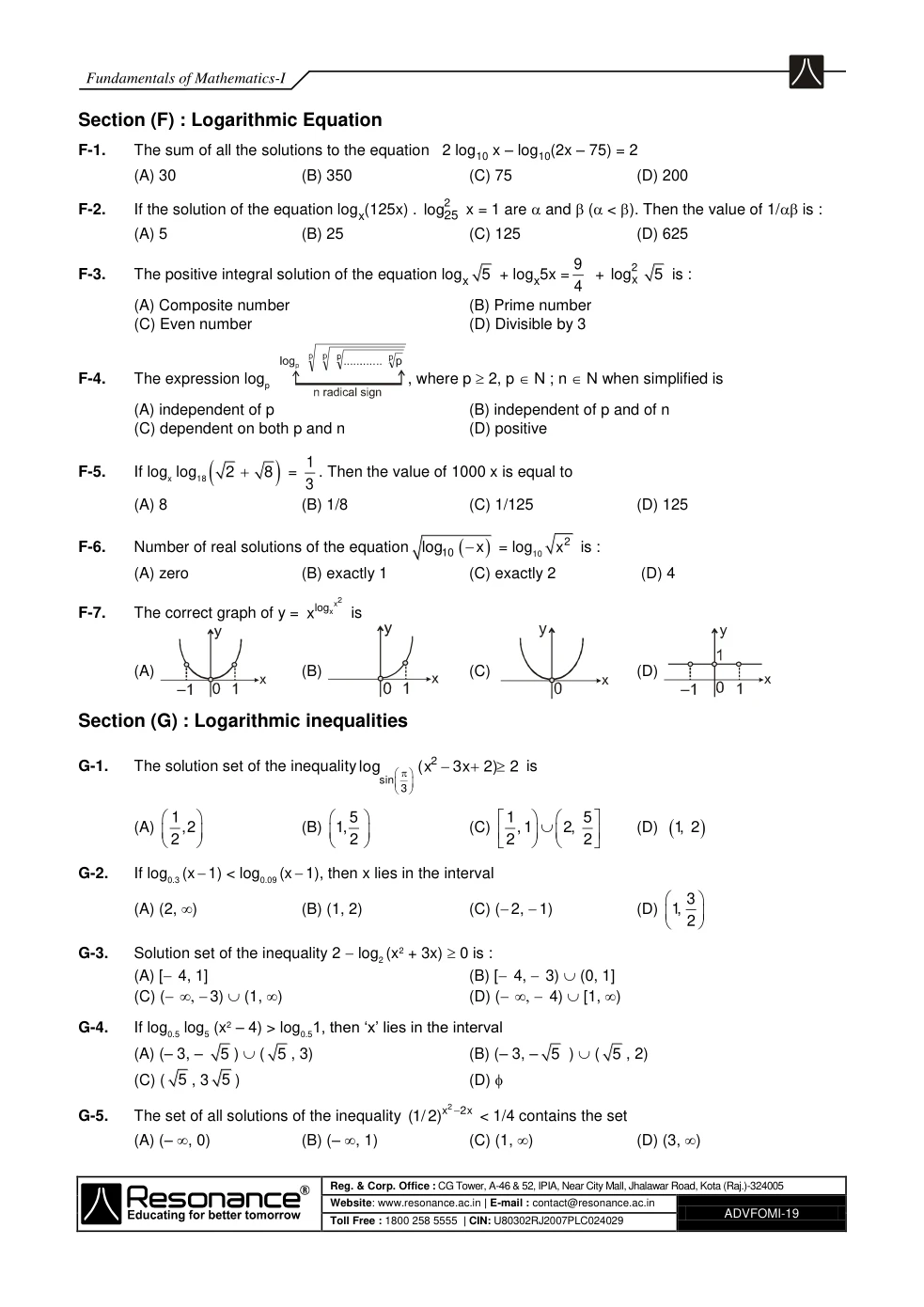
MAASFundamentals Of Mathematics I
© MAAS. All rights reserved.Page 21 / 58
Extracted text · page 21
Fundamentals of Mathematics-I
Section (F) : Logarithmic Equation
F-1. The sum of all the solutions to the equation 2 log10 x – log10(2x – 75) = 2
(A) 30 (B) 350 (C) 75 (D) 200
F-2. If the solution of the equation logx(125x) . log252 x = 1 are and ( < ). Then the value of 1/is :
(A) 5 (B) 25 (C) 125 (D) 625
9 2
F-3. The positive integral solution of the equation logx 5 + logx5x = + log x 5 is : 4
(A) Composite number (B) Prime number
(C) Even number (D) Divisible by 3
F-4. The expression logp , where p 2, p N ; n N when simplified is
(A) independent of p (B) independent of p and of n
(C) dependent on both p and n (D) positive
1
= . Then the value of 1000 x is equal to 2 8F-5. If logx log18 3
(A) 8 (B) 1/8 (C) 1/125 (D) 125
2 is :F-6. Number of real solutions of the equation log10 x = log10 x
(A) zero (B) exactly 1 (C) exactly 2 (D) 4
x 2
x isF-7. The correct graph of y = x log
(A) (B) (C) (D)
Section (G) : Logarithmic inequalities
G-1. The solution set of the inequality log (x2 3x 2) 2 is
sin
3
5 1 5 1, 2 (A) 1,2 (B) 1, (C) , 1 2, (D) 2 2 2 2
G-2. If log0.3 (x 1) < log0.09 (x 1), then x lies in the interval
3
(A) (2, ) (B) (1, 2) (C) ( 2, 1) (D) 1,
2
G-3. Solution set of the inequality 2 log2 (x2 + 3x) 0 is :
(A) [ 4, 1] (B) [ 4, 3) (0, 1]
(C) ( 3) (1, ) (D) ( 4) [1, )
G-4. If log0.5 log5 (x2 – 4) > log0.51, then ‘x’ lies in the interval
(A) (– 3, – 5 ) ( 5 , 3) (B) (– 3, – 5 ) ( 5 , 2)
(C) ( 5 , 3 5 ) (D)
x 2 2x
G-5. The set of all solutions of the inequality (1/2) < 1/4 contains the set
(A) (– , 0) (B) (– , 1) (C) (1, ) (D) (3, )
ADVFOMI-19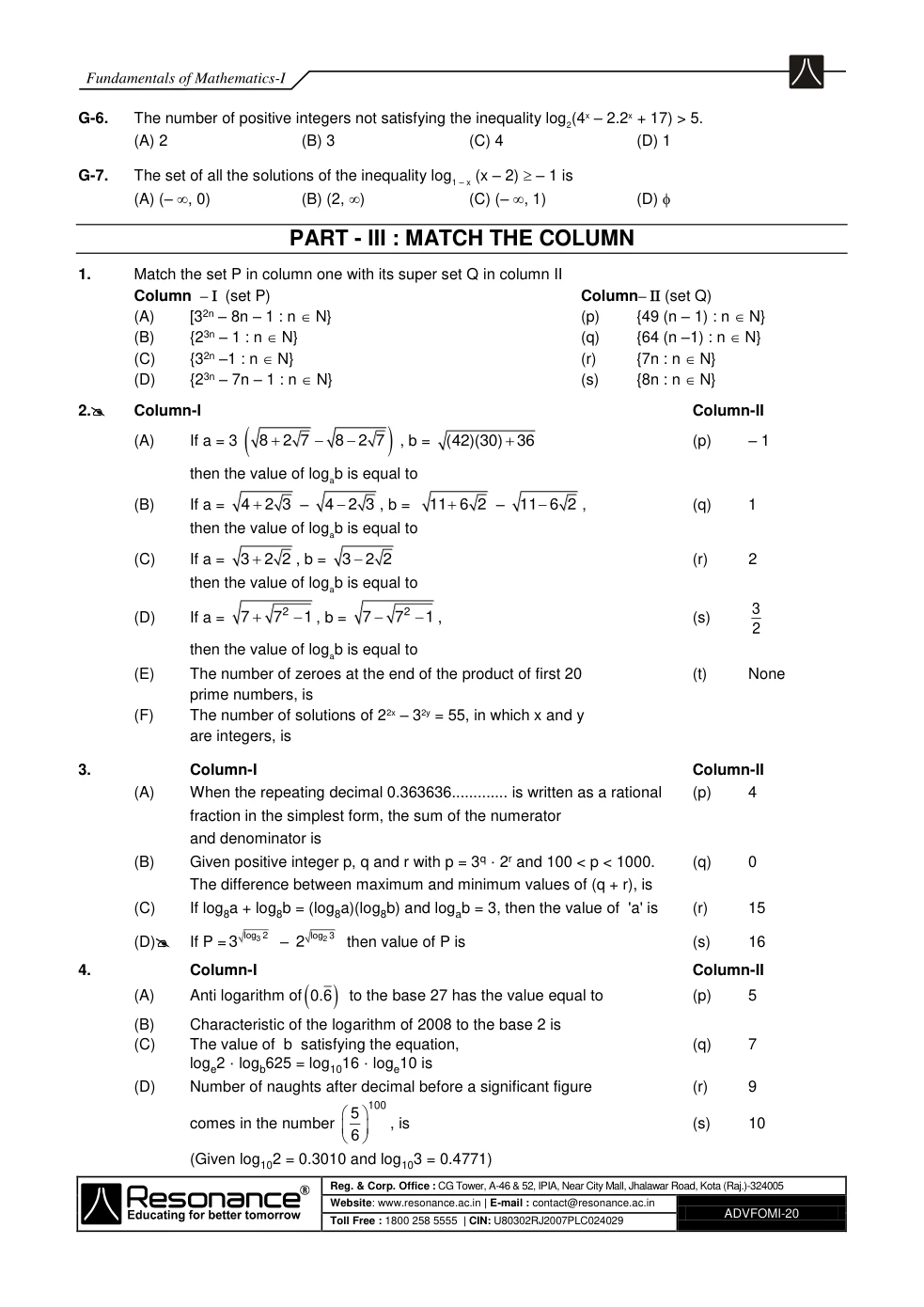
MAASFundamentals Of Mathematics I
© MAAS. All rights reserved.Page 22 / 58
Extracted text · page 22
Fundamentals of Mathematics-I
G-6. The number of positive integers not satisfying the inequality log2(4x – 2.2x + 17) > 5.
(A) 2 (B) 3 (C) 4 (D) 1
G-7. The set of all the solutions of the inequality log1 – x (x – 2) – 1 is
(A) (– , 0) (B) (2, ) (C) (– , 1) (D)
PART - III : MATCH THE COLUMN
1. Match the set P in column one with its super set Q in column II
Column – (set P) Column– (set Q)
(A) [32n – 8n – 1 : n N} (p) {49 (n – 1) : n N}
(B) {23n – 1 : n N} (q) {64 (n –1) : n N}
(C) {32n –1 : n N} (r) {7n : n N}
(D) {23n – 7n – 1 : n N} (s) {8n : n N}
2. Column-I Column-II
(A) If a = 3 8 2 7 8 2 7 , b = (42)(30) 36 (p) – 1
then the value of logab is equal to
(B) If a = 4 2 3 – 4 2 3 , b = 11 6 2 – 11 6 2 , (q) 1
then the value of logab is equal to
(C) If a = 3 2 2 , b = 3 2 2 (r) 2
then the value of logab is equal to
(D) If a = 7 7 2 1 , b = 7 7 2 1 , (s) 3
2
then the value of logab is equal to
(E) The number of zeroes at the end of the product of first 20 (t) None
prime numbers, is
(F) The number of solutions of 22x – 32y = 55, in which x and y
are integers, is
3. Column-I Column-II
(A) When the repeating decimal 0.363636............. is written as a rational (p) 4
fraction in the simplest form, the sum of the numerator
and denominator is
(B) Given positive integer p, q and r with p = 3q · 2r and 100 < p < 1000. (q) 0
The difference between maximum and minimum values of (q + r), is
(C) If log8a + log8b = (log8a)(log8b) and logab = 3, then the value of 'a' is (r) 15
(D) If P = 3 log3 2 – 2 log2 3 then value of P is (s) 16
4. Column-I Column-II
(A) Anti logarithm 0.6 to the base 27 has the value equal to (p) 5 of
(B) Characteristic of the logarithm of 2008 to the base 2 is
(C) The value of b satisfying the equation, (q) 7
loge2 · logb625 = log1016 · loge10 is
(D) Number of naughts after decimal before a significant figure (r) 9
5 100
comes in the number , is (s) 10
6
(Given log102 = 0.3010 and log103 = 0.4771)
ADVFOMI-20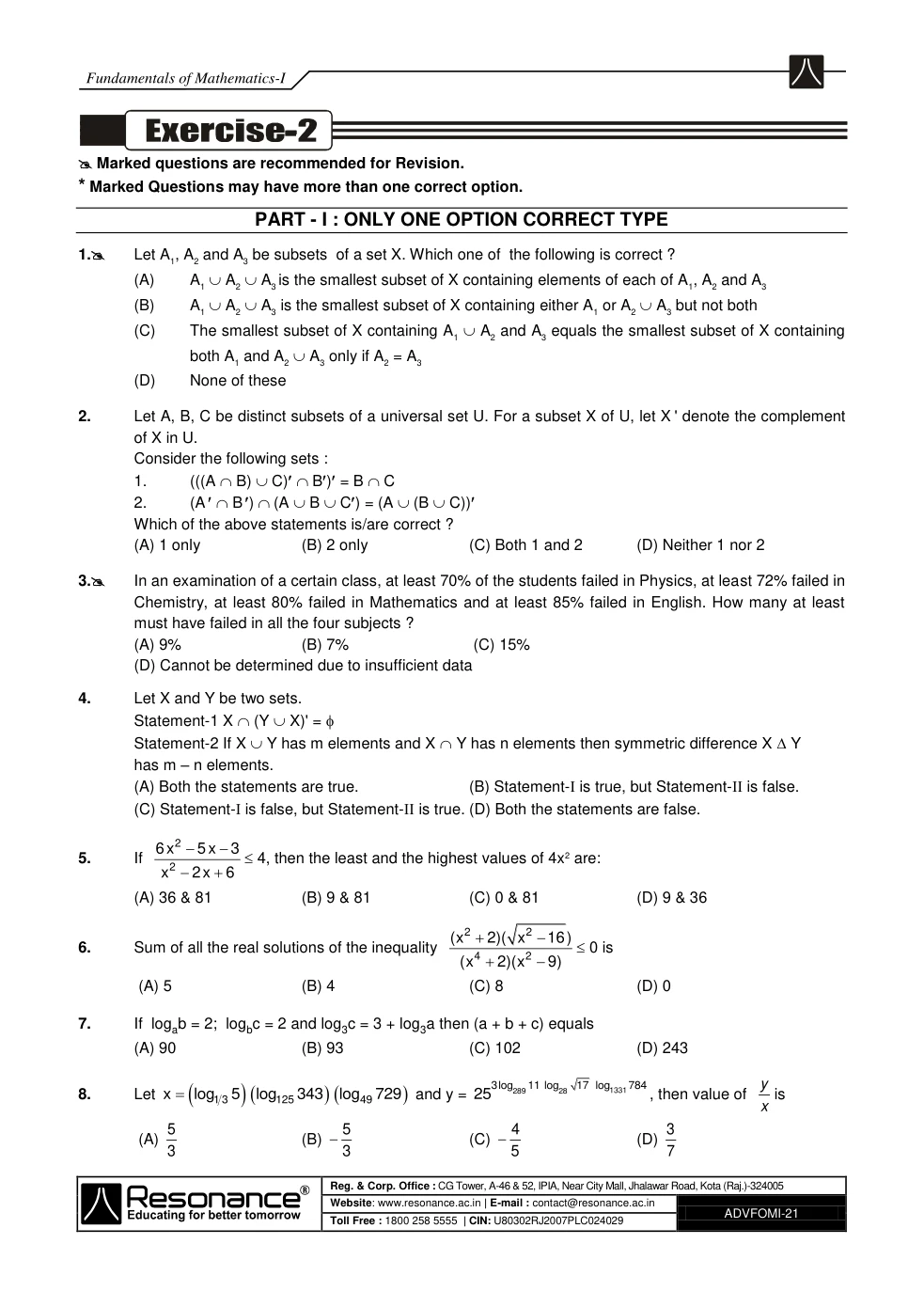
MAASFundamentals Of Mathematics I
© MAAS. All rights reserved.Page 23 / 58
Extracted text · page 23
Fundamentals of Mathematics-I
Marked questions are recommended for Revision.
* Marked Questions may have more than one correct option.
PART - I : ONLY ONE OPTION CORRECT TYPE
1. Let A1, A2 and A3 be subsets of a set X. Which one of the following is correct ?
(A) A1 A2 A3 is the smallest subset of X containing elements of each of A1, A2 and A3
(B) A1 A2 A3 is the smallest subset of X containing either A1 or A2 A3 but not both
(C) The smallest subset of X containing A1 A2 and A3 equals the smallest subset of X containing
both A1 and A2 A3 only if A2 = A3
(D) None of these
2. Let A, B, C be distinct subsets of a universal set U. For a subset X of U, let X ' denote the complement
of X in U.
Consider the following sets :
1. (((A B) C) B) = B C
2. (A B )(A B C) = (A (B C))
Which of the above statements is/are correct ?
(A) 1 only (B) 2 only (C) Both 1 and 2 (D) Neither 1 nor 2
3. In an examination of a certain class, at least 70% of the students failed in Physics, at least 72% failed in
Chemistry, at least 80% failed in Mathematics and at least 85% failed in English. How many at least
must have failed in all the four subjects ?
(A) 9% (B) 7% (C) 15%
(D) Cannot be determined due to insufficient data
4. Let X and Y be two sets.
Statement-1 X (Y X)' =
Statement-2 If X Y has m elements and X Y has n elements then symmetric difference X Y
has m – n elements.
(A) Both the statements are true. (B) Statement- is true, but Statement- is false.
(C) Statement- is false, but Statement- is true. (D) Both the statements are false.
6x 2 5x 3
5. If 4, then the least and the highest values of 4x2 are:
x 2 2x 6
(A) 36 & 81 (B) 9 & 81 (C) 0 & 81 (D) 9 & 36
(x 2 2)( x 2 16)
6. Sum of all the real solutions of the inequality 0 is
(x 4 2)(x 2 9)
(A) 5 (B) 4 (C) 8 (D) 0
7. If logab = 2; logbc = 2 and log3c = 3 + log3a then (a + b + c) equals
(A) 90 (B) 93 (C) 102 (D) 243
3log289 11 log28 17 log1331 784 y and y = 25 , then value of is8. Let x log1 3 5 log125 343 log49 729 x
5 5 4 3
(A) (B) (C) (D)
3 3 5 7
ADVFOMI-21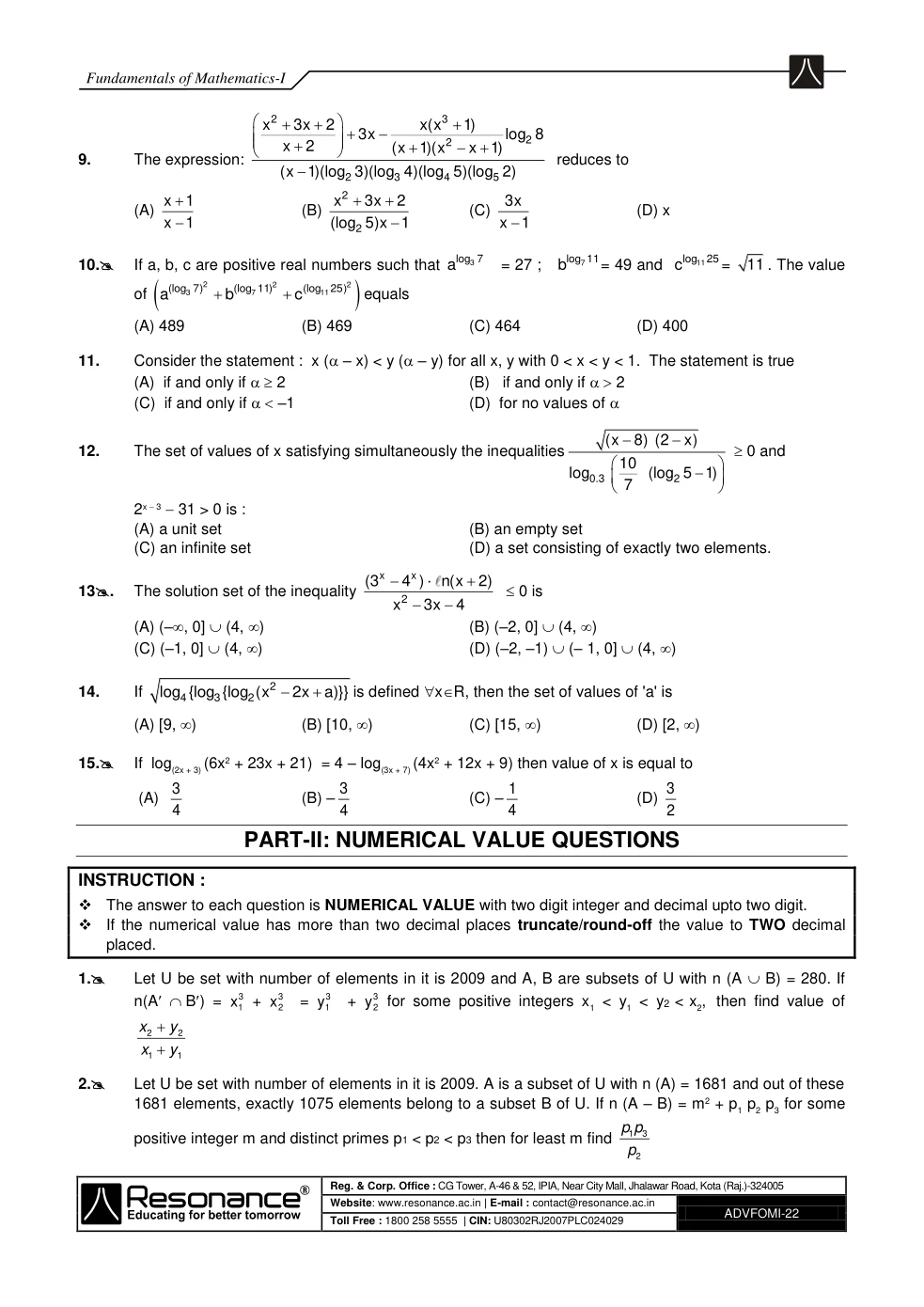
MAASFundamentals Of Mathematics I
© MAAS. All rights reserved.Page 24 / 58
Extracted text · page 24
Fundamentals of Mathematics-I
x 2 3x 2 x(x 3 1)
3x log2 8 (x 1)(x 2 x 1) x 2 9. The expression: reduces to
(x 1)(log2 3)(log3 4)(log4 5)(log5 2)
x 1 x 2 3x 2 3x
(A) (B) (C) (D) x
x 1 (log2 5)x 1 x 1
10. If a, b, c are positive real numbers such that alog 11 25 = 11 . The value 3 7 = 27 ; blog 7 11 = 49 and c log
11 25)2 equals of a(log 3 7)2 b(log 7 11)2 c (log
(A) 489 (B) 469 (C) 464 (D) 400
11. Consider the statement : x ( – x) < y ( – y) for all x, y with 0 < x < y < 1. The statement is true
(A) if and only if 2 (B) if and only if 2
(C) if and only if –1 (D) for no values of
(x 8) (2 x)
12. The set of values of x satisfying simultaneously the inequalities 0 and
10
log0.3 (log2 5 1)
7
2x 3 31 > 0 is :
(A) a unit set (B) an empty set
(C) an infinite set (D) a set consisting of exactly two elements.
(3 x 4 x ) · n(x 2)
13. The solution set of the inequality 0 is
x 2 3x 4
(A) (–, 0] (4, ) (B) (–2, 0] (4, )
(C) (–1, 0] (4, ) (D) (–2, –1) (– 1, 0] (4, )
14. If log4 {log3 {log2 (x 2 2x a)}} is defined xR, then the set of values of 'a' is
(A) [9, ) (B) [10, ) (C) [15, ) (D) [2, )
15. If log(2x + 3) (6x2 + 23x + 21) = 4 – log(3x + 7) (4x2 + 12x + 9) then value of x is equal to
3 3 1 3
(A) (B) – (C) – (D)
4 4 4 2
PART-II: NUMERICAL VALUE QUESTIONS
INSTRUCTION :
The answer to each question is NUMERICAL VALUE with two digit integer and decimal upto two digit.
If the numerical value has more than two decimal places truncate/round-off the value to TWO decimal
placed.
1. Let U be set with number of elements in it is 2009 and A, B are subsets of U with n (A B) = 280. If
n(A B) = x 13 + x 32 = y 13 + y 32 for some positive integers x1 < y1 < y2 < x2, then find value of
x 2 y 2
x1 y 1
2. Let U be set with number of elements in it is 2009. A is a subset of U with n (A) = 1681 and out of these
1681 elements, exactly 1075 elements belong to a subset B of U. If n (A – B) = m2 + p1 p2 p3 for some
p1 p3
positive integer m and distinct primes p1 < p2 < p3 then for least m find
p2
ADVFOMI-22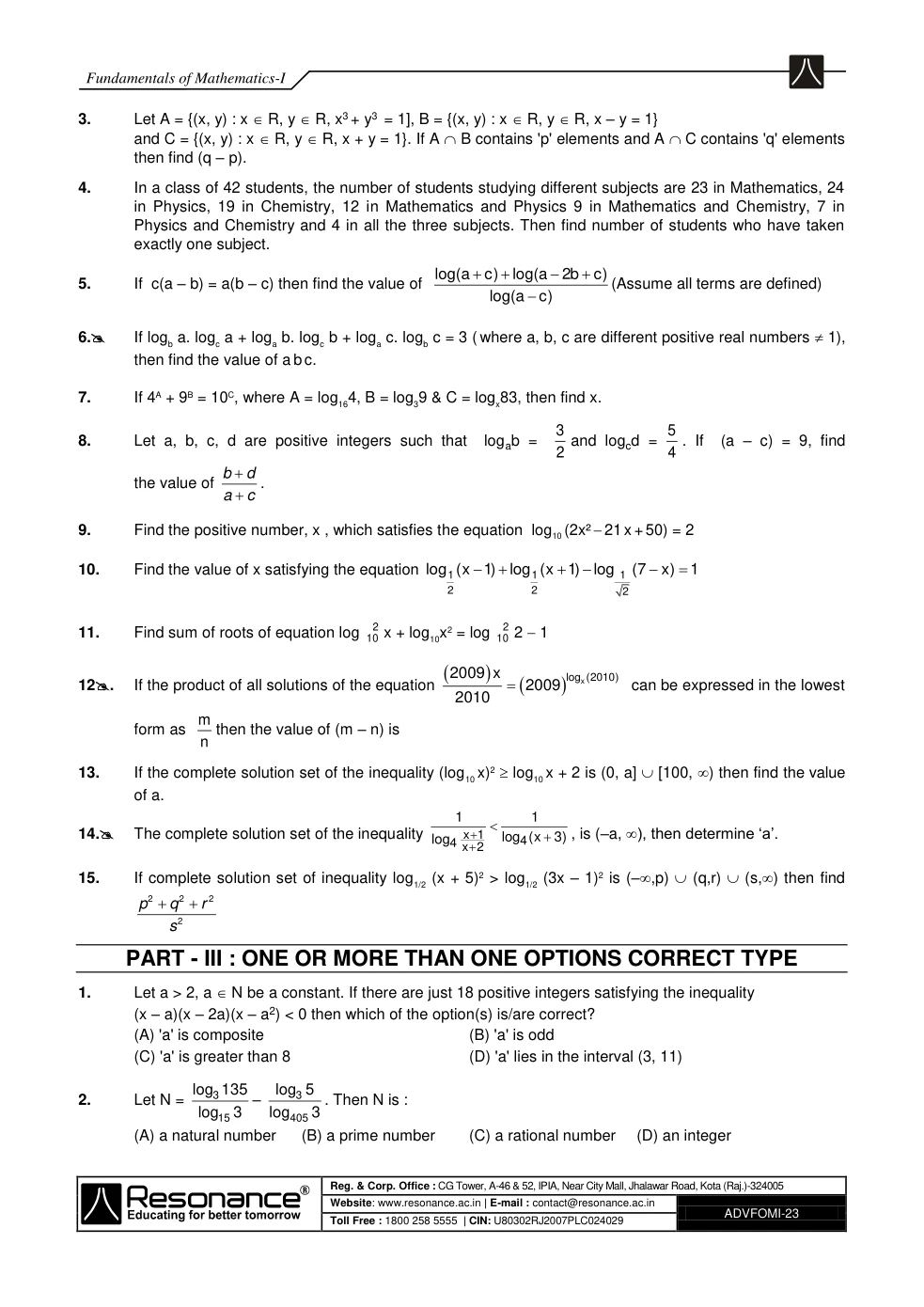
MAASFundamentals Of Mathematics I
© MAAS. All rights reserved.Page 25 / 58
Extracted text · page 25
Fundamentals of Mathematics-I
3. Let A = {(x, y) : x R, y R, x3 + y3 = 1], B = {(x, y) : x R, y R, x – y = 1}
and C = {(x, y) : x R, y R, x + y = 1}. If A B contains 'p' elements and A C contains 'q' elements
then find (q – p).
4. In a class of 42 students, the number of students studying different subjects are 23 in Mathematics, 24
in Physics, 19 in Chemistry, 12 in Mathematics and Physics 9 in Mathematics and Chemistry, 7 in
Physics and Chemistry and 4 in all the three subjects. Then find number of students who have taken
exactly one subject.
log(a c) log(a 2b c)
5. If c(a – b) = a(b – c) then find the value of (Assume all terms are defined)
log(a c)
6. If logb a. logc a + loga b. logc b + loga c. logb c = 3 ( where a, b, c are different positive real numbers 1),
then find the value of a b c.
7. If 4A + 9B = 10C, where A = log164, B = log39 & C = logx83, then find x.
3 5
8. Let a, b, c, d are positive integers such that logab = and logcd = . If (a – c) = 9, find
2 4
b d
the value of .
a c
9. Find the positive number, x , which satisfies the equation log10 (2x² 21 x + 50) = 2
10. Find the value of x satisfying the equation log 1 (x 1) log 1 (x 1) log 1 (7 x) 1
2 2 2
11. Find sum of roots of equation log 102 x + log10x2 = log 102 2 1
2009 x logx (2010)12. If the product of all solutions of the equation 2009 can be expressed in the lowest
2010
m
form as then the value of (m – n) is
n
13. If the complete solution set of the inequality (log10 x)2 log10 x + 2 is (0, a] [100, ) then find the value
of a.
1 1
14. The complete solution set of the inequality 4 ( x 3 ) , is (–a, ), then determine ‘a’. log4 xx21 log
15. If complete solution set of inequality log1/2 (x + 5)2 > log1/2 (3x – 1)2 is (–,p) (q,r) (s,) then find
p 2 q 2 r 2
s 2
PART - III : ONE OR MORE THAN ONE OPTIONS CORRECT TYPE
1. Let a > 2, a N be a constant. If there are just 18 positive integers satisfying the inequality
(x – a)(x – 2a)(x – a2) < 0 then which of the option(s) is/are correct?
(A) 'a' is composite (B) 'a' is odd
(C) 'a' is greater than 8 (D) 'a' lies in the interval (3, 11)
log3 135 log3 52. Let N = – . Then N is :
log15 3 log405 3
(A) a natural number (B) a prime number (C) a rational number (D) an integer
ADVFOMI-23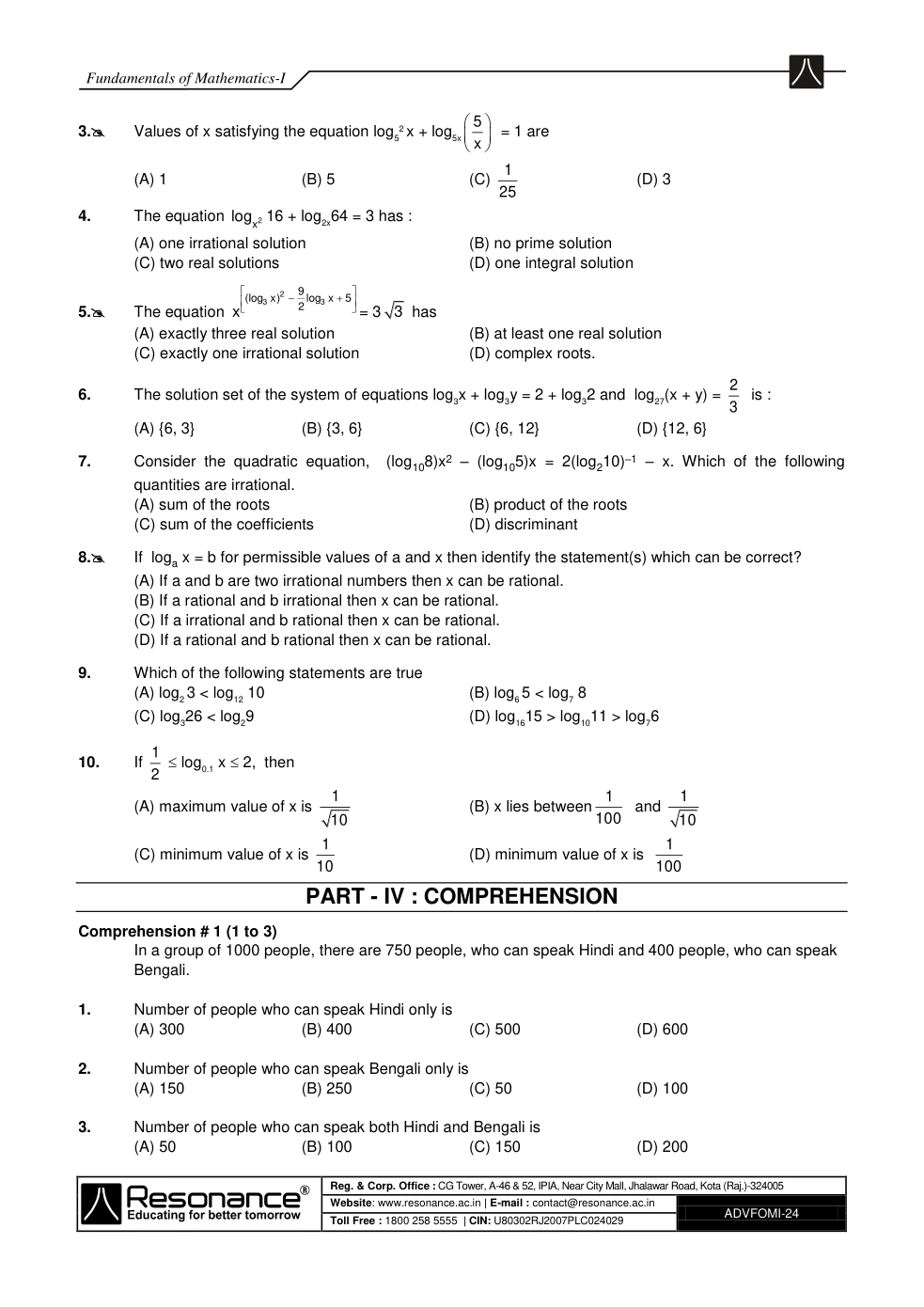
MAASFundamentals Of Mathematics I
© MAAS. All rights reserved.Page 26 / 58
Extracted text · page 26
Fundamentals of Mathematics-I
2 5 3. Values of x satisfying the equation log5 x + log5x = 1 are
x
1
(A) 1 (B) 5 (C) (D) 3
25
4. The equation log 16 + log2x64 = 3 has : x 2
(A) one irrational solution (B) no prime solution
(C) two real solutions (D) one integral solution
2 9
(log3 x) log3 x 5
5. The equation x 2 = 3 3 has
(A) exactly three real solution (B) at least one real solution
(C) exactly one irrational solution (D) complex roots.
2
6. The solution set of the system of equations log3x + log3y = 2 + log32 and log27(x + y) = is :
3
(A) {6, 3} (B) {3, 6} (C) {6, 12} (D) {12, 6}
7. Consider the quadratic equation, (log108)x2 – (log105)x = 2(log210)–1 – x. Which of the following
quantities are irrational.
(A) sum of the roots (B) product of the roots
(C) sum of the coefficients (D) discriminant
8. If loga x = b for permissible values of a and x then identify the statement(s) which can be correct?
(A) If a and b are two irrational numbers then x can be rational.
(B) If a rational and b irrational then x can be rational.
(C) If a irrational and b rational then x can be rational.
(D) If a rational and b rational then x can be rational.
9. Which of the following statements are true
(A) log2 3 < log12 10 (B) log6 5 < log7 8
(C) log326 < log29 (D) log1615 > log1011 > log76
1
10. If log0.1 x 2, then
2
1 1 1
(A) maximum value of x is (B) x lies between and
10 100 10
1 1
(C) minimum value of x is (D) minimum value of x is
10 100
PART - IV : COMPREHENSION
Comprehension # 1 (1 to 3)
In a group of 1000 people, there are 750 people, who can speak Hindi and 400 people, who can speak
Bengali.
1. Number of people who can speak Hindi only is
(A) 300 (B) 400 (C) 500 (D) 600
2. Number of people who can speak Bengali only is
(A) 150 (B) 250 (C) 50 (D) 100
3. Number of people who can speak both Hindi and Bengali is
(A) 50 (B) 100 (C) 150 (D) 200
ADVFOMI-24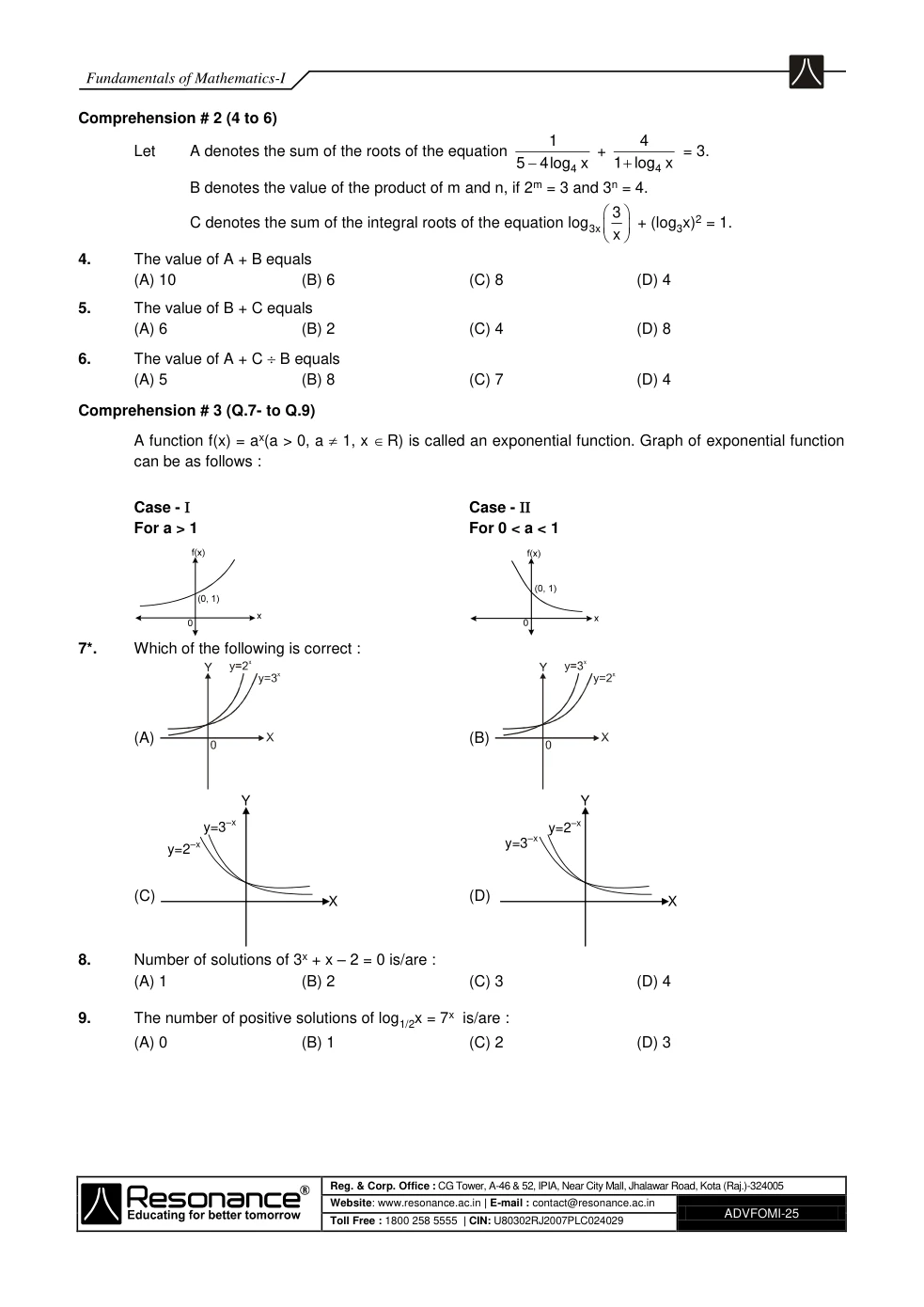
MAASFundamentals Of Mathematics I
© MAAS. All rights reserved.Page 27 / 58
Extracted text · page 27
Fundamentals of Mathematics-I
Comprehension # 2 (4 to 6)
1 4
Let A denotes the sum of the roots of the equation + = 3.
5 4log4 x 1 log 4 x
B denotes the value of the product of m and n, if 2m = 3 and 3n = 4.
3
C denotes the sum of the integral roots of the equation log3x + (log3x)2 = 1.
x
4. The value of A + B equals
(A) 10 (B) 6 (C) 8 (D) 4
5. The value of B + C equals
(A) 6 (B) 2 (C) 4 (D) 8
6. The value of A + C B equals
(A) 5 (B) 8 (C) 7 (D) 4
Comprehension # 3 (Q.7- to Q.9)
A function f(x) = ax(a > 0, a 1, x R) is called an exponential function. Graph of exponential function
can be as follows :
Case - Case -
For a > 1 For 0 < a < 1
7*. Which of the following is correct :
(A) (B)
Y Y
y=3–x y=2–x
y=3–x y=2–x
(C) X (D) X
8. Number of solutions of 3x + x – 2 = 0 is/are :
(A) 1 (B) 2 (C) 3 (D) 4
9. The number of positive solutions of log1/2x = 7x is/are :
(A) 0 (B) 1 (C) 2 (D) 3
ADVFOMI-25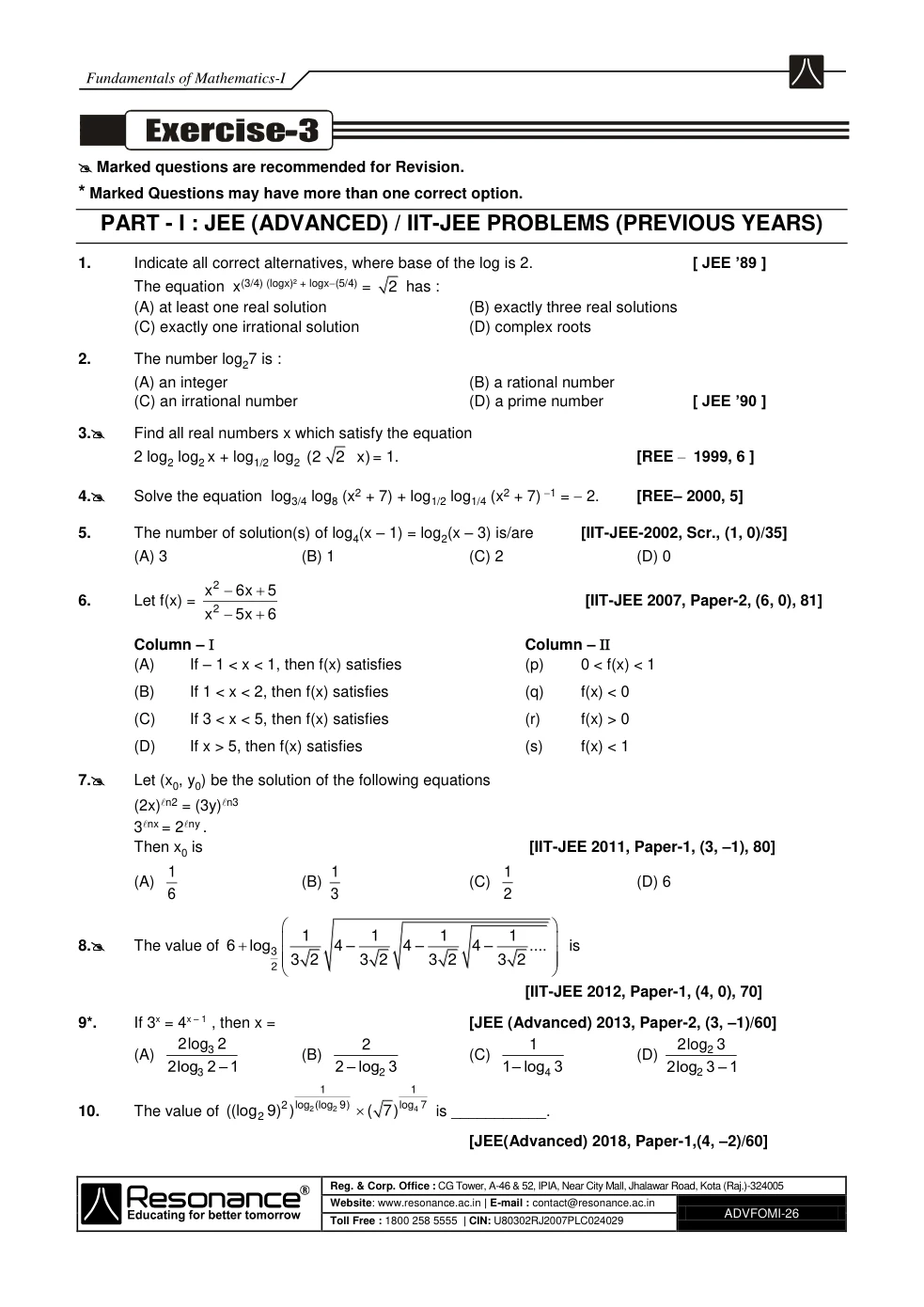
MAASFundamentals Of Mathematics I
© MAAS. All rights reserved.Page 28 / 58
Extracted text · page 28
Fundamentals of Mathematics-I
Marked questions are recommended for Revision.
* Marked Questions may have more than one correct option.
PART - I : JEE (ADVANCED) / IIT-JEE PROBLEMS (PREVIOUS YEARS)
1. Indicate all correct alternatives, where base of the log is 2. [ JEE ’89 ]
The equation x(3/4) (logx)² + logx(5/4) = 2 has :
(A) at least one real solution (B) exactly three real solutions
(C) exactly one irrational solution (D) complex roots
2. The number log27 is :
(A) an integer (B) a rational number
(C) an irrational number (D) a prime number [ JEE ’90 ]
3. Find all real numbers x which satisfy the equation
2 log2 log2 x + log1/2 log2 (2 2 x)= 1. [REE – 1999, 6 ]
4. Solve the equation log3/4 log8 (x2 + 7) + log1/2 log1/4 (x2 + 7) 1 = 2. [REE– 2000, 5]
5. The number of solution(s) of log4(x – 1) = log2(x – 3) is/are [IIT-JEE-2002, Scr., (1, 0)/35]
(A) 3 (B) 1 (C) 2 (D) 0
x 2 6x 5
6. Let f(x) = [IIT-JEE 2007, Paper-2, (6, 0), 81]
x 2 5x 6
Column – Column –
(A) If – 1 < x < 1, then f(x) satisfies (p) 0 < f(x) < 1
(B) If 1 < x < 2, then f(x) satisfies (q) f(x) < 0
(C) If 3 < x < 5, then f(x) satisfies (r) f(x) > 0
(D) If x > 5, then f(x) satisfies (s) f(x) < 1
7. Let (x0, y0) be the solution of the following equations
(2x)n2 = (3y)n3
3nx = 2ny .
Then x0 is [IIT-JEE 2011, Paper-1, (3, –1), 80]
1 1 1
(A) (B) (C) (D) 6
6 3 2
1 1 1 1 8. The value of 6 log 3 4 – 4 – 4 – .... is 2 3 2 3 2 3 2 3 2
[IIT-JEE 2012, Paper-1, (4, 0), 70]
9*. If 3x = 4x – 1 , then x = [JEE (Advanced) 2013, Paper-2, (3, –1)/60]
2log3 2 2 1 2log2 3 (A) (B) (C) (D)
2log3 2 – 1 2 – log2 3 1– log4 3 2log2 3 – 1
1 1
2 (log2 9) ( 7) log 4 7 is ___________.10. The value of ((log 2 9)2 ) log
[JEE(Advanced) 2018, Paper-1,(4, –2)/60]
ADVFOMI-26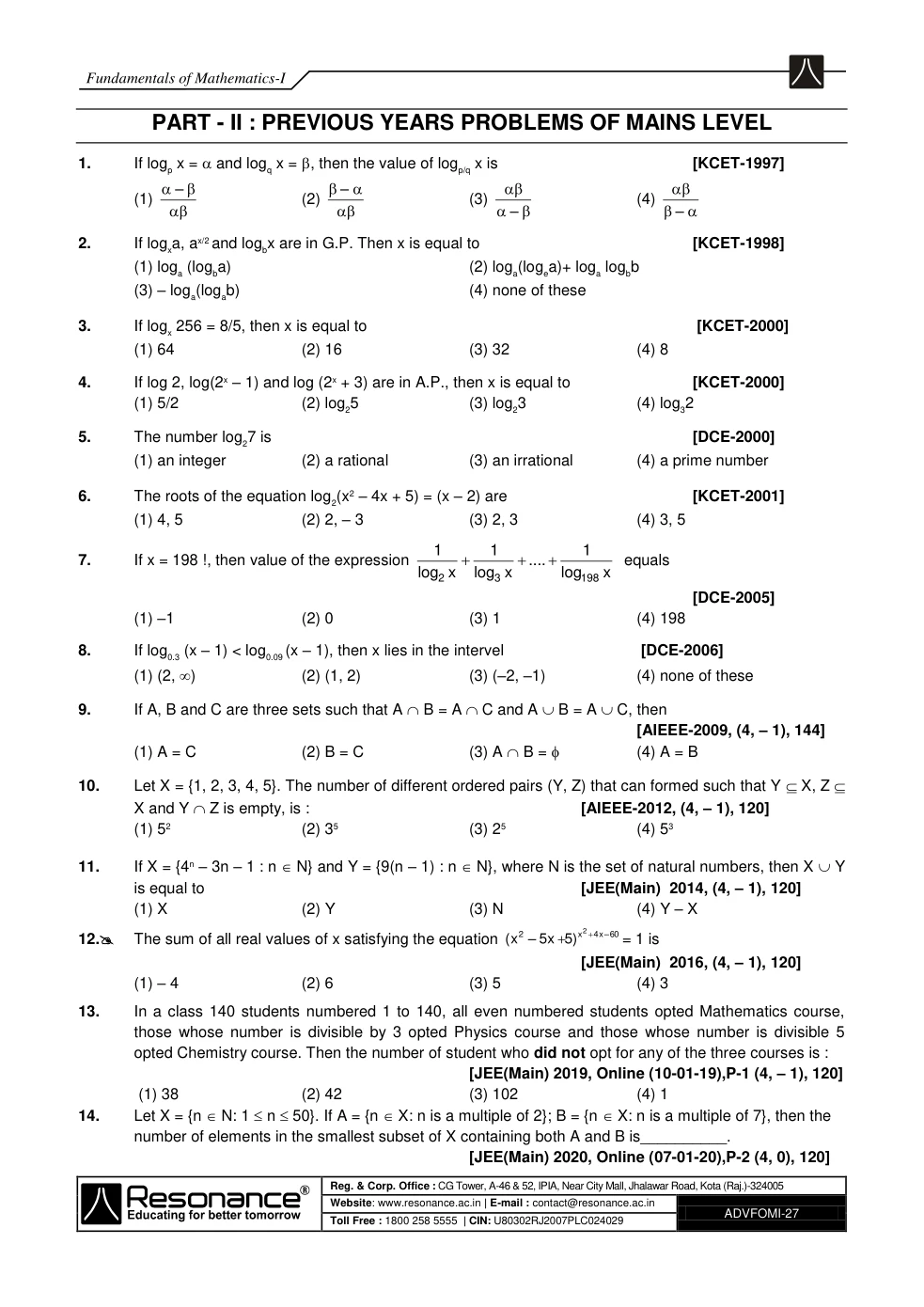
MAASFundamentals Of Mathematics I
© MAAS. All rights reserved.Page 29 / 58
Extracted text · page 29
Fundamentals of Mathematics-I
PART - II : PREVIOUS YEARS PROBLEMS OF MAINS LEVEL
1. If logp x = and logq x = , then the value of logp/q x is [KCET-1997]
– –
(1) (2) (3) (4)
– –
2. If logxa, ax/2 and logbx are in G.P. Then x is equal to [KCET-1998]
(1) loga (logba) (2) loga(logea)+ loga logbb
(3) – loga(logab) (4) none of these
3. If logx 256 = 8/5, then x is equal to [KCET-2000]
(1) 64 (2) 16 (3) 32 (4) 8
4. If log 2, log(2x – 1) and log (2x + 3) are in A.P., then x is equal to [KCET-2000]
(1) 5/2 (2) log25 (3) log23 (4) log32
5. The number log27 is [DCE-2000]
(1) an integer (2) a rational (3) an irrational (4) a prime number
6. The roots of the equation log2(x2 – 4x + 5) = (x – 2) are [KCET-2001]
(1) 4, 5 (2) 2, – 3 (3) 2, 3 (4) 3, 5
1 1 1
7. If x = 198 !, then value of the expression .... equals
log2 x log3 x log198 x
[DCE-2005]
(1) –1 (2) 0 (3) 1 (4) 198
8. If log0.3 (x – 1) < log0.09 (x – 1), then x lies in the intervel [DCE-2006]
(1) (2, ) (2) (1, 2) (3) (–2, –1) (4) none of these
9. If A, B and C are three sets such that A B = A C and A B = A C, then
[AIEEE-2009, (4, – 1), 144]
(1) A = C (2) B = C (3) A B = (4) A = B
10. Let X = {1, 2, 3, 4, 5}. The number of different ordered pairs (Y, Z) that can formed such that Y X, Z
X and Y Z is empty, is : [AIEEE-2012, (4, – 1), 120]
(1) 52 (2) 35 (3) 25 (4) 53
11. If X = {4n – 3n – 1 : n N} and Y = {9(n – 1) : n N}, where N is the set of natural numbers, then X Y
is equal to [JEE(Main) 2014, (4, – 1), 120]
(1) X (2) Y (3) N (4) Y – X
12. The sum of all real values of x satisfying the equation ( x 2 – 5 x 5) x 2 4 x – 60 = 1 is
[JEE(Main) 2016, (4, – 1), 120]
(1) – 4 (2) 6 (3) 5 (4) 3
13. In a class 140 students numbered 1 to 140, all even numbered students opted Mathematics course,
those whose number is divisible by 3 opted Physics course and those whose number is divisible 5
opted Chemistry course. Then the number of student who did not opt for any of the three courses is :
[JEE(Main) 2019, Online (10-01-19),P-1 (4, – 1), 120]
(1) 38 (2) 42 (3) 102 (4) 1
14. Let X = {n N: 1 n 50}. If A = {n X: n is a multiple of 2}; B = {n X: n is a multiple of 7}, then the
number of elements in the smallest subset of X containing both A and B is__________.
[JEE(Main) 2020, Online (07-01-20),P-2 (4, 0), 120]
ADVFOMI-27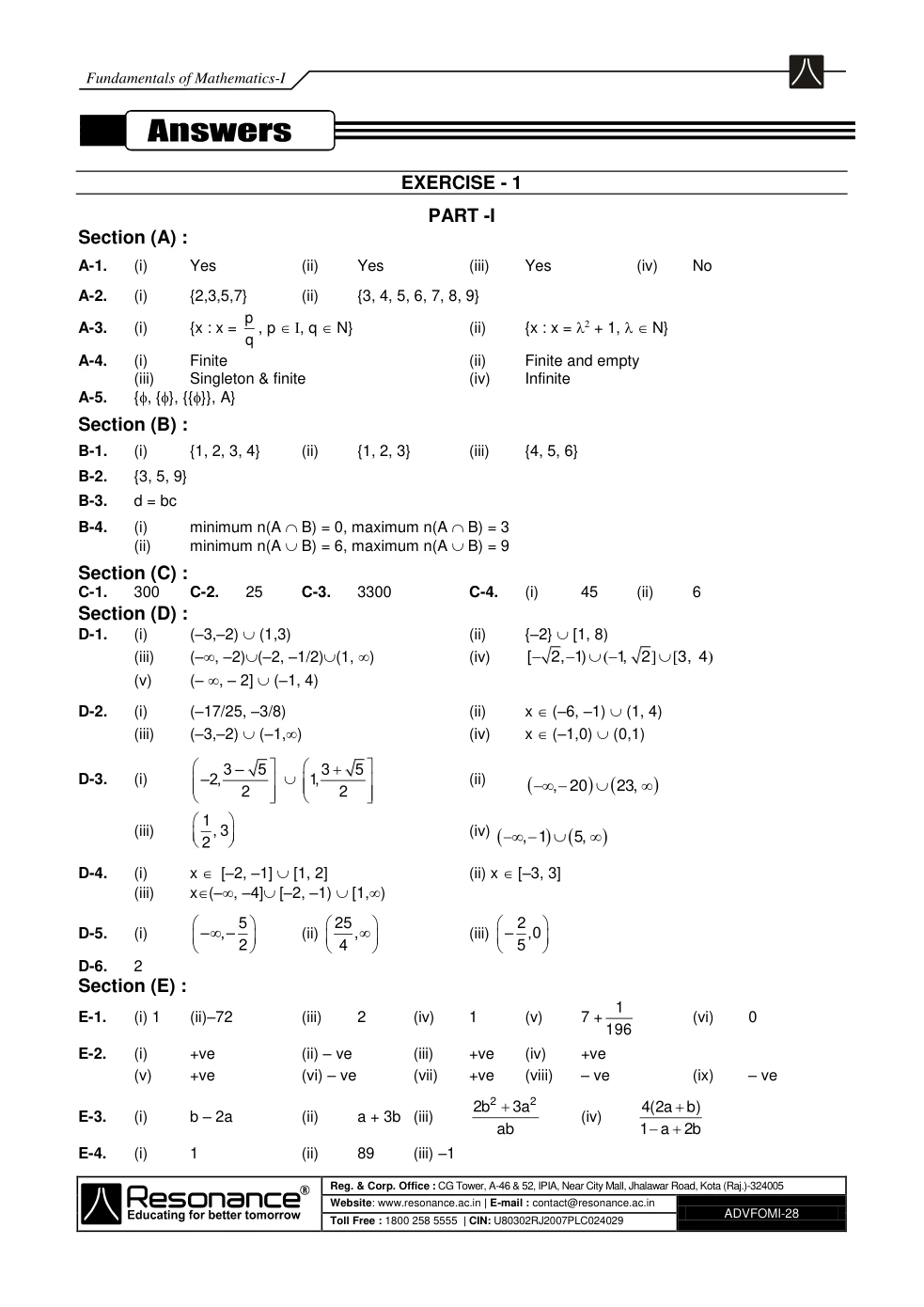
MAASFundamentals Of Mathematics I
© MAAS. All rights reserved.Page 30 / 58
Extracted text · page 30
Fundamentals of Mathematics-I
EXERCISE - 1
PART -I
Section (A) :
A-1. (i) Yes (ii) Yes (iii) Yes (iv) No
A-2. (i) {2,3,5,7} (ii) {3, 4, 5, 6, 7, 8, 9}
p
A-3. (i) {x : x = , p , q N} (ii) {x : x = + 1, N}
q
A-4. (i) Finite (ii) Finite and empty
(iii) Singleton & finite (iv) Infinite
A-5. {, {}, {{}}, A}
Section (B) :
B-1. (i) {1, 2, 3, 4} (ii) {1, 2, 3} (iii) {4, 5, 6}
B-2. {3, 5, 9}
B-3. d = bc
B-4. (i) minimum n(A B) = 0, maximum n(A B) = 3
(ii) minimum n(A B) = 6, maximum n(A B) = 9
Section (C) :
C-1. 300 C-2. 25 C-3. 3300 C-4. (i) 45 (ii) 6
Section (D) :
D-1. (i) (–3,–2) (1,3) (ii) {–2} [1, 8)
(iii) (–, –2)(–2, –1/2)(1, ) (iv) [ 2, 1) 1, 2 3, 4
(v) (– , – 2] (–1, 4)
D-2. (i) (–17/25, –3/8) (ii) x (–6, –1) (1, 4)
(iii) (–3,–2) (–1,) (iv) x (–1,0) (0,1)
3 – 5 3 5
1, –2,D-3. (i) 2 (ii) , 20 23, 2
(iii) 1, 3 , 1 5, 2 (iv)
D-4. (i) x [–2, –1] [1, 2] (ii) x [–3, 3]
(iii) x(–, –4][–2, –1) [1,)
5 2 D-5. (i) – ,– (ii) 25, (iii) – ,0
2 4 5
D-6. 2
Section (E) :
1
E-1. (i) 1 (ii)–72 (iii) 2 (iv) 1 (v) 7 + (vi) 0
196
E-2. (i) +ve (ii) – ve (iii) +ve (iv) +ve
(v) +ve (vi) – ve (vii) +ve (viii) – ve (ix) – ve
2b 2 3a 2 4(2a b)
E-3. (i) b – 2a (ii) a + 3b (iii) (iv)
ab 1 a 2b
E-4. (i) 1 (ii) 89 (iii) –1
ADVFOMI-28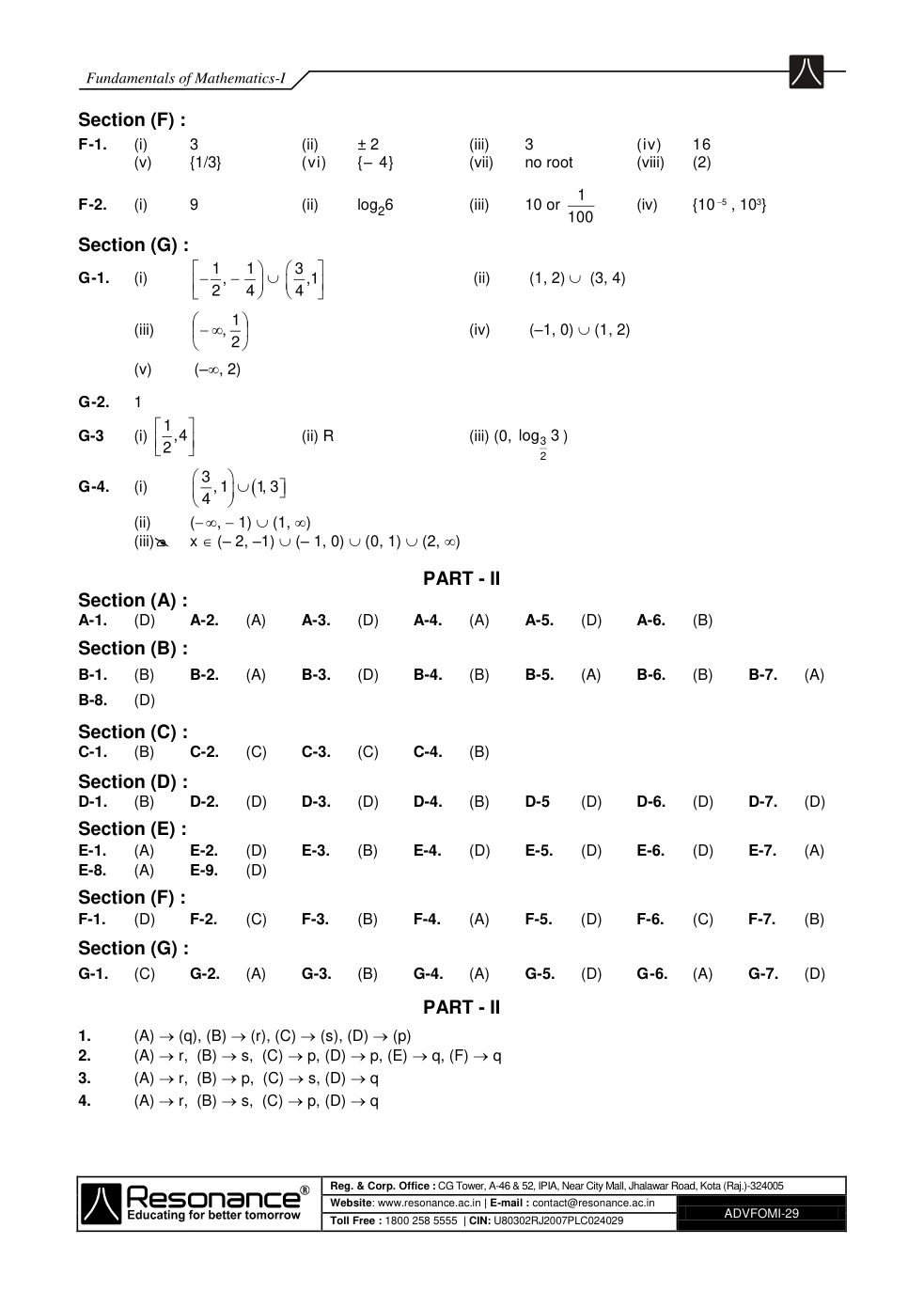
MAASFundamentals Of Mathematics I
© MAAS. All rights reserved.Page 31 / 58
Extracted text · page 31
Fundamentals of Mathematics-I
Section (F) :
F-1. (i) 3 (ii) ± 2 (iii) 3 (iv) 16
(v) {1/3} (vi) {– 4} (vii) no root (viii) (2)
1 5
F-2. (i) 9 (ii) log26 (iii) 10 or (iv) {10 , 103} 100
Section (G) :
1 1 3 G-1. (i) , ,1 (ii) (1, 2) (3, 4) 2 4 4
1
(iii) , (iv) (–1, 0) (1, 2)
2
(v) (–, 2)
G-2. 1
1,4 G-3 (i) (ii) R (iii) (0, log 3 3 )
2 2
3
G-4. (i) , 1 1, 3
4
(ii) (, 1) (1, )
(iii) x (– 2, –1) (– 1, 0) (0, 1) (2, )
PART - II
Section (A) :
A-1. (D) A-2. (A) A-3. (D) A-4. (A) A-5. (D) A-6. (B)
Section (B) :
B-1. (B) B-2. (A) B-3. (D) B-4. (B) B-5. (A) B-6. (B) B-7. (A)
B-8. (D)
Section (C) :
C-1. (B) C-2. (C) C-3. (C) C-4. (B)
Section (D) :
D-1. (B) D-2. (D) D-3. (D) D-4. (B) D-5 (D) D-6. (D) D-7. (D)
Section (E) :
E-1. (A) E-2. (D) E-3. (B) E-4. (D) E-5. (D) E-6. (D) E-7. (A)
E-8. (A) E-9. (D)
Section (F) :
F-1. (D) F-2. (C) F-3. (B) F-4. (A) F-5. (D) F-6. (C) F-7. (B)
Section (G) :
G-1. (C) G-2. (A) G-3. (B) G-4. (A) G-5. (D) G-6. (A) G-7. (D)
PART - II
1. (A) (q), (B) (r), (C) (s), (D) (p)
2. (A) r, (B) s, (C) p, (D) p, (E) q, (F) q
3. (A) r, (B) p, (C) s, (D) q
4. (A) r, (B) s, (C) p, (D) q
ADVFOMI-29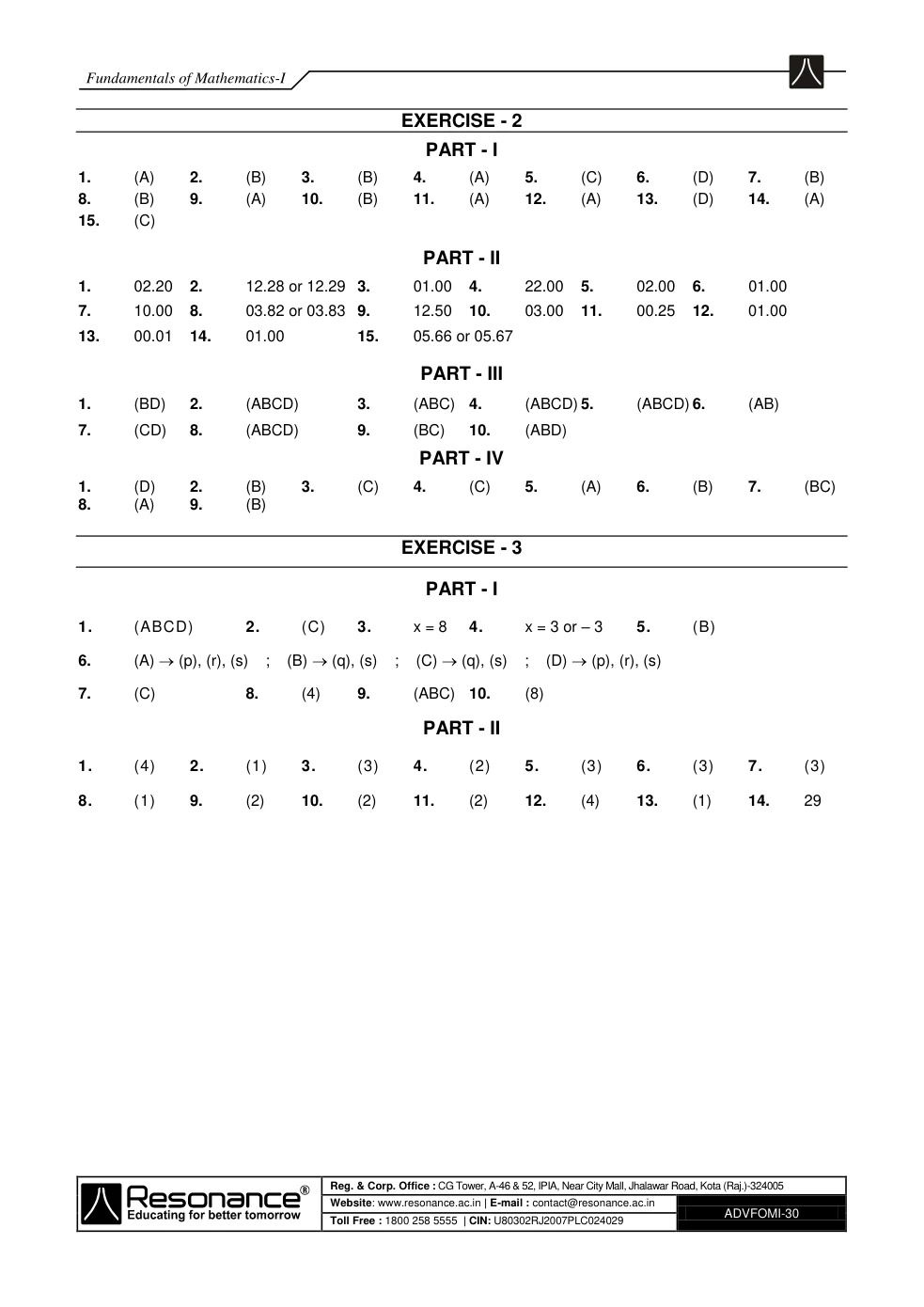
MAASFundamentals Of Mathematics I
© MAAS. All rights reserved.Page 32 / 58
Extracted text · page 32
Fundamentals of Mathematics-I
EXERCISE - 2
PART - I
1. (A) 2. (B) 3. (B) 4. (A) 5. (C) 6. (D) 7. (B)
8. (B) 9. (A) 10. (B) 11. (A) 12. (A) 13. (D) 14. (A)
15. (C)
PART - II
1. 02.20 2. 12.28 or 12.29 3. 01.00 4. 22.00 5. 02.00 6. 01.00
7. 10.00 8. 03.82 or 03.83 9. 12.50 10. 03.00 11. 00.25 12. 01.00
13. 00.01 14. 01.00 15. 05.66 or 05.67
PART - III
1. (BD) 2. (ABCD) 3. (ABC) 4. (ABCD) 5. (ABCD) 6. (AB)
7. (CD) 8. (ABCD) 9. (BC) 10. (ABD)
PART - IV
1. (D) 2. (B) 3. (C) 4. (C) 5. (A) 6. (B) 7. (BC)
8. (A) 9. (B)
EXERCISE - 3
PART - I
1. (ABCD) 2. (C) 3. x = 8 4. x = 3 or – 3 5. (B)
6. (A) (p), (r), (s) ; (B) (q), (s) ; (C) (q), (s) ; (D) (p), (r), (s)
7. (C) 8. (4) 9. (ABC) 10. (8)
PART - II
1. (4) 2. (1) 3. (3) 4. (2) 5. (3) 6. (3) 7. (3)
8. (1) 9. (2) 10. (2) 11. (2) 12. (4) 13. (1) 14. 29
ADVFOMI-30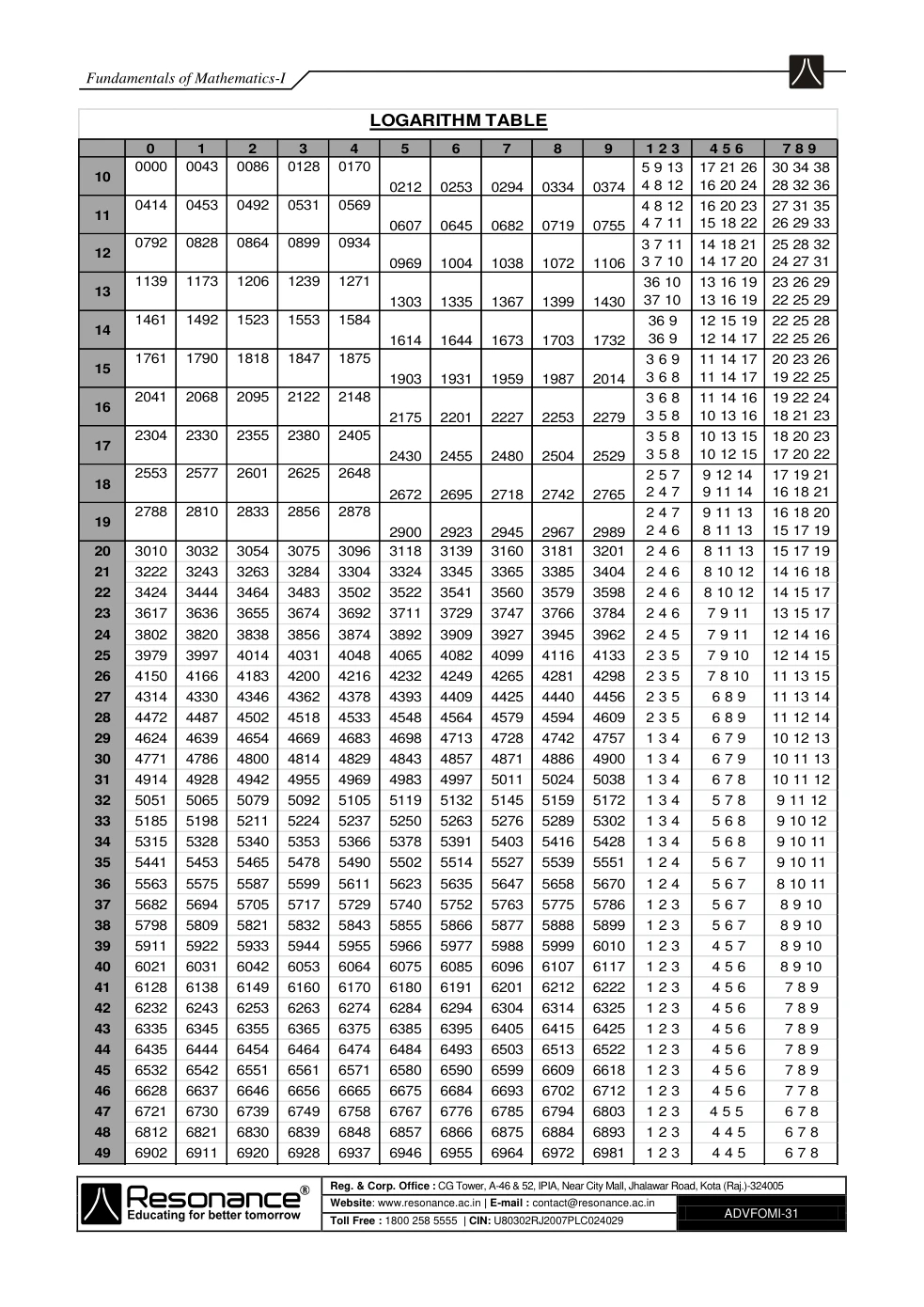
MAASFundamentals Of Mathematics I
© MAAS. All rights reserved.Page 33 / 58
Extracted text · page 33
Fundamentals of Mathematics-I

                       LOGARITHM TABLE

       0     1     2     3     4     5     6     7     8     9    1 2 3    4 5 6     7 8 9
      0000  0043  0086  0128  0170                                5 9 13  17 21 26  30 34 38
 10
                                     0212  0253  0294  0334  0374  4 8 12  16 20 24  28 32 36
      0414  0453  0492  0531  0569                                4 8 12  16 20 23  27 31 35
 11
                                     0607  0645  0682  0719  0755  4 7 11  15 18 22  26 29 33
      0792  0828  0864  0899  0934                                3 7 11  14 18 21  25 28 32
 12
                                     0969  1004  1038  1072  1106  3 7 10  14 17 20  24 27 31
      1139  1173  1206  1239  1271                                 36 10  13 16 19  23 26 29
 13
                                     1303  1335  1367  1399  1430  37 10  13 16 19  22 25 29
      1461  1492  1523  1553  1584                                  36 9   12 15 19  22 25 28
 14
                                     1614  1644  1673  1703  1732   36 9   12 14 17  22 25 26
      1761  1790  1818  1847  1875                                 3 6 9  11 14 17  20 23 26
 15
                                     1903  1931  1959  1987  2014  3 6 8  11 14 17  19 22 25
      2041  2068  2095  2122  2148                                 3 6 8  11 14 16  19 22 24
 16
                                     2175  2201  2227  2253  2279  3 5 8  10 13 16  18 21 23
      2304  2330  2355  2380  2405                                 3 5 8  10 13 15  18 20 23
 17
                                     2430  2455  2480  2504  2529  3 5 8  10 12 15  17 20 22
      2553  2577  2601  2625  2648                                 2 5 7   9 12 14  17 19 21
 18
                                     2672  2695  2718  2742  2765  2 4 7   9 11 14  16 18 21
      2788  2810  2833  2856  2878                                 2 4 7   9 11 13  16 18 20
 19
                                     2900  2923  2945  2967  2989  2 4 6   8 11 13  15 17 19
 20   3010  3032  3054  3075  3096  3118  3139  3160  3181  3201  2 4 6   8 11 13  15 17 19
 21   3222  3243  3263  3284  3304  3324  3345  3365  3385  3404  2 4 6   8 10 12  14 16 18
 22   3424  3444  3464  3483  3502  3522  3541  3560  3579  3598  2 4 6   8 10 12  14 15 17
 23   3617  3636  3655  3674  3692  3711  3729  3747  3766  3784  2 4 6   7 9 11   13 15 17
 24   3802  3820  3838  3856  3874  3892  3909  3927  3945  3962  2 4 5   7 9 11   12 14 16
 25   3979  3997  4014  4031  4048  4065  4082  4099  4116  4133  2 3 5   7 9 10   12 14 15
 26   4150  4166  4183  4200  4216  4232  4249  4265  4281  4298  2 3 5   7 8 10   11 13 15
 27   4314  4330  4346  4362  4378  4393  4409  4425  4440  4456  2 3 5    6 8 9   11 13 14
 28   4472  4487  4502  4518  4533  4548  4564  4579  4594  4609  2 3 5    6 8 9   11 12 14
 29   4624  4639  4654  4669  4683  4698  4713  4728  4742  4757  1 3 4    6 7 9   10 12 13
 30   4771  4786  4800  4814  4829  4843  4857  4871  4886  4900  1 3 4    6 7 9   10 11 13
 31   4914  4928  4942  4955  4969  4983  4997  5011  5024  5038  1 3 4    6 7 8   10 11 12
 32   5051  5065  5079  5092  5105  5119  5132  5145  5159  5172  1 3 4    5 7 8    9 11 12
 33   5185  5198  5211  5224  5237  5250  5263  5276  5289  5302  1 3 4    5 6 8    9 10 12
 34   5315  5328  5340  5353  5366  5378  5391  5403  5416  5428  1 3 4    5 6 8    9 10 11
 35   5441  5453  5465  5478  5490  5502  5514  5527  5539  5551  1 2 4    5 6 7    9 10 11
 36   5563  5575  5587  5599  5611  5623  5635  5647  5658  5670  1 2 4    5 6 7    8 10 11
 37   5682  5694  5705  5717  5729  5740  5752  5763  5775  5786  1 2 3    5 6 7    8 9 10
 38   5798  5809  5821  5832  5843  5855  5866  5877  5888  5899  1 2 3    5 6 7    8 9 10
 39   5911  5922  5933  5944  5955  5966  5977  5988  5999  6010  1 2 3    4 5 7    8 9 10
 40   6021  6031  6042  6053  6064  6075  6085  6096  6107  6117  1 2 3    4 5 6    8 9 10
 41   6128  6138  6149  6160  6170  6180  6191  6201  6212  6222  1 2 3    4 5 6     7 8 9
 42   6232  6243  6253  6263  6274  6284  6294  6304  6314  6325  1 2 3    4 5 6     7 8 9
 43   6335  6345  6355  6365  6375  6385  6395  6405  6415  6425  1 2 3    4 5 6     7 8 9
 44   6435  6444  6454  6464  6474  6484  6493  6503  6513  6522  1 2 3    4 5 6     7 8 9
 45   6532  6542  6551  6561  6571  6580  6590  6599  6609  6618  1 2 3    4 5 6     7 8 9
 46   6628  6637  6646  6656  6665  6675  6684  6693  6702  6712  1 2 3    4 5 6     7 7 8
 47   6721  6730  6739  6749  6758  6767  6776  6785  6794  6803  1 2 3    4 5 5     6 7 8
 48   6812  6821  6830  6839  6848  6857  6866  6875  6884  6893  1 2 3    4 4 5     6 7 8
 49   6902  6911  6920  6928  6937  6946  6955  6964  6972  6981  1 2 3    4 4 5     6 7 8


                                                                                     ADVFOMI-31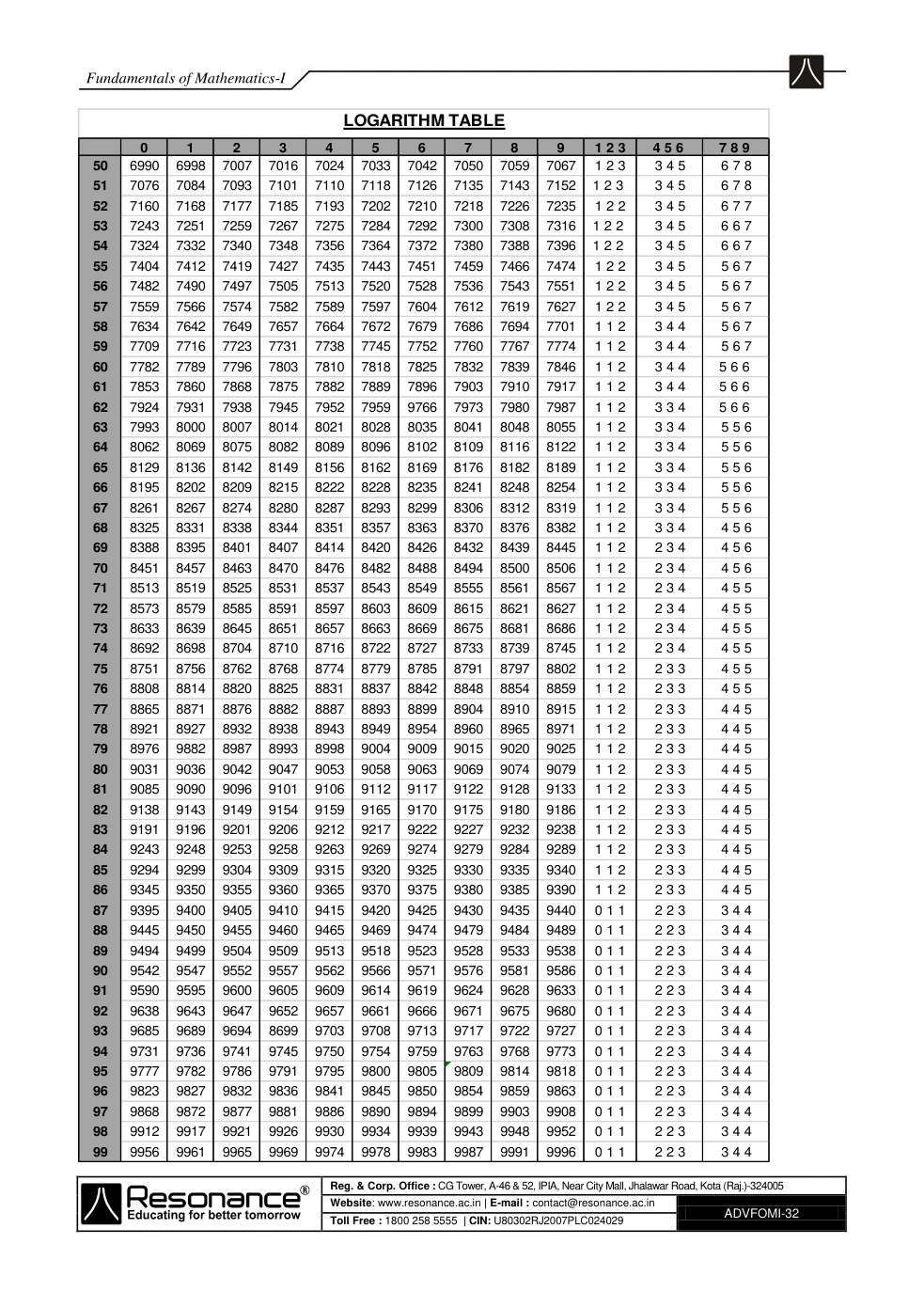
MAASFundamentals Of Mathematics I
© MAAS. All rights reserved.Page 34 / 58
Extracted text · page 34
Fundamentals of Mathematics-I


                       LOGARITHM TABLE

       0     1     2     3     4     5     6     7     8     9    1 2 3    4 5 6     7 8 9
 50   6990  6998  7007  7016  7024  7033  7042  7050  7059  7067  1 2 3    3 4 5     6 7 8
 51   7076  7084  7093  7101  7110  7118  7126  7135  7143  7152  1 2 3    3 4 5     6 7 8
 52   7160  7168  7177  7185  7193  7202  7210  7218  7226  7235  1 2 2    3 4 5     6 7 7
 53   7243  7251  7259  7267  7275  7284  7292  7300  7308  7316  1 2 2    3 4 5     6 6 7
 54   7324  7332  7340  7348  7356  7364  7372  7380  7388  7396  1 2 2    3 4 5     6 6 7
 55   7404  7412  7419  7427  7435  7443  7451  7459  7466  7474  1 2 2    3 4 5     5 6 7
 56   7482  7490  7497  7505  7513  7520  7528  7536  7543  7551  1 2 2    3 4 5     5 6 7
 57   7559  7566  7574  7582  7589  7597  7604  7612  7619  7627  1 2 2    3 4 5     5 6 7
 58   7634  7642  7649  7657  7664  7672  7679  7686  7694  7701  1 1 2    3 4 4     5 6 7
 59   7709  7716  7723  7731  7738  7745  7752  7760  7767  7774  1 1 2    3 4 4     5 6 7
 60   7782  7789  7796  7803  7810  7818  7825  7832  7839  7846  1 1 2    3 4 4    5 6 6
 61   7853  7860  7868  7875  7882  7889  7896  7903  7910  7917  1 1 2    3 4 4    5 6 6
 62   7924  7931  7938  7945  7952  7959  9766  7973  7980  7987  1 1 2    3 3 4    5 6 6
 63   7993  8000  8007  8014  8021  8028  8035  8041  8048  8055  1 1 2    3 3 4     5 5 6
 64   8062  8069  8075  8082  8089  8096  8102  8109  8116  8122  1 1 2    3 3 4     5 5 6
 65   8129  8136  8142  8149  8156  8162  8169  8176  8182  8189  1 1 2    3 3 4     5 5 6
 66   8195  8202  8209  8215  8222  8228  8235  8241  8248  8254  1 1 2    3 3 4     5 5 6
 67   8261  8267  8274  8280  8287  8293  8299  8306  8312  8319  1 1 2    3 3 4     5 5 6
 68   8325  8331  8338  8344  8351  8357  8363  8370  8376  8382  1 1 2    3 3 4     4 5 6
 69   8388  8395  8401  8407  8414  8420  8426  8432  8439  8445  1 1 2    2 3 4     4 5 6
 70   8451  8457  8463  8470  8476  8482  8488  8494  8500  8506  1 1 2    2 3 4     4 5 6
 71   8513  8519  8525  8531  8537  8543  8549  8555  8561  8567  1 1 2    2 3 4     4 5 5
 72   8573  8579  8585  8591  8597  8603  8609  8615  8621  8627  1 1 2    2 3 4     4 5 5
 73   8633  8639  8645  8651  8657  8663  8669  8675  8681  8686  1 1 2    2 3 4     4 5 5
 74   8692  8698  8704  8710  8716  8722  8727  8733  8739  8745  1 1 2    2 3 4     4 5 5
 75   8751  8756  8762  8768  8774  8779  8785  8791  8797  8802  1 1 2    2 3 3     4 5 5
 76   8808  8814  8820  8825  8831  8837  8842  8848  8854  8859  1 1 2    2 3 3     4 5 5
 77   8865  8871  8876  8882  8887  8893  8899  8904  8910  8915  1 1 2    2 3 3     4 4 5
 78   8921  8927  8932  8938  8943  8949  8954  8960  8965  8971  1 1 2    2 3 3     4 4 5
 79   8976  9882  8987  8993  8998  9004  9009  9015  9020  9025  1 1 2    2 3 3     4 4 5
 80   9031  9036  9042  9047  9053  9058  9063  9069  9074  9079  1 1 2    2 3 3     4 4 5
 81   9085  9090  9096  9101  9106  9112  9117  9122  9128  9133  1 1 2    2 3 3     4 4 5
 82   9138  9143  9149  9154  9159  9165  9170  9175  9180  9186  1 1 2    2 3 3     4 4 5
 83   9191  9196  9201  9206  9212  9217  9222  9227  9232  9238  1 1 2    2 3 3     4 4 5
 84   9243  9248  9253  9258  9263  9269  9274  9279  9284  9289  1 1 2    2 3 3     4 4 5
 85   9294  9299  9304  9309  9315  9320  9325  9330  9335  9340  1 1 2    2 3 3     4 4 5
 86   9345  9350  9355  9360  9365  9370  9375  9380  9385  9390  1 1 2    2 3 3     4 4 5
 87   9395  9400  9405  9410  9415  9420  9425  9430  9435  9440  0 1 1    2 2 3     3 4 4
 88   9445  9450  9455  9460  9465  9469  9474  9479  9484  9489  0 1 1    2 2 3     3 4 4
 89   9494  9499  9504  9509  9513  9518  9523  9528  9533  9538  0 1 1    2 2 3     3 4 4
 90   9542  9547  9552  9557  9562  9566  9571  9576  9581  9586  0 1 1    2 2 3     3 4 4
 91   9590  9595  9600  9605  9609  9614  9619  9624  9628  9633  0 1 1    2 2 3     3 4 4
 92   9638  9643  9647  9652  9657  9661  9666  9671  9675  9680  0 1 1    2 2 3     3 4 4
 93   9685  9689  9694  8699  9703  9708  9713  9717  9722  9727  0 1 1    2 2 3     3 4 4
 94   9731  9736  9741  9745  9750  9754  9759  9763  9768  9773  0 1 1    2 2 3     3 4 4
 95   9777  9782  9786  9791  9795  9800  9805  9809  9814  9818  0 1 1    2 2 3     3 4 4
 96   9823  9827  9832  9836  9841  9845  9850  9854  9859  9863  0 1 1    2 2 3     3 4 4
 97   9868  9872  9877  9881  9886  9890  9894  9899  9903  9908  0 1 1    2 2 3     3 4 4
 98   9912  9917  9921  9926  9930  9934  9939  9943  9948  9952  0 1 1    2 2 3     3 4 4
 99   9956  9961  9965  9969  9974  9978  9983  9987  9991  9996  0 1 1    2 2 3     3 4 4


                                                                                     ADVFOMI-32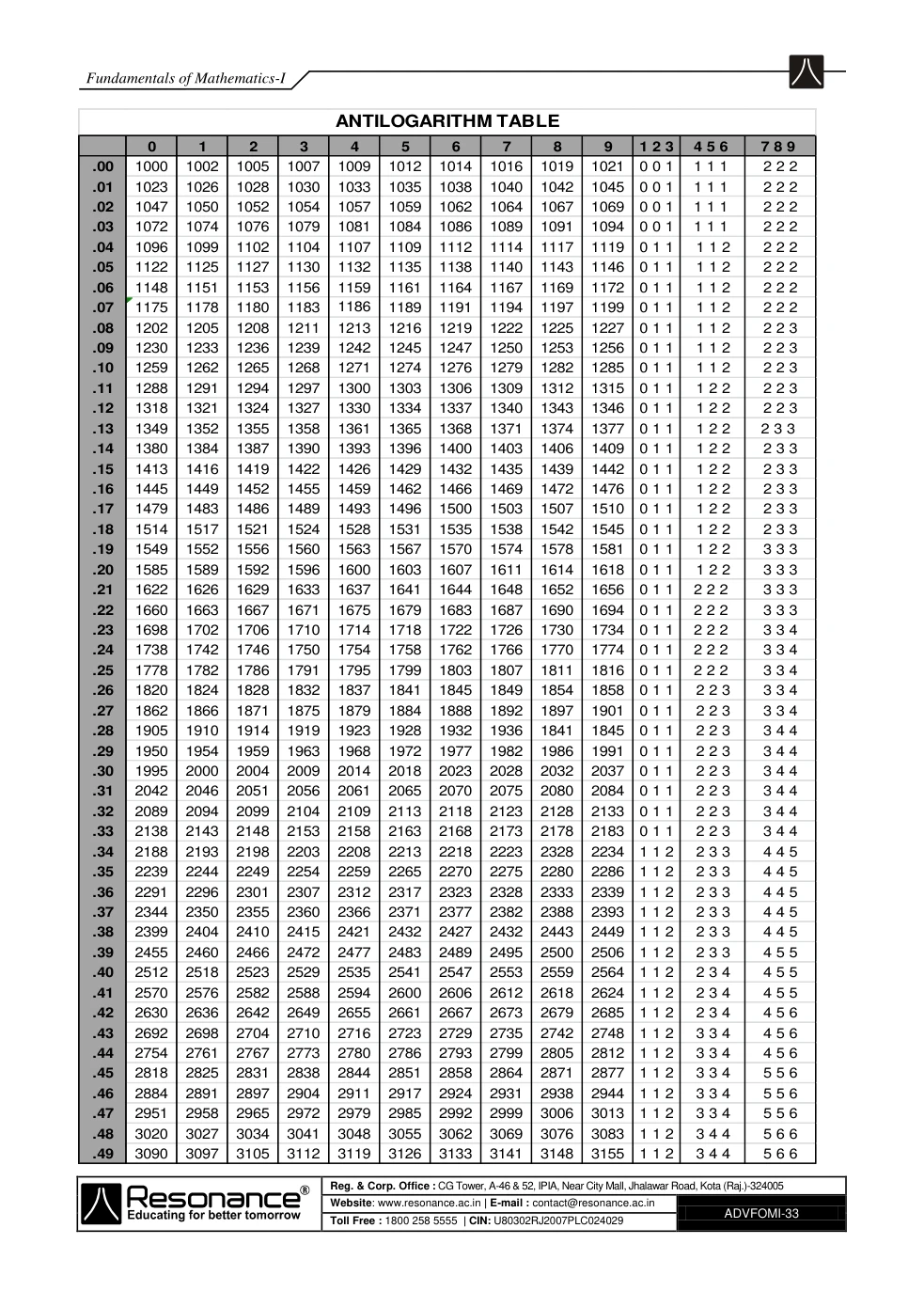
MAASFundamentals Of Mathematics I
© MAAS. All rights reserved.Page 35 / 58
Extracted text · page 35
Fundamentals of Mathematics-I

                     ANTILOGARITHM TABLE

       0     1     2     3     4     5     6     7     8     9   1 2 3  4 5 6    7 8 9
 .00   1000  1002  1005  1007  1009  1012  1014  1016  1019  1021  0 0 1  1 1 1    2 2 2
 .01   1023  1026  1028  1030  1033  1035  1038  1040  1042  1045  0 0 1  1 1 1    2 2 2
 .02   1047  1050  1052  1054  1057  1059  1062  1064  1067  1069  0 0 1  1 1 1    2 2 2
 .03   1072  1074  1076  1079  1081  1084  1086  1089  1091  1094  0 0 1  1 1 1    2 2 2
 .04   1096  1099  1102  1104  1107  1109  1112  1114  1117  1119  0 1 1   1 1 2    2 2 2
 .05   1122  1125  1127  1130  1132  1135  1138  1140  1143  1146  0 1 1   1 1 2    2 2 2
 .06   1148  1151  1153  1156  1159  1161  1164  1167  1169  1172  0 1 1   1 1 2    2 2 2
 .07   1175  1178  1180  1183  1186  1189  1191  1194  1197  1199  0 1 1   1 1 2    2 2 2
 .08   1202  1205  1208  1211  1213  1216  1219  1222  1225  1227  0 1 1   1 1 2    2 2 3
 .09   1230  1233  1236  1239  1242  1245  1247  1250  1253  1256  0 1 1   1 1 2    2 2 3
 .10   1259  1262  1265  1268  1271  1274  1276  1279  1282  1285  0 1 1   1 1 2    2 2 3
 .11   1288  1291  1294  1297  1300  1303  1306  1309  1312  1315  0 1 1   1 2 2    2 2 3
 .12   1318  1321  1324  1327  1330  1334  1337  1340  1343  1346  0 1 1   1 2 2    2 2 3
 .13   1349  1352  1355  1358  1361  1365  1368  1371  1374  1377  0 1 1   1 2 2    2 3 3
 .14   1380  1384  1387  1390  1393  1396  1400  1403  1406  1409  0 1 1   1 2 2    2 3 3
 .15   1413  1416  1419  1422  1426  1429  1432  1435  1439  1442  0 1 1   1 2 2    2 3 3
 .16   1445  1449  1452  1455  1459  1462  1466  1469  1472  1476  0 1 1   1 2 2    2 3 3
 .17   1479  1483  1486  1489  1493  1496  1500  1503  1507  1510  0 1 1   1 2 2    2 3 3
 .18   1514  1517  1521  1524  1528  1531  1535  1538  1542  1545  0 1 1   1 2 2    2 3 3
 .19   1549  1552  1556  1560  1563  1567  1570  1574  1578  1581  0 1 1   1 2 2    3 3 3
 .20   1585  1589  1592  1596  1600  1603  1607  1611  1614  1618  0 1 1   1 2 2    3 3 3
 .21   1622  1626  1629  1633  1637  1641  1644  1648  1652  1656  0 1 1  2 2 2    3 3 3
 .22   1660  1663  1667  1671  1675  1679  1683  1687  1690  1694  0 1 1  2 2 2    3 3 3
 .23   1698  1702  1706  1710  1714  1718  1722  1726  1730  1734  0 1 1  2 2 2    3 3 4
 .24   1738  1742  1746  1750  1754  1758  1762  1766  1770  1774  0 1 1  2 2 2    3 3 4
 .25   1778  1782  1786  1791  1795  1799  1803  1807  1811  1816  0 1 1  2 2 2    3 3 4
 .26   1820  1824  1828  1832  1837  1841  1845  1849  1854  1858  0 1 1   2 2 3    3 3 4
 .27   1862  1866  1871  1875  1879  1884  1888  1892  1897  1901  0 1 1   2 2 3    3 3 4
 .28   1905  1910  1914  1919  1923  1928  1932  1936  1841  1845  0 1 1   2 2 3    3 4 4
 .29   1950  1954  1959  1963  1968  1972  1977  1982  1986  1991  0 1 1   2 2 3    3 4 4
 .30   1995  2000  2004  2009  2014  2018  2023  2028  2032  2037  0 1 1   2 2 3    3 4 4
 .31   2042  2046  2051  2056  2061  2065  2070  2075  2080  2084  0 1 1   2 2 3    3 4 4
 .32   2089  2094  2099  2104  2109  2113  2118  2123  2128  2133  0 1 1   2 2 3    3 4 4
 .33   2138  2143  2148  2153  2158  2163  2168  2173  2178  2183  0 1 1   2 2 3    3 4 4
 .34   2188  2193  2198  2203  2208  2213  2218  2223  2328  2234  1 1 2   2 3 3    4 4 5
 .35   2239  2244  2249  2254  2259  2265  2270  2275  2280  2286  1 1 2   2 3 3    4 4 5
 .36   2291  2296  2301  2307  2312  2317  2323  2328  2333  2339  1 1 2   2 3 3    4 4 5
 .37   2344  2350  2355  2360  2366  2371  2377  2382  2388  2393  1 1 2   2 3 3    4 4 5
 .38   2399  2404  2410  2415  2421  2432  2427  2432  2443  2449  1 1 2   2 3 3    4 4 5
 .39   2455  2460  2466  2472  2477  2483  2489  2495  2500  2506  1 1 2   2 3 3    4 5 5
 .40   2512  2518  2523  2529  2535  2541  2547  2553  2559  2564  1 1 2   2 3 4    4 5 5
 .41   2570  2576  2582  2588  2594  2600  2606  2612  2618  2624  1 1 2   2 3 4    4 5 5
 .42   2630  2636  2642  2649  2655  2661  2667  2673  2679  2685  1 1 2   2 3 4    4 5 6
 .43   2692  2698  2704  2710  2716  2723  2729  2735  2742  2748  1 1 2   3 3 4    4 5 6
 .44   2754  2761  2767  2773  2780  2786  2793  2799  2805  2812  1 1 2   3 3 4    4 5 6
 .45   2818  2825  2831  2838  2844  2851  2858  2864  2871  2877  1 1 2   3 3 4    5 5 6
 .46   2884  2891  2897  2904  2911  2917  2924  2931  2938  2944  1 1 2   3 3 4    5 5 6
 .47   2951  2958  2965  2972  2979  2985  2992  2999  3006  3013  1 1 2   3 3 4    5 5 6
 .48   3020  3027  3034  3041  3048  3055  3062  3069  3076  3083  1 1 2   3 4 4    5 6 6
 .49   3090  3097  3105  3112  3119  3126  3133  3141  3148  3155  1 1 2   3 4 4    5 6 6


                                                                                     ADVFOMI-33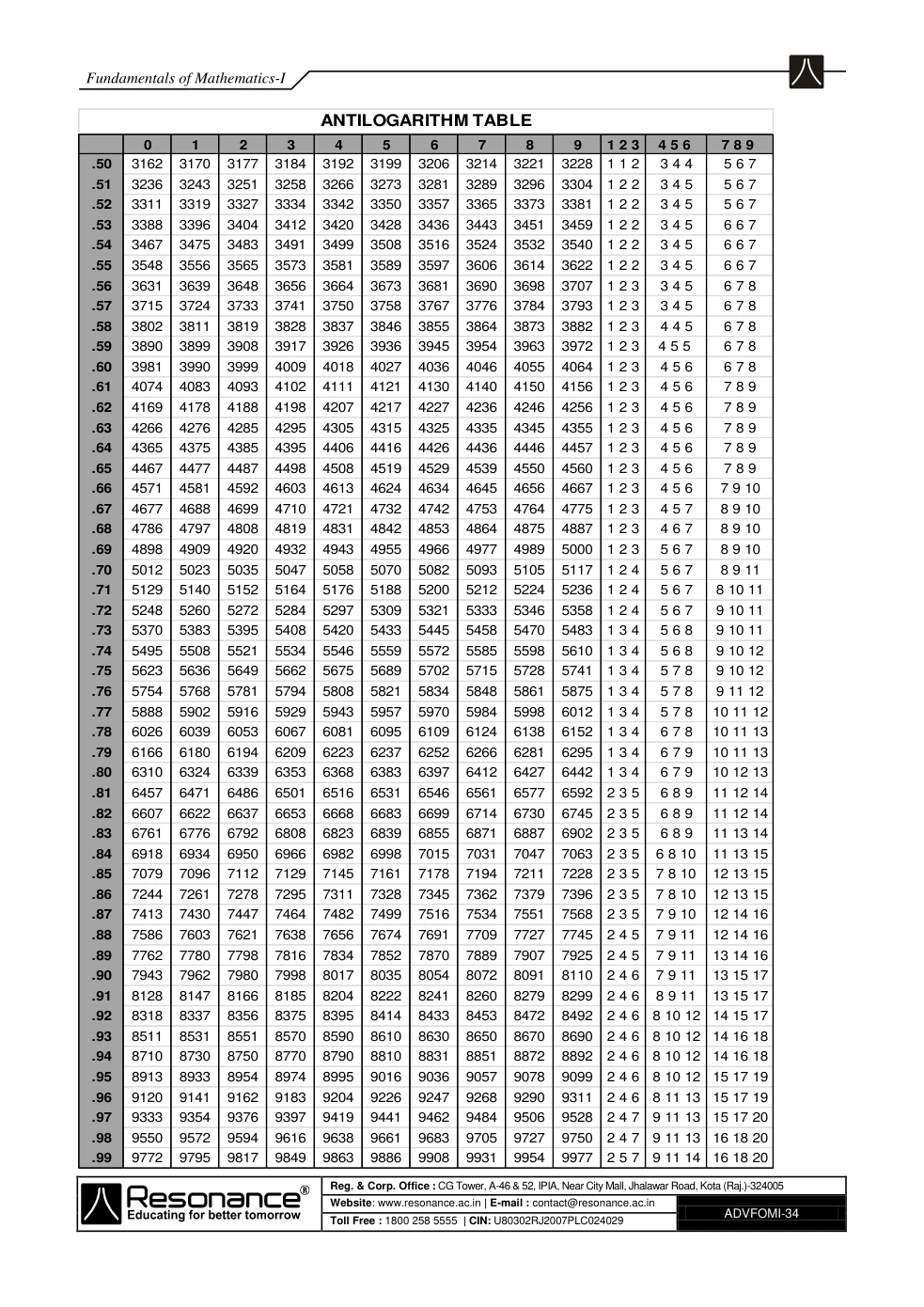
MAASFundamentals Of Mathematics I
© MAAS. All rights reserved.Page 36 / 58
Extracted text · page 36
Fundamentals of Mathematics-I


                     ANTILOGARITHM TABLE

       0     1     2     3     4     5     6     7     8     9   1 2 3  4 5 6    7 8 9
 .50   3162  3170  3177  3184  3192  3199  3206  3214  3221  3228  1 1 2   3 4 4    5 6 7
 .51   3236  3243  3251  3258  3266  3273  3281  3289  3296  3304  1 2 2   3 4 5    5 6 7
 .52   3311  3319  3327  3334  3342  3350  3357  3365  3373  3381  1 2 2   3 4 5    5 6 7
 .53   3388  3396  3404  3412  3420  3428  3436  3443  3451  3459  1 2 2   3 4 5    6 6 7
 .54   3467  3475  3483  3491  3499  3508  3516  3524  3532  3540  1 2 2   3 4 5    6 6 7
 .55   3548  3556  3565  3573  3581  3589  3597  3606  3614  3622  1 2 2   3 4 5    6 6 7
 .56   3631  3639  3648  3656  3664  3673  3681  3690  3698  3707  1 2 3   3 4 5    6 7 8
 .57   3715  3724  3733  3741  3750  3758  3767  3776  3784  3793  1 2 3   3 4 5    6 7 8
 .58   3802  3811  3819  3828  3837  3846  3855  3864  3873  3882  1 2 3   4 4 5    6 7 8
 .59   3890  3899  3908  3917  3926  3936  3945  3954  3963  3972  1 2 3  4 5 5    6 7 8
 .60   3981  3990  3999  4009  4018  4027  4036  4046  4055  4064  1 2 3   4 5 6    6 7 8
 .61   4074  4083  4093  4102  4111  4121  4130  4140  4150  4156  1 2 3   4 5 6    7 8 9
 .62   4169  4178  4188  4198  4207  4217  4227  4236  4246  4256  1 2 3   4 5 6    7 8 9
 .63   4266  4276  4285  4295  4305  4315  4325  4335  4345  4355  1 2 3   4 5 6    7 8 9
 .64   4365  4375  4385  4395  4406  4416  4426  4436  4446  4457  1 2 3   4 5 6    7 8 9
 .65   4467  4477  4487  4498  4508  4519  4529  4539  4550  4560  1 2 3   4 5 6    7 8 9
 .66   4571  4581  4592  4603  4613  4624  4634  4645  4656  4667  1 2 3   4 5 6   7 9 10
 .67   4677  4688  4699  4710  4721  4732  4742  4753  4764  4775  1 2 3   4 5 7   8 9 10
 .68   4786  4797  4808  4819  4831  4842  4853  4864  4875  4887  1 2 3   4 6 7   8 9 10
 .69   4898  4909  4920  4932  4943  4955  4966  4977  4989  5000  1 2 3   5 6 7   8 9 10
 .70   5012  5023  5035  5047  5058  5070  5082  5093  5105  5117  1 2 4   5 6 7   8 9 11
 .71   5129  5140  5152  5164  5176  5188  5200  5212  5224  5236  1 2 4   5 6 7   8 10 11
 .72   5248  5260  5272  5284  5297  5309  5321  5333  5346  5358  1 2 4   5 6 7   9 10 11
 .73   5370  5383  5395  5408  5420  5433  5445  5458  5470  5483  1 3 4   5 6 8   9 10 11
 .74   5495  5508  5521  5534  5546  5559  5572  5585  5598  5610  1 3 4   5 6 8   9 10 12
 .75   5623  5636  5649  5662  5675  5689  5702  5715  5728  5741  1 3 4   5 7 8   9 10 12
 .76   5754  5768  5781  5794  5808  5821  5834  5848  5861  5875  1 3 4   5 7 8   9 11 12
 .77   5888  5902  5916  5929  5943  5957  5970  5984  5998  6012  1 3 4   5 7 8  10 11 12
 .78   6026  6039  6053  6067  6081  6095  6109  6124  6138  6152  1 3 4   6 7 8  10 11 13
 .79   6166  6180  6194  6209  6223  6237  6252  6266  6281  6295  1 3 4   6 7 9  10 11 13
 .80   6310  6324  6339  6353  6368  6383  6397  6412  6427  6442  1 3 4   6 7 9  10 12 13
 .81   6457  6471  6486  6501  6516  6531  6546  6561  6577  6592  2 3 5   6 8 9  11 12 14
 .82   6607  6622  6637  6653  6668  6683  6699  6714  6730  6745  2 3 5   6 8 9  11 12 14
 .83   6761  6776  6792  6808  6823  6839  6855  6871  6887  6902  2 3 5   6 8 9  11 13 14
 .84   6918  6934  6950  6966  6982  6998  7015  7031  7047  7063  2 3 5  6 8 10  11 13 15
 .85   7079  7096  7112  7129  7145  7161  7178  7194  7211  7228  2 3 5  7 8 10  12 13 15
 .86   7244  7261  7278  7295  7311  7328  7345  7362  7379  7396  2 3 5  7 8 10  12 13 15
 .87   7413  7430  7447  7464  7482  7499  7516  7534  7551  7568  2 3 5  7 9 10  12 14 16
 .88   7586  7603  7621  7638  7656  7674  7691  7709  7727  7745  2 4 5  7 9 11  12 14 16
 .89   7762  7780  7798  7816  7834  7852  7870  7889  7907  7925  2 4 5  7 9 11  13 14 16
 .90   7943  7962  7980  7998  8017  8035  8054  8072  8091  8110  2 4 6  7 9 11  13 15 17
 .91   8128  8147  8166  8185  8204  8222  8241  8260  8279  8299  2 4 6  8 9 11  13 15 17
 .92   8318  8337  8356  8375  8395  8414  8433  8453  8472  8492  2 4 6  8 10 12  14 15 17
 .93   8511  8531  8551  8570  8590  8610  8630  8650  8670  8690  2 4 6  8 10 12  14 16 18
 .94   8710  8730  8750  8770  8790  8810  8831  8851  8872  8892  2 4 6  8 10 12  14 16 18
 .95   8913  8933  8954  8974  8995  9016  9036  9057  9078  9099  2 4 6  8 10 12  15 17 19
 .96   9120  9141  9162  9183  9204  9226  9247  9268  9290  9311  2 4 6  8 11 13  15 17 19
 .97   9333  9354  9376  9397  9419  9441  9462  9484  9506  9528  2 4 7  9 11 13  15 17 20
 .98   9550  9572  9594  9616  9638  9661  9683  9705  9727  9750  2 4 7  9 11 13  16 18 20
 .99   9772  9795  9817  9849  9863  9886  9908  9931  9954  9977  2 5 7  9 11 14  16 18 20


                                                                                     ADVFOMI-34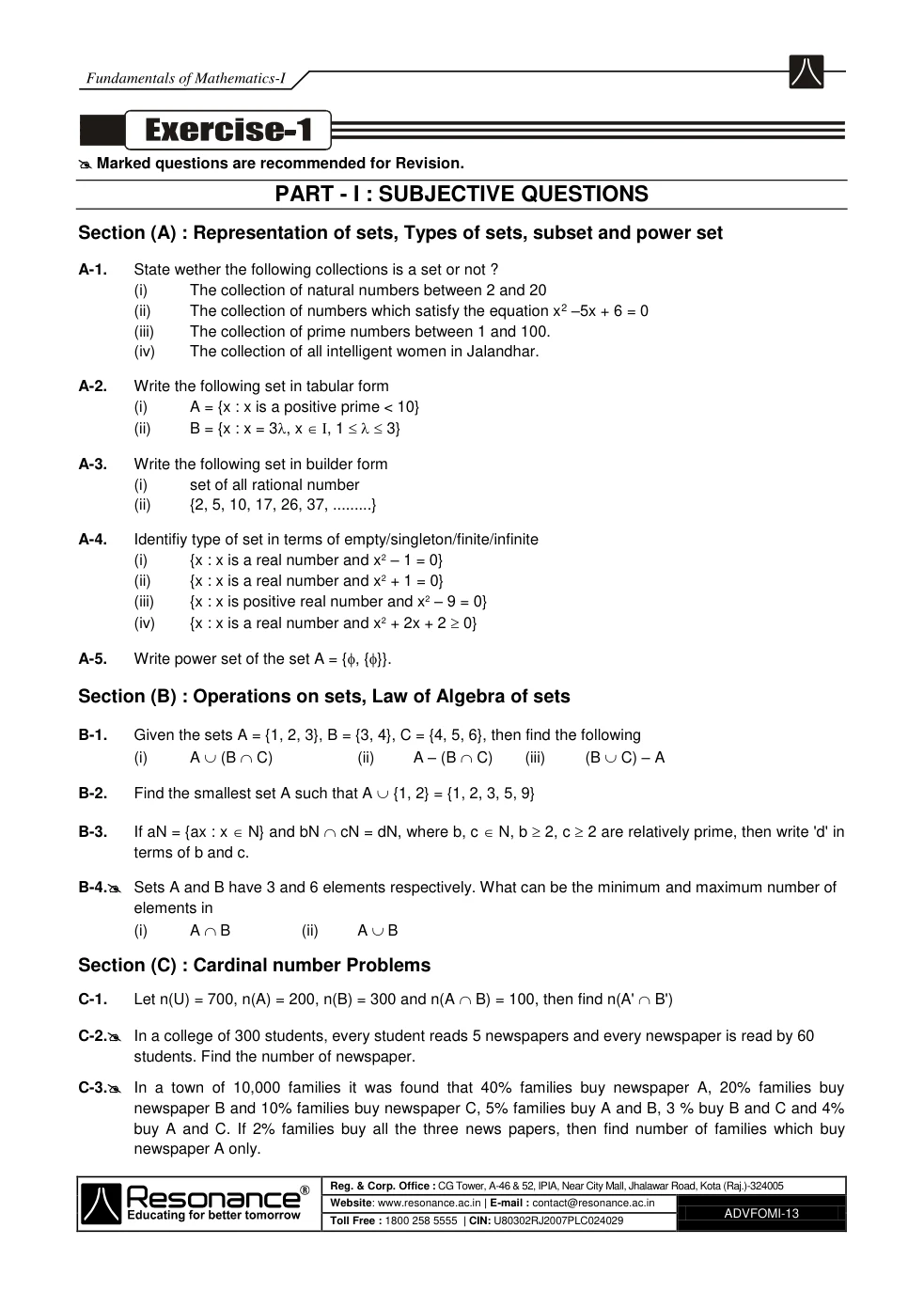
MAASFundamentals Of Mathematics I
© MAAS. All rights reserved.Page 37 / 58
Extracted text · page 37
Fundamentals of Mathematics-I
Marked questions are recommended for Revision.
PART - I : SUBJECTIVE QUESTIONS
Section (A) : Representation of sets, Types of sets, subset and power set
A-1. State wether the following collections is a set or not ?
(i) The collection of natural numbers between 2 and 20
(ii) The collection of numbers which satisfy the equation x2 –5x + 6 = 0
(iii) The collection of prime numbers between 1 and 100.
(iv) The collection of all intelligent women in Jalandhar.
A-2. Write the following set in tabular form
(i) A = {x : x is a positive prime < 10}
(ii) B = {x : x = 3, x , 1 3}
A-3. Write the following set in builder form
(i) set of all rational number
(ii) {2, 5, 10, 17, 26, 37, .........}
A-4. Identifiy type of set in terms of empty/singleton/finite/infinite
(i) {x : x is a real number and x2 – 1 = 0}
(ii) {x : x is a real number and x2 + 1 = 0}
(iii) {x : x is positive real number and x2 – 9 = 0}
(iv) {x : x is a real number and x2 + 2x + 2 0}
A-5. Write power set of the set A = {, {}}.
Section (B) : Operations on sets, Law of Algebra of sets
B-1. Given the sets A = {1, 2, 3}, B = {3, 4}, C = {4, 5, 6}, then find the following
(i) A (B C) (ii) A – (B C) (iii) (B C) – A
B-2. Find the smallest set A such that A {1, 2} = {1, 2, 3, 5, 9}
B-3. If aN = {ax : x N} and bN cN = dN, where b, c N, b 2, c 2 are relatively prime, then write 'd' in
terms of b and c.
B-4. Sets A and B have 3 and 6 elements respectively. What can be the minimum and maximum number of
elements in
(i) A B (ii) A B
Section (C) : Cardinal number Problems
C-1. Let n(U) = 700, n(A) = 200, n(B) = 300 and n(A B) = 100, then find n(A' B')
C-2. In a college of 300 students, every student reads 5 newspapers and every newspaper is read by 60
students. Find the number of newspaper.
C-3. In a town of 10,000 families it was found that 40% families buy newspaper A, 20% families buy
newspaper B and 10% families buy newspaper C, 5% families buy A and B, 3 % buy B and C and 4%
buy A and C. If 2% families buy all the three news papers, then find number of families which buy
newspaper A only.
ADVFOMI-13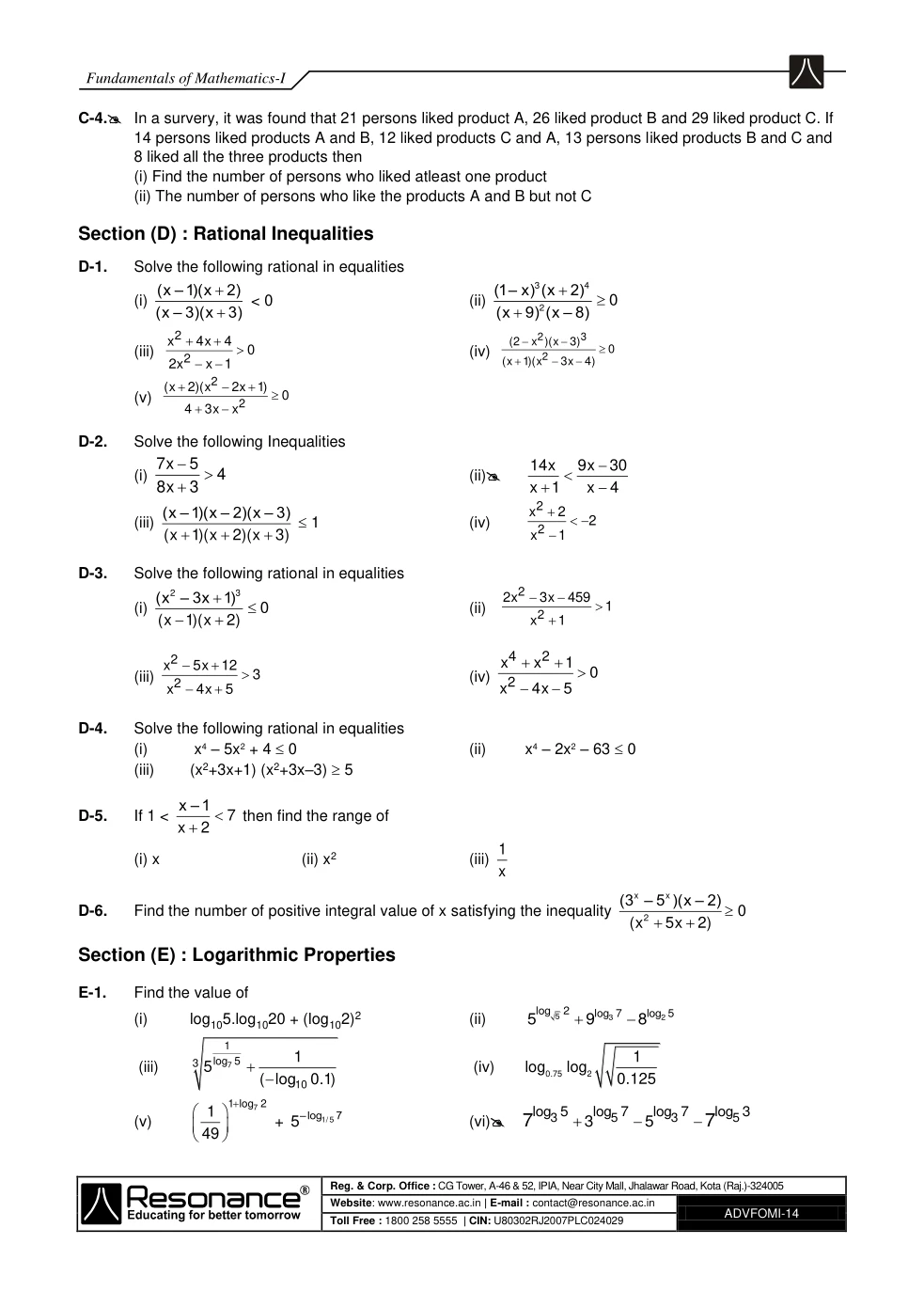
MAASFundamentals Of Mathematics I
© MAAS. All rights reserved.Page 38 / 58
Extracted text · page 38
Fundamentals of Mathematics-I
C-4. In a survery, it was found that 21 persons liked product A, 26 liked product B and 29 liked product C. If
14 persons liked products A and B, 12 liked products C and A, 13 persons liked products B and C and
8 liked all the three products then
(i) Find the number of persons who liked atleast one product
(ii) The number of persons who like the products A and B but not C
Section (D) : Rational Inequalities
D-1. Solve the following rational in equalities
(x –1)(x 2) (1– x)3 (x 2)4
(i) < 0 (ii) 2 0 (x – 3)(x 3) (x 9) (x – 8)
2 2 3 x 4 x 4 ( 2 x )( x 3 ) 0 (iii) 0 (iv) ( x 1)( x 2 3 x 4 ) 2 x 2 x 1
2 ( x 2)( x 2 x 1)
(v) 2 0 4 3 x x
D-2. Solve the following Inequalities
7 x 5 14x 9x 30 (i) 4 (ii)
8 x 3 x 1 x 4
2 (x –1)(x – 2)(x – 3) x 2
(iii) 1 (iv) 2
(x 1)(x 2)(x 3) x 2 1
D-3. Solve the following rational in equalities
(x 2 – 3x 1)3 2 x 2 3 x 459
(i) 0 (ii) 1
(x 1)(x 2) x 2 1
x 2 5 x 12 x 4 x 2 1
(iii) 3 (iv) 2 0 2 x 4 x 5 x 4 x 5
D-4. Solve the following rational in equalities
(i) x4 – 5x2 + 4 0 (ii) x4 – 2x2 – 63 0
(iii) (x2+3x+1) (x2+3x–3) 5
x – 1
D-5. If 1 < 7 then find the range of
x 2
1
(i) x (ii) x2 (iii)
x
(3 x – 5 x )(x – 2)
D-6. Find the number of positive integral value of x satisfying the inequality 2 0 (x 5x 2)
Section (E) : Logarithmic Properties
E-1. Find the value of
log 5 2 log3 7 log2 5 (i) log105.log1020 + (log102)2 (ii) 5 9 8
1
3 log7 5 1 1
(iii) 5 ( log10 0.1) (iv) log0.75 log2 0.125
1 log7 2
1 –log1/ 5 7 log3 5 log5 7 log3 7 log5 3 (v) + 5 (vi) 7 3 5 7
49
ADVFOMI-14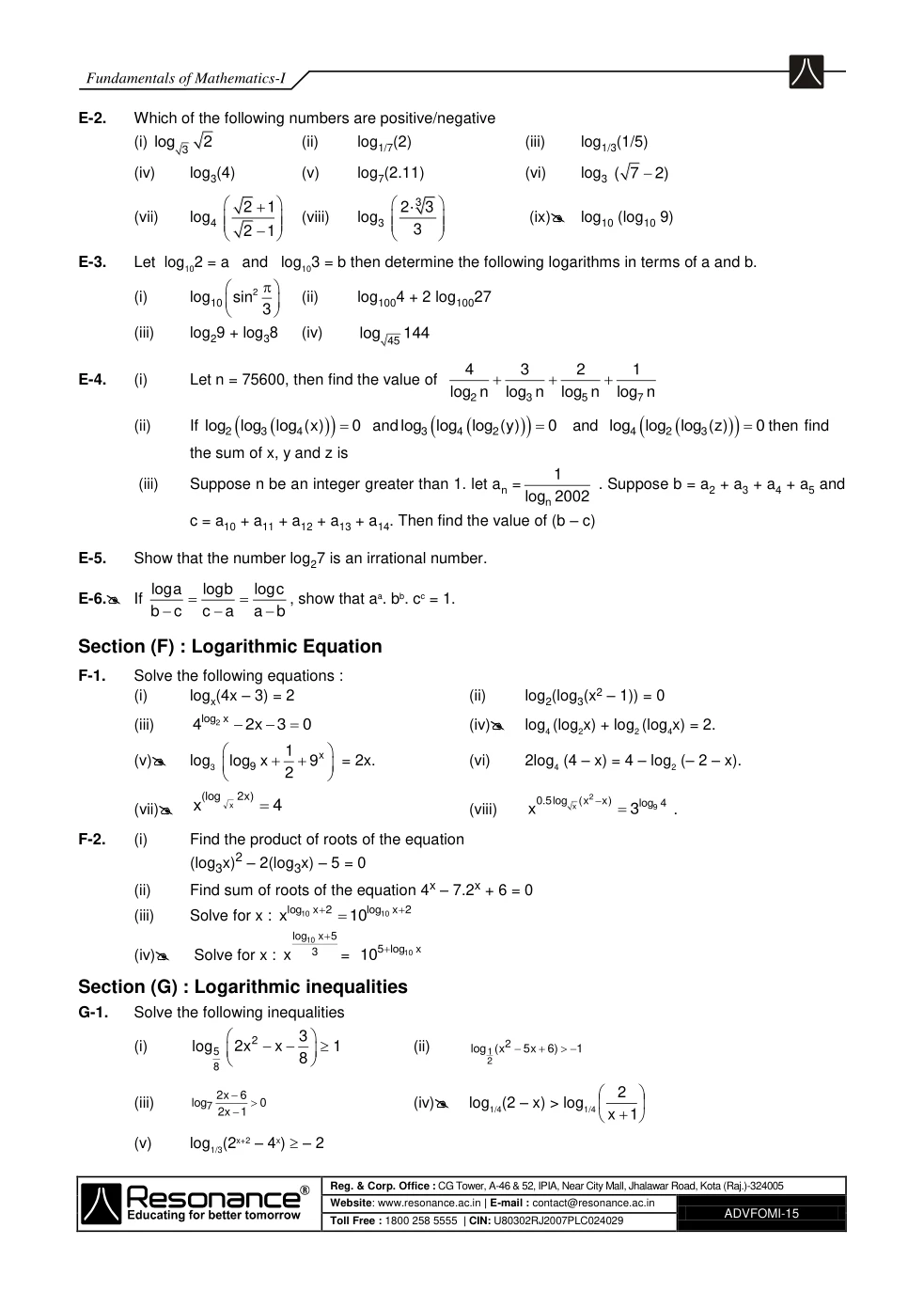
MAASFundamentals Of Mathematics I
© MAAS. All rights reserved.Page 39 / 58
Extracted text · page 39
Fundamentals of Mathematics-I
E-2. Which of the following numbers are positive/negative
(i) log 2 (ii) log1/7(2) (iii) log1/3(1/5) 3
(iv) log3(4) (v) log7(2.11) (vi) log3 ( 7 2)
2 1 2· 3 3
(vii) log4 (viii) log3 (ix) log10 (log10 9) 2 1 3
E-3. Let log102 = a and log103 = b then determine the following logarithms in terms of a and b.
2
(i) log10 sin (ii) log1004 + 2 log10027
3
(iii) log29 + log38 (iv) log 45 144
4 3 2 1
E-4. (i) Let n = 75600, then find the value of
log2 n log3 n log5 n log7 n
(ii) If log2 log3 log4 (x) 0 and log3 log4 log2 (y) 0 and log4 log2 log3 (z) 0 then find
the sum of x, y and z is
1
(iii) Suppose n be an integer greater than 1. let an = . Suppose b = a2 + a3 + a4 + a5 and
logn 2002
c = a10 + a11 + a12 + a13 + a14. Then find the value of (b – c)
E-5. Show that the number log27 is an irrational number.
loga logb logc
E-6. If , show that aa. bb. cc = 1.
b c c a a b
Section (F) : Logarithmic Equation
F-1. Solve the following equations :
(i) logx(4x – 3) = 2 (ii) log2(log3(x2 – 1)) = 0
(iii) 4log 2 x 2x 3 0 (iv) log4 (log2x) + log2 (log4x) = 2.
1 x
(v) log3 log9 x 9 = 2x. (vi) 2log4 (4 – x) = 4 – log2 (– 2 – x). 2
(log
x 0.5log x (x 2 x) (vii) x 9 4 . 2 x) 4 (viii) x 3log
F-2. (i) Find the product of roots of the equation
(log3x)2 – 2(log3x) – 5 = 0
(ii) Find sum of roots of the equation 4x – 7.2x + 6 = 0
10 x 2 (iii) Solve for x : xlog 10 x 2 10log
log10 x 5
10 x (iv) Solve for x : x 3 = 105 log
Section (G) : Logarithmic inequalities
G-1. Solve the following inequalities
2 3 2 (i) log 5 2x x 1 (ii) log 1 ( x 5 x 6 ) 1
2 8 8
2 x 6 2
(iii) log7 0 (iv) log1/4(2 – x) > log1/4 2 x 1 x 1
(v) log1/3(2x+2 – 4x) – 2
ADVFOMI-15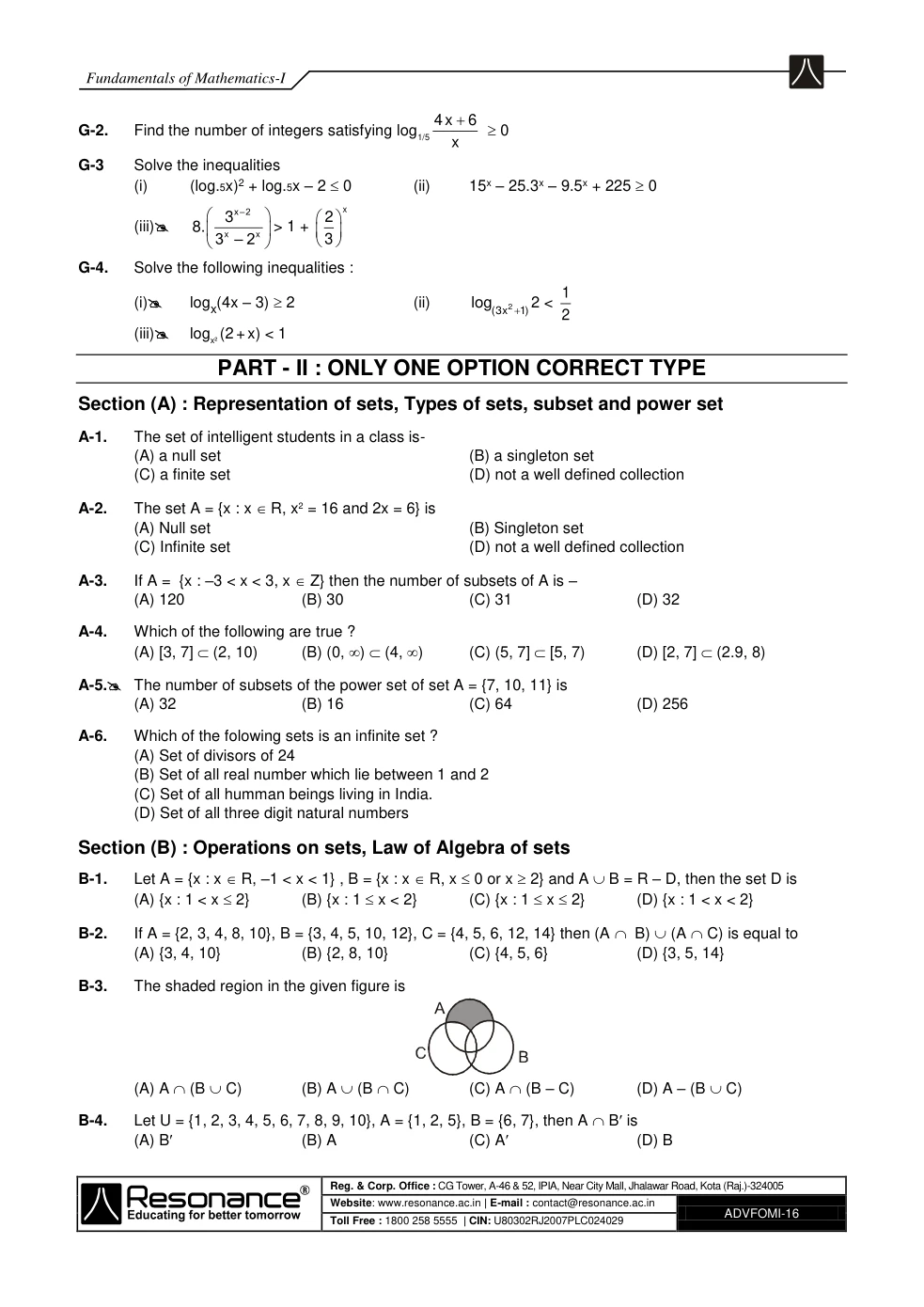
MAASFundamentals Of Mathematics I
© MAAS. All rights reserved.Page 40 / 58
Extracted text · page 40
Fundamentals of Mathematics-I
4x 6
G-2. Find the number of integers satisfying log1/5 0
x
G-3 Solve the inequalities
(i) (log.5x)2 + log.5x – 2 0 (ii) 15x – 25.3x – 9.5x + 225 0
3 x–2 2 x
(iii) 8. x x > 1 +
3 – 2 3
G-4. Solve the following inequalities :
1
2 (i) logx(4x – 3) 2 (ii) log(3x 21) < 2
(iii) logx² (2 + x) < 1
PART - II : ONLY ONE OPTION CORRECT TYPE
Section (A) : Representation of sets, Types of sets, subset and power set
A-1. The set of intelligent students in a class is-
(A) a null set (B) a singleton set
(C) a finite set (D) not a well defined collection
A-2. The set A = {x : x R, x2 = 16 and 2x = 6} is
(A) Null set (B) Singleton set
(C) Infinite set (D) not a well defined collection
A-3. If A = {x : –3 < x < 3, x Z} then the number of subsets of A is –
(A) 120 (B) 30 (C) 31 (D) 32
A-4. Which of the following are true ?
(A) [3, 7] (2, 10) (B) (0, ) (4, ) (C) (5, 7] [5, 7) (D) [2, 7] (2.9, 8)
A-5. The number of subsets of the power set of set A = {7, 10, 11} is
(A) 32 (B) 16 (C) 64 (D) 256
A-6. Which of the folowing sets is an infinite set ?
(A) Set of divisors of 24
(B) Set of all real number which lie between 1 and 2
(C) Set of all humman beings living in India.
(D) Set of all three digit natural numbers
Section (B) : Operations on sets, Law of Algebra of sets
B-1. Let A = {x : x R, –1 < x < 1} , B = {x : x R, x 0 or x 2} and A B = R – D, then the set D is
(A) {x : 1 < x 2} (B) {x : 1 x < 2} (C) {x : 1 x 2} (D) {x : 1 < x < 2}
B-2. If A = {2, 3, 4, 8, 10}, B = {3, 4, 5, 10, 12}, C = {4, 5, 6, 12, 14} then (A B) (A C) is equal to
(A) {3, 4, 10} (B) {2, 8, 10} (C) {4, 5, 6} (D) {3, 5, 14}
B-3. The shaded region in the given figure is
(A) A (B C) (B) A (B C) (C) A (B – C) (D) A – (B C)
B-4. Let U = {1, 2, 3, 4, 5, 6, 7, 8, 9, 10}, A = {1, 2, 5}, B = {6, 7}, then A Bis
(A) B (B) A (C) A (D) B
ADVFOMI-16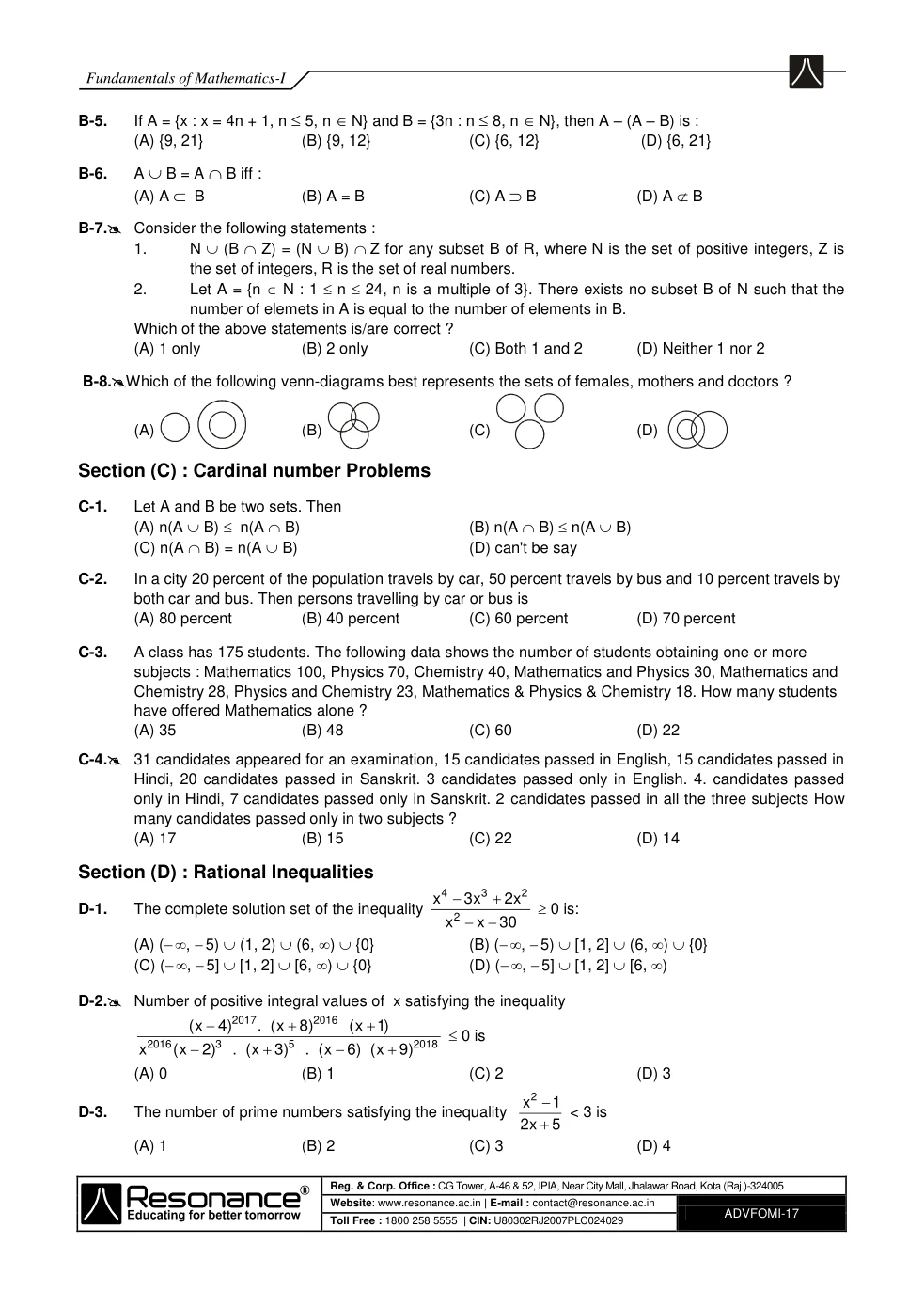
MAASFundamentals Of Mathematics I
© MAAS. All rights reserved.Page 41 / 58
Extracted text · page 41
Fundamentals of Mathematics-I
B-5. If A = {x : x = 4n + 1, n 5, n N} and B = {3n : n 8, n N}, then A – (A – B) is :
(A) {9, 21} (B) {9, 12} (C) {6, 12} (D) {6, 21}
B-6. A B = A B iff :
(A) A B (B) A = B (C) A B (D) A B
B-7. Consider the following statements :
1. N (B Z) = (N B) Z for any subset B of R, where N is the set of positive integers, Z is
the set of integers, R is the set of real numbers.
2. Let A = {n N : 1 n 24, n is a multiple of 3}. There exists no subset B of N such that the
number of elemets in A is equal to the number of elements in B.
Which of the above statements is/are correct ?
(A) 1 only (B) 2 only (C) Both 1 and 2 (D) Neither 1 nor 2
B-8.Which of the following venn-diagrams best represents the sets of females, mothers and doctors ?
(A) (B) (C) (D)
Section (C) : Cardinal number Problems
C-1. Let A and B be two sets. Then
(A) n(A B) n(A B) (B) n(A B) n(A B)
(C) n(A B) = n(A B) (D) can't be say
C-2. In a city 20 percent of the population travels by car, 50 percent travels by bus and 10 percent travels by
both car and bus. Then persons travelling by car or bus is
(A) 80 percent (B) 40 percent (C) 60 percent (D) 70 percent
C-3. A class has 175 students. The following data shows the number of students obtaining one or more
subjects : Mathematics 100, Physics 70, Chemistry 40, Mathematics and Physics 30, Mathematics and
Chemistry 28, Physics and Chemistry 23, Mathematics & Physics & Chemistry 18. How many students
have offered Mathematics alone ?
(A) 35 (B) 48 (C) 60 (D) 22
C-4. 31 candidates appeared for an examination, 15 candidates passed in English, 15 candidates passed in
Hindi, 20 candidates passed in Sanskrit. 3 candidates passed only in English. 4. candidates passed
only in Hindi, 7 candidates passed only in Sanskrit. 2 candidates passed in all the three subjects How
many candidates passed only in two subjects ?
(A) 17 (B) 15 (C) 22 (D) 14
Section (D) : Rational Inequalities
x 4 3x 3 2x 2
D-1. The complete solution set of the inequality 0 is:
x 2 x 30
(A) (, 5) (1, 2) (6, ) {0} (B) (, 5) [1, 2] (6, ) {0}
(C) (, 5] [1, 2] [6, ) {0} (D) (, 5] [1, 2] [6, )
D-2. Number of positive integral values of x satisfying the inequality
(x 4)2017 . (x 8)2016 (x 1)
0 is
x 2016 (x 2)3 . (x 3)5 . (x 6) (x 9)2018
(A) 0 (B) 1 (C) 2 (D) 3
x 2 1
D-3. The number of prime numbers satisfying the inequality < 3 is
2x 5
(A) 1 (B) 2 (C) 3 (D) 4
ADVFOMI-17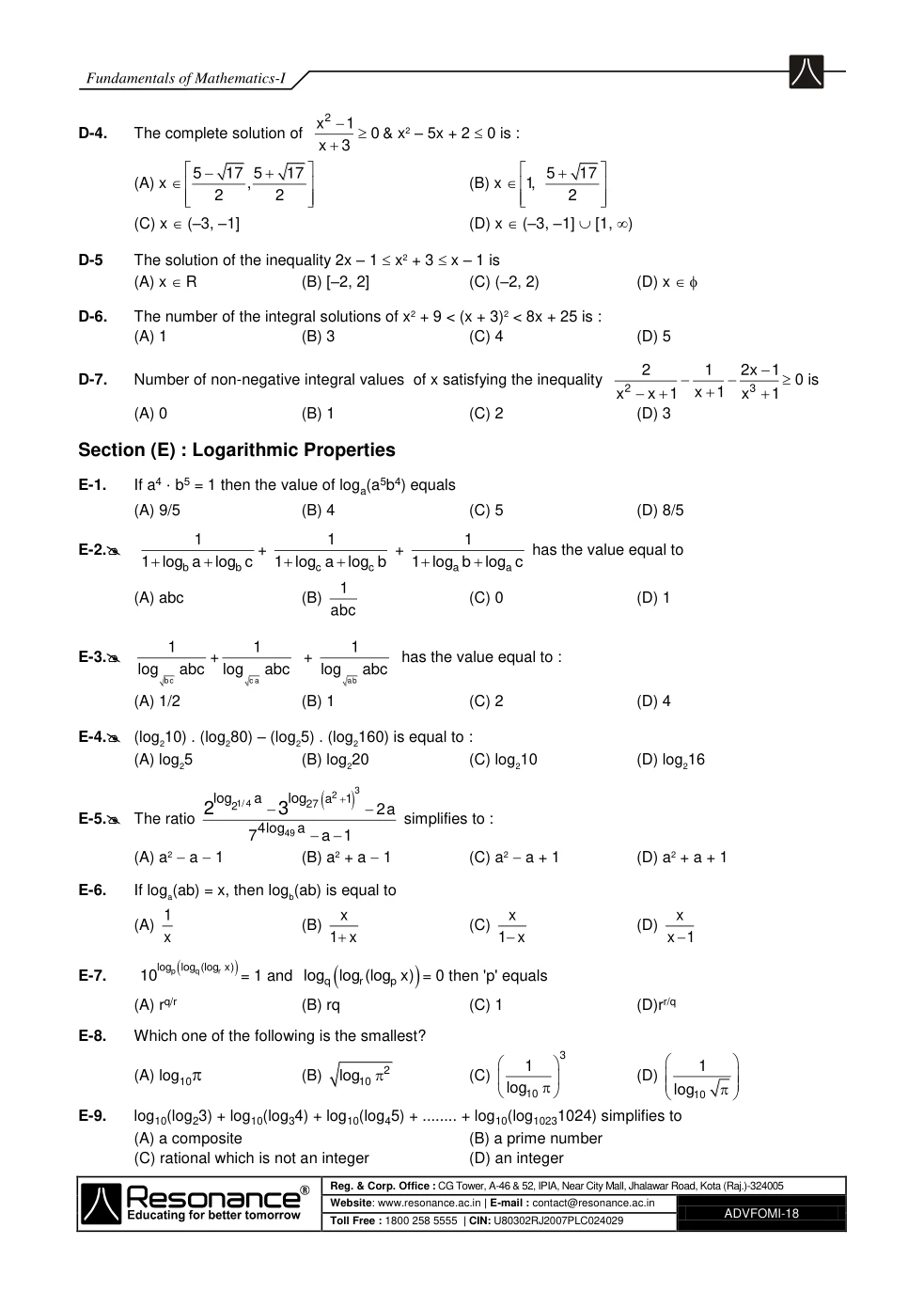
MAASFundamentals Of Mathematics I
© MAAS. All rights reserved.Page 42 / 58
Extracted text · page 42
Fundamentals of Mathematics-I
x 2 1
D-4. The complete solution of 0 & x2 – 5x + 2 0 is :
x 3
17 5 17 5 17 (A) x 5 , (B) x 1,
2 2 2
(C) x (–3, –1] (D) x (–3, –1] [1, )
D-5 The solution of the inequality 2x – 1 x2 + 3 x – 1 is
(A) x R (B) [–2, 2] (C) (–2, 2) (D) x
D-6. The number of the integral solutions of x2 + 9 < (x + 3)2 < 8x + 25 is :
(A) 1 (B) 3 (C) 4 (D) 5
2 1 2x 1
D-7. Number of non-negative integral values of x satisfying the inequality 0 is
x 2 x 1 x 1 x 3 1
(A) 0 (B) 1 (C) 2 (D) 3
Section (E) : Logarithmic Properties
E-1. If a4 · b5 = 1 then the value of loga(a5b4) equals
(A) 9/5 (B) 4 (C) 5 (D) 8/5
1 1 1
E-2. + + has the value equal to
1 logb a logb c 1 logc a logc b 1 loga b loga c
1
(A) abc (B) (C) 0 (D) 1
abc
1 1 1
E-3. + + has the value equal to :
log abc log abc log abc
bc c a ab
(A) 1/2 (B) 1 (C) 2 (D) 4
E-4. (log210) . (log280) – (log25) . (log2160) is equal to :
(A) log25 (B) log220 (C) log210 (D) log216
3
a2 1 log a log27 21/ 4 2 3 2a
E-5. The ratio simplifies to :
4log49 a 7 a 1
(A) a2 a 1 (B) a2 + a 1 (C) a2 a + 1 (D) a2 + a + 1
E-6. If loga(ab) = x, then logb(ab) is equal to
1 x x x
(A) (B) (C) (D)
x 1 x 1 x x 1
logp logq (logr x) = 0 then 'p' equalsE-7. 10 = 1 and logq logr (logp x)
(A) rq/r (B) rq (C) 1 (D)rr/q
E-8. Which one of the following is the smallest?
2 1 3 1 (A) log10 (B) log10 (C) (D) log10 log10
E-9. log10(log23) + log10(log34) + log10(log45) + ........ + log10(log10231024) simplifies to
(A) a composite (B) a prime number
(C) rational which is not an integer (D) an integer
ADVFOMI-18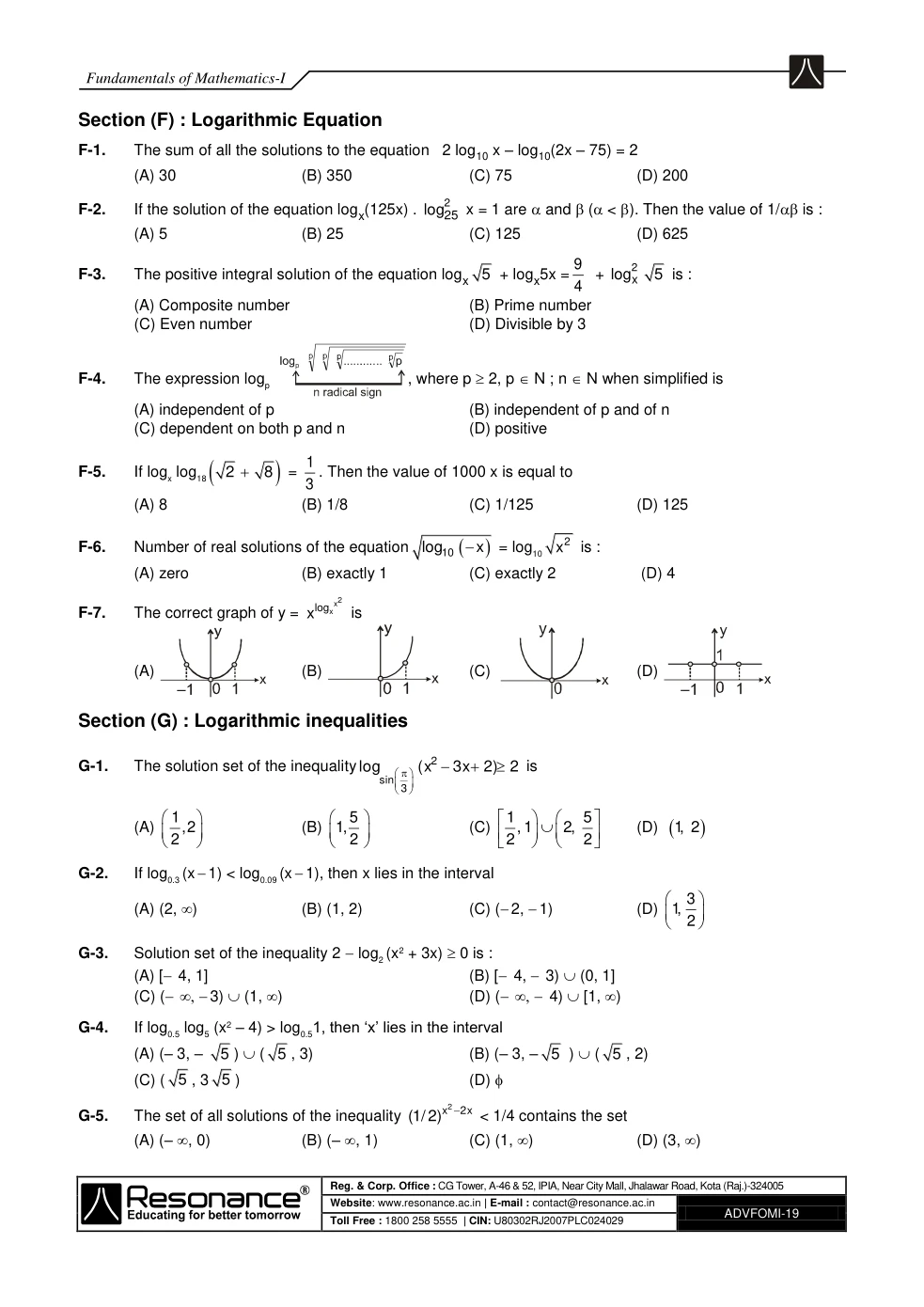
MAASFundamentals Of Mathematics I
© MAAS. All rights reserved.Page 43 / 58
Extracted text · page 43
Fundamentals of Mathematics-I
Section (F) : Logarithmic Equation
F-1. The sum of all the solutions to the equation 2 log10 x – log10(2x – 75) = 2
(A) 30 (B) 350 (C) 75 (D) 200
F-2. If the solution of the equation logx(125x) . log252 x = 1 are and ( < ). Then the value of 1/is :
(A) 5 (B) 25 (C) 125 (D) 625
9 2
F-3. The positive integral solution of the equation logx 5 + logx5x = + log x 5 is : 4
(A) Composite number (B) Prime number
(C) Even number (D) Divisible by 3
F-4. The expression logp , where p 2, p N ; n N when simplified is
(A) independent of p (B) independent of p and of n
(C) dependent on both p and n (D) positive
1
= . Then the value of 1000 x is equal to 2 8F-5. If logx log18 3
(A) 8 (B) 1/8 (C) 1/125 (D) 125
F-6. Number of real solutions of the equation log10 x = log10 x 2 is :
(A) zero (B) exactly 1 (C) exactly 2 (D) 4
x 2
x isF-7. The correct graph of y = x log
(A) (B) (C) (D)
Section (G) : Logarithmic inequalities
G-1. The solution set of the inequality log (x2 3x 2) 2 is
sin
3
5 1 5 1,2 1, 2 (A) (B) 1, (C) , 1 2, (D) 2 2 2 2
G-2. If log0.3 (x 1) < log0.09 (x 1), then x lies in the interval
3
(A) (2, ) (B) (1, 2) (C) ( 2, 1) (D) 1, 2
G-3. Solution set of the inequality 2 log2 (x2 + 3x) 0 is :
(A) [ 4, 1] (B) [ 4, 3) (0, 1]
(C) ( 3) (1, ) (D) ( 4) [1, )
G-4. If log0.5 log5 (x2 – 4) > log0.51, then ‘x’ lies in the interval
(A) (– 3, – 5 ) ( 5 , 3) (B) (– 3, – 5 ) ( 5 , 2)
(C) ( 5 , 3 5 ) (D)
x 2 2xG-5. The set of all solutions of the inequality (1/2) < 1/4 contains the set
(A) (– , 0) (B) (– , 1) (C) (1, ) (D) (3, )
ADVFOMI-19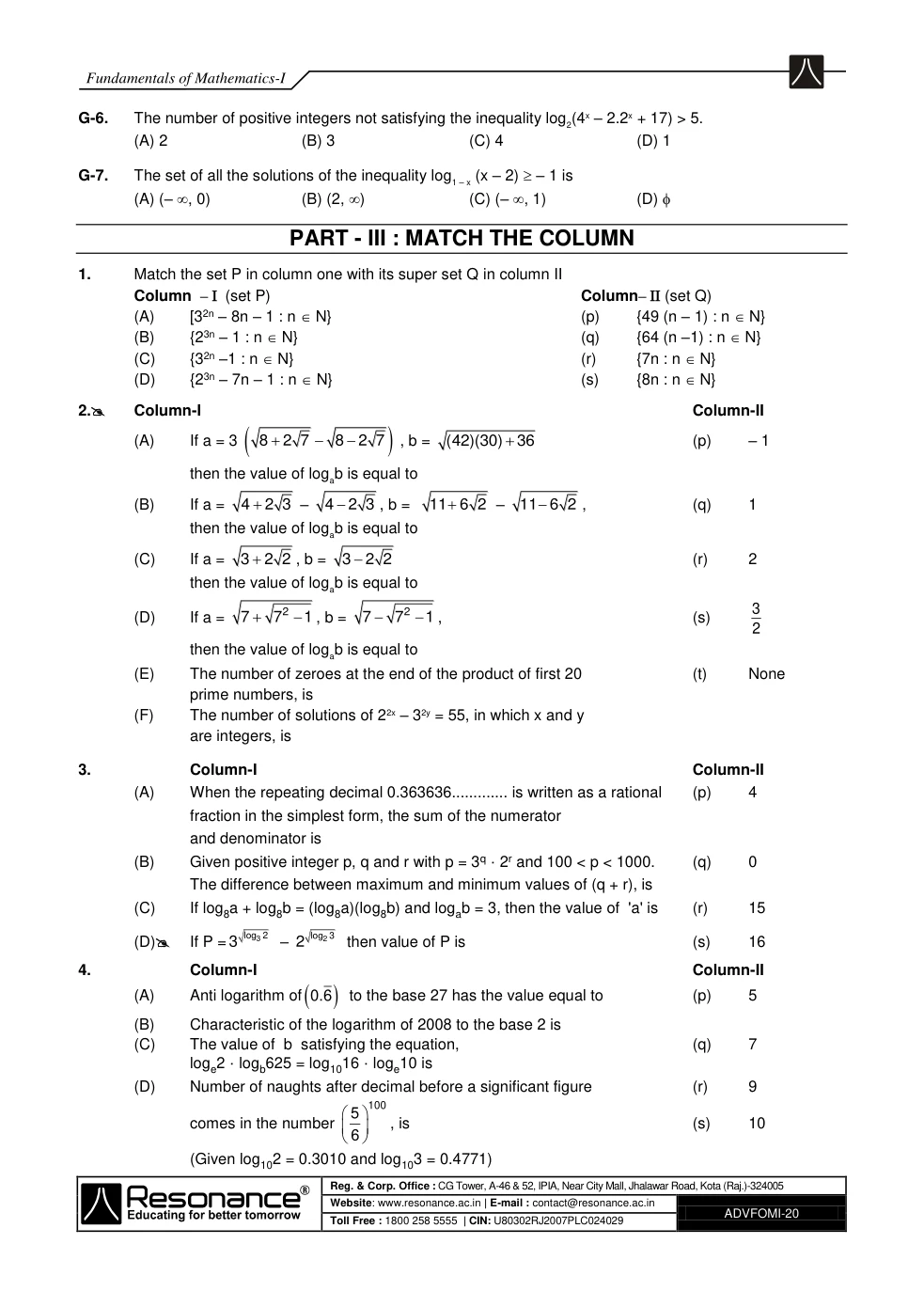
MAASFundamentals Of Mathematics I
© MAAS. All rights reserved.Page 44 / 58
Extracted text · page 44
Fundamentals of Mathematics-I
G-6. The number of positive integers not satisfying the inequality log2(4x – 2.2x + 17) > 5.
(A) 2 (B) 3 (C) 4 (D) 1
G-7. The set of all the solutions of the inequality log1 – x (x – 2) – 1 is
(A) (– , 0) (B) (2, ) (C) (– , 1) (D)
PART - III : MATCH THE COLUMN
1. Match the set P in column one with its super set Q in column II
Column – (set P) Column– (set Q)
(A) [32n – 8n – 1 : n N} (p) {49 (n – 1) : n N}
(B) {23n – 1 : n N} (q) {64 (n –1) : n N}
(C) {32n –1 : n N} (r) {7n : n N}
(D) {23n – 7n – 1 : n N} (s) {8n : n N}
2. Column-I Column-II
(A) If a = 3 8 2 7 8 2 7 , b = (42)(30) 36 (p) – 1
then the value of logab is equal to
(B) If a = 4 2 3 – 4 2 3 , b = 11 6 2 – 11 6 2 , (q) 1
then the value of logab is equal to
(C) If a = 3 2 2 , b = 3 2 2 (r) 2
then the value of logab is equal to
2 2 3 (D) If a = 7 7 1 , b = 7 7 1 , (s)
2
then the value of logab is equal to
(E) The number of zeroes at the end of the product of first 20 (t) None
prime numbers, is
(F) The number of solutions of 22x – 32y = 55, in which x and y
are integers, is
3. Column-I Column-II
(A) When the repeating decimal 0.363636............. is written as a rational (p) 4
fraction in the simplest form, the sum of the numerator
and denominator is
(B) Given positive integer p, q and r with p = 3q · 2r and 100 < p < 1000. (q) 0
The difference between maximum and minimum values of (q + r), is
(C) If log8a + log8b = (log8a)(log8b) and logab = 3, then the value of 'a' is (r) 15
(D) If P = 3 log3 2 – 2 log2 3 then value of P is (s) 16
4. Column-I Column-II
(A) Anti logarithm 0.6 to the base 27 has the value equal to (p) 5 of
(B) Characteristic of the logarithm of 2008 to the base 2 is
(C) The value of b satisfying the equation, (q) 7
loge2 · logb625 = log1016 · loge10 is
(D) Number of naughts after decimal before a significant figure (r) 9
5 100
comes in the number , is (s) 10
6
(Given log102 = 0.3010 and log103 = 0.4771)
ADVFOMI-20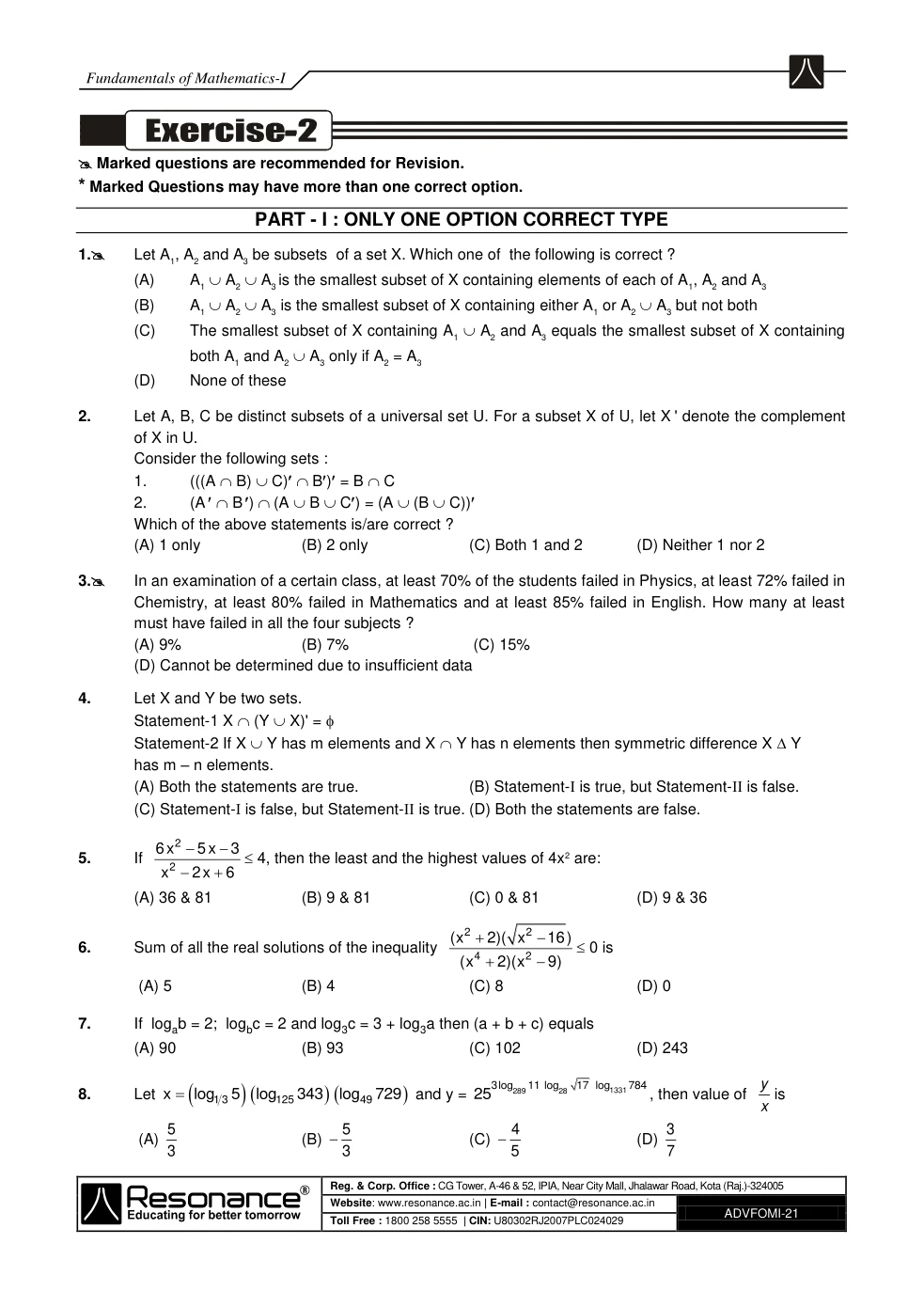
MAASFundamentals Of Mathematics I
© MAAS. All rights reserved.Page 45 / 58
Extracted text · page 45
Fundamentals of Mathematics-I
Marked questions are recommended for Revision.
* Marked Questions may have more than one correct option.
PART - I : ONLY ONE OPTION CORRECT TYPE
1. Let A1, A2 and A3 be subsets of a set X. Which one of the following is correct ?
(A) A1 A2 A3 is the smallest subset of X containing elements of each of A1, A2 and A3
(B) A1 A2 A3 is the smallest subset of X containing either A1 or A2 A3 but not both
(C) The smallest subset of X containing A1 A2 and A3 equals the smallest subset of X containing
both A1 and A2 A3 only if A2 = A3
(D) None of these
2. Let A, B, C be distinct subsets of a universal set U. For a subset X of U, let X ' denote the complement
of X in U.
Consider the following sets :
1. (((A B) C) B) = B C
2. (A B )(A B C) = (A (B C))
Which of the above statements is/are correct ?
(A) 1 only (B) 2 only (C) Both 1 and 2 (D) Neither 1 nor 2
3. In an examination of a certain class, at least 70% of the students failed in Physics, at least 72% failed in
Chemistry, at least 80% failed in Mathematics and at least 85% failed in English. How many at least
must have failed in all the four subjects ?
(A) 9% (B) 7% (C) 15%
(D) Cannot be determined due to insufficient data
4. Let X and Y be two sets.
Statement-1 X (Y X)' =
Statement-2 If X Y has m elements and X Y has n elements then symmetric difference X Y
has m – n elements.
(A) Both the statements are true. (B) Statement- is true, but Statement- is false.
(C) Statement- is false, but Statement- is true. (D) Both the statements are false.
6x 2 5x 3
5. If 4, then the least and the highest values of 4x2 are:
x 2 2x 6
(A) 36 & 81 (B) 9 & 81 (C) 0 & 81 (D) 9 & 36
(x 2 2)( x 2 16)
6. Sum of all the real solutions of the inequality 0 is
(x 4 2)(x 2 9)
(A) 5 (B) 4 (C) 8 (D) 0
7. If logab = 2; logbc = 2 and log3c = 3 + log3a then (a + b + c) equals
(A) 90 (B) 93 (C) 102 (D) 243
3log289 11 log28 17 log1331 784 y8. Let x log125 343 log49 729 and y = 25 , then value of is log1 3 5 x
5 5 4 3
(A) (B) (C) (D)
3 3 5 7
ADVFOMI-21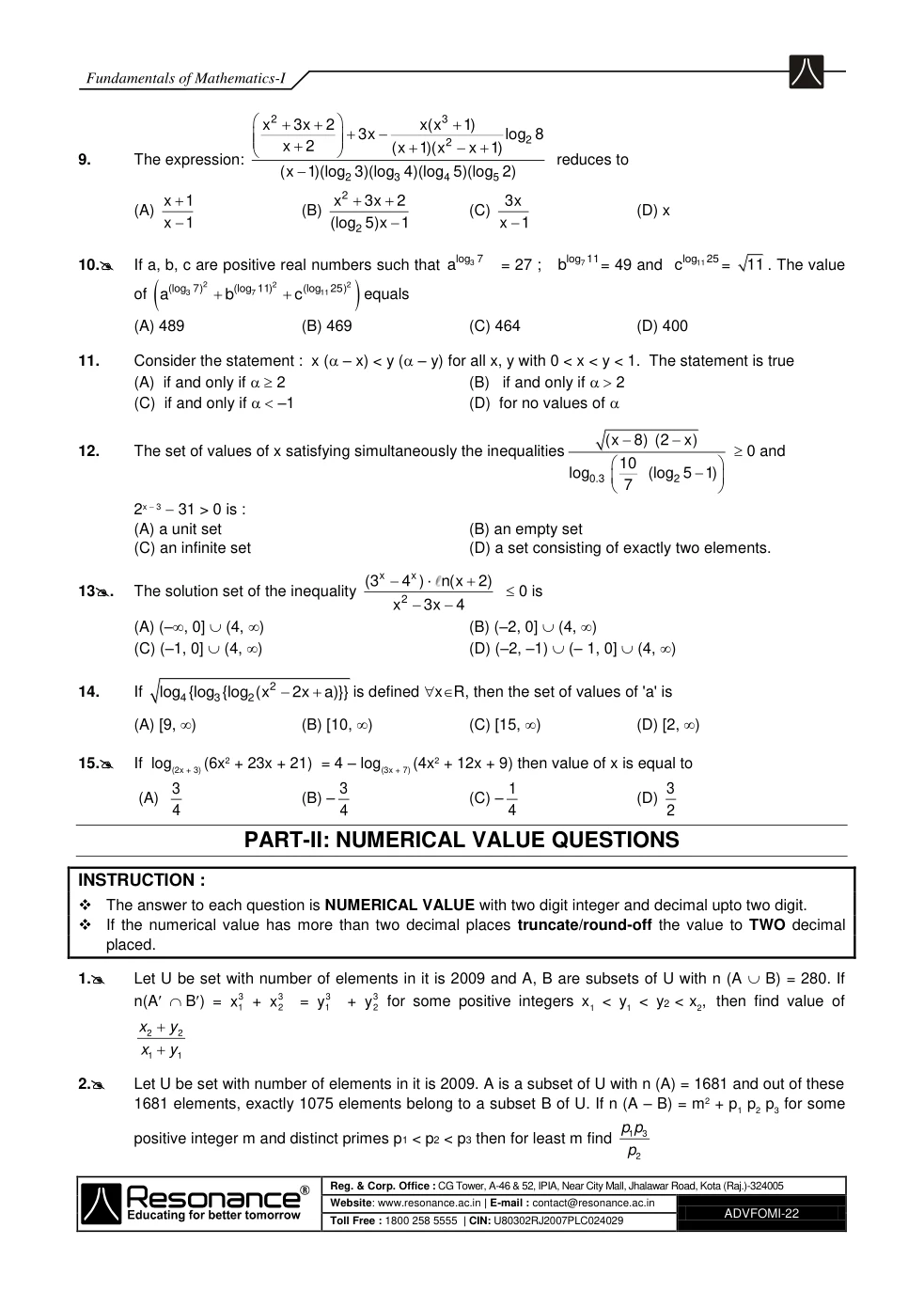
MAASFundamentals Of Mathematics I
© MAAS. All rights reserved.Page 46 / 58
Extracted text · page 46
Fundamentals of Mathematics-I
x 2 3x 2 x(x 3 1)
3x log2 8 (x 1)(x 2 x 1) x 2 9. The expression: reduces to
(x 1)(log2 3)(log3 4)(log4 5)(log5 2)
x 1 x 2 3x 2 3x
(A) (B) (C) (D) x
x 1 (log2 5)x 1 x 1
10. If a, b, c are positive real numbers such that alog 3 7 = 27 ; blog 11 25 = 11 . The value 7 11 = 49 and c log
(log3 7)2 (log7 11)2 (log11 25)2 of a b c equals
(A) 489 (B) 469 (C) 464 (D) 400
11. Consider the statement : x ( – x) < y ( – y) for all x, y with 0 < x < y < 1. The statement is true
(A) if and only if 2 (B) if and only if 2
(C) if and only if –1 (D) for no values of
(x 8) (2 x)
12. The set of values of x satisfying simultaneously the inequalities 0 and
10
log0.3 (log2 5 1) 7
2x 3 31 > 0 is :
(A) a unit set (B) an empty set
(C) an infinite set (D) a set consisting of exactly two elements.
(3 x 4 x ) · n(x 2)
13. The solution set of the inequality 0 is
x 2 3x 4
(A) (–, 0] (4, ) (B) (–2, 0] (4, )
(C) (–1, 0] (4, ) (D) (–2, –1) (– 1, 0] (4, )
14. If log4 {log3 {log2 (x 2 2x a)}} is defined xR, then the set of values of 'a' is
(A) [9, ) (B) [10, ) (C) [15, ) (D) [2, )
15. If log(2x + 3) (6x2 + 23x + 21) = 4 – log(3x + 7) (4x2 + 12x + 9) then value of x is equal to
3 3 1 3
(A) (B) – (C) – (D)
4 4 4 2
PART-II: NUMERICAL VALUE QUESTIONS
INSTRUCTION :
The answer to each question is NUMERICAL VALUE with two digit integer and decimal upto two digit.
If the numerical value has more than two decimal places truncate/round-off the value to TWO decimal
placed.
1. Let U be set with number of elements in it is 2009 and A, B are subsets of U with n (A B) = 280. If
n(A B) = x 13 + x 32 = y 13 + y 32 for some positive integers x1 < y1 < y2 < x2, then find value of
x 2 y 2
x1 y 1
2. Let U be set with number of elements in it is 2009. A is a subset of U with n (A) = 1681 and out of these
1681 elements, exactly 1075 elements belong to a subset B of U. If n (A – B) = m2 + p1 p2 p3 for some
p1 p3 positive integer m and distinct primes p1 < p2 < p3 then for least m find
p2
ADVFOMI-22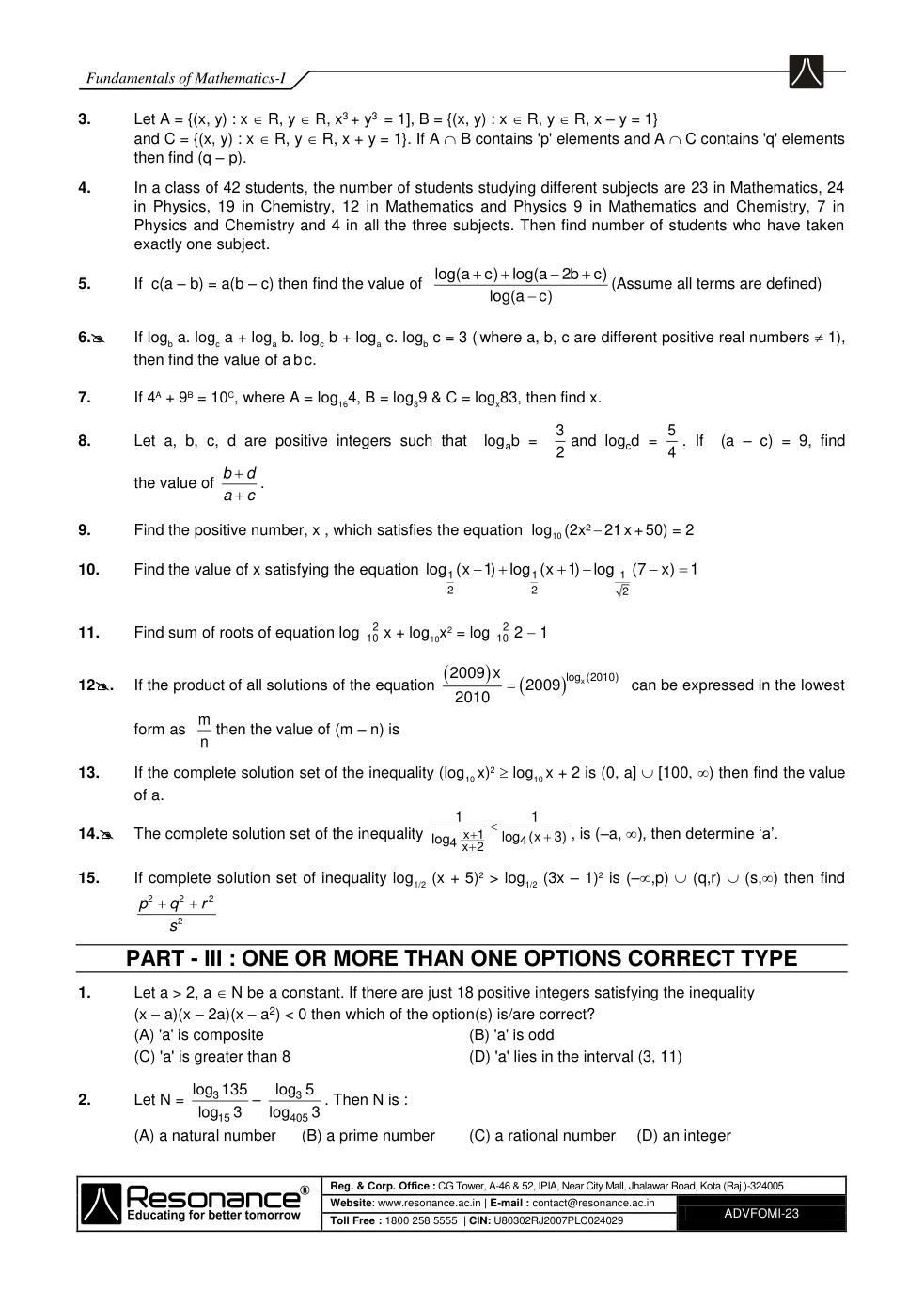
MAASFundamentals Of Mathematics I
© MAAS. All rights reserved.Page 47 / 58
Extracted text · page 47
Fundamentals of Mathematics-I
3. Let A = {(x, y) : x R, y R, x3 + y3 = 1], B = {(x, y) : x R, y R, x – y = 1}
and C = {(x, y) : x R, y R, x + y = 1}. If A B contains 'p' elements and A C contains 'q' elements
then find (q – p).
4. In a class of 42 students, the number of students studying different subjects are 23 in Mathematics, 24
in Physics, 19 in Chemistry, 12 in Mathematics and Physics 9 in Mathematics and Chemistry, 7 in
Physics and Chemistry and 4 in all the three subjects. Then find number of students who have taken
exactly one subject.
log(a c) log(a 2b c)
5. If c(a – b) = a(b – c) then find the value of (Assume all terms are defined)
log(a c)
6. If logb a. logc a + loga b. logc b + loga c. logb c = 3 ( where a, b, c are different positive real numbers 1),
then find the value of a b c.
7. If 4A + 9B = 10C, where A = log164, B = log39 & C = logx83, then find x.
3 5
8. Let a, b, c, d are positive integers such that logab = and logcd = . If (a – c) = 9, find 2 4
b d
the value of .
a c
9. Find the positive number, x , which satisfies the equation log10 (2x² 21 x + 50) = 2
10. Find the value of x satisfying the equation log 1 (x 1) log 1 (x 1) log 1 (7 x) 1
2 2 2
11. Find sum of roots of equation log 102 x + log10x2 = log 102 2 1
2009 x logx (2010)12. If the product of all solutions of the equation 2009 can be expressed in the lowest
2010
m
form as then the value of (m – n) is
n
13. If the complete solution set of the inequality (log10 x)2 log10 x + 2 is (0, a] [100, ) then find the value
of a.
1 1
14. The complete solution set of the inequality 4 ( x 3 ) , is (–a, ), then determine ‘a’. log4 xx21 log
15. If complete solution set of inequality log1/2 (x + 5)2 > log1/2 (3x – 1)2 is (–,p) (q,r) (s,) then find
p 2 q 2 r 2
s 2
PART - III : ONE OR MORE THAN ONE OPTIONS CORRECT TYPE
1. Let a > 2, a N be a constant. If there are just 18 positive integers satisfying the inequality
(x – a)(x – 2a)(x – a2) < 0 then which of the option(s) is/are correct?
(A) 'a' is composite (B) 'a' is odd
(C) 'a' is greater than 8 (D) 'a' lies in the interval (3, 11)
log3 135 log3 52. Let N = – . Then N is :
log15 3 log405 3
(A) a natural number (B) a prime number (C) a rational number (D) an integer
ADVFOMI-23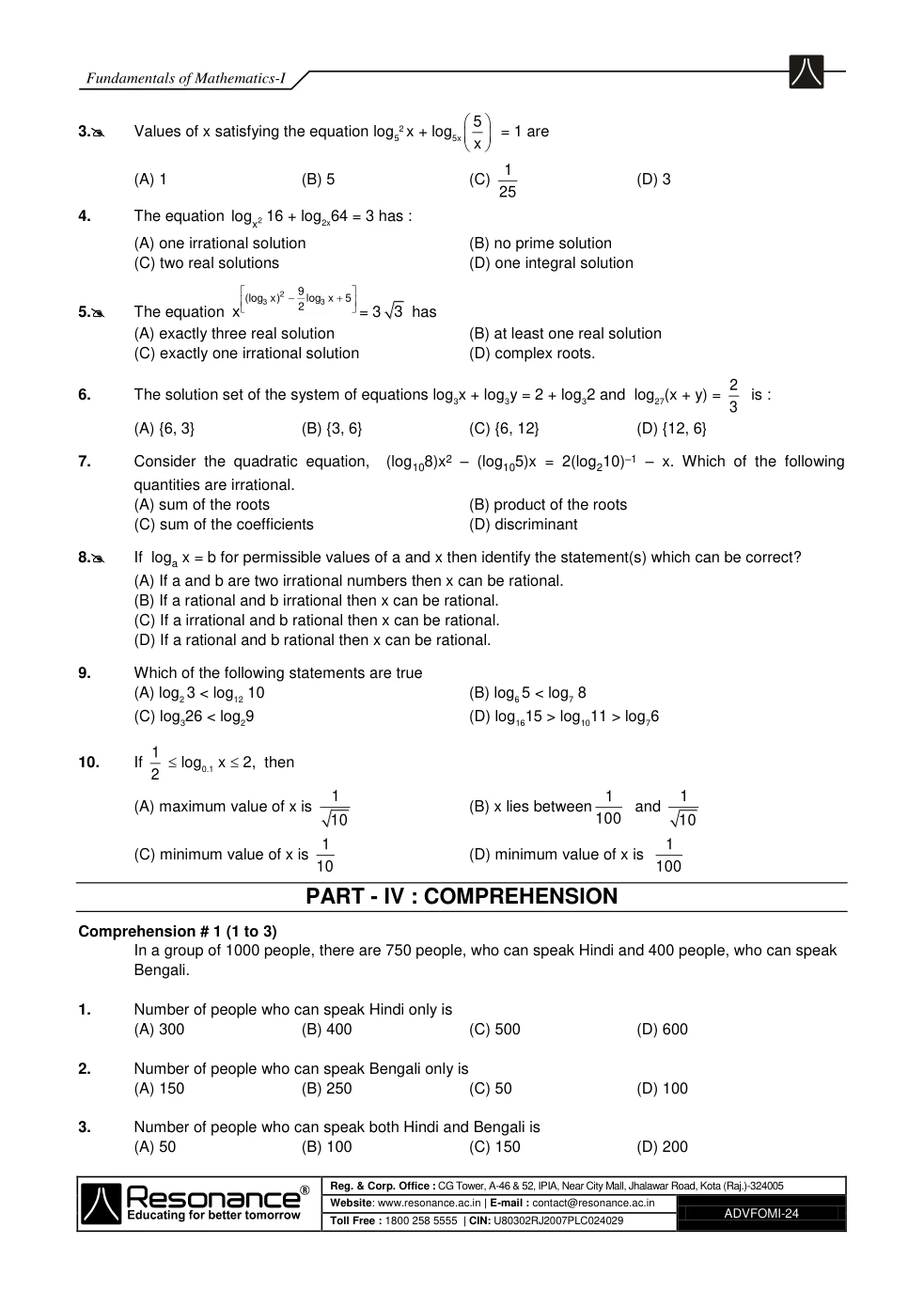
MAASFundamentals Of Mathematics I
© MAAS. All rights reserved.Page 48 / 58
Extracted text · page 48
Fundamentals of Mathematics-I
2 5 3. Values of x satisfying the equation log5 x + log5x = 1 are x
1
(A) 1 (B) 5 (C) (D) 3
25
4. The equation log 16 + log2x64 = 3 has : x 2
(A) one irrational solution (B) no prime solution
(C) two real solutions (D) one integral solution
2 9
(log3 x) log3 x 5
5. The equation x 2 = 3 3 has
(A) exactly three real solution (B) at least one real solution
(C) exactly one irrational solution (D) complex roots.
2
6. The solution set of the system of equations log3x + log3y = 2 + log32 and log27(x + y) = is :
3
(A) {6, 3} (B) {3, 6} (C) {6, 12} (D) {12, 6}
7. Consider the quadratic equation, (log108)x2 – (log105)x = 2(log210)–1 – x. Which of the following
quantities are irrational.
(A) sum of the roots (B) product of the roots
(C) sum of the coefficients (D) discriminant
8. If loga x = b for permissible values of a and x then identify the statement(s) which can be correct?
(A) If a and b are two irrational numbers then x can be rational.
(B) If a rational and b irrational then x can be rational.
(C) If a irrational and b rational then x can be rational.
(D) If a rational and b rational then x can be rational.
9. Which of the following statements are true
(A) log2 3 < log12 10 (B) log6 5 < log7 8
(C) log326 < log29 (D) log1615 > log1011 > log76
1
10. If log0.1 x 2, then
2
1 1 1
(A) maximum value of x is (B) x lies between and
10 100 10
1 1
(C) minimum value of x is (D) minimum value of x is
10 100
PART - IV : COMPREHENSION
Comprehension # 1 (1 to 3)
In a group of 1000 people, there are 750 people, who can speak Hindi and 400 people, who can speak
Bengali.
1. Number of people who can speak Hindi only is
(A) 300 (B) 400 (C) 500 (D) 600
2. Number of people who can speak Bengali only is
(A) 150 (B) 250 (C) 50 (D) 100
3. Number of people who can speak both Hindi and Bengali is
(A) 50 (B) 100 (C) 150 (D) 200
ADVFOMI-24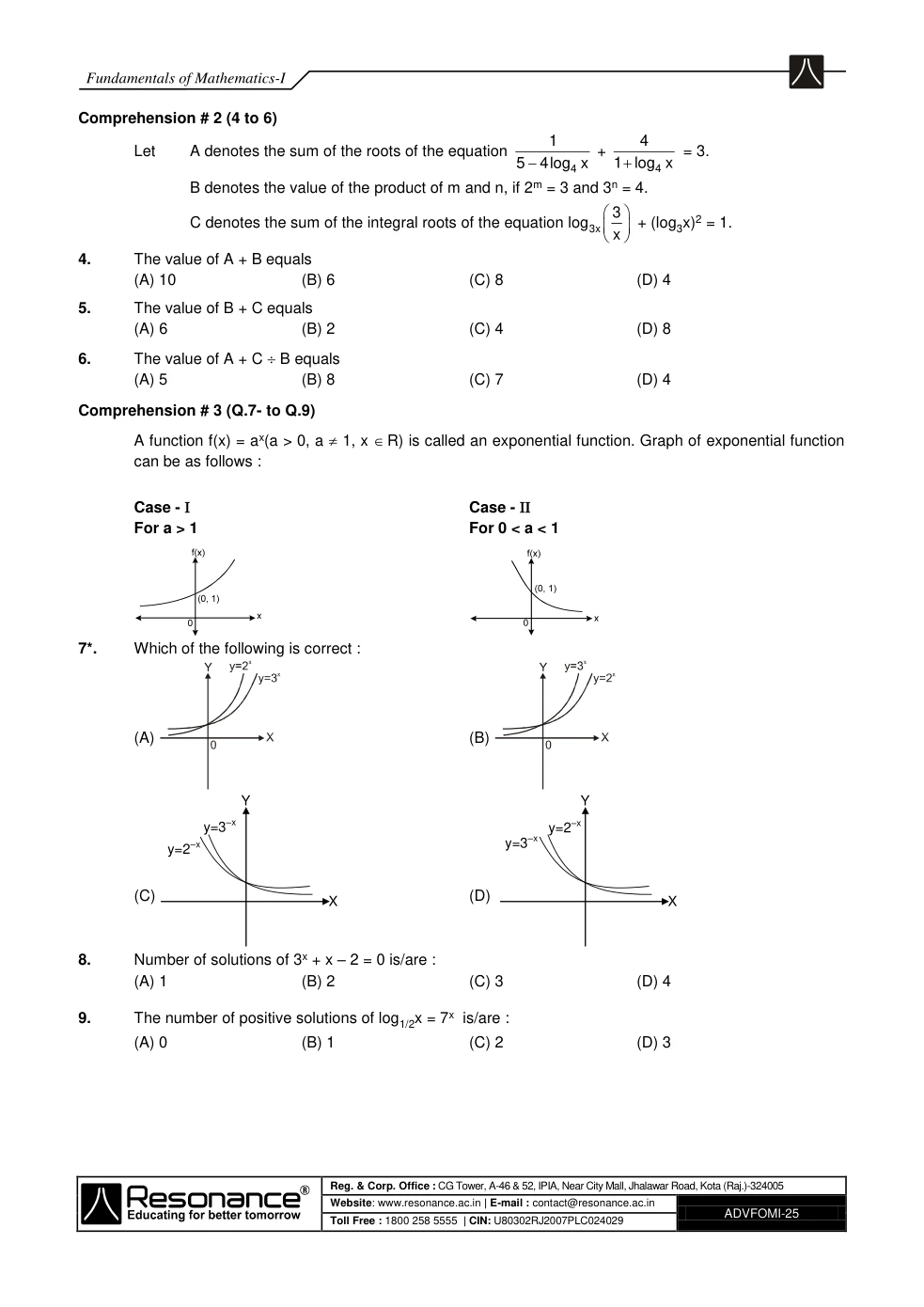
MAASFundamentals Of Mathematics I
© MAAS. All rights reserved.Page 49 / 58
Extracted text · page 49
Fundamentals of Mathematics-I
Comprehension # 2 (4 to 6)
1 4
Let A denotes the sum of the roots of the equation + = 3.
5 4log4 x 1 log 4 x
B denotes the value of the product of m and n, if 2m = 3 and 3n = 4.
3
C denotes the sum of the integral roots of the equation log3x + (log3x)2 = 1. x
4. The value of A + B equals
(A) 10 (B) 6 (C) 8 (D) 4
5. The value of B + C equals
(A) 6 (B) 2 (C) 4 (D) 8
6. The value of A + C B equals
(A) 5 (B) 8 (C) 7 (D) 4
Comprehension # 3 (Q.7- to Q.9)
A function f(x) = ax(a > 0, a 1, x R) is called an exponential function. Graph of exponential function
can be as follows :
Case - Case -
For a > 1 For 0 < a < 1
7*. Which of the following is correct :
(A) (B)
Y Y
y=3–x y=2–x
y=3–x y=2–x
(C) X (D) X
8. Number of solutions of 3x + x – 2 = 0 is/are :
(A) 1 (B) 2 (C) 3 (D) 4
9. The number of positive solutions of log1/2x = 7x is/are :
(A) 0 (B) 1 (C) 2 (D) 3
ADVFOMI-25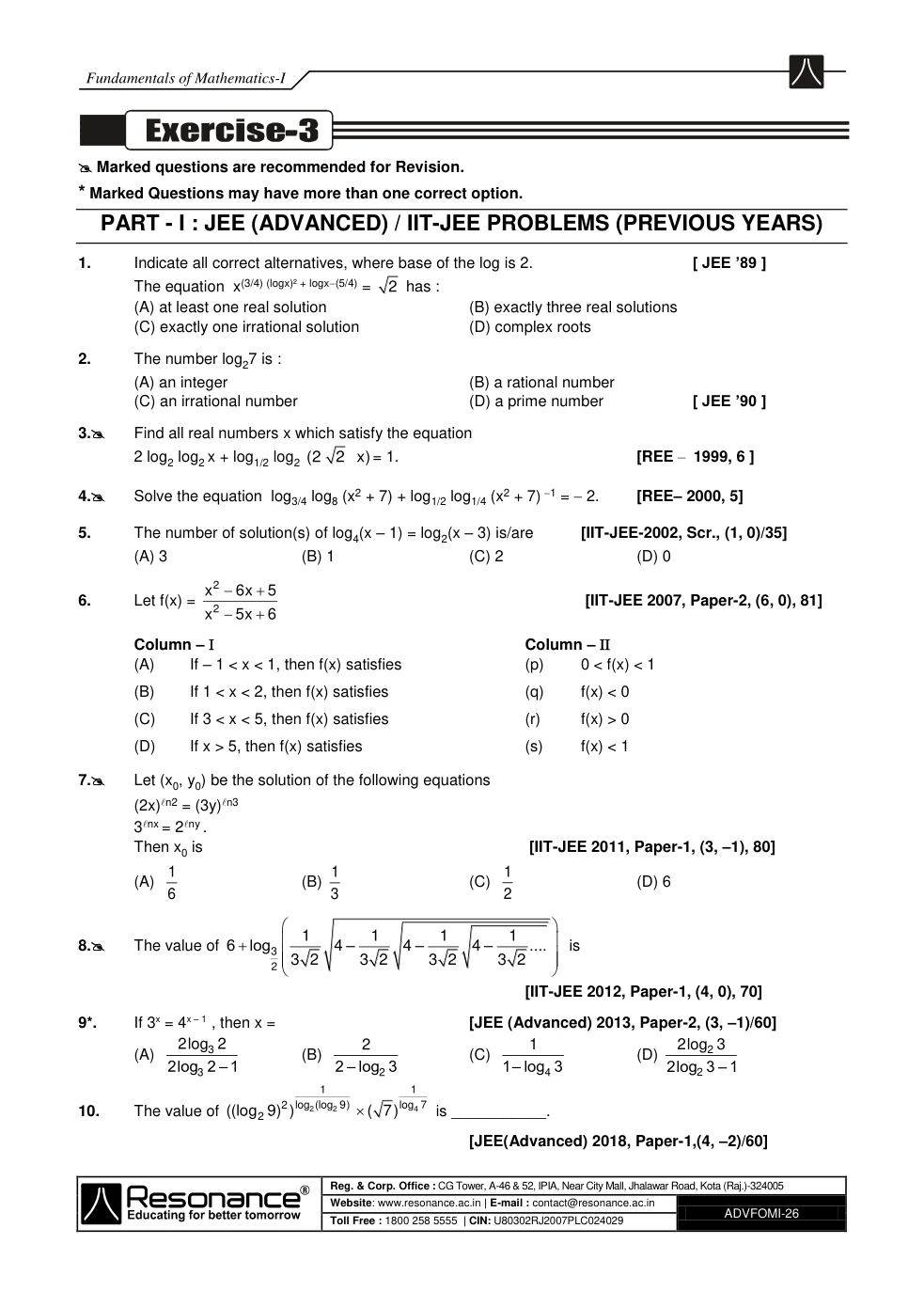
MAASFundamentals Of Mathematics I
© MAAS. All rights reserved.Page 50 / 58
Extracted text · page 50
Fundamentals of Mathematics-I
Marked questions are recommended for Revision.
* Marked Questions may have more than one correct option.
PART - I : JEE (ADVANCED) / IIT-JEE PROBLEMS (PREVIOUS YEARS)
1. Indicate all correct alternatives, where base of the log is 2. [ JEE ’89 ]
The equation x(3/4) (logx)² + logx(5/4) = 2 has :
(A) at least one real solution (B) exactly three real solutions
(C) exactly one irrational solution (D) complex roots
2. The number log27 is :
(A) an integer (B) a rational number
(C) an irrational number (D) a prime number [ JEE ’90 ]
3. Find all real numbers x which satisfy the equation
2 log2 log2 x + log1/2 log2 (2 2 x)= 1. [REE – 1999, 6 ]
4. Solve the equation log3/4 log8 (x2 + 7) + log1/2 log1/4 (x2 + 7) 1 = 2. [REE– 2000, 5]
5. The number of solution(s) of log4(x – 1) = log2(x – 3) is/are [IIT-JEE-2002, Scr., (1, 0)/35]
(A) 3 (B) 1 (C) 2 (D) 0
x 2 6x 5
6. Let f(x) = [IIT-JEE 2007, Paper-2, (6, 0), 81]
x 2 5x 6
Column – Column –
(A) If – 1 < x < 1, then f(x) satisfies (p) 0 < f(x) < 1
(B) If 1 < x < 2, then f(x) satisfies (q) f(x) < 0
(C) If 3 < x < 5, then f(x) satisfies (r) f(x) > 0
(D) If x > 5, then f(x) satisfies (s) f(x) < 1
7. Let (x0, y0) be the solution of the following equations
(2x)n2 = (3y)n3
3nx = 2ny .
Then x0 is [IIT-JEE 2011, Paper-1, (3, –1), 80]
1 1 1
(A) (B) (C) (D) 6
6 3 2
1 1 1 1 8. The value of 6 log 3 4 – 4 – 4 – .... is 3 2 3 2 3 2 3 2 2
[IIT-JEE 2012, Paper-1, (4, 0), 70]
9*. If 3x = 4x – 1 , then x = [JEE (Advanced) 2013, Paper-2, (3, –1)/60]
2log3 2 2 1 2log2 3 (A) (B) (C) (D)
2log3 2 – 1 2 – log2 3 1– log4 3 2log2 3 – 1
1 1
2 (log2 9) ( 7) log 4 7 is ___________.10. The value of ((log 2 9)2 ) log
[JEE(Advanced) 2018, Paper-1,(4, –2)/60]
ADVFOMI-26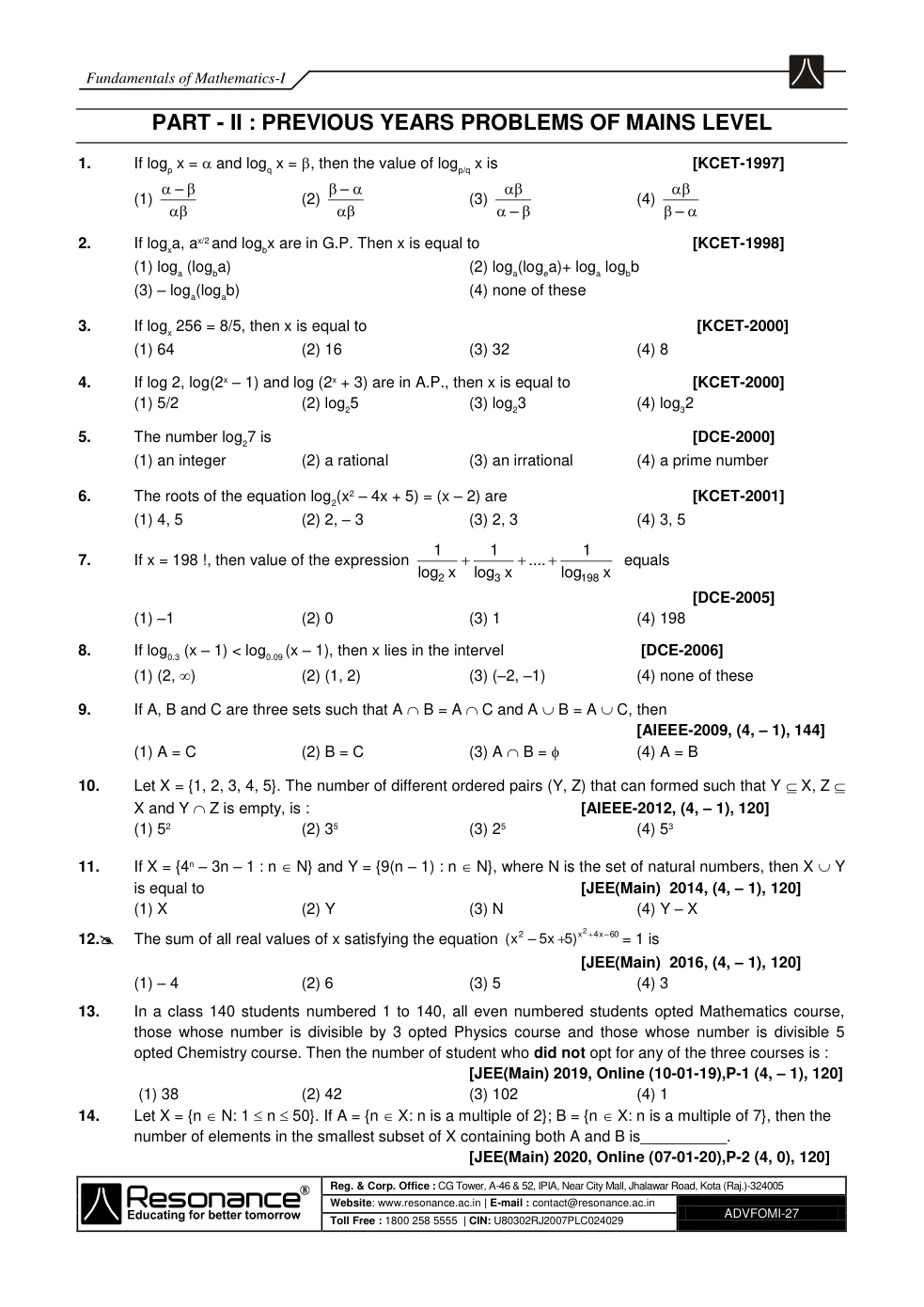
MAASFundamentals Of Mathematics I
© MAAS. All rights reserved.Page 51 / 58
Extracted text · page 51
Fundamentals of Mathematics-I
PART - II : PREVIOUS YEARS PROBLEMS OF MAINS LEVEL
1. If logp x = and logq x = , then the value of logp/q x is [KCET-1997]
– –
(1) (2) (3) (4)
– –
2. If logxa, ax/2 and logbx are in G.P. Then x is equal to [KCET-1998]
(1) loga (logba) (2) loga(logea)+ loga logbb
(3) – loga(logab) (4) none of these
3. If logx 256 = 8/5, then x is equal to [KCET-2000]
(1) 64 (2) 16 (3) 32 (4) 8
4. If log 2, log(2x – 1) and log (2x + 3) are in A.P., then x is equal to [KCET-2000]
(1) 5/2 (2) log25 (3) log23 (4) log32
5. The number log27 is [DCE-2000]
(1) an integer (2) a rational (3) an irrational (4) a prime number
6. The roots of the equation log2(x2 – 4x + 5) = (x – 2) are [KCET-2001]
(1) 4, 5 (2) 2, – 3 (3) 2, 3 (4) 3, 5
1 1 1
7. If x = 198 !, then value of the expression .... equals
log2 x log3 x log198 x
[DCE-2005]
(1) –1 (2) 0 (3) 1 (4) 198
8. If log0.3 (x – 1) < log0.09 (x – 1), then x lies in the intervel [DCE-2006]
(1) (2, ) (2) (1, 2) (3) (–2, –1) (4) none of these
9. If A, B and C are three sets such that A B = A C and A B = A C, then
[AIEEE-2009, (4, – 1), 144]
(1) A = C (2) B = C (3) A B = (4) A = B
10. Let X = {1, 2, 3, 4, 5}. The number of different ordered pairs (Y, Z) that can formed such that Y X, Z
X and Y Z is empty, is : [AIEEE-2012, (4, – 1), 120]
(1) 52 (2) 35 (3) 25 (4) 53
11. If X = {4n – 3n – 1 : n N} and Y = {9(n – 1) : n N}, where N is the set of natural numbers, then X Y
is equal to [JEE(Main) 2014, (4, – 1), 120]
(1) X (2) Y (3) N (4) Y – X
12. The sum of all real values of x satisfying the equation ( x 2 – 5 x 5) x 2 4 x – 60 = 1 is
[JEE(Main) 2016, (4, – 1), 120]
(1) – 4 (2) 6 (3) 5 (4) 3
13. In a class 140 students numbered 1 to 140, all even numbered students opted Mathematics course,
those whose number is divisible by 3 opted Physics course and those whose number is divisible 5
opted Chemistry course. Then the number of student who did not opt for any of the three courses is :
[JEE(Main) 2019, Online (10-01-19),P-1 (4, – 1), 120]
(1) 38 (2) 42 (3) 102 (4) 1
14. Let X = {n N: 1 n 50}. If A = {n X: n is a multiple of 2}; B = {n X: n is a multiple of 7}, then the
number of elements in the smallest subset of X containing both A and B is__________.
[JEE(Main) 2020, Online (07-01-20),P-2 (4, 0), 120]
ADVFOMI-27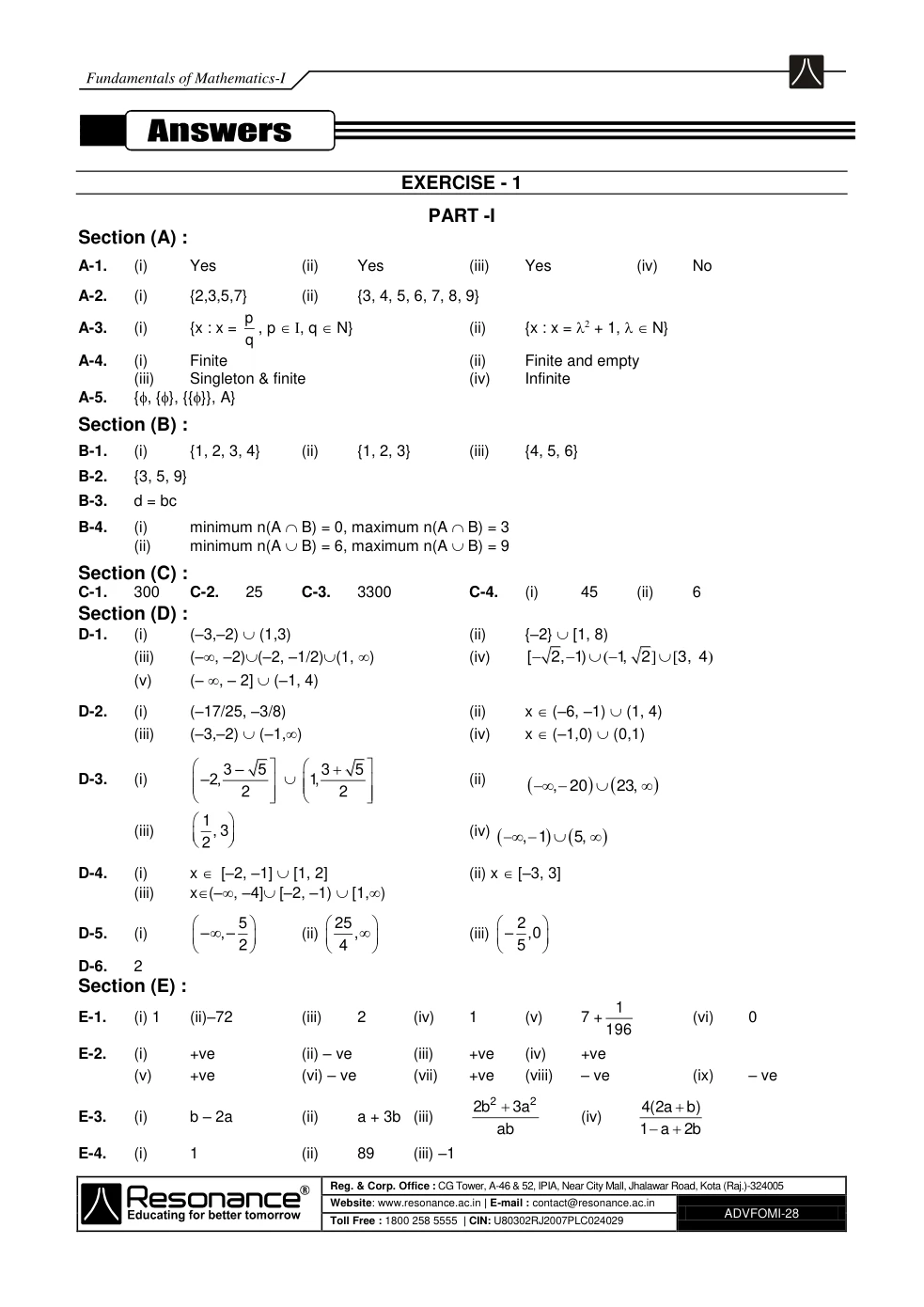
MAASFundamentals Of Mathematics I
© MAAS. All rights reserved.Page 52 / 58
Extracted text · page 52
Fundamentals of Mathematics-I
EXERCISE - 1
PART -I
Section (A) :
A-1. (i) Yes (ii) Yes (iii) Yes (iv) No
A-2. (i) {2,3,5,7} (ii) {3, 4, 5, 6, 7, 8, 9}
p
A-3. (i) {x : x = , p , q N} (ii) {x : x = + 1, N}
q
A-4. (i) Finite (ii) Finite and empty
(iii) Singleton & finite (iv) Infinite
A-5. {, {}, {{}}, A}
Section (B) :
B-1. (i) {1, 2, 3, 4} (ii) {1, 2, 3} (iii) {4, 5, 6}
B-2. {3, 5, 9}
B-3. d = bc
B-4. (i) minimum n(A B) = 0, maximum n(A B) = 3
(ii) minimum n(A B) = 6, maximum n(A B) = 9
Section (C) :
C-1. 300 C-2. 25 C-3. 3300 C-4. (i) 45 (ii) 6
Section (D) :
D-1. (i) (–3,–2) (1,3) (ii) {–2} [1, 8)
(iii) (–, –2)(–2, –1/2)(1, ) (iv) [ 2, 1) 1, 2 3, 4
(v) (– , – 2] (–1, 4)
D-2. (i) (–17/25, –3/8) (ii) x (–6, –1) (1, 4)
(iii) (–3,–2) (–1,) (iv) x (–1,0) (0,1)
3 – 5 3 5
–2, 1,D-3. (i) 2 (ii) , 20 23, 2
(iii) 1, 3 , 1 5, 2 (iv)
D-4. (i) x [–2, –1] [1, 2] (ii) x [–3, 3]
(iii) x(–, –4][–2, –1) [1,)
5 2 D-5. (i) – ,– (ii) 25, (iii) – ,0
2 4 5
D-6. 2
Section (E) :
1
E-1. (i) 1 (ii)–72 (iii) 2 (iv) 1 (v) 7 + (vi) 0
196
E-2. (i) +ve (ii) – ve (iii) +ve (iv) +ve
(v) +ve (vi) – ve (vii) +ve (viii) – ve (ix) – ve
2b 2 3a 2 4(2a b)
E-3. (i) b – 2a (ii) a + 3b (iii) (iv)
ab 1 a 2b
E-4. (i) 1 (ii) 89 (iii) –1
ADVFOMI-28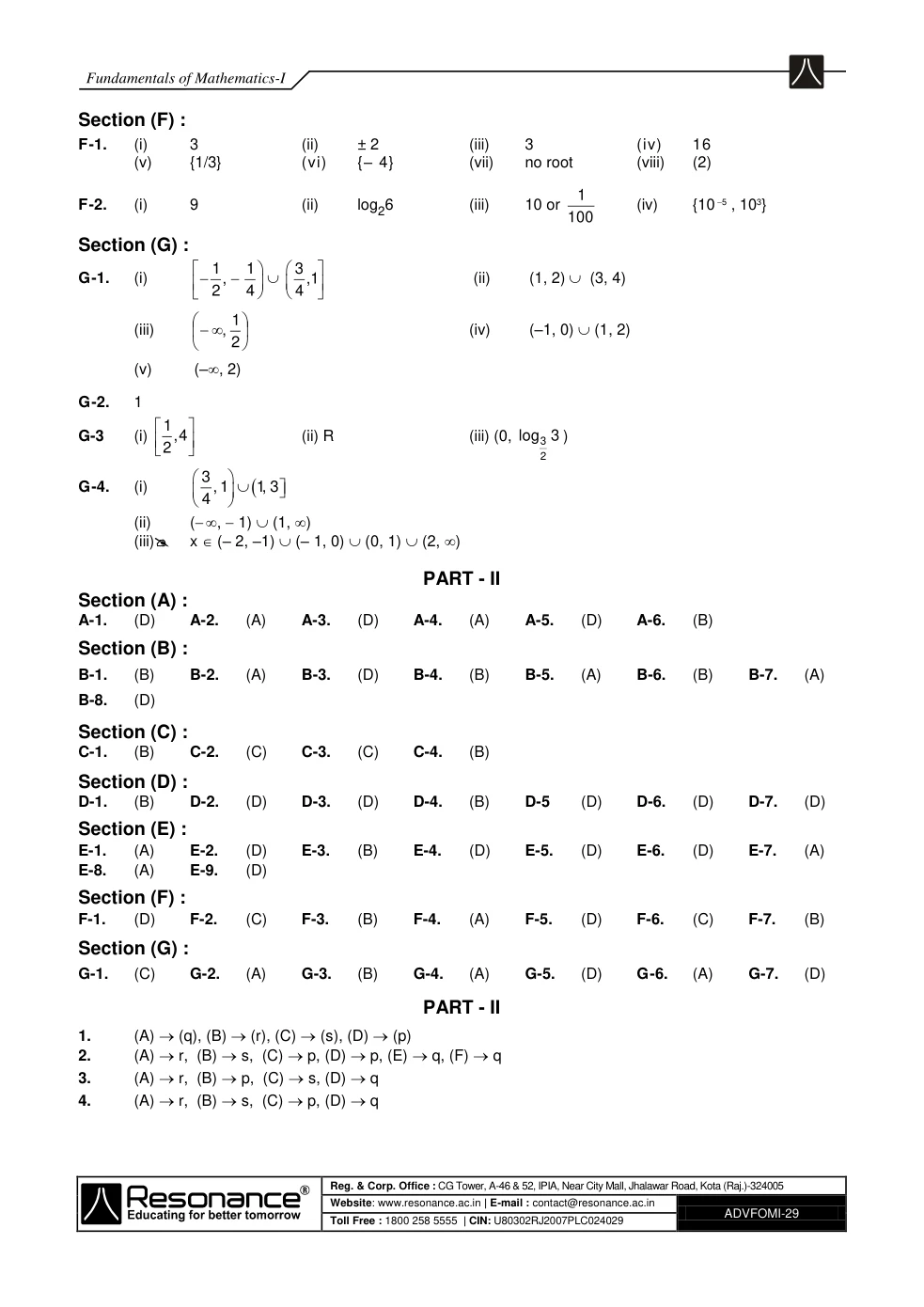
MAASFundamentals Of Mathematics I
© MAAS. All rights reserved.Page 53 / 58
Extracted text · page 53
Fundamentals of Mathematics-I
Section (F) :
F-1. (i) 3 (ii) ± 2 (iii) 3 (iv) 16
(v) {1/3} (vi) {– 4} (vii) no root (viii) (2)
1 5F-2. (i) 9 (ii) log26 (iii) 10 or (iv) {10 , 103} 100
Section (G) :
1 1 G-1. (i) , 3 ,1 (ii) (1, 2) (3, 4)
2 4 4
1
(iii) , (iv) (–1, 0) (1, 2)
2
(v) (–, 2)
G-2. 1
1,4 G-3 (i) (ii) R (iii) (0, log 3 3 )
2 2
3
G-4. (i) , 1 1, 3 4
(ii) (, 1) (1, )
(iii) x (– 2, –1) (– 1, 0) (0, 1) (2, )
PART - II
Section (A) :
A-1. (D) A-2. (A) A-3. (D) A-4. (A) A-5. (D) A-6. (B)
Section (B) :
B-1. (B) B-2. (A) B-3. (D) B-4. (B) B-5. (A) B-6. (B) B-7. (A)
B-8. (D)
Section (C) :
C-1. (B) C-2. (C) C-3. (C) C-4. (B)
Section (D) :
D-1. (B) D-2. (D) D-3. (D) D-4. (B) D-5 (D) D-6. (D) D-7. (D)
Section (E) :
E-1. (A) E-2. (D) E-3. (B) E-4. (D) E-5. (D) E-6. (D) E-7. (A)
E-8. (A) E-9. (D)
Section (F) :
F-1. (D) F-2. (C) F-3. (B) F-4. (A) F-5. (D) F-6. (C) F-7. (B)
Section (G) :
G-1. (C) G-2. (A) G-3. (B) G-4. (A) G-5. (D) G-6. (A) G-7. (D)
PART - II
1. (A) (q), (B) (r), (C) (s), (D) (p)
2. (A) r, (B) s, (C) p, (D) p, (E) q, (F) q
3. (A) r, (B) p, (C) s, (D) q
4. (A) r, (B) s, (C) p, (D) q
ADVFOMI-29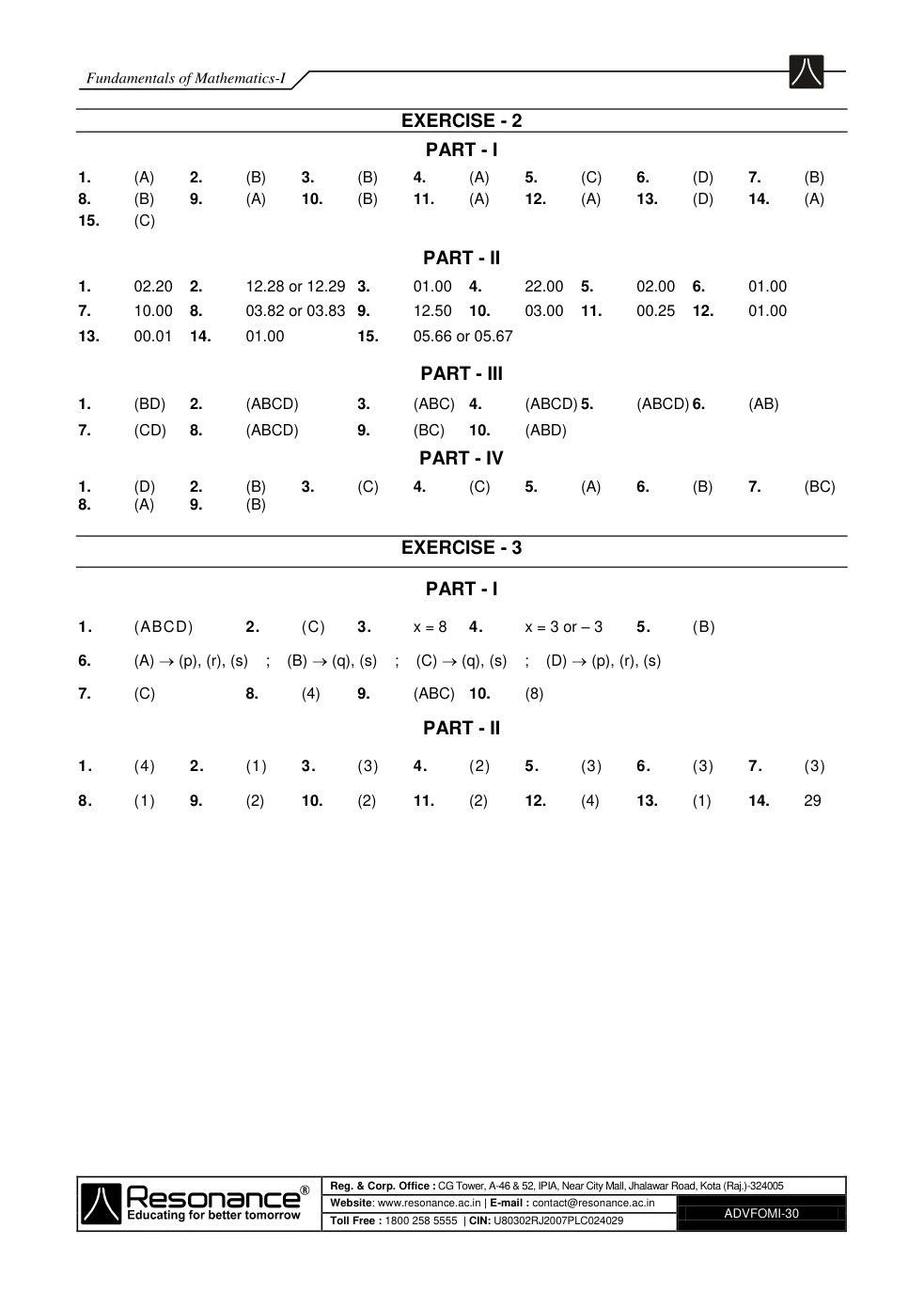
MAASFundamentals Of Mathematics I
© MAAS. All rights reserved.Page 54 / 58
Extracted text · page 54
Fundamentals of Mathematics-I
EXERCISE - 2
PART - I
1. (A) 2. (B) 3. (B) 4. (A) 5. (C) 6. (D) 7. (B)
8. (B) 9. (A) 10. (B) 11. (A) 12. (A) 13. (D) 14. (A)
15. (C)
PART - II
1. 02.20 2. 12.28 or 12.29 3. 01.00 4. 22.00 5. 02.00 6. 01.00
7. 10.00 8. 03.82 or 03.83 9. 12.50 10. 03.00 11. 00.25 12. 01.00
13. 00.01 14. 01.00 15. 05.66 or 05.67
PART - III
1. (BD) 2. (ABCD) 3. (ABC) 4. (ABCD) 5. (ABCD) 6. (AB)
7. (CD) 8. (ABCD) 9. (BC) 10. (ABD)
PART - IV
1. (D) 2. (B) 3. (C) 4. (C) 5. (A) 6. (B) 7. (BC)
8. (A) 9. (B)
EXERCISE - 3
PART - I
1. (ABCD) 2. (C) 3. x = 8 4. x = 3 or – 3 5. (B)
6. (A) (p), (r), (s) ; (B) (q), (s) ; (C) (q), (s) ; (D) (p), (r), (s)
7. (C) 8. (4) 9. (ABC) 10. (8)
PART - II
1. (4) 2. (1) 3. (3) 4. (2) 5. (3) 6. (3) 7. (3)
8. (1) 9. (2) 10. (2) 11. (2) 12. (4) 13. (1) 14. 29
ADVFOMI-30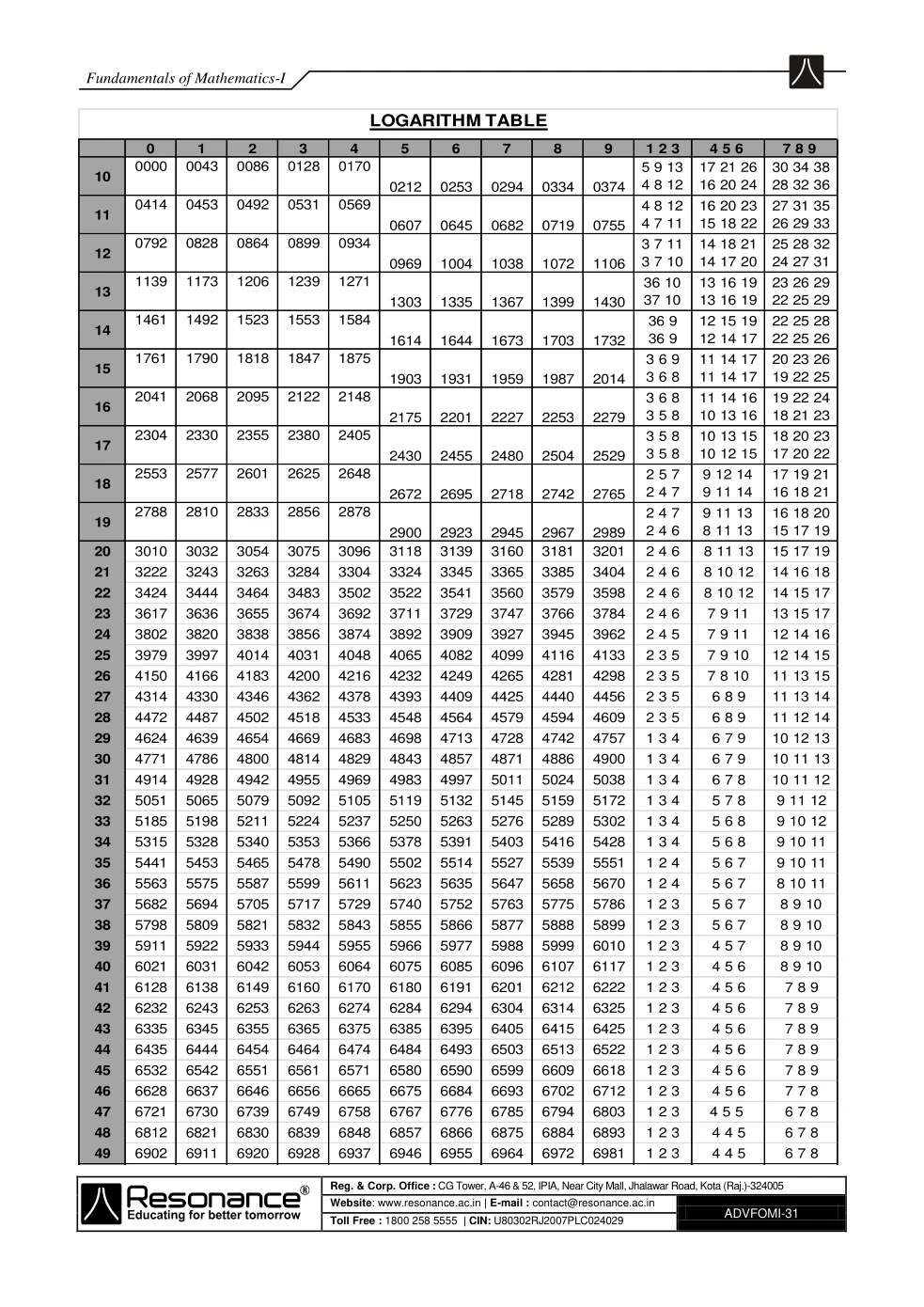
MAASFundamentals Of Mathematics I
© MAAS. All rights reserved.Page 55 / 58
Extracted text · page 55
Fundamentals of Mathematics-I

                       LOGARITHM TABLE

       0     1     2     3     4     5     6     7     8     9    1 2 3    4 5 6     7 8 9
      0000  0043  0086  0128  0170                                5 9 13  17 21 26  30 34 38
 10
                                     0212  0253  0294  0334  0374  4 8 12  16 20 24  28 32 36
      0414  0453  0492  0531  0569                                4 8 12  16 20 23  27 31 35
 11
                                     0607  0645  0682  0719  0755  4 7 11  15 18 22  26 29 33
      0792  0828  0864  0899  0934                                3 7 11  14 18 21  25 28 32
 12
                                     0969  1004  1038  1072  1106  3 7 10  14 17 20  24 27 31
      1139  1173  1206  1239  1271                                 36 10  13 16 19  23 26 29
 13
                                     1303  1335  1367  1399  1430  37 10  13 16 19  22 25 29
      1461  1492  1523  1553  1584                                  36 9   12 15 19  22 25 28
 14
                                     1614  1644  1673  1703  1732   36 9   12 14 17  22 25 26
      1761  1790  1818  1847  1875                                 3 6 9  11 14 17  20 23 26
 15
                                     1903  1931  1959  1987  2014  3 6 8  11 14 17  19 22 25
      2041  2068  2095  2122  2148                                 3 6 8  11 14 16  19 22 24
 16
                                     2175  2201  2227  2253  2279  3 5 8  10 13 16  18 21 23
      2304  2330  2355  2380  2405                                 3 5 8  10 13 15  18 20 23
 17
                                     2430  2455  2480  2504  2529  3 5 8  10 12 15  17 20 22
      2553  2577  2601  2625  2648                                 2 5 7   9 12 14  17 19 21
 18
                                     2672  2695  2718  2742  2765  2 4 7   9 11 14  16 18 21
      2788  2810  2833  2856  2878                                 2 4 7   9 11 13  16 18 20
 19
                                     2900  2923  2945  2967  2989  2 4 6   8 11 13  15 17 19
 20   3010  3032  3054  3075  3096  3118  3139  3160  3181  3201  2 4 6   8 11 13  15 17 19
 21   3222  3243  3263  3284  3304  3324  3345  3365  3385  3404  2 4 6   8 10 12  14 16 18
 22   3424  3444  3464  3483  3502  3522  3541  3560  3579  3598  2 4 6   8 10 12  14 15 17
 23   3617  3636  3655  3674  3692  3711  3729  3747  3766  3784  2 4 6   7 9 11   13 15 17
 24   3802  3820  3838  3856  3874  3892  3909  3927  3945  3962  2 4 5   7 9 11   12 14 16
 25   3979  3997  4014  4031  4048  4065  4082  4099  4116  4133  2 3 5   7 9 10   12 14 15
 26   4150  4166  4183  4200  4216  4232  4249  4265  4281  4298  2 3 5   7 8 10   11 13 15
 27   4314  4330  4346  4362  4378  4393  4409  4425  4440  4456  2 3 5    6 8 9   11 13 14
 28   4472  4487  4502  4518  4533  4548  4564  4579  4594  4609  2 3 5    6 8 9   11 12 14
 29   4624  4639  4654  4669  4683  4698  4713  4728  4742  4757  1 3 4    6 7 9   10 12 13
 30   4771  4786  4800  4814  4829  4843  4857  4871  4886  4900  1 3 4    6 7 9   10 11 13
 31   4914  4928  4942  4955  4969  4983  4997  5011  5024  5038  1 3 4    6 7 8   10 11 12
 32   5051  5065  5079  5092  5105  5119  5132  5145  5159  5172  1 3 4    5 7 8    9 11 12
 33   5185  5198  5211  5224  5237  5250  5263  5276  5289  5302  1 3 4    5 6 8    9 10 12
 34   5315  5328  5340  5353  5366  5378  5391  5403  5416  5428  1 3 4    5 6 8    9 10 11
 35   5441  5453  5465  5478  5490  5502  5514  5527  5539  5551  1 2 4    5 6 7    9 10 11
 36   5563  5575  5587  5599  5611  5623  5635  5647  5658  5670  1 2 4    5 6 7    8 10 11
 37   5682  5694  5705  5717  5729  5740  5752  5763  5775  5786  1 2 3    5 6 7    8 9 10
 38   5798  5809  5821  5832  5843  5855  5866  5877  5888  5899  1 2 3    5 6 7    8 9 10
 39   5911  5922  5933  5944  5955  5966  5977  5988  5999  6010  1 2 3    4 5 7    8 9 10
 40   6021  6031  6042  6053  6064  6075  6085  6096  6107  6117  1 2 3    4 5 6    8 9 10
 41   6128  6138  6149  6160  6170  6180  6191  6201  6212  6222  1 2 3    4 5 6     7 8 9
 42   6232  6243  6253  6263  6274  6284  6294  6304  6314  6325  1 2 3    4 5 6     7 8 9
 43   6335  6345  6355  6365  6375  6385  6395  6405  6415  6425  1 2 3    4 5 6     7 8 9
 44   6435  6444  6454  6464  6474  6484  6493  6503  6513  6522  1 2 3    4 5 6     7 8 9
 45   6532  6542  6551  6561  6571  6580  6590  6599  6609  6618  1 2 3    4 5 6     7 8 9
 46   6628  6637  6646  6656  6665  6675  6684  6693  6702  6712  1 2 3    4 5 6     7 7 8
 47   6721  6730  6739  6749  6758  6767  6776  6785  6794  6803  1 2 3    4 5 5     6 7 8
 48   6812  6821  6830  6839  6848  6857  6866  6875  6884  6893  1 2 3    4 4 5     6 7 8
 49   6902  6911  6920  6928  6937  6946  6955  6964  6972  6981  1 2 3    4 4 5     6 7 8


                                                                                     ADVFOMI-31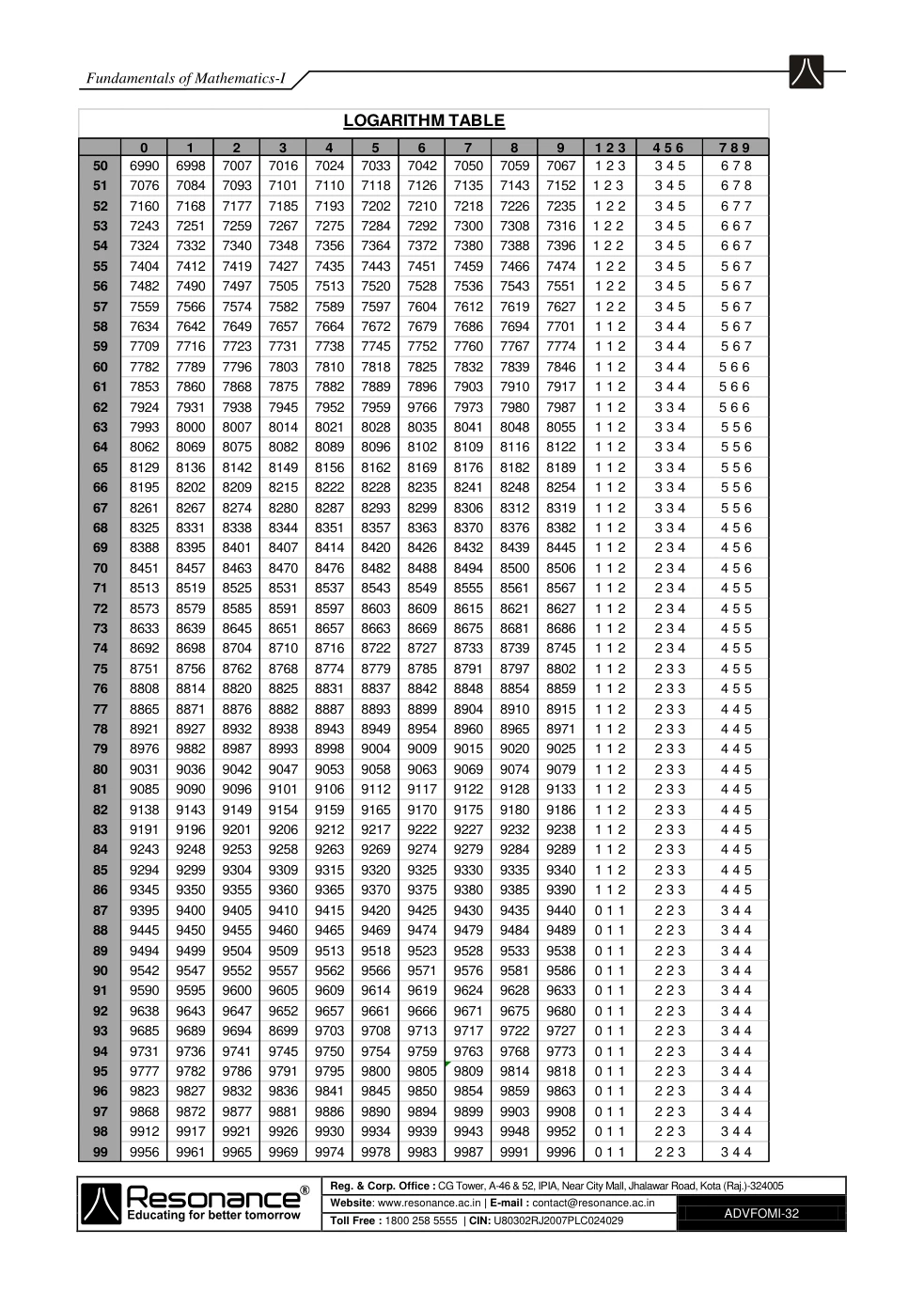
MAASFundamentals Of Mathematics I
© MAAS. All rights reserved.Page 56 / 58
Extracted text · page 56
Fundamentals of Mathematics-I

                       LOGARITHM TABLE

       0     1     2     3     4     5     6     7     8     9    1 2 3    4 5 6     7 8 9
 50   6990  6998  7007  7016  7024  7033  7042  7050  7059  7067  1 2 3    3 4 5     6 7 8
 51   7076  7084  7093  7101  7110  7118  7126  7135  7143  7152  1 2 3    3 4 5     6 7 8
 52   7160  7168  7177  7185  7193  7202  7210  7218  7226  7235  1 2 2    3 4 5     6 7 7
 53   7243  7251  7259  7267  7275  7284  7292  7300  7308  7316  1 2 2    3 4 5     6 6 7
 54   7324  7332  7340  7348  7356  7364  7372  7380  7388  7396  1 2 2    3 4 5     6 6 7
 55   7404  7412  7419  7427  7435  7443  7451  7459  7466  7474  1 2 2    3 4 5     5 6 7
 56   7482  7490  7497  7505  7513  7520  7528  7536  7543  7551  1 2 2    3 4 5     5 6 7
 57   7559  7566  7574  7582  7589  7597  7604  7612  7619  7627  1 2 2    3 4 5     5 6 7
 58   7634  7642  7649  7657  7664  7672  7679  7686  7694  7701  1 1 2    3 4 4     5 6 7
 59   7709  7716  7723  7731  7738  7745  7752  7760  7767  7774  1 1 2    3 4 4     5 6 7
 60   7782  7789  7796  7803  7810  7818  7825  7832  7839  7846  1 1 2    3 4 4    5 6 6
 61   7853  7860  7868  7875  7882  7889  7896  7903  7910  7917  1 1 2    3 4 4    5 6 6
 62   7924  7931  7938  7945  7952  7959  9766  7973  7980  7987  1 1 2    3 3 4    5 6 6
 63   7993  8000  8007  8014  8021  8028  8035  8041  8048  8055  1 1 2    3 3 4     5 5 6
 64   8062  8069  8075  8082  8089  8096  8102  8109  8116  8122  1 1 2    3 3 4     5 5 6
 65   8129  8136  8142  8149  8156  8162  8169  8176  8182  8189  1 1 2    3 3 4     5 5 6
 66   8195  8202  8209  8215  8222  8228  8235  8241  8248  8254  1 1 2    3 3 4     5 5 6
 67   8261  8267  8274  8280  8287  8293  8299  8306  8312  8319  1 1 2    3 3 4     5 5 6
 68   8325  8331  8338  8344  8351  8357  8363  8370  8376  8382  1 1 2    3 3 4     4 5 6
 69   8388  8395  8401  8407  8414  8420  8426  8432  8439  8445  1 1 2    2 3 4     4 5 6
 70   8451  8457  8463  8470  8476  8482  8488  8494  8500  8506  1 1 2    2 3 4     4 5 6
 71   8513  8519  8525  8531  8537  8543  8549  8555  8561  8567  1 1 2    2 3 4     4 5 5
 72   8573  8579  8585  8591  8597  8603  8609  8615  8621  8627  1 1 2    2 3 4     4 5 5
 73   8633  8639  8645  8651  8657  8663  8669  8675  8681  8686  1 1 2    2 3 4     4 5 5
 74   8692  8698  8704  8710  8716  8722  8727  8733  8739  8745  1 1 2    2 3 4     4 5 5
 75   8751  8756  8762  8768  8774  8779  8785  8791  8797  8802  1 1 2    2 3 3     4 5 5
 76   8808  8814  8820  8825  8831  8837  8842  8848  8854  8859  1 1 2    2 3 3     4 5 5
 77   8865  8871  8876  8882  8887  8893  8899  8904  8910  8915  1 1 2    2 3 3     4 4 5
 78   8921  8927  8932  8938  8943  8949  8954  8960  8965  8971  1 1 2    2 3 3     4 4 5
 79   8976  9882  8987  8993  8998  9004  9009  9015  9020  9025  1 1 2    2 3 3     4 4 5
 80   9031  9036  9042  9047  9053  9058  9063  9069  9074  9079  1 1 2    2 3 3     4 4 5
 81   9085  9090  9096  9101  9106  9112  9117  9122  9128  9133  1 1 2    2 3 3     4 4 5
 82   9138  9143  9149  9154  9159  9165  9170  9175  9180  9186  1 1 2    2 3 3     4 4 5
 83   9191  9196  9201  9206  9212  9217  9222  9227  9232  9238  1 1 2    2 3 3     4 4 5
 84   9243  9248  9253  9258  9263  9269  9274  9279  9284  9289  1 1 2    2 3 3     4 4 5
 85   9294  9299  9304  9309  9315  9320  9325  9330  9335  9340  1 1 2    2 3 3     4 4 5
 86   9345  9350  9355  9360  9365  9370  9375  9380  9385  9390  1 1 2    2 3 3     4 4 5
 87   9395  9400  9405  9410  9415  9420  9425  9430  9435  9440  0 1 1    2 2 3     3 4 4
 88   9445  9450  9455  9460  9465  9469  9474  9479  9484  9489  0 1 1    2 2 3     3 4 4
 89   9494  9499  9504  9509  9513  9518  9523  9528  9533  9538  0 1 1    2 2 3     3 4 4
 90   9542  9547  9552  9557  9562  9566  9571  9576  9581  9586  0 1 1    2 2 3     3 4 4
 91   9590  9595  9600  9605  9609  9614  9619  9624  9628  9633  0 1 1    2 2 3     3 4 4
 92   9638  9643  9647  9652  9657  9661  9666  9671  9675  9680  0 1 1    2 2 3     3 4 4
 93   9685  9689  9694  8699  9703  9708  9713  9717  9722  9727  0 1 1    2 2 3     3 4 4
 94   9731  9736  9741  9745  9750  9754  9759  9763  9768  9773  0 1 1    2 2 3     3 4 4
 95   9777  9782  9786  9791  9795  9800  9805  9809  9814  9818  0 1 1    2 2 3     3 4 4
 96   9823  9827  9832  9836  9841  9845  9850  9854  9859  9863  0 1 1    2 2 3     3 4 4
 97   9868  9872  9877  9881  9886  9890  9894  9899  9903  9908  0 1 1    2 2 3     3 4 4
 98   9912  9917  9921  9926  9930  9934  9939  9943  9948  9952  0 1 1    2 2 3     3 4 4
 99   9956  9961  9965  9969  9974  9978  9983  9987  9991  9996  0 1 1    2 2 3     3 4 4


                                                                                     ADVFOMI-32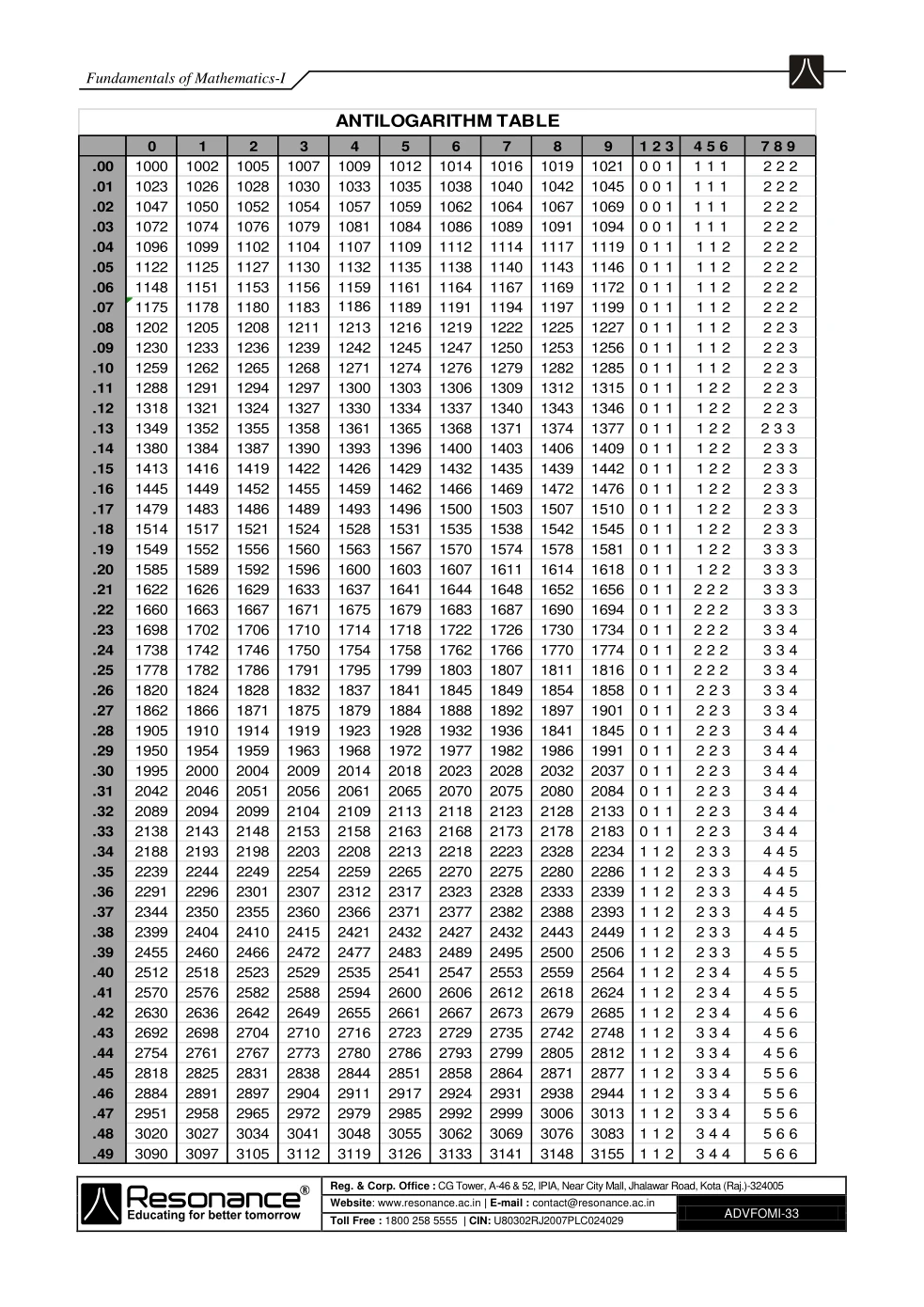
MAASFundamentals Of Mathematics I
© MAAS. All rights reserved.Page 57 / 58
Extracted text · page 57
Fundamentals of Mathematics-I

                     ANTILOGARITHM TABLE

       0     1     2     3     4     5     6     7     8     9   1 2 3  4 5 6    7 8 9
 .00   1000  1002  1005  1007  1009  1012  1014  1016  1019  1021  0 0 1  1 1 1    2 2 2
 .01   1023  1026  1028  1030  1033  1035  1038  1040  1042  1045  0 0 1  1 1 1    2 2 2
 .02   1047  1050  1052  1054  1057  1059  1062  1064  1067  1069  0 0 1  1 1 1    2 2 2
 .03   1072  1074  1076  1079  1081  1084  1086  1089  1091  1094  0 0 1  1 1 1    2 2 2
 .04   1096  1099  1102  1104  1107  1109  1112  1114  1117  1119  0 1 1   1 1 2    2 2 2
 .05   1122  1125  1127  1130  1132  1135  1138  1140  1143  1146  0 1 1   1 1 2    2 2 2
 .06   1148  1151  1153  1156  1159  1161  1164  1167  1169  1172  0 1 1   1 1 2    2 2 2
 .07   1175  1178  1180  1183  1186  1189  1191  1194  1197  1199  0 1 1   1 1 2    2 2 2
 .08   1202  1205  1208  1211  1213  1216  1219  1222  1225  1227  0 1 1   1 1 2    2 2 3
 .09   1230  1233  1236  1239  1242  1245  1247  1250  1253  1256  0 1 1   1 1 2    2 2 3
 .10   1259  1262  1265  1268  1271  1274  1276  1279  1282  1285  0 1 1   1 1 2    2 2 3
 .11   1288  1291  1294  1297  1300  1303  1306  1309  1312  1315  0 1 1   1 2 2    2 2 3
 .12   1318  1321  1324  1327  1330  1334  1337  1340  1343  1346  0 1 1   1 2 2    2 2 3
 .13   1349  1352  1355  1358  1361  1365  1368  1371  1374  1377  0 1 1   1 2 2    2 3 3
 .14   1380  1384  1387  1390  1393  1396  1400  1403  1406  1409  0 1 1   1 2 2    2 3 3
 .15   1413  1416  1419  1422  1426  1429  1432  1435  1439  1442  0 1 1   1 2 2    2 3 3
 .16   1445  1449  1452  1455  1459  1462  1466  1469  1472  1476  0 1 1   1 2 2    2 3 3
 .17   1479  1483  1486  1489  1493  1496  1500  1503  1507  1510  0 1 1   1 2 2    2 3 3
 .18   1514  1517  1521  1524  1528  1531  1535  1538  1542  1545  0 1 1   1 2 2    2 3 3
 .19   1549  1552  1556  1560  1563  1567  1570  1574  1578  1581  0 1 1   1 2 2    3 3 3
 .20   1585  1589  1592  1596  1600  1603  1607  1611  1614  1618  0 1 1   1 2 2    3 3 3
 .21   1622  1626  1629  1633  1637  1641  1644  1648  1652  1656  0 1 1  2 2 2    3 3 3
 .22   1660  1663  1667  1671  1675  1679  1683  1687  1690  1694  0 1 1  2 2 2    3 3 3
 .23   1698  1702  1706  1710  1714  1718  1722  1726  1730  1734  0 1 1  2 2 2    3 3 4
 .24   1738  1742  1746  1750  1754  1758  1762  1766  1770  1774  0 1 1  2 2 2    3 3 4
 .25   1778  1782  1786  1791  1795  1799  1803  1807  1811  1816  0 1 1  2 2 2    3 3 4
 .26   1820  1824  1828  1832  1837  1841  1845  1849  1854  1858  0 1 1   2 2 3    3 3 4
 .27   1862  1866  1871  1875  1879  1884  1888  1892  1897  1901  0 1 1   2 2 3    3 3 4
 .28   1905  1910  1914  1919  1923  1928  1932  1936  1841  1845  0 1 1   2 2 3    3 4 4
 .29   1950  1954  1959  1963  1968  1972  1977  1982  1986  1991  0 1 1   2 2 3    3 4 4
 .30   1995  2000  2004  2009  2014  2018  2023  2028  2032  2037  0 1 1   2 2 3    3 4 4
 .31   2042  2046  2051  2056  2061  2065  2070  2075  2080  2084  0 1 1   2 2 3    3 4 4
 .32   2089  2094  2099  2104  2109  2113  2118  2123  2128  2133  0 1 1   2 2 3    3 4 4
 .33   2138  2143  2148  2153  2158  2163  2168  2173  2178  2183  0 1 1   2 2 3    3 4 4
 .34   2188  2193  2198  2203  2208  2213  2218  2223  2328  2234  1 1 2   2 3 3    4 4 5
 .35   2239  2244  2249  2254  2259  2265  2270  2275  2280  2286  1 1 2   2 3 3    4 4 5
 .36   2291  2296  2301  2307  2312  2317  2323  2328  2333  2339  1 1 2   2 3 3    4 4 5
 .37   2344  2350  2355  2360  2366  2371  2377  2382  2388  2393  1 1 2   2 3 3    4 4 5
 .38   2399  2404  2410  2415  2421  2432  2427  2432  2443  2449  1 1 2   2 3 3    4 4 5
 .39   2455  2460  2466  2472  2477  2483  2489  2495  2500  2506  1 1 2   2 3 3    4 5 5
 .40   2512  2518  2523  2529  2535  2541  2547  2553  2559  2564  1 1 2   2 3 4    4 5 5
 .41   2570  2576  2582  2588  2594  2600  2606  2612  2618  2624  1 1 2   2 3 4    4 5 5
 .42   2630  2636  2642  2649  2655  2661  2667  2673  2679  2685  1 1 2   2 3 4    4 5 6
 .43   2692  2698  2704  2710  2716  2723  2729  2735  2742  2748  1 1 2   3 3 4    4 5 6
 .44   2754  2761  2767  2773  2780  2786  2793  2799  2805  2812  1 1 2   3 3 4    4 5 6
 .45   2818  2825  2831  2838  2844  2851  2858  2864  2871  2877  1 1 2   3 3 4    5 5 6
 .46   2884  2891  2897  2904  2911  2917  2924  2931  2938  2944  1 1 2   3 3 4    5 5 6
 .47   2951  2958  2965  2972  2979  2985  2992  2999  3006  3013  1 1 2   3 3 4    5 5 6
 .48   3020  3027  3034  3041  3048  3055  3062  3069  3076  3083  1 1 2   3 4 4    5 6 6
 .49   3090  3097  3105  3112  3119  3126  3133  3141  3148  3155  1 1 2   3 4 4    5 6 6


                                                                                     ADVFOMI-33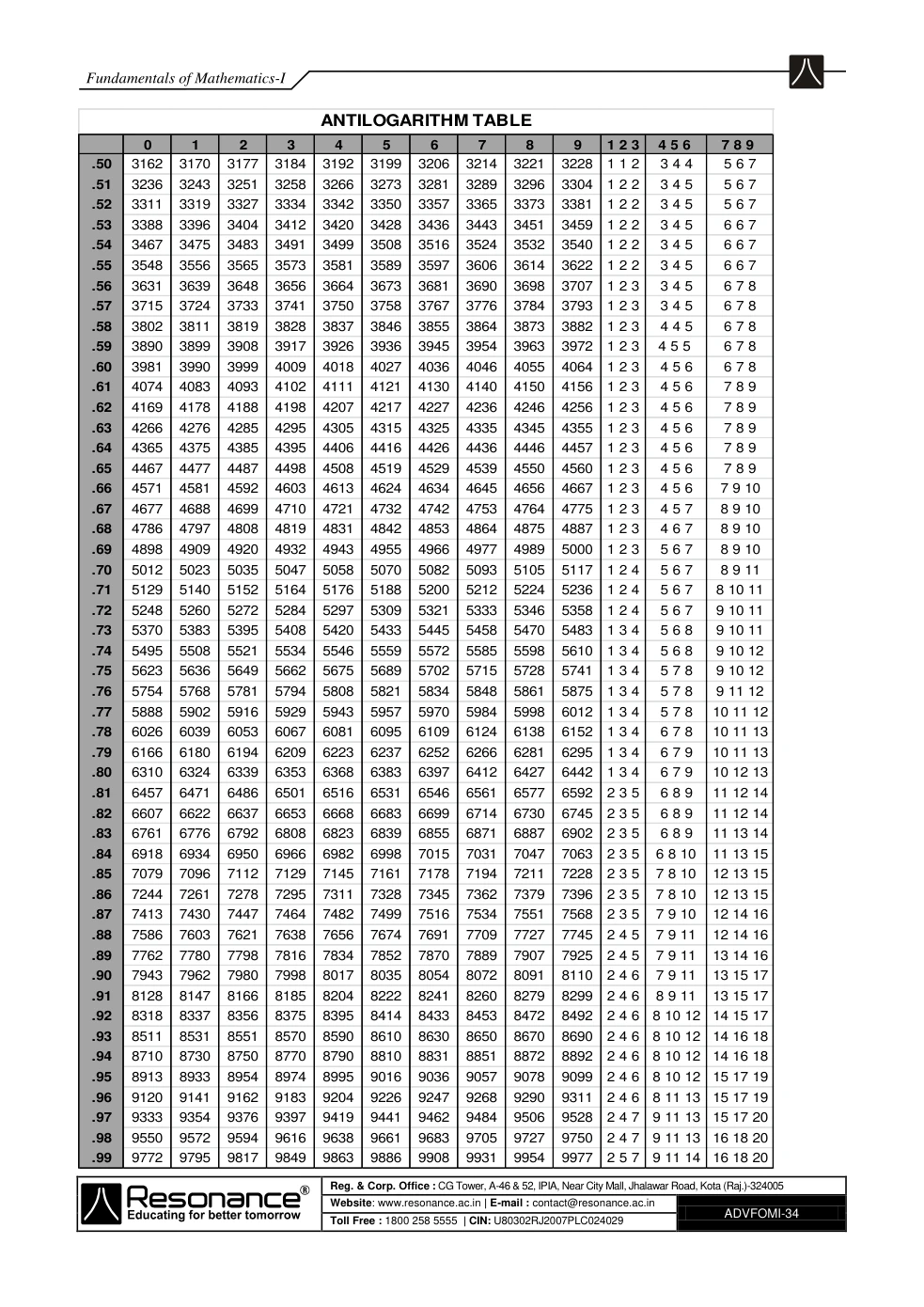
MAASFundamentals Of Mathematics I
© MAAS. All rights reserved.Page 58 / 58
Extracted text · page 58
Fundamentals of Mathematics-I

                     ANTILOGARITHM TABLE

       0     1     2     3     4     5     6     7     8     9   1 2 3  4 5 6    7 8 9
 .50   3162  3170  3177  3184  3192  3199  3206  3214  3221  3228  1 1 2   3 4 4    5 6 7
 .51   3236  3243  3251  3258  3266  3273  3281  3289  3296  3304  1 2 2   3 4 5    5 6 7
 .52   3311  3319  3327  3334  3342  3350  3357  3365  3373  3381  1 2 2   3 4 5    5 6 7
 .53   3388  3396  3404  3412  3420  3428  3436  3443  3451  3459  1 2 2   3 4 5    6 6 7
 .54   3467  3475  3483  3491  3499  3508  3516  3524  3532  3540  1 2 2   3 4 5    6 6 7
 .55   3548  3556  3565  3573  3581  3589  3597  3606  3614  3622  1 2 2   3 4 5    6 6 7
 .56   3631  3639  3648  3656  3664  3673  3681  3690  3698  3707  1 2 3   3 4 5    6 7 8
 .57   3715  3724  3733  3741  3750  3758  3767  3776  3784  3793  1 2 3   3 4 5    6 7 8
 .58   3802  3811  3819  3828  3837  3846  3855  3864  3873  3882  1 2 3   4 4 5    6 7 8
 .59   3890  3899  3908  3917  3926  3936  3945  3954  3963  3972  1 2 3  4 5 5    6 7 8
 .60   3981  3990  3999  4009  4018  4027  4036  4046  4055  4064  1 2 3   4 5 6    6 7 8
 .61   4074  4083  4093  4102  4111  4121  4130  4140  4150  4156  1 2 3   4 5 6    7 8 9
 .62   4169  4178  4188  4198  4207  4217  4227  4236  4246  4256  1 2 3   4 5 6    7 8 9
 .63   4266  4276  4285  4295  4305  4315  4325  4335  4345  4355  1 2 3   4 5 6    7 8 9
 .64   4365  4375  4385  4395  4406  4416  4426  4436  4446  4457  1 2 3   4 5 6    7 8 9
 .65   4467  4477  4487  4498  4508  4519  4529  4539  4550  4560  1 2 3   4 5 6    7 8 9
 .66   4571  4581  4592  4603  4613  4624  4634  4645  4656  4667  1 2 3   4 5 6   7 9 10
 .67   4677  4688  4699  4710  4721  4732  4742  4753  4764  4775  1 2 3   4 5 7   8 9 10
 .68   4786  4797  4808  4819  4831  4842  4853  4864  4875  4887  1 2 3   4 6 7   8 9 10
 .69   4898  4909  4920  4932  4943  4955  4966  4977  4989  5000  1 2 3   5 6 7   8 9 10
 .70   5012  5023  5035  5047  5058  5070  5082  5093  5105  5117  1 2 4   5 6 7   8 9 11
 .71   5129  5140  5152  5164  5176  5188  5200  5212  5224  5236  1 2 4   5 6 7   8 10 11
 .72   5248  5260  5272  5284  5297  5309  5321  5333  5346  5358  1 2 4   5 6 7   9 10 11
 .73   5370  5383  5395  5408  5420  5433  5445  5458  5470  5483  1 3 4   5 6 8   9 10 11
 .74   5495  5508  5521  5534  5546  5559  5572  5585  5598  5610  1 3 4   5 6 8   9 10 12
 .75   5623  5636  5649  5662  5675  5689  5702  5715  5728  5741  1 3 4   5 7 8   9 10 12
 .76   5754  5768  5781  5794  5808  5821  5834  5848  5861  5875  1 3 4   5 7 8   9 11 12
 .77   5888  5902  5916  5929  5943  5957  5970  5984  5998  6012  1 3 4   5 7 8  10 11 12
 .78   6026  6039  6053  6067  6081  6095  6109  6124  6138  6152  1 3 4   6 7 8  10 11 13
 .79   6166  6180  6194  6209  6223  6237  6252  6266  6281  6295  1 3 4   6 7 9  10 11 13
 .80   6310  6324  6339  6353  6368  6383  6397  6412  6427  6442  1 3 4   6 7 9  10 12 13
 .81   6457  6471  6486  6501  6516  6531  6546  6561  6577  6592  2 3 5   6 8 9  11 12 14
 .82   6607  6622  6637  6653  6668  6683  6699  6714  6730  6745  2 3 5   6 8 9  11 12 14
 .83   6761  6776  6792  6808  6823  6839  6855  6871  6887  6902  2 3 5   6 8 9  11 13 14
 .84   6918  6934  6950  6966  6982  6998  7015  7031  7047  7063  2 3 5  6 8 10  11 13 15
 .85   7079  7096  7112  7129  7145  7161  7178  7194  7211  7228  2 3 5  7 8 10  12 13 15
 .86   7244  7261  7278  7295  7311  7328  7345  7362  7379  7396  2 3 5  7 8 10  12 13 15
 .87   7413  7430  7447  7464  7482  7499  7516  7534  7551  7568  2 3 5  7 9 10  12 14 16
 .88   7586  7603  7621  7638  7656  7674  7691  7709  7727  7745  2 4 5  7 9 11  12 14 16
 .89   7762  7780  7798  7816  7834  7852  7870  7889  7907  7925  2 4 5  7 9 11  13 14 16
 .90   7943  7962  7980  7998  8017  8035  8054  8072  8091  8110  2 4 6  7 9 11  13 15 17
 .91   8128  8147  8166  8185  8204  8222  8241  8260  8279  8299  2 4 6  8 9 11  13 15 17
 .92   8318  8337  8356  8375  8395  8414  8433  8453  8472  8492  2 4 6  8 10 12  14 15 17
 .93   8511  8531  8551  8570  8590  8610  8630  8650  8670  8690  2 4 6  8 10 12  14 16 18
 .94   8710  8730  8750  8770  8790  8810  8831  8851  8872  8892  2 4 6  8 10 12  14 16 18
 .95   8913  8933  8954  8974  8995  9016  9036  9057  9078  9099  2 4 6  8 10 12  15 17 19
 .96   9120  9141  9162  9183  9204  9226  9247  9268  9290  9311  2 4 6  8 11 13  15 17 19
 .97   9333  9354  9376  9397  9419  9441  9462  9484  9506  9528  2 4 7  9 11 13  15 17 20
 .98   9550  9572  9594  9616  9638  9661  9683  9705  9727  9750  2 4 7  9 11 13  16 18 20
 .99   9772  9795  9817  9849  9863  9886  9908  9931  9954  9977  2 5 7  9 11 14  16 18 20

                                                                                     ADVFOMI-34