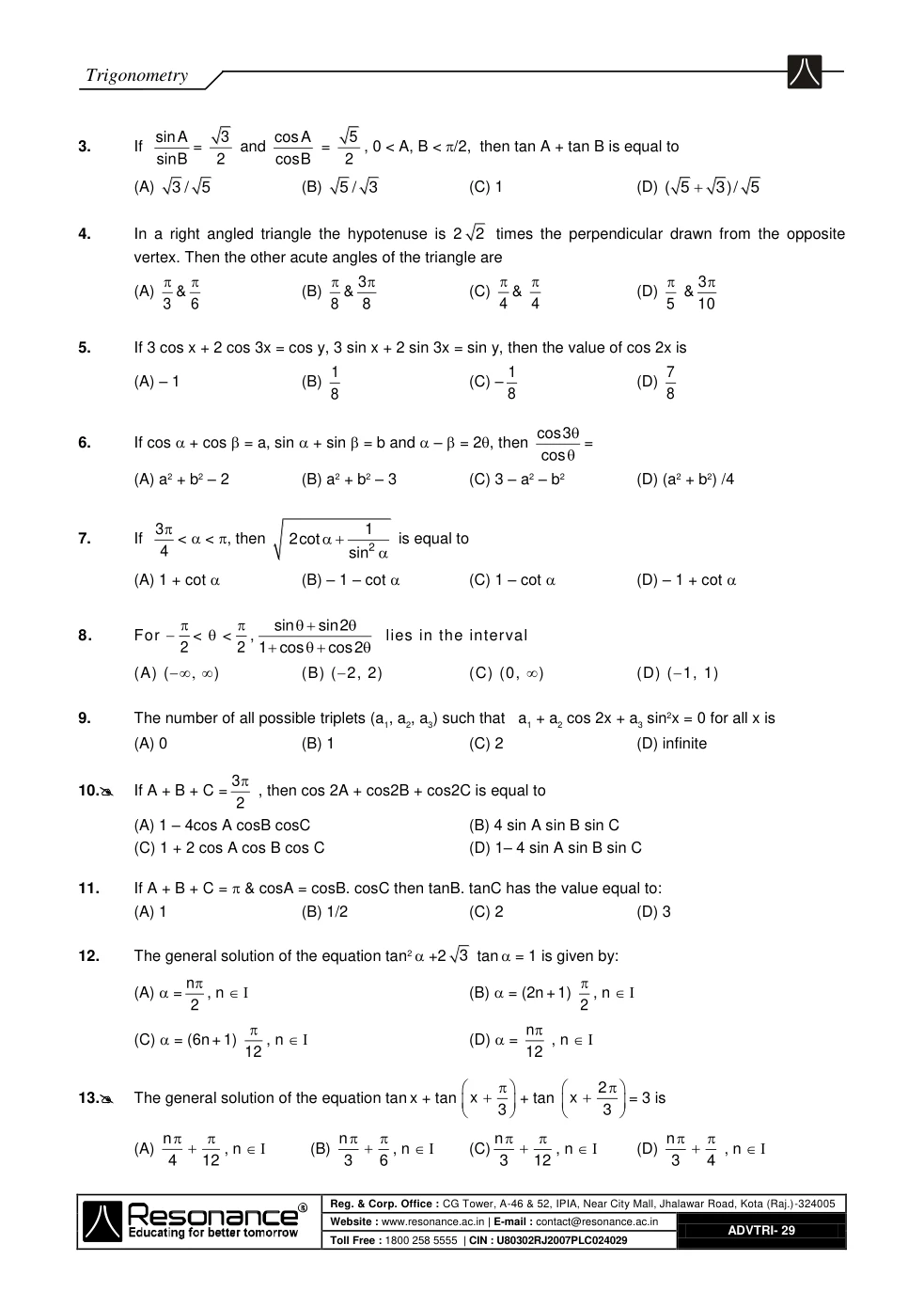
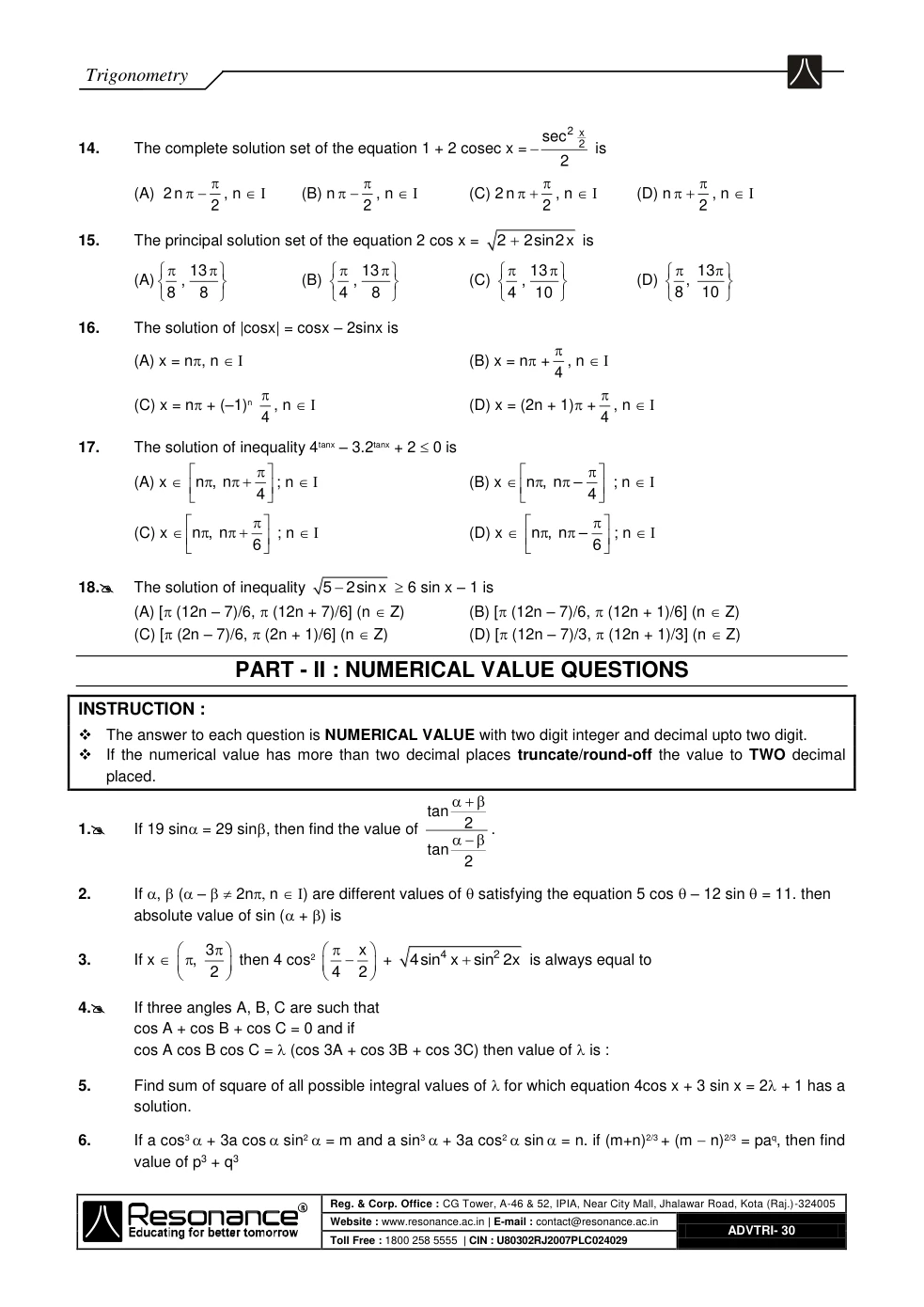
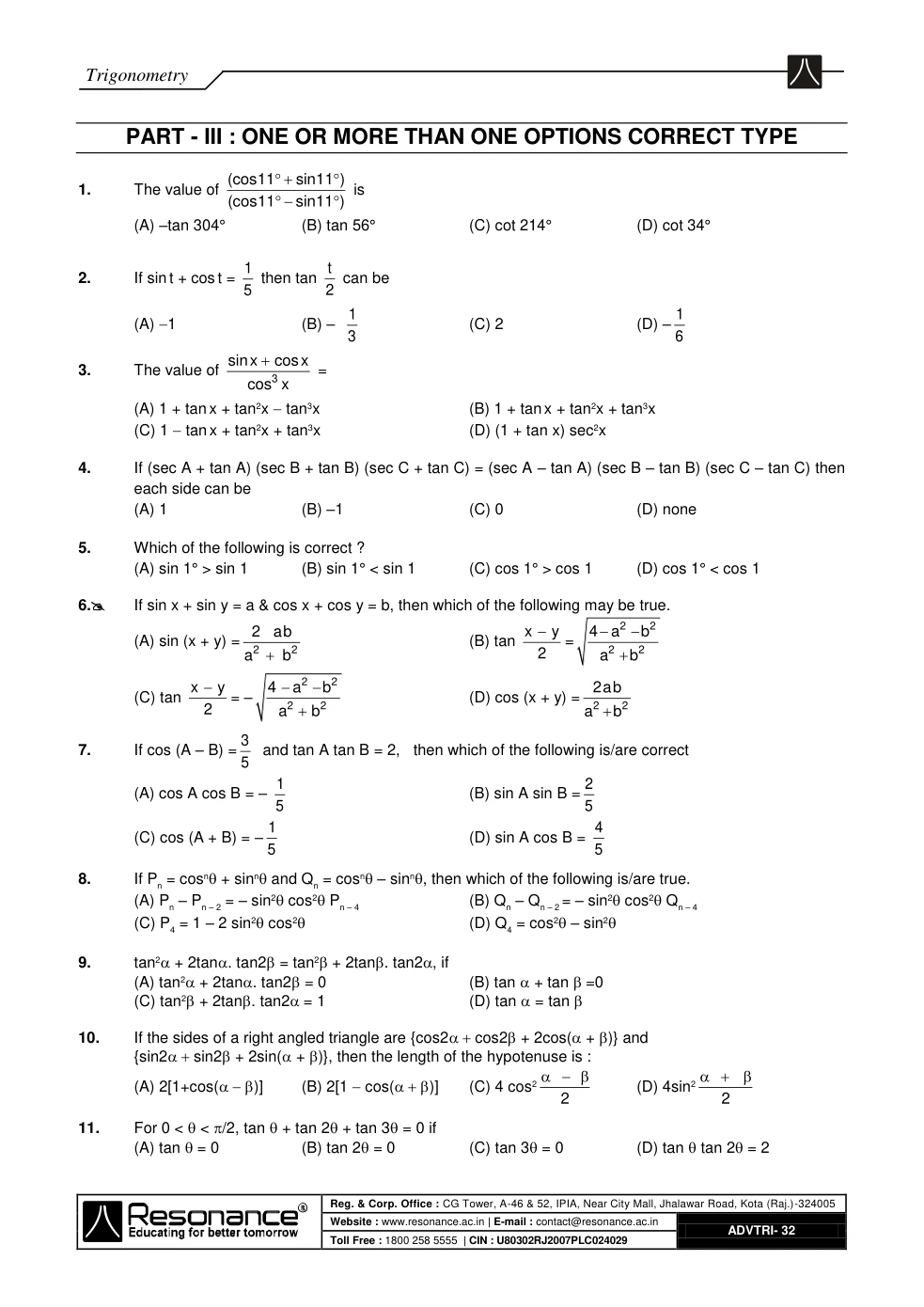
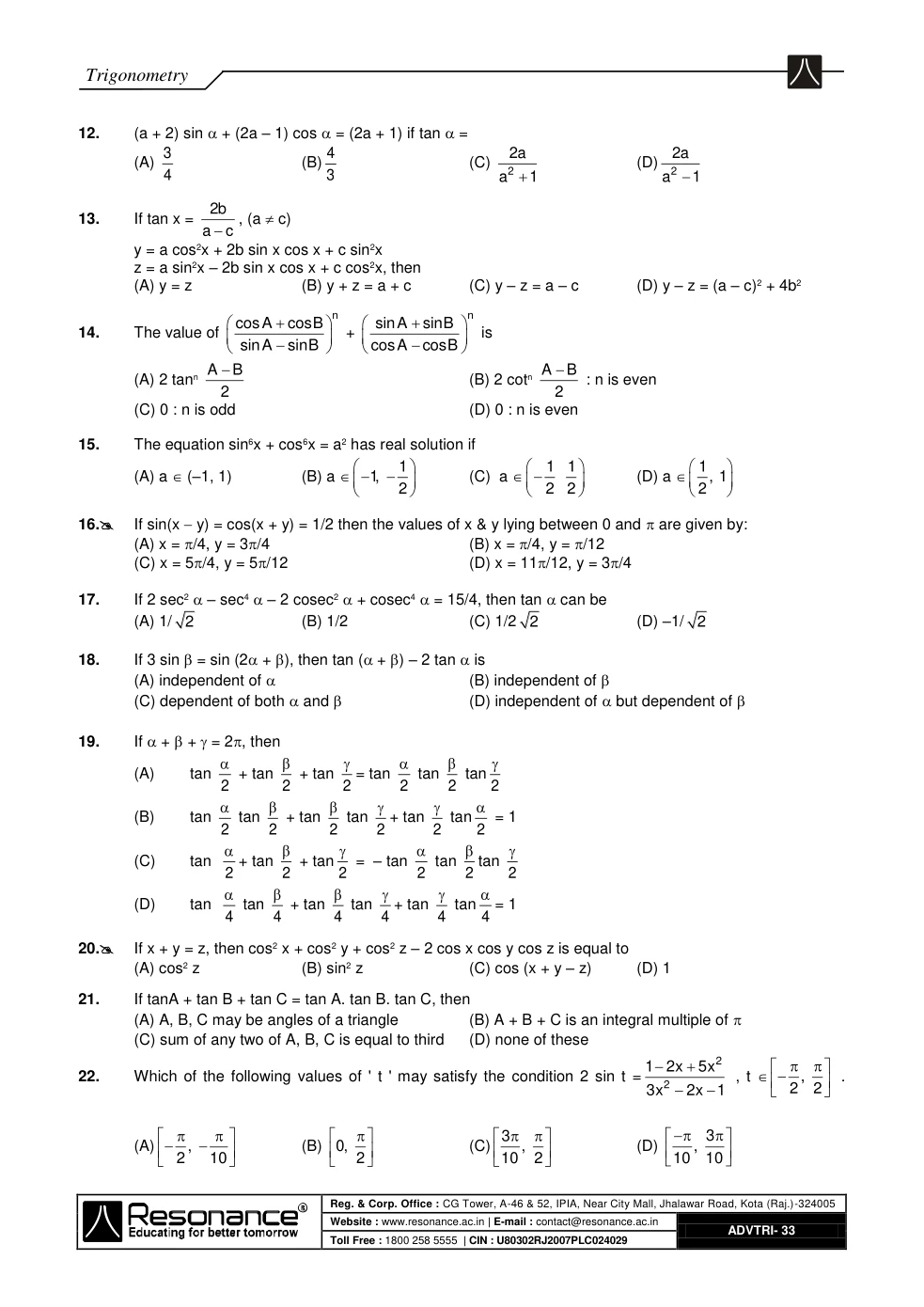
Visual-fidelity edition: source-page equations, diagrams and charts are preserved as page images. Text transcripts are provided where extractable. The original source may contain markings within the artwork.
Rendered source page 1 of 47: Trigonometry
MAASTrigonometry
© MAAS. All rights reserved.Page 1 / 47
Extracted text · page 1
 Trigonometry


                 When writing about transcendental issues, be transcendentally clear....... Descartes, Rene

The word 'trigonometry' is derived from the Greek words 'trigon' and ' metron' and it means 'measuring the sides
and angles of a triangle'.
Angle :
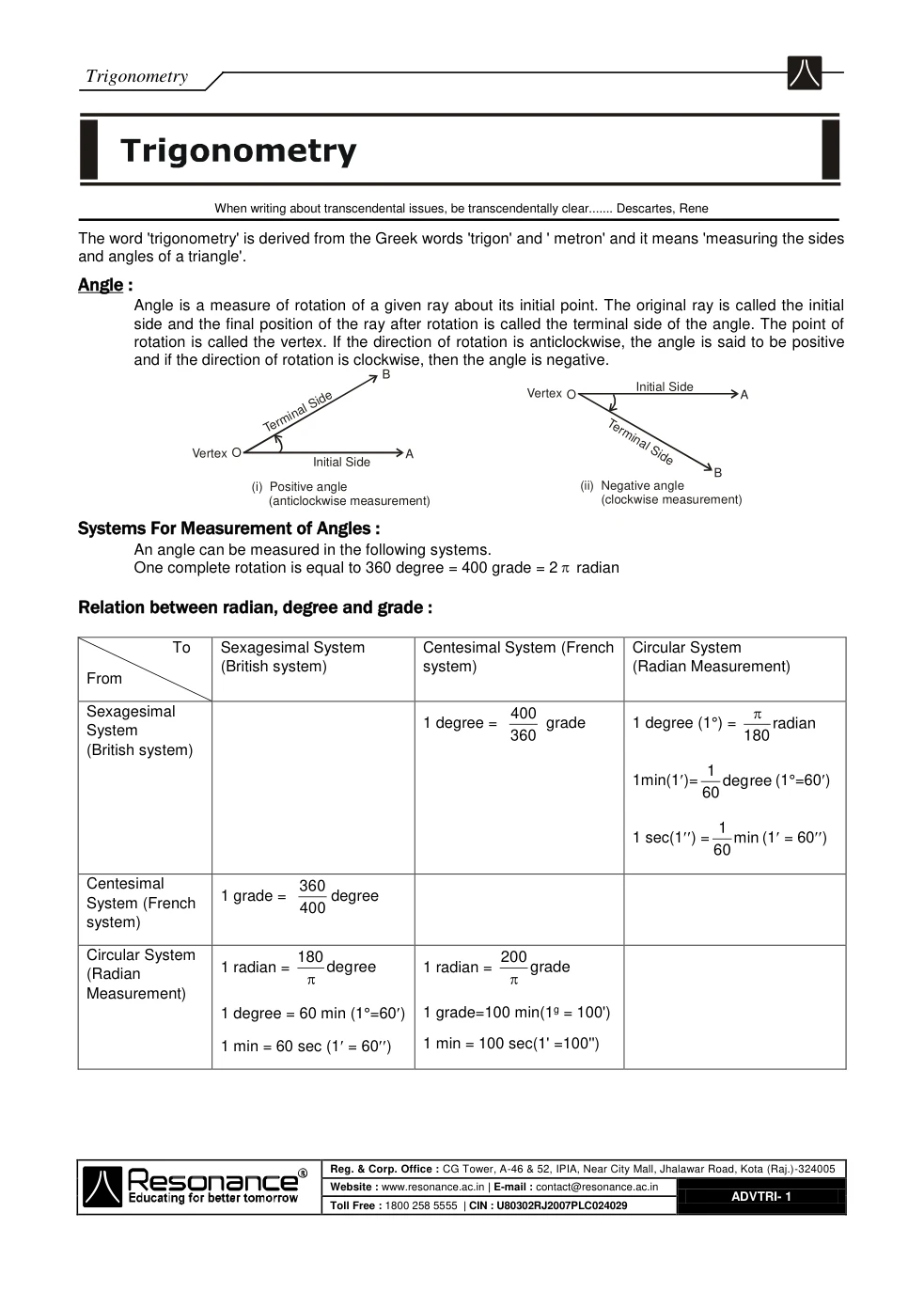
       Angle is a measure of rotation of a given ray about its initial point. The original ray is called the initial
        side and the final position of the ray after rotation is called the terminal side of the angle. The point of
         rotation is called the vertex. If the direction of rotation is anticlockwise, the angle is said to be positive
       and if the direction of rotation is clockwise, then the angle is negative.
                                    B
                                                                                                                                       Initial Side
                                Side                                 Vertex O                    A
                               Terminal                                                                                         Terminal
                   Vertex O                                       A                                 Side                                                         Initial Side
                                                                             B
                                              (i) Positive angle                                                                   (ii) Negative angle
                                  (anticlockwise measurement)                              (clockwise measurement)
Systems For Measurement of Angles :
      An angle can be measured in the following systems.
      One complete rotation is equal to 360 degree = 400 grade = 2  radian

Relation between radian, degree and grade :

          To    Sexagesimal System       Centesimal System (French   Circular System
                        (British system)            system)                    (Radian Measurement)
 From

 Sexagesimal                                       400                         
                                        1 degree =      grade     1 degree (1°) =     radian System                                                  360                        180
 (British system)
                                                                        1
                                                                            1min(1)=   degree (1°=60)
                                                                        60

                                                                          1
                                                                 1 sec(1) =   min (1 = 60)
                                                                         60

 Centesimal                360
                 1 grade =      degree
 System (French            400
 system)

 Circular System            180                    200
                 1 radian =    degree     1 radian =     grade
 (Radian                                         
 Measurement)
                 1 degree = 60 min (1°=60)  1 grade=100 min(1g = 100')

                 1 min = 60 sec (1 = 60)    1 min = 100 sec(1' =100'')


                                                                                           ADVTRI- 1
Rendered source page 2 of 47: Trigonometry
MAASTrigonometry
© MAAS. All rights reserved.Page 2 / 47
Extracted text · page 2
 Trigonometry


Note : #     The minutes and seconds in the Sexagesimal system are different with the minutes and
              seconds respectively in the Centesimal System. Symbols in both systems are also different.
       #           If no symbol is mentioned while showing measurement of angle, then  it is considered to be
             measured in radians.
                 e.g.     = 15  implies 15 radian

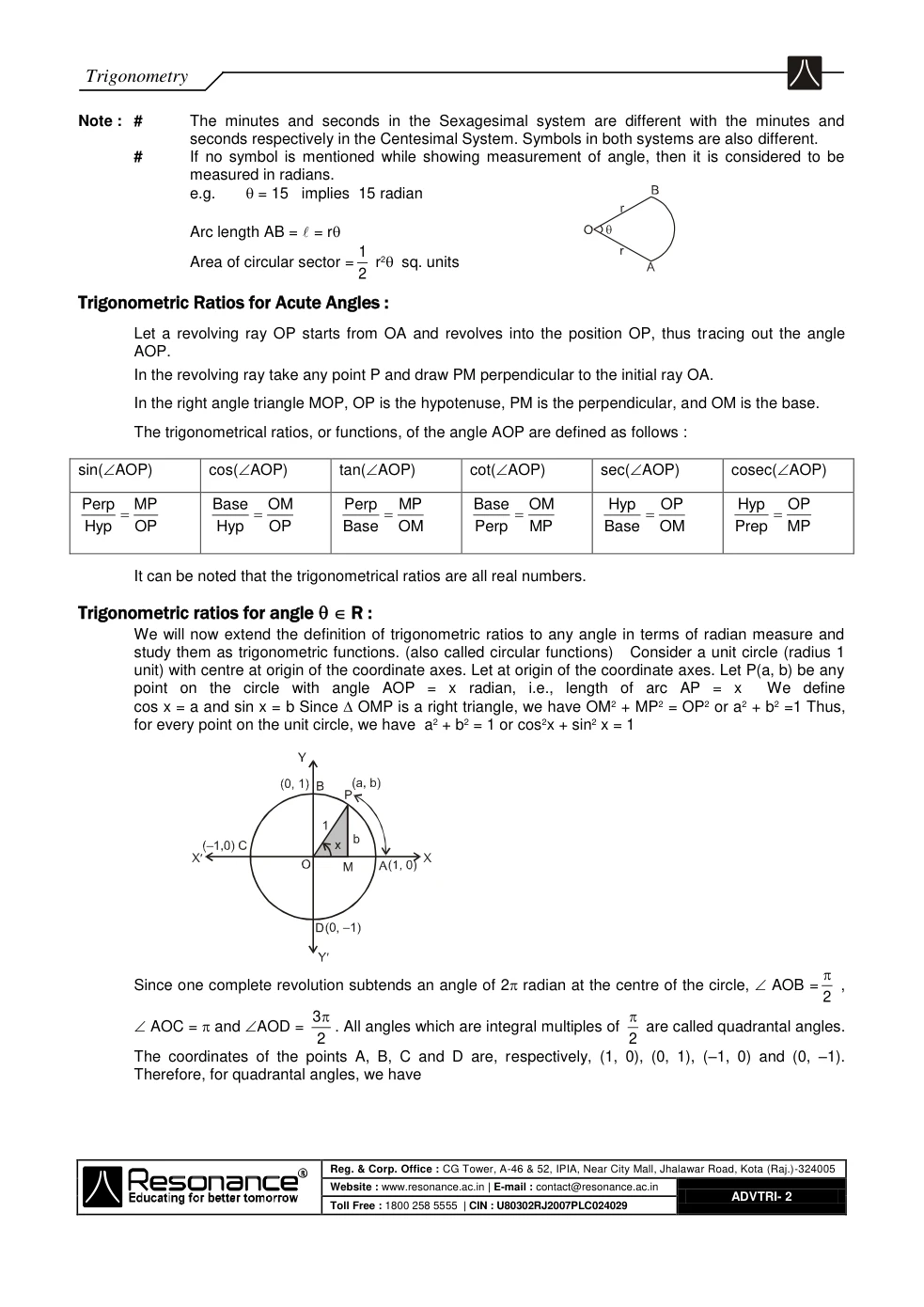
              Arc length AB = = r
                                  1
              Area of circular sector =    r2 sq. units
                                  2
Trigonometric Ratios for Acute Angles :

        Let a revolving ray OP starts from OA and revolves into the position OP, thus tracing out the angle
      AOP.
         In the revolving ray take any point P and draw PM perpendicular to the initial ray OA.

         In the right angle triangle MOP, OP is the hypotenuse, PM is the perpendicular, and OM is the base.

      The trigonometrical ratios, or functions, of the angle AOP are defined as follows :

sin(AOP)      cos(AOP)      tan(AOP)      cot(AOP)      sec(AOP)      cosec(AOP)

Perp  MP      Base  OM      Perp  MP      Base  OM      Hyp  OP      Hyp  OP
                                                                           
 Hyp  OP      Hyp  OP      Base  OM      Perp  MP      Base  OM      Prep  MP


             It can be noted that the trigonometrical ratios are all real numbers.

Trigonometric ratios for angle  R :
     We will now extend the definition of trigonometric ratios to any angle in terms of radian measure and
        study them as trigonometric functions. (also called circular functions)  Consider a unit circle (radius 1
         unit) with centre at origin of the coordinate axes. Let at origin of the coordinate axes. Let P(a, b) be any
        point on  the  circle  with  angle AOP =  x  radian,   i.e.,  length  of  arc AP =  x  We  define
       cos x = a and sin x = b Since  OMP is a right triangle, we have OM2 + MP2 = OP2 or a2 + b2 =1 Thus,
         for every point on the unit circle, we have a2 + b2 = 1 or cos2x + sin2 x = 1


                                                                                           
       Since one complete revolution subtends an angle of 2 radian at the centre of the circle,  AOB =     , 
                                                                                          2
                            3                                            AOC =  and AOD =  . All angles which are integral multiples of    are called quadrantal angles.
                            2                                     2
      The coordinates of the points A, B, C and D are, respectively, (1, 0), (0, 1), (–1, 0) and (0, –1).
        Therefore, for quadrantal angles, we have


                                                                                           ADVTRI- 2
Rendered source page 3 of 47: Trigonometry
MAASTrigonometry
© MAAS. All rights reserved.Page 3 / 47
Extracted text · page 3
 Trigonometry


              cos 0 = 1                sin 0 = 0,
                                                    cos = 0               sin   = 1
                  2                  2
              cos  = –1               sin  = 0
                 3                  3 
              cos    = 0             sin    = – 1
                  2                  2
              cos 2 = 1               sin 2 = 0
     Now  if we take one complete revolution from the position OP, we again come back to same position
      OP. Thus, we also observe that if x increases (or decreases) by any integral multiple of 2 , the values
         of sine and cosine functions do not change. Thus, sin (2n + x) = sin x , n  Z, cos (2n + x) = cos x,
       n  Z. Further, sin x = 0,  if x = 0, ±  , ± 2 , ± 3 ....., i.e., when x is an integral multiple of  and
                          3    5        cos x = 0, if x = ± , ±  , ±       , .....i.e., cos x vanishes when x is an odd multiple of . Thus sin x =
                      2    2    2                                              2
       0 implies x = n , where n is any integer cos x = 0 implies x = (2n + 1) , where n is any integer.
                                                                  2
     We now define other trigonometric functions in terms of sine and cosine functions :
                      1
              cosec x =          , x  n ,       where n is any integer.
                         sinx
                     1              
              sec x =           , x  (2n + 1)      , where n is any integer.
                    cosx             2
                       sinx             
                tan x =           , x  (2n + 1)      , where n is any integer.
                    cosx            2
                   cosx
                cot x =           , x  n , where n is any integer.
                       sinx
     We have shown that for all real x, sin2x + cos2x = 1
                                                                         
             It follows that  1 + tan2x = sec2x               (Think ! )        {x  (2n + 1)       ; n  Z}
                                                                        2
                    1 + cot2x = cosec2x             (Think !)        {x  n ; n  Z}

Sign of The Trigonometric Functions

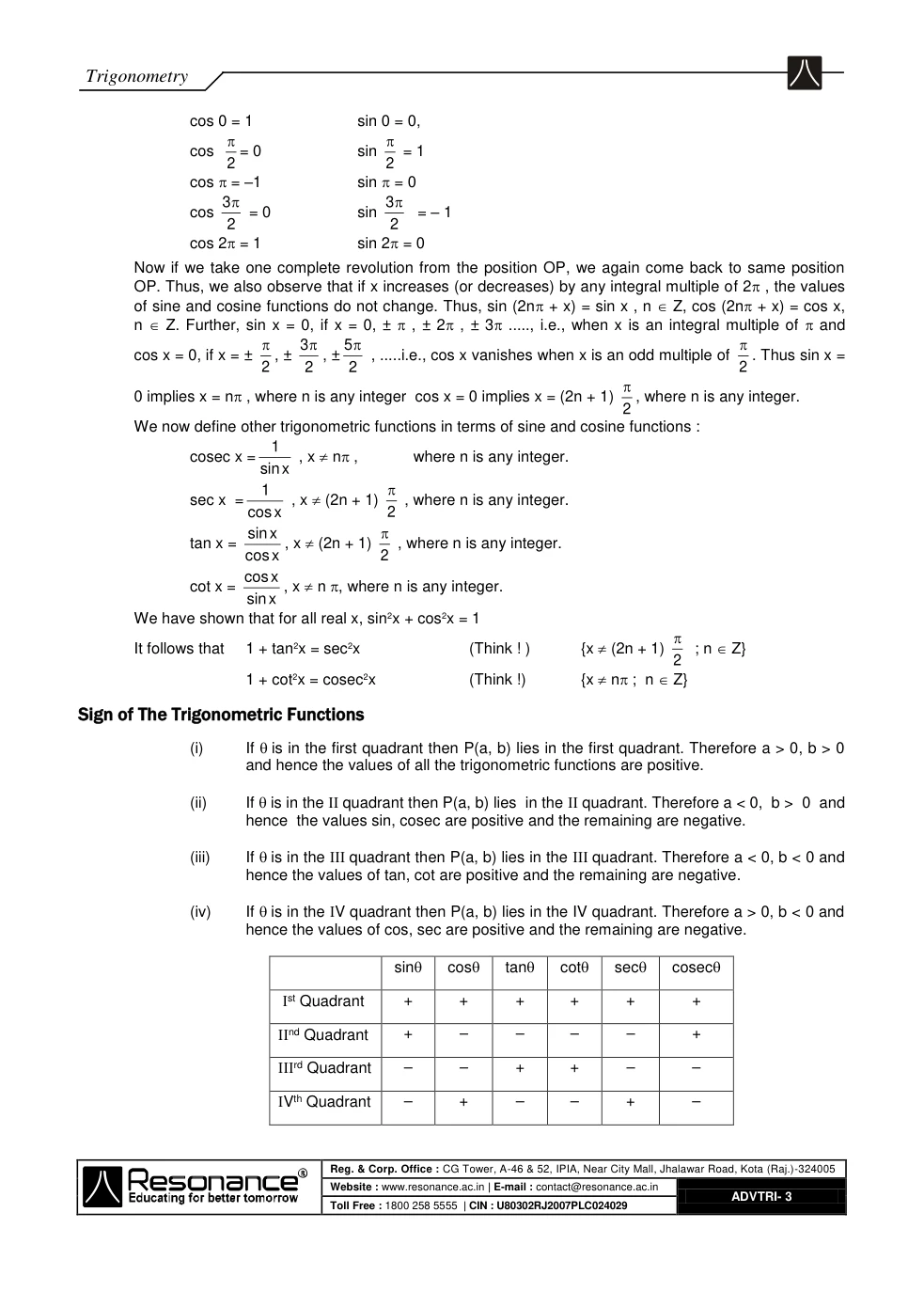
                        (i)          If is in the first quadrant then P(a, b) lies in the first quadrant. Therefore a > 0, b > 0
                    and hence the values of all the trigonometric functions are positive.

                          (ii)         If is in the quadrant then P(a, b) lies in the quadrant. Therefore a < 0, b > 0 and
                    hence the values sin, cosec are positive and the remaining are negative.

                           (iii)        If is in the quadrant then P(a, b) lies in the quadrant. Therefore a < 0, b < 0 and
                    hence the values of tan, cot are positive and the remaining are negative.

                     (iv)        If is in the V quadrant then P(a, b) lies in the IV quadrant. Therefore a > 0, b < 0 and
                    hence the values of cos, sec are positive and the remaining are negative.

                                              sin   cos   tan    cot   sec   cosec

                                               st Quadrant    +     +     +     +     +      +

                                     nd Quadrant    +     –      –     –      –      +

                                         rd Quadrant    –     –     +     +     –       –

                                 Vth Quadrant    –     +      –     –     +       –


                                                                                           ADVTRI- 3
Rendered source page 4 of 47: Trigonometry
MAASTrigonometry
© MAAS. All rights reserved.Page 4 / 47
Extracted text · page 4
 Trigonometry


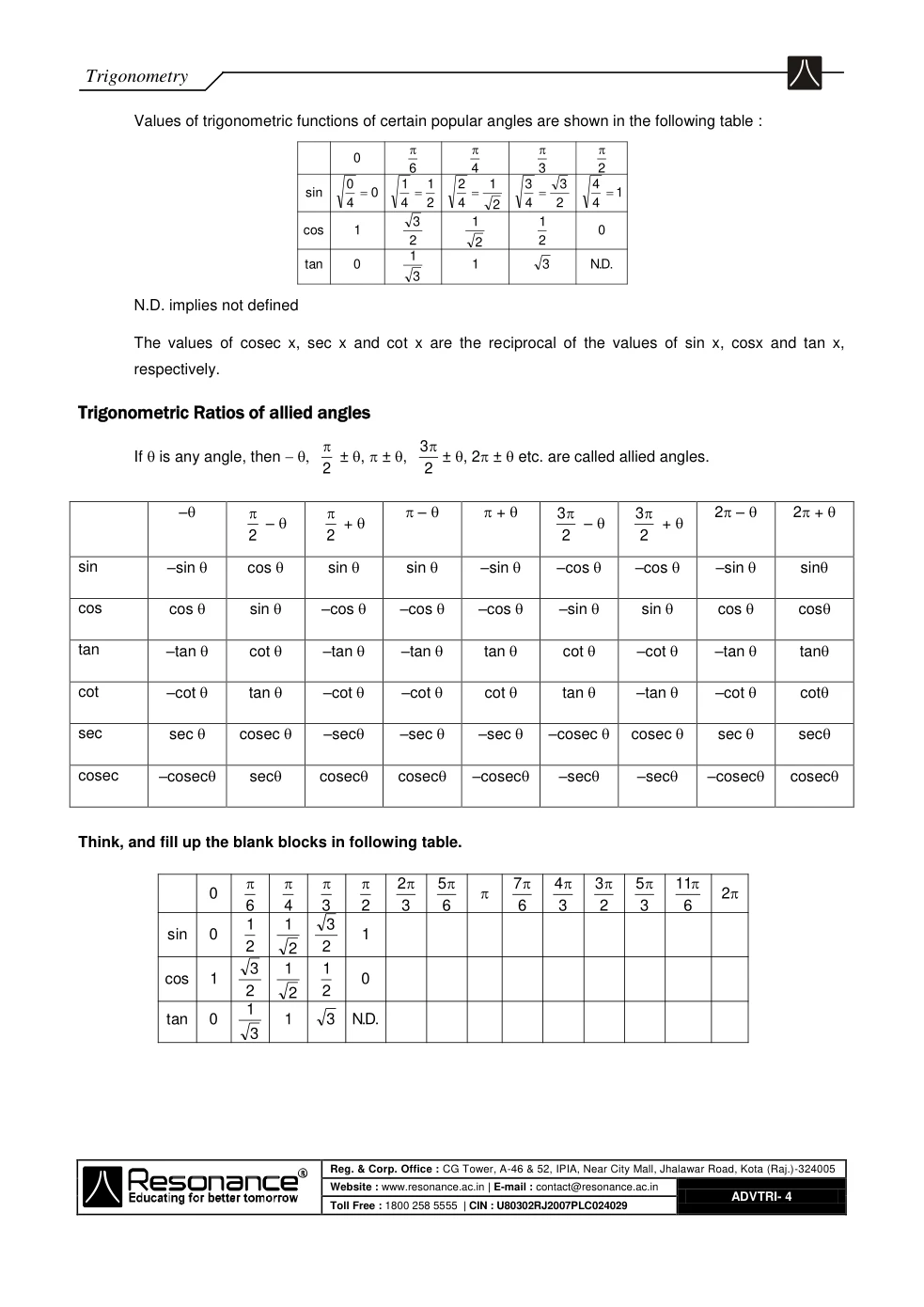
       Values of trigonometric functions of certain popular angles are shown in the following table :

                                                                     
                                      0
                                             6       4        3       2
                                     0      1   1   2   1    3    3   4
                                        sin      0                             1
                                     4      4   2   4    2   4   2    4
                                              3       1        1
                                 cos    1                                0
                                             2        2        2
                                             1
                                     tan    0               1         3    N.D.
                                              3

       N.D. implies not defined

      The values of cosec x, sec x and cot x are the reciprocal of the values of sin x, cosx and tan x,

        respectively.

Trigonometric Ratios of allied angles

                                         3             If  is any angle, then     ± ,  ± ,  ± , 2 ±  etc. are called allied angles.
                              2           2

            –                         –       +      3        3        2 –     2 + 
                      –       +                          –       + 
                     2        2                           2        2

sin          –sin      cos       sin       sin      –sin     –cos     –cos     –sin      sin

cos         cos       sin     –cos     –cos     –cos     –sin       sin      cos      cos

tan          –tan      cot      –tan     –tan      tan       cot      –cot     –tan      tan

cot          –cot      tan      –cot     –cot      cot       tan      –tan     –cot      cot

sec         sec     cosec    –sec     –sec     –sec   –cosec   cosec     sec      sec

cosec     –cosec    sec     cosec    cosec   –cosec    –sec     –sec    –cosec   cosec


Think, and fill up the blank blocks in following table.

                                 2    5        7    4    3    5    11
               0                                                          2 
                   6   4   3    2    3    6        6    3    2    3    6
                   1   1    3
             sin  0                 1
                   2    2   2
                    3   1   1
           cos  1                0
                   2    2   2
                   1
            tan  0        1    3 N.D.
                    3


                                                                                           ADVTRI- 4
Rendered source page 5 of 47: Trigonometry
MAASTrigonometry
© MAAS. All rights reserved.Page 5 / 47
Extracted text · page 5
 Trigonometry

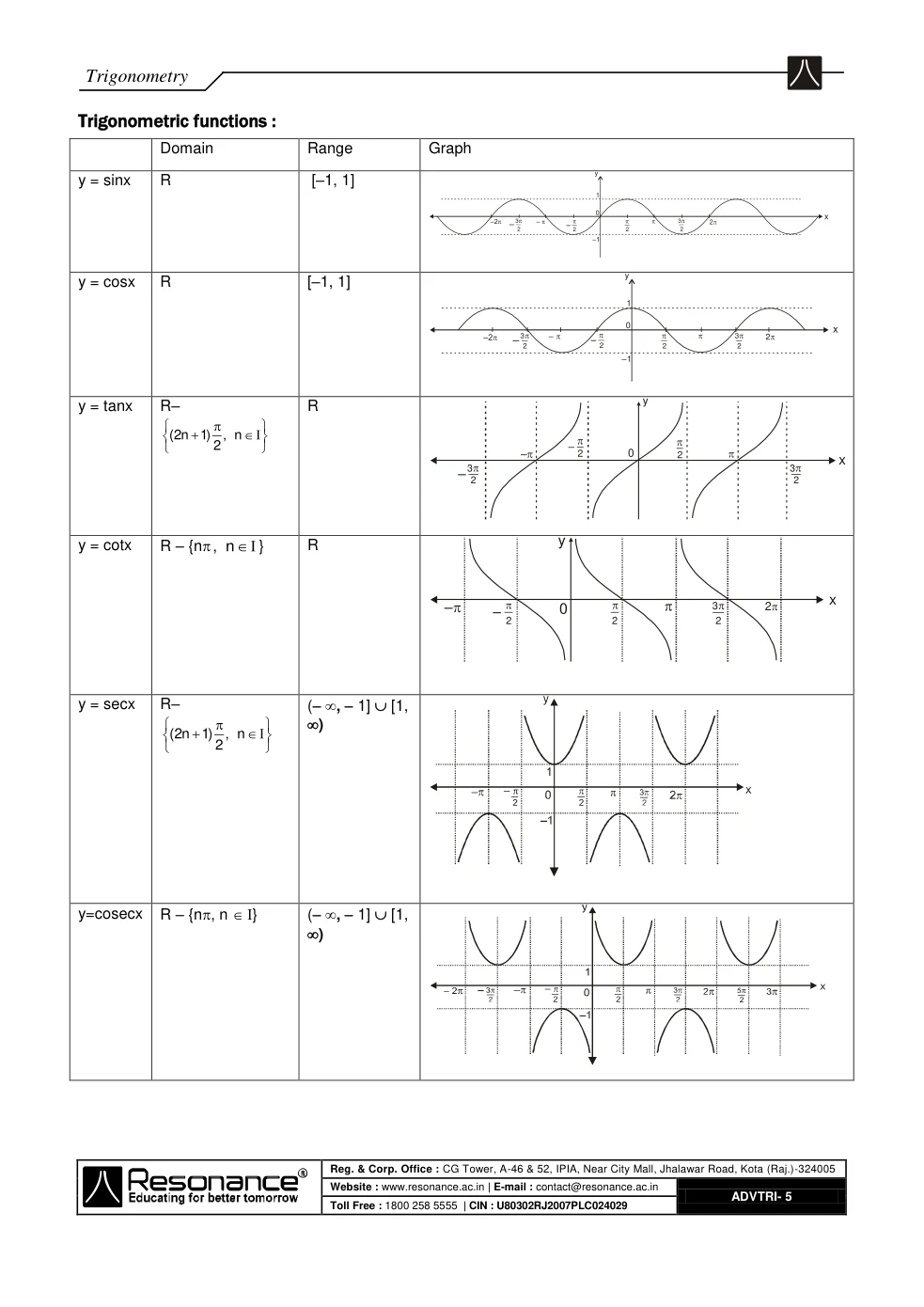
Trigonometric functions :

         Domain          Range         Graph

y = sinx   R                      [–1, 1]                                                                         y
                                                                                                                                             1

                                                                                                                                            0
                                                                                                                 –2    3    –                                                                                                                                                                           3       2                         x
                                                                                                                                        2                2               2                2
                                                                                                                                          –1

y = cosx  R                     [–1, 1]                                                                 y

                                                                                                                     1

                                                                                                                     0                                      x
                                                                                       –2     3    –                                    3     2
                                                                                                            2                  2              2                 2
                                                                                                                  –1


y = tanx   R–           R                                                          y
                        
            (2n  1)   , n                                                                                     2                                                                              –        2       0        2                                                                                                                  x                                                                  3                                                      3
                                                – 2                                                          2


y = cotx   R – {n, n}    R                                y

                                           –             0                    3      2       x
                                                                          2                 2                 2


y = secx   R–                   (,  1]  [1,
                            )
            (2n  1)   , n  
                  2      


y=cosecx  R – {n, n }        (,  1]  [1,
                            )


                                                                                           ADVTRI- 5
Rendered source page 6 of 47: Trigonometry
MAASTrigonometry
© MAAS. All rights reserved.Page 6 / 47
Extracted text · page 6
 Trigonometry

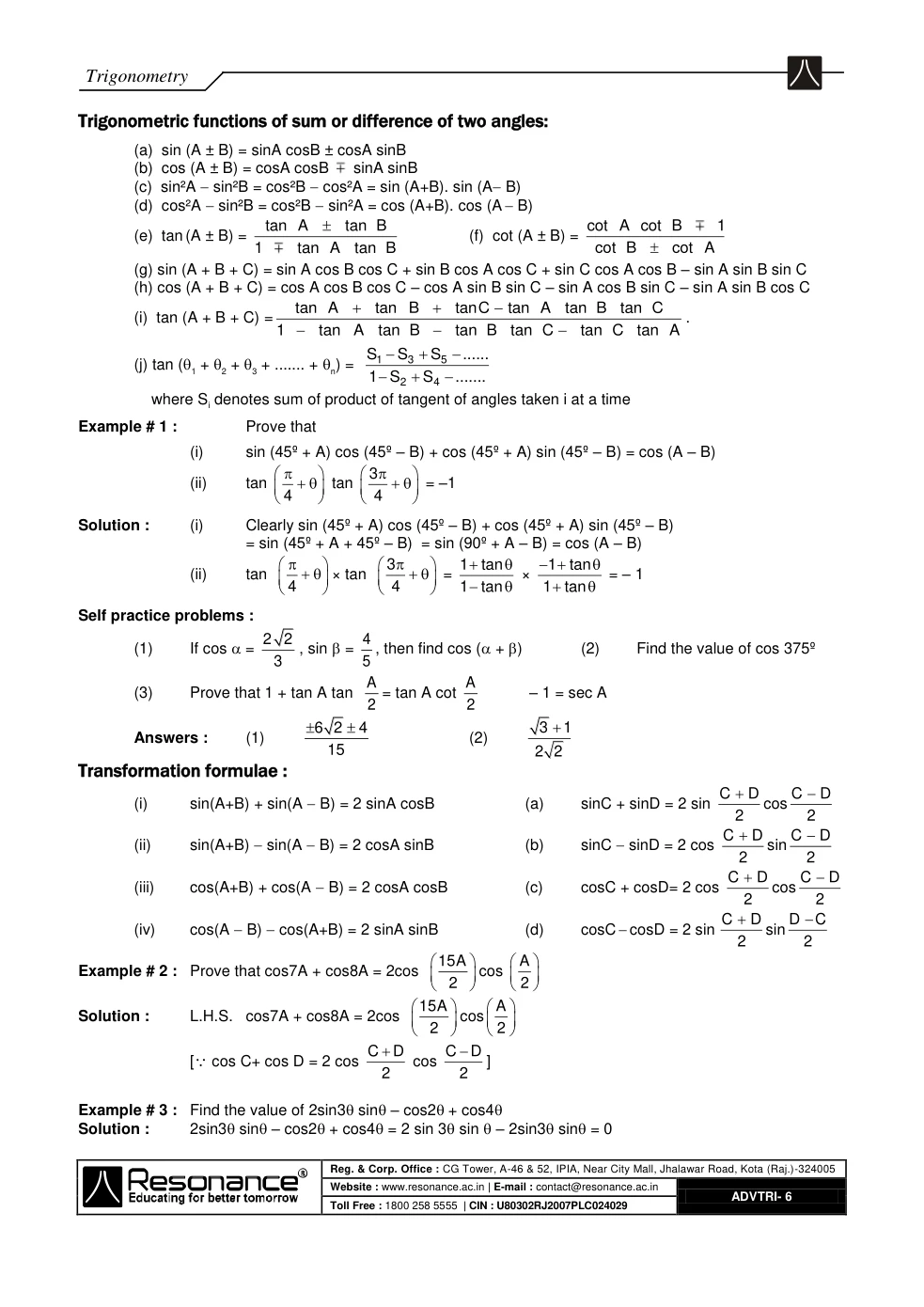
Trigonometric functions of sum or difference of two angles:

         (a) sin (A ± B) = sinA cosB ± cosA sinB
         (b) cos (A ± B) = cosA cosB   sinA sinB
         (c) sin²A  sin²B = cos²B  cos²A = sin (A+B). sin (A B)
         (d) cos²A  sin²B = cos²B  sin²A = cos (A+B). cos (A  B)
                          tan A    tan B                             cot A  cot B    1
         (e) tan (A ± B) =                                             (f) cot (A ± B) =
                    1     tan A  tan B                             cot B    cot A
         (g) sin (A + B + C) = sin A cos B cos C + sin B cos A cos C + sin C cos A cos B – sin A sin B sin C
         (h) cos (A + B + C) = cos A cos B cos C – cos A sin B sin C – sin A cos B sin C – sin A sin B cos C
                              tan A    tan B    tanC  tan A  tan B  tan C
            (i) tan (A + B + C) =                                                                                                .
                      1   tan A  tan B   tan B  tan C   tan C  tan A
                           S1  S3  S5  ......            (j) tan (1 + 2 + 3 + ....... + n) =
                                 1  S2  S 4  .......
         where Si denotes sum of product of tangent of angles taken i at a time
Example # 1 :        Prove that
                        (i)      sin (45º + A) cos (45º – B) + cos (45º + A) sin (45º – B) = cos (A – B)
                                             3                               (ii)     tan     tan      = –1                                                                                       4           4     

Solution :         (i)      Clearly sin (45º + A) cos (45º – B) + cos (45º + A) sin (45º – B)
                   = sin (45º + A + 45º – B) = sin (90º + A – B) = cos (A – B)
                                               3        1  tan   1  tan                           (ii)     tan    × tan      =        ×         = – 1                                                                                         4             4        1  tan    1  tan 

Self practice problems :
                     2 2         4
         (1)         If cos  =          , sin  =     , then find cos ( + )         (2)     Find the value of cos 375º
                       3          5
                             A         A
         (3)     Prove that 1 + tan A tan   = tan A cot        – 1 = sec A
                                   2           2
                          6 2  4                    3  1
      Answers :      (1)                                (2)
                             15                      2 2
Transformation formulae :
                                                         C  D   C  D
            (i)      sin(A+B) + sin(A  B) = 2 sinA cosB              (a)     sinC + sinD = 2 sin       cos
                                                                            2       2
                                                         C  D  C  D
             (ii)     sin(A+B)  sin(A  B) = 2 cosA sinB              (b)     sinC  sinD = 2 cos        sin
                                                                            2       2
                                                          C  D   C  D
              (iii)    cos(A+B) + cos(A  B) = 2 cosA cosB             (c)    cosC + cosD= 2 cos       cos
                                                                             2       2
                                                         C  D  D  C
          (iv)    cos(A  B)  cos(A+B) = 2 sinA sinB              (d)    cosC  cosD = 2 sin        sin
                                                                            2       2
                                                            15A        A 
Example # 2 :  Prove that cos7A + cos8A = 2cos         cos    
                                                            2         2 
                                                         15A       A 
Solution :      L.H.S. cos7A + cos8A = 2cos         cos    
                                                         2        2 
                          C  D    C  D
             [ cos C+ cos D = 2 cos       cos            ]
                                   2        2

Example # 3 :  Find the value of 2sin3 sin – cos2+ cos4
Solution :     2sin3 sin – cos2+ cos4 = 2 sin 3 sin  – 2sin3 sin = 0


                                                                                           ADVTRI- 6
Rendered source page 7 of 47: Trigonometry
MAASTrigonometry
© MAAS. All rights reserved.Page 7 / 47
Extracted text · page 7
 Trigonometry


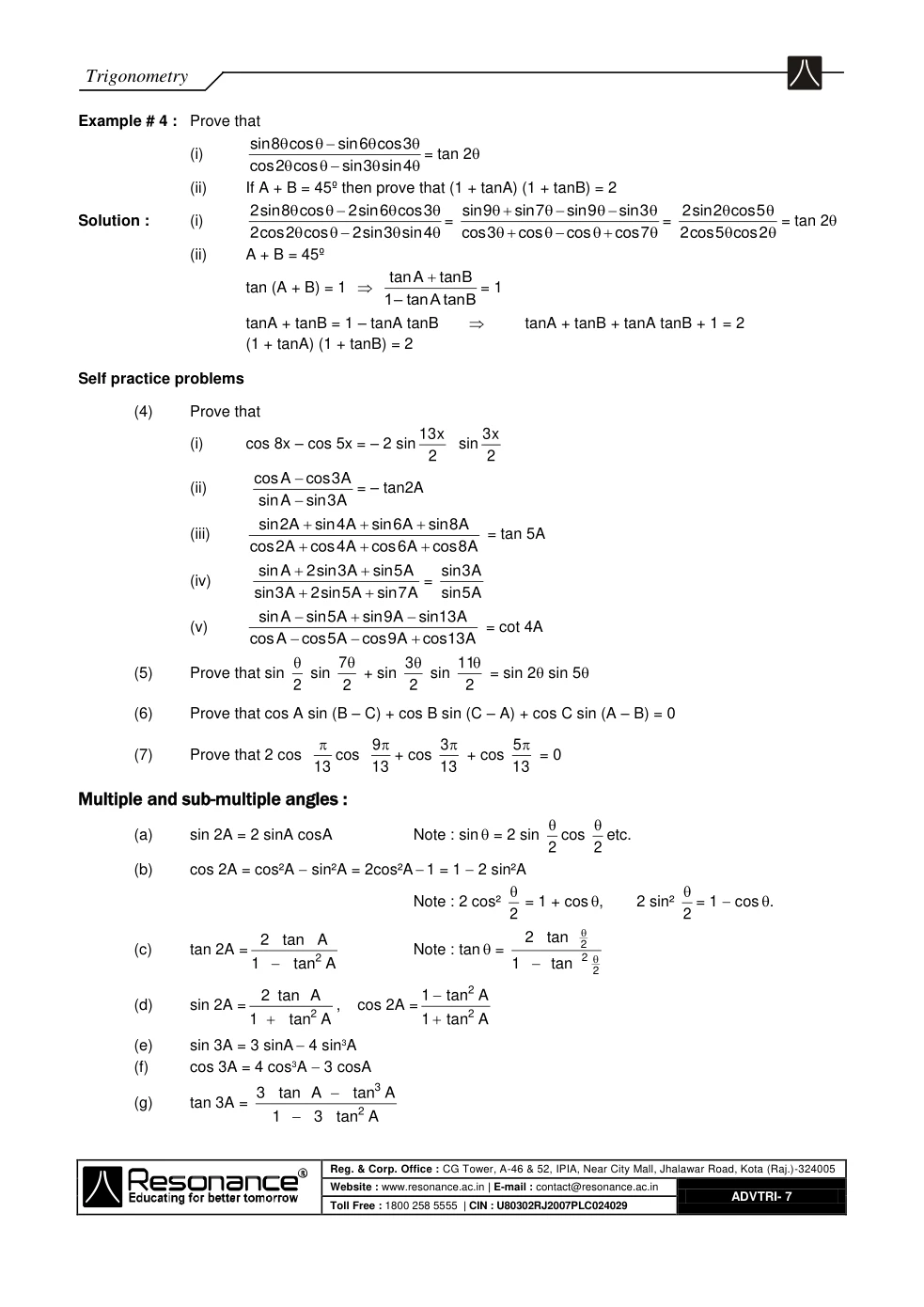
Example # 4 :  Prove that
                       sin8 cos  sin6 cos3
                        (i)                                tan 2                    cos2 cos  sin3 sin4=
                          (ii)         If A + B = 45º then prove that (1 + tanA) (1 + tanB) = 2
                     2sin8 cos  2sin6 cos3   sin9  sin7  sin9  sin3    2sin2  cos5 
Solution :         (i)                           =                       =            = tan 2
                   2cos2 cos  2sin3 sin4  cos3  cos  cos  cos7   2cos5  cos2 
                          (ii)    A + B = 45º
                                    tanA  tanB
                       tan (A + B) = 1             = 1
                                 1– tanA tanB
                     tanA + tanB = 1 – tanA tanB        tanA + tanB + tanA tanB + 1 = 2
                        (1 + tanA) (1 + tanB) = 2

Self practice problems

         (4)     Prove that
                                        13x    3x
                        (i)     cos 8x – cos 5x = – 2 sin       sin
                                         2      2
                   cosA  cos3A
                          (ii)                 = – tan2A
                      sinA  sin3A
                      sin2A  sin4A  sin6A  sin8A
                           (iii)                               = tan 5A
                   cos2A  cos4A  cos6A  cos8A
                      sinA  2sin3A  sin5A   sin3A
                     (iv)                        =
                      sin3A  2sin5A  sin7A   sin5A
                      sinA  sin5A  sin9A  sin13A
                   (v)                               = cot 4A
                   cosA  cos5A  cos9A  cos13A
                                7       3     11
         (5)     Prove that sin    sin    + sin     sin    = sin 2 sin 5
                          2     2       2      2

         (6)     Prove that cos A sin (B – C) + cos B sin (C – A) + cos C sin (A – B) = 0

                                   9       3        5          (7)     Prove that 2 cos  cos  + cos    + cos    = 0
                           13     13      13      13

Multiple and sub-multiple angles :
         (a)      sin 2A = 2 sinA cosA          Note : sin  = 2 sin cos etc.
                                                         2     2
         (b)     cos 2A = cos²A  sin²A = 2cos²A  1 = 1  2 sin²A
                                                                                                 Note : 2 cos²   = 1 + cos ,    2 sin² = 1  cos .
                                                    2                    2
                     2  tan A                       2  tan  2         (c)     tan 2A =                    Note : tan  =
                    1   tan2 A                    1  tan 2                                                                                     2
                     2 tan A            1  tan2 A
         (d)      sin 2A =                     ,  cos 2A =
                    1   tan2 A          1  tan2 A
         (e)      sin 3A = 3 sinA  4 sin3A
           (f)     cos 3A = 4 cos3A  3 cosA
                    3  tan A   tan3 A
         (g)     tan 3A =
                      1  3  tan2 A


                                                                                           ADVTRI- 7
Rendered source page 8 of 47: Trigonometry
MAASTrigonometry
© MAAS. All rights reserved.Page 8 / 47
Extracted text · page 8
 Trigonometry


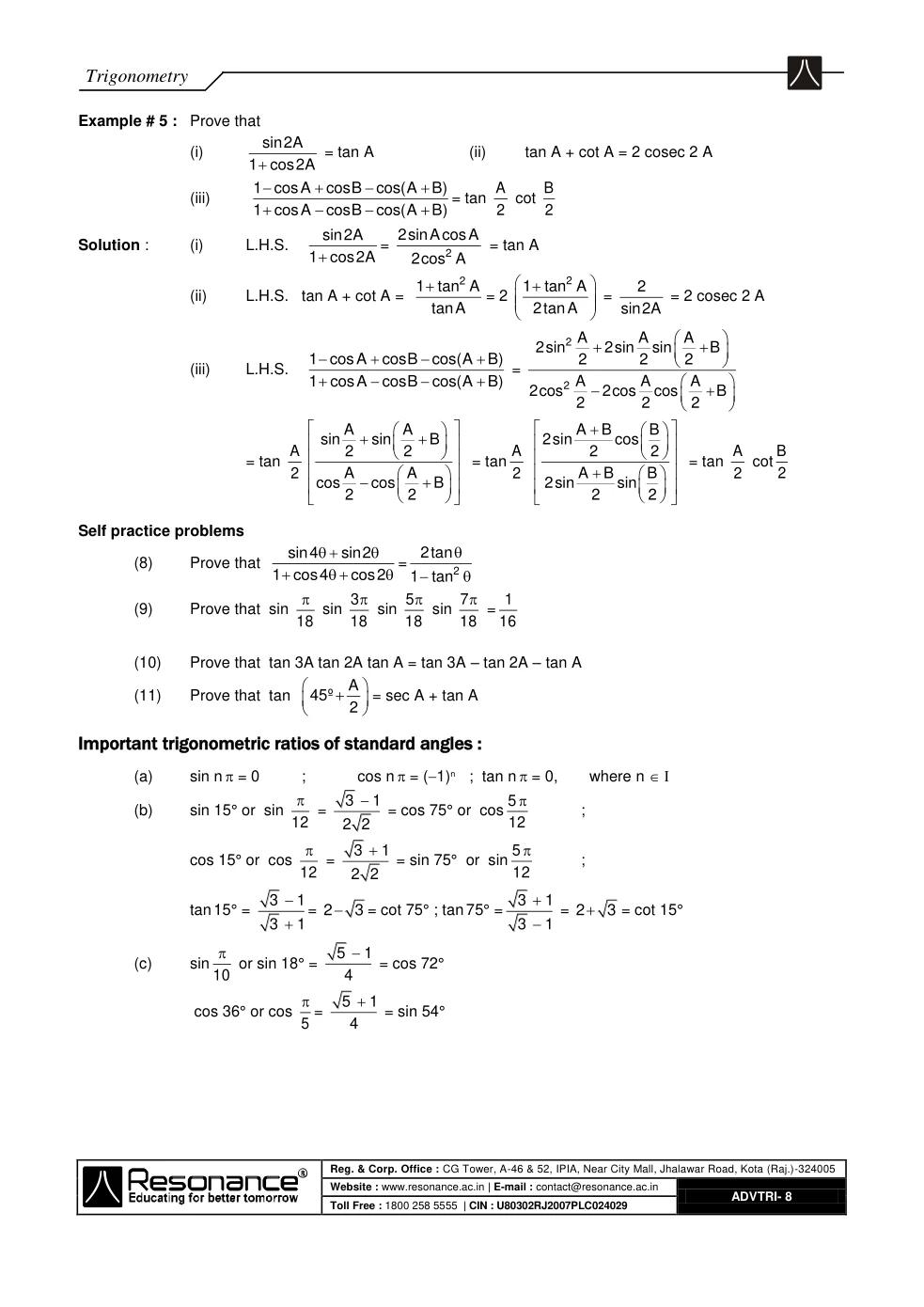
Example # 5 :  Prove that
                       sin2A
                        (i)             = tan A                      (ii)     tan A + cot A = 2 cosec 2 A
                   1  cos2A
                    1  cosA  cosB  cos(A  B)     A    B
                           (iii)                           = tan    cot
                    1  cosA  cosB  cos(A  B)      2     2
                              sin2A    2sinAcosA
Solution :         (i)      L.H.S.          =           = tan A
                          1  cos2A    2cos 2 A
                                       1  tan2 A       1  tan2 A      2
                          (ii)     L.H.S.  tan A + cot A =         = 2              =      = 2 cosec 2 A                                         tanA         2tanA     sin2A                                                                                    
                                                                                2 A     A     A     
                                                             2sin    2sin   sin    B                           1  cosA  cosB  cos(A  B)         2      2     2                                (iii)     L.H.S.                         =
                          1  cosA  cosB  cos(A  B)          2 A     A      A     
                                                     2cos    2cos  cos    B                                                          2      2      2     
                                         A       A                     A  B      B  
                                       sin   sin    B               2sin     cos                          A     2        2           A        2        2       A   B                   = tan                             = tan                            = tan    cot
                          2     A        A            2      A  B     B         2    2
                                       cos   cos    B               2sin      sin     
                                          2        2                        2       2  

Self practice problems
                            sin4 sin2     2tan 
         (8)     Prove that                      1  cos4 cos2= 1  tan                                                             2 
                                3     5     7    1
         (9)     Prove that sin     sin     sin     sin    =
                         18    18    18    18   16

        (10)    Prove that tan 3A tan 2A tan A = tan 3A – tan 2A – tan A
                                         A         (11)    Prove that tan  45º    = sec A + tan A                                                                                        2 

Important trigonometric ratios of standard angles :

         (a)      sin n  = 0          ;      cos n  = (1)n   ; tan n  = 0,    where n  
                               3  1               5 
         (b)      sin 15° or sin    =       = cos 75° or cos                  ;
                         12    2 2                12
                                3  1              5 
              cos 15° or cos    =       = sin 75° or sin                 ;
                          12    2 2                12
                      3  1                         3  1
                tan 15° =      = 2  3 = cot 75° ; tan 75° =      = 2  3 = cot 15°
                      3  1                         3  1

                              5  1
         (c)      sin    or sin 18° =       = cos 72°
                10             4
                              5  1              cos 36° or cos =       = sin 54°
                           5     4


                                                                                           ADVTRI- 8
Rendered source page 9 of 47: Trigonometry
MAASTrigonometry
© MAAS. All rights reserved.Page 9 / 47
Extracted text · page 9
 Trigonometry

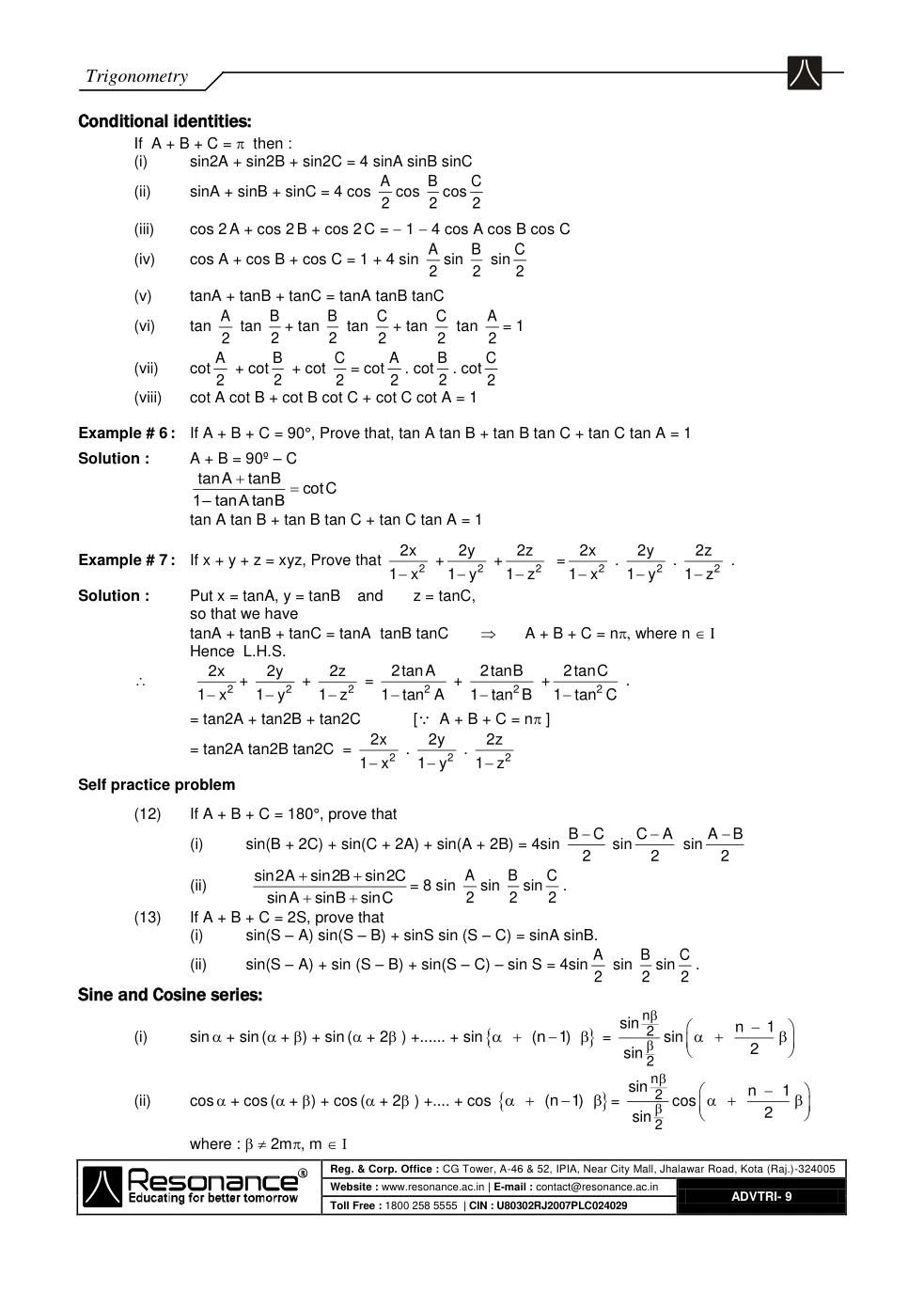
Conditional identities:
             If A + B + C =  then :
            (i)     sin2A + sin2B + sin2C = 4 sinA sinB sinC
                              A    B   C
             (ii)     sinA + sinB + sinC = 4 cos   cos   cos
                                     2     2    2
              (iii)    cos 2 A + cos 2 B + cos 2 C =  1  4 cos A cos B cos C
                                   A   B   C
          (iv)    cos A + cos B + cos C = 1 + 4 sin    sin    sin
                                          2    2    2
         (v)     tanA + tanB + tanC = tanA tanB tanC
              A    B     B    C    C    A
          (vi)     tan    tan   + tan    tan   + tan    tan   = 1
                 2     2      2     2      2     2
              A     B     C    A    B    C
           (vii)     cot   + cot   + cot   = cot     . cot    . cot
                 2      2      2      2     2     2
            (viii)    cot A cot B + cot B cot C + cot C cot A = 1

Example # 6 :   If A + B + C = 90°, Prove that, tan A tan B + tan B tan C + tan C tan A = 1
Solution :    A + B = 90º – C
              tanA  tanB
                         cotC
            1– tanA tanB
                tan A tan B + tan B tan C + tan C tan A = 1

                                      2x     2y     2z      2x     2y     2z
Example # 7 :   If x + y + z = xyz, Prove that      +     +      =            .            .             .
                                    1  x 2   1  y 2   1  z 2   1  x 2   1  y 2   1  z 2
Solution :     Put x = tanA, y = tanB  and    z = tanC,
              so that we have
              tanA + tanB + tanC = tanA tanB tanC      A + B + C = n where n  
             Hence L.H.S.
               2x     2y      2z     2tanA     2tanB    2tanC
              +      +      =         +         +                  .
              1  x 2   1  y 2   1  z 2   1  tan 2 A   1  tan 2 B  1  tan2 C
            = tan2A + tan2B + tan2C      [ A + B + C = n ]
                                   2x     2y     2z
            = tan2A tan2B tan2C =             .             .
                                 1  x 2   1  y 2   1  z 2
Self practice problem

        (12)       If A + B + C = 180°, prove that
                                               B  C   C  A   A  B
                        (i)      sin(B + 2C) + sin(C + 2A) + sin(A + 2B) = 4sin        sin        sin
                                                          2       2       2
                      sin2A  sin2B  sin2C      A   B   C
                          (ii)                      = 8 sin    sin    sin     .
                       sinA  sinB  sinC         2    2    2
        (13)       If A + B + C = 2S, prove that
                        (i)      sin(S – A) sin(S – B) + sinS sin (S – C) = sinA sinB.
                                                    A    B   C
                          (ii)      sin(S – A) + sin (S – B) + sin(S – C) – sin S = 4sin    sin    sin     .
                                                              2     2    2
Sine and Cosine series:
                                                                         n                                                                                    sin                                                                          2          n  1                                                                                                                                         (i)      sin  + sin (+) + sin ( + 2 ) +...... + sin (n  1)  =                                                                                                                                                                                  sin                                                                             2                                                                                                                                                                                                                                                                                                             sin                                                                          2
                                                                          n                                                                                     sin                                                                           2           n  1                                                                                                                                            (ii)     cos  + cos (+) + cos ( + 2 ) +.... + cos  (n  1) =                                                                                                                                                                              cos                                                                               2                                                                                                                                                                                                                                                                                                                  sin                                                                           2
             where :   2m, m  

                                                                                           ADVTRI- 9
Rendered source page 10 of 47: Trigonometry
MAASTrigonometry
© MAAS. All rights reserved.Page 10 / 47
Extracted text · page 10
 Trigonometry

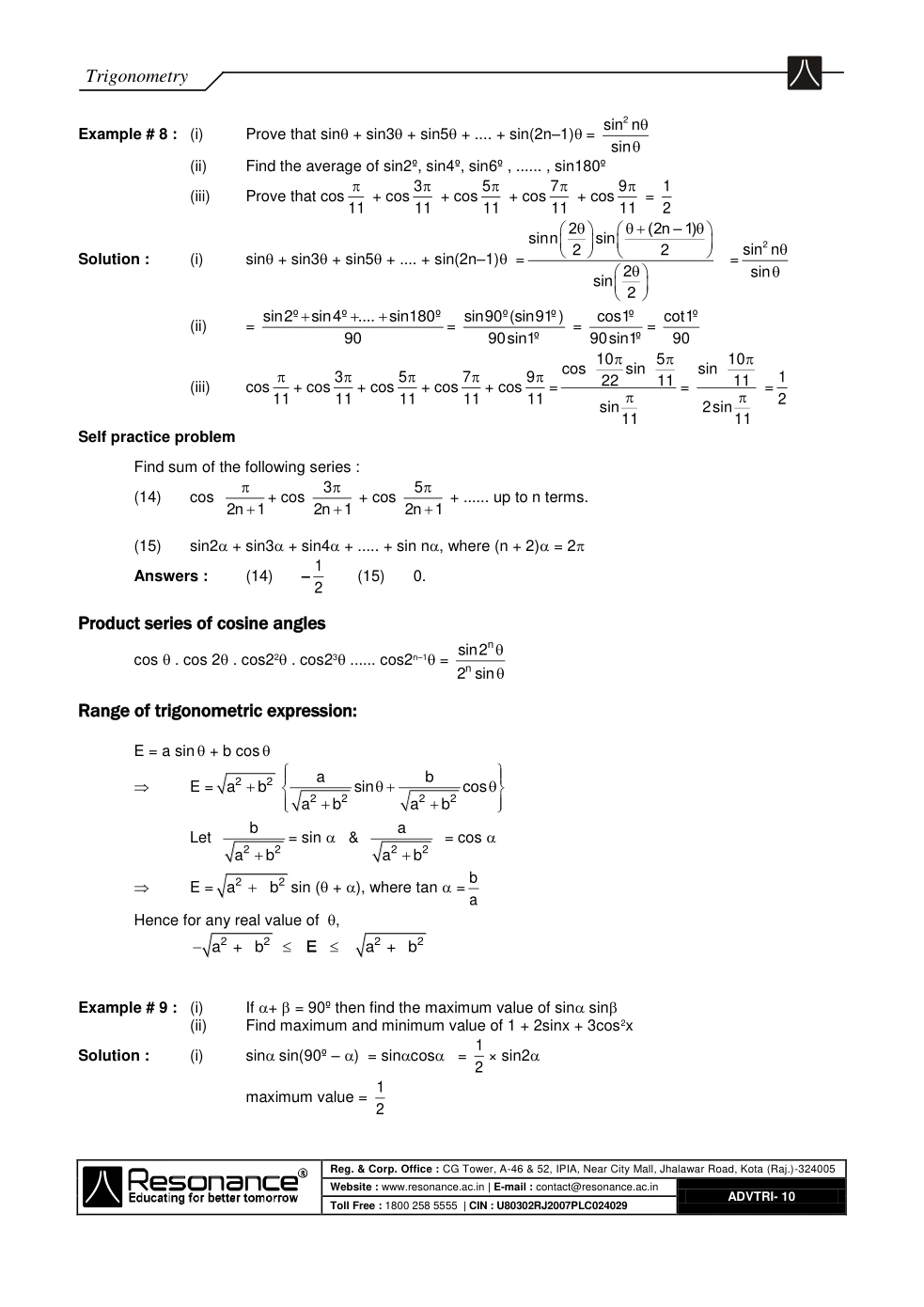
                                                                                sin 2 n 
Example # 8 :   (i)     Prove that sin + sin3 + sin5 + .... + sin(2n–1)=
                                                                                 sin 
                          (ii)     Find the average of sin2º, sin4º, sin6º , ...... , sin180º
                                       3       5       7       9    1
                           (iii)    Prove that cos   + cos   + cos   + cos   + cos   =
                               11      11      11      11      11   2
                                                                                 2       (2n – 1) 
                                                             sinn      sin                         2                                                                                 2         2           sin n Solution :         (i)      sin + sin3 + sin5 + .... + sin(2n–1) =                       =
                                                                                          2                sin 
                                                                              sin     
                                                                                          2 
                          sin2º  sin4º ....  sin180º   sin90º(sin91º)     cos1º    cot1º
                          (ii)    =                     =             =       =
                              90                 90sin1º       90sin1º    90
                                                            10     5       10 
                                                            cos      sin        sin
                              3       5       7       9        22    11       11   1                           (iii)    cos + cos + cos + cos + cos =              =        =
                       11     11     11     11     11                         2
                                                                   sin11        2sin11
Self practice problem

       Find sum of the following series :
                           3         5 
        (14)    cos      + cos      + cos      + ...... up to n terms.
                  2n  1      2n  1      2n  1

        (15)    sin2 + sin3 + sin4 + ..... + sin n, where (n + 2) = 2
                             1
      Answers :     (14)   –       (15)    0.
                             2

Product series of cosine angles
                                                   sin2n 
       cos  . cos 2 . cos22 . cos23 ...... cos2n–1 =
                                            2n sin 

Range of trigonometric expression:

     E = a sin  + b cos 
                                                                                                             a           b                                                                               2    2        E = a  b            sin         cos  
                           a 2  b 2       a 2  b 2     
                    b                a
                Let         = sin  &          = cos 
                  a 2  b 2            a 2  b 2
                         2      2                      b        E = a  b  sin ( + ), where tan  =
                                                a
      Hence for any real value of ,
              a2 + b2  E    a2 + b2


Example # 9 :   (i)          If +  = 90º then find the maximum value of sin sin
                          (ii)     Find maximum and minimum value of 1 + 2sinx + 3cos2x
                                                1
Solution :         (i)      sinsin(90º – ) = sincos =  × sin2
                                                2
                                    1
                  maximum value =
                                    2


                                                                                          ADVTRI- 10
Rendered source page 11 of 47: Trigonometry
MAASTrigonometry
© MAAS. All rights reserved.Page 11 / 47
Extracted text · page 11
 Trigonometry

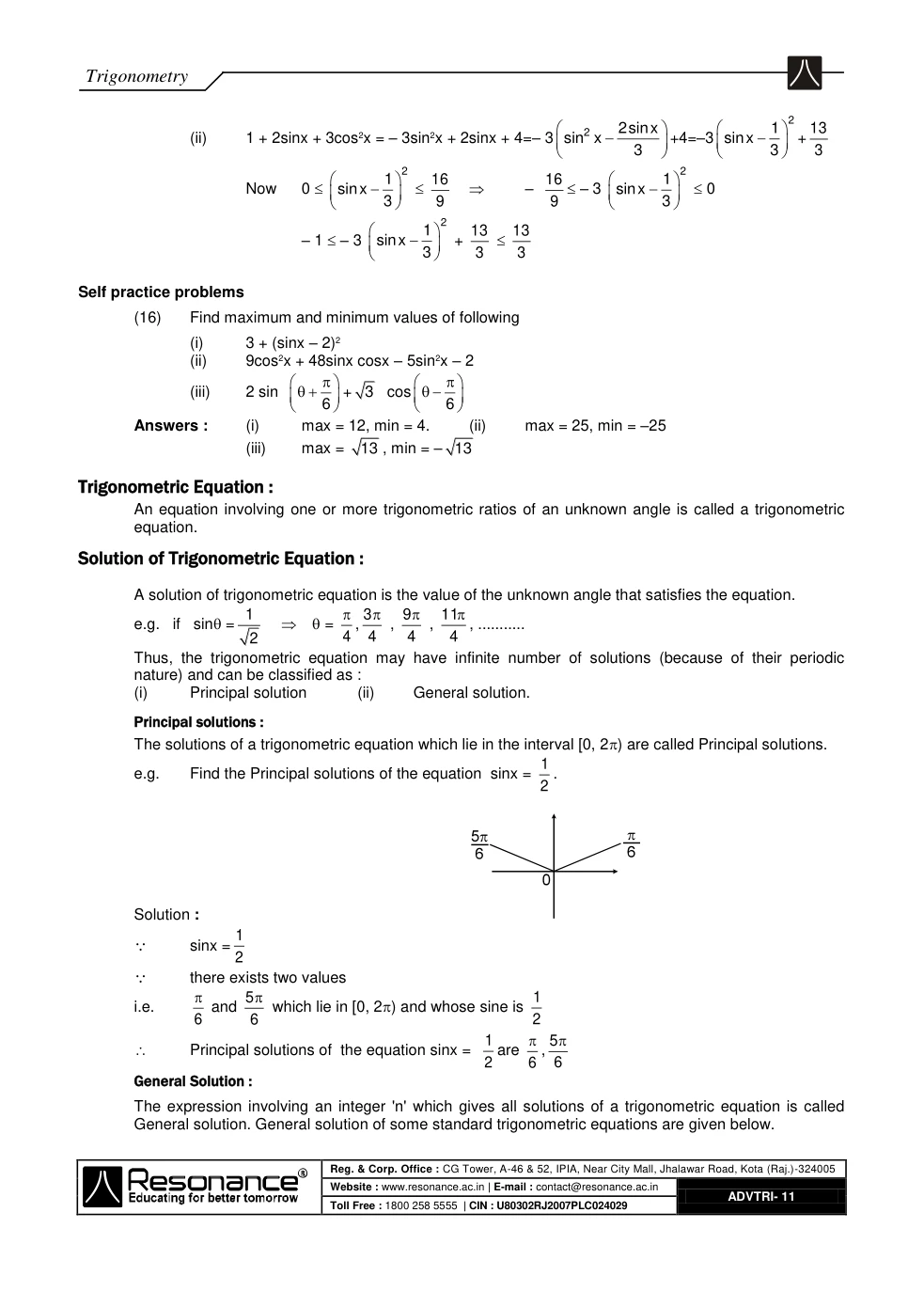
                                                                                  2    2sinx               1  2  13                          (ii)     1 + 2sinx + 3cos2x = – 3sin2x + 2sinx + 4=– 3  sin x       +4=–3 sinx     +                                                                                                                                                                                                        3                3    3
                                                1  2   16           16              1  2                Now   0   sinx             –     – 3  sinx      0                                                                                                
                                               3     9             9             3 
                                                      1  2   13   13                          – 1  – 3  sinx     +                                                              
                                                     3     3    3

Self practice problems
        (16)    Find maximum and minimum values of following
                        (i)     3 + (sinx – 2)2
                          (ii)     9cos2x + 48sinx cosx – 5sin2x – 2
                                                                                  (iii)    2 sin     + 3  cos                                                                                                  6                6 
      Answers :        (i)    max = 12, min = 4.         (ii)    max = 25, min = –25
                                         (iii)    max =  13 , min = – 13

Trigonometric Equation :
      An equation involving one or more trigonometric ratios of an unknown angle is called a trigonometric
        equation.

Solution of Trigonometric Equation :

     A solution of trigonometric equation is the value of the unknown angle that satisfies the equation.
                    1             3    9   11         e.g.   if  sin =        = ,       ,        ,   , ...........
                    2          4  4    4    4
       Thus, the trigonometric equation may have infinite number of solutions (because of their periodic
        nature) and can be classified as :
            (i)      Principal solution            (ii)     General solution.

         Principal solutions :
      The solutions of a trigonometric equation which lie in the interval [0, 2) are called Principal solutions.
                                                        1
         e.g.    Find the Principal solutions of the equation sinx =     .
                                                        2


        Solution :
                   1
          sinx =
                   2
          there exists two values
                   5                                  1
           i.e.       and    which lie in [0, 2) and whose sine is
              6      6                                 2
                                                 1       5           Principal solutions of the equation sinx =    are ,
                                                 2    6  6
        General Solution :

      The expression involving an integer 'n' which gives all solutions of a trigonometric equation is called
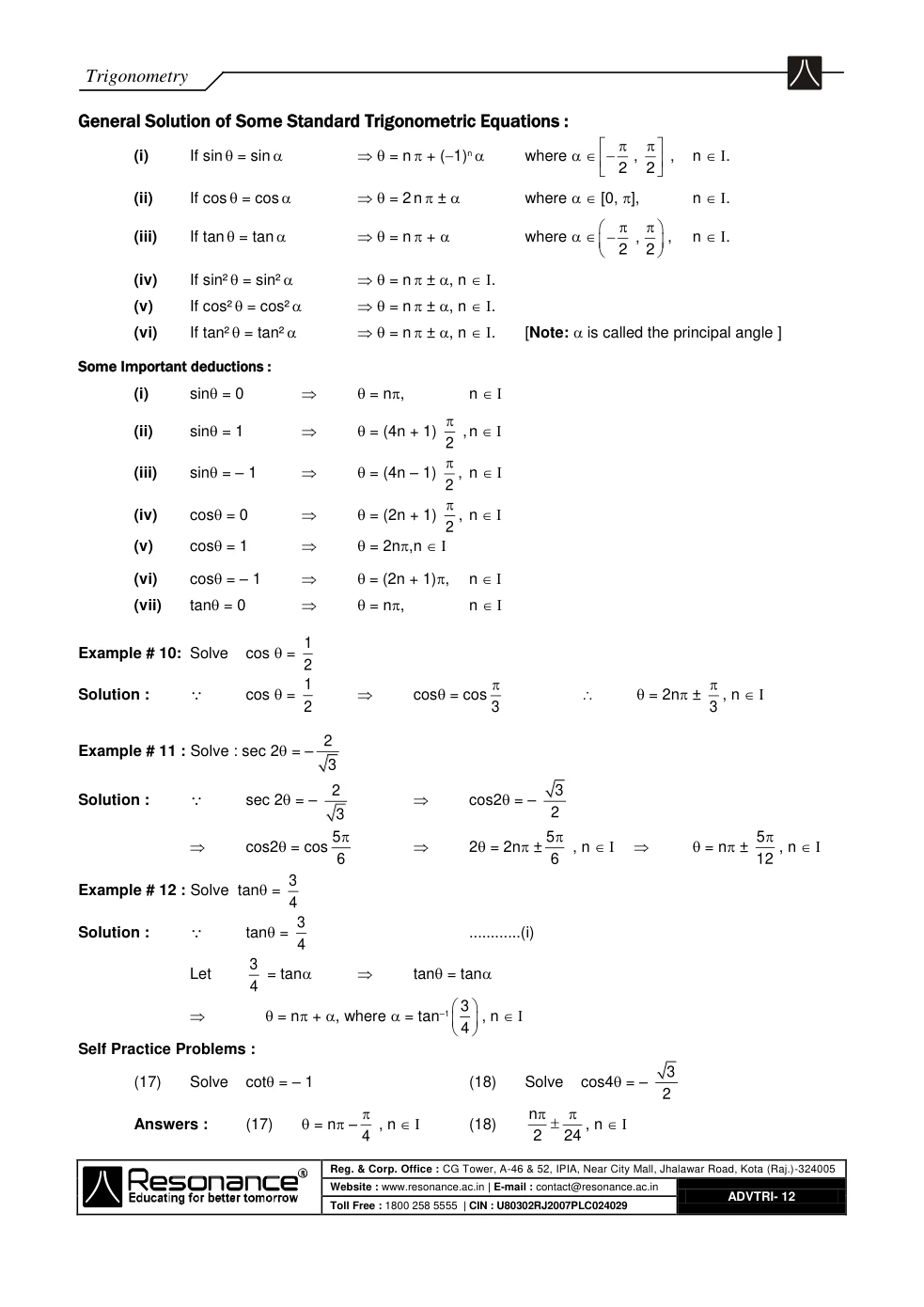
       General solution. General solution of some standard trigonometric equations are given below.


                                                                                          ADVTRI- 11
Rendered source page 12 of 47: Trigonometry
MAASTrigonometry
© MAAS. All rights reserved.Page 12 / 47
Extracted text · page 12
 Trigonometry

General Solution of Some Standard Trigonometric Equations :
                                                                                                      (i)          If sin  = sin       = n  + (1)n     where       ,       ,  n  .                                                                                                                                                                                        2  2 
            (ii)         If cos  = cos       = 2 n  ±         where   [0, ],      n  .
                                                                                                       (iii)        If tan  = tan       = n  +          where       ,      ,  n  .                                                                                                                                                                                       2  2 
          (iv)        If sin²  = sin²       = n  ± , n  .
         (v)         If cos²  = cos²       = n  ± , n  .
          (vi)        If tan²  = tan²       = n  ± , n  .    [Note:  is called the principal angle ]

Some Important deductions :
           (i)      sin = 0          = n,        n 
                                             
           (ii)     sin = 1            = (4n + 1)      , n
                                             2
            (iii)     sin = – 1           = (4n – 1) , n 
                                             2
          (iv)    cos = 0          = (2n + 1) , n
                                             2
         (v)     cos = 1            = 2n,n 

          (vi)    cos = – 1         = (2n + 1),   n
          (vii)    tan = 0            = n,        n 

                           1
Example # 10: Solve  cos  =
                           2
                           1                      Solution :        cos  =         cos = cos             = 2n ± , n 
                           2                      3                          3

                             2
Example # 11 : Solve : sec 2 = –
                              3
                              2                         3
Solution :        sec 2 = –              cos2 = –
                               3                        2
                              5                        5                        5            cos2 = cos           2 = 2n ±       , n       = n ±  , n 
                               6                        6                       12
                          3
Example # 12 : Solve tan =
                          4
                           3
Solution :         tan =                                          ............(i)
                           4
                     3
                Let      = tan         tan = tan
                     4
                                                                3 
                          = n + , where  = tan–1     , n
                                                                4 
Self Practice Problems :
                                                                      3
        (17)    Solve  cot = – 1                       (18)    Solve  cos4 = –
                                                                     2
                                                     n    
      Answers :     (17)     = n –     , n       (18)            , n 
                                  4                   2   24


                                                                                          ADVTRI- 12
Rendered source page 13 of 47: Trigonometry
MAASTrigonometry
© MAAS. All rights reserved.Page 13 / 47
Extracted text · page 13
 Trigonometry

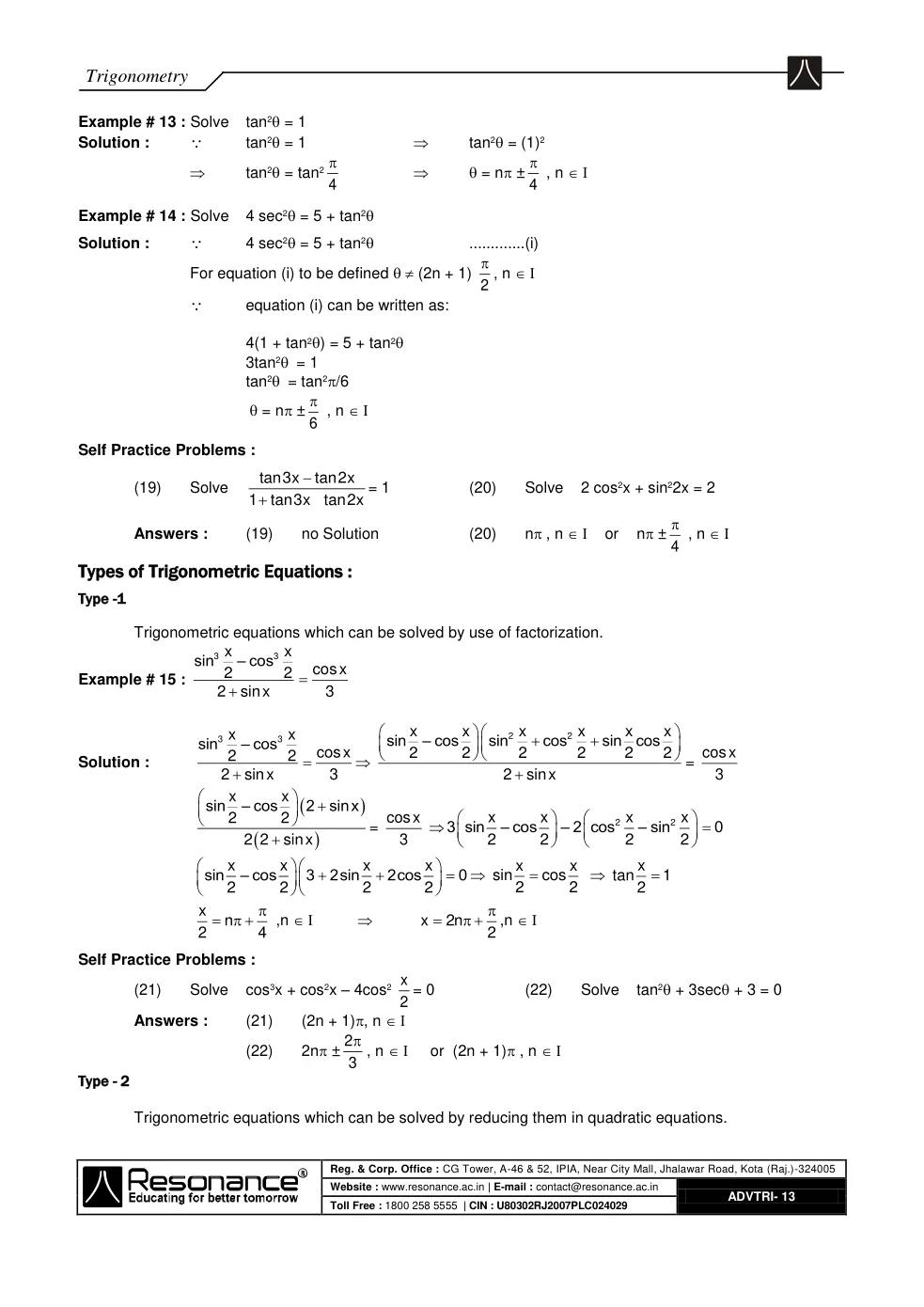
Example # 13 : Solve  tan2 = 1
Solution :         tan2 = 1             tan2 = (1)2
                                                       
                       tan2 = tan2                    = n ±     , n 
                              4                       4

Example # 14 : Solve  4 sec2 = 5 + tan2
Solution :        4 sec2 = 5 + tan2                     .............(i)
              For equation (i) to be defined  (2n + 1) , n 
                                                 2
              equation (i) can be written as:
                                                                       
                                 4(1 + tan2) = 5 + tan2
                         3tan2= 1
                          tan2= tan2/6
                            
                             = n ±     , n 
                            6

Self Practice Problems :

                       tan3x  tan2x
        (19)    Solve               = 1            (20)    Solve  2 cos2x + sin22x = 2
                   1  tan3x  tan2x
                                                                         
      Answers :     (19)   no Solution                (20)     n, n    or  n ±     , n
                                                                        4

Types of Trigonometric Equations :

Type -1

        Trigonometric equations which can be solved by use of factorization.
                           3 x        3 x                 sin   – cos
                 2      2  cosxExample # 15 :             
                2  sinx      3

                            3 x        3 x                 x      x     2 x        2 x     x    x                   sin   – cos                  sin  – cos   sin    cos    sin  cos  
                 2      2  cosx        2     2     2      2    2   2    cosxSolution :                                                        =
                2  sinx      3                   2  sinx                  3
                       x      x                      sin  – cos    2  sinx                        2     2           cosx         x      x          2 x       2 x                                        =    3  sin  – cos   – 2  cos   – sin    0                   2  2  sinx          3           2     2         2     2 
                      x      x        x       x          x      x        x
                    sin  – cos   3  2sin   2cos    0  sin   cos   tan   1                      2     2        2      2         2     2       2
               x                               
          n       ,n           x  2n   ,n                        
              2      4                         2

Self Practice Problems :
                                           x
        (21)    Solve  cos3x + cos2x – 4cos2  = 0             (22)    Solve   tan2 + 3sec + 3 = 0
                                       2
      Answers :     (21)    (2n + 1), n 
                               2                        (22)   2n ± , n    or (2n + 1) , n 
                                3
Type - 2

        Trigonometric equations which can be solved by reducing them in quadratic equations.



                                                                                          ADVTRI- 13
Rendered source page 14 of 47: Trigonometry
MAASTrigonometry
© MAAS. All rights reserved.Page 14 / 47
Extracted text · page 14
 Trigonometry


                         cosx   1
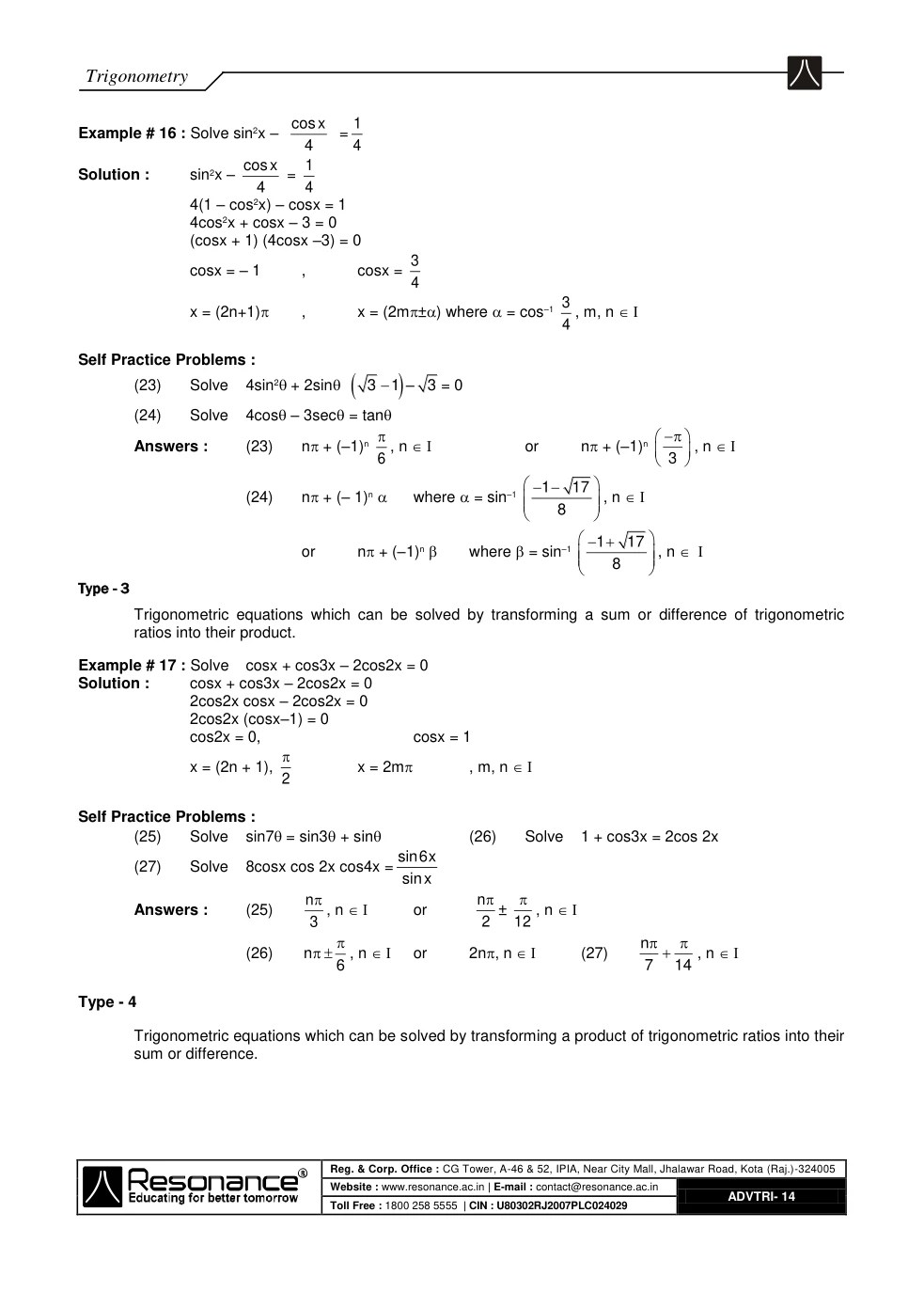
Example # 16 : Solve sin2x –       =
                          4     4
                   cosx   1
Solution :      sin2x –      =
                     4     4
               4(1 – cos2x) – cosx = 1
               4cos2x + cosx – 3 = 0
               (cosx + 1) (4cosx –3) = 0
                                        3
              cosx = – 1         ,      cosx =
                                        4
                                                           3
              x = (2n+1)       ,       x = (2m±) where  = cos–1     , m, n 
                                                           4

Self Practice Problems :
        (23)    Solve   4sin2+        3  1 –  3 = 0                                   2sin        
        (24)    Solve  4cos – 3sec = tan
                                                                                                         Answers :     (23)   n + (–1)n , n               or     n + (–1)n           , n                                                                                                                                           6                                              3 
                                                                           1   17 
                        (24)   n + (– 1)n    where  = sin–1             , n                                                                              8                                                                                          
                                                                                    1   17 
                                 or     n + (–1)n     where  = sin–1             , n                                                                                       8                                                                                                   
Type - 3

        Trigonometric equations which can be solved by transforming a sum or difference of trigonometric
         ratios into their product.

Example # 17 : Solve  cosx + cos3x – 2cos2x = 0
Solution :     cosx + cos3x – 2cos2x = 0
              2cos2x cosx – 2cos2x = 0
              2cos2x (cosx–1) = 0
              cos2x = 0,                   cosx = 1
                         
              x = (2n + 1),              x = 2m           , m, n 
                         2

Self Practice Problems :
        (25)    Solve  sin7= sin3 + sin            (26)    Solve  1 + cos3x = 2cos 2x
                                          sin6x
        (27)    Solve  8cosx cos 2x cos4x =
                                            sinx
                           n                   n      Answers :     (25)     , n        or      ± , n 
                            3                   2   12
                                                                n    
                        (26)    n     , n    or      2n, n       (27)            , n 
                              6                                  7  14

Type - 4


        Trigonometric equations which can be solved by transforming a product of trigonometric ratios into their
      sum or difference.


                                                                                          ADVTRI- 14
Rendered source page 15 of 47: Trigonometry
MAASTrigonometry
© MAAS. All rights reserved.Page 15 / 47
Extracted text · page 15
 Trigonometry

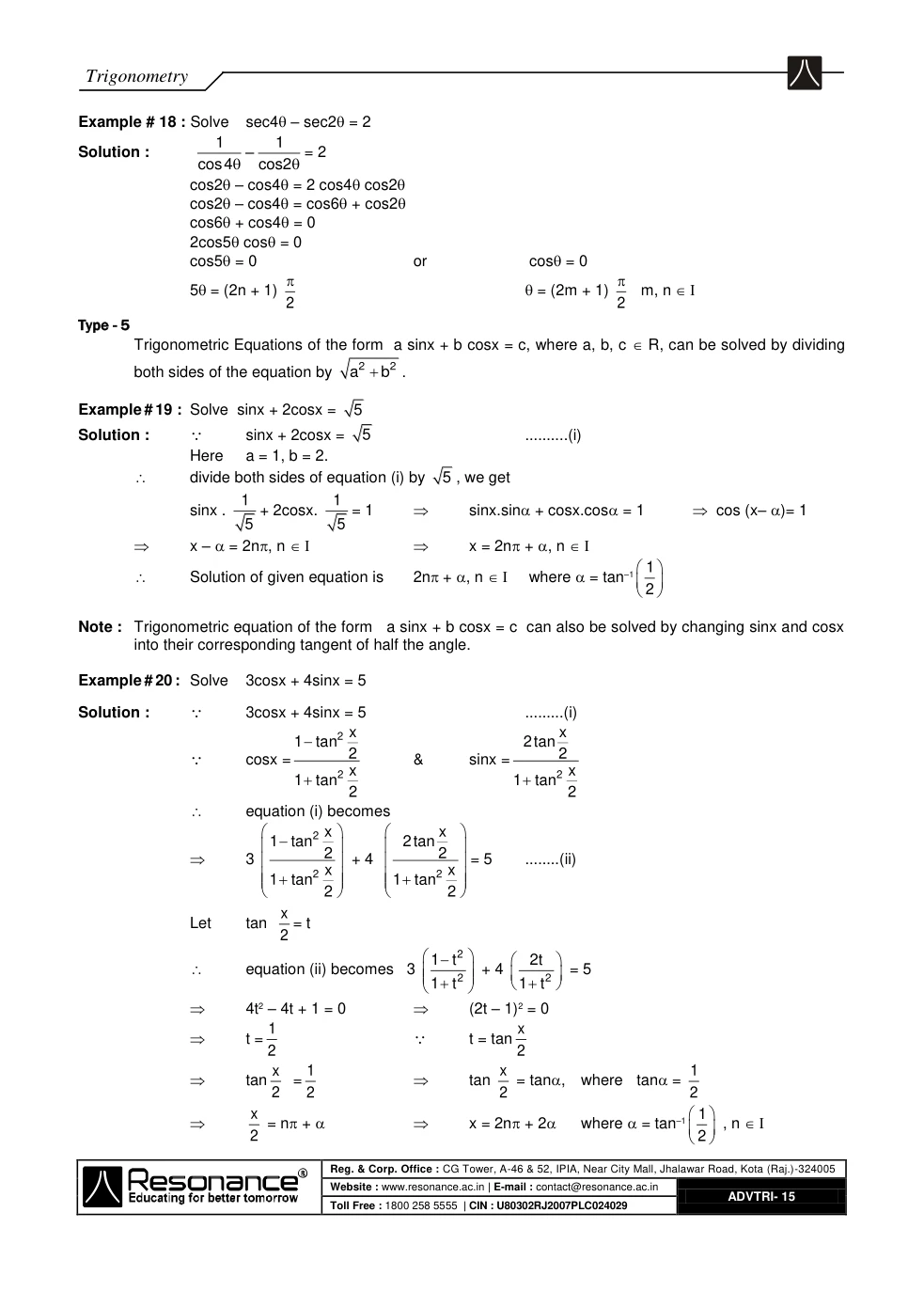
Example # 18 : Solve  sec4 – sec2 = 2
                1      1
Solution :           –      = 2
              cos4  cos2 
              cos2 – cos4 = 2 cos4 cos2
              cos2 – cos4 = cos6 + cos2
              cos6 + cos4 = 0
              2cos5 cos = 0
              cos5 = 0                       or             cos = 0                                          
                                                                  
                    5= (2n + 1)                                = (2m + 1)    m, n
                         2                                       2

Type - 5
        Trigonometric Equations of the form a sinx + b cosx = c, where a, b, c  R, can be solved by dividing
       both sides of the equation by  a2  b2 .

Example # 19 : Solve sinx + 2cosx =  5
Solution :         sinx + 2cosx =  5                                   ..........(i)
             Here   a = 1, b = 2.
          divide both sides of equation (i) by  5 , we get
                   1          1
                sinx .    + 2cosx.    = 1         sinx.sin + cosx.cos = 1    cos (x– )= 1
                    5          5
         x –  = 2n, n             x = 2n + , n 
                                                                                                1           Solution of given equation is    2n+ , n   where  = tan–1                                                                                                                                                                                                          2 

Note :  Trigonometric equation of the form  a sinx + b cosx = c can also be solved by changing sinx and cosx
         into their corresponding tangent of half the angle.

Example # 20 : Solve  3cosx + 4sinx = 5

Solution :        3cosx + 4sinx = 5                                    .........(i)
                                           2 x                          x                         1  tan                       2tan
                               2                       2                     cosx =            &       sinx =
                                           2 x                                 2 x                         1  tan                    1  tan
                               2                        2
                        equation (i) becomes
                                       2 x              x                        1  tan           2tan                                                                                          2            2                      3              + 4               = 5        ........(ii)
                                                                                                                  x                                                 x                                 1  tan 2                                                                                               1  tan 2                                                                
                                      2               2 
                           x
                Let     tan   = t
                        2
                                                           1  t 2         2t  
              equation (ii) becomes  3                                                                                                               + 4      2  = 5                                                               2                                                                                                                            1  t         1  t  
              4t2 – 4t + 1 = 0           (2t – 1)2 = 0
                       1                                 x
                         t =                     t = tan
                       2                             2
                          x   1                         x                      1
             tan   =             tan   = tan,  where  tan =
                       2   2                      2                      2
                       x                                                                          1 
                        = n +                x = 2n + 2   where  = tan–1      , n                      2                                                                          2 

                                                                                          ADVTRI- 15
Rendered source page 16 of 47: Trigonometry
MAASTrigonometry
© MAAS. All rights reserved.Page 16 / 47
Extracted text · page 16
 Trigonometry


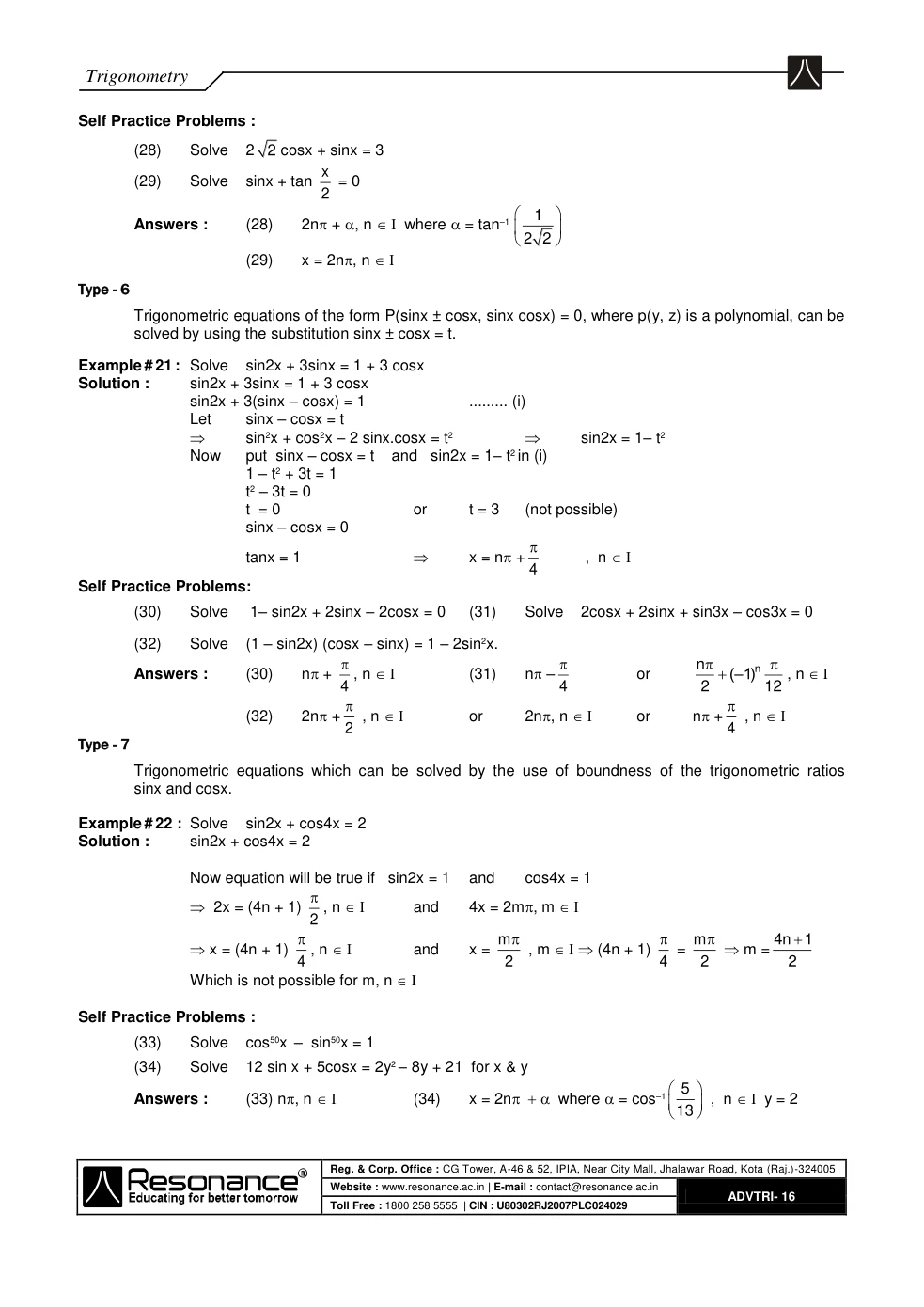
Self Practice Problems :

        (28)    Solve  2  2 cosx + sinx = 3
                                 x
        (29)    Solve   sinx + tan   = 0
                             2
                                                                           1  
      Answers :     (28)   2n + , n where  = tan–1       
                                                                          2 2 
                        (29)    x = 2n, n 

Type - 6

        Trigonometric equations of the form P(sinx ± cosx, sinx cosx) = 0, where p(y, z) is a polynomial, can be
        solved by using the substitution sinx ± cosx = t.

Example # 21 : Solve  sin2x + 3sinx = 1 + 3 cosx
Solution :      sin2x + 3sinx = 1 + 3 cosx
                sin2x + 3(sinx – cosx) = 1                        ......... (i)
                Let     sinx – cosx = t
                       sin2x + cos2x – 2 sinx.cosx = t2             sin2x = 1– t2
           Now   put sinx – cosx = t  and  sin2x = 1– t2 in (i)
                    1 – t2 + 3t = 1
                                     t2 – 3t = 0
                                       t = 0                   or          t = 3    (not possible)
                        sinx – cosx = 0
                                                       
                       tanx = 1            x = n +              , n 
                                                       4
Self Practice Problems:
        (30)    Solve   1– sin2x + 2sinx – 2cosx = 0   (31)    Solve  2cosx + 2sinx + sin3x – cos3x = 0

        (32)    Solve   (1 – sin2x) (cosx – sinx) = 1 – 2sin2x.
                                                                          n       n       Answers :     (30)   n + , n            (31)   n –              or         (–1)       , n
                                4                          4               2      12
                                                                               
                        (32)   2n +     , n           or      2n, n       or     n +     , n
                                2                                              4
Type - 7

        Trigonometric equations which can be solved by the use of boundness of the trigonometric ratios
        sinx and cosx.

Example # 22 : Solve  sin2x + cos4x = 2
Solution :      sin2x + cos4x = 2

           Now equation will be true if  sin2x = 1  and    cos4x = 1
        2x = (4n + 1) , n       and    4x = 2m, m
                            2
                                 m                    m        4n  1                  x = (4n + 1) , n        and    x =         , m (4n + 1)   =   m =
                           4                       2                  4    2         2
             Which is not possible for m, n

Self Practice Problems :
        (33)    Solve   cos50x – sin50x = 1
        (34)    Solve  12 sin x + 5cosx = 2y2 – 8y + 21 for x & y
                                                                                                    5 
      Answers :     (33) n, n            (34)    x = 2nwhere  = cos–1       , n y = 2                                                                                                    13 


                                                                                          ADVTRI- 16
Rendered source page 17 of 47: Trigonometry
MAASTrigonometry
© MAAS. All rights reserved.Page 17 / 47
Extracted text · page 17
 Trigonometry


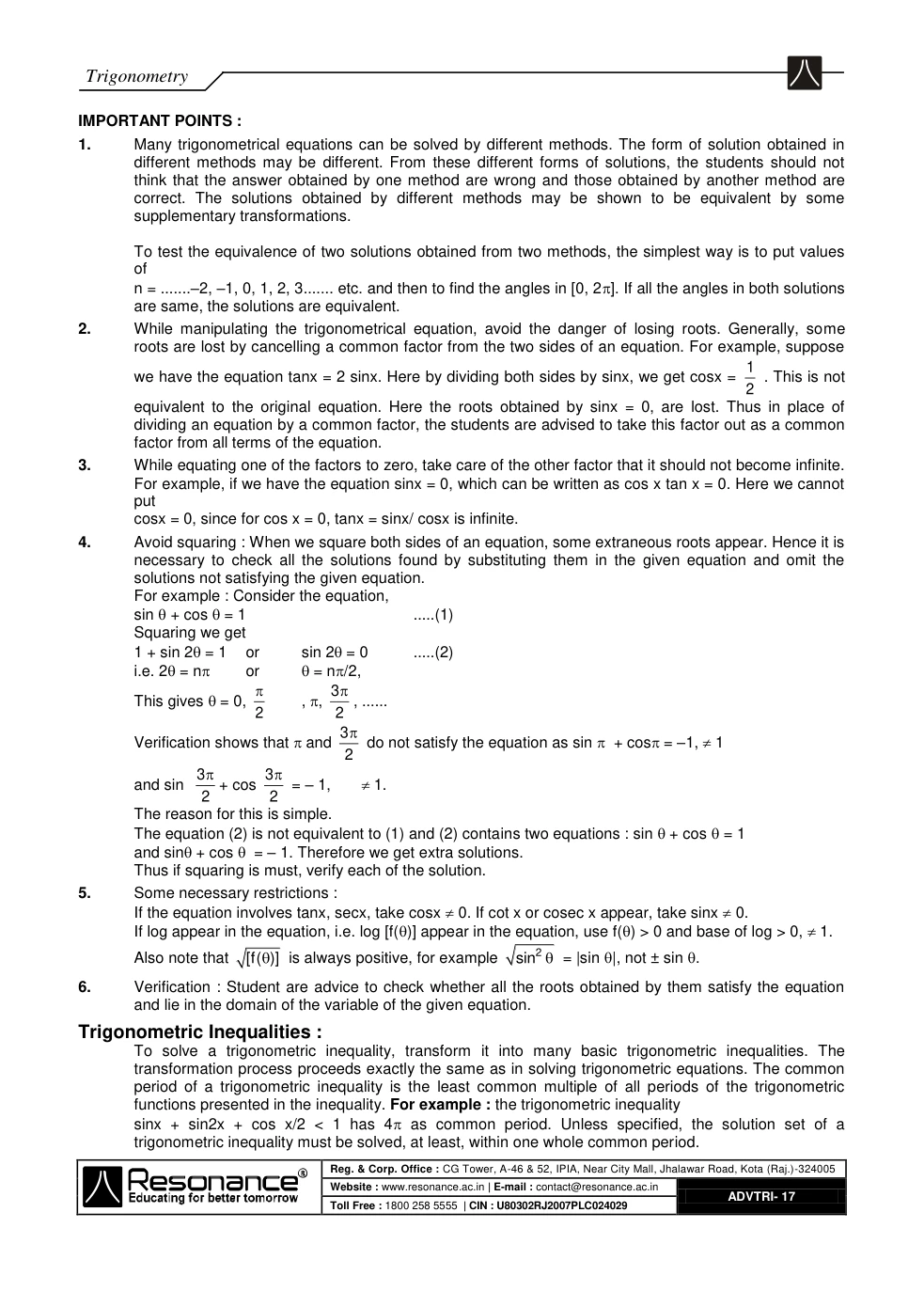
IMPORTANT POINTS :
1.     Many trigonometrical equations can be solved by different methods. The form of solution obtained in
         different methods may be different. From these different forms of solutions, the students should not
         think that the answer obtained by one method are wrong and those obtained by another method are
         correct. The solutions obtained by  different methods may be shown to be equivalent by some
       supplementary transformations.

      To test the equivalence of two solutions obtained from two methods, the simplest way is to put values
         of
       n = .......–2, –1, 0, 1, 2, 3....... etc. and then to find the angles in [0, 2]. If all the angles in both solutions
        are same, the solutions are equivalent.
2.      While manipulating the trigonometrical equation, avoid the danger of losing roots. Generally, some
        roots are lost by cancelling a common factor from the two sides of an equation. For example, suppose
                                                                                 1
      we have the equation tanx = 2 sinx. Here by dividing both sides by sinx, we get cosx =       . This is not
                                                                                 2
        equivalent to the original equation. Here the roots obtained by sinx = 0, are lost. Thus in place of
         dividing an equation by a common factor, the students are advised to take this factor out as a common
         factor from all terms of the equation.
3.      While equating one of the factors to zero, take care of the other factor that it should not become infinite.
       For example, if we have the equation sinx = 0, which can be written as cos x tan x = 0. Here we cannot
        put
       cosx = 0, since for cos x = 0, tanx = sinx/ cosx is infinite.
4.      Avoid squaring : When we square both sides of an equation, some extraneous roots appear. Hence it is
       necessary to check all the solutions found by substituting them in the given equation and omit the
        solutions not satisfying the given equation.
       For example : Consider the equation,
        sin  + cos = 1                                 .....(1)
       Squaring we get
       1 + sin 2= 1   or      sin 2= 0         .....(2)
           i.e. 2= n     or      = n/2,
                              3        This gives = 0,           ,,  , ......
                     2        2
                               3 
         Verification shows that and    do not satisfy the equation as sin  + cos= –1, 1
                               2
              3       3        and sin  + cos    = – 1,     1.
               2       2
      The reason for this is simple.
      The equation (2) is not equivalent to (1) and (2) contains two equations : sin + cos  = 1
       and sin+ cos  = – 1. Therefore we get extra solutions.
      Thus if squaring is must, verify each of the solution.
5.    Some necessary restrictions :
             If the equation involves tanx, secx, take cosx  0. If cot x or cosec x appear, take sinx  0.
             If log appear in the equation, i.e. log [f()] appear in the equation, use f() > 0 and base of log > 0, 1.
       Also note that   [f( )]  is always positive, for example   sin2  = |sin |, not ± sin .

6.       Verification : Student are advice to check whether all the roots obtained by them satisfy the equation
       and lie in the domain of the variable of the given equation.
Trigonometric Inequalities :
      To solve a trigonometric  inequality, transform   it  into many basic trigonometric  inequalities. The
        transformation process proceeds exactly the same as in solving trigonometric equations. The common
        period of a trigonometric inequality is the least common multiple of all periods of the trigonometric
        functions presented in the inequality. For example : the trigonometric inequality
        sinx + sin2x + cos x/2 < 1 has 4 as common period. Unless specified, the solution set of a
        trigonometric inequality must be solved, at least, within one whole common period.

                                                                                          ADVTRI- 17
Rendered source page 18 of 47: Trigonometry
MAASTrigonometry
© MAAS. All rights reserved.Page 18 / 47
Extracted text · page 18
 Trigonometry


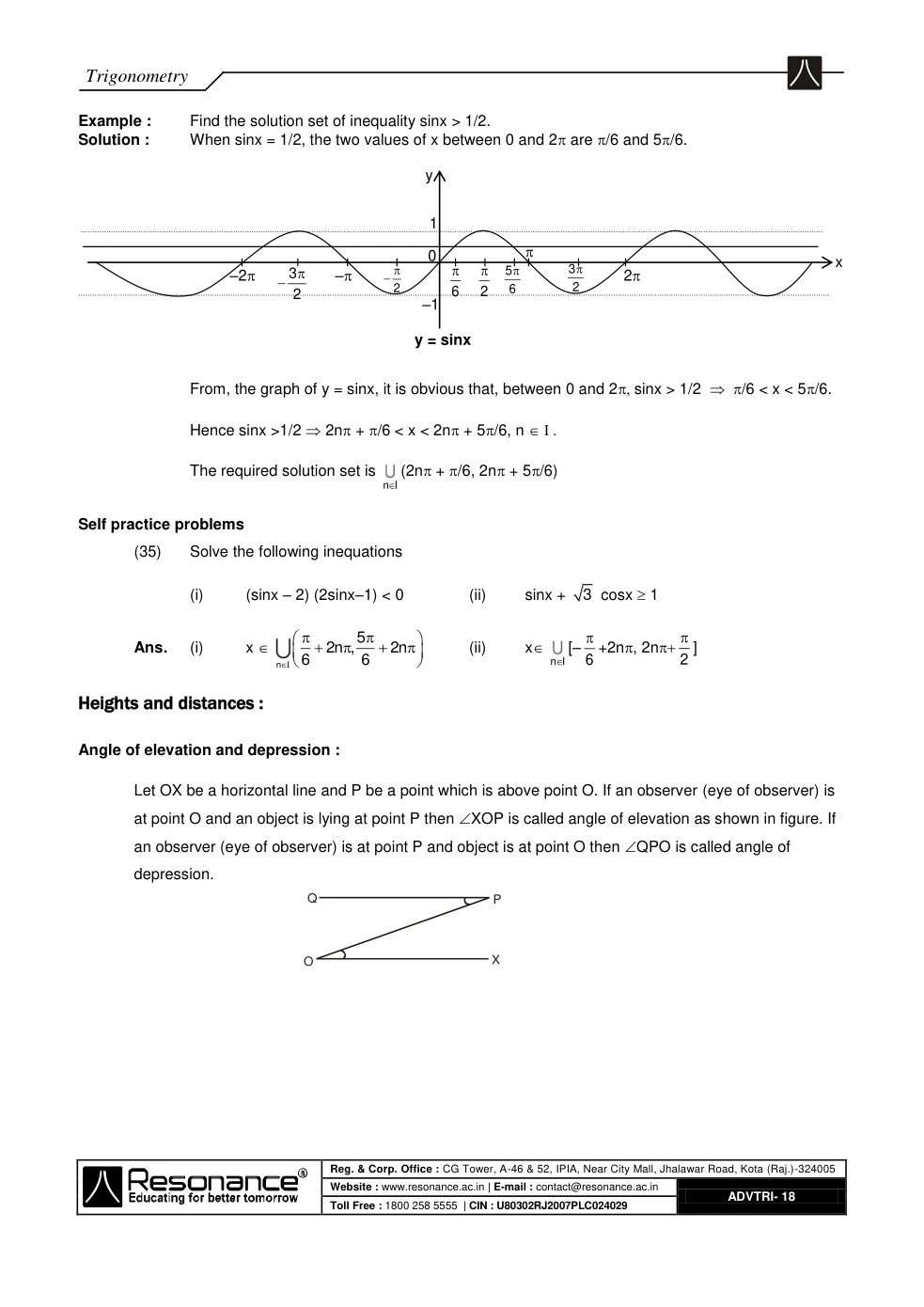
Example :     Find the solution set of inequality sinx > 1/2.
Solution :    When sinx = 1/2, the two values of x between 0 and 2 are /6 and 5/6.

                                             y


                                         1
                                         0                                                                                                              x
                  –2    3    –                  5        3      2                                                                       2       6   2   6        2                          2
                                        –1

                                       y = sinx


              From, the graph of y = sinx, it is obvious that, between 0 and 2sinx > 1/2  /6 < x < 5/6.

             Hence sinx >1/2  2n + /6 < x < 2n + 5/6, n  

                   The required solution set is   (2n + /6, 2n + 5/6)
                                                    nI

Self practice problems

        (35)    Solve the following inequations

                        (i)      (sinx – 2) (2sinx–1) < 0               (ii)      sinx +  3 cosx  1

                                         5               Ans.     (i)     x        2n,    2n            (ii)    x    [– +2n, 2n ]                                       n  6      6                              nI  6          2

Heights and distances :


Angle of elevation and depression :

        Let OX be a horizontal line and P be a point which is above point O. If an observer (eye of observer) is
         at point O and an object is lying at point P then XOP is called angle of elevation as shown in figure. If

       an observer (eye of observer) is at point P and object is at point O then QPO is called angle of

        depression.

                       Q                     P


                       O                     X


                                                                                          ADVTRI- 18
Rendered source page 19 of 47: Trigonometry
MAASTrigonometry
© MAAS. All rights reserved.Page 19 / 47
Extracted text · page 19
 Trigonometry


 Marked questions are recommended for Revision.

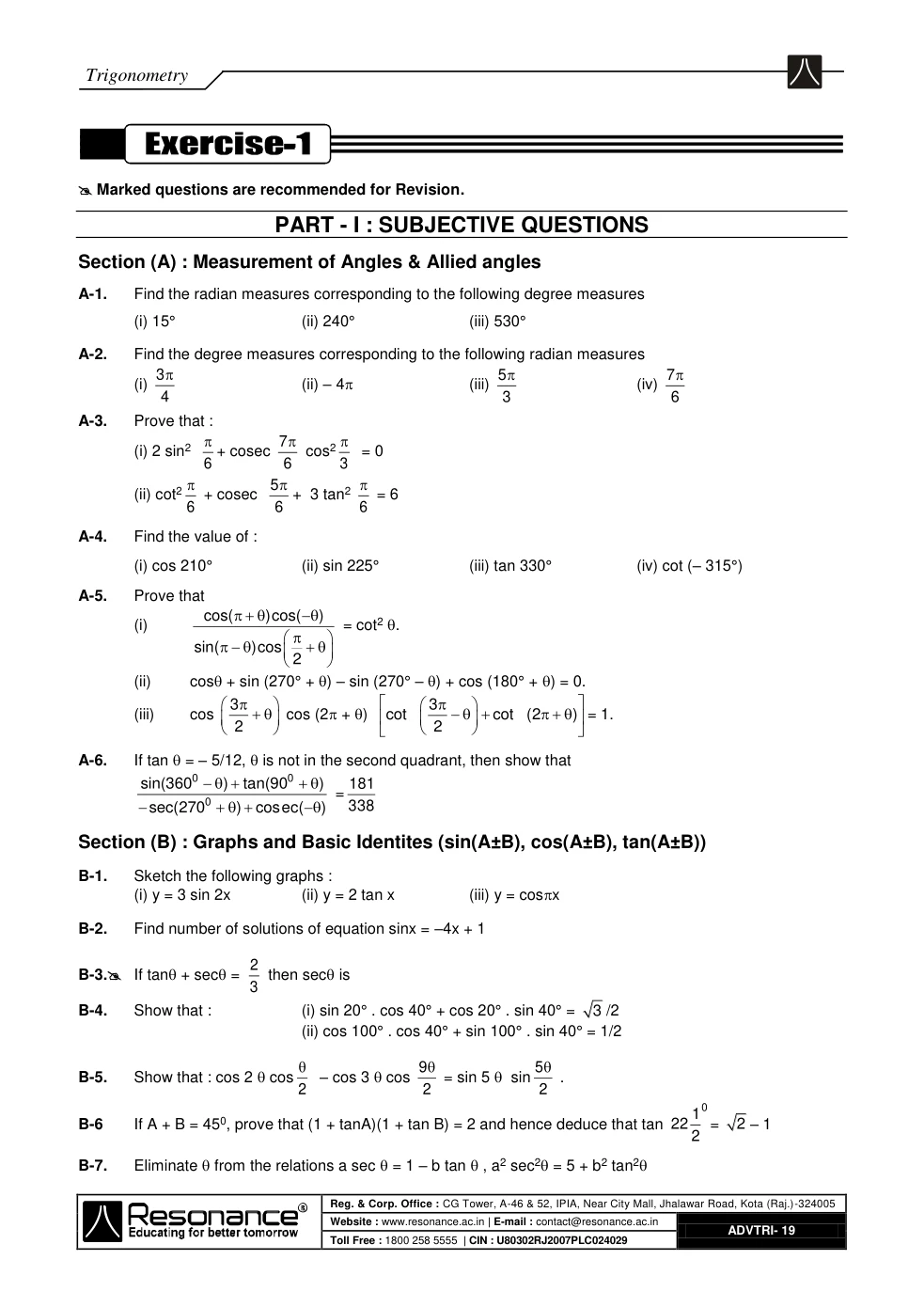
             PART - I : SUBJECTIVE QUESTIONS

Section (A) : Measurement of Angles & Allied angles

A-1.    Find the radian measures corresponding to the following degree measures

            (i) 15°                              (ii) 240°                            (iii) 530°

A-2.    Find the degree measures corresponding to the following radian measures
         3                                       5                   7 
            (i)                                    (ii) – 4                            (iii)                            (iv)
          4                                       3                   6
A-3.   Prove that :
                        7                  (i) 2 sin2 + cosec     cos2   = 0
               6        6      3
                      5                       (ii) cot2  + cosec  + 3 tan2   = 6
             6         6         6

A-4.    Find the value of :

            (i) cos 210°                     (ii) sin 225°                      (iii) tan 330°                (iv) cot (– 315°)

A-5.   Prove that
                 cos(  )cos(  )
            (i)                      = cot2 .
                                       
                  sin(  )cos                                       2    
             (ii)     cos + sin (270° + ) – sin (270° – ) + cos (180° + ) = 0.
                         3                            3                     
              (iii)    cos      cos (2 + )   cot      cot  (2 )  = 1.
                         2                            2                     

A-6.      If tan  = – 5/12,  is not in the second quadrant, then show that
        sin(3600 )  tan(900  )   181
                            =
        sec(2700 )  cosec(  )   338

Section (B) : Graphs and Basic Identites (sin(A±B), cos(A±B), tan(A±B))

B-1.   Sketch the following graphs :
            (i) y = 3 sin 2x                 (ii) y = 2 tan x                  (iii) y = cosx

B-2.    Find number of solutions of equation sinx = –4x + 1

                     2
B-3.   If tan + sec =    then sec is
                     3
B-4.   Show that :                    (i) sin 20° . cos 40° + cos 20° . sin 40° =  3 /2
                                                    (ii) cos 100° . cos 40° + sin 100° . sin 40° = 1/2

                                          9             5 
B-5.   Show that : cos 2  cos   – cos 3  cos    = sin 5  sin       .
                           2              2             2
                                                                       1 0
B-6       If A + B = 450, prove that (1 + tanA)(1 + tan B) = 2 and hence deduce that tan 22  =  2 – 1
                                                                       2

B-7.    Eliminate  from the relations a sec  = 1 – b tan  , a2 sec2 = 5 + b2 tan2


                                                                                          ADVTRI- 19
Rendered source page 20 of 47: Trigonometry
MAASTrigonometry
© MAAS. All rights reserved.Page 20 / 47
Extracted text · page 20
 Trigonometry


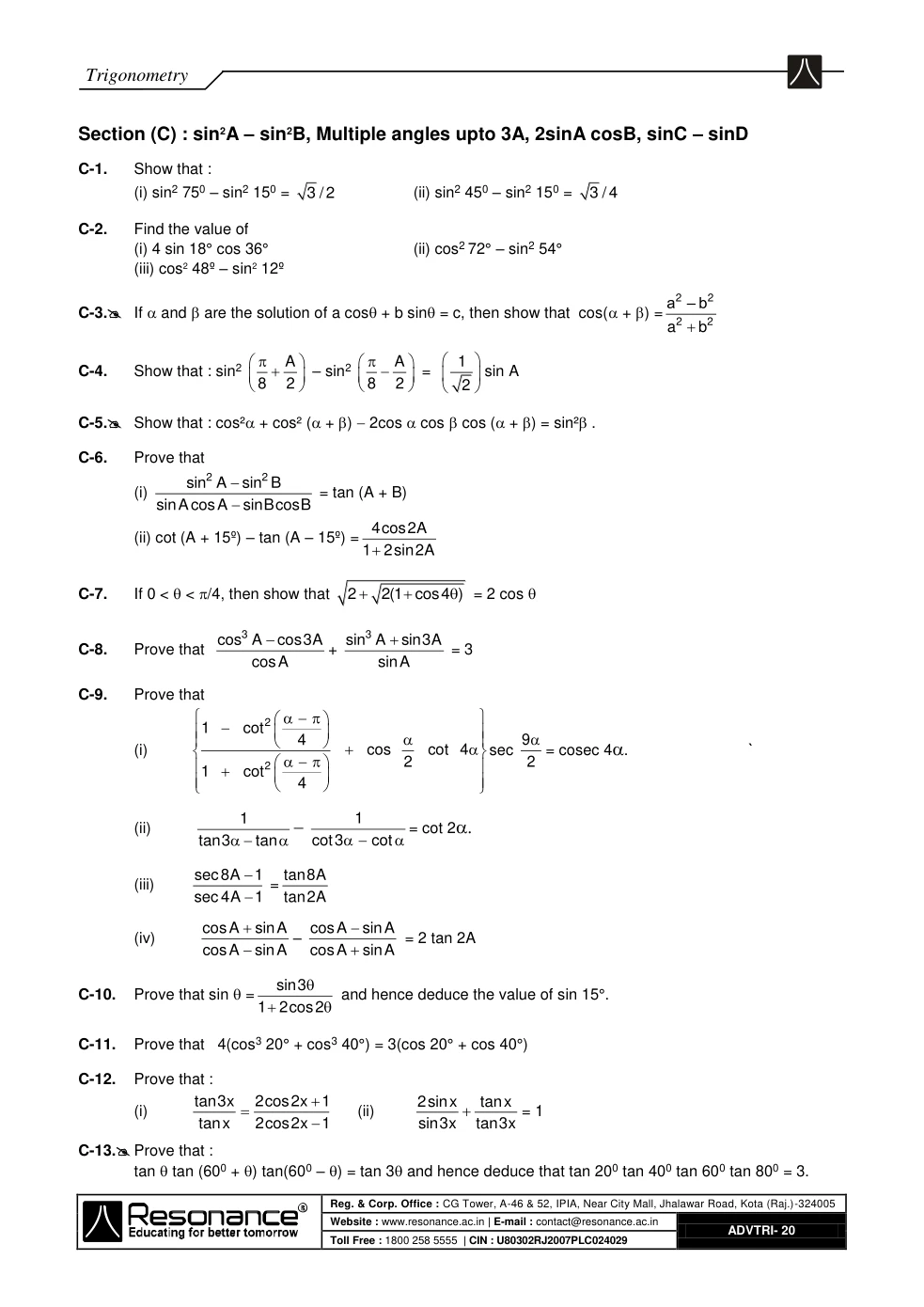
Section (C) : sin2A – sin2B, Multiple angles upto 3A, 2sinA cosB, sinC – sinD

C-1.   Show that :
            (i) sin2 750 – sin2 150 =  3 /2                  (ii) sin2 450 – sin2 150 =  3 / 4

C-2.    Find the value of
            (i) 4 sin 18° cos 36°                                  (ii) cos2 72° – sin2 54°
              (iii) cos2 48º – sin2 12º

                                                                    a 2 – b 2
C-3.   If  and  are the solution of a cos + b sin = c, then show that cos( + ) =
                                                                    a 2  b 2

                               A             A       1 
C-4.   Show that : sin2       – sin2       =        sin A
                             8  2           8  2        2 

C-5. Show that : cos² + cos² (+ )  2cos  cos  cos (+ ) = sin².

C-6.   Prove that
                sin2 A  sin2 B
            (i)                   = tan (A + B)
         sinAcosA  sinBcosB
                                4cos2A
             (ii) cot (A + 15º) – tan (A – 15º) =
                                1  2sin2A

C-7.      If 0 <  < /4, then show that  2   2(1  cos4) = 2 cos 

                 cos3 A  cos3A   sin3 A  sin3A
C-8.   Prove that              +             = 3
                   cosA           sinA

C-9.   Prove that
                         2                      
                1   cot                                                         4                       9            (i)                         cos     cot 4   sec = cosec 4.                       `
                                                                                        2              2                1   cot 2                                                                                                                      4                      

                  1            1             (ii)                                       cot 2                                    tan3 tan  cot3 cot =

             sec8A  1  tan8A             (iii)             =
              sec 4A  1  tan2A

             cosA  sinA  cosA  sinA          (iv)                –           = 2 tan 2A
             cosA  sinA  cosA  sinA

                          sin3
C-10.  Prove that sin  =          and hence deduce the value of sin 15°.
                    1  2cos2

C-11.  Prove that  4(cos3 20° + cos3 40°) = 3(cos 20° + cos 40°)

C-12.  Prove that :
              tan3x  2cos2x  1           2sinx   tanx
            (i)                                    (ii)                = 1
               tanx   2cos2x  1           sin3x  tan3x

C-13. Prove that :
        tan  tan (600 + ) tan(600 – ) = tan 3 and hence deduce that tan 200 tan 400 tan 600 tan 800 = 3.

                                                                                          ADVTRI- 20
Rendered source page 21 of 47: Trigonometry
MAASTrigonometry
© MAAS. All rights reserved.Page 21 / 47
Extracted text · page 21
 Trigonometry


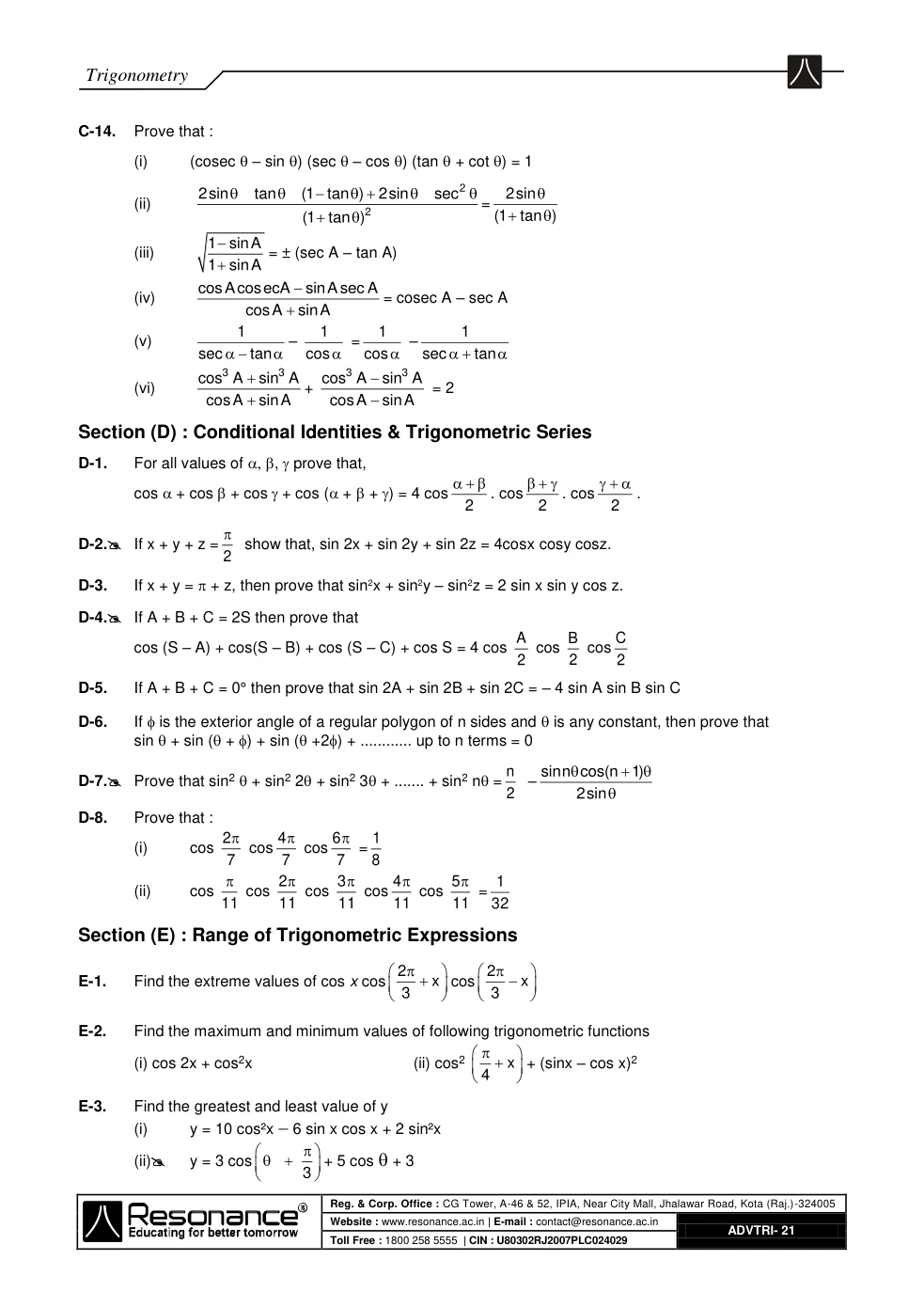
C-14.  Prove that :

            (i)      (cosec  – sin ) (sec  – cos ) (tan  + cot ) = 1

                2sin   tan   (1  tan )  2sin   sec 2     2sin 
             (ii)                                     =
                                  (1  tan )2                   (1  tan  )
               1  sinA
              (iii)             = ± (sec A – tan A)
               1  sinA
             cosAcosecA  sinAsec A
          (iv)                         = cosec A – sec A
                  cosA  sinA
                  1         1      1        1
         (v)                –      =      –
               sec  tan    cos   cos   sec  tan 
               cos3 A  sin3 A   cos3 A  sin3 A
          (vi)                 +             = 2
              cosA  sinA    cosA  sinA

Section (D) : Conditional Identities & Trigonometric Series

D-1.   For all values of  , prove that,
       cos + cos + cos+ cos (+  + ) = 4 cos . cos . cos .
                                             2       2       2

                  
D-2.   If x + y + z =   show that, sin 2x + sin 2y + sin 2z = 4cosx cosy cosz.
                  2

D-3.      If x + y =  + z, then prove that sin2x + sin2y – sin2z = 2 sin x sin y cos z.

D-4.   If A + B + C = 2S then prove that
                                            A    B   C
       cos (S – A) + cos(S – B) + cos (S – C) + cos S = 4 cos    cos   cos
                                                     2     2     2

D-5.      If A + B + C = 0° then prove that sin 2A + sin 2B + sin 2C = – 4 sin A sin B sin C

D-6.      If  is the exterior angle of a regular polygon of n sides and  is any constant, then prove that
        sin  + sin ( + ) + sin ( +2) + ............ up to n terms = 0

                                                    n    sinn cos(n  1)
D-7.  Prove that sin2  + sin2 2 + sin2 3 + ....... + sin2 n =   –
                                                    2        2sin 
D-8.   Prove that :
                 2     4     6    1
            (i)     cos    cos    cos   =
                  7     7     7   8
                       2      3     4      5    1
             (ii)     cos    cos    cos    cos    cos    =
                 11     11     11    11     11   32

Section (E) : Range of Trigonometric Expressions

                                                     2           2     E-1.    Find the extreme values of cos x cos     x cos     x                                                                                                                              3           3     

E-2.    Find the maximum and minimum values of following trigonometric functions
                                                                                   (i) cos 2x + cos2x                                      (ii) cos2    x + (sinx – cos x)2                                                                                                                                            4    

E-3.    Find the greatest and least value of y
            (i)     y = 10 cos²x  6 sin x cos x + 2 sin²x
                                   
                                   + 3         (ii)   y = 3 cos         + 5 cos                                   3 

                                                                                          ADVTRI- 21
Rendered source page 22 of 47: Trigonometry
MAASTrigonometry
© MAAS. All rights reserved.Page 22 / 47
Extracted text · page 22
 Trigonometry


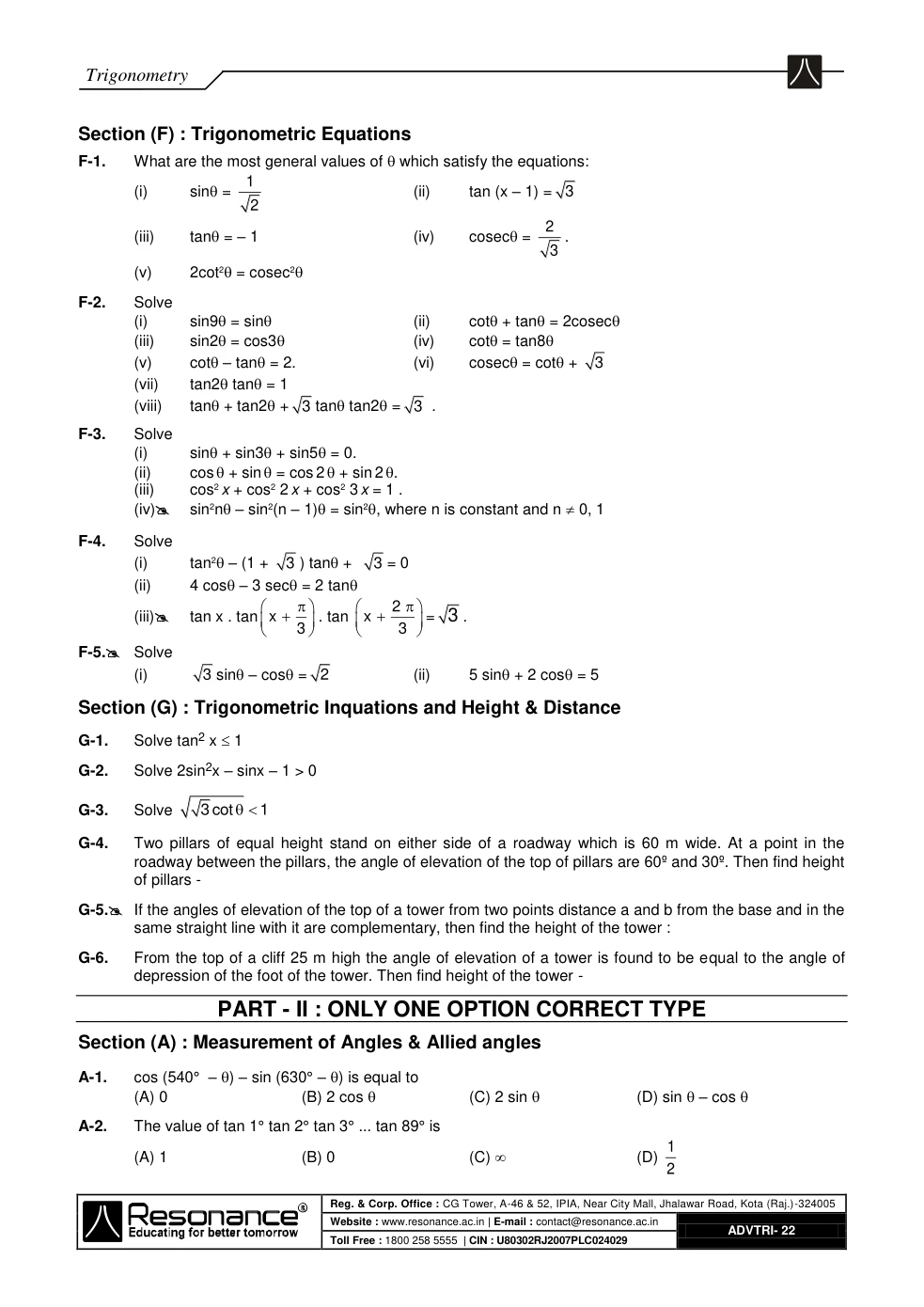
Section (F) : Trigonometric Equations
F-1.   What are the most general values of which satisfy the equations:
                    1
            (i)      sin =                                           (ii)     tan (x – 1) = 3
                    2
                                                       2
              (iii)     tan = – 1                             (iv)    cosec =        .
                                                        3
         (v)     2cot2 = cosec2

F-2.    Solve
            (i)      sin9 = sin                                (ii)     cot + tan = 2cosec                             
             (iii)     sin2 = cos3                          (iv)     cot = tan8                    
         (v)     cot – tan = 2.                      (vi)    cosec = cot +  3
           (vii)    tan2 tan = 1
            (viii)    tan + tan2 +  3 tan tan2 =  3  .

F-3.    Solve
            (i)      sin + sin3 + sin5 = 0.
             (ii)      cos + sin = cos 2 + sin 2.
              (iii)     cos2 x + cos2 2 x + cos2 3 x = 1 .
        (iv)   sin2n – sin2(n – 1) = sin2, where n is constant and n  0, 1

F-4.    Solve
            (i)      tan2 – (1 +  3 ) tan +  3 = 0
             (ii)     4 cos – 3 sec = 2 tan
                                              2  
          (iii)   tan x . tan  x     . tan  x       = 3 .                                  3            3  
F-5.  Solve
            (i)      3 sin – cos =  2                    (ii)     5 sin + 2 cos = 5

Section (G) : Trigonometric Inquations and Height & Distance

G-1.   Solve tan2 x  1

G-2.   Solve 2sin2x – sinx – 1 > 0

G-3.   Solve   3 cot  1

G-4.   Two pillars of equal height stand on either side of a roadway which is 60 m wide. At a point in the
       roadway between the pillars, the angle of elevation of the top of pillars are 60º and 30º. Then find height
         of pillars -

G-5.   If the angles of elevation of the top of a tower from two points distance a and b from the base and in the
      same straight line with it are complementary, then find the height of the tower :

G-6.   From the top of a cliff 25 m high the angle of elevation of a tower is found to be equal to the angle of
       depression of the foot of the tower. Then find height of the tower -

         PART - II : ONLY ONE OPTION CORRECT TYPE

Section (A) : Measurement of Angles & Allied angles

A-1.   cos (540° – ) – sin (630° – ) is equal to
        (A) 0                    (B) 2 cos              (C) 2 sin               (D) sin  – cos 

A-2.   The value of tan 1° tan 2° tan 3° ... tan 89° is
                                                                        1
        (A) 1                    (B) 0                   (C)                   (D)
                                                                        2


                                                                                          ADVTRI- 22
Rendered source page 23 of 47: Trigonometry
MAASTrigonometry
© MAAS. All rights reserved.Page 23 / 47
Extracted text · page 23
 Trigonometry


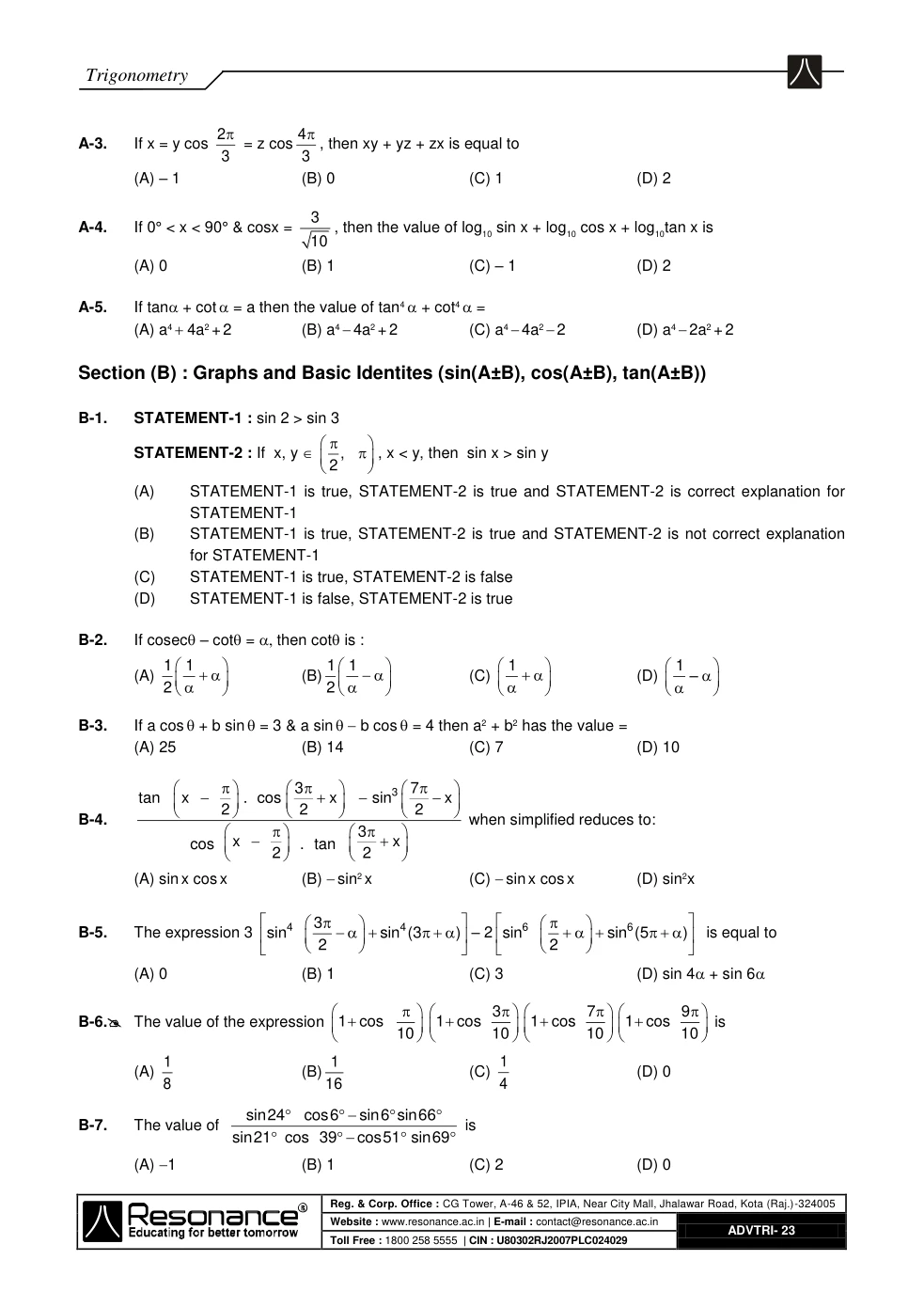
                2        4A-3.      If x = y cos    = z cos  , then xy + yz + zx is equal to
                 3        3
        (A) – 1                  (B) 0                   (C) 1                   (D) 2

                           3
A-4.      If 0° < x < 90° & cosx =          , then the value of log10 sin x + log10 cos x + log10tan x is
                           10
        (A) 0                    (B) 1                   (C) – 1                 (D) 2

A-5.      If tan + cot  = a then the value of tan4  + cot4  =
        (A) a4 4a2 + 2          (B) a4  4a2 + 2          (C) a4  4a2  2          (D) a4  2a2 + 2

Section (B) : Graphs and Basic Identites (sin(A±B), cos(A±B), tan(A±B))


B-1.   STATEMENT-1 : sin 2 > sin 3
                                                    STATEMENT-2 : If x, y       ,     , x < y, then sin x > sin y                                                                                        2     
        (A)    STATEMENT-1 is true, STATEMENT-2 is true and STATEMENT-2 is correct explanation for
           STATEMENT-1
        (B)    STATEMENT-1 is true, STATEMENT-2 is true and STATEMENT-2 is not correct explanation
                  for STATEMENT-1
        (C)    STATEMENT-1 is true, STATEMENT-2 is false
        (D)    STATEMENT-1 is false, STATEMENT-2 is true

B-2.      If cosec – cot = then cot is :
          1  1                1  1                        1                         1             (A)                (B)                (C)                (D)    –                                                                                                              2                  2                                                        

B-3.      If a cos  + b sin  = 3 & a sin  b cos  = 4 then a2 + b2 has the value =
        (A) 25                  (B) 14                  (C) 7                   (D) 10

                               3             3  7     
        tan   x      . cos     x    sin      x                      2          2               2     B-4.                                       when simplified reduces to:
                                         3     
              cos   x       . tan      x                              2            2     
        (A) sin x cos x           (B)  sin2 x              (C)  sin x cos x         (D) sin2x

                                 4   3            4                 6              6         
B-5.   The expression 3  sin       sin (3  )  – 2  sin      sin (5  )   is equal to
                                     2                                 2                     
        (A) 0                    (B) 1                   (C) 3                   (D) sin 4 + sin 6

                                                          3          7          9  B-6. The value of the expression  1  cos      1  cos      1  cos      1  cos        is                                                                                                                                                  10        10        10        10 
          1                   1                    1
        (A)                     (B)                     (C)                    (D) 0
          8                  16                   4

                      sin24 cos6 sin6 sin66 
B-7.   The value of                                            is
                    sin21 cos 39 cos51  sin69 
        (A) 1                  (B) 1                   (C) 2                   (D) 0


                                                                                          ADVTRI- 23
Rendered source page 24 of 47: Trigonometry
MAASTrigonometry
© MAAS. All rights reserved.Page 24 / 47
Extracted text · page 24
 Trigonometry


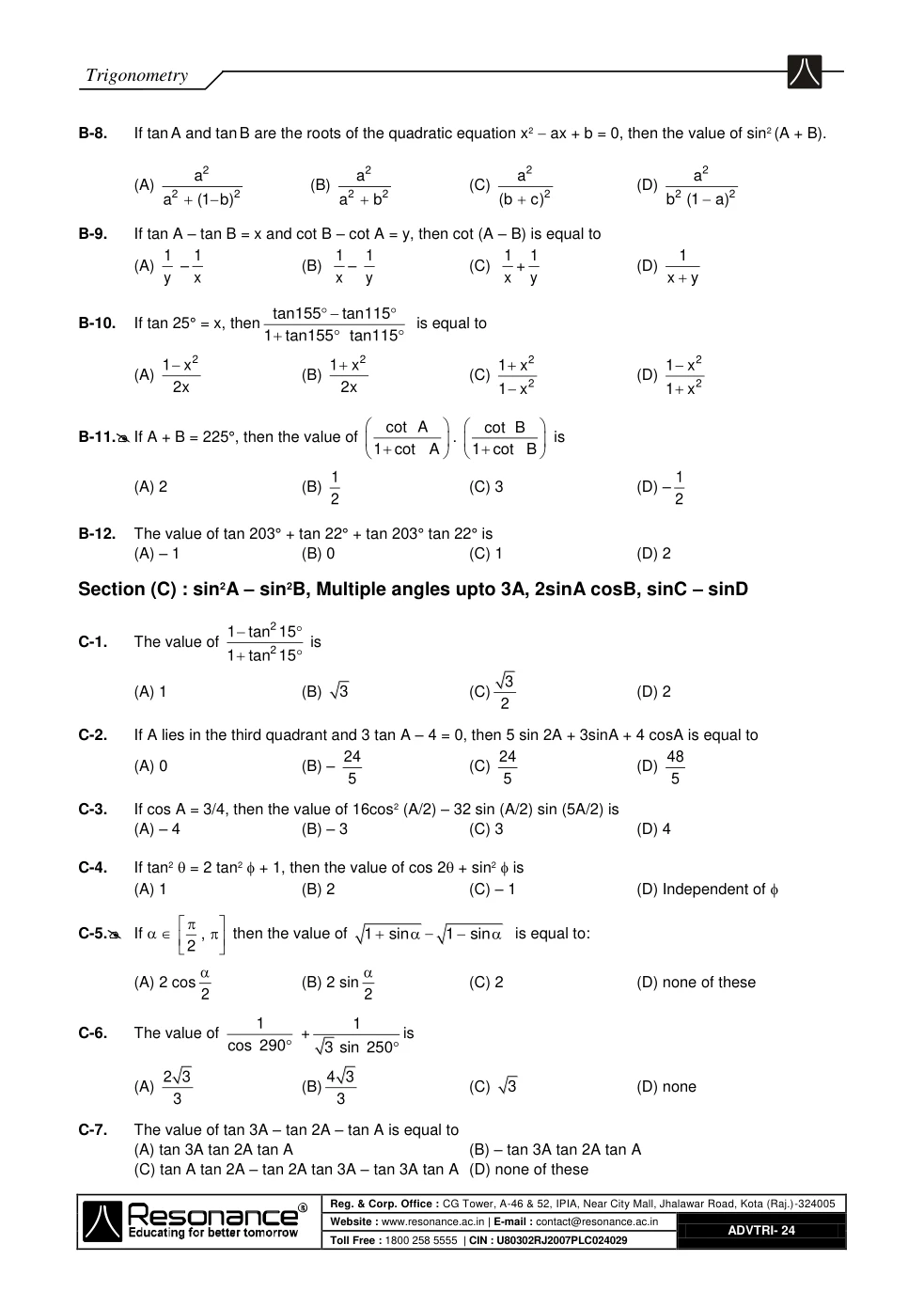
B-8.      If tan A and tan B are the roots of the quadratic equation x2  ax + b = 0, then the value of sin2 (A + B).

             a 2                 a 2                 a 2                  a 2
        (A)                       (B)                   (C)                    (D)
          a 2  (1 b)2           a 2  b 2                (b  c)2             b 2 (1  a)2

B-9.      If tan A – tan B = x and cot B – cot A = y, then cot (A – B) is equal to
          1   1                1   1                1  1                1
        (A)   –                (B)   –                (C)   +                (D)
            y   x                  x   y                  x   y                 x  y

                        tan155 tan115
B-10.    If tan 25° = x, then                            is equal to
                     1  tan155 tan115
          1  x 2               1  x 2               1  x 2               1  x 2
        (A)                     (B)                     (C)                    (D)
           2x                  2x                1  x 2               1  x 2

                                                  cot A       cot B  
B-11. If A + B = 225°, then the value of              .              is
                                                 1  cot A    1  cot B 
                               1                                         1
        (A) 2                    (B)                     (C) 3                   (D) –
                               2                                         2

B-12.  The value of tan 203° + tan 22° + tan 203° tan 22° is
        (A) – 1                  (B) 0                   (C) 1                   (D) 2

Section (C) : sin2A – sin2B, Multiple angles upto 3A, 2sinA cosB, sinC – sinD

                 1  tan2 15
C-1.   The value of                is
                 1  tan2 15

                                                  3
        (A) 1                    (B)  3                 (C)                    (D) 2
                                                  2

C-2.      If A lies in the third quadrant and 3 tan A – 4 = 0, then 5 sin 2A + 3sinA + 4 cosA is equal to
                               24                24                 48
        (A) 0                    (B) –                   (C)                    (D)
                                5                 5                   5

C-3.      If cos A = 3/4, then the value of 16cos2 (A/2) – 32 sin (A/2) sin (5A/2) is
        (A) – 4                  (B) – 3                 (C) 3                   (D) 4

C-4.      If tan2  = 2 tan2  + 1, then the value of cos 2 + sin2  is
        (A) 1                    (B) 2                   (C) – 1                 (D) Independent of 

                      C-5.   If        ,   then the value of  1  sin 1  sin   is equal to:                                         2    
                             
        (A) 2 cos               (B) 2 sin               (C) 2                   (D) none of these
               2                   2

                    1          1
C-6.   The value of         +                 is
                  cos 290    3 sin 250

          2 3                4 3
        (A)                     (B)                     (C)  3                 (D) none
           3                  3

C-7.   The value of tan 3A – tan 2A – tan A is equal to
        (A) tan 3A tan 2A tan A                          (B) – tan 3A tan 2A tan A
        (C) tan A tan 2A – tan 2A tan 3A – tan 3A tan A (D) none of these


                                                                                          ADVTRI- 24
Rendered source page 25 of 47: Trigonometry
MAASTrigonometry
© MAAS. All rights reserved.Page 25 / 47
Extracted text · page 25
 Trigonometry


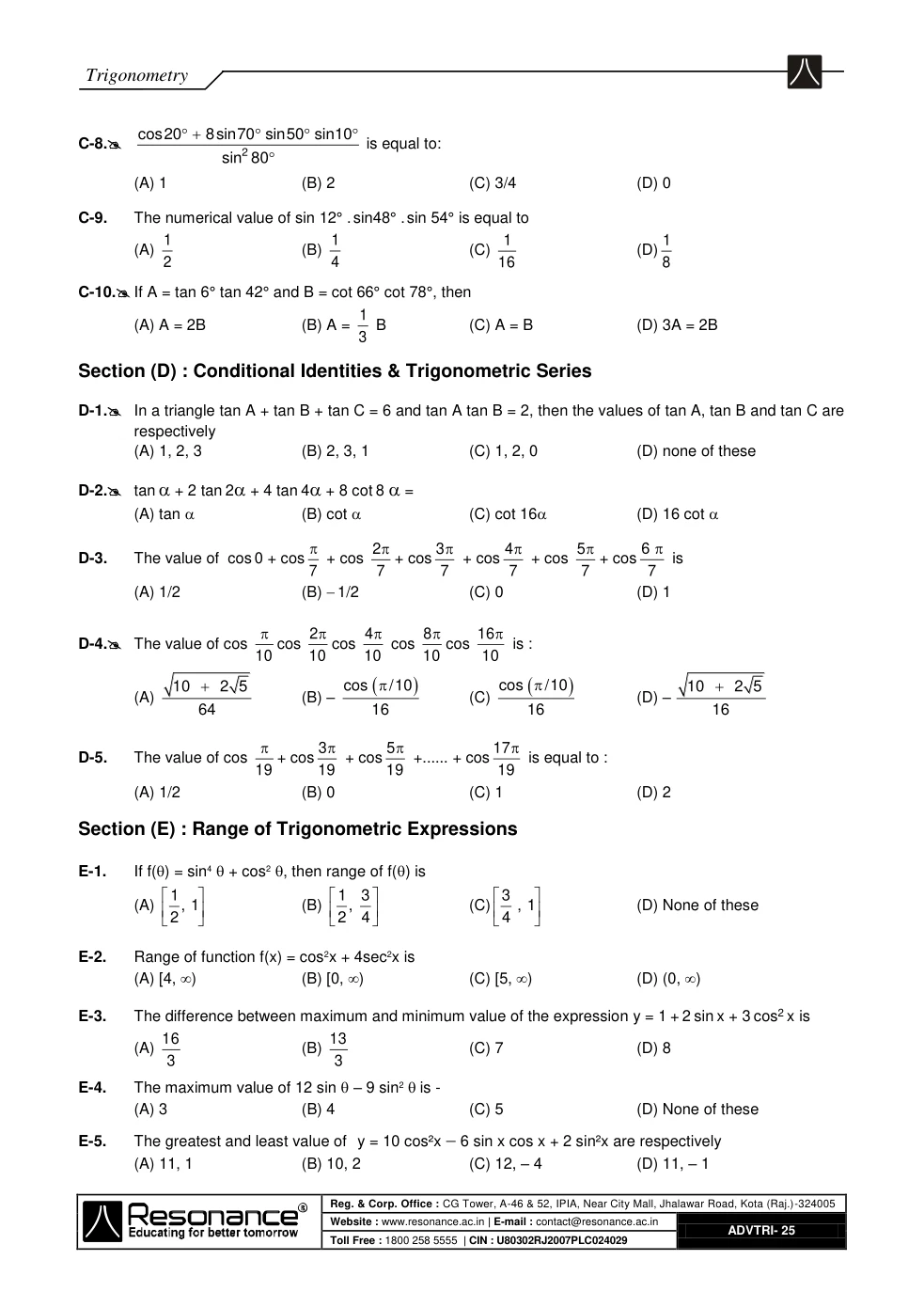
       cos20 8sin70 sin50 sin10
C-8.                                            is equal to:
                      sin2 80
        (A) 1                    (B) 2                   (C) 3/4                 (D) 0

C-9.   The numerical value of sin 12° . sin48° . sin 54° is equal to
          1                   1                   1                  1
        (A)                     (B)                     (C)                    (D)
          2                   4                   16                  8

C-10. If A = tan 6° tan 42° and B = cot 66° cot 78°, then
                                  1
        (A) A = 2B              (B) A =   B            (C) A = B              (D) 3A = 2B
                                  3

Section (D) : Conditional Identities & Trigonometric Series

D-1.  In a triangle tan A + tan B + tan C = 6 and tan A tan B = 2, then the values of tan A, tan B and tan C are
        respectively
        (A) 1, 2, 3               (B) 2, 3, 1              (C) 1, 2, 0              (D) none of these

D-2.  tan  + 2 tan 2 + 4 tan 4 + 8 cot 8  =
        (A) tan                     (B) cot                (C) cot 16             (D) 16 cot 

                                  2      3       4       5       6 D-3.   The value of cos 0 + cos  + cos  + cos   + cos   + cos  + cos      is
                            7       7       7       7        7       7
        (A) 1/2                  (B)  1/2               (C) 0                   (D) 1

                           2     4      8     16 D-4. The value of cos cos  cos    cos  cos        is :
                     10    10    10     10     10
           10  2 5            cos   /10           cos   /10              10  2 5
        (A)                     (B) –                   (C)                    (D) –
              64                  16                16                   16

                            3       5           17 D-5.   The value of cos + cos   + cos      +...... + cos       is equal to :
                     19     19      19           19
        (A) 1/2                  (B) 0                   (C) 1                   (D) 2

Section (E) : Range of Trigonometric Expressions

E-1.      If f() = sin4  + cos2 , then range of f() is

        (A)               1, 1              (B)  1 , 3              (C)  3  , 1             (D) None of these                                                                                      2                         2  4                     4    

E-2.   Range of function f(x) = cos2x + 4sec2x is
        (A) [4, )               (B) [0, )               (C) [5, )               (D) (0, )

E-3.   The difference between maximum and minimum value of the expression y = 1 + 2 sin x + 3 cos2 x is
          16                  13
        (A)                     (B)                     (C) 7                   (D) 8
           3                   3
E-4.   The maximum value of 12 sin  – 9 sin2 is -
        (A) 3                    (B) 4                   (C) 5                   (D) None of these
E-5.   The greatest and least value of y = 10 cos²x  6 sin x cos x + 2 sin²x are respectively
        (A) 11, 1                (B) 10, 2               (C) 12, – 4             (D) 11, – 1


                                                                                          ADVTRI- 25
Rendered source page 26 of 47: Trigonometry
MAASTrigonometry
© MAAS. All rights reserved.Page 26 / 47
Extracted text · page 26
 Trigonometry


Section (F) : Trigonometric Equations

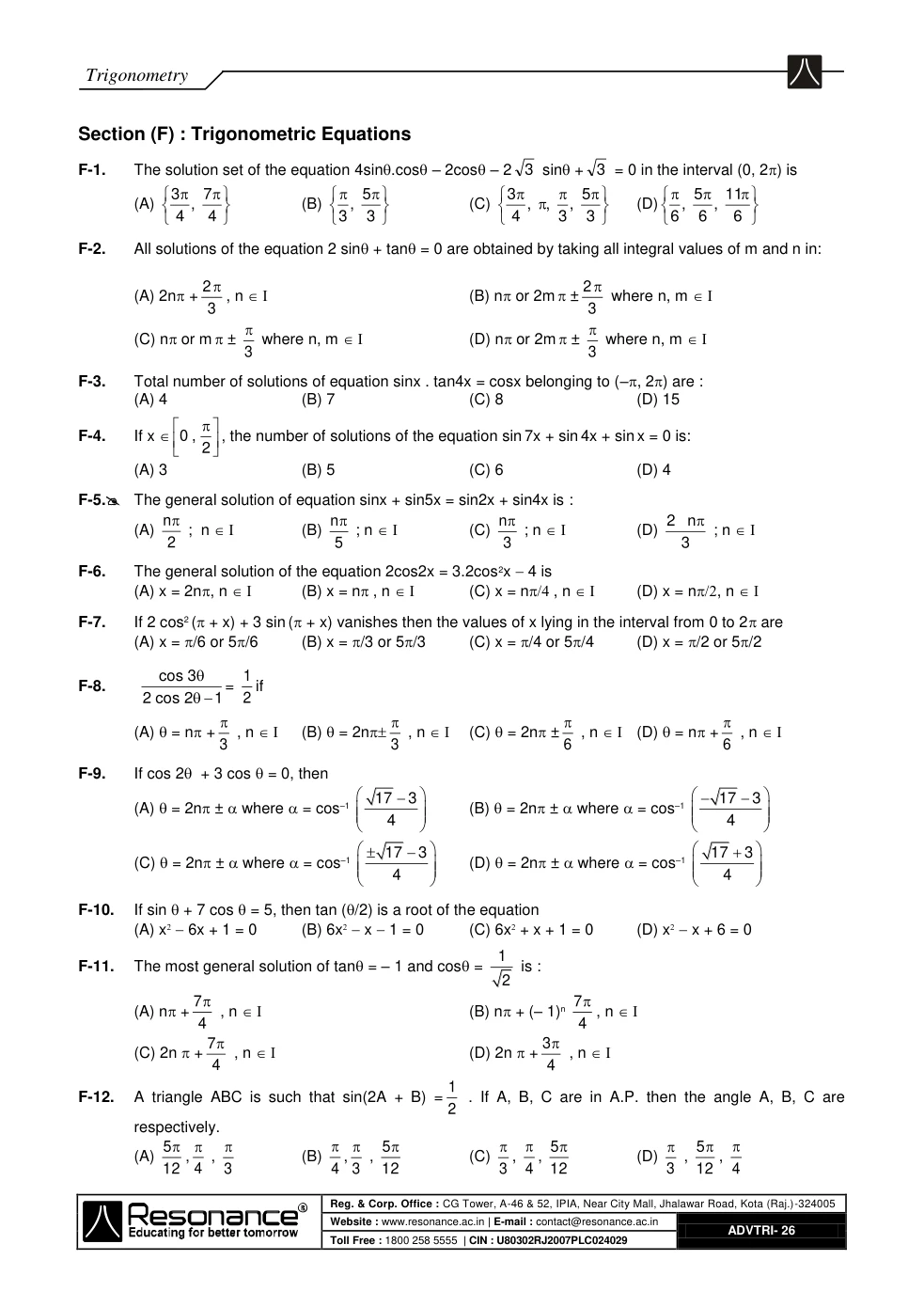
F-1.   The solution set of the equation 4sin.cos – 2cos – 2 3 sin + 3 = 0 in the interval (0, 2) is
            3   7                  5                 3       5            5   11 
        (A)      ,              (B)    ,               (C)      , ,    ,        (D)    ,      ,    
            4   4               3  3                4    3  3         6  6   6 

F-2.     All solutions of the equation 2 sin + tan = 0 are obtained by taking all integral values of m and n in:

               2                                            2         (A) 2n +  , n                              (B) n or 2m  ±    where n, m 
               3                                            3
                                                              
        (C) n or m  ±   where n, m                (D) n or 2m  ±   where n, m 
                    3                                         3

F-3.    Total number of solutions of equation sinx . tan4x = cosx belonging to (–, 2) are :
        (A) 4                    (B) 7                   (C) 8                   (D) 15
                    F-4.       If x 0 ,      , the number of solutions of the equation sin 7x + sin 4x + sin x = 0 is:                                         2 
        (A) 3                    (B) 5                   (C) 6                   (D) 4

F-5.  The general solution of equation sinx + sin5x = sin2x + sin4x is :
          n                   n                   n                  2 n 
        (A)        ; n           (B)        ; n            (C)        ; n            (D)             ; n  
           2                   5                   3                    3

F-6.   The general solution of the equation 2cos2x = 3.2cos2x  4 is
        (A) x = 2n, n        (B) x = n, n         (C) x = n, n      (D) x = n, n 

F-7.       If 2 cos2 ( + x) + 3 sin ( + x) vanishes then the values of x lying in the interval from 0 to 2 are
        (A) x = /6 or 5/6      (B) x = /3 or 5/3      (C) x = /4 or 5/4      (D) x = /2 or 5/2

          cos 3     1
F-8.             =      if
       2 cos 2 1  2
                                                                            
        (A)  = n +     , n    (B)  = 2n     , n    (C)  = 2n ±     , n   (D)  = n +     , n 
                 3                    3                    6                  6

F-9.       If cos 2 + 3 cos  = 0, then
                                               17  3                                               17  3 
        (A)  = 2n ±  where  = cos–1                 (B)  = 2n ±  where  = cos–1                                                             4                                                   4                                                                                                                    
                                                17  3                                             17  3 
        (C)  = 2n ±  where  = cos–1                 (D)  = 2n ±  where  = cos–1                                                            4                                                   4                                                                                                                  

F-10.     If sin  + 7 cos  = 5, then tan (/2) is a root of the equation
        (A) x2  6x + 1 = 0      (B) 6x2  x  1 = 0      (C) 6x2 + x + 1 = 0      (D) x2  x + 6 = 0

                                                  1
F-11.  The most general solution of tan = – 1 and cos =       is :
                                                  2
              7                                            7        (A) n +       , n                               (B) n + (– 1)n  , n 
              4                                            4
               7                                      3 
        (C) 2n  +       , n                                        (D) 2n  +       , n 
                4                                      4
                                             1
F-12.  A triangle ABC is such that sin(2A + B) =      .  If A, B, C are in A.P. then the angle A, B, C are
                                             2
        respectively.
          5                        5                   5                5           (A)  ,     ,             (B) ,     ,             (C) , ,             (D)      ,  ,
          12  4   3            4  3  12            3  4  12            3  12  4


                                                                                          ADVTRI- 26
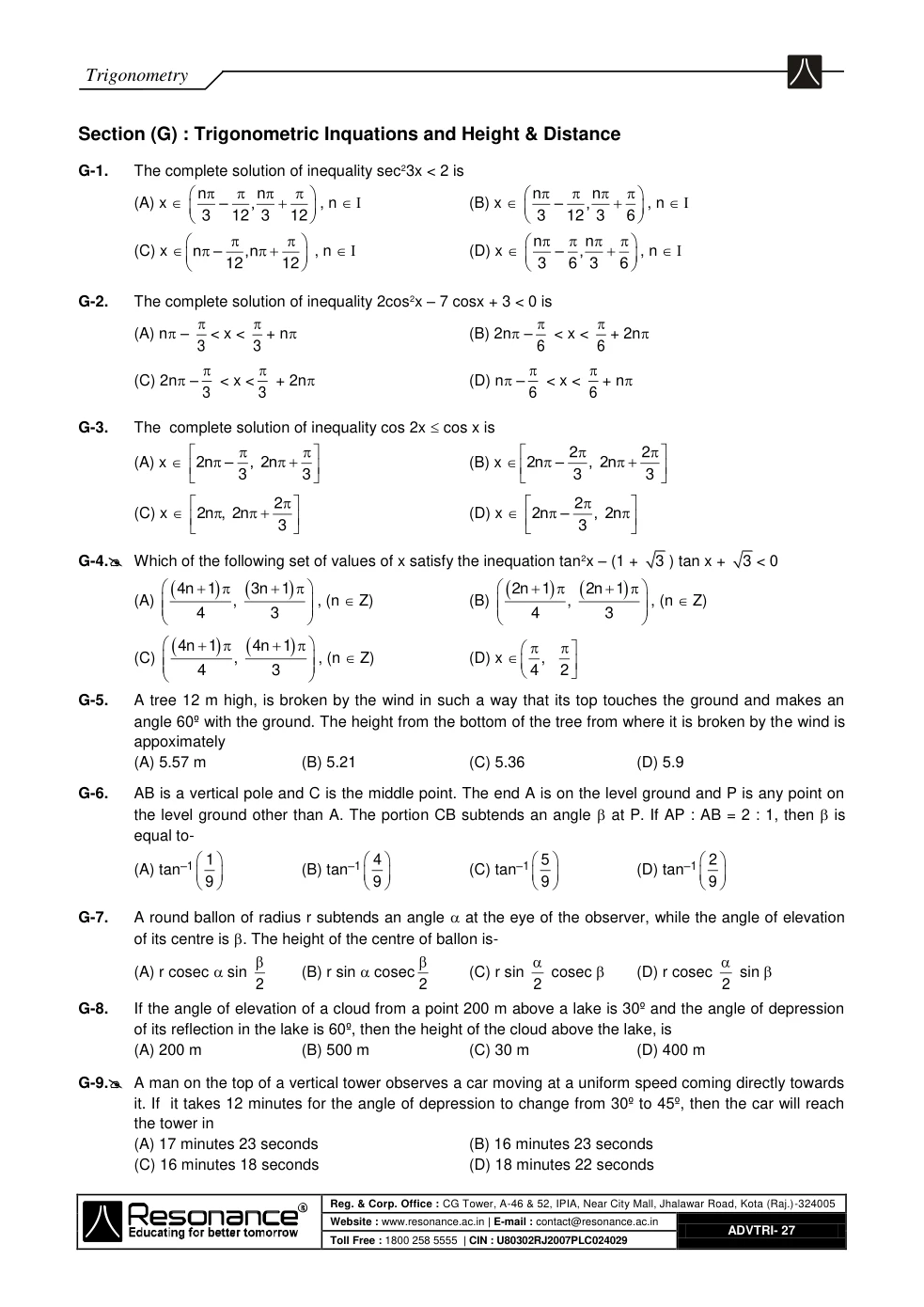
Rendered source page 27 of 47: Trigonometry
MAASTrigonometry
© MAAS. All rights reserved.Page 27 / 47
Extracted text · page 27
 Trigonometry


Section (G) : Trigonometric Inquations and Height & Distance

G-1.   The complete solution of inequality sec23x < 2 is
                   n   n                                      n   n   
        (A) x     –     ,        , n                 (B) x     –     ,       , n 
                   3  12 3  12                                    3  12 3  6 
                                                                  n   n   
        (C) x n  –   ,n      , n                 (D) x     –   ,       , n 
                      12    12                                      3   6 3  6 

G-2.   The complete solution of inequality 2cos2x – 7 cosx + 3 < 0 is
                                                                (A) n – < x < + n                         (B) 2n –  < x < + 2n
               3      3                                 6      6
                                                             (C) 2n –  < x <  + 2n                      (D) n –  < x < + n
               3      3                                6      6

G-3.   The complete solution of inequality cos 2x  cos x is
                                                                    2      2         (A) x   2n –    , 2n                         (B) x  2n –      , 2n                                                                                                                   3      3                                       3       3 
                           2                                           2              (C) x   2n, 2n                            (D) x   2n –      , 2n                                                                                                                  3                                           3       

G-4. Which of the following set of values of x satisfy the inequation tan2x – (1 +  3 ) tan x +  3 < 0
                4n  1     3n  1                                  2n  1     2n  1  
        (A)                ,             , (n  Z)              (B)                ,             , (n  Z)
                 4       3                                      4       3                                                                                               
                4n  1     4n  1                                         
                                                                                                           ,                                   ,        (C)                                                                                               , (n  Z)             (D) x                                                                                                                                                              3                                                                           4                                                       2                  4                                      
G-5.  A tree 12 m high, is broken by the wind in such a way that its top touches the ground and makes an
       angle 60º with the ground. The height from the bottom of the tree from where it is broken by the wind is
       appoximately
        (A) 5.57 m              (B) 5.21                (C) 5.36                (D) 5.9

G-6.  AB is a vertical pole and C is the middle point. The end A is on the level ground and P is any point on
        the level ground other than A. The portion CB subtends an angle  at P. If AP : AB = 2 : 1, then  is
       equal to-
                     1                          4                          5                          2 
        (A) tan–1               (B) tan–1               (C) tan–1               (D) tan–1                         9                          9                          9                          9 

G-7.  A round ballon of radius r subtends an angle  at the eye of the observer, while the angle of elevation
         of its centre is . The height of the centre of ballon is-
                                                                       
        (A) r cosec  sin        (B) r sin  cosec        (C) r sin   cosec     (D) r cosec    sin 
                      2                   2             2                      2
G-8.      If the angle of elevation of a cloud from a point 200 m above a lake is 30º and the angle of depression
         of its reflection in the lake is 60º, then the height of the cloud above the lake, is
        (A) 200 m               (B) 500 m              (C) 30 m               (D) 400 m

G-9. A man on the top of a vertical tower observes a car moving at a uniform speed coming directly towards
              it. If   it takes 12 minutes for the angle of depression to change from 30º to 45º, then the car will reach
        the tower in
        (A) 17 minutes 23 seconds                      (B) 16 minutes 23 seconds
        (C) 16 minutes 18 seconds                     (D) 18 minutes 22 seconds


                                                                                          ADVTRI- 27
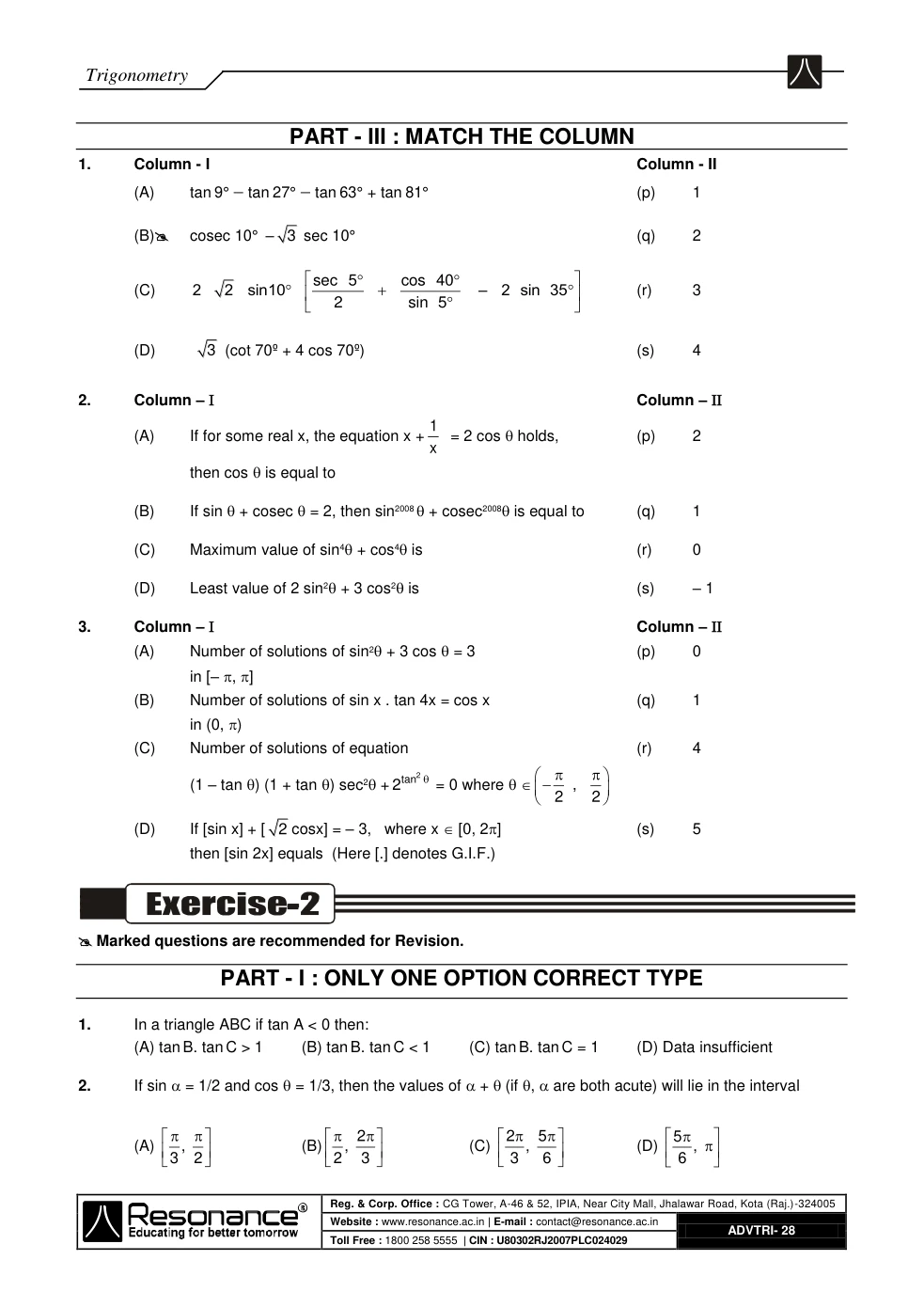
Rendered source page 28 of 47: Trigonometry
MAASTrigonometry
© MAAS. All rights reserved.Page 28 / 47
Extracted text · page 28
 Trigonometry


              PART - III : MATCH THE COLUMN
1.    Column - I                                            Column - II
        (A)     tan 9°  tan 27°  tan 63° + tan 81°                                 (p)    1

      (B)   cosec 10° –  3 sec 10°                                             (q)    2

                                      sec 5     cos 40                   
        (C)    2   2  sin10                    –  2  sin 35            (r)     3
                                        2          sin 5                    


        (D)      3 (cot 70º + 4 cos 70º)                                             (s)    4


2.    Column –                                             Column – 
                                           1
        (A)        If for some real x, the equation x +   = 2 cos  holds,            (p)    2
                                               x
               then cos  is equal to

        (B)        If sin  + cosec  = 2, then sin2008  + cosec2008 is equal to        (q)    1

        (C)    Maximum value of sin4 + cos4 is                                         (r)     0

        (D)     Least value of 2 sin2 + 3 cos2 is                                    (s)    – 1

3.    Column –                                             Column – 
        (A)    Number of solutions of sin2 + 3 cos  = 3                          (p)    0
                   in [– , ]
        (B)    Number of solutions of sin x . tan 4x = cos x                       (q)    1
                   in (0, )
        (C)    Number of solutions of equation                                            (r)     4
                                                               tan2                                        (1 – tan ) (1 + tan ) sec2 + 2    = 0 where        ,                                                                                                                                                                    2   2 

        (D)        If [sin x] + [  2 cosx] = – 3,  where x  [0, 2]                      (s)    5
               then [sin 2x] equals (Here [.] denotes G.I.F.)


 Marked questions are recommended for Revision.

          PART - I : ONLY ONE OPTION CORRECT TYPE

1.       In a triangle ABC if tan A < 0 then:
        (A) tan B. tan C > 1      (B) tan B. tan C < 1     (C) tan B. tan C = 1     (D) Data insufficient

2.          If sin  = 1/2 and cos  = 1/3, then the values of  + (if ,  are both acute) will lie in the interval


                                        2                      2  5                    5             (A)      ,                 (B)     ,                 (C)        ,               (D)        ,                                                                                                                  3  2                     2  3                     3   6                   6    


                                                                                          ADVTRI- 28
Rendered source page 29 of 47: Trigonometry
MAASTrigonometry
© MAAS. All rights reserved.Page 29 / 47
Extracted text · page 29
 Trigonometry


          sinA    3     cosA    5
3.          If      =    and      =        , 0 < A, B </2, then tan A + tan B is equal to
          sinB   2      cosB    2
        (A)  3 / 5             (B)  5 / 3             (C) 1                   (D) ( 5   3)/ 5


4.       In a right angled triangle the hypotenuse is 2  2  times the perpendicular drawn from the opposite
        vertex. Then the other acute angles of the triangle are
                                 3                                       3         (A) &                 (B) &                (C) &                (D)   &
          3  6                8   8                4   4                5   10


5.          If 3 cos x + 2 cos 3x = cos y, 3 sin x + 2 sin 3x = sin y, then the value of cos 2x is
                               1                     1                  7
        (A) – 1                  (B)                     (C) –                   (D)
                               8                     8                  8

                                                     cos3 
6.          If cos  + cos  = a, sin  + sin  = b and  –  = 2, then                                                         cos =
        (A) a2 + b2 – 2           (B) a2 + b2 – 3          (C) 3 – a2 – b2          (D) (a2 + b2) /4


         3                       17.          If  <  < , then   2cot           is equal to
          4                           sin2 
        (A) 1 + cot             (B) – 1 – cot           (C) 1 – cot            (D) – 1 + cot 

                             sin  sin28.     For  << ,                    lies in the interval        2      2 1  cos  cos2
       (A) ()           (B) (2, 2)           (C) (0, )            (D) (1, 1)

9.     The number of all possible triplets (a1, a2, a3) such that  a1 + a2 cos 2x + a3 sin2x = 0 for all x is
        (A) 0                    (B) 1                   (C) 2                   (D) infinite

                  3 
10.     If A + B + C =       , then cos 2A + cos2B + cos2C is equal to
                   2
        (A) 1 – 4cos A cosB cosC                       (B) 4 sin A sin B sin C
        (C) 1 + 2 cos A cos B cos C                    (D) 1– 4 sin A sin B sin C

11.        If A + B + C =  & cosA = cosB. cosC then tanB. tanC has the value equal to:
        (A) 1                    (B) 1/2                 (C) 2                   (D) 3

12.    The general solution of the equation tan2  +2  3 tan  = 1 is given by:

             n        (A)  =  , n                                 (B)  = (2n + 1) , n 
             2                                              2
                                                     n         (C)  = (6n + 1) , n                       (D)  =        , n 
                   12                               12


                                                                                 2  13.  The general solution of the equation tan x + tan  x    + tan  x     = 3 is                                                                                                                                                            3             3 
          n                  n                n                  n    
        (A)          , n       (B)         , n     (C)         , n      (D)          , n 
          4   12              3   6             3   12              3   4



                                                                                          ADVTRI- 29
Rendered source page 30 of 47: Trigonometry
MAASTrigonometry
© MAAS. All rights reserved.Page 30 / 47
Extracted text · page 30
 Trigonometry


                                                         sec 2 x
14.    The complete solution set of the equation 1 + 2 cosec x =        2  is
                                                       2
        (A) 2 n   , n       (B) n   , n         (C) 2 n   , n       (D) n   , n  
                2                 2                     2                  2

15.    The principal solution set of the equation 2 cos x =  2  2sin2x  is

             13                  13                  13                  13  
        (A)     ,               (B)     ,              (C)     ,              (D)    ,     
           8   8               4   8               4  10               8  10 

16.    The solution of |cosx| = cosx – 2sinx is
        (A) x = n, n                                 (B) x = n + , n 
                                                          4
        (C) x = n + (–1)n , n                      (D) x = (2n + 1) + , n 
                      4                                        4

17.    The solution of inequality 4tanx – 3.2tanx + 2  0 is
                                                                                   (A) x   n, n      ; n                       (B) x n, n –       ; n                                                                                                             4                                                 4 
                                                                                    (C) x n, n       ; n                      (D) x   n, n –      ; n                                                                                                              6                                                  6 

18.  The solution of inequality  5  2sinx  6 sin x – 1 is
        (A) [ (12n – 7)/6,  (12n + 7)/6] (n  Z)         (B) [ (12n – 7)/6,  (12n + 1)/6] (n  Z)
        (C) [ (2n – 7)/6,  (2n + 1)/6] (n  Z)           (D) [ (12n – 7)/3,  (12n + 1)/3] (n  Z)

           PART - II : NUMERICAL VALUE QUESTIONS

INSTRUCTION :
  The answer to each question is NUMERICAL VALUE with two digit integer and decimal upto two digit.
   If the numerical value has more than two decimal places truncate/round-off the value to TWO decimal
    placed.
                                  
                                                tan
                                             2
1.       If 19 sin = 29 sin, then find the value of   .
                                                tan
                                             2

2.          If ,  ( –   2nn  ) are different values of  satisfying the equation 5 cos  – 12 sin  = 11. then
        absolute value of sin ( + ) is

                   3                    x           4       2
3.          If x   ,      then 4 cos2       +  4sin x  sin 2x  is always equal to                   2                 4  2 

4.       If three angles A, B, C are such that
       cos A + cos B + cos C = 0 and if
       cos A cos B cos C =  (cos 3A + cos 3B + cos 3C) then value of  is :

5.      Find sum of square of all possible integral values of  for which equation 4cos x + 3 sin x = 2 + 1 has a
         solution.

6.          If a cos3  + 3a cos  sin2  = m and a sin3  + 3a cos2  sin  = n. if (m+n)2/3 + (m  n)2/3 = paq, then find
        value of p3 + q3


                                                                                          ADVTRI- 30
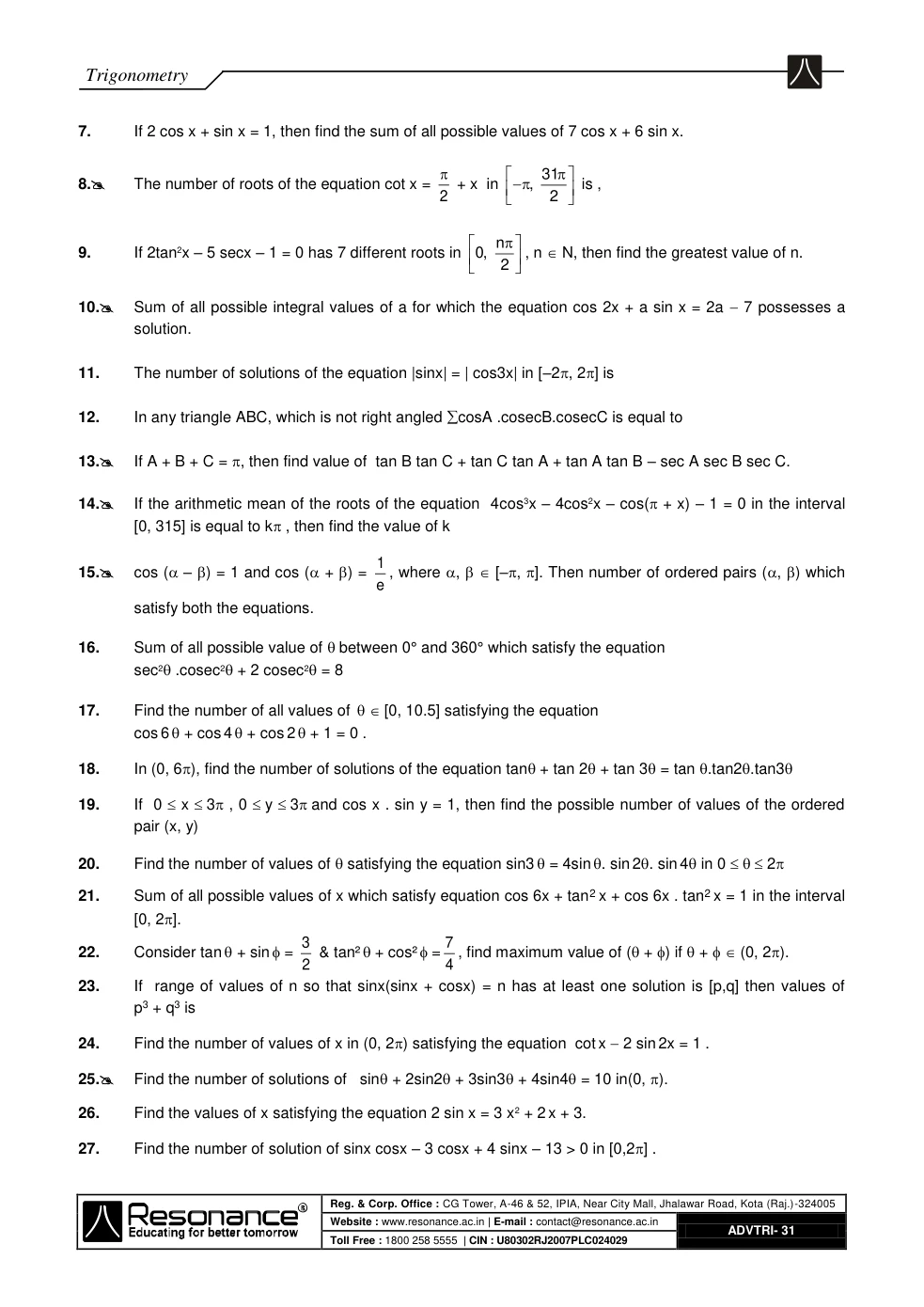
Rendered source page 31 of 47: Trigonometry
MAASTrigonometry
© MAAS. All rights reserved.Page 31 / 47
Extracted text · page 31
 Trigonometry


7.          If 2 cos x + sin x = 1, then find the sum of all possible values of 7 cos x + 6 sin x.

                                                          31 8.   The number of roots of the equation cot x =   + x in  ,         is ,                                                                                                                            2              2  

                                                                   n  9.          If 2tan2x – 5 secx – 1 = 0 has 7 different roots in  0,         , n  N, then find the greatest value of n.                                                                                                                                            2 

10.  Sum of all possible integral values of a for which the equation cos 2x + a sin x = 2a  7 possesses a
         solution.

11.    The number of solutions of the equation |sinx| = | cos3x| in [–2, 2] is

12.     In any triangle ABC, which is not right angled cosA .cosecB.cosecC is equal to

13.     If A + B + C = , then find value of tan B tan C + tan C tan A + tan A tan B – sec A sec B sec C.

14.     If the arithmetic mean of the roots of the equation 4cos3x – 4cos2x – cos( + x) – 1 = 0 in the interval
          [0, 315] is equal to k , then find the value of k

                                    1
15.   cos ( – ) = 1 and cos ( + ) =     , where ,   [–, ]. Then number of ordered pairs (, ) which
                                    e
         satisfy both the equations.

16.   Sum of all possible value of between 0° and 360° which satisfy the equation
        sec2 .cosec2 + 2 cosec2 = 8

17.     Find the number of all values of  [0, 10.5] satisfying the equation
       cos 6  + cos 4 + cos 2 + 1 = 0 .

18.     In (0, 6), find the number of solutions of the equation tan+ tan 2 + tan 3 = tan .tan2.tan3

19.        If 0  x 3 , 0 y 3and cos x . sin y = 1, then find the possible number of values of the ordered
         pair (x, y)

20.     Find the number of values of  satisfying the equation sin3  = 4sin . sin 2. sin 4 in 0 2

21.   Sum of all possible values of x which satisfy equation cos 6x + tan2 x + cos 6x . tan2 x = 1 in the interval
          [0, 2].
                           3                7
22.    Consider tan  + sin =   & tan² + cos² =    , find maximum value of ( + ) if  +   (0, 2).
                           2                4
23.        If  range of values of n so that sinx(sinx + cosx) = n has at least one solution is [p,q] then values of
        p3 + q3 is

24.     Find the number of values of x in (0, 2) satisfying the equation cot x  2 sin 2x = 1 .

25.   Find the number of solutions of  sin + 2sin2 + 3sin3 + 4sin4 = 10 in(0, ).

26.     Find the values of x satisfying the equation 2 sin x = 3 x2 + 2 x + 3.

27.     Find the number of solution of sinx cosx – 3 cosx + 4 sinx – 13 > 0 in [0,2] .


                                                                                          ADVTRI- 31
Rendered source page 32 of 47: Trigonometry
MAASTrigonometry
© MAAS. All rights reserved.Page 32 / 47
Extracted text · page 32
 Trigonometry


   PART - III : ONE OR MORE THAN ONE OPTIONS CORRECT TYPE

                   (cos11 sin11 )
1.     The value of                        is
                   (cos11 sin11 )
        (A) –tan 304°           (B) tan 56°             (C) cot 214°            (D) cot 34°

                    1                  t
2.          If sin t + cos t =   then tan   can be
                    5         2
                                 1                                       1
        (A) 1                  (B) –                   (C) 2                   (D) –
                                 3                                       6
                    sinx  cosx
3.     The value of           =
                     cos3 x
        (A) 1 + tan x + tan2x  tan3x                      (B) 1 + tan x + tan2x + tan3x
        (C) 1  tan x + tan2x + tan3x                     (D) (1 + tan x) sec2x

4.          If (sec A + tan A) (sec B + tan B) (sec C + tan C) = (sec A – tan A) (sec B – tan B) (sec C – tan C) then
       each side can be
        (A) 1                    (B) –1                  (C) 0                   (D) none

5.     Which of the following is correct ?
        (A) sin 1° > sin 1        (B) sin 1° < sin 1       (C) cos 1° > cos 1      (D) cos 1° < cos 1

6.       If sin x + sin y = a & cos x + cos y = b, then which of the following may be true.
                    2 ab                              x  y   4  a 2  b 2
        (A) sin (x + y) =                                 (B) tan     =
                   a 2  b 2                            2      a 2  b 2

              x  y     4  a 2  b 2                           2ab
        (C) tan     = –                              (D) cos (x + y) =
              2        a 2  b 2                              a 2  b 2

                    3
7.          If cos (A – B) =   and tan A tan B = 2,  then which of the following is/are correct
                    5
                        1                                     2
        (A) cos A cos B = –                             (B) sin A sin B =
                        5                                     5
                       1                                       4
        (C) cos (A + B) = –                             (D) sin A cos B =
                       5                                       5
8.          If Pn = cosn + sinn and Qn = cosn – sinn, then which of the following is/are true.
        (A) Pn – Pn – 2 = – sin2 cos2 Pn – 4                (B) Qn – Qn – 2 = – sin2 cos2 Qn – 4
        (C) P4 = 1 – 2 sin2 cos2                       (D) Q4 = cos2 – sin2

9.      tan2 + 2tan. tan2 = tan2 + 2tan. tan2, if
        (A) tan2 + 2tan. tan2 = 0                     (B) tan  + tan =0
        (C) tan2 + 2tan. tan2= 1                    (D) tan  = tan 

10.        If the sides of a right angled triangle are {cos2cos2 + 2cos( + )} and
        {sin2sin2 + 2sin( + )}, then the length of the hypotenuse is :
                                       
        (A) 2[1+cos()]      (B) 2[1  cos()]    (C) 4 cos2              (D) 4sin2
                                                       2                 2

11.    For 0 <  < /2, tan  + tan 2 + tan 3 = 0 if
        (A) tan  = 0            (B) tan 2 = 0          (C) tan 3 = 0          (D) tan  tan 2 = 2


                                                                                          ADVTRI- 32
Rendered source page 33 of 47: Trigonometry
MAASTrigonometry
© MAAS. All rights reserved.Page 33 / 47
Extracted text · page 33
 Trigonometry


12.     (a + 2) sin  + (2a – 1) cos  = (2a + 1) if tan  =
          3                   4                     2a                 2a
        (A)                     (B)                     (C)                    (D)
          4                   3                   a 2  1              a 2  1

                2b
13.        If tan x =          , (a  c)
              a  c
       y = a cos2x + 2b sin x cos x + c sin2x
       z = a sin2x – 2b sin x cos x + c cos2x, then
        (A) y = z                (B) y + z = a + c        (C) y – z = a – c        (D) y – z = (a – c)2 + 4b2

                         cosA  cosB n     sinA  sinB n
14.    The value of                  +                  is                         sinA  sinB       cosA  cosB 
            A  B                             A  B
        (A) 2 tann                                        (B) 2 cotn             : n is even
                2                                      2
        (C) 0 : n is odd                                 (D) 0 : n is even

15.    The equation sin6x + cos6x = a2 has real solution if
                                                   1                     1 1                               (A) a  (–1, 1)          (B) a  1,           (C) a               (D) a 1, 1                                                                                                                                                         2                     2 2                   2   

16.     If sin(x y) = cos(x + y) = 1/2 then the values of x & y lying between 0 and  are given by:
        (A) x = /4, y = 3/4                             (B) x =/4, y = /12
        (C) x = 5/4, y = 5/12                         (D) x = 11/12, y = 3/4

17.        If 2 sec2  – sec4  – 2 cosec2  + cosec4  = 15/4, then tan  can be
        (A) 1/  2                (B) 1/2                 (C) 1/2  2              (D) –1/  2

18.        If 3 sin  = sin (2 + ), then tan (+ ) – 2 tan  is
        (A) independent of                             (B) independent of 
        (C) dependent of both  and                   (D) independent of  but dependent of 

19.        If  +  +  = 2, then
                                                    (A)     tan   + tan   + tan = tan    tan    tan
                 2      2      2      2     2    2
                                                      (B)     tan    tan   + tan    tan + tan    tan   = 1
                 2     2      2     2      2    2
                                                               (C)     tan + tan   + tan  = – tan    tan tan
                  2      2      2         2     2    2
                                                   (D)     tan    tan   + tan    tan + tan    tan = 1
                  4     4      4     4      4    4

20.     If x + y = z, then cos2 x + cos2 y + cos2 z – 2 cos x cos y cos z is equal to
        (A) cos2 z               (B) sin2 z               (C) cos (x + y – z)      (D) 1

21.        If tanA + tan B + tan C = tan A. tan B. tan C, then
        (A) A, B, C may be angles of a triangle          (B) A + B + C is an integral multiple of 
        (C) sum of any two of A, B, C is equal to third   (D) none of these
                                                                 1  2x  5x 2            22.    Which of the following values of  '  t  ' may satisfy the condition 2 sin  t =                      ,  t     ,        .                                                                                               2                                                                                           3x  2x  1         2  2 

                                                          3                          3          (A)    ,               (B)  0,                 (C)       ,               (D)        ,                                                                                                                  2   10                   2                      10  2                     10  10 


                                                                                          ADVTRI- 33
Rendered source page 34 of 47: Trigonometry
MAASTrigonometry
© MAAS. All rights reserved.Page 34 / 47
Extracted text · page 34
 Trigonometry


23.     sinx, sin2x, sin3x are in A.P if
        (A) x = n/2, n        (B) x = n, n         (C) x = 2n, n        (D) x = (2n +1), n 

24.     sin x + sin2x + sin 3x = 0 if
        (A) sin x = 1/2          (B) sin 2x = 0           (C) sin 3x =  3 /2      (D) cos x =  1/2

25.    cos4x cos8x  cos5x cos9x = 0 if
        (A) cos12x = cos 14 x   (B) sin13 x = 0         (C) sinx = 0            (D) cosx = 0

26.     sinx  cos2x 1 assumes the least value for the set of values of x given by:
        (A) x = n + (1)n+1 (/6) , n                    (B) x = n + (1)n (/6) , n 
        (C) x = n + (1)n (/3), n                    (D) x = n (1)n (/6) , n 
                 
27.     Let 0      and x = X cos + Ysin , y = Xsin – Ycos such that x2 + 4xy + y2 = aX2 + bY2,
                 2

       where a, b are constants then

                                                                            
        (A) a = –1, b = 3        (B)  = /4             (C) a = 3, b = – 1       (D)  =
                                                                           3

28.        If the equation sin (x2) – sin(x2 + 2x) = 0 is solved for positive roots, then in the increasing sequence
         of positive root

            1   7                     1   3
        (A) first term is                                  (B) first term is
                     2                                     2

                                      1   11
        (C) third term is 1                              (D) third term is
                                                             2

29.    The general solution of the equation  cosx . cos6x = – 1, is :
        (A) x = (2n + 1), n                           (B) x = 2n, n 
        (C) x = (2n – 1), n                          (D) none of these

30.    Which of the following set of values of x satisfy the inequation sin 3x < sin x.
                8n  1                                              8n  1   (8n  1) 
        (A)                , 2n  , n                      (B)                ,             , n 
                 4                                                  4       4                                                                                             
                 8n  1   (8n  3)                                                8n  5           (C)                 ,             , n                (D)    2n  1 ,             , n                   4       4                                               4                                                                                                 
                         x                     x
31.    The equation 2sin    . cos2x + sin2x = 2 sin    . sin2x + cos2x has a root for which
                      2                   2
                                                         1                     1
        (A) sin2x = 1            (B) sin2x = – 1         (C) cosx =             (D) cos2x = –
                                                         2                     2

32.   cos 15 x = sin 5x if
                   n                                     n         (A) x =  + ,n                          (B) x = +       , n 
              20   5                                40  10
             3   n                                    3    n        (C) x =  +  , n                          (D) x =   +  , n 
             20   5                                   40  10

33.    5 sin2 x +  3 sinx cosx + 6 cos2x = 5 if
        (A) tan x =  1/   3                             (B) sin x = 0
        (C) x = n + /2, n                          (D) x = n + /6, n 


                                                                                          ADVTRI- 34
Rendered source page 35 of 47: Trigonometry
MAASTrigonometry
© MAAS. All rights reserved.Page 35 / 47
Extracted text · page 35
 Trigonometry


34.     sin2x + 2 sin x cos x  3cos2x = 0 if
        (A) tan x =                                      (B) tanx =  1
        (C) x = n + /4, n                          (D) x = n + tan1 (3), n 

35.     Solution set of inequality sin3 x cos x > cos3 x sin x , where x  (0, ),  is
                                      3                                                  3          (A)      ,                 (B)       ,              (C)  0 ,                (D)      ,                                                                                                                   4  2                     4                           4                     2  4 

36.    4 sin4x + cos4x = 1 if
                                                          1         1 
        (A) x = n  ; (n  I)                              (B) x = n ±    cos–1     ; (n  I)                                                          2         5 
              n        (C) x =   ; (n  I)                            (D) x = – n  ; (n  I)
              2

37.     sin x + sin 2x + sin 3x = cos x + cos 2x + cos 3x if
                  1                                   n                      2         (A) cos x = –            (B) sin 2x = cos 2x      (C) x =  +           (D) x = 2n ±       , (n )
                  2                                    2   8                   3

               PART - IV : COMPREHENSION
Comprehenssion # 1
        Let p be the product of the sines of the angles of a triangle ABC and q  is the product of the cosines
         of the angles.
1.       In this triangle tan A + tan B + tan C  is equal to
                                                   p
        (A) p + q                (B) p – q               (C)                    (D) none of these
                                                   q
2.      tan A tan B + tan B tan C + tan C tan A  is equal to
                             1  q                                    1  p
        (A) 1 + q                (B)                     (C) 1 + p               (D)
                               q                                      p
3.     The value of tan3 A + tan3 B + tan3 C is
          p3  3pq2             q3                  p 3                 p 3  3pq
        (A)                     (B)                     (C)                    (D)
             q3               p 3                  q3                   q3

Comprehension # 2
        Let a, b, c, d  R. Then the cubic equation of the type ax3 + bx2 + cx + d = 0 has either one root real or
           all three roots are real. But in case of trigonometric equations of the type a sin3 x + b sin2 x + c sinx + d
      = 0 can possess several solutions depending upon the domain of x.
      To  solve an  equation  of  the  type a cos + b  sin =  c. The  equation can be  written as
       cos ( – ) = c/  (a 2  b 2 ) .

      The solution is  = 2n +  ± , where tan  = b/a, cos  = c/  (a 2  b 2 ) .

4.    On the domain [–, ] the equation 4sin3 x + 2 sin2 x – 2sinx – 1 = 0 possess
        (A) only one real root                            (B) three real roots
        (C) four real roots                              (D) six real roots

                                               10tanx
5.       In the interval [–/4, /2], the equation, cos 4x +         = 3 has
                                             1  tan2 x
        (A) no solution          (B) one solution        (C) two solutions       (D) three solutions

                     1
6.       |tan x| = tan x +        (0  x  2) has
                    cosx
        (A) no solution          (B) one solution        (C) two solutions       (D) three solutions


                                                                                          ADVTRI- 35
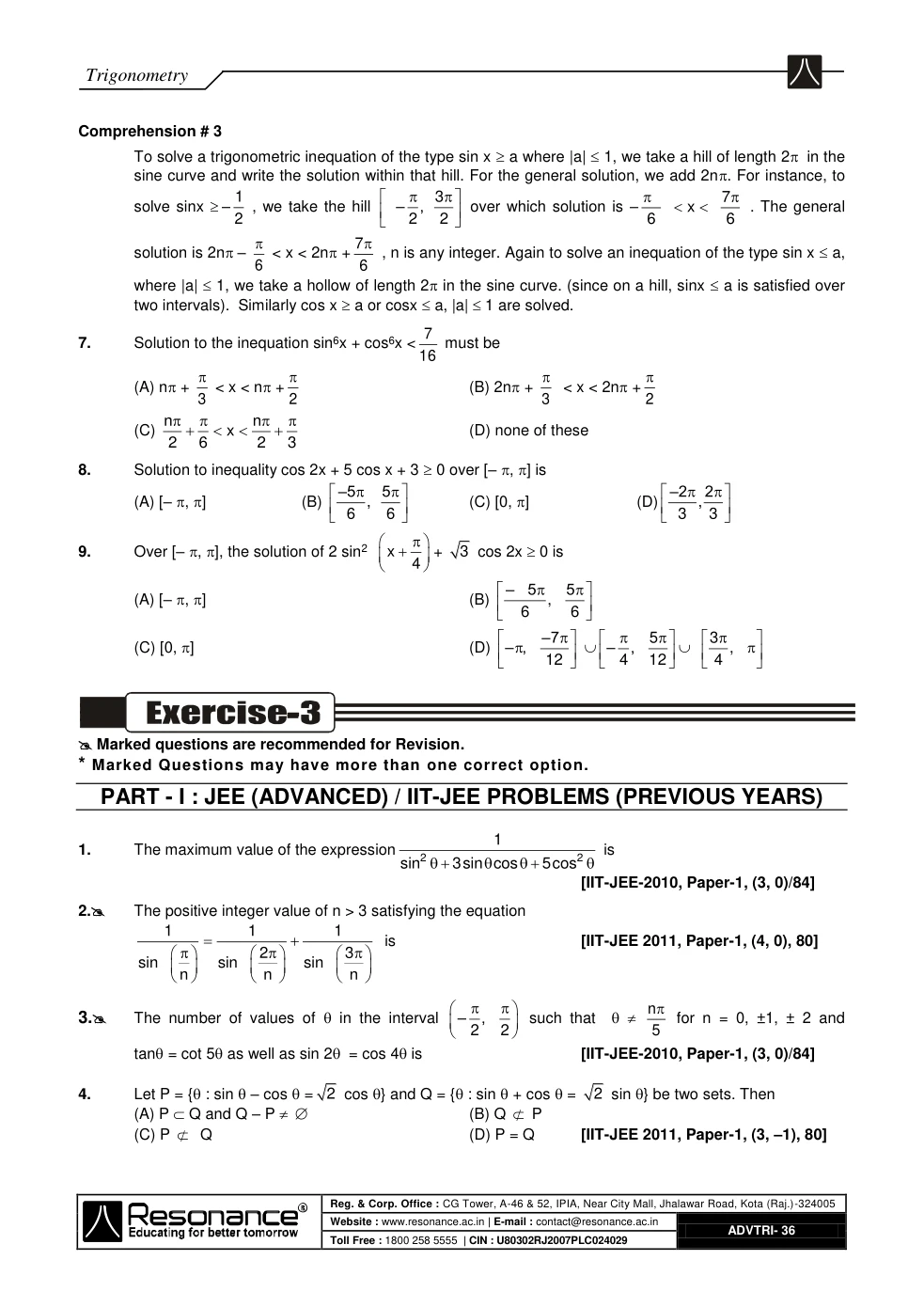
Rendered source page 36 of 47: Trigonometry
MAASTrigonometry
© MAAS. All rights reserved.Page 36 / 47
Extracted text · page 36
 Trigonometry


Comprehension # 3
      To solve a trigonometric inequation of the type sin x  a where |a|  1, we take a hill of length 2 in the
        sine curve and write the solution within that hill. For the general solution, we add 2n. For instance, to
                  1                            3                               7         solve sinx  –    , we take the hill   –   ,      over which solution is –     x           . The general                                                                               2                          2   2                      6        6
                                 7 
        solution is 2n–   < x < 2n +       , n is any integer. Again to solve an inequation of the type sin x  a,
                     6           6
       where |a|  1, we take a hollow of length 2 in the sine curve. (since on a hill, sinx  a is satisfied over
       two intervals). Similarly cos x  a or cosx  a, |a| 1 are solved.

                                         7
7.      Solution to the inequation sin6x + cos6x <   must be
                                        16
                                                                   
        (A) n +   < x < n +                           (B) 2n +   < x < 2n +
               3          2                              3            2
          n       n  
        (C)      x                              (D) none of these
          2  6      2  3
8.      Solution to inequality cos 2x + 5 cos x + 3  0 over [– , ] is
                                           –5   5                                             –2 2         (A) [– , ]              (B)          ,              (C) [0, ]               (D)         ,                                                                                                                                                   6    6                                            3   3 
                                                      9.     Over [– , ], the solution of 2 sin2  x    +  3 cos 2x  0 is                                                                                                              4 
                                                                      –  5   5          (A) [– , ]                                      (B)             ,                                                                                                                                                          6     6 
                                                                         –7          5       3              (C) [0, ]                                      (D)  – ,      –   ,              ,                                                                                                                                                                                      12       4  12      4      


 Marked questions are recommended for Revision.
* Marked Questions may have more than one correct option.
  PART - I : JEE (ADVANCED) / IIT-JEE PROBLEMS (PREVIOUS YEARS)

                                               1
1.     The maximum value of the expression                                      is
                                                sin2  3sin  cos  5cos 2 
                                                                     [IIT-JEE-2010, Paper-1, (3, 0)/84]

2.   The positive integer value of n > 3 satisfying the equation
          1         1         1
                                      is                          [IIT-JEE 2011, Paper-1, (4, 0), 80]
                           2          3  
         sin       sin         sin                      n           n          n 

                                                                                  n 
3.   The number of values of  in the interval   –   ,     such that          for n = 0, ±1, ± 2 and                                                                2  2                 5
        tan = cot 5 as well as sin 2 = cos 4is                      [IIT-JEE-2010, Paper-1, (3, 0)/84]

4.      Let P = { : sin  – cos  =  2 cos } and Q = { : sin  + cos  =  2 sin } be two sets. Then
        (A) P  Q and Q – P                          (B) Q  P
        (C) P  Q                                    (D) P = Q      [IIT-JEE 2011, Paper-1, (3, –1), 80]


                                                                                          ADVTRI- 36
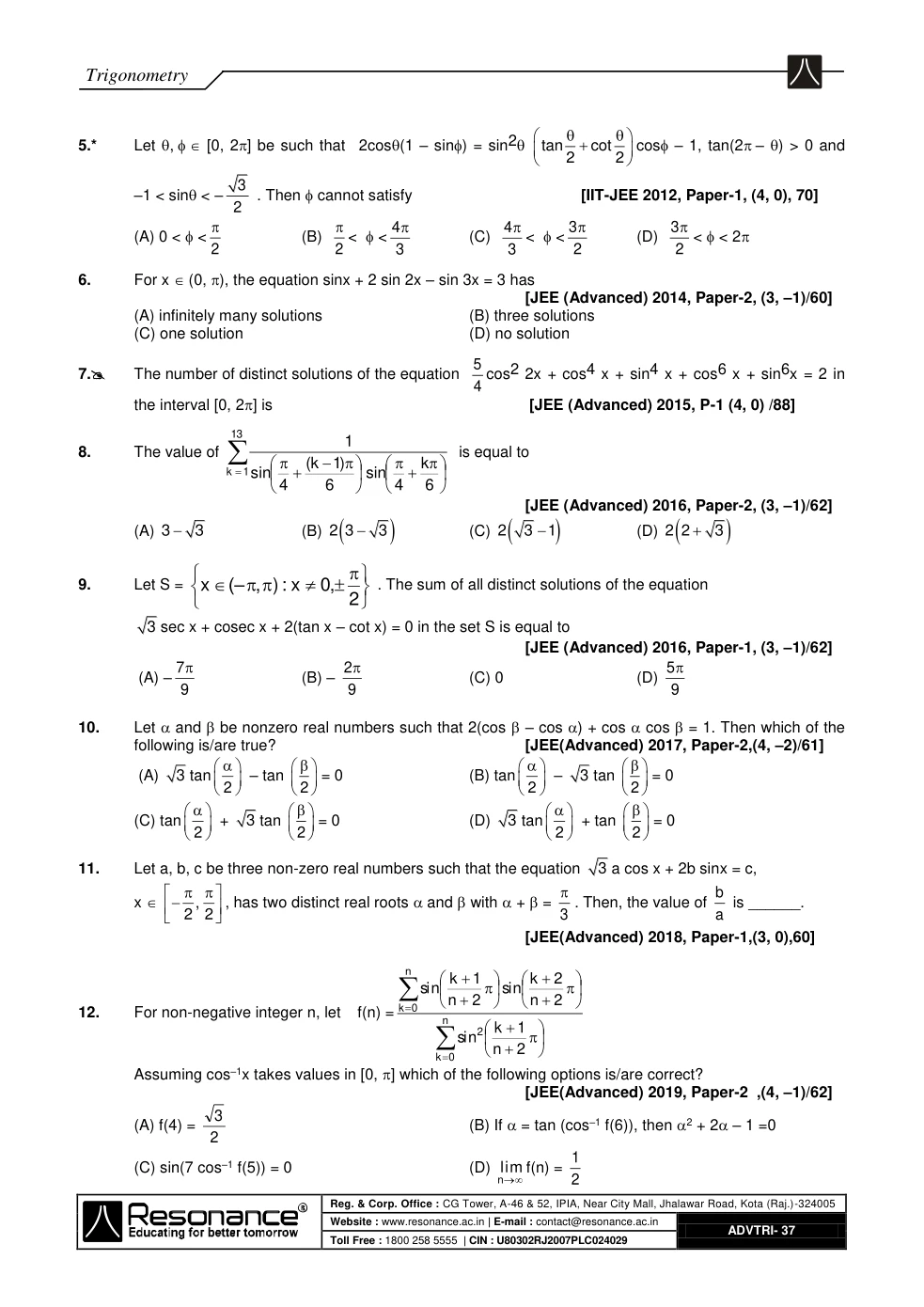
Rendered source page 37 of 47: Trigonometry
MAASTrigonometry
© MAAS. All rights reserved.Page 37 / 47
Extracted text · page 37
 Trigonometry


                                                                                    5.*     Let , [0, 2] be such that  2cos(1 – sin) = sin2  tan   cot   cos – 1, tan(2– ) > 0 and                                                                                                                                                                       2     2 
                   3
       –1 < sin < –        . Then  cannot satisfy                       [IIT-JEE 2012, Paper-1, (4, 0), 70]
                  2
                                    4            4       3           3        (A) 0 <  <              (B) <  <           (C)  <  <          (D)  <  < 2
                2              2      3            3       2           2

6.      For x (0, ), the equation sinx + 2 sin 2x – sin 3x = 3 has
                                                    [JEE (Advanced) 2014, Paper-2, (3, –1)/60]
        (A) infinitely many solutions                     (B) three solutions
        (C) one solution                                (D) no solution

                                                57.   The number of distinct solutions of the equation   cos2 2x + cos4 x + sin4 x + cos6 x + sin6x = 2 in
                                                4
        the interval [0, 2] is                              [JEE (Advanced) 2015, P-1 (4, 0) /88]

                         13           1
8.     The value of                                           is equal to               (k  )1        k                            k  1 sin            sin      
                                4    6         4  6 
                                                    [JEE (Advanced) 2016, Paper-2, (3, –1)/62]
        (A) 3  3              (B) 2 3  3           (C) 2  3  1           (D) 2 2   3                                                                                                                        

                           
9.      Let S =  x  (– ,  :) x  ,0        . The sum of all distinct solutions of the equation                                                   2 
        3 sec x + cosec x + 2(tan x – cot x) = 0 in the set S is equal to
                                                    [JEE (Advanced) 2016, Paper-1, (3, –1)/62]
            7                   2                                     5 
         (A) –                   (B) –                   (C) 0                   (D)
            9                   9                                     9

10.     Let  and  be nonzero real numbers such that 2(cos  – cos ) + cos  cos  = 1. Then which of the
        following is/are true?                             [JEE(Advanced) 2017, Paper-2,(4, –2)/61]
                                                                                      
         (A)  3 tan     – tan    = 0                  (B) tan     –  3 tan    = 0
                        2          2                                    2               2 
                                                                                      
        (C) tan     +  3 tan    = 0                  (D)  3 tan     + tan    = 0
                   2               2                                         2          2 

11.     Let a, b, c be three non-zero real numbers such that the equation  3 a cos x + 2b sinx = c,
                                                                            b       x      ,      , has two distinct real roots  and  with  +  = . Then, the value of     is ______.                                     2 2                                          3                  a
                                                     [JEE(Advanced) 2018, Paper-1,(3, 0),60]

                                                      n      k  1       k  2  
                                                     sin       sin                                                                                 k  0     n  2       n  2  12.    For non-negative integer n, let   f(n) =                                                            n
                                                                  2  k  1                                                            sin                                                                                          k  0      n  2  
       Assuming cos–1x takes values in [0, ] which of the following options is/are correct?
                                                     [JEE(Advanced) 2019, Paper-2  ,(4, –1)/62]
                3
        (A) f(4) =                                        (B) If  = tan (cos–1 f(6)), then 2 + 2 – 1 =0
                2
                                                            1
        (C) sin(7 cos–1 f(5)) = 0                         (D) nlim  f(n) = 2

                                                                                          ADVTRI- 37
Rendered source page 38 of 47: Trigonometry
MAASTrigonometry
© MAAS. All rights reserved.Page 38 / 47
Extracted text · page 38
 Trigonometry


For Q. 13 & 14
        Let f(x) = sin(cosx) and g(x) = cos(2sinx) be two functions defined for x > 0. Define the following sets
      whose elements are written in increasing order
           X = {x : f(x) = 0}, Y = {x : f (x) = 0}
            Z = {x : g(x) = 0}, W = {x : g(x) = 0}
          List-I contains sets X,Y,Z and W List-II contains some information regarding these set.
                                                     [JEE(Advanced) 2019, Paper-2  ,(4, –1)/62]
        List - I                                                  List - II
                                                            3 
           ()    X                                               (P)        ,      , 4  , 7                                                                                                                                                                                                  2  2                     
           ()   Y                                           (Q) an arithmetic progression
           ()   Z                                             (R) NOT an arithmetic progression
                                                           7  13
         (V)  W                                               (S)       ,      ,                                                                                                                                                                                               6  6  6    
                                                           2
                                                                   (T)       ,      ,                                                                                                                                                                                              3  3        
                                                            3 
                                                              (U)       ,                                                                                                                                                                                                 6  4  

13.    Which of the following is the only correct combination ?  [JEE(Advanced) 2019, Paper-2  ,(4, –1)/62]
         (1) IV – (Q), (T)          (2) III – (R), (U)          (3) III – (P), (Q), (U)     (4) IV – (P), (R), (S)

14.    Which is the following is only CORRECT combination ? [JEE(Advanced) 2019, Paper-2  ,(4, –1)/62]
         (1) I – (Q), (U)           (2) I – (P), (R)           (3) II – (Q), (T)           (4) II – (R), (S)

    PART - II : JEE (MAIN) / AIEEE PROBLEMS (PREVIOUS YEARS)

                     4                  51.    Let cos( + ) =  and let sin( – ) =       , where 0  ,   . Then tan 2 =
                     5                 13                4
                                                                 [AIEEE 2010 (4, –1), 144]
         56                  19                  20                 25
         (1)                        (2)                        (3)                        (4)
         33                  12                  7                  16

2.          If A = sin2 x + cos4 x, then for all real x :                          [AIEEE 2011 (4, –1), 120]
         3                  13                                    3     13
         (1)   A  1             (2)     A  1           (3) 1  A  2             (4)    A 
         4                  16                                    4     16

3.     In a PQR, if 3 sin P + 4 cos Q = 6 and 4 sin Q + 3 cos P = 1, then the angle R is equal to :
                                                                      [AIEEE-2012, (4, –1)/120]
          5                                                          3 
         (1)                        (2)                        (3)                        (4)
          6                  6                    4                   4

                     tanA      cot A
4.     The expression                can be written as :               [AIEEE - 2013, (4, –1),360]
                   1  cot A  1  tanA
         (1) sinA cosA + 1        (2) secA cosecA + 1     (3) tanA + cotA         (4) secA + cosecA

                1
5.      Let fk (x) =   (sinkx + coskx) where x R and k  1. Then f4(x) – f6(x) equals                  k
                                                                          [JEE(Main)2014,(4, – 1), 120]
          1                   1                   1                   1
         (1)                        (2)                        (3)                        (4)
          4                  12                   6                   3


                                                                                          ADVTRI- 38
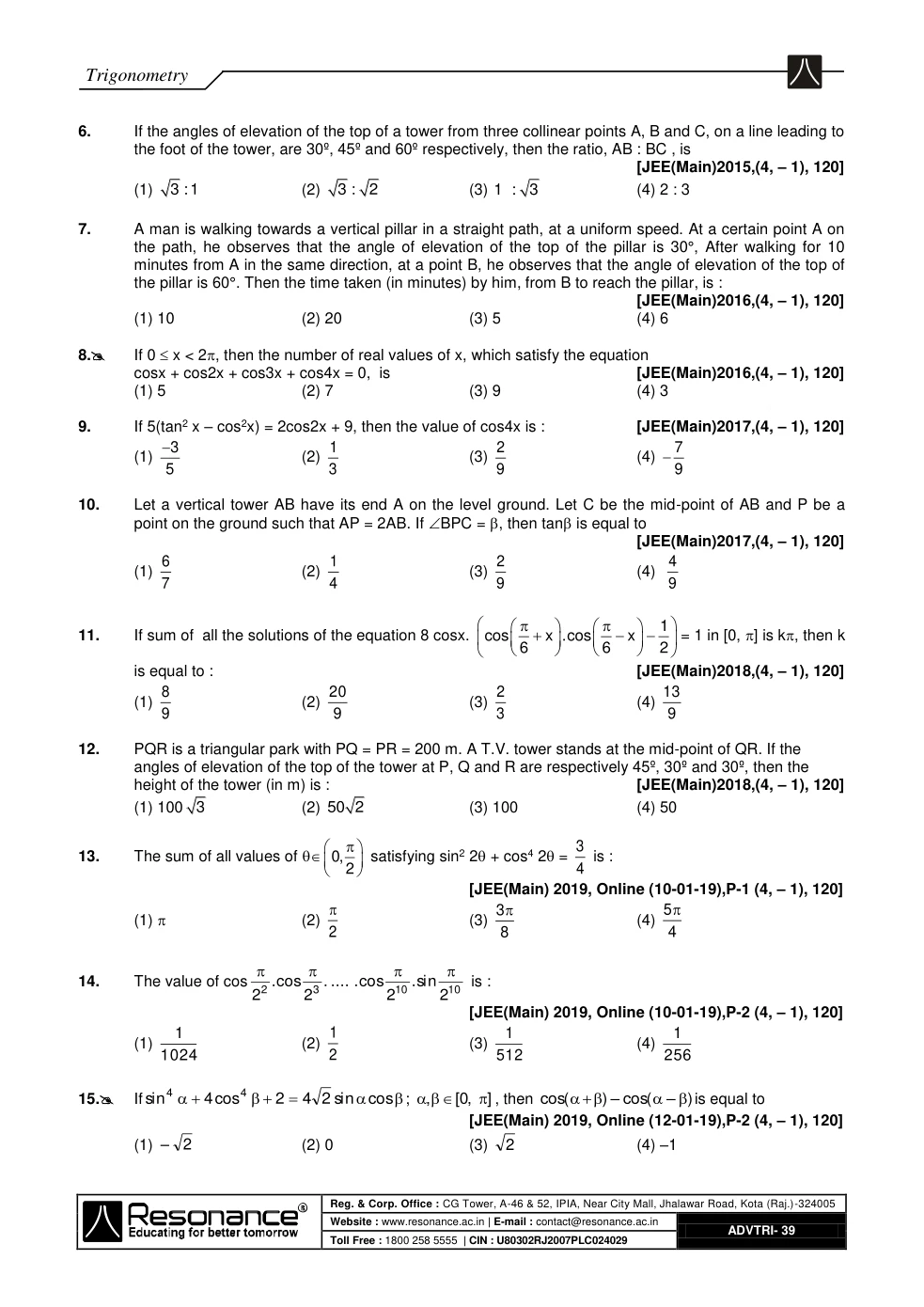
Rendered source page 39 of 47: Trigonometry
MAASTrigonometry
© MAAS. All rights reserved.Page 39 / 47
Extracted text · page 39
 Trigonometry


6.          If the angles of elevation of the top of a tower from three collinear points A, B and C, on a line leading to
        the foot of the tower, are 30º, 45º and 60º respectively, then the ratio, AB : BC , is
                                                                          [JEE(Main)2015,(4, – 1), 120]
         (1)  3 :1                (2)  3 :  2              (3) 1  :  3                (4) 2 : 3

7.    A man is walking towards a vertical pillar in a straight path, at a uniform speed. At a certain point A on
        the path, he observes that the angle of elevation of the top of the pillar is 30°, After walking for 10
       minutes from A in the same direction, at a point B, he observes that the angle of elevation of the top of
        the pillar is 60°. Then the time taken (in minutes) by him, from B to reach the pillar, is :
                                                                          [JEE(Main)2016,(4, – 1), 120]
         (1) 10                    (2) 20                    (3) 5                      (4) 6

8.       If 0  x < 2, then the number of real values of x, which satisfy the equation
       cosx + cos2x + cos3x + cos4x = 0,  is                                [JEE(Main)2016,(4, – 1), 120]
         (1) 5                      (2) 7                      (3) 9                      (4) 3

9.          If 5(tan2 x – cos2x) = 2cos2x + 9, then the value of cos4x is :            [JEE(Main)2017,(4, – 1), 120]
           3                  1                   2                    7
         (1)                        (2)                        (3)                        (4) 
          5                   3                   9                    9

10.     Let a vertical tower AB have its end A on the level ground. Let C be the mid-point of AB and P be a
        point on the ground such that AP = 2AB. If BPC = , then tan is equal to
                                                                          [JEE(Main)2017,(4, – 1), 120]
          6                   1                   2                    4
         (1)                        (2)                        (3)                        (4)
          7                   4                   9                    9

                                                                                      1 
11.        If sum of  all the solutions of the equation 8 cosx.  cos    x  .cos    x      = 1 in [0, ] is k, then k
                                                                      6          6      2 
          is equal to :                                                        [JEE(Main)2018,(4, – 1), 120]
          8                  20                  2                  13
         (1)                        (2)                        (3)                        (4)
          9                   9                   3                   9

12.   PQR is a triangular park with PQ = PR = 200 m. A T.V. tower stands at the mid-point of QR. If the
       angles of elevation of the top of the tower at P, Q and R are respectively 45º, 30º and 30º, then the
        height of the tower (in m) is :                                        [JEE(Main)2018,(4, – 1), 120]
         (1) 100  3               (2) 50 2                 (3) 100                   (4) 50

                                                                      3
13.    The sum of all values of 0,      satisfying sin2 2 + cos4 2 =     is :                                           2                           4
                                                 [JEE(Main) 2019, Online (10-01-19),P-1 (4, – 1), 120]
                                                  3                   5 
         (1)                       (2)                        (3)                        (4)
                               2                   8                   4

                                       
14.    The value of cos     . cos     . .... . cos      . sin      is :
                    2 2    2 3        210    210
                                                 [JEE(Main) 2019, Online (10-01-19),P-2 (4, – 1), 120]
           1                  1                    1                   1
         (1)                        (2)                        (3)                        (4)
         1024                2                  512                256

15.     If sin 4   4 cos 4   2  4 2 sin  cos  ; ,   [,0 ] , then cos(   ) – cos(  – ) is equal to
                                                 [JEE(Main) 2019, Online (12-01-19),P-2 (4, – 1), 120]
         (1) –  2                 (2) 0                      (3)  2                   (4) –1


                                                                                          ADVTRI- 39
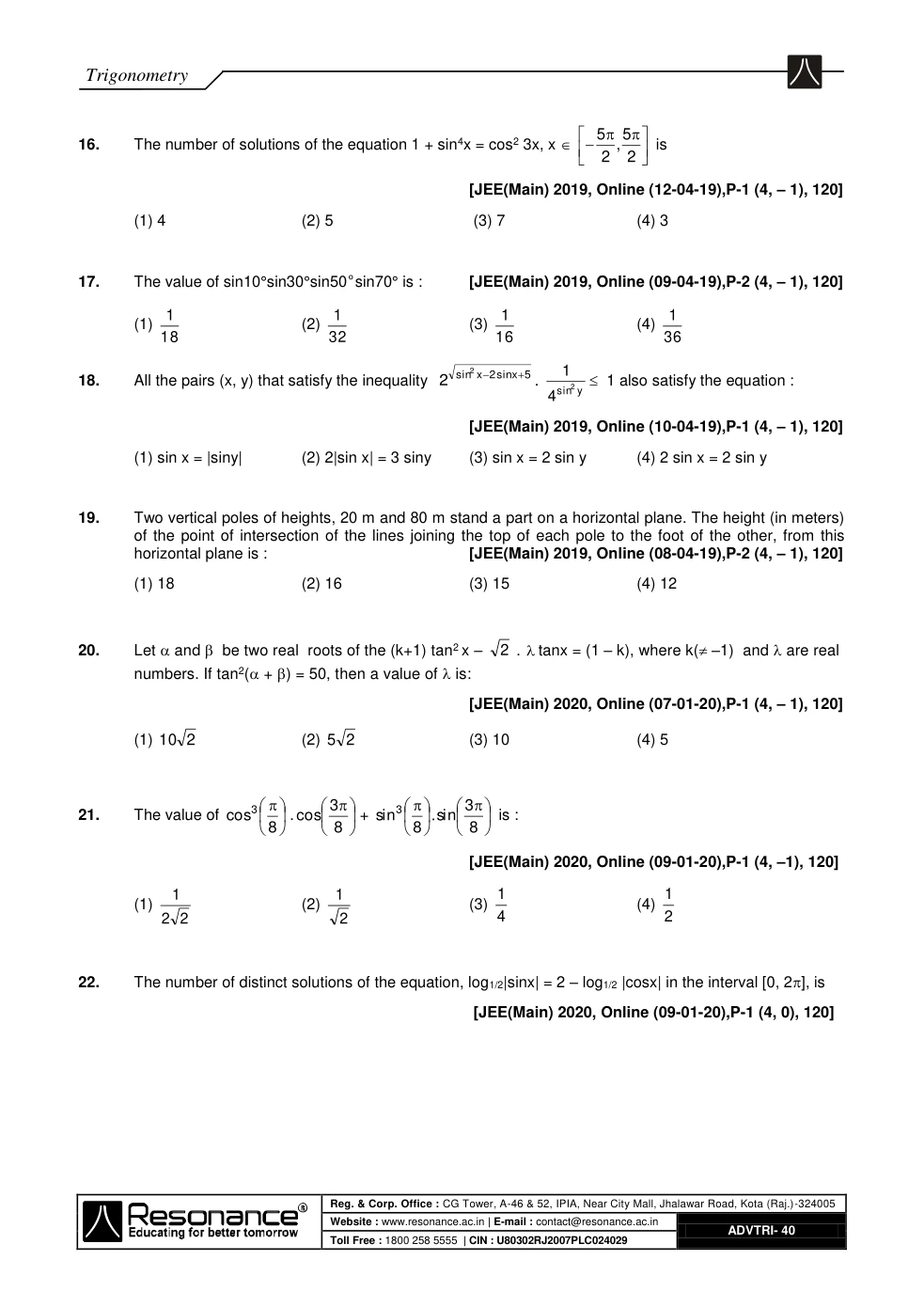
Rendered source page 40 of 47: Trigonometry
MAASTrigonometry
© MAAS. All rights reserved.Page 40 / 47
Extracted text · page 40
 Trigonometry


                                                                                    5  5  16.    The number of solutions of the equation 1 + sin4x = cos2 3x, x        ,      is                                                                                                                                                                                 2  2 

                                                 [JEE(Main) 2019, Online (12-04-19),P-1 (4, – 1), 120]

         (1) 4                      (2) 5                      (3) 7                     (4) 3


17.    The value of sin10°sin30°sin50ºsin70° is :      [JEE(Main) 2019, Online (09-04-19),P-2 (4, – 1), 120]

          1                   1                   1                   1
         (1)                        (2)                        (3)                        (4)
         18                 32                 16                 36

                                                                                  sin2 x  2 sinx  5    118.      All the pairs (x, y) that satisfy the inequality 2                    .       1 also satisfy the equation :
                                                                                                           sin2 y                                                       4

                                                 [JEE(Main) 2019, Online (10-04-19),P-1 (4, – 1), 120]

         (1) sin x = |siny|         (2) 2|sin x| = 3 siny      (3) sin x = 2 sin y        (4) 2 sin x = 2 sin y


19.    Two vertical poles of heights, 20 m and 80 m stand a part on a horizontal plane. The height (in meters)
         of the point of intersection of the lines joining the top of each pole to the foot of the other, from this
        horizontal plane is :                         [JEE(Main) 2019, Online (08-04-19),P-2 (4, – 1), 120]

         (1) 18                    (2) 16                    (3) 15                    (4) 12


20.     Let  and  be two real roots of the (k+1) tan2 x –  2  . tanx = (1– k), where k(–1) and  are real
       numbers. If tan2( + ) = 50, then a value of  is:

                                                 [JEE(Main) 2020, Online (07-01-20),P-1 (4, – 1), 120]

         (1) 10 2                 (2) 5 2                  (3) 10                    (4) 5


                        3          3  21.    The value of cos3    . cos     + sin3    . sin     is :
                               8        8          8      8 

                                                 [JEE(Main) 2020, Online (09-01-20),P-1 (4, –1), 120]

           1                  1                  1                   1
         (1)                        (2)                        (3)                        (4)
          2 2                  2                  4                   2


22.    The number of distinct solutions of the equation, log1/2|sinx| = 2 – log1/2 |cosx| in the interval [0, 2], is

                                                 [JEE(Main) 2020, Online (09-01-20),P-1 (4, 0), 120]


                                                                                          ADVTRI- 40
Rendered source page 41 of 47: Trigonometry
MAASTrigonometry
© MAAS. All rights reserved.Page 41 / 47
Extracted text · page 41
 Trigonometry


                           EXERCISE - 1

                            PART - I
Section (A) :
                      4            53 
A-1.      (i)                       (ii)                       (iii)
         12            3            18

A-2.      (i) 135°             (ii) – 720°          (iii) 300°          (iv) 210°

                 3         1             1
A-4.      (i)                (ii) –                    (iii) –               (iv)    1                                                  2                               2             3

Section (B) :


B-1.      (i)


             (ii)


              (iii)

                       1      2

                    13
B-2.   1      B-3.           B-7.    a2b2 + 4a2 = 9b2
                    12

Section (C)

                                     5  1                   3  1
C-2.      (i) 1                    (ii) –  5 / 4         (iii)                   C-10.
                                      8                     2 2

Section (E) :

        1  1
E-1.   –    ,            E-2.      (i) 2, –1              (ii) 3, 0
        4  4

E-3.      (i)      ymax = 11; ymin = 1                        (ii)     ymax = 10; ymin = – 4


                                                                                          ADVTRI- 41
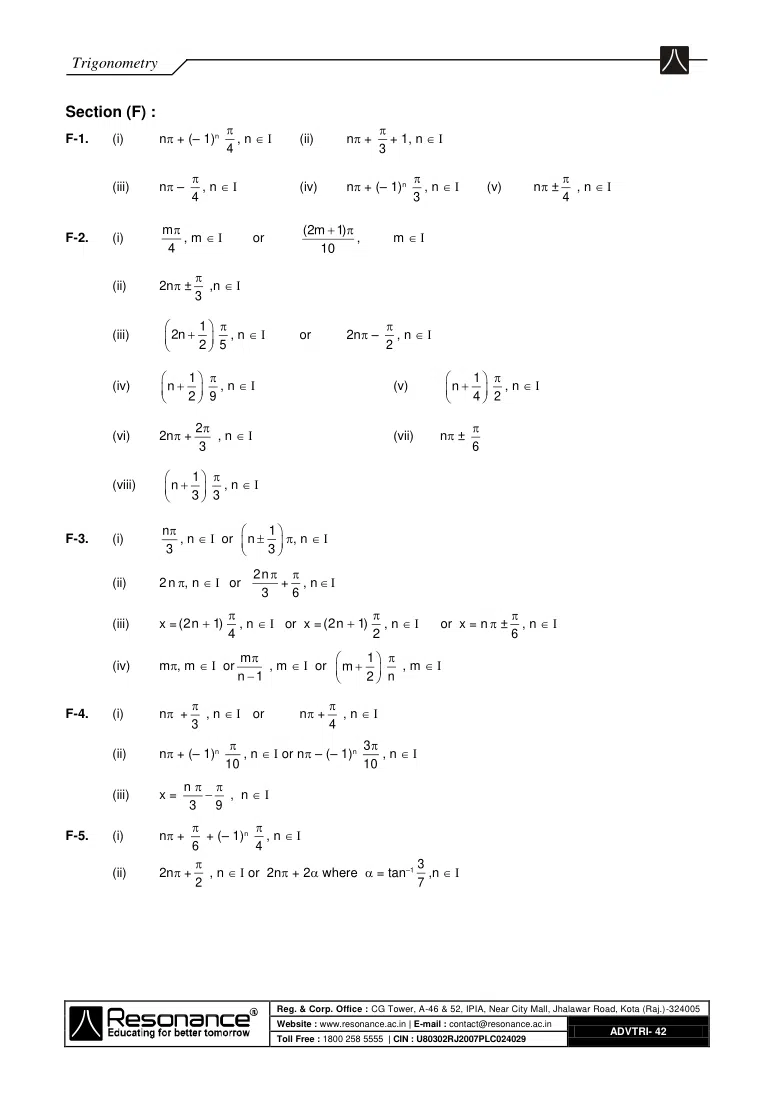
Rendered source page 42 of 47: Trigonometry
MAASTrigonometry
© MAAS. All rights reserved.Page 42 / 47
Extracted text · page 42
 Trigonometry


Section (F) :
F-1.      (i)     n + (– 1)n , n         (ii)     n + + 1, n
                       4                     3

                                                                                       (iii)    n – , n               (iv)    n + (– 1)n , n      (v)    n ±     , n 
                  4                               3                     4

         m                 (2m  1)F-2.      (i)       , m      or            ,   m 
              4                    10

                   
            (ii)    2n ±   ,n 
                   3

                        1               (iii)      2n     , n       or     2n – , n                                                     2 5                       2

                      1                                                    1           (iv)     n     , n                                    (v)      n     , n                                                                                                      2 9                                                 4 2

                  2                                        
          (vi)    2n +       , n                                     (vii)    n ±
                   3                                       6

                       1             (viii)     n     , n                                                              3 3

              n                 1 F-3.      (i)       , n  or  n     , n                                                        3                 3 

                        2n            (ii)     2 n , n or   + , n  
                           3   6

                                                       (iii)     x =(2n  1)    , n   or x =(2n  1)    , n     or x = n  ± , n  
                      4                   2                   6

                m                    1            (iv)    m, m  or          , m  or m            , m                                                                                      n  1                  2 n

                                      
F-4.      (i)      n +     , n   or     n +     , n 
                  3                   4

                                          3            (ii)     n + (– 1)n , n  or n – (– 1)n  , n       
                      10                 10

                 n                 (iii)     x =       , n           
                 3   9
                   F-5.      (i)     n +   + (– 1)n , n 
                  6        4
                                                  3
             (ii)     2n+     , n  or 2n + 2 where  = tan–1   ,n
                   2                               7


                                                                                          ADVTRI- 42
Rendered source page 43 of 47: Trigonometry
MAASTrigonometry
© MAAS. All rights reserved.Page 43 / 47
Extracted text · page 43
 Trigonometry


Section (G) :

                                                               7       11 G-1.   x n  ,n       : n  I             G-2.    2n     , 2n                                                                                                          4     4                                        6        6  

G-3.     (n/3, n + /2]                G-4.   15  3 m

G-5.    ab                                 G-6.   50 m

                              PART - II
Section (A) :

A-1.    (A)     A-2.    (A)     A-3.    (B)     A-4.    (C)     A-5.    (B)

Section (B) :

B-1.    (A)     B-2.    (B)     B-3.    (A)     B-4.    (D)     B-5.    (B)     B-6.    (B)     B-7.    (A)

B-8.    (A)     B-9.    (C)     B-10.   (A)     B-11.   (B)     B-12.   (C)

Section (C) :
C-1.    (C)     C-2.    (A)     C-3.    (C)     C-4.    (D)     C-5.    (A)     C-6.    (B)     C-7.    (A)

C-8.    (B)     C-9.    (D)     C-10.   (C)

Section (D) :
D-1.    (A)     D-2.    (B)     D-3.    (D)     D-4.    (B)     D-5.    (A)

Section (E) :

E-1.    (C)     E-2.    (C)     E-3.    (A)     E-4.    (B)     E-5.    (A)

Section (F) :

F-1.    (D)     F-2.    (B)     F-3.    (D)     F-4.    (B)     F-5.    (C)     F-6.    (B)     F-7.    (A)

F-8.    (B)     F-9.    (A)     F-10.   (B)     F-11.   (C)     F-12.   (B)

Section (G) :

G-1.    (A)     G-2.    (C)     G-3.    (B)     G-4.    (A)     G-5.    (A)     G-6.    (D)     G-7.    (D)

G-8.    (D)     G-9.    (B)
                              PART - III
1.      (A)  (s),       (B)  (s),      (C)  (s),      (D)  (r)

2.      (A)  (q, s),    (B)  (p),      (C)  (q),      (D)  (p)

3.      (A)  (q),      (B)  (s),      (C)  (r),      (D)  (p)

                           EXERCISE - 2

                            PART - I
1.      (B)     2.      (B)     3.      (D)     4.      (B)     5.      (A)     6.      (B)     7.      (B)

8.      (A)     9.      (D)     10.     (D)     11.     (C)     12.     (C)     13.     (C)     14.     (A)

15.     (A)     16.     (D)     17.     (A)     18.     (B)


                                                                                          ADVTRI- 43
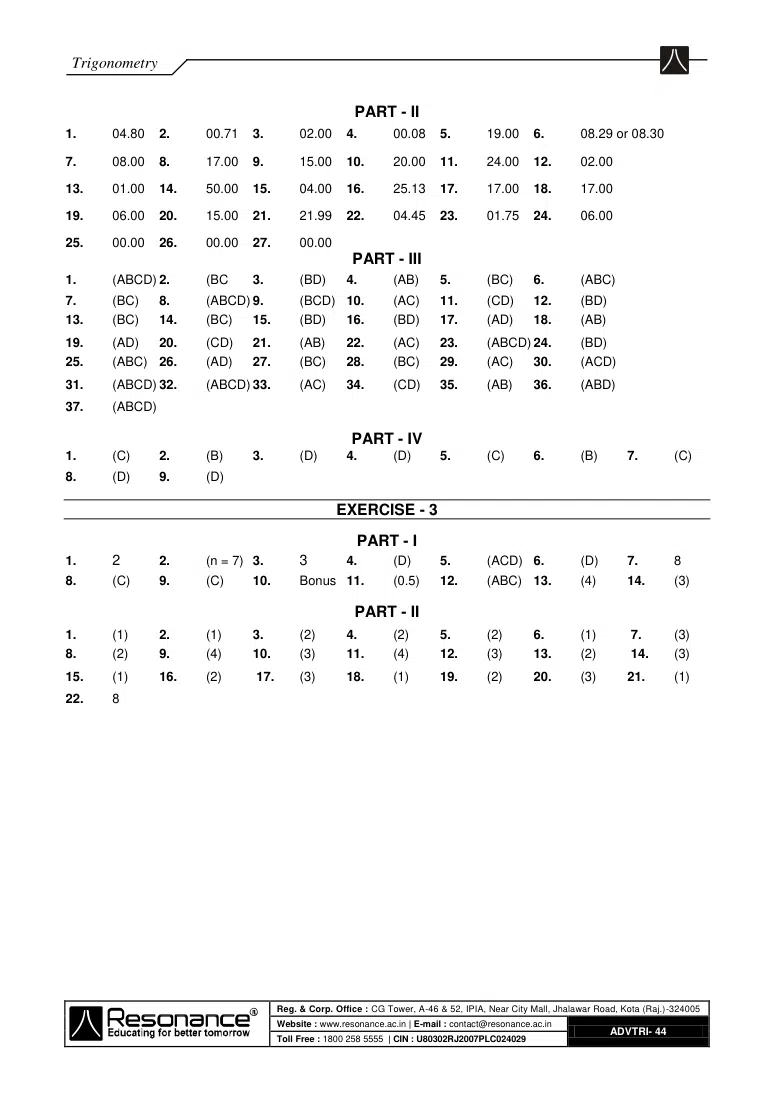
Rendered source page 44 of 47: Trigonometry
MAASTrigonometry
© MAAS. All rights reserved.Page 44 / 47
Extracted text · page 44
 Trigonometry


                           PART - II
1.      04.80   2.      00.71   3.      02.00   4.      00.08   5.      19.00   6.      08.29 or 08.30

7.      08.00   8.      17.00   9.      15.00  10.    20.00  11.    24.00  12.    02.00

13.    01.00  14.    50.00  15.    04.00  16.    25.13  17.    17.00  18.    17.00

19.    06.00  20.    15.00  21.    21.99  22.    04.45  23.    01.75  24.     06.00

25.    00.00  26.    00.00  27.    00.00
                           PART - III
1.     (ABCD) 2.     (BC     3.     (BD)    4.      (AB)    5.     (BC)    6.     (ABC)
7.     (BC)    8.     (ABCD) 9.     (BCD)  10.    (AC)   11.    (CD)   12.    (BD)
13.    (BC)   14.    (BC)   15.    (BD)   16.    (BD)   17.    (AD)   18.    (AB)

19.    (AD)   20.    (CD)   21.    (AB)    22.    (AC)   23.    (ABCD) 24.    (BD)
25.    (ABC)  26.    (AD)   27.    (BC)   28.    (BC)   29.    (AC)   30.    (ACD)

31.    (ABCD) 32.    (ABCD) 33.    (AC)   34.    (CD)   35.    (AB)    36.    (ABD)

37.    (ABCD)

                           PART - IV
1.      (C)     2.      (B)     3.      (D)     4.      (D)     5.      (C)     6.      (B)     7.      (C)
8.      (D)     9.      (D)

                           EXERCISE - 3

                            PART - I
1.     2       2.      (n = 7)  3.     3       4.      (D)     5.     (ACD)  6.      (D)     7.     8
8.      (C)     9.      (C)     10.    Bonus  11.     (0.5)   12.    (ABC)  13.     (4)     14.     (3)

                           PART - II
1.       (1)      2.       (1)      3.       (2)      4.       (2)      5.       (2)      6.       (1)      7.      (3)
8.       (2)      9.       (4)     10.     (3)     11.     (4)     12.     (3)     13.     (2)      14.     (3)

15.     (1)     16.     (2)      17.     (3)     18.     (1)     19.     (2)     20.     (3)     21.     (1)

22.    8


                                                                                          ADVTRI- 44
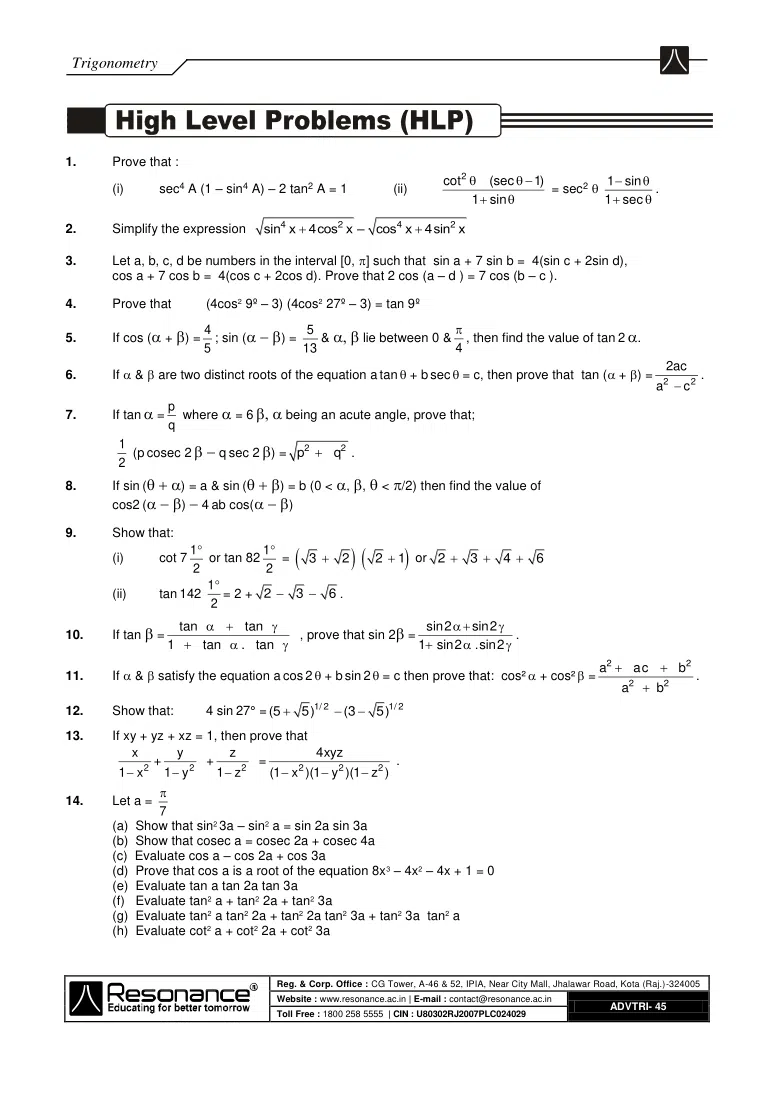
Rendered source page 45 of 47: Trigonometry
MAASTrigonometry
© MAAS. All rights reserved.Page 45 / 47
Extracted text · page 45
 Trigonometry


1.     Prove that :
                                                                 cot 2   (sec  1)         1  sin 
            (i)      sec4 A (1 – sin4 A) – 2 tan2 A = 1             (ii)                   = sec2                                                        1  sin             1  sec .

2.      Simplify the expression   sin4 x  4cos2 x –  cos 4 x  4sin2 x

3.      Let a, b, c, d be numbers in the interval [0, ] such that sin a + 7 sin b = 4(sin c + 2sin d),
       cos a + 7 cos b = 4(cos c + 2cos d). Prove that 2 cos (a – d ) = 7 cos (b – c ).

4.     Prove that      (4cos2 9º – 3) (4cos2 27º – 3) = tan 9º

                    4              55.          If cos (+ ) =    ; sin ( ) =   &   lie between 0 & , then find the value of tan 2 .
                    5             13                    4
                                                                                       2ac
6.          If  &  are two distinct roots of the equation a tan + b sec = c, then prove that tan (+ ) =             .
                                                                                 a 2  c 2
               p7.          If tan  =   where  = 6   being an acute angle, prove that;
               q
        1                                  2      2            (p cosec 2  q sec 2 ) = p   q   .
        2
8.          If sin () = a & sin () = b (0 <, ,</2) then find the value of
       cos2 ()  4 ab cos()

9.    Show that:
                  1          1 
            (i)      cot 7    or tan 82   =   3   2   2  1  or 2   3   4   6                                                                                      2         2
                    1             (ii)     tan 142  = 2 + 2   3   6 .
                     2
                   tan     tan                          sin2  sin2 10.        If tan  =                                      , prove that sin 2 =              1   tan  .  tan                    1 sin2  .sin2 .
                                                                        a 2  ac   b 2
11.        If  &  satisfy the equation a cos 2 + b sin 2 = c then prove that: cos² + cos²  =                            .
                                                                            a 2  b 2
12.    Show that:    4 sin 27° = (5   5)1/ 2  (3   5)1/ 2

13.        If xy + yz + xz = 1, then prove that
          x      y       z            4xyz
            +      +      =                                    .
       1  x 2  1  y 2   1  z 2    (1  x 2 )(1  y 2 )(1  z 2 )
              
14.     Let a =
              7
         (a) Show that sin2 3a – sin2 a = sin 2a sin 3a
         (b) Show that cosec a = cosec 2a + cosec 4a
         (c) Evaluate cos a – cos 2a + cos 3a
         (d) Prove that cos a is a root of the equation 8x3 – 4x2 – 4x + 1 = 0
         (e) Evaluate tan a tan 2a tan 3a
           (f)  Evaluate tan2 a + tan2 2a + tan2 3a
         (g) Evaluate tan2 a tan2 2a + tan2 2a tan2 3a + tan2 3a tan2 a
         (h) Evaluate cot2 a + cot2 2a + cot2 3a


                                                                                          ADVTRI- 45
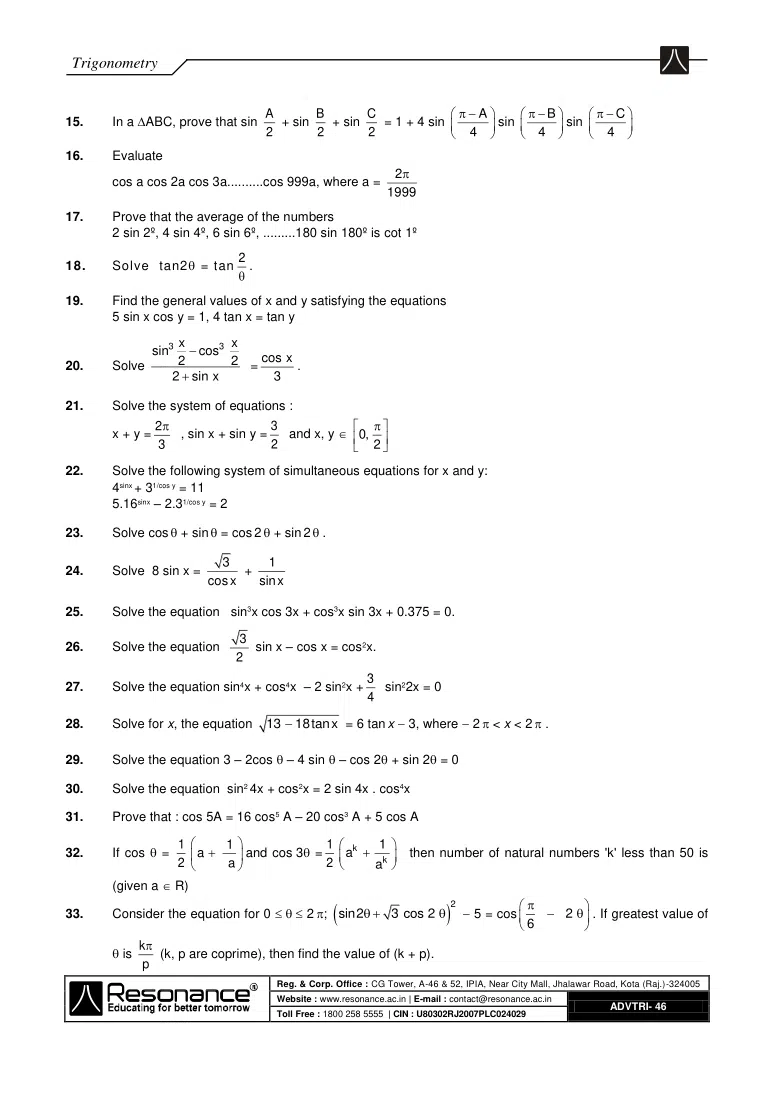
Rendered source page 46 of 47: Trigonometry
MAASTrigonometry
© MAAS. All rights reserved.Page 46 / 47
Extracted text · page 46
 Trigonometry


                        A     B     C                 A        B        C 15.     In a ABC, prove that sin   + sin   + sin   = 1 + 4 sin          sin         sin                                                                                                                                        2      2      2                 4          4          4   
16.     Evaluate
                                             2 
       cos a cos 2a cos 3a..........cos 999a, where a =
                                            1999

17.    Prove that the average of the numbers
       2 sin 2º, 4 sin 4º, 6 sin 6º, .........180 sin 180º is cot 1º

                         2
18.    Solve tan2 = tan    .
                           

19.     Find the general values of x and y satisfying the equations
       5 sin x cos y = 1, 4 tan x = tan y

                    3 x       3 x                sin    cos
               2      2   cos x20.    Solve              =           .
               2  sin x        3

21.    Solve the system of equations :
             2                3                         x + y =        , sin x + sin y =   and x, y   0,                                                                            3               2                 2 

22.    Solve the following system of simultaneous equations for x and y:
            4sinx + 31/cos y = 11
          5.16sinx – 2.31/cos y = 2

23.    Solve cos + sin = cos 2 + sin 2.

                      3     1
24.    Solve 8 sin x =      +
                    cosx    sinx

25.    Solve the equation  sin3x cos 3x + cos3x sin 3x + 0.375 = 0.

                         3
26.    Solve the equation      sin x – cos x = cos2x.
                        2
                                            3
27.    Solve the equation sin4x + cos4x – 2 sin2x +    sin22x = 0
                                            4

28.    Solve for x, the equation  13  18tanx = 6 tan x  3, where  2  < x < 2  .

29.    Solve the equation 3 – 2cos  – 4 sin  – cos 2 + sin 2 = 0

30.    Solve the equation sin2 4x + cos2x = 2 sin 4x . cos4x

31.    Prove that : cos 5A = 16 cos5 A – 20 cos3 A + 5 cos A

                1     1             1   k   1 
32.        If cos  =     a      and cos 3 =    a    k   then number of natural numbers 'k' less than 50 is                2     a             2     a  
        (given a  R)
                                                                          2                       33.    Consider the equation for 0  2 ;                                           sin2 3 cos 2                                                          5 = cos      2   . If greatest value of                                                                                                                                                                                                                                              6          
            k 
        is      (k, p are coprime), then find the value of (k + p).
           p


                                                                                          ADVTRI- 46
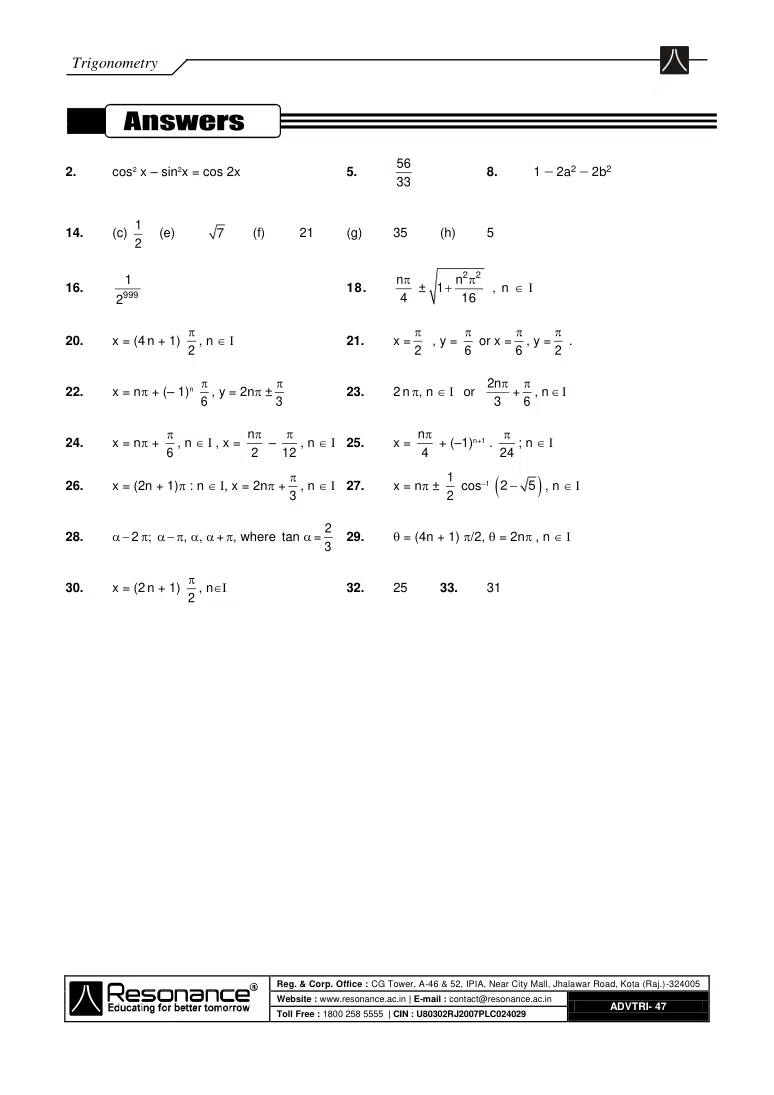
Rendered source page 47 of 47: Trigonometry
MAASTrigonometry
© MAAS. All rights reserved.Page 47 / 47
Extracted text · page 47
 Trigonometry


                                              562.      cos2 x – sin2x = cos 2x                    5.                        8.     1  2a2  2b2
                                              33


          1
14.      (c)      (e)      7       (f)     21      (g)    35      (h)    5
          2

        1                                      n       n2  2
16.                                        18.       ±  1            , n 
       2999                                     4       16

                                                                     20.    x = (4 n + 1) , n                           21.    x =      , y =    or x = , y =     .
                  2                                2      6      6     2

                                                            2n22.    x = n + (– 1)n , y = 2n ±            23.    2 n , n or   + , n  
                    6          3                             3   6

                          n                       n 24.    x = n + , n  , x =    – , n   25.    x =    + (–1)n+1 . ; n 
               6           2   12                  4          24

                                                       1
                                                                                                                                     , n                                                            2   526.    x = (2n + 1) : n , x = 2n + , n 27.    x = n ±    cos–1                                                                                                                                              3                      2

                                      2
28.      2    , ,  + , where tan  =    29.     = (4n + 1) /2,  = 2n , n  
                                      3

30.    x = (2 n + 1) , nI                    32.    25     33.    31
                  2


                                                                                          ADVTRI- 47