Visual-fidelity edition: source-page equations, diagrams and charts are preserved as page images. Text transcripts are provided where extractable. The original source may contain markings within the artwork.
MAASFundamentals Of Mathematics Ii
© MAAS. All rights reserved.Page 1 / 18
Extracted text · page 1
Fundamentals of Mathematics-II
He is unworthy of the name of man who is ignorant of the fact that the diagonal of square is incommensurable with its side .......Plato
Absolute value function / modulus function :
x if x 0
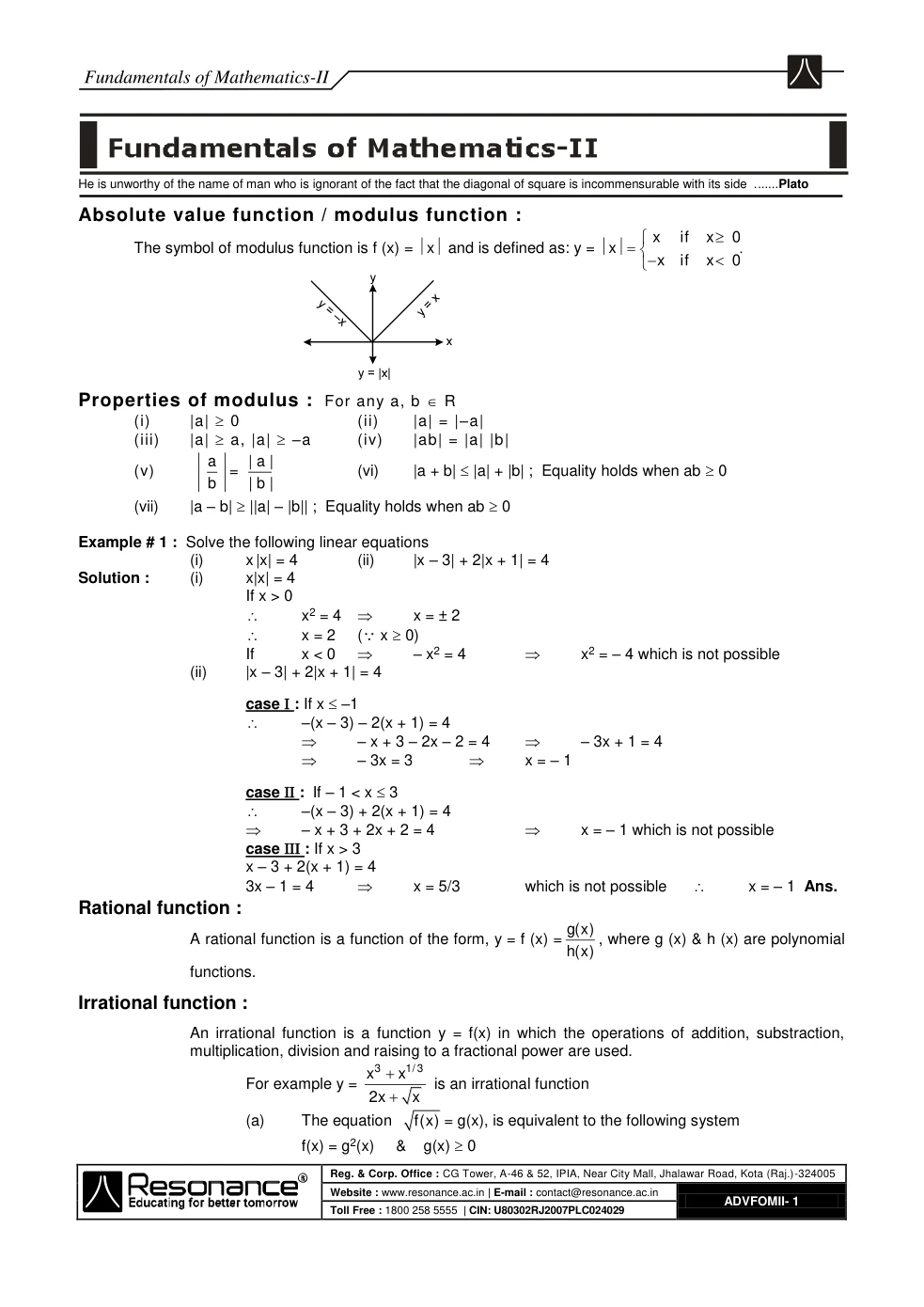
The symbol of modulus function is f (x) = x and is defined as: y = x x if x 0
Properties of modulus : For any a, b R
(i) |a| 0 (ii) |a| = |–a|
(iii) |a| a, |a| –a (iv) |ab| = |a| |b|
a | a |
(v) = (vi) |a + b| |a| + |b| ; Equality holds when ab 0
b | b |
(vii) |a – b| ||a| – |b|| ; Equality holds when ab 0
Example # 1 : Solve the following linear equations
(i) x |x| = 4 (ii) |x – 3| + 2|x + 1| = 4
Solution : (i) x|x| = 4
If x > 0
x2 = 4 x = ± 2
x = 2 ( x 0)
If x < 0 – x2 = 4 x2 = – 4 which is not possible
(ii) |x – 3| + 2|x + 1| = 4
case : If x –1
–(x – 3) – 2(x + 1) = 4
– x + 3 – 2x – 2 = 4 – 3x + 1 = 4
– 3x = 3 x = – 1
case : If – 1 < x 3
–(x – 3) + 2(x + 1) = 4
– x + 3 + 2x + 2 = 4 x = – 1 which is not possible
case : If x > 3
x – 3 + 2(x + 1) = 4
3x – 1 = 4 x = 5/3 which is not possible x = – 1 Ans.
Rational function :
g(x)
A rational function is a function of the form, y = f (x) = , where g (x) & h (x) are polynomial
h(x)
functions.
Irrational function :
An irrational function is a function y = f(x) in which the operations of addition, substraction,
multiplication, division and raising to a fractional power are used.
x 3 x1/ 3
For example y = is an irrational function
2x x
(a) The equation f(x) = g(x), is equivalent to the following system
f(x) = g2(x) & g(x) 0
ADVFOMII- 1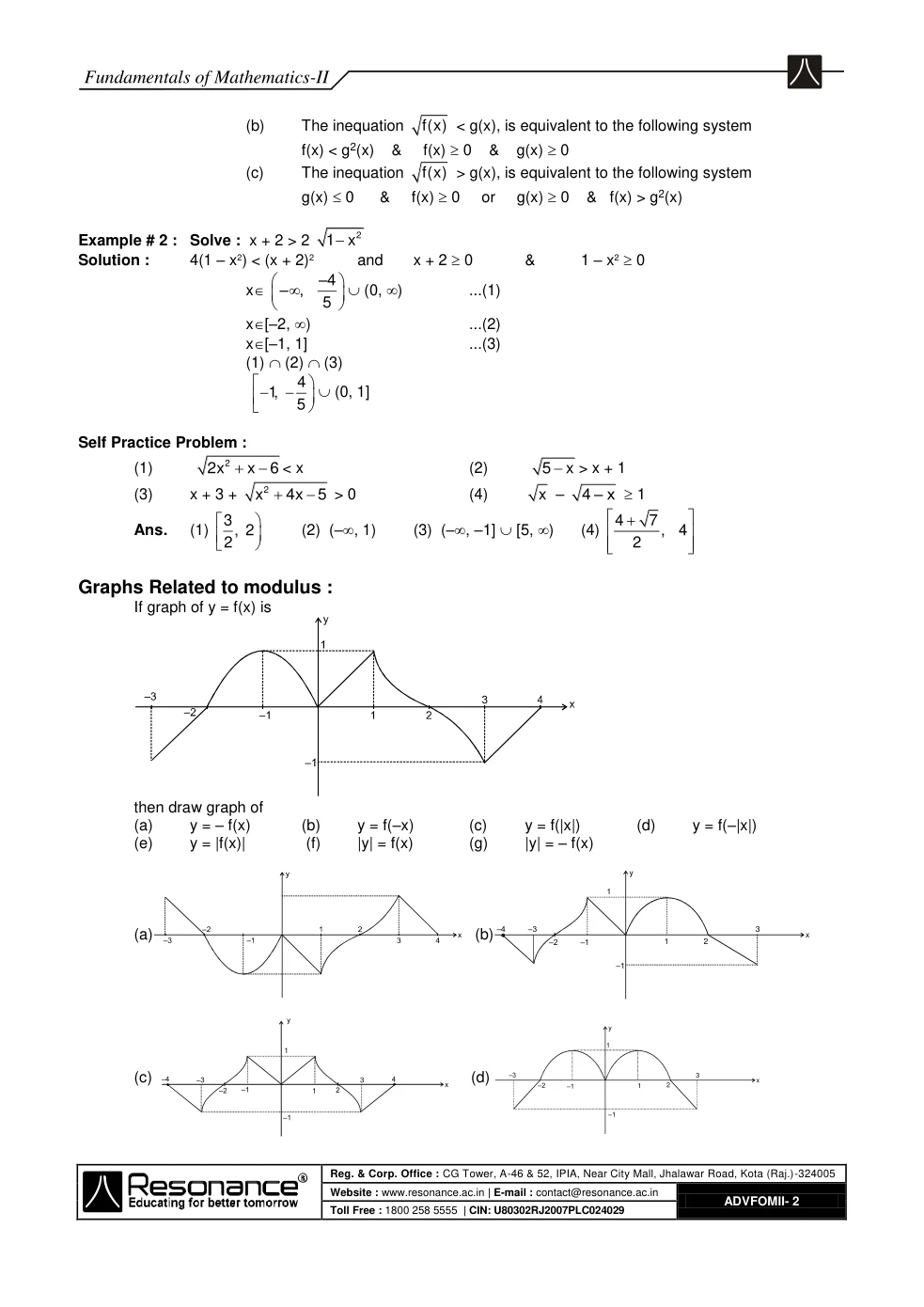
MAASFundamentals Of Mathematics Ii
© MAAS. All rights reserved.Page 2 / 18
Extracted text · page 2
Fundamentals of Mathematics-II
(b) The inequation f(x) < g(x), is equivalent to the following system
f(x) < g2(x) & f(x) 0 & g(x) 0
(c) The inequation f(x) > g(x), is equivalent to the following system
g(x) 0 & f(x) 0 or g(x) 0 & f(x) > g2(x)
Example # 2 : Solve : x + 2 > 2 1 x 2
Solution : 4(1 – x2) < (x + 2)2 and x + 2 0 & 1 – x2 0
–4
x – , (0, ) ...(1)
5
x[–2, ) ...(2)
x[–1, 1] ...(3)
(1) (2) (3)
4
1, (0, 1] 5
Self Practice Problem :
(1) 2x 2 x 6 < x (2) 5 x > x + 1
(3) x + 3 + x 2 4x 5 > 0 (4) x – 4 – x 1
4 7
(2) (–, 1) (3) (–, –1] [5, ) (4) , 4 Ans. (1) 3, 2 2 2
Graphs Related to modulus :
If graph of y = f(x) is
then draw graph of
(a) y = – f(x) (b) y = f(–x) (c) y = f(|x|) (d) y = f(–|x|)
(e) y = |f(x)| (f) |y| = f(x) (g) |y| = – f(x)
y
1
x (a) (b) –4 –3 –2 –1 1 2 3
–1
y
y
1
1
x (c) –4 –3 3 4 x (d) –3 –2 –1 1 2 3
–2 –1 1 2
–1 –1
ADVFOMII- 2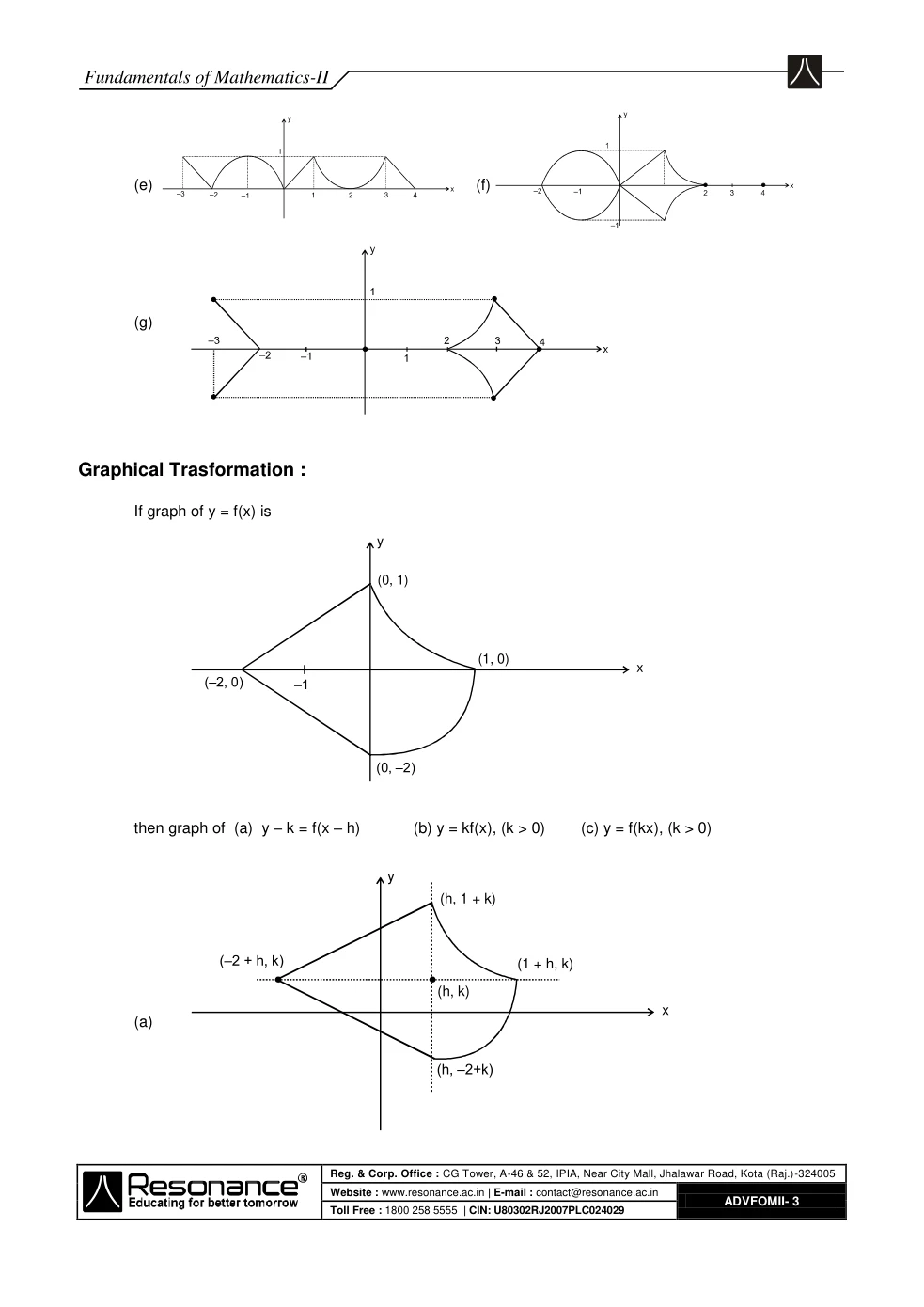
MAASFundamentals Of Mathematics Ii
© MAAS. All rights reserved.Page 3 / 18
Extracted text · page 3
 Fundamentals of Mathematics-II


                                                        y


                                                1

         (e)                                                                                x    (f)
                        –3      –2      –1               1        2        3      4


         (g)


Graphical Trasformation :

             If graph of y = f(x) is

                                            y


                                                         (0, 1)


                                                                             (1, 0)
                                                                                   x
                      (–2, 0)       –1


                                                         (0, –2)


       then graph of (a) y – k = f(x – h)        (b) y = kf(x), (k > 0)      (c) y = f(kx), (k > 0)


                                           y
                                                                  (h, 1 + k)


                     (–2 + h, k)                                     (1 + h, k)

                                                                 (h, k)
                                                                                  x
         (a)


                                                                 (h, –2+k)


                                                                                         ADVFOMII- 3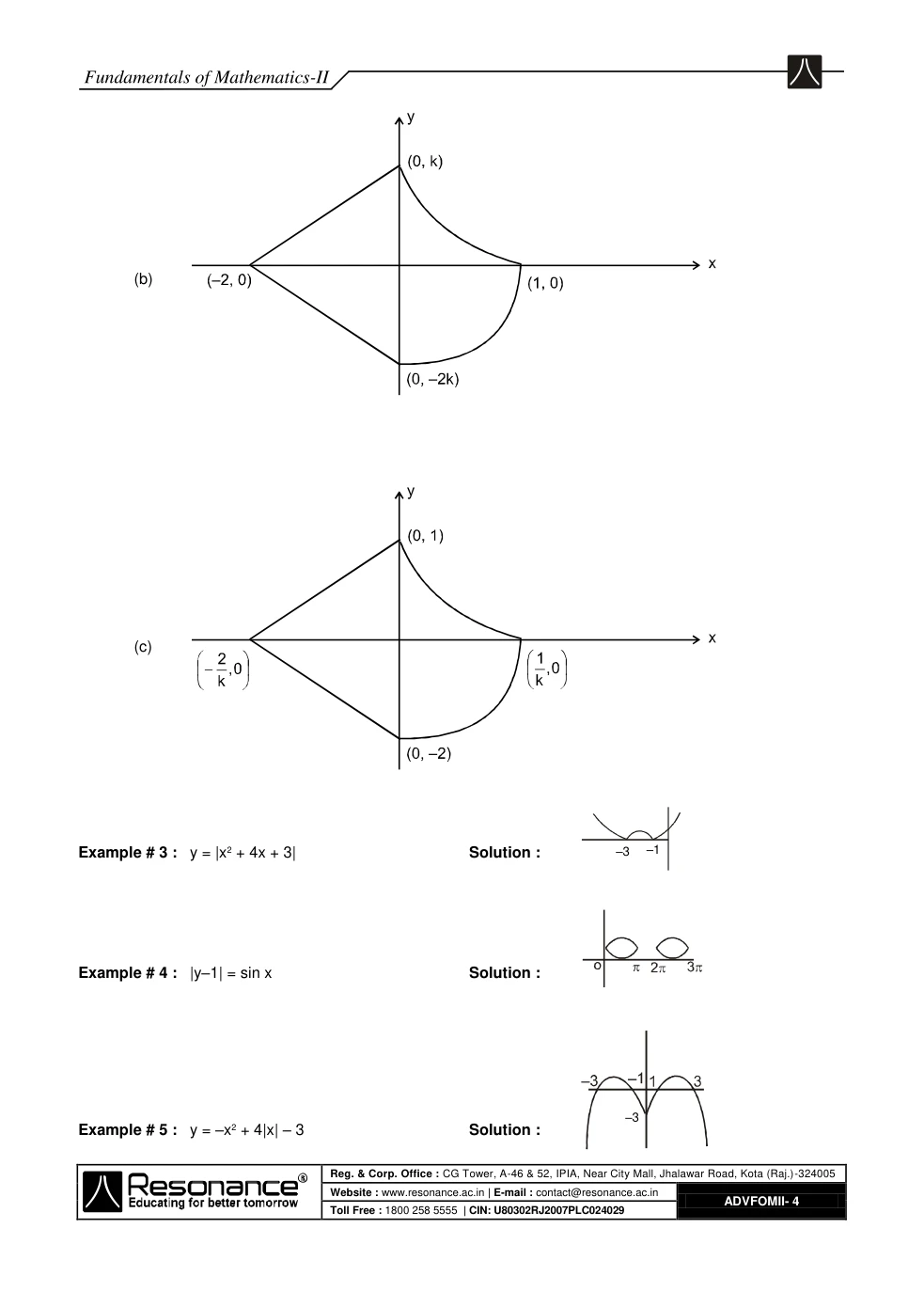
MAASFundamentals Of Mathematics Ii
© MAAS. All rights reserved.Page 4 / 18
Extracted text · page 4
 Fundamentals of Mathematics-II


         (b)


         (c)


Example # 3 :  y = |x2 + 4x + 3|                      Solution :           –3  –1


Example # 4 :  |y–1| = sin x                         Solution :


                                                                               –3
Example # 5 :  y = –x2 + 4|x| – 3                     Solution :


                                                                                         ADVFOMII- 4
MAASFundamentals Of Mathematics Ii
© MAAS. All rights reserved.Page 5 / 18
Extracted text · page 5
Fundamentals of Mathematics-II
3
–3 3
Example # 6 : y = ||x |–3| Solution :
x
Example # 7 : y = sin Solution : period is 6
3
Example # 8 : y = sinx 3 Solution : Graphical Transformation
Example # 9 : y = |–n |–x|| Solution :
Example # 10 : |y| = x2 – 3x + 2 Solution :
ADVFOMII- 5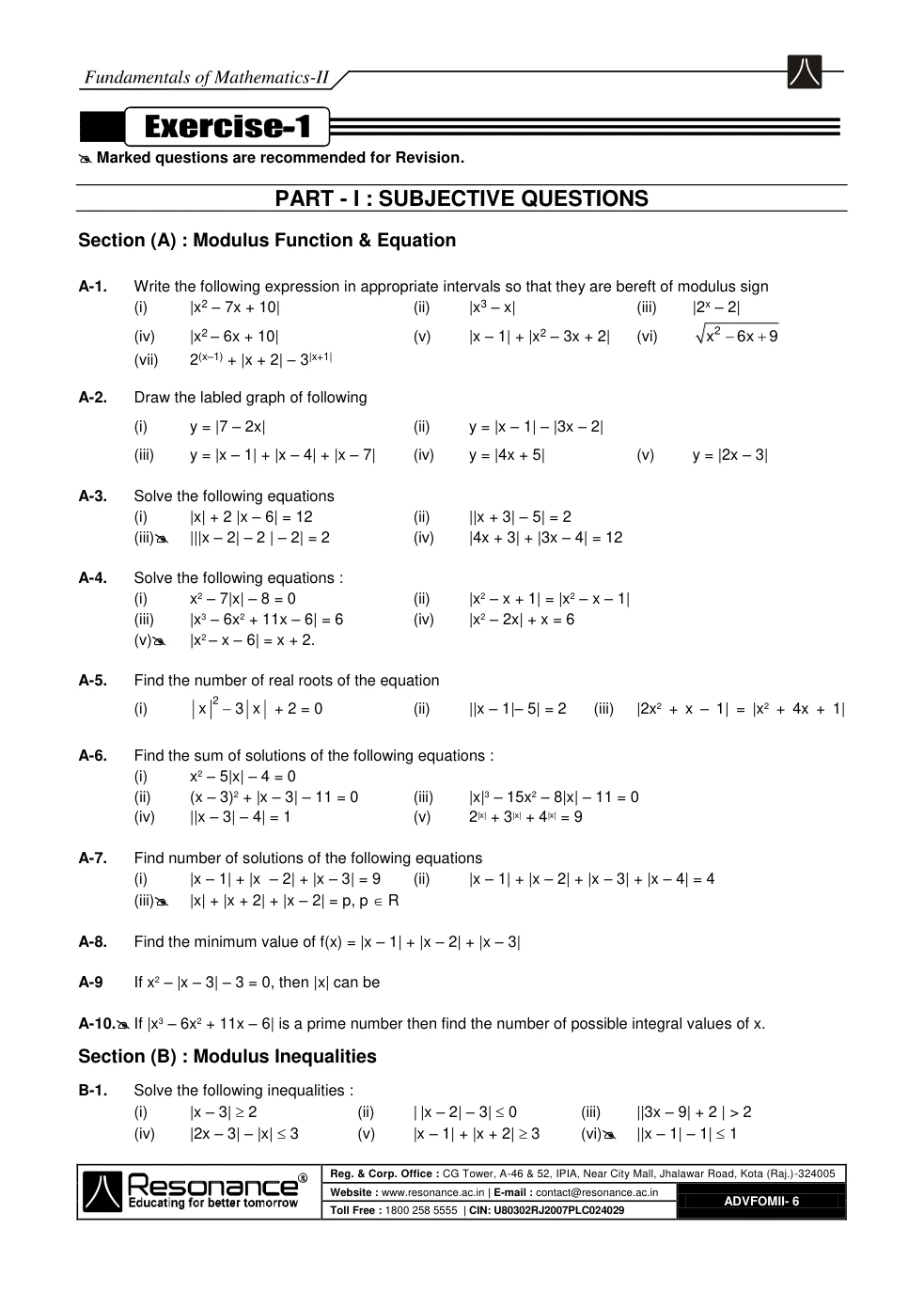
MAASFundamentals Of Mathematics Ii
© MAAS. All rights reserved.Page 6 / 18
Extracted text · page 6
Fundamentals of Mathematics-II
Marked questions are recommended for Revision.
PART - I : SUBJECTIVE QUESTIONS
Section (A) : Modulus Function & Equation
A-1. Write the following expression in appropriate intervals so that they are bereft of modulus sign
(i) |x2 – 7x + 10| (ii) |x3 – x| (iii) |2x – 2|
(iv) |x2 – 6x + 10| (v) |x – 1| + |x2 – 3x + 2| (vi) x 2 6x 9
(vii) 2(x–1) + |x + 2| – 3|x+1|
A-2. Draw the labled graph of following
(i) y = |7 – 2x| (ii) y = |x – 1| – |3x – 2|
(iii) y = |x – 1| + |x – 4| + |x – 7| (iv) y = |4x + 5| (v) y = |2x – 3|
A-3. Solve the following equations
(i) |x| + 2 |x – 6| = 12 (ii) ||x + 3| – 5| = 2
(iii) |||x – 2| – 2 | – 2| = 2 (iv) |4x + 3| + |3x – 4| = 12
A-4. Solve the following equations :
(i) x2 – 7|x| – 8 = 0 (ii) |x2 – x + 1| = |x2 – x – 1|
(iii) |x3 – 6x2 + 11x – 6| = 6 (iv) |x2 – 2x| + x = 6
(v) |x2 – x – 6| = x + 2.
A-5. Find the number of real roots of the equation
2
(i) x 3 x + 2 = 0 (ii) ||x – 1|– 5| = 2 (iii) |2x2 + x – 1| = |x2 + 4x + 1|
A-6. Find the sum of solutions of the following equations :
(i) x2 – 5|x| – 4 = 0
(ii) (x – 3)2 + |x – 3| – 11 = 0 (iii) |x|3 – 15x2 – 8|x| – 11 = 0
(iv) ||x – 3| – 4| = 1 (v) 2|x| + 3|x| + 4|x| = 9
A-7. Find number of solutions of the following equations
(i) |x – 1| + |x – 2| + |x – 3| = 9 (ii) |x – 1| + |x – 2| + |x – 3| + |x – 4| = 4
(iii) |x| + |x + 2| + |x – 2| = p, p R
A-8. Find the minimum value of f(x) = |x – 1| + |x – 2| + |x – 3|
A-9 If x2 – |x – 3| – 3 = 0, then |x| can be
A-10. If |x3 – 6x2 + 11x – 6| is a prime number then find the number of possible integral values of x.
Section (B) : Modulus Inequalities
B-1. Solve the following inequalities :
(i) |x – 3| 2 (ii) | |x – 2| – 3| 0 (iii) ||3x – 9| + 2 | > 2
(iv) |2x – 3| – |x| 3 (v) |x – 1| + |x + 2| 3 (vi) ||x – 1| – 1| 1
ADVFOMII- 6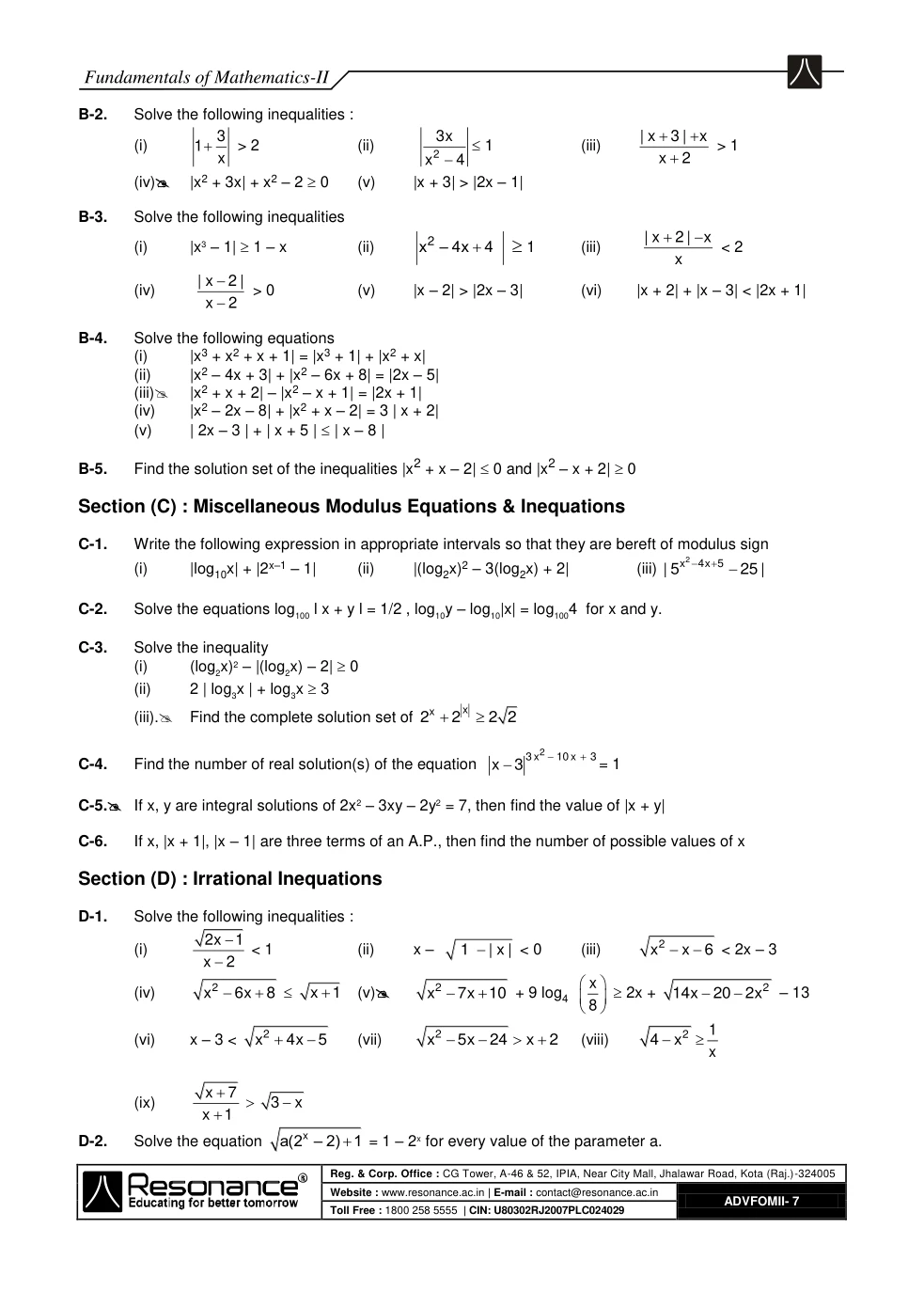
MAASFundamentals Of Mathematics Ii
© MAAS. All rights reserved.Page 7 / 18
Extracted text · page 7
Fundamentals of Mathematics-II
B-2. Solve the following inequalities :
3 3x | x 3 | x
(i) 1 > 2 (ii) 1 (iii) > 1
x x 2 4 x 2
(iv) |x2 + 3x| + x2 – 2 0 (v) |x + 3| > |2x – 1|
B-3. Solve the following inequalities
2 | x 2 | x (i) |x3 – 1| 1 – x (ii) x – 4x 4 1 (iii) < 2
x
| x 2 |
(iv) > 0 (v) |x – 2| > |2x – 3| (vi) |x + 2| + |x – 3| < |2x + 1|
x 2
B-4. Solve the following equations
(i) |x3 + x2 + x + 1| = |x3 + 1| + |x2 + x|
(ii) |x2 – 4x + 3| + |x2 – 6x + 8| = |2x – 5|
(iii) |x2 + x + 2| – |x2 – x + 1| = |2x + 1|
(iv) |x2 – 2x – 8| + |x2 + x – 2| = 3 | x + 2|
(v) | 2x – 3 | + | x + 5 | | x – 8 |
B-5. Find the solution set of the inequalities |x2 + x – 2| 0 and |x2 – x + 2| 0
Section (C) : Miscellaneous Modulus Equations & Inequations
C-1. Write the following expression in appropriate intervals so that they are bereft of modulus sign
x 2 4x 5 (i) |log10x| + |2x–1 – 1| (ii) |(log2x)2 – 3(log2x) + 2| (iii) | 5 25 |
C-2. Solve the equations log100 l x + y l = 1/2 , log10y – log10|x| = log1004 for x and y.
C-3. Solve the inequality
(i) (log2x)2 – |(log2x) – 2| 0
(ii) 2 | log3x | + log3x 3
x x (iii). Find the complete solution set of 2 2 2 2
3 x 2 10 x 3
C-4. Find the number of real solution(s) of the equation x 3 = 1
C-5. If x, y are integral solutions of 2x2 – 3xy – 2y2 = 7, then find the value of |x + y|
C-6. If x, |x + 1|, |x – 1| are three terms of an A.P., then find the number of possible values of x
Section (D) : Irrational Inequations
D-1. Solve the following inequalities :
2x 1 2 (i) < 1 (ii) x – 1 | x | < 0 (iii) x x 6 < 2x – 3
x 2
2 2 x 2
(iv) x 6x 8 x 1 (v) x 7x 10 + 9 log4 2x + 14x 20 2x – 13 8
(vi) x – 3 < x 2 4x 5 (vii) x 2 5x 24 x 2 (viii) 4 x 2 1
x
x 7
(ix) 3 x
x 1
D-2. Solve the equation a(2 x – 2) 1 = 1 – 2x for every value of the parameter a.
ADVFOMII- 7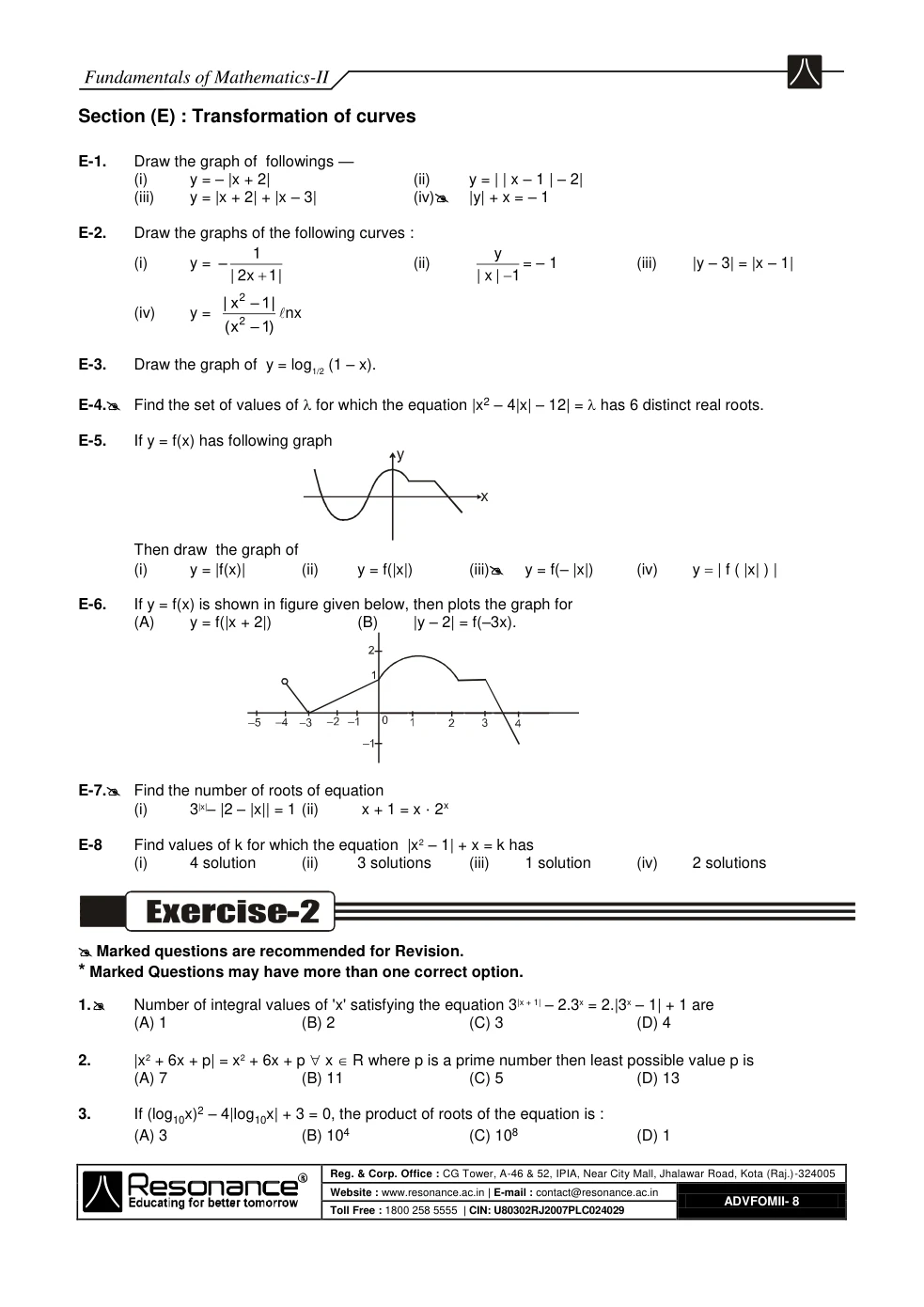
MAASFundamentals Of Mathematics Ii
© MAAS. All rights reserved.Page 8 / 18
Extracted text · page 8
Fundamentals of Mathematics-II
Section (E) : Transformation of curves
E-1. Draw the graph of followings —
(i) y = – |x + 2| (ii) y = | | x – 1 | – 2|
(iii) y = |x + 2| + |x – 3| (iv) |y| + x = – 1
E-2. Draw the graphs of the following curves :
1 y
(i) y = – (ii) – 1 (iii) |y – 3| = |x – 1| | 2x 1| | x | =1
| x 2 – 1|
(iv) y = nx
(x 2 – 1)
E-3. Draw the graph of y = log1/2 (1 – x).
E-4. Find the set of values of for which the equation |x2 – 4|x| – 12| = has 6 distinct real roots.
E-5. If y = f(x) has following graph
Then draw the graph of
(i) y = |f(x)| (ii) y = f(|x|) (iii) y = f(– |x|) (iv) y | f ( |x| ) |
E-6. If y = f(x) is shown in figure given below, then plots the graph for
(A) y = f(|x + 2|) (B) |y – 2| = f(–3x).
E-7. Find the number of roots of equation
(i) 3|x|– |2 – |x|| = 1 (ii) x + 1 = x · 2x
E-8 Find values of k for which the equation |x2 – 1| + x = k has
(i) 4 solution (ii) 3 solutions (iii) 1 solution (iv) 2 solutions
Marked questions are recommended for Revision.
* Marked Questions may have more than one correct option.
1. Number of integral values of 'x' satisfying the equation 3|x + 1| – 2.3x = 2.|3x – 1| + 1 are
(A) 1 (B) 2 (C) 3 (D) 4
2. |x2 + 6x + p| = x2 + 6x + p x R where p is a prime number then least possible value p is
(A) 7 (B) 11 (C) 5 (D) 13
3. If (log10x)2 – 4|log10x| + 3 = 0, the product of roots of the equation is :
(A) 3 (B) 104 (C) 108 (D) 1
ADVFOMII- 8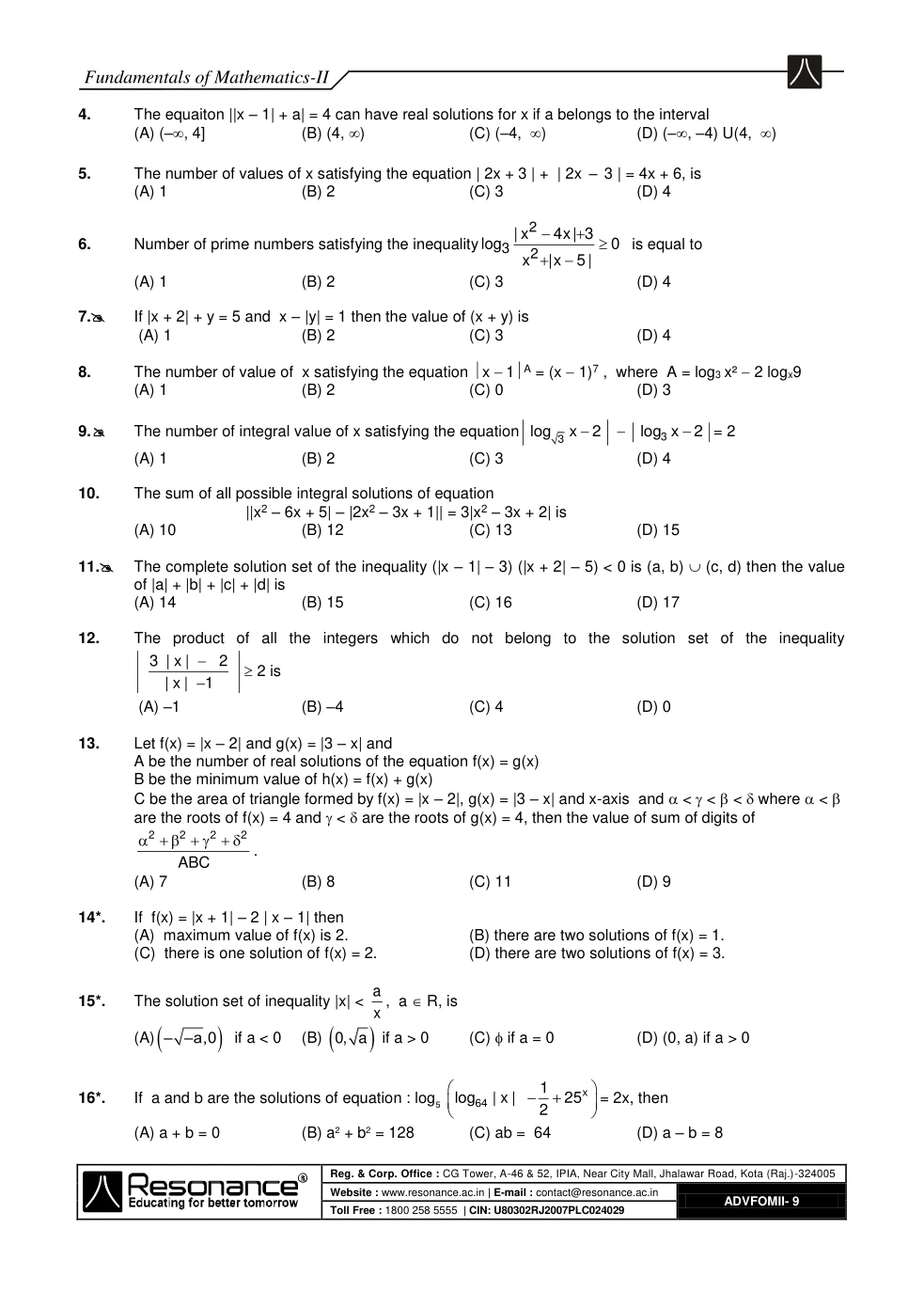
MAASFundamentals Of Mathematics Ii
© MAAS. All rights reserved.Page 9 / 18
Extracted text · page 9
Fundamentals of Mathematics-II
4. The equaiton ||x – 1| + a| = 4 can have real solutions for x if a belongs to the interval
(A) (–, 4] (B) (4, ) (C) (–4, ) (D) (–, –4) U(4, )
5. The number of values of x satisfying the equation | 2x + 3 | + | 2x – 3 | = 4x + 6, is
(A) 1 (B) 2 (C) 3 (D) 4
2 | x 4 x |3
6. Number of prime numbers satisfying the inequality log3 0 is equal to 2 x | x 5 |
(A) 1 (B) 2 (C) 3 (D) 4
7. If |x + 2| + y = 5 and x – |y| = 1 then the value of (x + y) is
(A) 1 (B) 2 (C) 3 (D) 4
8. The number of value of x satisfying the equation x 1A = (x 1)7 , where A = log3 x² 2 logx9
(A) 1 (B) 2 (C) 0 (D) 3
9. The number of integral value of x satisfying the equation log x 2 log3 x 2 = 2 3
(A) 1 (B) 2 (C) 3 (D) 4
10. The sum of all possible integral solutions of equation
||x2 – 6x + 5| – |2x2 – 3x + 1|| = 3|x2 – 3x + 2| is
(A) 10 (B) 12 (C) 13 (D) 15
11. The complete solution set of the inequality (|x – 1| – 3) (|x + 2| – 5) < 0 is (a, b) (c, d) then the value
of |a| + |b| + |c| + |d| is
(A) 14 (B) 15 (C) 16 (D) 17
12. The product of all the integers which do not belong to the solution set of the inequality
3 | x | 2
2 is
| x | 1
(A) –1 (B) –4 (C) 4 (D) 0
13. Let f(x) = |x – 2| and g(x) = |3 – x| and
A be the number of real solutions of the equation f(x) = g(x)
B be the minimum value of h(x) = f(x) + g(x)
C be the area of triangle formed by f(x) = |x – 2|, g(x) = |3 – x| and x-axis and < < < where <
are the roots of f(x) = 4 and < are the roots of g(x) = 4, then the value of sum of digits of
2 2 2 2
.
ABC
(A) 7 (B) 8 (C) 11 (D) 9
14*. If f(x) = |x + 1| – 2 | x – 1| then
(A) maximum value of f(x) is 2. (B) there are two solutions of f(x) = 1.
(C) there is one solution of f(x) = 2. (D) there are two solutions of f(x) = 3.
a
15*. The solution set of inequality |x| < , a R, is
x
– –a,0 if a < 0 (B) 0, a if a > 0 (C) if a = 0 (D) (0, a) if a > 0 (A)
1 x
16*. If a and b are the solutions of equation : log5 log64 | x | 25 = 2x, then 2
(A) a + b = 0 (B) a2 + b2 = 128 (C) ab = 64 (D) a – b = 8
ADVFOMII- 9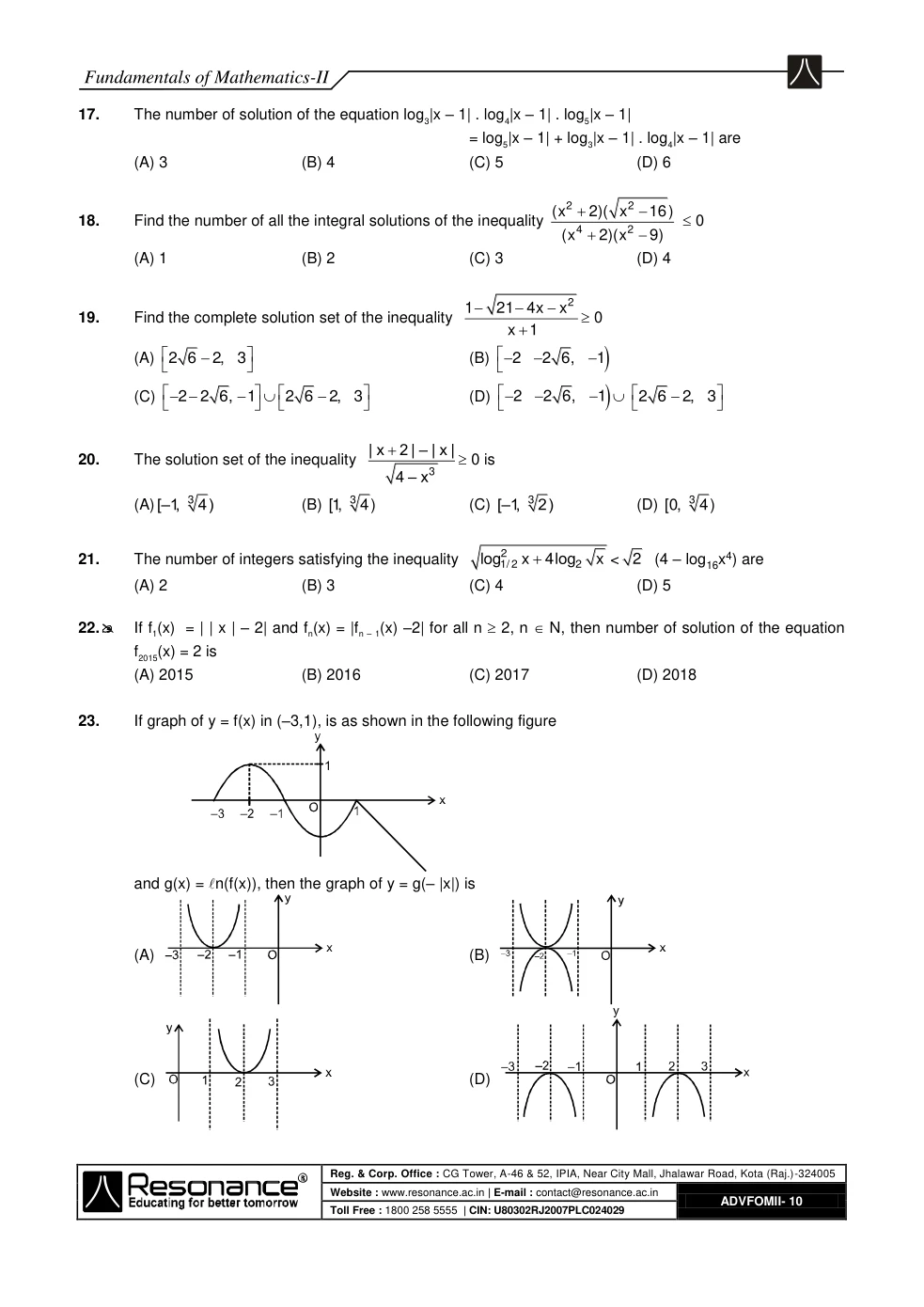
MAASFundamentals Of Mathematics Ii
© MAAS. All rights reserved.Page 10 / 18
Extracted text · page 10
Fundamentals of Mathematics-II
17. The number of solution of the equation log3|x – 1| . log4|x – 1| . log5|x – 1|
= log5|x – 1| + log3|x – 1| . log4|x – 1| are
(A) 3 (B) 4 (C) 5 (D) 6
(x 2 2)( x 2 16)
18. Find the number of all the integral solutions of the inequality 0
(x 4 2)(x 2 9)
(A) 1 (B) 2 (C) 3 (D) 4
1 21 4x x 2
19. Find the complete solution set of the inequality 0
x 1
(A) 2 6 2, 3 (B) 2 2 6, 1
(C) 2 2 6, 1 6 2, 3 (D) 2 2 6, 1 2 6 2, 3 2
| x 2 | – | x |
20. The solution set of the inequality 0 is
4 – x 3
(A) [–1, 3 4) (B) [1, 3 4) (C) [–1, 3 2) (D) [0, 3 4)
21. The number of integers satisfying the inequality log1/2 2 x 4log2 x < 2 (4 – log16x4) are
(A) 2 (B) 3 (C) 4 (D) 5
22. If f1(x) = | | x | – 2| and fn(x) = |fn – 1(x) –2| for all n 2, n N, then number of solution of the equation
f2015(x) = 2 is
(A) 2015 (B) 2016 (C) 2017 (D) 2018
23. If graph of y = f(x) in (–3,1), is as shown in the following figure
and g(x) = n(f(x)), then the graph of y = g(– |x|) is
(A) (B)
(C) (D)
ADVFOMII- 10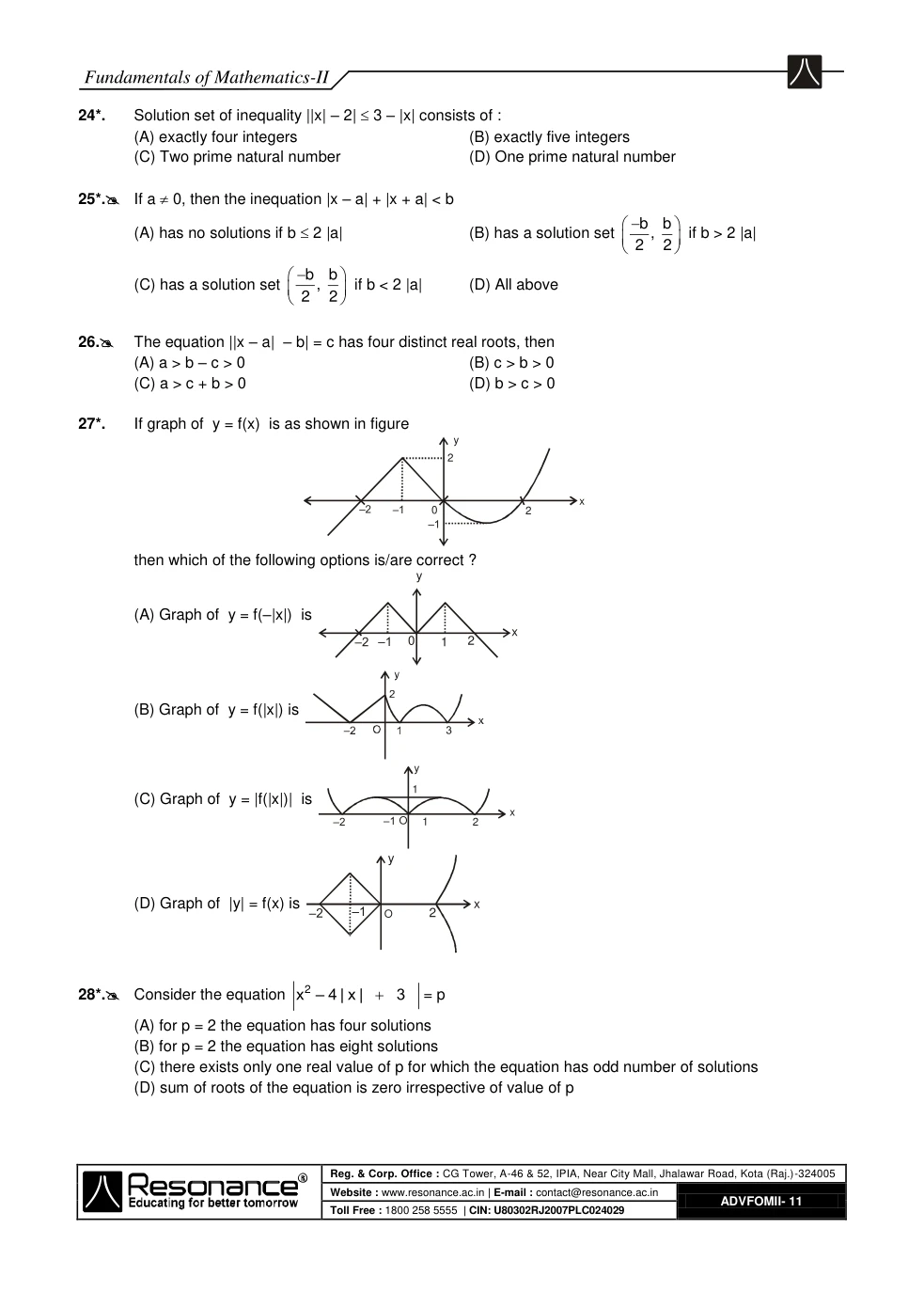
MAASFundamentals Of Mathematics Ii
© MAAS. All rights reserved.Page 11 / 18
Extracted text · page 11
Fundamentals of Mathematics-II
24*. Solution set of inequality ||x| – 2| 3 – |x| consists of :
(A) exactly four integers (B) exactly five integers
(C) Two prime natural number (D) One prime natural number
25*. If a 0, then the inequation |x – a| + |x + a| < b
b b (A) has no solutions if b 2 |a| (B) has a solution set , if b > 2 |a| 2 2
b b
(C) has a solution set , if b < 2 |a| (D) All above 2 2
26. The equation ||x – a| – b| = c has four distinct real roots, then
(A) a > b – c > 0 (B) c > b > 0
(C) a > c + b > 0 (D) b > c > 0
27*. If graph of y = f(x) is as shown in figure
y
2
x
–2 –1 0 2
–1
then which of the following options is/are correct ?
y
(A) Graph of y = f(–|x|) is
x
–2 –1 0 1 2
(B) Graph of y = f(|x|) is
y
1
(C) Graph of y = |f(|x|)| is
x
–2 –1 O 1 2
y
(D) Graph of |y| = f(x) is x
–2 –1 O 2
28*. Consider the equation x 2 – 4 | x | 3 = p
(A) for p = 2 the equation has four solutions
(B) for p = 2 the equation has eight solutions
(C) there exists only one real value of p for which the equation has odd number of solutions
(D) sum of roots of the equation is zero irrespective of value of p
ADVFOMII- 11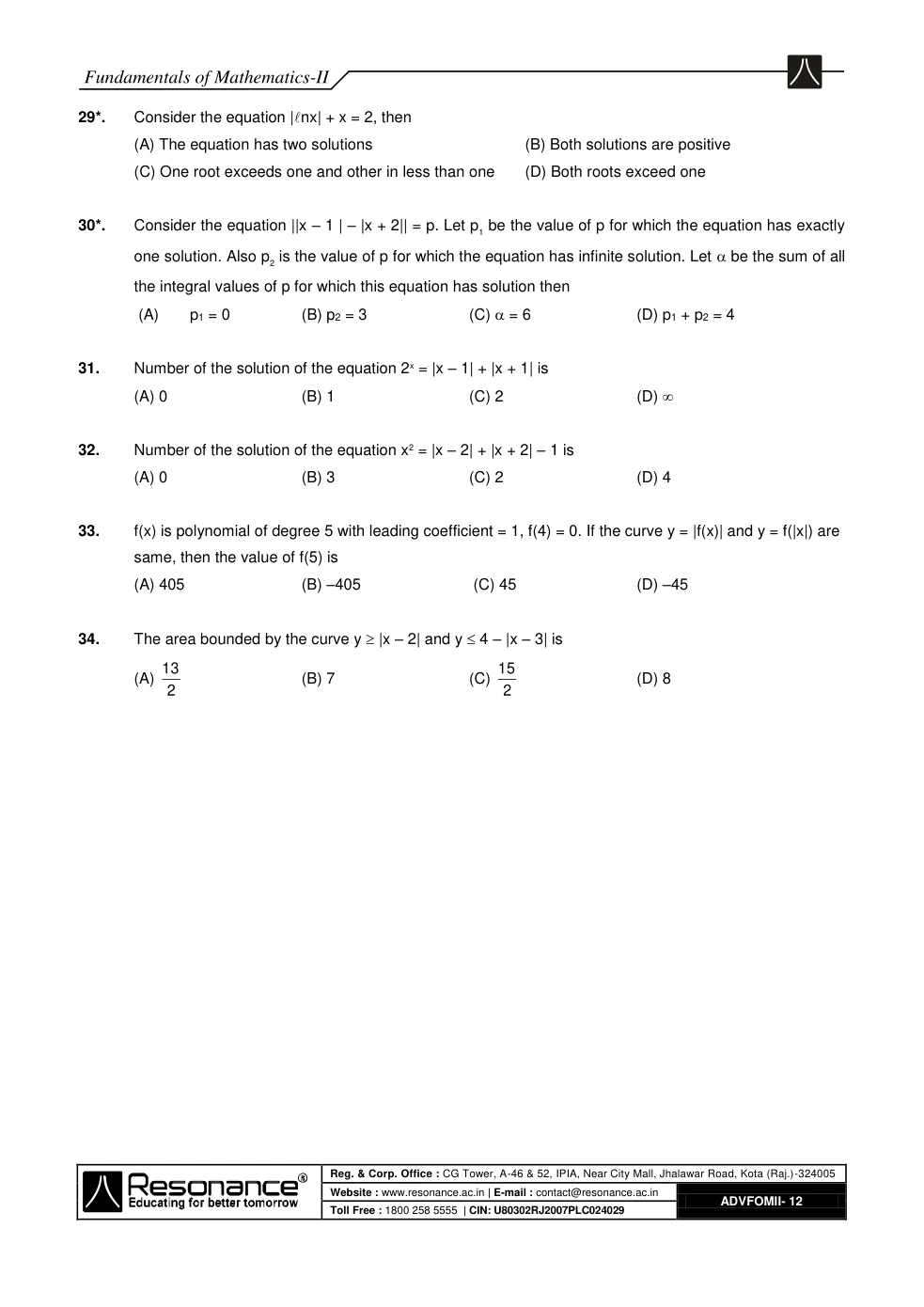
MAASFundamentals Of Mathematics Ii
© MAAS. All rights reserved.Page 12 / 18
Extracted text · page 12
Fundamentals of Mathematics-II
29*. Consider the equation |nx| + x = 2, then
(A) The equation has two solutions (B) Both solutions are positive
(C) One root exceeds one and other in less than one (D) Both roots exceed one
30*. Consider the equation ||x – 1 | – |x + 2|| = p. Let p1 be the value of p for which the equation has exactly
one solution. Also p2 is the value of p for which the equation has infinite solution. Let be the sum of all
the integral values of p for which this equation has solution then
(A) p1 = 0 (B) p2 = 3 (C) = 6 (D) p1 + p2 = 4
31. Number of the solution of the equation 2x = |x – 1| + |x + 1| is
(A) 0 (B) 1 (C) 2 (D)
32. Number of the solution of the equation x2 = |x – 2| + |x + 2| – 1 is
(A) 0 (B) 3 (C) 2 (D) 4
33. f(x) is polynomial of degree 5 with leading coefficient = 1, f(4) = 0. If the curve y = |f(x)| and y = f(|x|) are
same, then the value of f(5) is
(A) 405 (B) –405 (C) 45 (D) –45
34. The area bounded by the curve y |x – 2| and y 4 – |x – 3| is
13 15
(A) (B) 7 (C) (D) 8
2 2
ADVFOMII- 12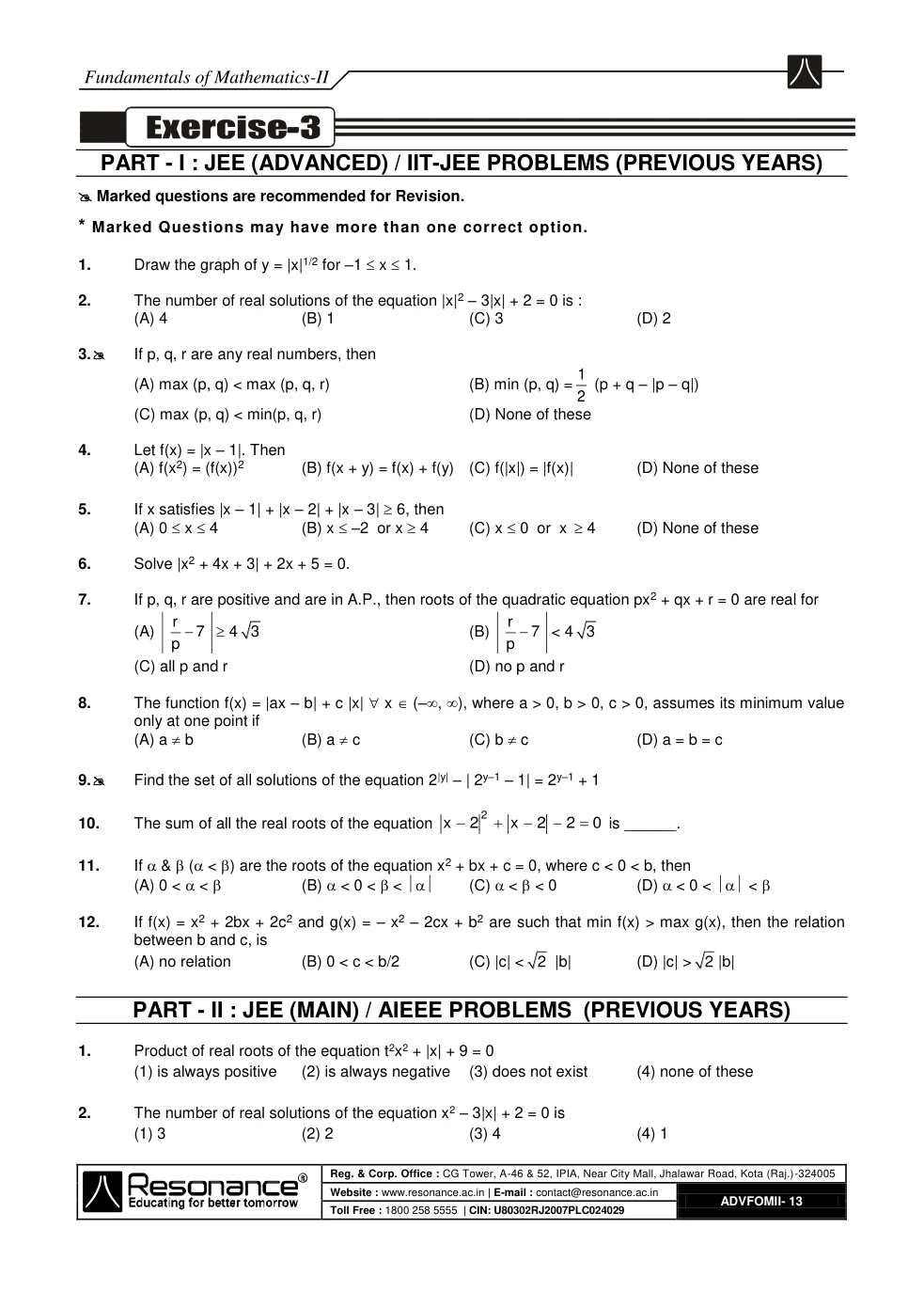
MAASFundamentals Of Mathematics Ii
© MAAS. All rights reserved.Page 13 / 18
Extracted text · page 13
Fundamentals of Mathematics-II
PART - I : JEE (ADVANCED) / IIT-JEE PROBLEMS (PREVIOUS YEARS)
Marked questions are recommended for Revision.
* Marked Questions may have more than one correct option.
1. Draw the graph of y = |x|1/2 for –1 x 1.
2. The number of real solutions of the equation |x|2 – 3|x| + 2 = 0 is :
(A) 4 (B) 1 (C) 3 (D) 2
3. If p, q, r are any real numbers, then
1
(A) max (p, q) < max (p, q, r) (B) min (p, q) = (p + q – |p – q|)
2
(C) max (p, q) < min(p, q, r) (D) None of these
4. Let f(x) = |x – 1|. Then
(A) f(x2) = (f(x))2 (B) f(x + y) = f(x) + f(y) (C) f(|x|) = |f(x)| (D) None of these
5. If x satisfies |x – 1| + |x – 2| + |x – 3| 6, then
(A) 0 x 4 (B) x –2 or x 4 (C) x 0 or x 4 (D) None of these
6. Solve |x2 + 4x + 3| + 2x + 5 = 0.
7. If p, q, r are positive and are in A.P., then roots of the quadratic equation px2 + qx + r = 0 are real for
r r
(A) 7 4 3 (B) 7 < 4 3
p p
(C) all p and r (D) no p and r
8. The function f(x) = |ax – b| + c |x| x (–, ), where a > 0, b > 0, c > 0, assumes its minimum value
only at one point if
(A) a b (B) a c (C) b c (D) a = b = c
9. Find the set of all solutions of the equation 2|y| – | 2y–1 – 1| = 2y–1 + 1
2
10. The sum of all the real roots of the equation x 2 x 2 2 0 is ______.
11. If & ( < ) are the roots of the equation x2 + bx + c = 0, where c < 0 < b, then
(A) 0 < < (B) < 0 < < (C) < < 0 (D) < 0 < <
12. If f(x) = x2 + 2bx + 2c2 and g(x) = – x2 – 2cx + b2 are such that min f(x) > max g(x), then the relation
between b and c, is
(A) no relation (B) 0 < c < b/2 (C) |c| < 2 |b| (D) |c| > 2 |b|
PART - II : JEE (MAIN) / AIEEE PROBLEMS (PREVIOUS YEARS)
1. Product of real roots of the equation t2x2 + |x| + 9 = 0
(1) is always positive (2) is always negative (3) does not exist (4) none of these
2. The number of real solutions of the equation x2 – 3|x| + 2 = 0 is
(1) 3 (2) 2 (3) 4 (4) 1
ADVFOMII- 13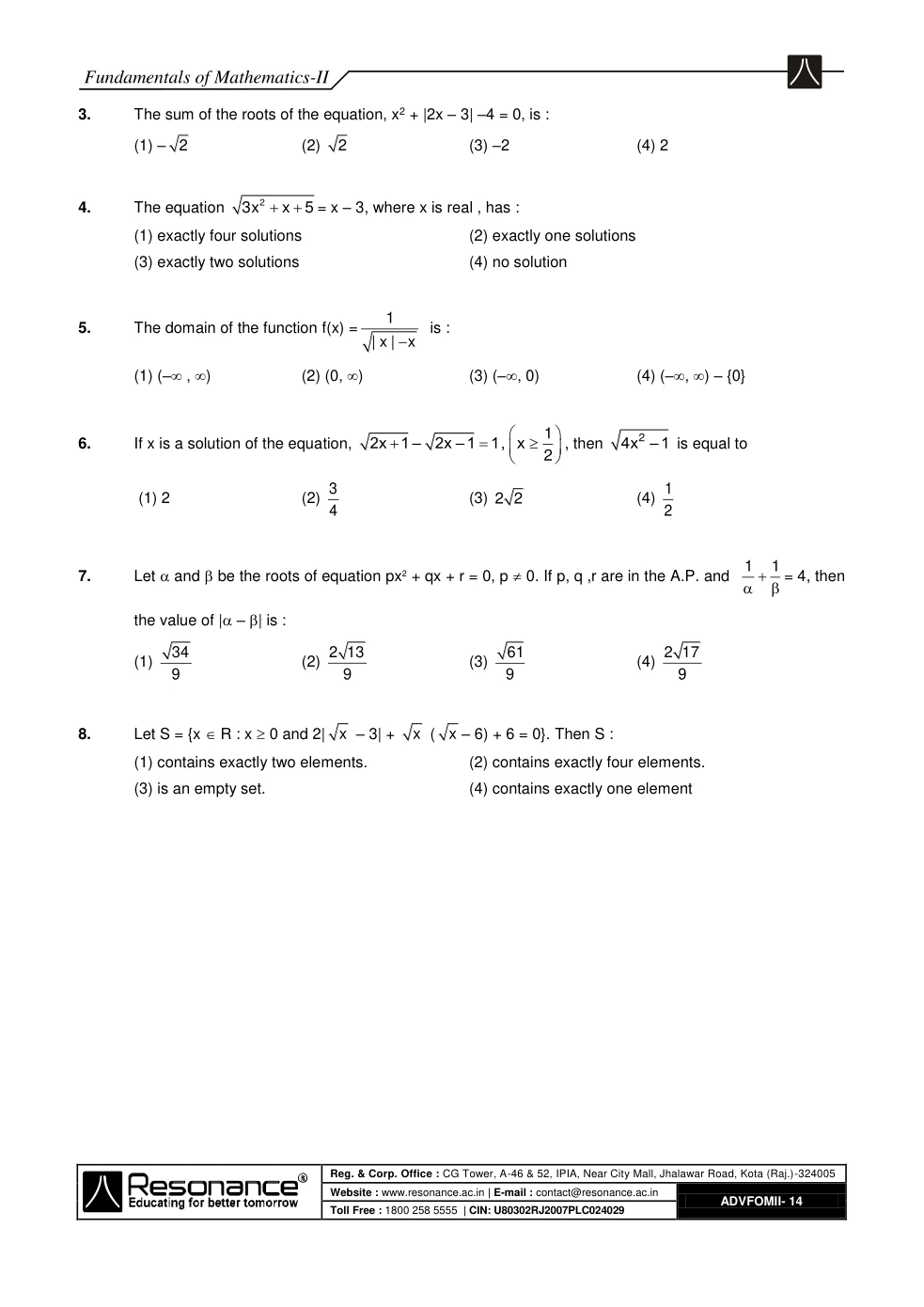
MAASFundamentals Of Mathematics Ii
© MAAS. All rights reserved.Page 14 / 18
Extracted text · page 14
Fundamentals of Mathematics-II
3. The sum of the roots of the equation, x2 + |2x – 3| –4 = 0, is :
(1) – 2 (2) 2 (3) –2 (4) 2
4. The equation 3x 2 x 5 = x – 3, where x is real , has :
(1) exactly four solutions (2) exactly one solutions
(3) exactly two solutions (4) no solution
1
5. The domain of the function f(x) = is :
| x | x
(1) (– , ) (2) (0, ) (3) (–, 0) (4) (–, ) – {0}
1 26. If x is a solution of the equation, 2x 1 – 2x –1 1, x , then 4x –1 is equal to 2
3 1
(1) 2 (2) (3) 2 2 (4)
4 2
1 1
7. Let and be the roots of equation px2 + qx + r = 0, p 0. If p, q ,r are in the A.P. and 4, then =
the value of | – | is :
34 2 13 61 2 17
(1) (2) (3) (4)
9 9 9 9
8. Let S = {x R : x 0 and 2| x – 3| + x ( x – 6) + 6 = 0}. Then S :
(1) contains exactly two elements. (2) contains exactly four elements.
(3) is an empty set. (4) contains exactly one element
ADVFOMII- 14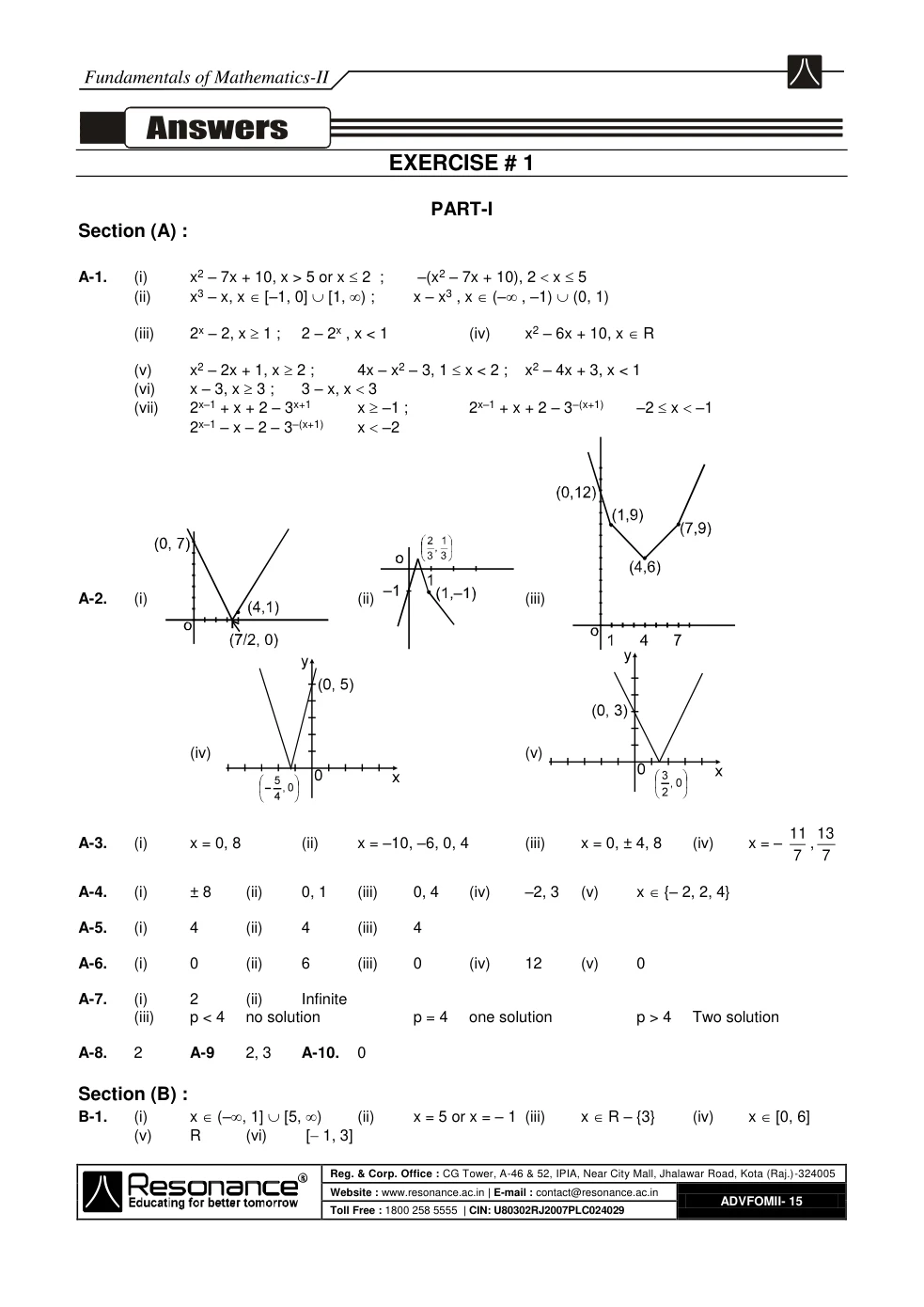
MAASFundamentals Of Mathematics Ii
© MAAS. All rights reserved.Page 15 / 18
Extracted text · page 15
Fundamentals of Mathematics-II
EXERCISE # 1
PART-I
Section (A) :
A-1. (i) x2 – 7x + 10, x > 5 or x 2 ; –(x2 – 7x + 10), 2 x 5
(ii) x3 – x, x [–1, 0] [1, ) ; x – x3 , x (– , –1) (0, 1)
(iii) 2x – 2, x 1 ; 2 – 2x , x < 1 (iv) x2 – 6x + 10, x R
(v) x2 – 2x + 1, x 2 ; 4x – x2 – 3, 1 x < 2 ; x2 – 4x + 3, x < 1
(vi) x – 3, x 3 ; 3 – x, x 3
(vii) 2x–1 + x + 2 – 3x+1 x –1 ; 2x–1 + x + 2 – 3–(x+1) –2 x –1
2x–1 – x – 2 – 3–(x+1) x –2
A-2. (i) (ii) (iii)
(iv) (v)
11 13
A-3. (i) x = 0, 8 (ii) x = –10, –6, 0, 4 (iii) x = 0, ± 4, 8 (iv) x = – ,
7 7
A-4. (i) ± 8 (ii) 0, 1 (iii) 0, 4 (iv) –2, 3 (v) x {– 2, 2, 4}
A-5. (i) 4 (ii) 4 (iii) 4
A-6. (i) 0 (ii) 6 (iii) 0 (iv) 12 (v) 0
A-7. (i) 2 (ii) Infinite
(iii) p < 4 no solution p = 4 one solution p > 4 Two solution
A-8. 2 A-9 2, 3 A-10. 0
Section (B) :
B-1. (i) x (–, 1] [5, ) (ii) x = 5 or x = – 1 (iii) x R – {3} (iv) x [0, 6]
(v) R (vi) [ 1, 3]
ADVFOMII- 15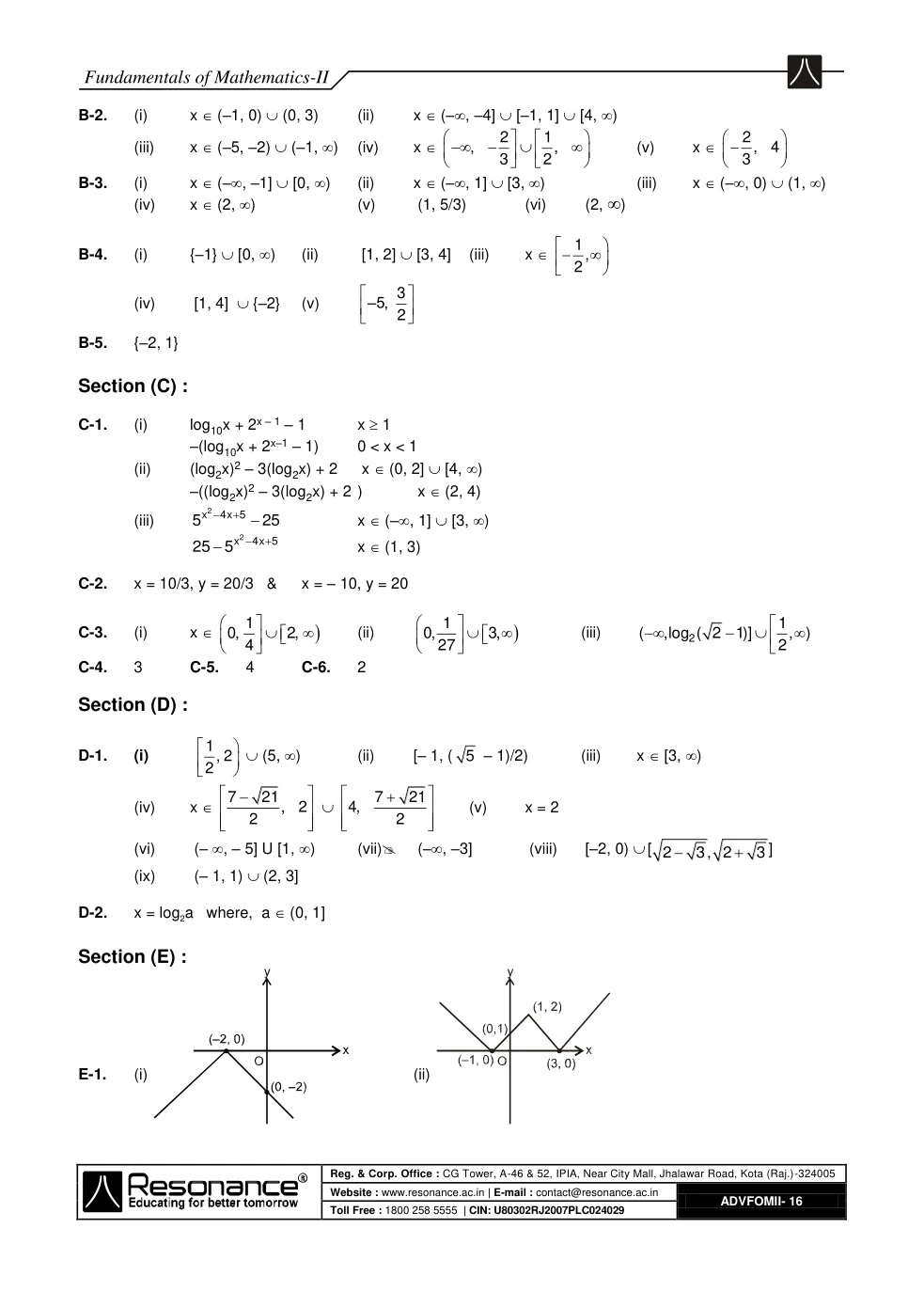
MAASFundamentals Of Mathematics Ii
© MAAS. All rights reserved.Page 16 / 18
Extracted text · page 16
Fundamentals of Mathematics-II
B-2. (i) x (–1, 0) (0, 3) (ii) x (–, –4] [–1, 1] [4, )
2 1 (iii) x (–5, –2) (–1, ) (iv) x , , (v) x 2, 4 3 2 3
B-3. (i) x (–, –1] [0, ) (ii) x (–, 1] [3, ) (iii) x (–, 0) (1, )
(iv) x (2, ) (v) (1, 5/3) (vi) (2, )
B-4. (i) {–1} [0, ) (ii) [1, 2] [3, 4] (iii) x 1, 2
3 (iv) [1, 4] {–2} (v) –5, 2
B-5. {–2, 1}
Section (C) :
C-1. (i) log10x + 2x – 1 – 1 x 1
–(log10x + 2x–1 – 1) 0 < x < 1
(ii) (log2x)2 – 3(log2x) + 2 x (0, 2] [4, )
–((log2x)2 – 3(log2x) + 2 ) x (2, 4)
x 2 4x 5 (iii) 5 25 x (–, 1] [3, )
x 2 4x 5 25 5 x (1, 3)
C-2. x = 10/3, y = 20/3 & x = – 10, y = 20
1 1 1 3, (iii) ( ,log2 ( 2 1)] , )C-3. (i) x 0, 2, (ii) 0, 4 27 2
C-4. 3 C-5. 4 C-6. 2
Section (D) :
D-1. (i) 1, 2 (5, ) (ii) [– 1, ( 5 – 1)/2) (iii) x [3, )
2
7 21 (iv) x 7 21, 2 4, (v) x = 2
2 2
(vi) (– , – 5] U [1, ) (vii) (–, –3] (viii) [–2, 0) [ 2 3, 2 3 ]
(ix) (– 1, 1) (2, 3]
D-2. x = log2a where, a (0, 1]
Section (E) :
E-1. (i) (ii)
ADVFOMII- 16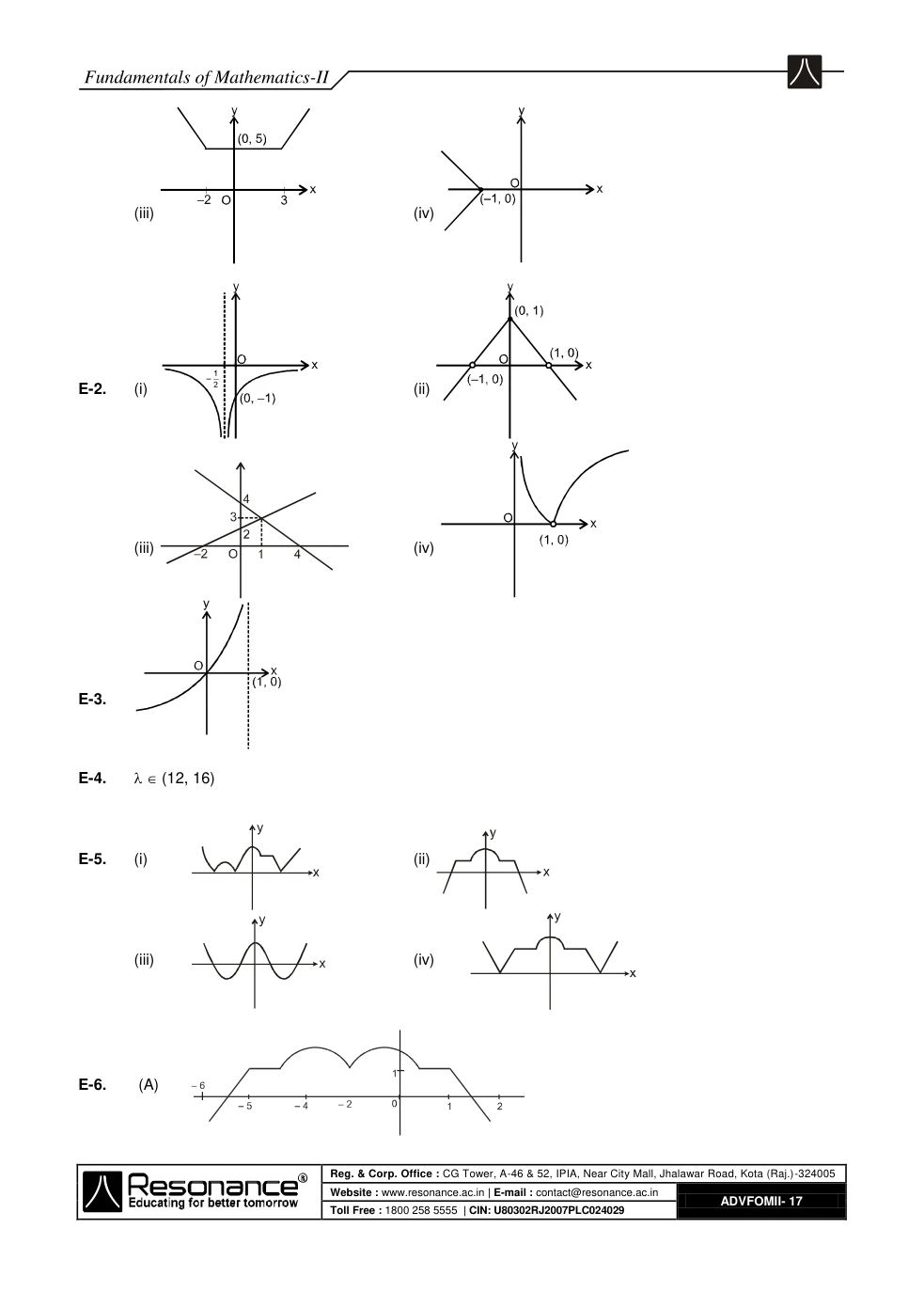
MAASFundamentals Of Mathematics Ii
© MAAS. All rights reserved.Page 17 / 18
Extracted text · page 17
Fundamentals of Mathematics-II
(iii) (iv)
E-2. (i) (ii)
(iii) (iv)
E-3.
E-4. (12, 16)
E-5. (i) (ii)
(iii) (iv)
E-6. (A)
ADVFOMII- 17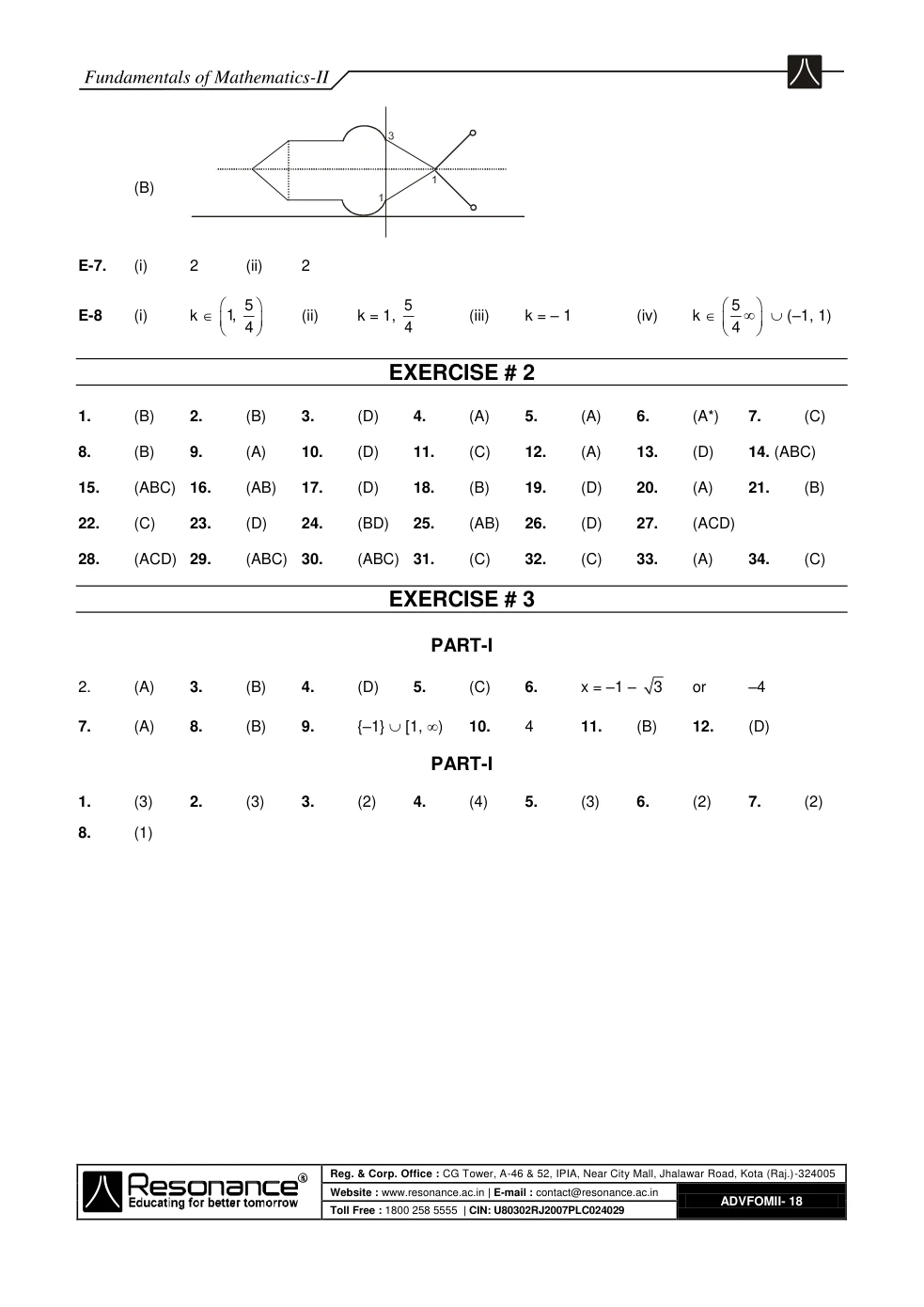
MAASFundamentals Of Mathematics Ii
© MAAS. All rights reserved.Page 18 / 18
Extracted text · page 18
Fundamentals of Mathematics-II
(B)
E-7. (i) 2 (ii) 2
5 5 5 E-8 (i) k 1, (ii) k = 1, (iii) k = – 1 (iv) k (–1, 1) 4 4 4
EXERCISE # 2
1. (B) 2. (B) 3. (D) 4. (A) 5. (A) 6. (A*) 7. (C)
8. (B) 9. (A) 10. (D) 11. (C) 12. (A) 13. (D) 14. (ABC)
15. (ABC) 16. (AB) 17. (D) 18. (B) 19. (D) 20. (A) 21. (B)
22. (C) 23. (D) 24. (BD) 25. (AB) 26. (D) 27. (ACD)
28. (ACD) 29. (ABC) 30. (ABC) 31. (C) 32. (C) 33. (A) 34. (C)
EXERCISE # 3
PART-I
2. (A) 3. (B) 4. (D) 5. (C) 6. x = –1 – 3 or –4
7. (A) 8. (B) 9. {–1} [1, ) 10. 4 11. (B) 12. (D)
PART-I
1. (3) 2. (3) 3. (2) 4. (4) 5. (3) 6. (2) 7. (2)
8. (1)
ADVFOMII- 18