Visual-fidelity edition: source-page equations, diagrams and charts are preserved as page images. Text transcripts are provided where extractable. The original source may contain markings within the artwork.
MAASSequence And Series
© MAAS. All rights reserved.Page 1 / 34
Extracted text · page 1
Sequence and Series
"1729 is a very interesting number; it is the smallest number expressible as the sum of two cubes in two different ways." ...... S.Ramanujan
Sequence :
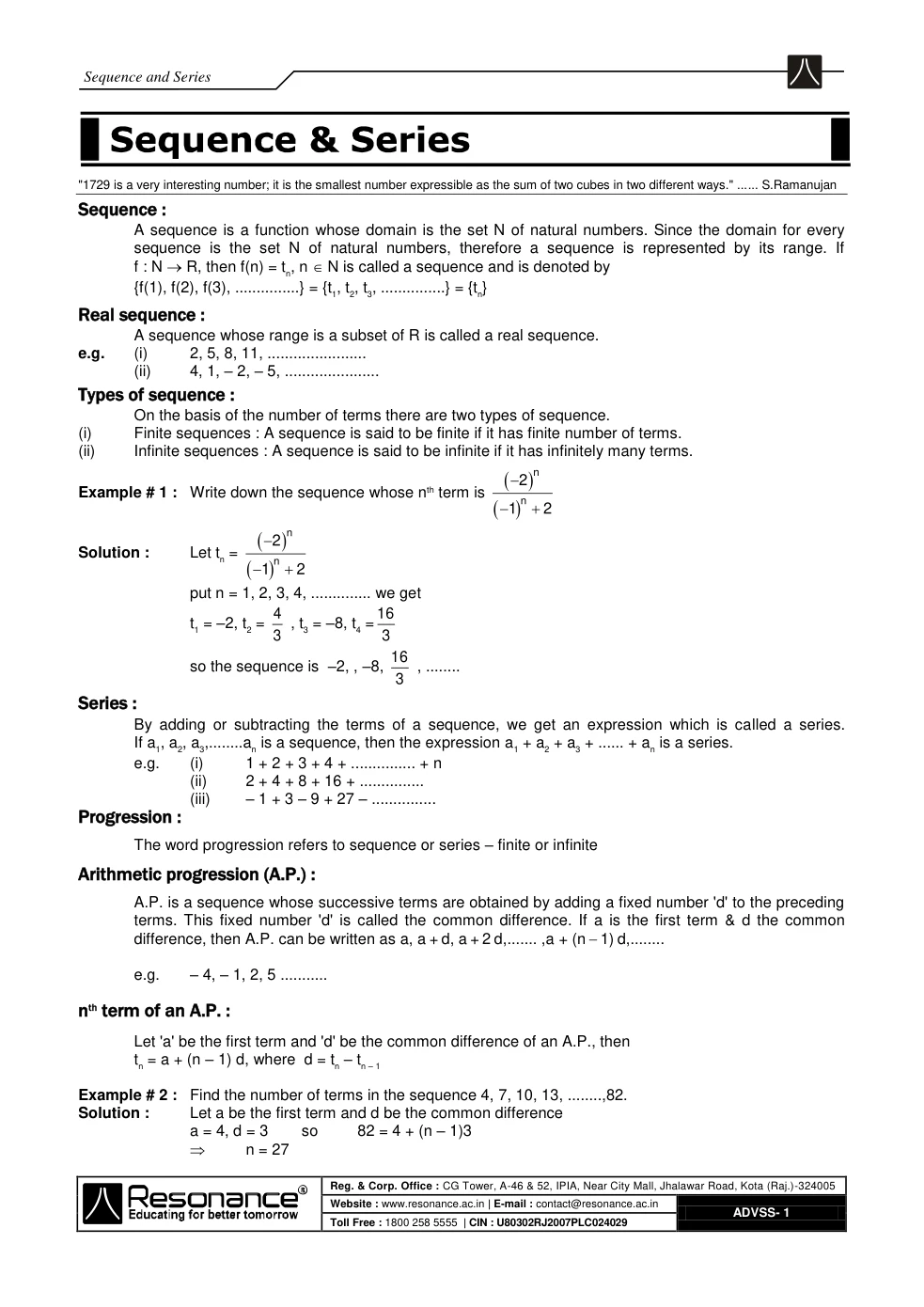
A sequence is a function whose domain is the set N of natural numbers. Since the domain for every
sequence is the set N of natural numbers, therefore a sequence is represented by its range. If
f : N R, then f(n) = tn, n N is called a sequence and is denoted by
{f(1), f(2), f(3), ...............} = {t1, t2, t3, ...............} = {tn}
Real sequence :
A sequence whose range is a subset of R is called a real sequence.
e.g. (i) 2, 5, 8, 11, .......................
(ii) 4, 1, – 2, – 5, ......................
Types of sequence :
On the basis of the number of terms there are two types of sequence.
(i) Finite sequences : A sequence is said to be finite if it has finite number of terms.
(ii) Infinite sequences : A sequence is said to be infinite if it has infinitely many terms.
2 n
Example # 1 : Write down the sequence whose nth term is
1n 2
2 n
Solution : Let tn = n 1 2
put n = 1, 2, 3, 4, .............. we get
4 16
t1 = –2, t2 = , t3 = –8, t4 =
3 3
16
so the sequence is –2, , –8, , ........
3
Series :
By adding or subtracting the terms of a sequence, we get an expression which is called a series.
If a1, a2, a3,........an is a sequence, then the expression a1 + a2 + a3 + ...... + an is a series.
e.g. (i) 1 + 2 + 3 + 4 + ............... + n
(ii) 2 + 4 + 8 + 16 + ...............
(iii) – 1 + 3 – 9 + 27 – ...............
Progression :
The word progression refers to sequence or series – finite or infinite
Arithmetic progression (A.P.) :
A.P. is a sequence whose successive terms are obtained by adding a fixed number 'd' to the preceding
terms. This fixed number 'd' is called the common difference. If a is the first term & d the common
difference, then A.P. can be written as a, a + d, a + 2 d,....... ,a + (n 1) d,........
e.g. – 4, – 1, 2, 5 ...........
nth term of an A.P. :
Let 'a' be the first term and 'd' be the common difference of an A.P., then
tn = a + (n – 1) d, where d = tn – tn – 1
Example # 2 : Find the number of terms in the sequence 4, 7, 10, 13, ........,82.
Solution : Let a be the first term and d be the common difference
a = 4, d = 3 so 82 = 4 + (n – 1)3
n = 27
ADVSS- 1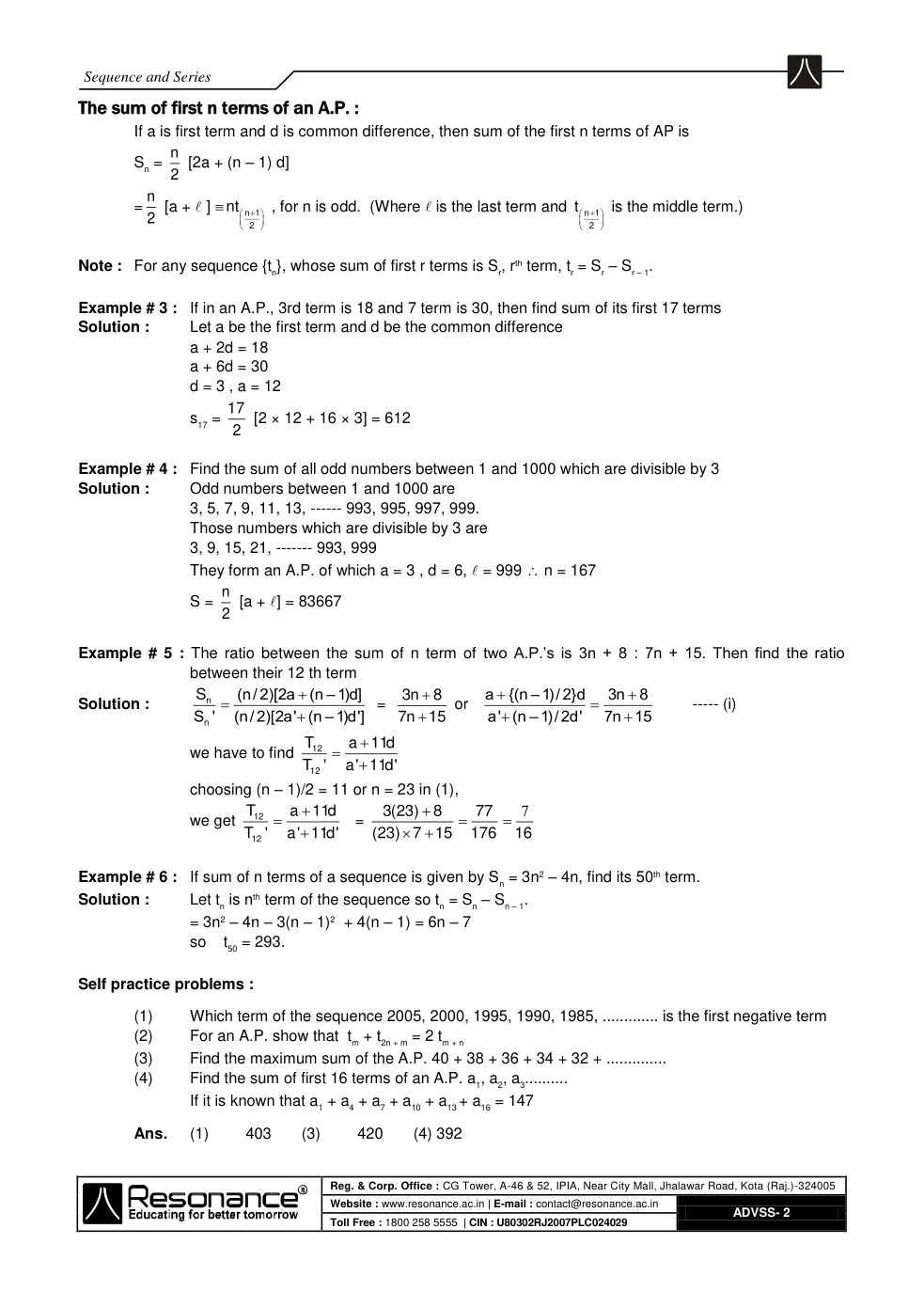
MAASSequence And Series
© MAAS. All rights reserved.Page 2 / 34
Extracted text · page 2
Sequence and Series
The sum of first n terms of an A.P. :
If a is first term and d is common difference, then sum of the first n terms of AP is
n
Sn = [2a + (n – 1) d]
2
n
= [a + ] nt n 1 , for n is odd. (Where is the last term and t n 1 is the middle term.)
2 2 2
Note : For any sequence {tn}, whose sum of first r terms is Sr, rth term, tr = Sr – Sr – 1.
Example # 3 : If in an A.P., 3rd term is 18 and 7 term is 30, then find sum of its first 17 terms
Solution : Let a be the first term and d be the common difference
a + 2d = 18
a + 6d = 30
d = 3 , a = 12
17
s17 = [2 × 12 + 16 × 3] = 612
2
Example # 4 : Find the sum of all odd numbers between 1 and 1000 which are divisible by 3
Solution : Odd numbers between 1 and 1000 are
3, 5, 7, 9, 11, 13, ------ 993, 995, 997, 999.
Those numbers which are divisible by 3 are
3, 9, 15, 21, ------- 993, 999
They form an A.P. of which a = 3 , d = 6, = 999 n = 167
n
S = [a + ] = 83667
2
Example # 5 : The ratio between the sum of n term of two A.P.’s is 3n + 8 : 7n + 15. Then find the ratio
between their 12 th term
Sn (n/2)[2a (n –1)d] 3n 8 a {(n –1)/2}d 3n 8Solution : = or ----- (i)
Sn ' (n/2)[2a' (n –1)d'] 7n 15 a' (n –1)/2d' 7n 15
T12 a 11d we have to find
T12 ' a' 11d'
choosing (n – 1)/2 = 11 or n = 23 in (1),
T12 a 11d 3(23) 8 77 we get =
T12 ' a' 11d' (23) 7 15 176 16
Example # 6 : If sum of n terms of a sequence is given by Sn = 3n2 – 4n, find its 50th term.
Solution : Let tn is nth term of the sequence so tn = Sn – Sn – 1.
= 3n2 – 4n – 3(n – 1)2 + 4(n – 1) = 6n – 7
so t50 = 293.
Self practice problems :
(1) Which term of the sequence 2005, 2000, 1995, 1990, 1985, ............. is the first negative term
(2) For an A.P. show that tm + t2n + m = 2 tm + n
(3) Find the maximum sum of the A.P. 40 + 38 + 36 + 34 + 32 + ..............
(4) Find the sum of first 16 terms of an A.P. a1, a2, a3..........
If it is known that a1 + a4 + a7 + a10 + a13 + a16 = 147
Ans. (1) 403 (3) 420 (4) 392
ADVSS- 2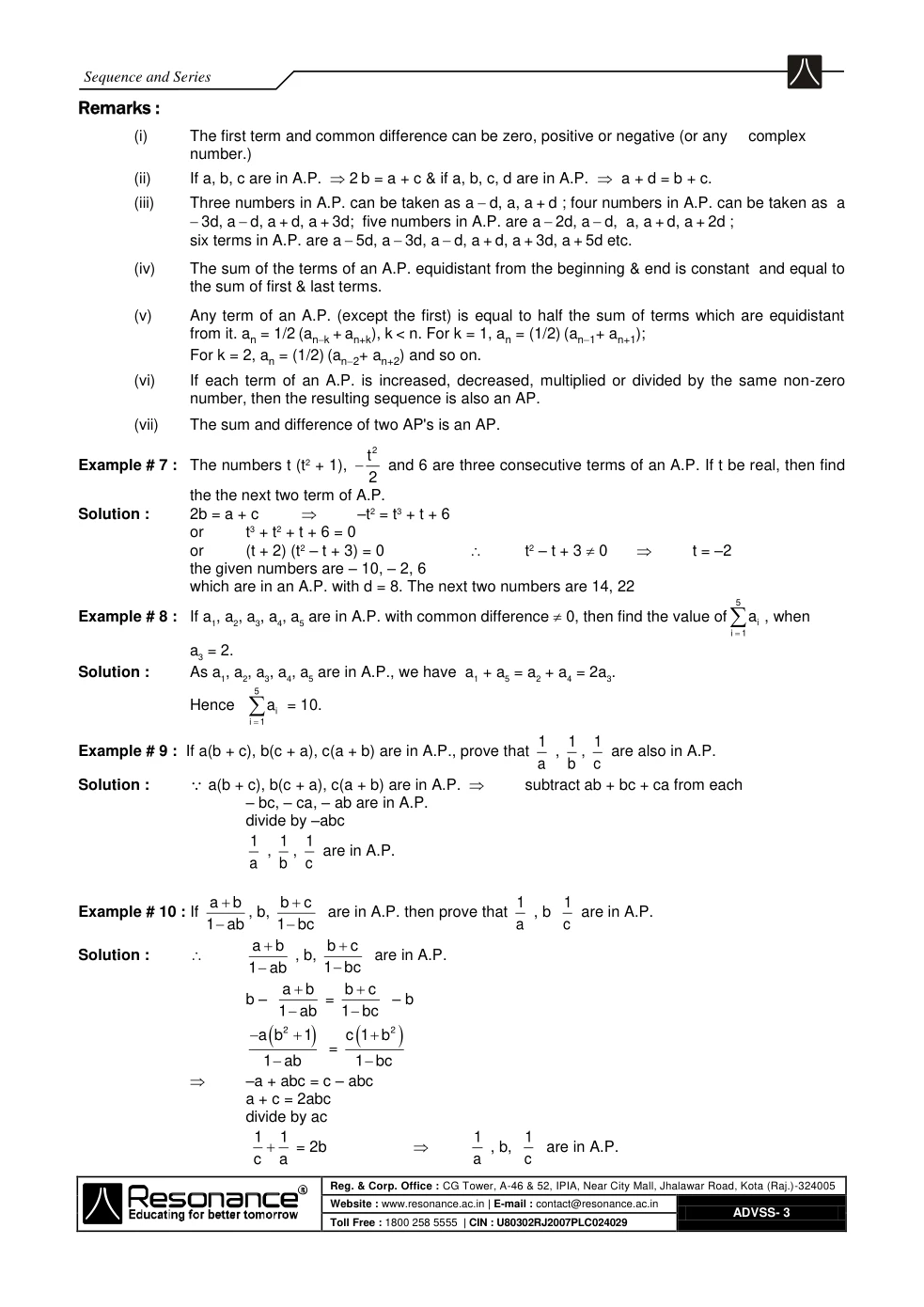
MAASSequence And Series
© MAAS. All rights reserved.Page 3 / 34
Extracted text · page 3
Sequence and Series
Remarks :
(i) The first term and common difference can be zero, positive or negative (or any complex
number.)
(ii) If a, b, c are in A.P. 2 b = a + c & if a, b, c, d are in A.P. a + d = b + c.
(iii) Three numbers in A.P. can be taken as a d, a, a + d ; four numbers in A.P. can be taken as a
3d, a d, a + d, a + 3d; five numbers in A.P. are a 2d, a d, a, a + d, a + 2d ;
six terms in A.P. are a 5d, a 3d, a d, a + d, a + 3d, a + 5d etc.
(iv) The sum of the terms of an A.P. equidistant from the beginning & end is constant and equal to
the sum of first & last terms.
(v) Any term of an A.P. (except the first) is equal to half the sum of terms which are equidistant
from it. an = 1/2 (ank + an+k), k < n. For k = 1, an = (1/2) (an1+ an+1);
For k = 2, an = (1/2) (an2+ an+2) and so on.
(vi) If each term of an A.P. is increased, decreased, multiplied or divided by the same non-zero
number, then the resulting sequence is also an AP.
(vii) The sum and difference of two AP's is an AP.
2t
Example # 7 : The numbers t (t2 + 1), and 6 are three consecutive terms of an A.P. If t be real, then find
2
the the next two term of A.P.
Solution : 2b = a + c –t2 = t3 + t + 6
or t3 + t2 + t + 6 = 0
or (t + 2) (t2 – t + 3) = 0 t2 – t + 3 0 t = –2
the given numbers are – 10, – 2, 6
which are in an A.P. with d = 8. The next two numbers are 14, 22
5
Example # 8 : If a1, a2, a3, a4, a5 are in A.P. with common difference 0, then find the value of i 1 a i , when
a3 = 2.
Solution : As a1, a2, a3, a4, a5 are in A.P., we have a1 + a5 = a2 + a4 = 2a3.
5
Hence a i = 10. i 1
1 1 1
Example # 9 : If a(b + c), b(c + a), c(a + b) are in A.P., prove that , , are also in A.P.
a b c
Solution : a(b + c), b(c + a), c(a + b) are in A.P. subtract ab + bc + ca from each
– bc, – ca, – ab are in A.P.
divide by –abc
1 1 1
, , are in A.P.
a b c
a b b c 1 1
Example # 10 : If , b, are in A.P. then prove that , b are in A.P.
1 ab 1 bc a c
a b b c
Solution : , b, are in A.P.
1 ab 1 bc
a b b c
b – = – b
1 ab 1 bc
2 a b 2 1 c 1 b
=
1 ab 1 bc
–a + abc = c – abc
a + c = 2abc
divide by ac
1 1 1 1
= 2b , b, are in A.P.
c a a c
ADVSS- 3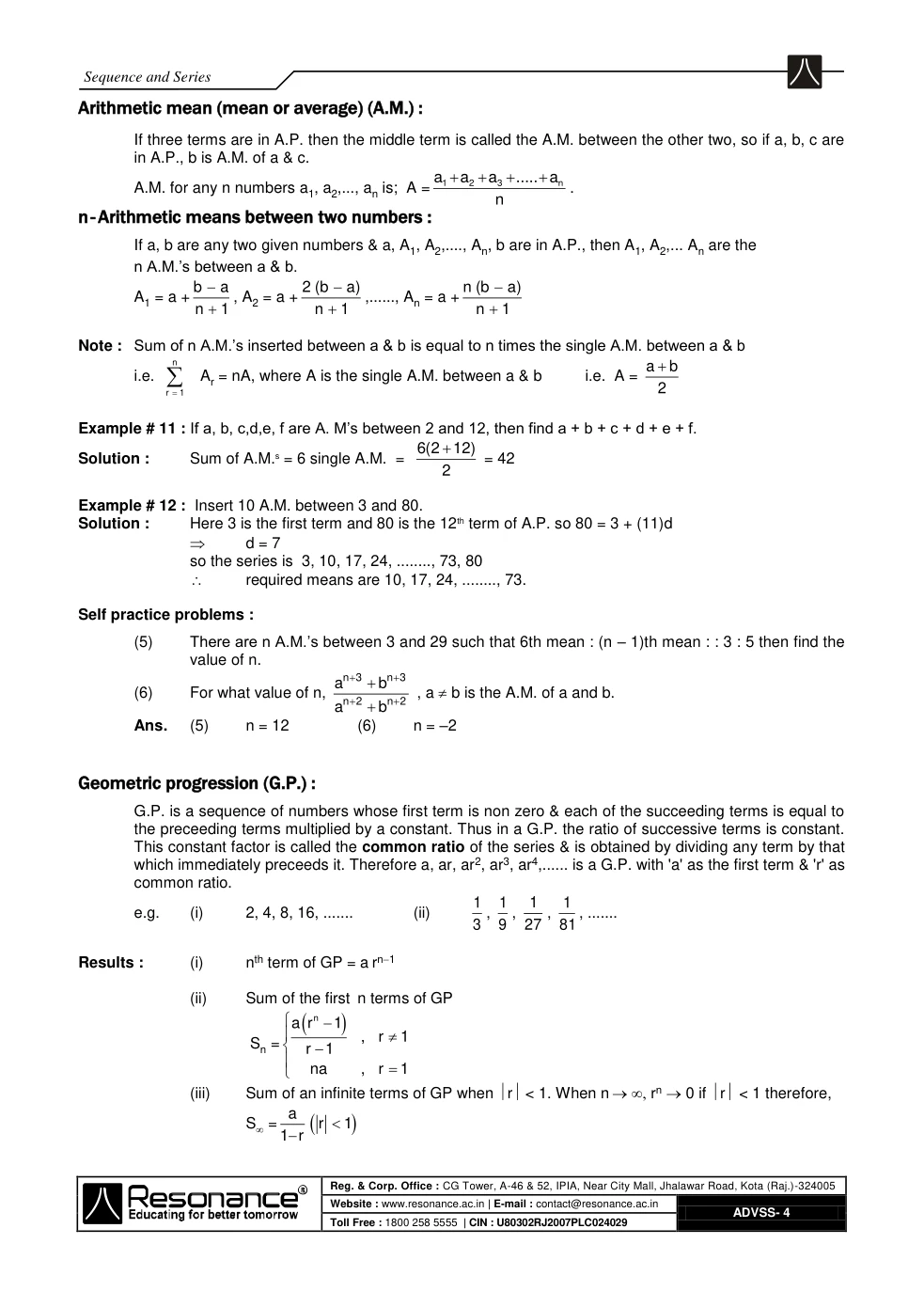
MAASSequence And Series
© MAAS. All rights reserved.Page 4 / 34
Extracted text · page 4
Sequence and Series
Arithmetic mean (mean or average) (A.M.) :
If three terms are in A.P. then the middle term is called the A.M. between the other two, so if a, b, c are
in A.P., b is A.M. of a & c.
a1 a 2 a 3 ..... an
A.M. for any n numbers a1, a2,..., an is; A = . n
n - Arithmetic means between two numbers :
If a, b are any two given numbers & a, A1, A2,...., An, b are in A.P., then A1, A2,... An are the
n A.M.’s between a & b.
b a 2 (b a) n (b a)
A1 = a + , A2 = a + ,......, An = a + n 1 n 1 n 1
Note : Sum of n A.M.’s inserted between a & b is equal to n times the single A.M. between a & b
n a b
i.e. Ar = nA, where A is the single A.M. between a & b i.e. A = r1 2
Example # 11 : If a, b, c,d,e, f are A. M’s between 2 and 12, then find a + b + c + d + e + f.
6(2 12)
Solution : Sum of A.M.s = 6 single A.M. = = 42
2
Example # 12 : Insert 10 A.M. between 3 and 80.
Solution : Here 3 is the first term and 80 is the 12th term of A.P. so 80 = 3 + (11)d
d = 7
so the series is 3, 10, 17, 24, ........, 73, 80
required means are 10, 17, 24, ........, 73.
Self practice problems :
(5) There are n A.M.’s between 3 and 29 such that 6th mean : (n – 1)th mean : : 3 : 5 then find the
value of n.
an 3 bn 3
(6) For what value of n, , a b is the A.M. of a and b.
an 2 bn 2
Ans. (5) n = 12 (6) n = –2
Geometric progression (G.P.) :
G.P. is a sequence of numbers whose first term is non zero & each of the succeeding terms is equal to
the preceeding terms multiplied by a constant. Thus in a G.P. the ratio of successive terms is constant.
This constant factor is called the common ratio of the series & is obtained by dividing any term by that
which immediately preceeds it. Therefore a, ar, ar2, ar3, ar4,...... is a G.P. with 'a' as the first term & 'r' as
common ratio.
1 1 1 1
e.g. (i) 2, 4, 8, 16, ....... (ii) , , , , .......
3 9 27 81
Results : (i) nth term of GP = a rn1
(ii) Sum of the first n terms of GP
a r n 1 , r 1
Sn = r 1
na , r 1
(iii) Sum of an infinite terms of GP when r < 1. When n rn 0 if r < 1 therefore,
a S = r 1 1 r
ADVSS- 4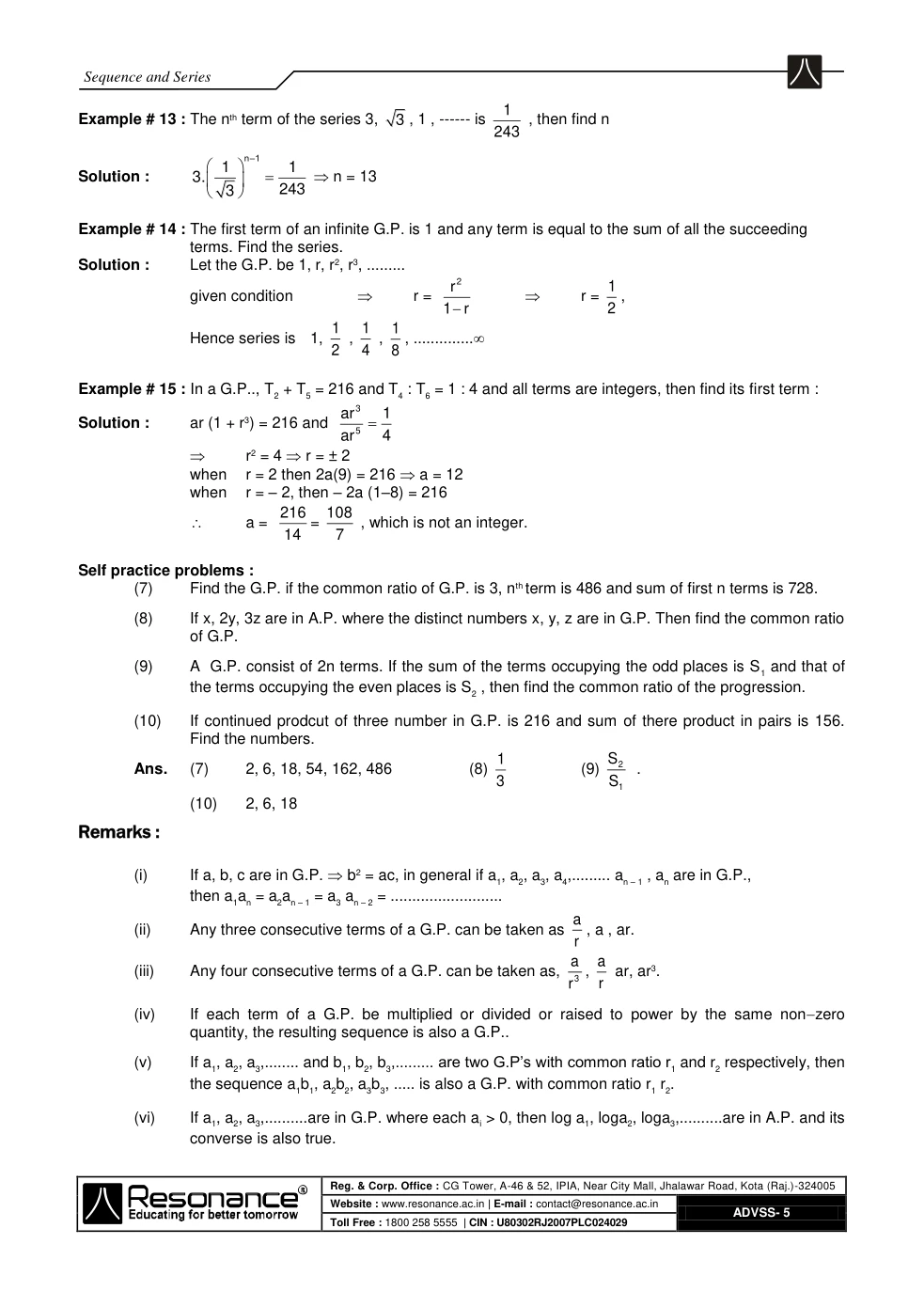
MAASSequence And Series
© MAAS. All rights reserved.Page 5 / 34
Extracted text · page 5
Sequence and Series
1
Example # 13 : The nth term of the series 3, 3 , 1 , ------ is , then find n
243
1 n–1 1
Solution : 3. n = 13
3 243
Example # 14 : The first term of an infinite G.P. is 1 and any term is equal to the sum of all the succeeding
terms. Find the series.
Solution : Let the G.P. be 1, r, r2, r3, .........
2r 1
given condition r = r = ,
1 r 2
1 1 1
Hence series is 1, , , , ..............
2 4 8
Example # 15 : In a G.P.., T2 + T5 = 216 and T4 : T6 = 1 : 4 and all terms are integers, then find its first term :
ar 3 1
Solution : ar (1 + r3) = 216 and 5 ar 4
r2 = 4 r = ± 2
when r = 2 then 2a(9) = 216 a = 12
when r = – 2, then – 2a (1–8) = 216
216 108
a = = , which is not an integer.
14 7
Self practice problems :
(7) Find the G.P. if the common ratio of G.P. is 3, nth term is 486 and sum of first n terms is 728.
(8) If x, 2y, 3z are in A.P. where the distinct numbers x, y, z are in G.P. Then find the common ratio
of G.P.
(9) A G.P. consist of 2n terms. If the sum of the terms occupying the odd places is S1 and that of
the terms occupying the even places is S2 , then find the common ratio of the progression.
(10) If continued prodcut of three number in G.P. is 216 and sum of there product in pairs is 156.
Find the numbers.
1 S 2 Ans. (7) 2, 6, 18, 54, 162, 486 (8) (9) .
3 S1
(10) 2, 6, 18
Remarks :
(i) If a, b, c are in G.P. b2 = ac, in general if a1, a2, a3, a4,......... an – 1 , an are in G.P.,
then a1an = a2an – 1 = a3 an – 2 = ..........................
a
(ii) Any three consecutive terms of a G.P. can be taken as , a , ar.
r
a a
(iii) Any four consecutive terms of a G.P. can be taken as, 3 , ar, ar3. r r
(iv) If each term of a G.P. be multiplied or divided or raised to power by the same nonzero
quantity, the resulting sequence is also a G.P..
(v) If a1, a2, a3,........ and b1, b2, b3,......... are two G.P’s with common ratio r1 and r2 respectively, then
the sequence a1b1, a2b2, a3b3, ..... is also a G.P. with common ratio r1 r2.
(vi) If a1, a2, a3,..........are in G.P. where each ai > 0, then log a1, loga2, loga3,..........are in A.P. and its
converse is also true.
ADVSS- 5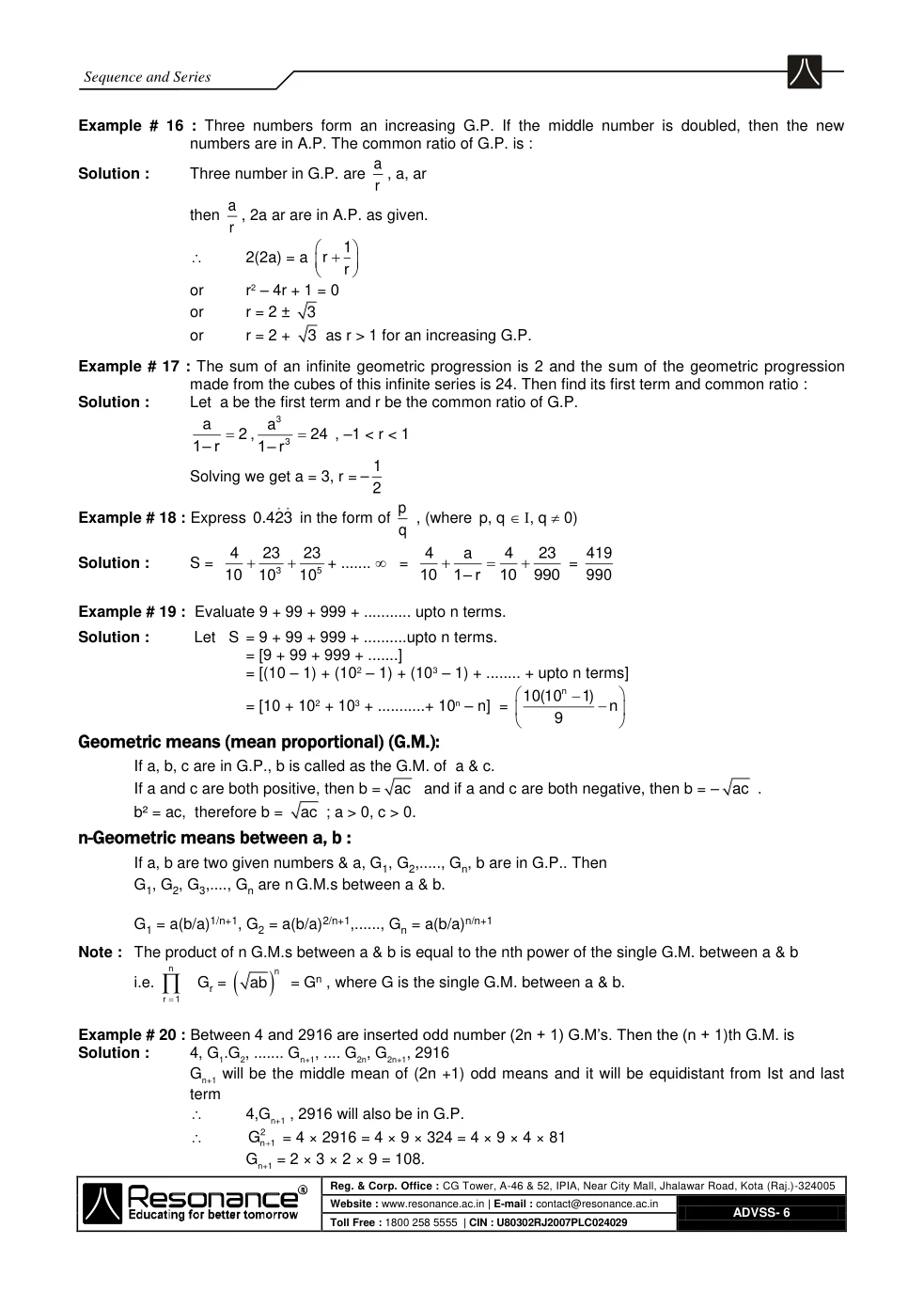
MAASSequence And Series
© MAAS. All rights reserved.Page 6 / 34
Extracted text · page 6
Sequence and Series
Example # 16 : Three numbers form an increasing G.P. If the middle number is doubled, then the new
numbers are in A.P. The common ratio of G.P. is :
a
Solution : Three number in G.P. are , a, ar
r
a
then , 2a ar are in A.P. as given.
r
1
2(2a) = a r
r
or r2 – 4r + 1 = 0
or r = 2 ± 3
or r = 2 + 3 as r > 1 for an increasing G.P.
Example # 17 : The sum of an infinite geometric progression is 2 and the sum of the geometric progression
made from the cubes of this infinite series is 24. Then find its first term and common ratio :
Solution : Let a be the first term and r be the common ratio of G.P.
a a 3
2 , 3 24 , –1 < r < 1 1– r 1– r
1
Solving we get a = 3, r = –
2
p
Example # 18 : Express 0.423 in the form of , (where p, q , q 0)
q
4 23 23 4 a 4 23 419
Solution : S = 3 5 + ....... = = 10 10 10 10 1– r 10 990 990
Example # 19 : Evaluate 9 + 99 + 999 + ........... upto n terms.
Solution : Let S = 9 + 99 + 999 + ..........upto n terms.
= [9 + 99 + 999 + .......]
= [(10 – 1) + (102 – 1) + (103 – 1) + ........ + upto n terms]
10(10n 1)
= [10 + 102 + 103 + ...........+ 10n – n] = n
9
Geometric means (mean proportional) (G.M.):
If a, b, c are in G.P., b is called as the G.M. of a & c.
If a and c are both positive, then b = ac and if a and c are both negative, then b = – ac .
b² = ac, therefore b = ac ; a > 0, c > 0.
n-Geometric means between a, b :
If a, b are two given numbers & a, G1, G2,....., Gn, b are in G.P.. Then
G1, G2, G3,...., Gn are n G.M.s between a & b.
G1 = a(b/a)1/n+1, G2 = a(b/a)2/n+1,......, Gn = a(b/a)n/n+1
Note : The product of n G.M.s between a & b is equal to the nth power of the single G.M. between a & b
n n
= Gn , where G is the single G.M. between a & b. ab i.e. Gr = r 1
Example # 20 : Between 4 and 2916 are inserted odd number (2n + 1) G.M’s. Then the (n + 1)th G.M. is
Solution : 4, G1.G2, ....... Gn+1, .... G2n, G2n+1, 2916
Gn+1 will be the middle mean of (2n +1) odd means and it will be equidistant from Ist and last
term
4,Gn+1 , 2916 will also be in G.P.
Gn2 1 = 4 × 2916 = 4 × 9 × 324 = 4 × 9 × 4 × 81
Gn+1 = 2 × 3 × 2 × 9 = 108.
ADVSS- 6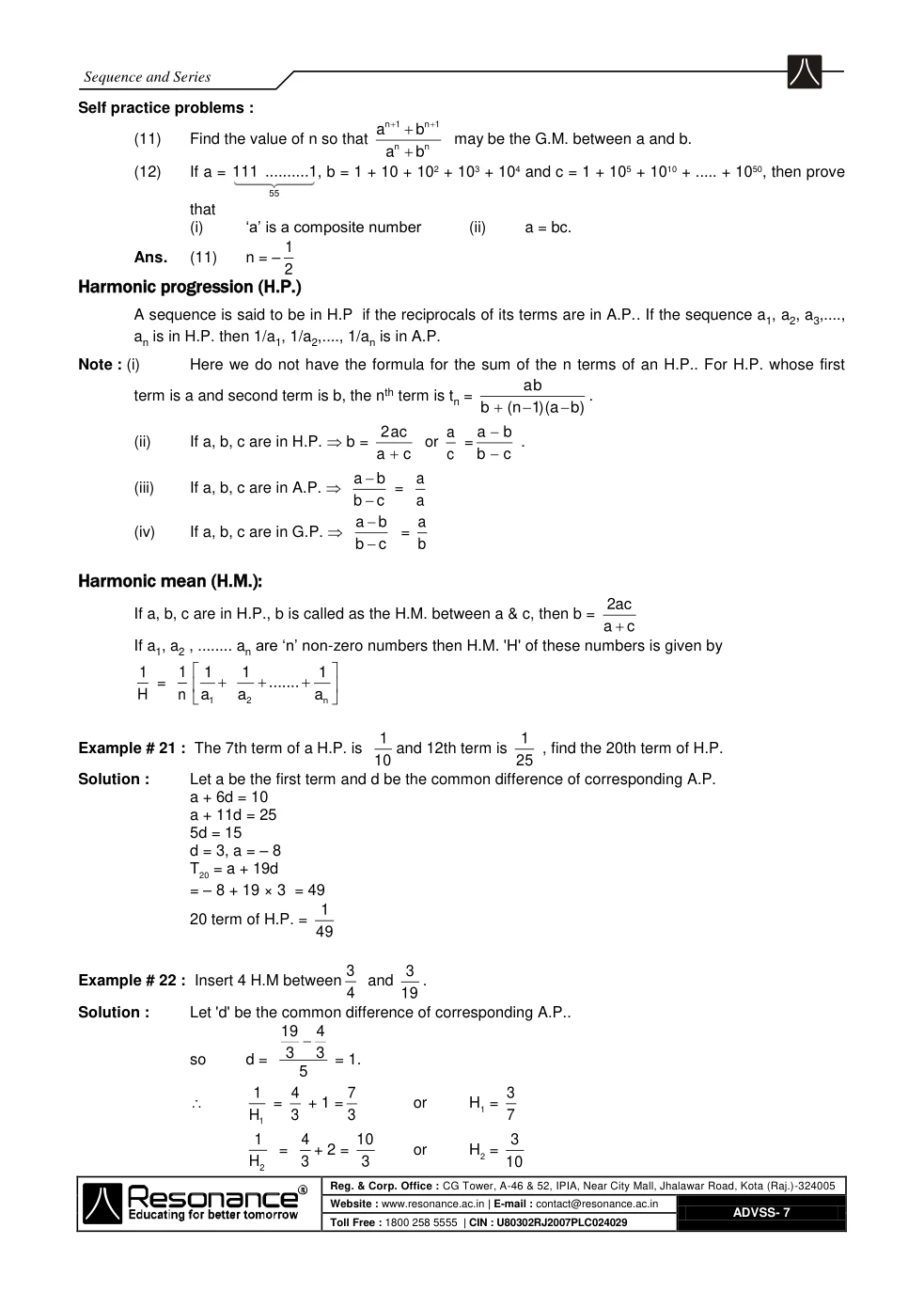
MAASSequence And Series
© MAAS. All rights reserved.Page 7 / 34
Extracted text · page 7
Sequence and Series
Self practice problems :
an 1 bn 1
(11) Find the value of n so that n n may be the G.M. between a and b. a b
(12) If a = 111 ..........1, b = 1 + 10 + 102 + 103 + 104 and c = 1 + 105 + 1010 + ..... + 1050, then prove
55
that
(i) ‘a’ is a composite number (ii) a = bc.
1
Ans. (11) n = –
2
Harmonic progression (H.P.)
A sequence is said to be in H.P if the reciprocals of its terms are in A.P.. If the sequence a1, a2, a3,....,
an is in H.P. then 1/a1, 1/a2,...., 1/an is in A.P.
Note : (i) Here we do not have the formula for the sum of the n terms of an H.P.. For H.P. whose first
ab
term is a and second term is b, the nth term is tn = . b (n 1)(a b)
2ac a a b
(ii) If a, b, c are in H.P. b = or = .
a c c b c
a b a
(iii) If a, b, c are in A.P. =
b c a
a b a
(iv) If a, b, c are in G.P. =
b c b
Harmonic mean (H.M.):
2ac
If a, b, c are in H.P., b is called as the H.M. between a & c, then b =
a c
If a1, a2 , ........ an are ‘n’ non-zero numbers then H.M. 'H' of these numbers is given by
1 1 1 1 1
= .......
H n a1 a 2 an
1 1
Example # 21 : The 7th term of a H.P. is and 12th term is , find the 20th term of H.P.
10 25
Solution : Let a be the first term and d be the common difference of corresponding A.P.
a + 6d = 10
a + 11d = 25
5d = 15
d = 3, a = – 8
T20 = a + 19d
= – 8 + 19 × 3 = 49
1
20 term of H.P. =
49
3 3
Example # 22 : Insert 4 H.M between and .
4 19
Solution : Let 'd' be the common difference of corresponding A.P..
19 4
3 3 so d = = 1.
5
1 4 7 3
= + 1 = or H1 =
H1 3 3 7
1 4 10 3
= + 2 = or H2 =
H 2 3 3 10
ADVSS- 7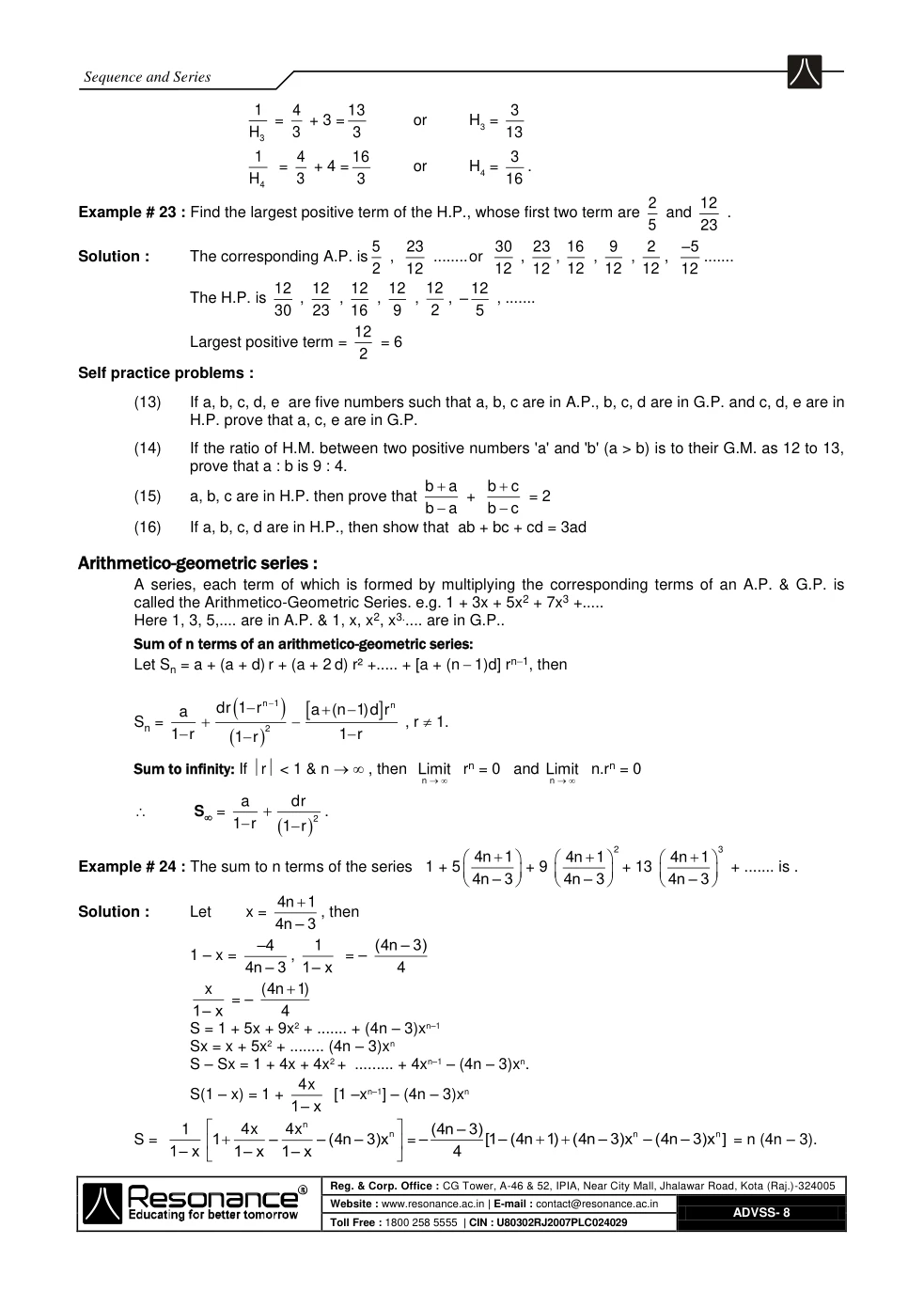
MAASSequence And Series
© MAAS. All rights reserved.Page 8 / 34
Extracted text · page 8
Sequence and Series
1 4 13 3
= + 3 = or H3 =
H3 3 3 13
1 4 16 3
= + 4 = or H4 = .
H 4 3 3 16
2 12
Example # 23 : Find the largest positive term of the H.P., whose first two term are and .
5 23
5 23 30 23 16 9 2 –5
Solution : The corresponding A.P. is , ........ or , , , , , .......
2 12 12 12 12 12 12 12
12 12 12 12 12 12
The H.P. is , , , , , – , .......
30 23 16 9 2 5
12
Largest positive term = = 6
2
Self practice problems :
(13) If a, b, c, d, e are five numbers such that a, b, c are in A.P., b, c, d are in G.P. and c, d, e are in
H.P. prove that a, c, e are in G.P.
(14) If the ratio of H.M. between two positive numbers 'a' and 'b' (a > b) is to their G.M. as 12 to 13,
prove that a : b is 9 : 4.
b a b c
(15) a, b, c are in H.P. then prove that + = 2
b a b c
(16) If a, b, c, d are in H.P., then show that ab + bc + cd = 3ad
Arithmetico-geometric series :
A series, each term of which is formed by multiplying the corresponding terms of an A.P. & G.P. is
called the Arithmetico-Geometric Series. e.g. 1 + 3x + 5x2 + 7x3 +.....
Here 1, 3, 5,.... are in A.P. & 1, x, x2, x3..... are in G.P..
Sum of n terms of an arithmetico-geometric series:
Let Sn = a + (a + d) r + (a + 2 d) r² +..... + [a + (n 1)d] rn1, then
n 1 n a dr 1 r a (n 1)d r
Sn = 2 , r 1.
1 r 1 r 1 r
Sum to infinity: If r < 1 & n , then nLimit rn = 0 and nLimit n.rn = 0
a dr
S = 2 .
1 r 1 r
4n 1 4n 1 2 4n 1 3
Example # 24 : The sum to n terms of the series 1 + 5 + 9 + 13 + ....... is . 4n – 3 4n – 3 4n – 3
4n 1
Solution : Let x = , then
4n – 3
–4 1 (4n – 3)
1 – x = , = –
4n – 3 1– x 4
x (4n 1)
= –
1– x 4
S = 1 + 5x + 9x2 + ....... + (4n – 3)xn–1
Sx = x + 5x2 + ........ (4n – 3)xn
S – Sx = 1 + 4x + 4x2 + ......... + 4xn–1 – (4n – 3)xn.
4x
S(1 – x) = 1 + [1 –xn–1] – (4n – 3)xn
1– x
1 4x 4x n n (4n – 3) n n
S = 1 – – (4n – 3)x = – [1– (4n 1) (4n – 3)x – (4n – 3)x ] = n (4n – 3).
1– x 1– x 1– x 4
ADVSS- 8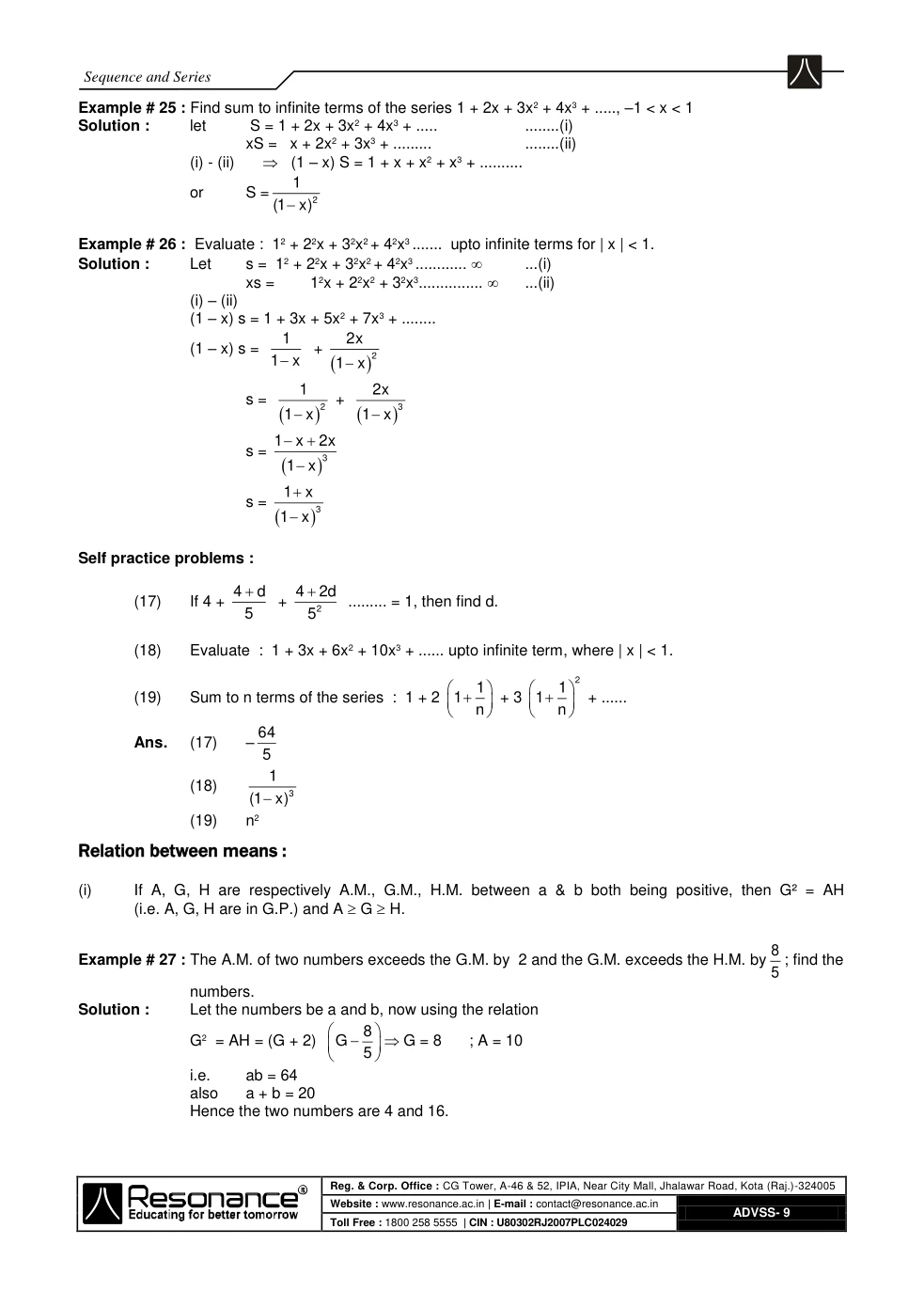
MAASSequence And Series
© MAAS. All rights reserved.Page 9 / 34
Extracted text · page 9
Sequence and Series
Example # 25 : Find sum to infinite terms of the series 1 + 2x + 3x2 + 4x3 + ....., –1 < x < 1
Solution : let S = 1 + 2x + 3x2 + 4x3 + ..... ........(i)
xS = x + 2x2 + 3x3 + ......... ........(ii)
(i) - (ii) (1 – x) S = 1 + x + x2 + x3 + ..........
1
or S = 2 (1 x)
Example # 26 : Evaluate : 12 + 22x + 32x2 + 42x3 ....... upto infinite terms for | x | < 1.
Solution : Let s = 12 + 22x + 32x2 + 42x3 ............ ...(i)
xs = 12x + 22x2 + 32x3............... ...(ii)
(i) – (ii)
(1 – x) s = 1 + 3x + 5x2 + 7x3 + ........
1 2x
(1 – x) s = + 2
1 x 1 x
1 2x
s = 2 + 3
1 x 1 x
1 x 2x
s = 3
1 x
1 x
s = 3
1 x
Self practice problems :
4 d 4 2d
(17) If 4 + + 2 ......... = 1, then find d. 5 5
(18) Evaluate : 1 + 3x + 6x2 + 10x3 + ...... upto infinite term, where | x | < 1.
1 1 2
(19) Sum to n terms of the series : 1 + 2 1 + 3 1 + ...... n n
64
Ans. (17) –
5
1
(18) 3 (1 x)
(19) n2
Relation between means :
(i) If A, G, H are respectively A.M., G.M., H.M. between a & b both being positive, then G² = AH
(i.e. A, G, H are in G.P.) and A G H.
8
Example # 27 : The A.M. of two numbers exceeds the G.M. by 2 and the G.M. exceeds the H.M. by ; find the
5
numbers.
Solution : Let the numbers be a and b, now using the relation
8
G2 = AH = (G + 2) G G = 8 ; A = 10 5
i.e. ab = 64
also a + b = 20
Hence the two numbers are 4 and 16.
ADVSS- 9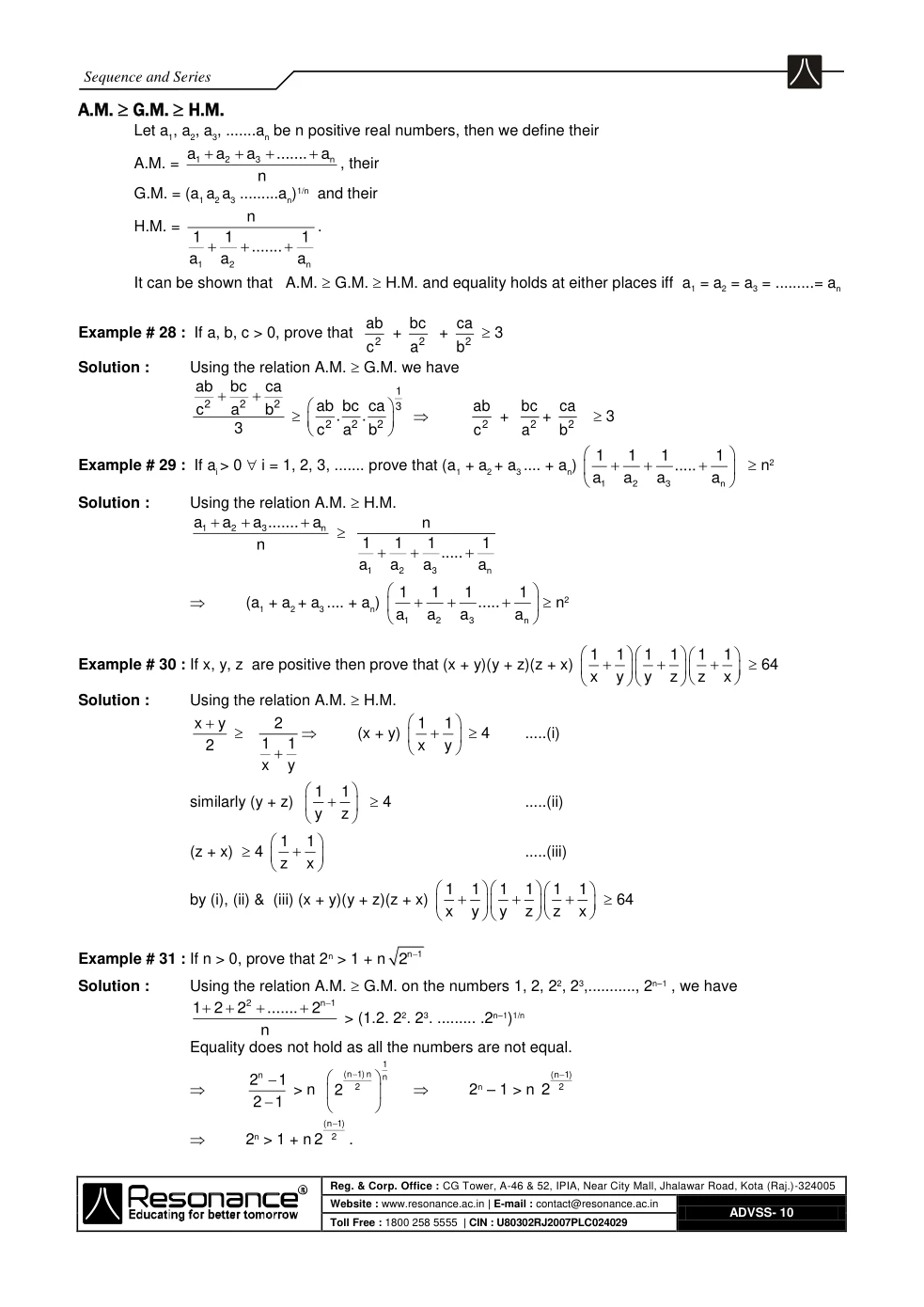
MAASSequence And Series
© MAAS. All rights reserved.Page 10 / 34
Extracted text · page 10
Sequence and Series
A.M. G.M. H.M.
Let a1, a2, a3, .......an be n positive real numbers, then we define their
a1 a 2 a3 ....... an A.M. = , their
n
G.M. = (a1 a2 a3 .........an)1/n and their
n
H.M. = .
1 1 1
.......
a1 a 2 an
It can be shown that A.M. G.M. H.M. and equality holds at either places iff a1 = a2 = a3 = .........= an
ab bc ca
Example # 28 : If a, b, c > 0, prove that + + 3
c 2 a 2 b 2
Solution : Using the relation A.M. G.M. we have
ab bc ca 1
c 2 a 2 b 2 ab bc ca 3 ab bc ca 2 . 2 . 2 2 + 2 + 2 3 3 c a b c a b
1 1 1 1
Example # 29 : If ai > 0 i = 1, 2, 3, ....... prove that (a1 + a2 + a3 .... + an) ..... n2
a1 a 2 a 3 a n
Solution : Using the relation A.M. H.M.
a1 a 2 a3 ....... an n
n 1 1 1 1 .....
a1 a 2 a 3 an
1 1 1 1
(a1 + a2 + a3 .... + an) ..... n2
a1 a 2 a 3 a n
1 1 1 1 1 1
Example # 30 : If x, y, z are positive then prove that (x + y)(y + z)(z + x) 64
x y y z z x
Solution : Using the relation A.M. H.M.
x y 2 1 1
(x + y) 4 .....(i) 2 1 1 x y
x y
1 1
similarly (y + z) 4 .....(ii)
y z
1 1 (z + x) 4 .....(iii) z x
1 1 1 1 1 1
by (i), (ii) & (iii) (x + y)(y + z)(z + x) 64
x y y z z x
Example # 31 : If n > 0, prove that 2n > 1 + n 2n 1
Solution : Using the relation A.M. G.M. on the numbers 1, 2, 22, 23,..........., 2n–1 , we have
1 2 22 ....... 2n 1
> (1.2. 22. 23. ......... .2n–1)1/n
n
Equality does not hold as all the numbers are not equal.
1
2n 1 (n 21) n n (n21) > n 2 2n – 1 > n 2
2 1
(n 1)
2n > 1 + n 2 2 .
ADVSS- 10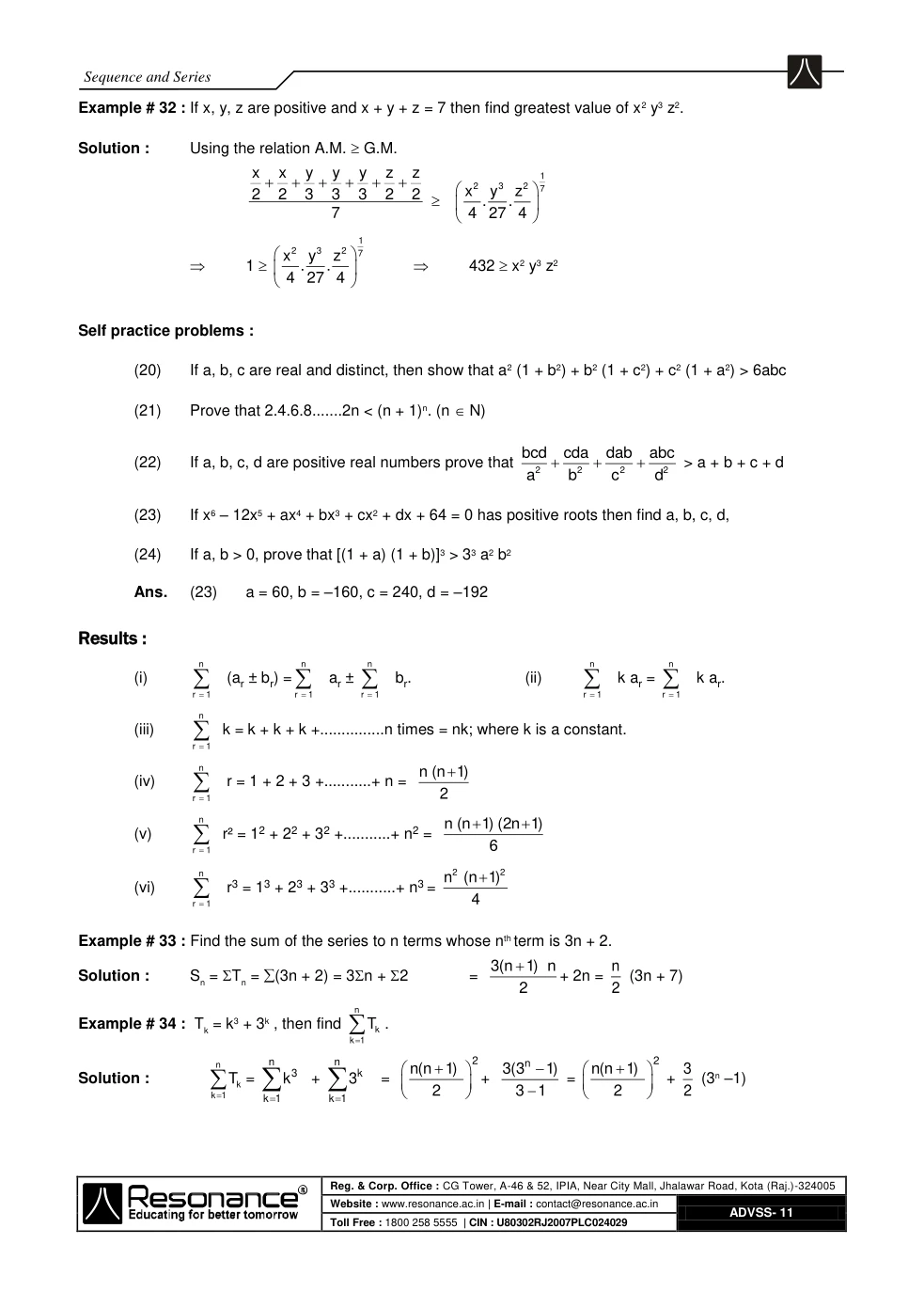
MAASSequence And Series
© MAAS. All rights reserved.Page 11 / 34
Extracted text · page 11
Sequence and Series
Example # 32 : If x, y, z are positive and x + y + z = 7 then find greatest value of x2 y3 z2.
Solution : Using the relation A.M. G.M.
x x y y y z z 1
2 3 2 7 2 2 3 3 3 2 2 x y z . .
7 4 27 4
1
x 2 y 3 z 2 7
1 . . 432 x2 y3 z2
4 27 4
Self practice problems :
(20) If a, b, c are real and distinct, then show that a2 (1 + b2) + b2 (1 + c2) + c2 (1 + a2) > 6abc
(21) Prove that 2.4.6.8.......2n < (n + 1)n. (n N)
bcd cda dab abc
(22) If a, b, c, d are positive real numbers prove that 2 2 2 2 > a + b + c + d a b c d
(23) If x6 – 12x5 + ax4 + bx3 + cx2 + dx + 64 = 0 has positive roots then find a, b, c, d,
(24) If a, b > 0, prove that [(1 + a) (1 + b)]3 > 33 a2 b2
Ans. (23) a = 60, b = –160, c = 240, d = –192
Results :
n n n n n
(i) (ar ± br) = ar ± br. (ii) k ar = k ar. r1 r1 r1 r1 r1
n
(iii) k = k + k + k +...............n times = nk; where k is a constant. r1
n n (n 1)
(iv) r = 1 + 2 + 3 +...........+ n = r1 2
n n (n 1) (2n 1)
(v) r² = 12 + 22 + 32 +...........+ n2 = r1 6
n n2 (n 1)2
(vi) r3 = 13 + 23 + 33 +...........+ n3 = r1 4
Example # 33 : Find the sum of the series to n terms whose nth term is 3n + 2.
3(n 1) n n
Solution : Sn = Tn = (3n + 2) = 3n + 2 = + 2n = (3n + 7)
2 2
n
Example # 34 : Tk = k3 + 3k , then find Tk . k 1
n n n 2 n 2 3 k n(n 1) 3(3 1) n(n 1) 3
Solution : Tk = k + 3 = + = + (3n –1) 2 3 1 2 2 k 1 k 1 k 1
ADVSS- 11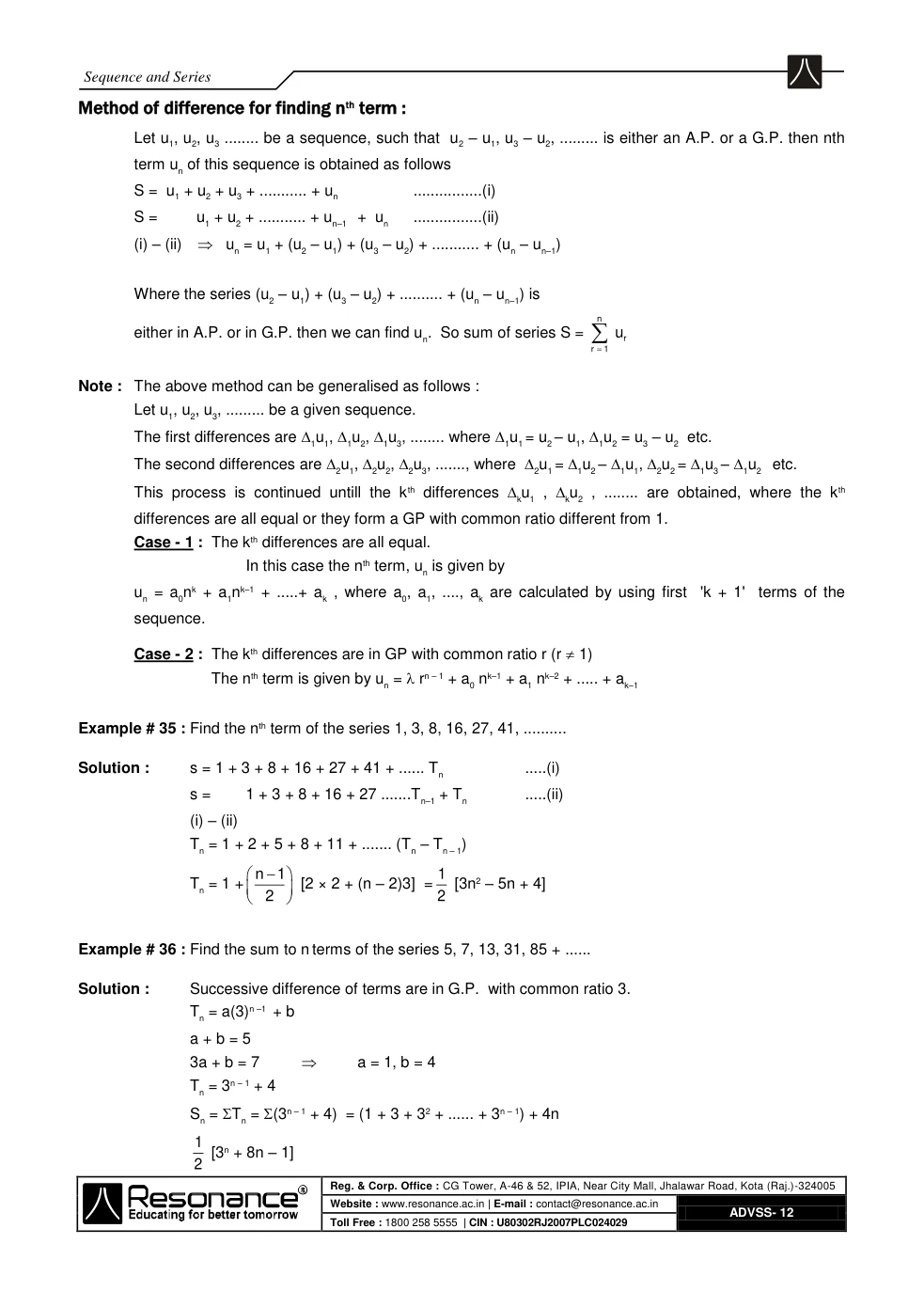
MAASSequence And Series
© MAAS. All rights reserved.Page 12 / 34
Extracted text · page 12
Sequence and Series
Method of difference for finding nth term :
Let u1, u2, u3 ........ be a sequence, such that u2 – u1, u3 – u2, ......... is either an A.P. or a G.P. then nth
term un of this sequence is obtained as follows
S = u1 + u2 + u3 + ........... + un ................(i)
S = u1 + u2 + ........... + un–1 + un ................(ii)
(i) – (ii) un = u1 + (u2 – u1) + (u3 – u2) + ........... + (un – un–1)
Where the series (u2 – u1) + (u3 – u2) + .......... + (un – un–1) is
n
either in A.P. or in G.P. then we can find un. So sum of series S = ur r1
Note : The above method can be generalised as follows :
Let u1, u2, u3, ......... be a given sequence.
The first differences are 1u1, 1u2, 1u3, ........ where 1u1 = u2 – u1, 1u2 = u3 – u2 etc.
The second differences are 2u1, 2u2, 2u3, ......., where 2u1 = 1u2 – 1u1, 2u2 = 1u3 – 1u2 etc.
This process is continued untill the kth differences ku1 , ku2 , ........ are obtained, where the kth
differences are all equal or they form a GP with common ratio different from 1.
Case - 1 : The kth differences are all equal.
In this case the nth term, un is given by
un = a0nk + a1nk–1 + .....+ ak , where a0, a1, ...., ak are calculated by using first 'k + 1' terms of the
sequence.
Case - 2 : The kth differences are in GP with common ratio r (r 1)
The nth term is given by un = rn – 1 + a0 nk–1 + a1 nk–2 + ..... + ak–1
Example # 35 : Find the nth term of the series 1, 3, 8, 16, 27, 41, ..........
Solution : s = 1 + 3 + 8 + 16 + 27 + 41 + ...... Tn .....(i)
s = 1 + 3 + 8 + 16 + 27 .......Tn–1 + Tn .....(ii)
(i) – (ii)
Tn = 1 + 2 + 5 + 8 + 11 + ....... (Tn – Tn – 1)
n 1 1
Tn = 1 + [2 × 2 + (n – 2)3] = [3n2 – 5n + 4] 2 2
Example # 36 : Find the sum to n terms of the series 5, 7, 13, 31, 85 + ......
Solution : Successive difference of terms are in G.P. with common ratio 3.
Tn = a(3)n –1 + b
a + b = 5
3a + b = 7 a = 1, b = 4
Tn = 3n – 1 + 4
Sn = Tn = (3n – 1 + 4) = (1 + 3 + 32 + ...... + 3n – 1) + 4n
1
[3n + 8n – 1]
2
ADVSS- 12
MAASSequence And Series
© MAAS. All rights reserved.Page 13 / 34
Extracted text · page 13
Sequence and Series
Method of difference for finding sn :
If possible express rth term as difference of two terms as tr = ± (f(r) – f(r ± 1)). This can be explained with
the help of examples given below.
t1 = f(1) – f(0),
t2 = f(2) – f(1),
tn = f(n) – f(n-1)
Sn = f(n) – f(0)
Example # 37 : Find the sum of n-terms of the series 2.5 + 5.8 + 8.11 + ...........
Solution : Tr = (3r – 1) (3r + 2) = 9r2 + 3r – 2
n n n n
Sn = Tr = 9 Tr + 3 r – 2 r 1 r 1 r 1 r 1
n n 1 2n 1 n n 1
= 9 + 3 – 2n
6 2
= 3n(n + 1)2 – 2n
1 1 1
Example # 38 : Sum to n terms of the series + + + .........
(1 x)(1 3x) (1 3x)(1 5x) (1 5x)(1 7x)
Solution : Let Tr be the general term of the series
1
Tr =
1 (2r 1)x 1 2r 1 x
1 1 (2r 1)x 1 (2r 1)x 1 1
So Tr = =
2x 1 (2r 1)x 1 (2r 1)x 1 (2r 1)x (1 (2r 1)x)
Sn = Tr = T1 + T2 + T3 + .......... + Tn
1 1 1 n
= =
(1 x)[1 (2n 1)x] 2x 1 x 1 (2n 1)x
1 1 1
Example # 39 : Sum to n terms of the series +............
1.4.7 4.7.10 7.10.13
1 1 1 1
Solution : Tn = =
3n 2 3n 1 3n 4 6 3n 2 3n 1 3n 1 3n 4
1 1 1 1 1 1 1
= ...... 6 1.4 4.7 4.7 7.10 3n 2 3n 1 3n 1 3n 4
1 1 1
=
6 4 3n 1 3n 4
ADVSS- 13
MAASSequence And Series
© MAAS. All rights reserved.Page 14 / 34
Extracted text · page 14
Sequence and Series
Example # 40 : Find the general term and sum of n terms of the series
1 + 5 + 19 + 49 + 101 + 181 + 295 + .........
Solution : The sequence of difference between successive term 4, 14, 30, 52, 80 .....
The sequence of the second order difference is 10, 16, 22, 28, ...... clearly it is an A.P>
so let nth term
Tn = an3 + bn2 + cn + d
a + b + c + d = 1 ....(i)
8a + 4b + 2c + d = 5 ....(ii)
27a + 9b + 3c + d = 19 ....(iii)
64a + 16b + 4c + d = 49 ....(iv)
from (i), (ii), (iii) & (iv)
a = 1, b = –1, c = 0, d = 1 Tn = n3 – n2 + 1
2 1 3n 2 n n 1 2 n n 1 2n 1 n n
sn = (n3 – n2 + 1 ) = 2 – 6 + n = 12 + n
Self practice problems :
(25) Sum to n terms the following series
3 5 7
(i) 2 2 2 2 2 2 +........... 1 .2 2 .3 3 .4
(ii) 1 + (1 + 2) + (1 + 2 + 3) + (1 + 2 + 3 + 4) ........
(iii) 4 + 14 + 30 + 52 + 82 + 114 + ..........
n n 1
(26) If Tr = (n + 1)(n + 2)(n + 3) then find r 1 r 1 Tr
2n n 2 n n 1 n 2 n
Ans. (25) (i) (ii) (iii) n(n + 1)2 (26)
n 2 n 1 2 6 6
ADVSS- 14
MAASSequence And Series
© MAAS. All rights reserved.Page 15 / 34
Extracted text · page 15
Sequence and Series
Marked questions are recommended for Revision.
PART - I : SUBJECTIVE QUESTIONS
Section (A) : Arithmetic Progression
A-1. In an A.P. the third term is four times the first term, and the sixth term is 17 ; find the series.
p
A-2. Find the sum of first 35 terms of the series whose pth term is + 2.
7
A-3. Find the number of integers between 100 & 1000 that are divisible by 7
A-4. Find the sum of all those integers between 100 and 800 each of which on division by 16 leaves the
remainder 7.
A-5. The sum of first p-terms of an A.P. is q and the sum of first q terms is p, find the sum of first (p + q)
terms.
A-6. The sum of three consecutive numbers in A.P. is 27, and their product is 504, find them.
A-7. The fourth power of the common difference of an arithmetic progression with integer entries is added to
the product of any four consecutive terms of it. Prove that the resulting sum is the square of an integer.
A-8. If a, b, c are in A.P., then show that:
(i) a2 (b + c), b2 (c + a), c2 (a + b) are also in A.P.
(ii) b + c a, c + a b, a + b c are in A.P.
A-9. There are n A.M's between 3 and 54, such that the 8th mean: (n 2)th mean:: 3: 5. The value of n is.
Section (B) : Geometric Progression
B-1. The third term of a G.P. is the square of the first term. If the second term is 8, find its sixth term.
B-2. The continued product of three numbers in G.P. is 216, and the sum of the products of them in pairs is
156; find the numbers
B-3. The sum of infinite number of terms of a G.P. is 4 and the sum of their cubes is 192. Find the series.
B-4. The sum of three numbers which are consecutive terms of an A.P. is 21. If the second number is
reduced by 1 & the third is increased by 1, we obtain three consecutive terms of a G.P., find the
numbers.
B-5. If the pth, qth & rth terms of an AP are in GP. Find the common ratio of the GP.
B-6. If a, b, c, d are in G.P., prove that :
(i) (a2 b2), (b2 c2), (c2 d2) are in G.P.
1 1 1
(ii) 2 2 , 2 2 , 2 2 are in G.P. a b b c c d
32 243
B-7. Let five geometric means are inserted between and then find sum of all the geometric
3 2
means.
ADVSS- 15
MAASSequence And Series
© MAAS. All rights reserved.Page 16 / 34
Extracted text · page 16
Sequence and Series
Section (C) : Harmonic and Arithmetic Geometric Progression
1 1
C-1. Find the 4th term of an H.P. whose 7th term is and 13th term is .
20 38
C-2. Insert three harmonic means between 1 and 7.
a – x a – y a – z
C-3. If = = and p, q, r are in A.P. then prove that x, y, z are in H.P.
px qy rz
C-4. If a2, b2, c2 are in A.P. show that b + c , c + a, a + b are in H.P.
1 1 1 1
C-5. If b is the harmonic mean between a and c, then prove that + = .
b a b c a c
C-6. Sum the following series
2 3 4
(i) 1 + + 2 + 3 + ........ to n terms.
2 2 2
3 7 15 31
(ii) 1 + + + + + ..... to infinity.
4 16 64 256
C-7. Find the sum of n terms of the series the rth term of which is (2r + 1)2r.
Section (D) : Relation between A.M., G.M., H.M
D-1. Using the relation A.M. G.M. prove that
(i) (x2y + y2z + z2x) (xy2 + yz2 + zx2) 9x2 y2 z2. (x, y, z are positive real number)
(ii) (a + b) . (b + c) . (c + a) abc ; if a, b, c are positive real numbers
x100
D-2. If x > 0, then find greatest value of the expression 2 3 200 . 1 x x x ..... x
16
D-3. The H.M. between two numbers is , their A.M. is A and G.M. is G. If 2A + G2 = 26, then find the
5
numbers.
D-4. If a, b, c are positive real numbers and sides of the triangle, then prove that
(a + b + c)3 27 (a + b – c) (c + a – b) (b + c – a)
D-5. If ai >0 for all i = 1,2,3 .........n then prove that
(1 + a1 + a2 1) (1 + a2 + a2 2) ......... (1 + an + a2 n) 3n(a1 a2 a3 ...... an)
Section (E) : Summation of series
E-1. Find the sum to n-terms of the sequence.
(i) 1 + 5 + 13 + 29 + 61 + ........ up to n terms
(ii) 3 + 33 + 333 + 3333 + .............. up to n terms
1 3 7 15
E-2. + .... to n terms.
2 4 8 16
ADVSS- 16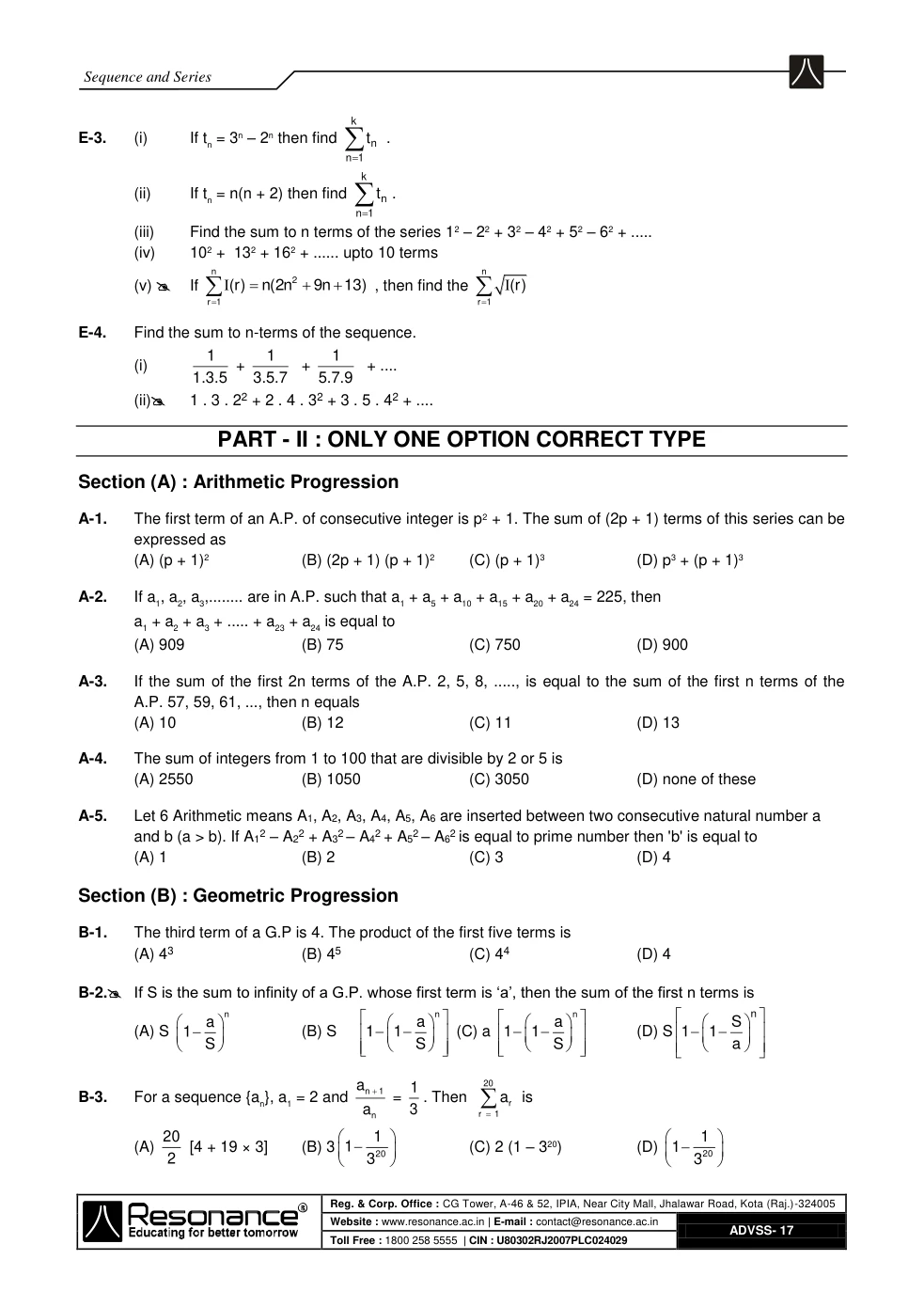
MAASSequence And Series
© MAAS. All rights reserved.Page 17 / 34
Extracted text · page 17
Sequence and Series
k
E-3. (i) If tn = 3n – 2n then find t n . n 1
k
(ii) If tn = n(n + 2) then find t n . n 1
(iii) Find the sum to n terms of the series 12 – 22 + 32 – 42 + 52 – 62 + .....
(iv) 102 + 132 + 162 + ...... upto 10 terms
n n
(v) If (r) (r) n(2n 2 9n 13) , then find the
r 1 r 1
E-4. Find the sum to n-terms of the sequence.
1 1 1
(i) + + + ....
1.3.5 3.5.7 5.7.9
(ii) 1 . 3 . 22 + 2 . 4 . 32 + 3 . 5 . 42 + ....
PART - II : ONLY ONE OPTION CORRECT TYPE
Section (A) : Arithmetic Progression
A-1. The first term of an A.P. of consecutive integer is p2 + 1. The sum of (2p + 1) terms of this series can be
expressed as
(A) (p + 1)2 (B) (2p + 1) (p + 1)2 (C) (p + 1)3 (D) p3 + (p + 1)3
A-2. If a1, a2, a3,........ are in A.P. such that a1 + a5 + a10 + a15 + a20 + a24 = 225, then
a1 + a2 + a3 + ..... + a23 + a24 is equal to
(A) 909 (B) 75 (C) 750 (D) 900
A-3. If the sum of the first 2n terms of the A.P. 2, 5, 8, ....., is equal to the sum of the first n terms of the
A.P. 57, 59, 61, ..., then n equals
(A) 10 (B) 12 (C) 11 (D) 13
A-4. The sum of integers from 1 to 100 that are divisible by 2 or 5 is
(A) 2550 (B) 1050 (C) 3050 (D) none of these
A-5. Let 6 Arithmetic means A1, A2, A3, A4, A5, A6 are inserted between two consecutive natural number a
and b (a > b). If A12 – A22 + A32 – A42 + A52 – A62 is equal to prime number then 'b' is equal to
(A) 1 (B) 2 (C) 3 (D) 4
Section (B) : Geometric Progression
B-1. The third term of a G.P is 4. The product of the first five terms is
(A) 43 (B) 45 (C) 44 (D) 4
B-2. If S is the sum to infinity of a G.P. whose first term is ‘a’, then the sum of the first n terms is
a n a n a n S n
(A) S 1 (B) S 1 1 (C) a 1 1 (D) S 1 1
S S S a
a n 1 1 20
B-3. For a sequence {an}, a1 = 2 and = . Then a r is a n 3 r1
20 1 1
(A) [4 + 19 × 3] (B) 3 1 20 (C) 2 (1 – 320) (D) 1 20
2 3 3
ADVSS- 17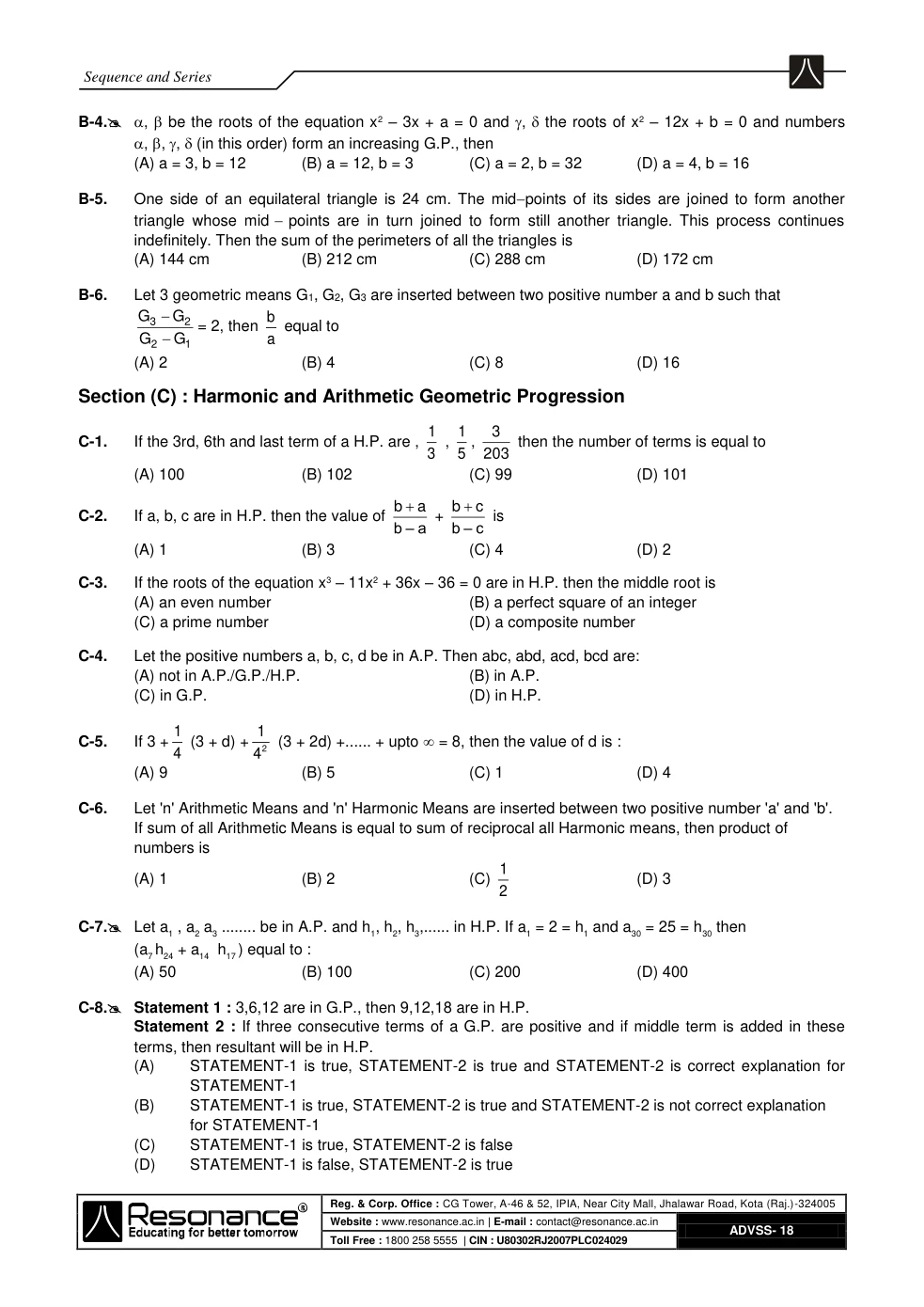
MAASSequence And Series
© MAAS. All rights reserved.Page 18 / 34
Extracted text · page 18
Sequence and Series
B-4. , be the roots of the equation x2 – 3x + a = 0 and , the roots of x2 – 12x + b = 0 and numbers
, , , (in this order) form an increasing G.P., then
(A) a = 3, b = 12 (B) a = 12, b = 3 (C) a = 2, b = 32 (D) a = 4, b = 16
B-5. One side of an equilateral triangle is 24 cm. The midpoints of its sides are joined to form another
triangle whose mid points are in turn joined to form still another triangle. This process continues
indefinitely. Then the sum of the perimeters of all the triangles is
(A) 144 cm (B) 212 cm (C) 288 cm (D) 172 cm
B-6. Let 3 geometric means G1, G2, G3 are inserted between two positive number a and b such that
G3 G2 b = 2, then equal to
G2 G1 a
(A) 2 (B) 4 (C) 8 (D) 16
Section (C) : Harmonic and Arithmetic Geometric Progression
1 1 3
C-1. If the 3rd, 6th and last term of a H.P. are , , , then the number of terms is equal to
3 5 203
(A) 100 (B) 102 (C) 99 (D) 101
b a b c
C-2. If a, b, c are in H.P. then the value of + is
b – a b – c
(A) 1 (B) 3 (C) 4 (D) 2
C-3. If the roots of the equation x3 – 11x2 + 36x – 36 = 0 are in H.P. then the middle root is
(A) an even number (B) a perfect square of an integer
(C) a prime number (D) a composite number
C-4. Let the positive numbers a, b, c, d be in A.P. Then abc, abd, acd, bcd are:
(A) not in A.P./G.P./H.P. (B) in A.P.
(C) in G.P. (D) in H.P.
1 1
C-5. If 3 + (3 + d) + 2 (3 + 2d) +...... + upto = 8, then the value of d is :
4 4
(A) 9 (B) 5 (C) 1 (D) 4
C-6. Let 'n' Arithmetic Means and 'n' Harmonic Means are inserted between two positive number 'a' and 'b'.
If sum of all Arithmetic Means is equal to sum of reciprocal all Harmonic means, then product of
numbers is
1
(A) 1 (B) 2 (C) (D) 3
2
C-7. Let a1 , a2 a3 ........ be in A.P. and h1, h2, h3,...... in H.P. If a1 = 2 = h1 and a30 = 25 = h30 then
(a7 h24 + a14 h17 ) equal to :
(A) 50 (B) 100 (C) 200 (D) 400
C-8. Statement 1 : 3,6,12 are in G.P., then 9,12,18 are in H.P.
Statement 2 : If three consecutive terms of a G.P. are positive and if middle term is added in these
terms, then resultant will be in H.P.
(A) STATEMENT-1 is true, STATEMENT-2 is true and STATEMENT-2 is correct explanation for
STATEMENT-1
(B) STATEMENT-1 is true, STATEMENT-2 is true and STATEMENT-2 is not correct explanation
for STATEMENT-1
(C) STATEMENT-1 is true, STATEMENT-2 is false
(D) STATEMENT-1 is false, STATEMENT-2 is true
ADVSS- 18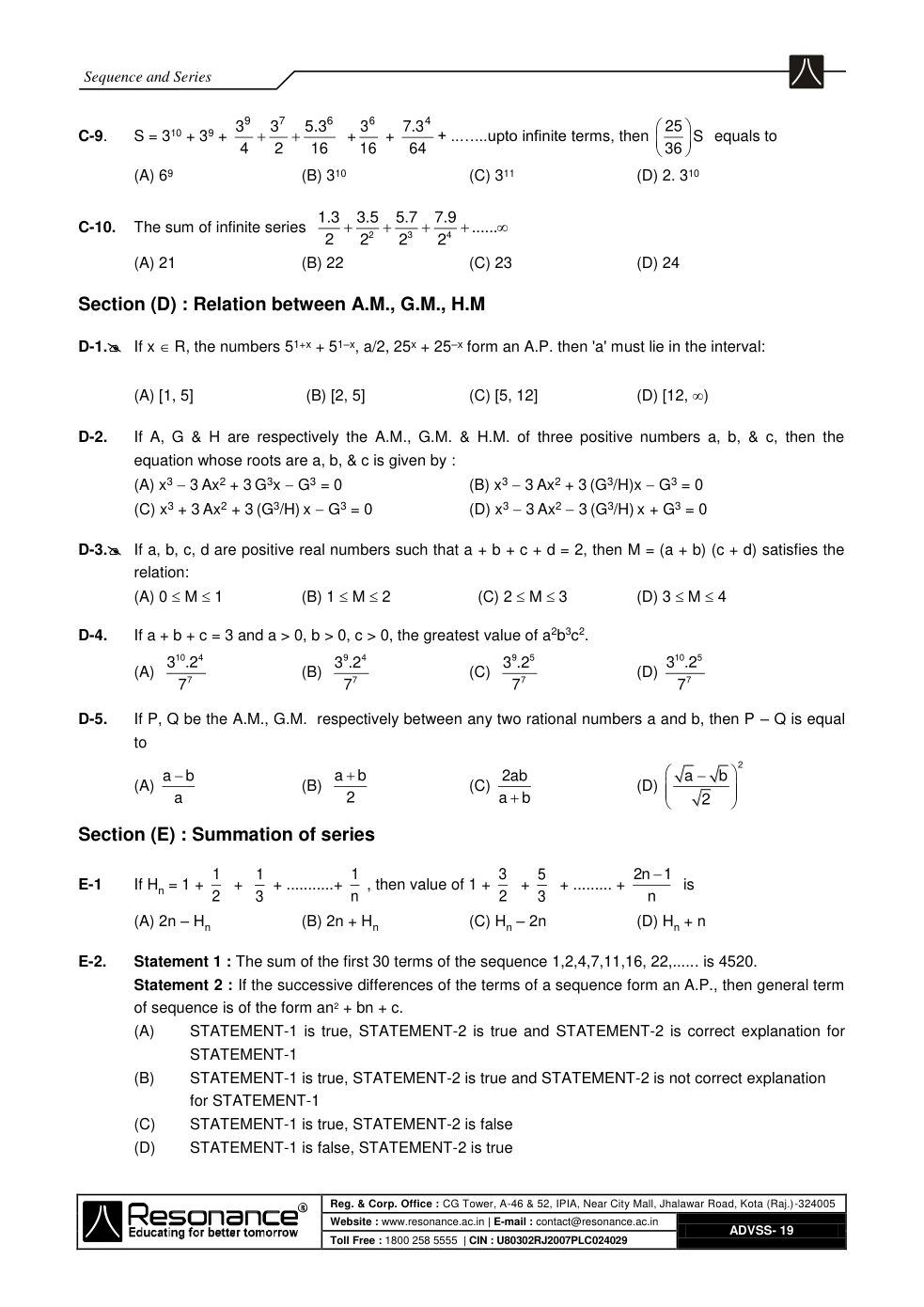
MAASSequence And Series
© MAAS. All rights reserved.Page 19 / 34
Extracted text · page 19
Sequence and Series
39 37 5.36 3 6 7.3 4 25
C-9. S = 310 + 39 + + + + ..…...upto infinite terms, then S equals to
4 2 16 16 64 36
(A) 69 (B) 310 (C) 311 (D) 2. 310
1.3 3.5 5.7 7.9
C-10. The sum of infinite series 2 3 4 ......
2 2 2 2
(A) 21 (B) 22 (C) 23 (D) 24
Section (D) : Relation between A.M., G.M., H.M
D-1. If x R, the numbers 51+x + 51–x, a/2, 25x + 25–x form an A.P. then 'a' must lie in the interval:
(A) [1, 5] (B) [2, 5] (C) [5, 12] (D) [12, )
D-2. If A, G & H are respectively the A.M., G.M. & H.M. of three positive numbers a, b, & c, then the
equation whose roots are a, b, & c is given by :
(A) x3 3 Ax2 + 3 G3x G3 = 0 (B) x3 3 Ax2 + 3 (G3/H)x G3 = 0
(C) x3 + 3 Ax2 + 3 (G3/H) x G3 = 0 (D) x3 3 Ax2 3 (G3/H) x + G3 = 0
D-3. If a, b, c, d are positive real numbers such that a + b + c + d = 2, then M = (a + b) (c + d) satisfies the
relation:
(A) 0 M 1 (B) 1 M 2 (C) 2 M 3 (D) 3 M 4
D-4. If a + b + c = 3 and a > 0, b > 0, c > 0, the greatest value of a2b3c2.
310.2 4 3 9.2 4 3 9.25 310.2 5
(A) 7 (B) 7 (C) 7 (D) 7
7 7 7 7
D-5. If P, Q be the A.M., G.M. respectively between any two rational numbers a and b, then P – Q is equal
to
a b a b 2ab a b 2
(A) (B) (C) (D) a 2 a b 2
Section (E) : Summation of series
1 1 1 3 5 2n 1
E-1 If Hn = 1 + + + ...........+ , then value of 1 + + + ......... + is
2 3 n 2 3 n
(A) 2n – Hn (B) 2n + Hn (C) Hn – 2n (D) Hn + n
E-2. Statement 1 : The sum of the first 30 terms of the sequence 1,2,4,7,11,16, 22,...... is 4520.
Statement 2 : If the successive differences of the terms of a sequence form an A.P., then general term
of sequence is of the form an2 + bn + c.
(A) STATEMENT-1 is true, STATEMENT-2 is true and STATEMENT-2 is correct explanation for
STATEMENT-1
(B) STATEMENT-1 is true, STATEMENT-2 is true and STATEMENT-2 is not correct explanation
for STATEMENT-1
(C) STATEMENT-1 is true, STATEMENT-2 is false
(D) STATEMENT-1 is false, STATEMENT-2 is true
ADVSS- 19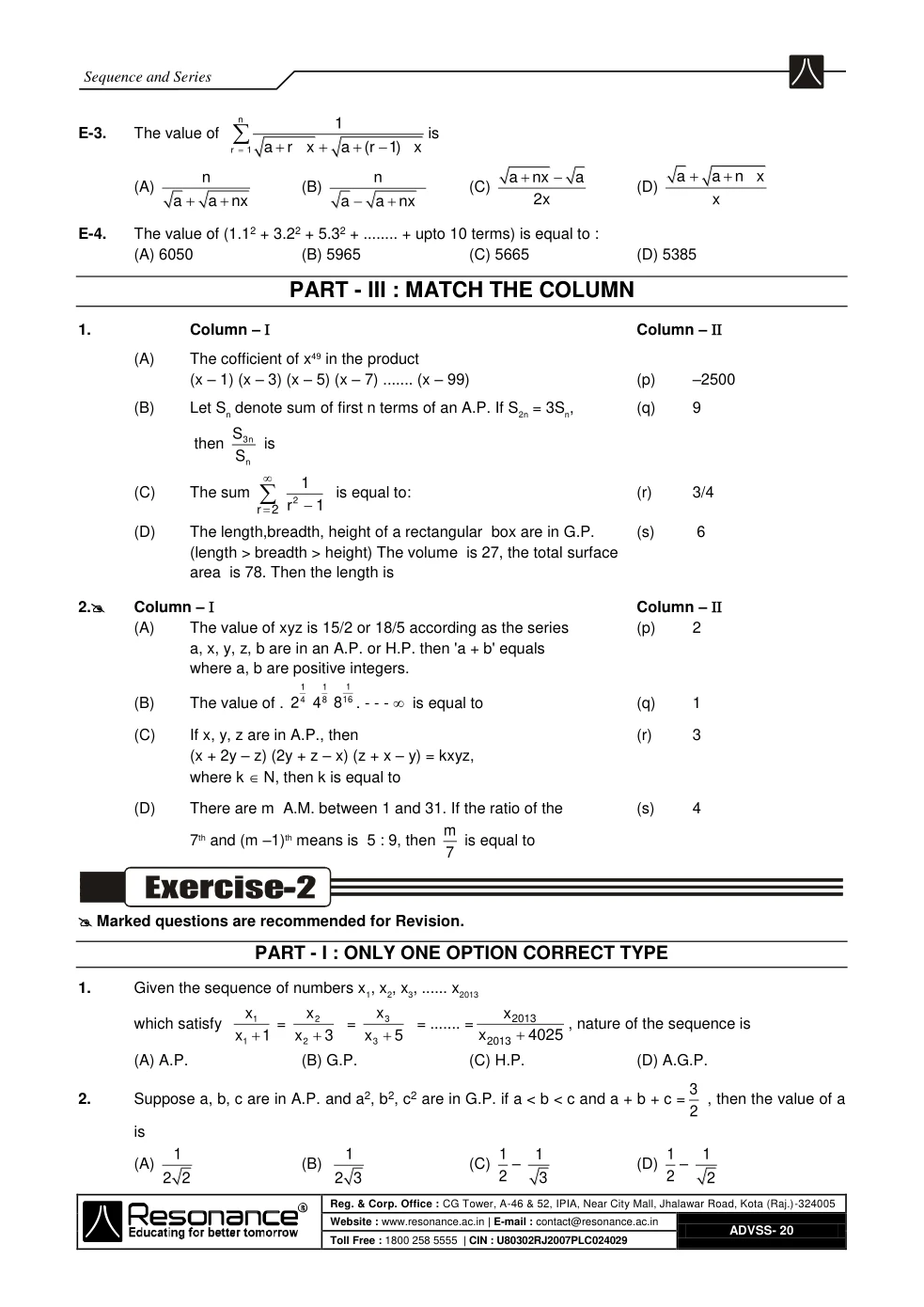
MAASSequence And Series
© MAAS. All rights reserved.Page 20 / 34
Extracted text · page 20
Sequence and Series
n 1
E-3. The value of is r 1 a r x a (r 1) x
n n a nx a a a n x
(A) (B) (C) (D)
a a nx a a nx 2x x
E-4. The value of (1.12 + 3.22 + 5.32 + ........ + upto 10 terms) is equal to :
(A) 6050 (B) 5965 (C) 5665 (D) 5385
PART - III : MATCH THE COLUMN
1. Column – Column –
(A) The cofficient of x49 in the product
(x – 1) (x – 3) (x – 5) (x – 7) ....... (x – 99) (p) –2500
(B) Let Sn denote sum of first n terms of an A.P. If S2n = 3Sn, (q) 9
S 3n
then is
S n
1
(C) The sum is equal to: (r) 3/4 2 r 2 r 1
(D) The length,breadth, height of a rectangular box are in G.P. (s) 6
(length > breadth > height) The volume is 27, the total surface
area is 78. Then the length is
2. Column – Column –
(A) The value of xyz is 15/2 or 18/5 according as the series (p) 2
a, x, y, z, b are in an A.P. or H.P. then 'a + b' equals
where a, b are positive integers.
1 1 1
(B) The value of . 2 4 4 8 8 16 . - - - is equal to (q) 1
(C) If x, y, z are in A.P., then (r) 3
(x + 2y – z) (2y + z – x) (z + x – y) = kxyz,
where k N, then k is equal to
(D) There are m A.M. between 1 and 31. If the ratio of the (s) 4
m
7th and (m –1)th means is 5 : 9, then is equal to
7
Marked questions are recommended for Revision.
PART - I : ONLY ONE OPTION CORRECT TYPE
1. Given the sequence of numbers x1, x2, x3, ...... x2013
x 1 x 2 x 3 x 2013 which satisfy = = = ....... = , nature of the sequence is
x 1 1 x 2 3 x 3 5 x 2013 4025
(A) A.P. (B) G.P. (C) H.P. (D) A.G.P.
3
2. Suppose a, b, c are in A.P. and a2, b2, c2 are in G.P. if a < b < c and a + b + c = , then the value of a
2
is
1 1 1 1 1 1
(A) (B) (C) – (D) –
2 2 2 3 2 3 2 2
ADVSS- 20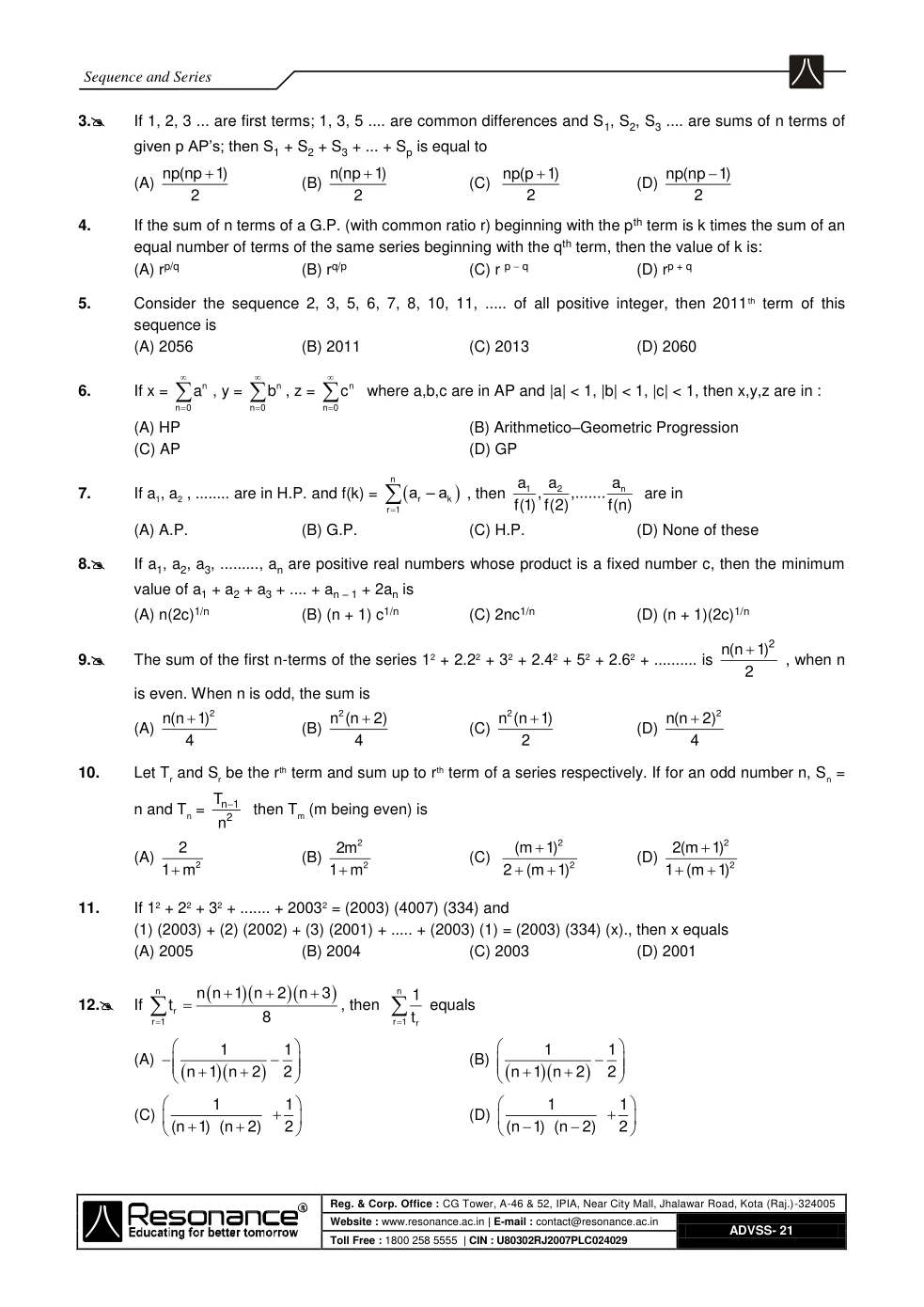
MAASSequence And Series
© MAAS. All rights reserved.Page 21 / 34
Extracted text · page 21
Sequence and Series
3. If 1, 2, 3 ... are first terms; 1, 3, 5 .... are common differences and S1, S2, S3 .... are sums of n terms of
given p AP’s; then S1 + S2 + S3 + ... + Sp is equal to
np(np 1) n(np 1) np(p 1) np(np 1)
(A) (B) (C) (D)
2 2 2 2
4. If the sum of n terms of a G.P. (with common ratio r) beginning with the pth term is k times the sum of an
equal number of terms of the same series beginning with the qth term, then the value of k is:
(A) rp/q (B) rq/p (C) r p q (D) rp + q
5. Consider the sequence 2, 3, 5, 6, 7, 8, 10, 11, ..... of all positive integer, then 2011th term of this
sequence is
(A) 2056 (B) 2011 (C) 2013 (D) 2060
6. If x = a n , y = b n , z = c n where a,b,c are in AP and |a| < 1, |b| < 1, |c| < 1, then x,y,z are in : n 0 n 0 n 0
(A) HP (B) Arithmetico–Geometric Progression
(C) AP (D) GP
n a1 a 2 an
7. If a1, a2 , ........ are in H.P. and f(k) = r 1 ar – ak , then f(1) , f(2) ,....... f(n) are in
(A) A.P. (B) G.P. (C) H.P. (D) None of these
8. If a1, a2, a3, ........., an are positive real numbers whose product is a fixed number c, then the minimum
value of a1 + a2 + a3 + .... + an – 1 + 2an is
(A) n(2c)1/n (B) (n + 1) c1/n (C) 2nc1/n (D) (n + 1)(2c)1/n
n(n 1)2
9. The sum of the first n-terms of the series 12 + 2.22 + 32 + 2.42 + 52 + 2.62 + .......... is , when n
2
is even. When n is odd, the sum is
n(n 1)2 n2 (n 2) n2 (n 1) n(n 2)2
(A) (B) (C) (D)
4 4 2 4
10. Let Tr and Sr be the rth term and sum up to rth term of a series respectively. If for an odd number n, Sn =
Tn 1
n and Tn = 2 then Tm (m being even) is
n
2 2m 2 (m 1)2 2(m 1)2
(A) 2 (B) 2 (C) 2 (D) 2 1 m 1 m 2 (m 1) 1 (m 1)
11. If 12 + 22 + 32 + ....... + 20032 = (2003) (4007) (334) and
(1) (2003) + (2) (2002) + (3) (2001) + ..... + (2003) (1) = (2003) (334) (x)., then x equals
(A) 2005 (B) 2004 (C) 2003 (D) 2001
n 1 n n n 1 n 2 n 3
12. If t r , then equals r 1 8 r 1 t r
1 1 1 1
(A) (B) n 1 n 2 2 n 1 n 2 2
1 1 1 1
(C) (D)
(n 1) (n 2) 2 (n 1) (n 2) 2
ADVSS- 21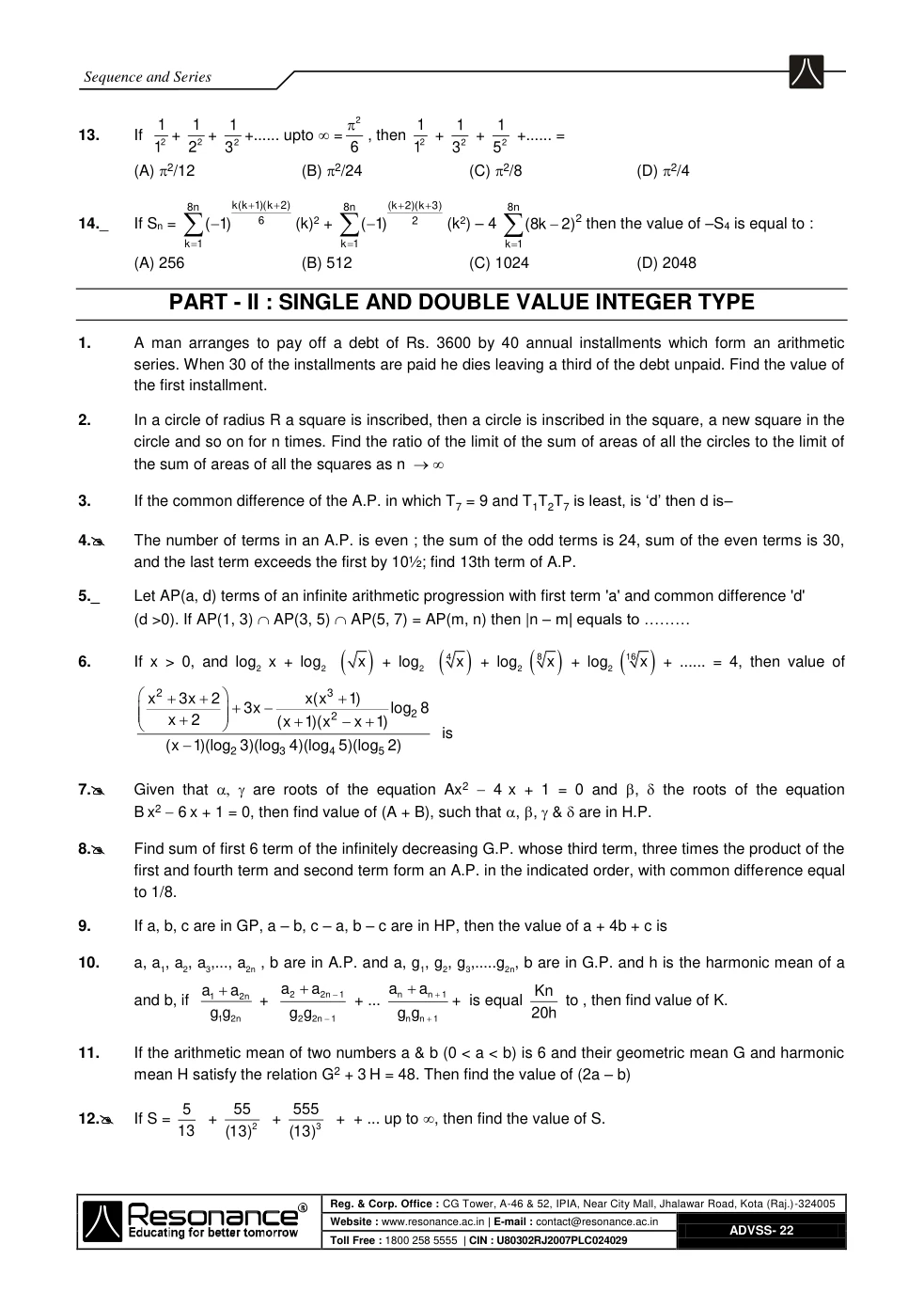
MAASSequence And Series
© MAAS. All rights reserved.Page 22 / 34
Extracted text · page 22
Sequence and Series
1 1 1 2 1 1 1
13. If 2 + 2 + 2 +...... upto = , then 2 + 2 + 2 +...... =
1 2 3 6 1 3 5
(A) 2/12 (B) 2/24 (C) 2/8 (D) 2/4
8n k ( k 1)( k 2 ) 8n ( k 2 )( k 3 ) 8n
14._ If Sn = ( )1 6 (k)2 + ( )1 2 (k2) – 4 ( 8k 22) then the value of –S4 is equal to :
k 1 k 1 k 1
(A) 256 (B) 512 (C) 1024 (D) 2048
PART - II : SINGLE AND DOUBLE VALUE INTEGER TYPE
1. A man arranges to pay off a debt of Rs. 3600 by 40 annual installments which form an arithmetic
series. When 30 of the installments are paid he dies leaving a third of the debt unpaid. Find the value of
the first installment.
2. In a circle of radius R a square is inscribed, then a circle is inscribed in the square, a new square in the
circle and so on for n times. Find the ratio of the limit of the sum of areas of all the circles to the limit of
the sum of areas of all the squares as n
3. If the common difference of the A.P. in which T7 = 9 and T1T2T7 is least, is ‘d’ then d is–
4. The number of terms in an A.P. is even ; the sum of the odd terms is 24, sum of the even terms is 30,
and the last term exceeds the first by 10½; find 13th term of A.P.
5._ Let AP(a, d) terms of an infinite arithmetic progression with first term 'a' and common difference 'd'
(d >0). If AP(1, 3) AP(3, 5) AP(5, 7) = AP(m, n) then |n – m| equals to ………
+ ...... = 4, then value of 16 x x 4 x 8 x + log2 6. If x > 0, and log2 x + log2 + log2 + log2
x 2 3x 2 x(x 3 1)
3x log2 8 x 2 (x 1)(x 2 x 1) is
(x 1)(log2 3)(log3 4)(log4 5)(log5 2)
7. Given that are roots of the equation Ax2 4 x + 1 = 0 and , the roots of the equation
B x2 6 x + 1 = 0, then find value of (A + B), such that , , & are in H.P.
8. Find sum of first 6 term of the infinitely decreasing G.P. whose third term, three times the product of the
first and fourth term and second term form an A.P. in the indicated order, with common difference equal
to 1/8.
9. If a, b, c are in GP, a – b, c – a, b – c are in HP, then the value of a + 4b + c is
10. a, a1, a2, a3,..., a2n , b are in A.P. and a, g1, g2, g3,.....g2n, b are in G.P. and h is the harmonic mean of a
a1 a 2n a 2 a 2n 1 an an 1 Kn
and b, if + + ... + is equal to , then find value of K.
g1g2n g2 g2n 1 gn gn 1 20h
11. If the arithmetic mean of two numbers a & b (0 < a < b) is 6 and their geometric mean G and harmonic
mean H satisfy the relation G2 + 3 H = 48. Then find the value of (2a – b)
5 55 555
12. If S = + 2 + 3 + + ... up to , then find the value of S.
13 (13) (13)
ADVSS- 22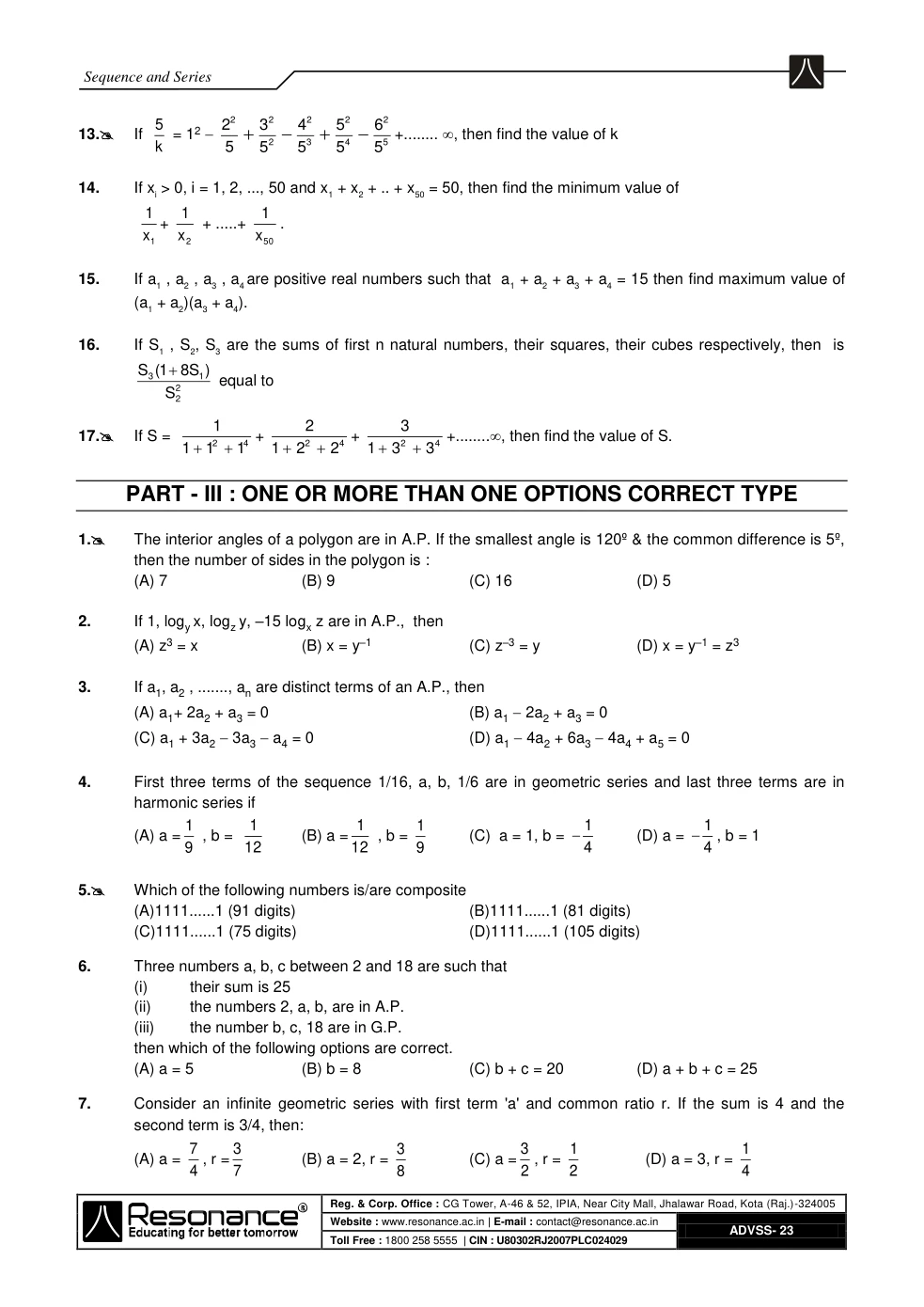
MAASSequence And Series
© MAAS. All rights reserved.Page 23 / 34
Extracted text · page 23
Sequence and Series
5 22 3 2 4 2 5 2 6 2
13. If = 12 2 3 4 5 +........ , then find the value of k
k 5 5 5 5 5
14. If xi > 0, i = 1, 2, ..., 50 and x1 + x2 + .. + x50 = 50, then find the minimum value of
1 1 1
+ + .....+ .
x 1 x 2 x 50
15. If a1 , a2 , a3 , a4 are positive real numbers such that a1 + a2 + a3 + a4 = 15 then find maximum value of
(a1 + a2)(a3 + a4).
16. If S1 , S2, S3 are the sums of first n natural numbers, their squares, their cubes respectively, then is
S 3 (1 8S1 )
2 equal to
S 2
1 2 3
17. If S = 2 4 + 2 4 + 2 4 +........, then find the value of S. 1 1 1 1 2 2 1 3 3
PART - III : ONE OR MORE THAN ONE OPTIONS CORRECT TYPE
1. The interior angles of a polygon are in A.P. If the smallest angle is 120º & the common difference is 5º,
then the number of sides in the polygon is :
(A) 7 (B) 9 (C) 16 (D) 5
2. If 1, logy x, logz y, –15 logx z are in A.P., then
(A) z3 = x (B) x = y–1 (C) z–3 = y (D) x = y–1 = z3
3. If a1, a2 , ......., an are distinct terms of an A.P., then
(A) a1+ 2a2 + a3 = 0 (B) a1 2a2 + a3 = 0
(C) a1 + 3a2 3a3 a4 = 0 (D) a1 4a2 + 6a3 4a4 + a5 = 0
4. First three terms of the sequence 1/16, a, b, 1/6 are in geometric series and last three terms are in
harmonic series if
1 1 1 1 1 1
(A) a = , b = (B) a = , b = (C) a = 1, b = (D) a = , b = 1
9 12 12 9 4 4
5. Which of the following numbers is/are composite
(A)1111......1 (91 digits) (B)1111......1 (81 digits)
(C)1111......1 (75 digits) (D)1111......1 (105 digits)
6. Three numbers a, b, c between 2 and 18 are such that
(i) their sum is 25
(ii) the numbers 2, a, b, are in A.P.
(iii) the number b, c, 18 are in G.P.
then which of the following options are correct.
(A) a = 5 (B) b = 8 (C) b + c = 20 (D) a + b + c = 25
7. Consider an infinite geometric series with first term 'a' and common ratio r. If the sum is 4 and the
second term is 3/4, then:
7 3 3 3 1 1
(A) a = , r = (B) a = 2, r = (C) a = , r = (D) a = 3, r =
4 7 8 2 2 4
ADVSS- 23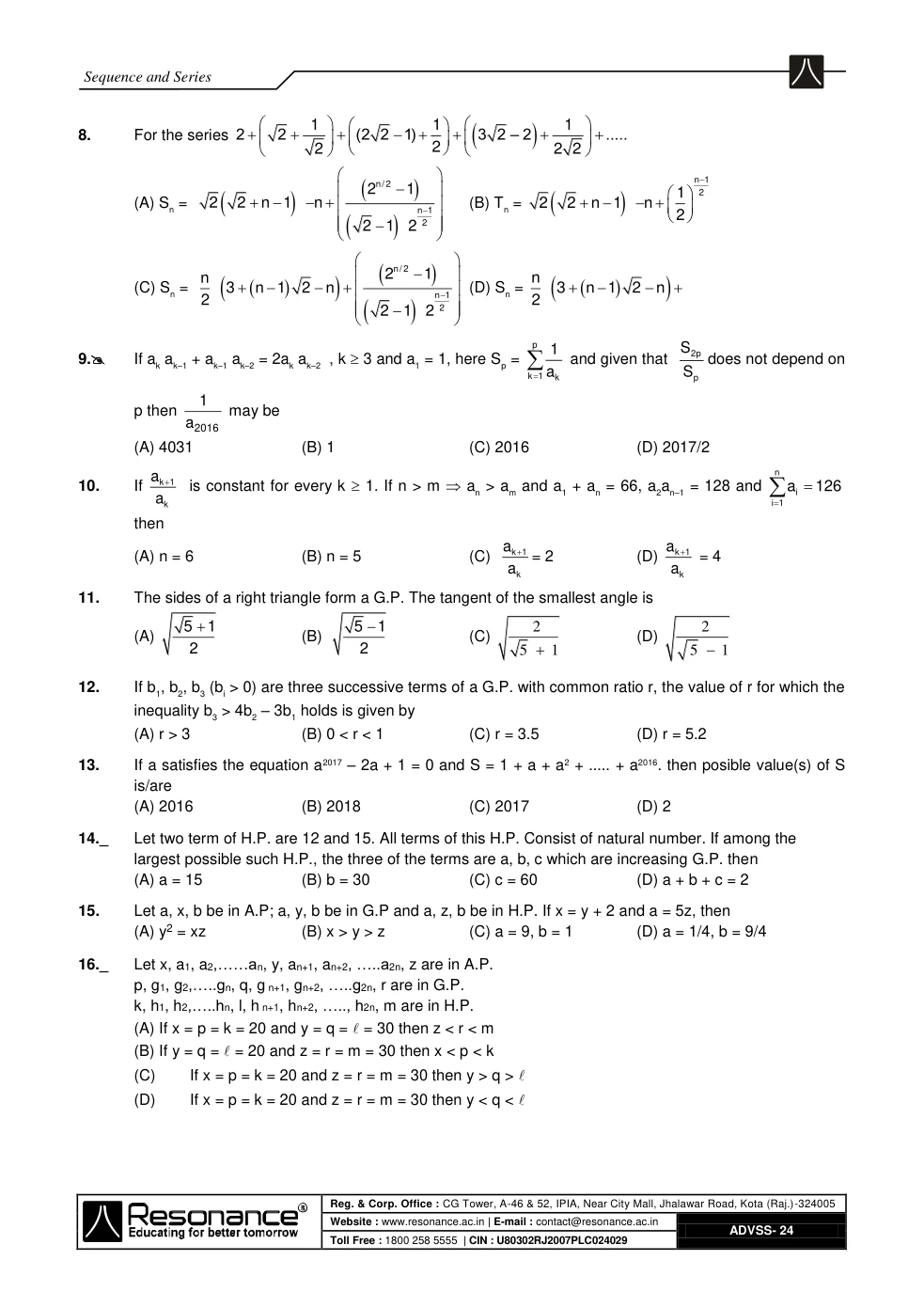
MAASSequence And Series
© MAAS. All rights reserved.Page 24 / 34
Extracted text · page 24
Sequence and Series
1 1 1
.....8. For the series 2 2 (2 2 1) 3 2 – 2 2 2 2 2
n 1 n/ 2
2 2 1 1 2 n 1 2 n 1 n (A) Sn = 2 n n 1 (B) Tn = 2
2 2 2 1 2
n 2 n/ 2 1 n (C) Sn = 3 n 1 2 n n 1 (D) Sn = 3 n 1 2 n
2 2 2 2 1 2
p 1 S 2p
9. If ak ak–1 + ak–1 ak–2 = 2ak ak–2 , k 3 and a1 = 1, here Sp = k 1 a k and given that S p does not depend on
1
p then may be
a 2016
(A) 4031 (B) 1 (C) 2016 (D) 2017/2
a k 1 n ai 12610. If is constant for every k 1. If n > m an > am and a1 + an = 66, a2an–1 = 128 and
a k i 1
then
a k 1 a k 1 (A) n = 6 (B) n = 5 (C) = 2 (D) = 4
a k a k
11. The sides of a right triangle form a G.P. The tangent of the smallest angle is
5 1 5 1 2 2
(A) (B) (C) (D)
2 2 5 1 5 1
12. If b1, b2, b3 (bi > 0) are three successive terms of a G.P. with common ratio r, the value of r for which the
inequality b3 > 4b2 – 3b1 holds is given by
(A) r > 3 (B) 0 < r < 1 (C) r = 3.5 (D) r = 5.2
13. If a satisfies the equation a2017 – 2a + 1 = 0 and S = 1 + a + a2 + ..... + a2016. then posible value(s) of S
is/are
(A) 2016 (B) 2018 (C) 2017 (D) 2
14._ Let two term of H.P. are 12 and 15. All terms of this H.P. Consist of natural number. If among the
largest possible such H.P., the three of the terms are a, b, c which are increasing G.P. then
(A) a = 15 (B) b = 30 (C) c = 60 (D) a + b + c = 2
15. Let a, x, b be in A.P; a, y, b be in G.P and a, z, b be in H.P. If x = y + 2 and a = 5z, then
(A) y2 = xz (B) x > y > z (C) a = 9, b = 1 (D) a = 1/4, b = 9/4
16._ Let x, a1, a2,……an, y, an+1, an+2, …..a2n, z are in A.P.
p, g1, g2,…..gn, q, g n+1, gn+2, …..g2n, r are in G.P.
k, h1, h2,…..hn, l, h n+1, hn+2, ….., h2n, m are in H.P.
(A) If x = p = k = 20 and y = q = = 30 then z < r < m
(B) If y = q = = 20 and z = r = m = 30 then x < p < k
(C) If x = p = k = 20 and z = r = m = 30 then y > q >
(D) If x = p = k = 20 and z = r = m = 30 then y < q <
ADVSS- 24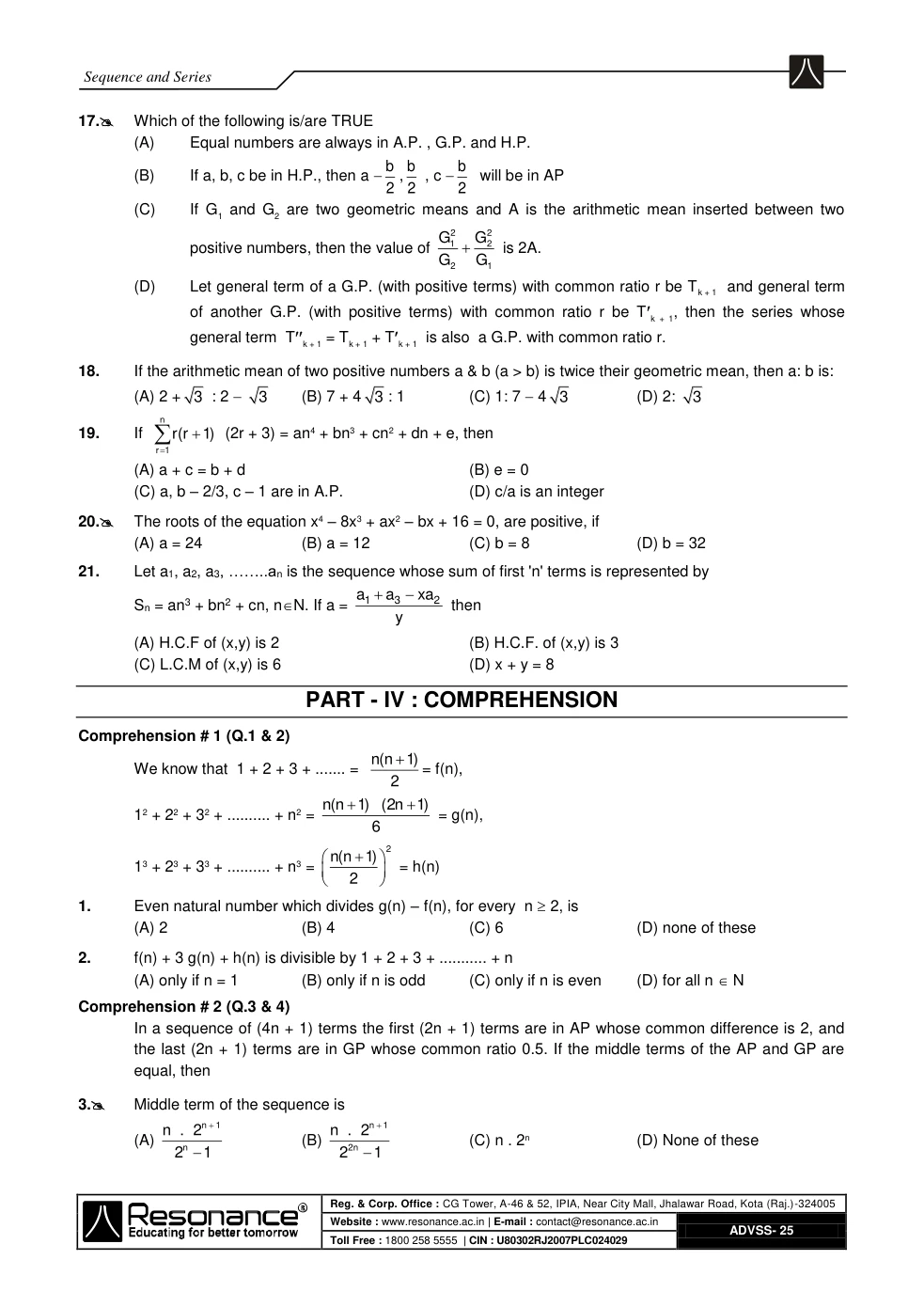
MAASSequence And Series
© MAAS. All rights reserved.Page 25 / 34
Extracted text · page 25
Sequence and Series
17. Which of the following is/are TRUE
(A) Equal numbers are always in A.P. , G.P. and H.P.
(B) If a, b, c be in H.P., then a b , b , c b will be in AP
2 2 2
(C) If G1 and G2 are two geometric means and A is the arithmetic mean inserted between two
G12 G22 positive numbers, then the value of is 2A.
G2 G1
(D) Let general term of a G.P. (with positive terms) with common ratio r be Tk + 1 and general term
of another G.P. (with positive terms) with common ratio r be Tk + 1, then the series whose
general term Tk + 1 = Tk + 1 + Tk + 1 is also a G.P. with common ratio r.
18. If the arithmetic mean of two positive numbers a & b (a > b) is twice their geometric mean, then a: b is:
(A) 2 + 3 : 2 3 (B) 7 + 4 3 : 1 (C) 1: 7 4 3 (D) 2: 3
n
19. If r(r 1) (2r + 3) = an4 + bn3 + cn2 + dn + e, then
r 1
(A) a + c = b + d (B) e = 0
(C) a, b – 2/3, c – 1 are in A.P. (D) c/a is an integer
20. The roots of the equation x4 – 8x3 + ax2 – bx + 16 = 0, are positive, if
(A) a = 24 (B) a = 12 (C) b = 8 (D) b = 32
21. Let a1, a2, a3, ……..an is the sequence whose sum of first 'n' terms is represented by
a1 a3 xa 2 Sn = an3 + bn2 + cn, nN. If a = then
y
(A) H.C.F of (x,y) is 2 (B) H.C.F. of (x,y) is 3
(C) L.C.M of (x,y) is 6 (D) x + y = 8
PART - IV : COMPREHENSION
Comprehension # 1 (Q.1 & 2)
n(n 1)
We know that 1 + 2 + 3 + ....... = = f(n),
2
n(n 1) (2n 1)
12 + 22 + 32 + .......... + n2 = = g(n),
6
n(n 1) 2
13 + 23 + 33 + .......... + n3 = = h(n)
2
1. Even natural number which divides g(n) – f(n), for every n 2, is
(A) 2 (B) 4 (C) 6 (D) none of these
2. f(n) + 3 g(n) + h(n) is divisible by 1 + 2 + 3 + ........... + n
(A) only if n = 1 (B) only if n is odd (C) only if n is even (D) for all n N
Comprehension # 2 (Q.3 & 4)
In a sequence of (4n + 1) terms the first (2n + 1) terms are in AP whose common difference is 2, and
the last (2n + 1) terms are in GP whose common ratio 0.5. If the middle terms of the AP and GP are
equal, then
3. Middle term of the sequence is
n . 2n 1 n . 2n 1
(A) n (B) 2n (C) n . 2n (D) None of these 2 1 2 1
ADVSS- 25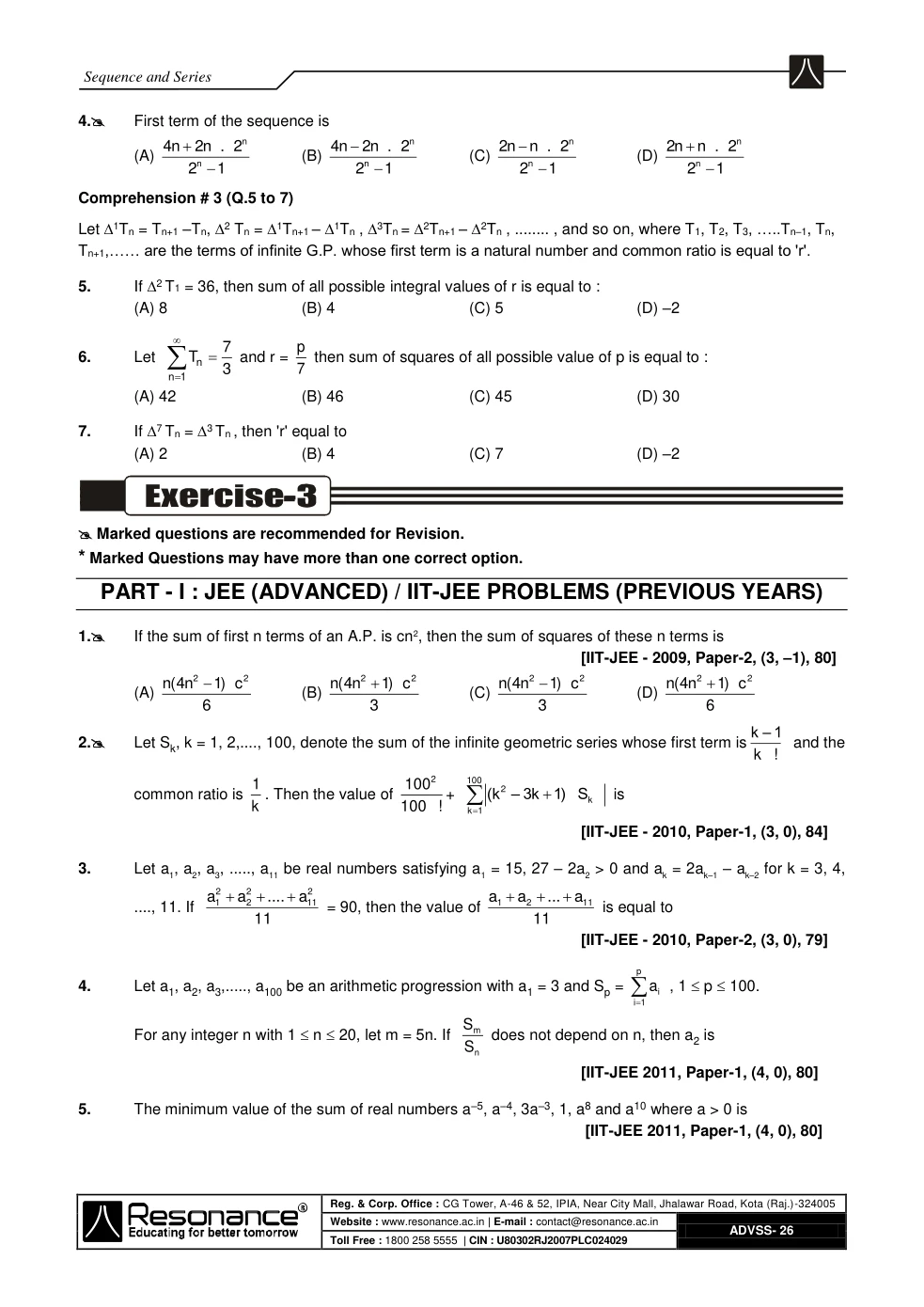
MAASSequence And Series
© MAAS. All rights reserved.Page 26 / 34
Extracted text · page 26
Sequence and Series
4. First term of the sequence is
4n 2n . 2n 4n 2n . 2n 2n n . 2n 2n n . 2n
(A) n (B) n (C) n (D) n 2 1 2 1 2 1 2 1
Comprehension # 3 (Q.5 to 7)
Let 1Tn = Tn+1 –Tn, 2 Tn = 1Tn+1 – 1Tn , 3Tn = 2Tn+1 – 2Tn , ........ , and so on, where T1, T2, T3, …..Tn–1, Tn,
Tn+1,…… are the terms of infinite G.P. whose first term is a natural number and common ratio is equal to 'r'.
5. If 2 T1 = 36, then sum of all possible integral values of r is equal to :
(A) 8 (B) 4 (C) 5 (D) –2
7 p
6. Let Tn and r = then sum of squares of all possible value of p is equal to : 3 7 n 1
(A) 42 (B) 46 (C) 45 (D) 30
7. If 7 Tn = 3 Tn , then 'r' equal to
(A) 2 (B) 4 (C) 7 (D) –2
Marked questions are recommended for Revision.
* Marked Questions may have more than one correct option.
PART - I : JEE (ADVANCED) / IIT-JEE PROBLEMS (PREVIOUS YEARS)
1. If the sum of first n terms of an A.P. is cn2, then the sum of squares of these n terms is
[IIT-JEE - 2009, Paper-2, (3, –1), 80]
n(4n2 1) c 2 n(4n2 1) c 2 n(4n2 1) c 2 n(4n2 1) c 2
(A) (B) (C) (D)
6 3 3 6
k – 1
2. Let Sk, k = 1, 2,...., 100, denote the sum of the infinite geometric series whose first term is and the
k !
1 100 2 100 2
common ratio is . Then the value of + is (k – 3k 1) Sk k 100 ! k 1
[IIT-JEE - 2010, Paper-1, (3, 0), 84]
3. Let a1, a2, a3, ....., a11 be real numbers satisfying a1 = 15, 27 – 2a2 > 0 and ak = 2ak–1 – ak–2 for k = 3, 4,
a12 a 22 .... a112 a1 a 2 ... a11 ...., 11. If = 90, then the value of is equal to
11 11
[IIT-JEE - 2010, Paper-2, (3, 0), 79]
p
a i , 1 p 100.4. Let a1, a2, a3,....., a100 be an arithmetic progression with a1 = 3 and Sp = i 1
S m
For any integer n with 1 n 20, let m = 5n. If does not depend on n, then a2 is
S n
[IIT-JEE 2011, Paper-1, (4, 0), 80]
5. The minimum value of the sum of real numbers a–5, a–4, 3a–3, 1, a8 and a10 where a > 0 is
[IIT-JEE 2011, Paper-1, (4, 0), 80]
ADVSS- 26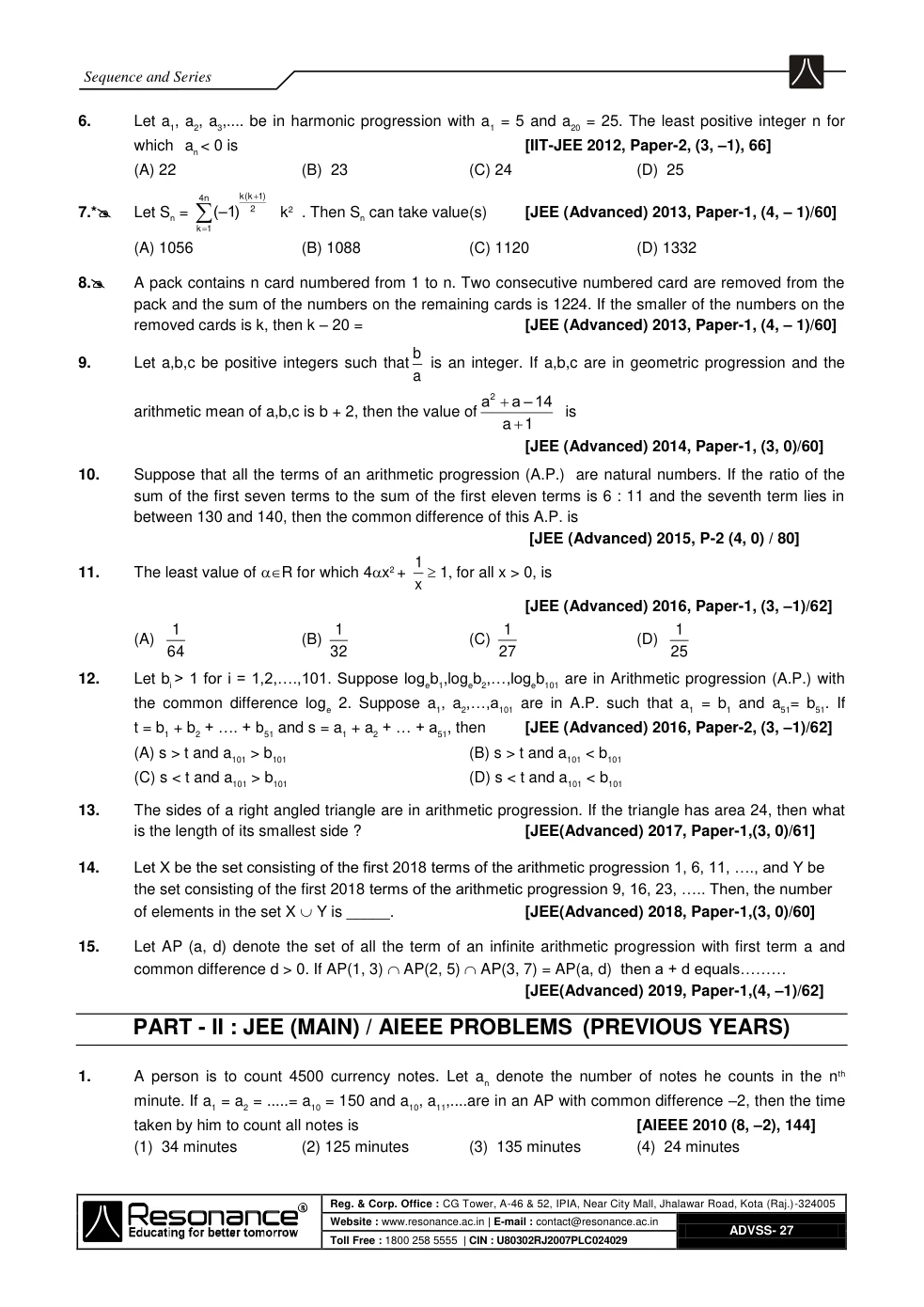
MAASSequence And Series
© MAAS. All rights reserved.Page 27 / 34
Extracted text · page 27
Sequence and Series
6. Let a1, a2, a3,.... be in harmonic progression with a1 = 5 and a20 = 25. The least positive integer n for
which an < 0 is [IIT-JEE 2012, Paper-2, (3, –1), 66]
(A) 22 (B) 23 (C) 24 (D) 25
4n k(k 1)
7.* Let Sn = 2 k2 . Then Sn can take value(s) [JEE (Advanced) 2013, Paper-1, (4, – 1)/60] k 1 (–1)
(A) 1056 (B) 1088 (C) 1120 (D) 1332
8. A pack contains n card numbered from 1 to n. Two consecutive numbered card are removed from the
pack and the sum of the numbers on the remaining cards is 1224. If the smaller of the numbers on the
removed cards is k, then k – 20 = [JEE (Advanced) 2013, Paper-1, (4, – 1)/60]
b
9. Let a,b,c be positive integers such that is an integer. If a,b,c are in geometric progression and the
a
a 2 a –14
arithmetic mean of a,b,c is b + 2, then the value of is
a 1
[JEE (Advanced) 2014, Paper-1, (3, 0)/60]
10. Suppose that all the terms of an arithmetic progression (A.P.) are natural numbers. If the ratio of the
sum of the first seven terms to the sum of the first eleven terms is 6 : 11 and the seventh term lies in
between 130 and 140, then the common difference of this A.P. is
[JEE (Advanced) 2015, P-2 (4, 0) / 80]
1
11. The least value of R for which 4x2 + 1for all x > 0, is
x
[JEE (Advanced) 2016, Paper-1, (3, –1)/62]
1 1 1 1
(A) (B) (C) (D)
64 32 27 25
12. Let bi > 1 for i = 1,2,….,101. Suppose logeb1,logeb2,…,logeb101 are in Arithmetic progression (A.P.) with
the common difference loge 2. Suppose a1, a2,…,a101 are in A.P. such that a1 = b1 and a51= b51. If
t = b1 + b2 + …. + b51 and s = a1 + a2 + … + a51, then [JEE (Advanced) 2016, Paper-2, (3, –1)/62]
(A) s > t and a101 > b101 (B) s > t and a101 < b101
(C) s < t and a101 > b101 (D) s < t and a101 < b101
13. The sides of a right angled triangle are in arithmetic progression. If the triangle has area 24, then what
is the length of its smallest side ? [JEE(Advanced) 2017, Paper-1,(3, 0)/61]
14. Let X be the set consisting of the first 2018 terms of the arithmetic progression 1, 6, 11, …., and Y be
the set consisting of the first 2018 terms of the arithmetic progression 9, 16, 23, ….. Then, the number
of elements in the set X Y is _____. [JEE(Advanced) 2018, Paper-1,(3, 0)/60]
15. Let AP (a, d) denote the set of all the term of an infinite arithmetic progression with first term a and
common difference d > 0. If AP(1, 3) AP(2, 5) AP(3, 7) = AP(a, d) then a + d equals………
[JEE(Advanced) 2019, Paper-1,(4, –1)/62]
PART - II : JEE (MAIN) / AIEEE PROBLEMS (PREVIOUS YEARS)
1. A person is to count 4500 currency notes. Let an denote the number of notes he counts in the nth
minute. If a1 = a2 = .....= a10 = 150 and a10, a11,....are in an AP with common difference –2, then the time
taken by him to count all notes is [AIEEE 2010 (8, –2), 144]
(1) 34 minutes (2) 125 minutes (3) 135 minutes (4) 24 minutes
ADVSS- 27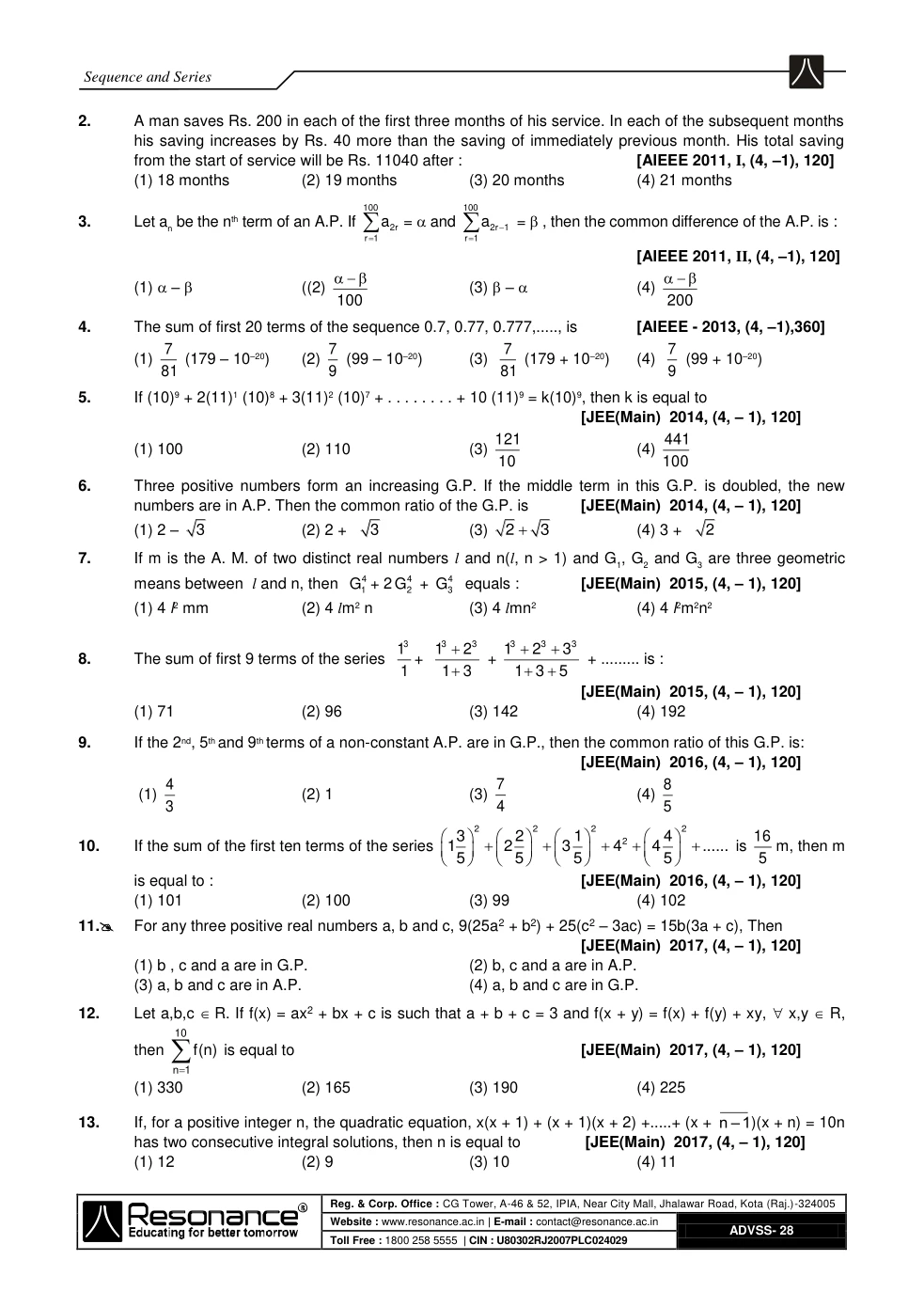
MAASSequence And Series
© MAAS. All rights reserved.Page 28 / 34
Extracted text · page 28
Sequence and Series
2. A man saves Rs. 200 in each of the first three months of his service. In each of the subsequent months
his saving increases by Rs. 40 more than the saving of immediately previous month. His total saving
from the start of service will be Rs. 11040 after : [AIEEE 2011, I, (4, –1), 120]
(1) 18 months (2) 19 months (3) 20 months (4) 21 months
100 100
a 2r 1 = , then the common difference of the A.P. is :3. Let an be the nth term of an A.P. If r 1 a 2r = and r 1
[AIEEE 2011, II, (4, –1), 120]
(1) – ((2) (3) – (4)
100 200
4. The sum of first 20 terms of the sequence 0.7, 0.77, 0.777,....., is [AIEEE - 2013, (4, –1),360]
7 7 7 7
(1) (179 – 10–20) (2) (99 – 10–20) (3) (179 + 10–20) (4) (99 + 10–20)
81 9 81 9
5. If (10)9 + 2(11)1 (10)8 + 3(11)2 (10)7 + . . . . . . . . + 10 (11)9 = k(10)9, then k is equal to
[JEE(Main) 2014, (4, – 1), 120]
121 441
(1) 100 (2) 110 (3) (4)
10 100
6. Three positive numbers form an increasing G.P. If the middle term in this G.P. is doubled, the new
numbers are in A.P. Then the common ratio of the G.P. is [JEE(Main) 2014, (4, – 1), 120]
(1) 2 – 3 (2) 2 + 3 (3) 2 3 (4) 3 + 2
7. If m is the A. M. of two distinct real numbers l and n(l, n > 1) and G1, G2 and G3 are three geometric
means between l and n, then G14 + 2 G 24 + G34 equals : [JEE(Main) 2015, (4, – 1), 120]
(1) 4 l2 mm (2) 4 lm2 n (3) 4 lmn2 (4) 4 l2m2n2
31 13 23 13 23 3 3
8. The sum of first 9 terms of the series + + + ......... is :
1 1 3 1 3 5
[JEE(Main) 2015, (4, – 1), 120]
(1) 71 (2) 96 (3) 142 (4) 192
9. If the 2nd, 5th and 9th terms of a non-constant A.P. are in G.P., then the common ratio of this G.P. is:
[JEE(Main) 2016, (4, – 1), 120]
4 7 8
(1) (2) 1 (3) (4)
3 4 5
3 2 2 2 1 2 2 4 2 16
10. If the sum of the first ten terms of the series 1 2 3 4 4 ...... is m, then m
5 5 5 5 5
is equal to : [JEE(Main) 2016, (4, – 1), 120]
(1) 101 (2) 100 (3) 99 (4) 102
11. For any three positive real numbers a, b and c, 9(25a2 + b2) + 25(c2 – 3ac) = 15b(3a + c), Then
[JEE(Main) 2017, (4, – 1), 120]
(1) b , c and a are in G.P. (2) b, c and a are in A.P.
(3) a, b and c are in A.P. (4) a, b and c are in G.P.
12. Let a,b,c R. If f(x) = ax2 + bx + c is such that a + b + c = 3 and f(x + y) = f(x) + f(y) + xy, x,y R,
10
then f(n) is equal to [JEE(Main) 2017, (4, – 1), 120] n 1
(1) 330 (2) 165 (3) 190 (4) 225
13. If, for a positive integer n, the quadratic equation, x(x + 1) + (x + 1)(x + 2) +.....+ (x + n –1)(x + n) = 10n
has two consecutive integral solutions, then n is equal to [JEE(Main) 2017, (4, – 1), 120]
(1) 12 (2) 9 (3) 10 (4) 11
ADVSS- 28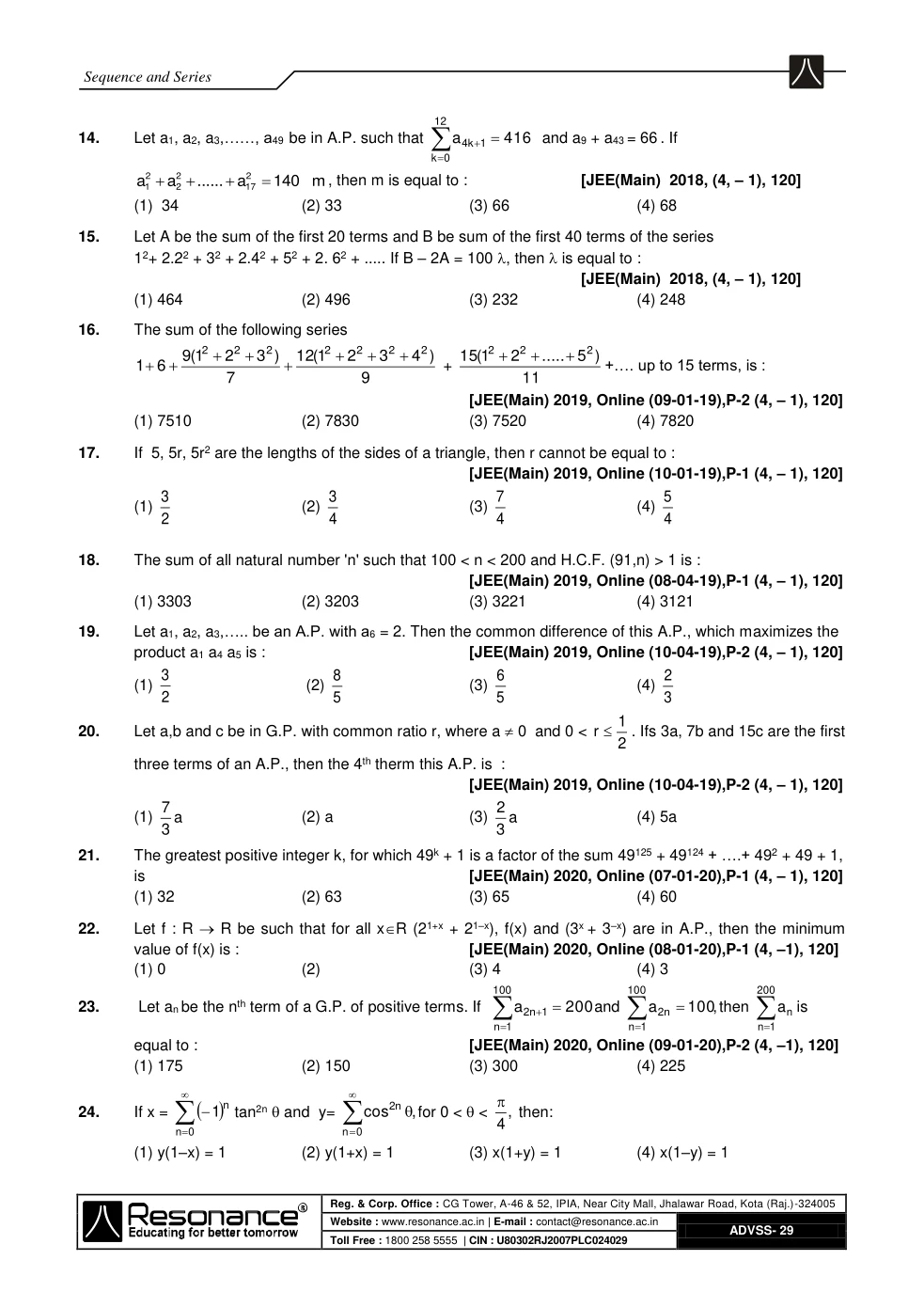
MAASSequence And Series
© MAAS. All rights reserved.Page 29 / 34
Extracted text · page 29
Sequence and Series
12
14. Let a1, a2, a3,……, a49 be in A.P. such that a 4k 1 416 and a9 + a43 = 66 . If
k 0
a12 a22 ...... a172 140 m , then m is equal to : [JEE(Main) 2018, (4, – 1), 120]
(1) 34 (2) 33 (3) 66 (4) 68
15. Let A be the sum of the first 20 terms and B be sum of the first 40 terms of the series
12+ 2.22 + 32 + 2.42 + 52 + 2. 62 + ..... If B – 2A = 100 , then is equal to :
[JEE(Main) 2018, (4, – 1), 120]
(1) 464 (2) 496 (3) 232 (4) 248
16. The sum of the following series
9(12 2 2 3 2 ) 12(12 2 2 3 2 4 2 ) 15(12 2 2 ..... 5 2 )
1 6 + +…. up to 15 terms, is :
7 9 11
[JEE(Main) 2019, Online (09-01-19),P-2 (4, – 1), 120]
(1) 7510 (2) 7830 (3) 7520 (4) 7820
17. If 5, 5r, 5r2 are the lengths of the sides of a triangle, then r cannot be equal to :
[JEE(Main) 2019, Online (10-01-19),P-1 (4, – 1), 120]
3 3 7 5
(1) (2) (3) (4)
2 4 4 4
18. The sum of all natural number 'n' such that 100 < n < 200 and H.C.F. (91,n) > 1 is :
[JEE(Main) 2019, Online (08-04-19),P-1 (4, – 1), 120]
(1) 3303 (2) 3203 (3) 3221 (4) 3121
19. Let a1, a2, a3,….. be an A.P. with a6 = 2. Then the common difference of this A.P., which maximizes the
product a1 a4 a5 is : [JEE(Main) 2019, Online (10-04-19),P-2 (4, – 1), 120]
3 8 6 2
(1) (2) (3) (4)
2 5 5 3
1
20. Let a,b and c be in G.P. with common ratio r, where a 0 and 0 < r . Ifs 3a, 7b and 15c are the first
2
three terms of an A.P., then the 4th therm this A.P. is :
[JEE(Main) 2019, Online (10-04-19),P-2 (4, – 1), 120]
7 2
(1) a (2) a (3) a (4) 5a
3 3
21. The greatest positive integer k, for which 49k + 1 is a factor of the sum 49125 + 49124 + ….+ 492 + 49 + 1,
is [JEE(Main) 2020, Online (07-01-20),P-1 (4, – 1), 120]
(1) 32 (2) 63 (3) 65 (4) 60
22. Let f : R R be such that for all xR (21+x + 21–x), f(x) and (3x + 3–x) are in A.P., then the minimum
value of f(x) is : [JEE(Main) 2020, Online (08-01-20),P-1 (4, –1), 120]
(1) 0 (2) (3) 4 (4) 3
100 100 200
23. Let an be the nth term of a G.P. of positive terms. If a 2n 1 200 and a 2n 100, then a n is
n 1 n 1 n 1
equal to : [JEE(Main) 2020, Online (09-01-20),P-2 (4, –1), 120]
(1) 175 (2) 150 (3) 300 (4) 225
n 2n cos , for 0 < < , then:24. If x = 1 tan2n and y= 4 n 0 n 0
(1) y(1–x) = 1 (2) y(1+x) = 1 (3) x(1+y) = 1 (4) x(1–y) = 1
ADVSS- 29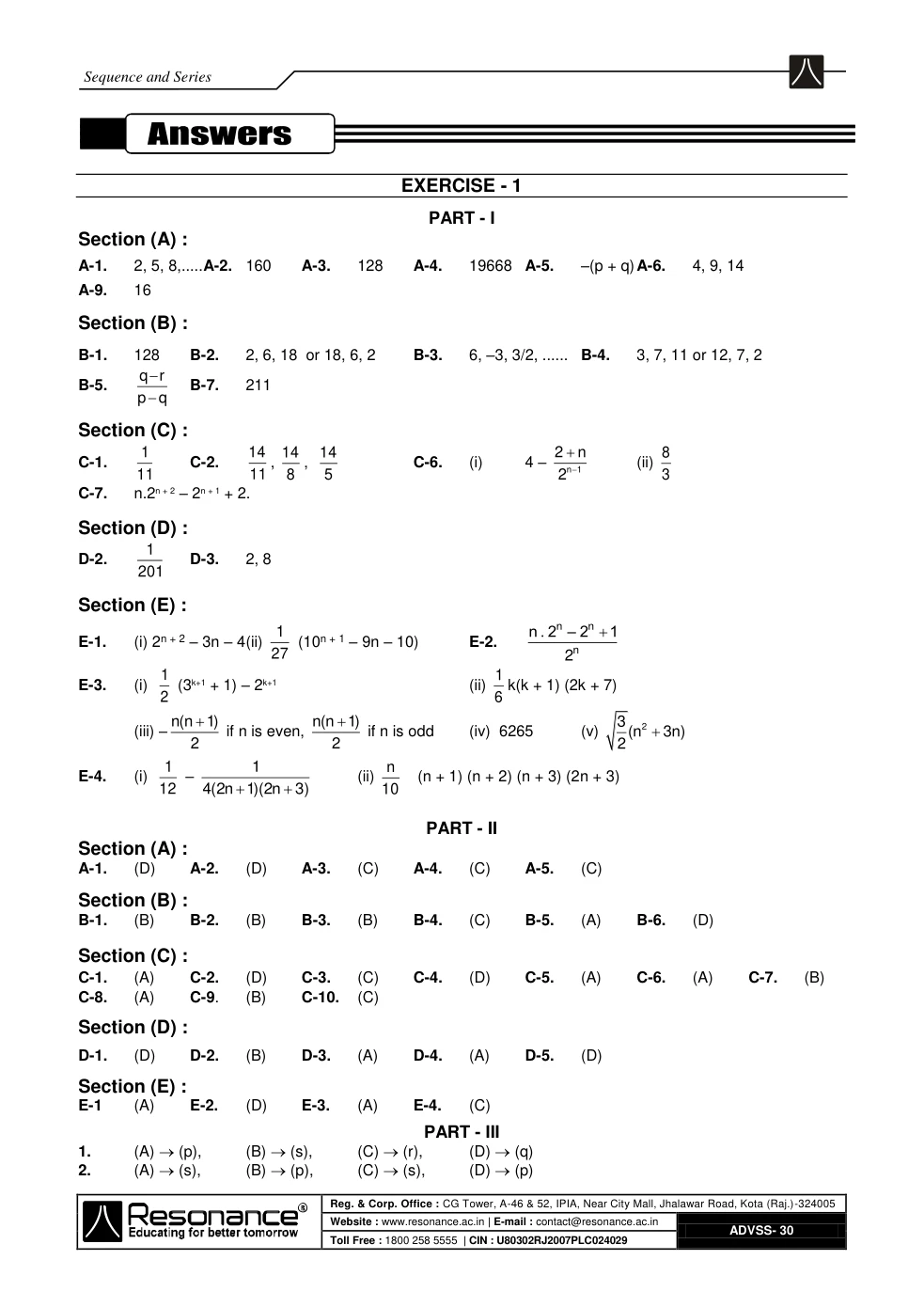
MAASSequence And Series
© MAAS. All rights reserved.Page 30 / 34
Extracted text · page 30
Sequence and Series
EXERCISE - 1
PART - I
Section (A) :
A-1. 2, 5, 8,.....A-2. 160 A-3. 128 A-4. 19668 A-5. –(p + q) A-6. 4, 9, 14
A-9. 16
Section (B) :
B-1. 128 B-2. 2, 6, 18 or 18, 6, 2 B-3. 6, –3, 3/2, ...... B-4. 3, 7, 11 or 12, 7, 2
q r
B-5. B-7. 211
p q
Section (C) :
1 14 14 14 2 n 8
C-1. C-2. , , C-6. (i) 4 – n 1 (ii)
11 11 8 5 2 3
C-7. n.2n + 2 – 2n + 1 + 2.
Section (D) :
1
D-2. D-3. 2, 8
201
Section (E) :
+ 2 1 + 1 n . 2n – 2n 1E-1. (i) 2n – 3n – 4 (ii) (10n – 9n – 10) E-2. n 27 2
1 1
E-3. (i) (3k+1 + 1) – 2k+1 (ii) k(k + 1) (2k + 7)
2 6
n(n 1) n(n 1) 2 (iii) – if n is even, if n is odd (iv) 6265 (v) 3(n 3n)
2 2 2
1 1 n
E-4. (i) – (ii) (n + 1) (n + 2) (n + 3) (2n + 3)
12 4(2n 1)(2n 3) 10
PART - II
Section (A) :
A-1. (D) A-2. (D) A-3. (C) A-4. (C) A-5. (C)
Section (B) :
B-1. (B) B-2. (B) B-3. (B) B-4. (C) B-5. (A) B-6. (D)
Section (C) :
C-1. (A) C-2. (D) C-3. (C) C-4. (D) C-5. (A) C-6. (A) C-7. (B)
C-8. (A) C-9. (B) C-10. (C)
Section (D) :
D-1. (D) D-2. (B) D-3. (A) D-4. (A) D-5. (D)
Section (E) :
E-1 (A) E-2. (D) E-3. (A) E-4. (C)
PART - III
1. (A) (p), (B) (s), (C) (r), (D) (q)
2. (A) (s), (B) (p), (C) (s), (D) (p)
ADVSS- 30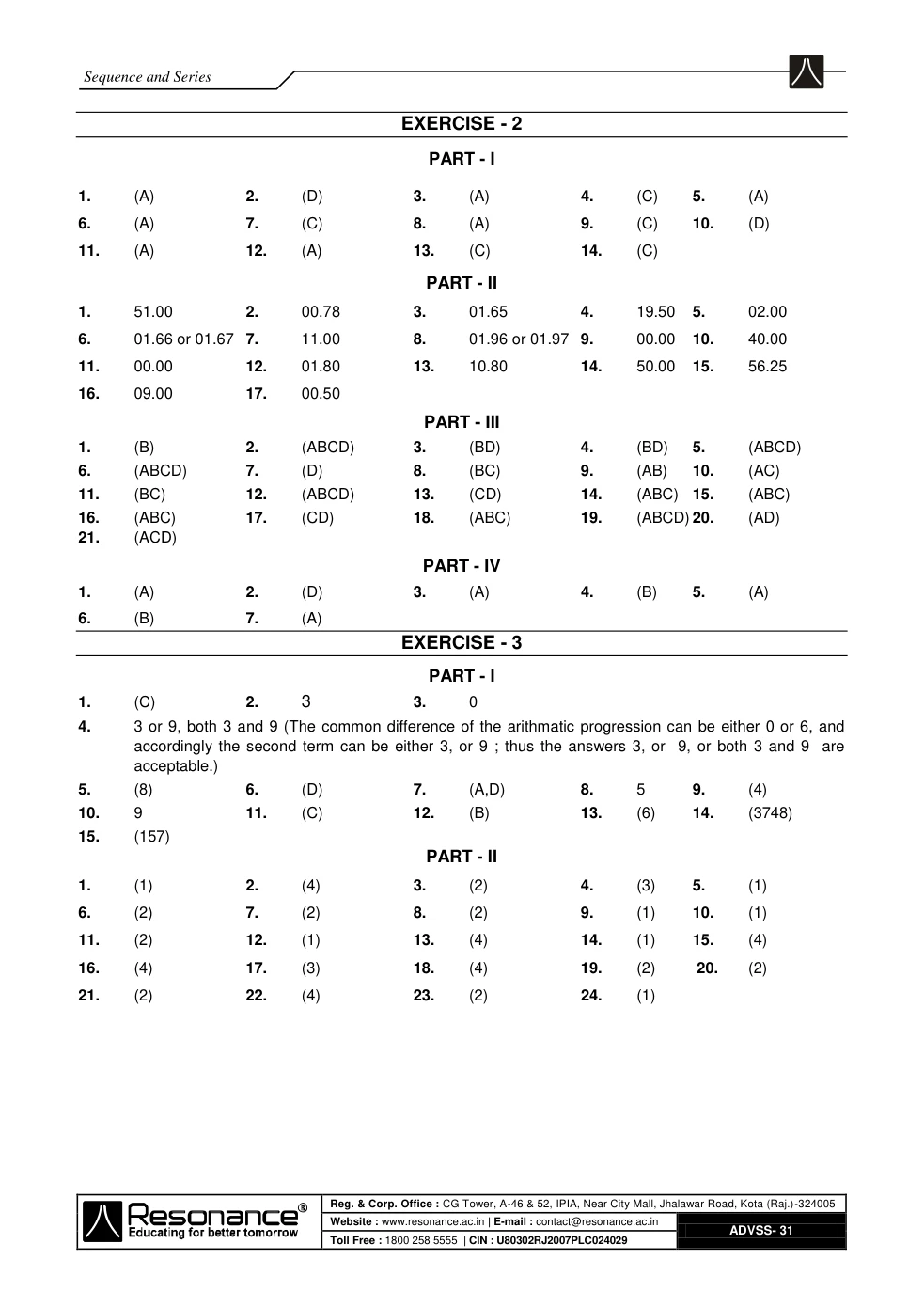
MAASSequence And Series
© MAAS. All rights reserved.Page 31 / 34
Extracted text · page 31
 Sequence and Series


                           EXERCISE - 2

                              PART - I

1.      (A)              2.      (D)              3.      (A)              4.      (C)     5.      (A)

6.      (A)              7.      (C)              8.      (A)              9.      (C)     10.     (D)

11.     (A)             12.     (A)             13.     (C)             14.     (C)

                              PART - II

1.      51.00           2.      00.78           3.      01.65           4.      19.50   5.      02.00

6.      01.66 or 01.67  7.      11.00           8.      01.96 or 01.97  9.      00.00  10.    40.00

11.    00.00          12.    01.80          13.    10.80          14.    50.00  15.    56.25

16.    09.00          17.    00.50

                              PART - III

1.      (B)              2.     (ABCD)         3.     (BD)            4.     (BD)    5.     (ABCD)

6.     (ABCD)         7.      (D)              8.     (BC)            9.      (AB)    10.    (AC)

11.    (BC)           12.    (ABCD)        13.    (CD)           14.    (ABC)  15.    (ABC)

16.    (ABC)          17.    (CD)           18.    (ABC)          19.    (ABCD) 20.    (AD)
21.    (ACD)

                              PART - IV

1.      (A)              2.      (D)              3.      (A)              4.      (B)     5.      (A)

6.      (B)              7.      (A)
                           EXERCISE - 3

                              PART - I
1.      (C)              2.     3                3.     0

4.     3 or 9, both 3 and 9 (The common difference of the arithmatic progression can be either 0 or 6, and
        accordingly the second term can be either 3, or 9  ; thus the answers 3, or  9, or both 3 and 9  are
        acceptable.)

5.       (8)              6.      (D)              7.      (A,D)            8.     5       9.       (4)

10.    9              11.     (C)             12.     (B)             13.     (6)     14.     (3748)

15.     (157)
                              PART - II

1.       (1)              2.       (4)              3.       (2)              4.       (3)      5.       (1)

6.       (2)              7.       (2)              8.       (2)              9.       (1)     10.     (1)

11.     (2)             12.     (1)             13.     (4)             14.     (1)     15.     (4)

16.     (4)             17.     (3)             18.     (4)             19.     (2)      20.     (2)

21.     (2)             22.     (4)             23.     (2)             24.     (1)


                                                                                   ADVSS- 31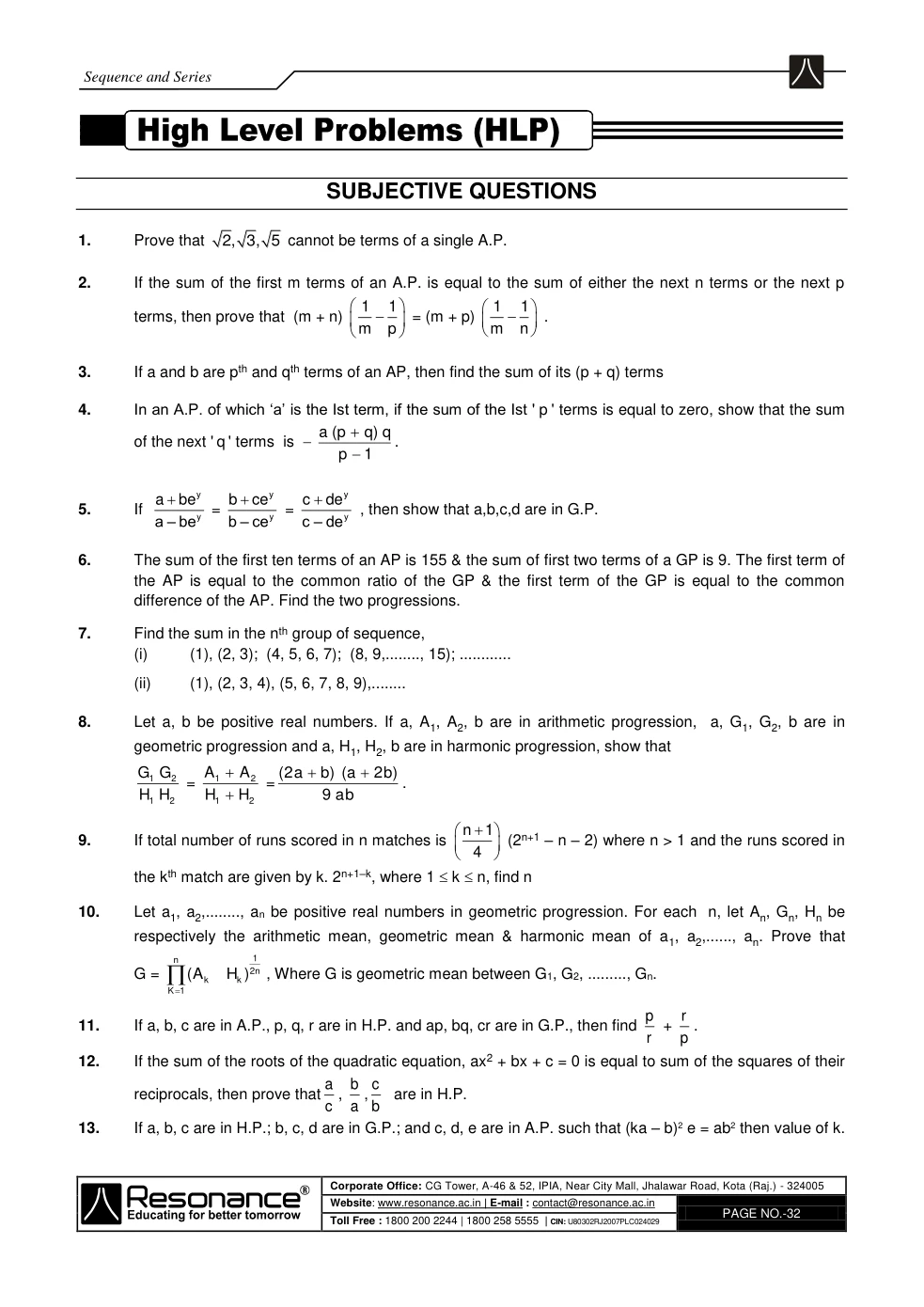
MAASSequence And Series
© MAAS. All rights reserved.Page 32 / 34
Extracted text · page 32
Sequence and Series
SUBJECTIVE QUESTIONS
1. Prove that 2, 3, 5 cannot be terms of a single A.P.
2. If the sum of the first m terms of an A.P. is equal to the sum of either the next n terms or the next p
1 1 1 1
terms, then prove that (m + n) = (m + p) .
m p m n
3. If a and b are pth and qth terms of an AP, then find the sum of its (p + q) terms
4. In an A.P. of which ‘a’ is the Ist term, if the sum of the Ist ' p ' terms is equal to zero, show that the sum
of the next ' q ' terms is a (p q) q .
p 1
a be y b ce y c de y
5. If y = y = y , then show that a,b,c,d are in G.P. a – be b – ce c – de
6. The sum of the first ten terms of an AP is 155 & the sum of first two terms of a GP is 9. The first term of
the AP is equal to the common ratio of the GP & the first term of the GP is equal to the common
difference of the AP. Find the two progressions.
7. Find the sum in the nth group of sequence,
(i) (1), (2, 3); (4, 5, 6, 7); (8, 9,........, 15); ............
(ii) (1), (2, 3, 4), (5, 6, 7, 8, 9),........
8. Let a, b be positive real numbers. If a, A1, A2, b are in arithmetic progression, a, G1, G2, b are in
geometric progression and a, H1, H2, b are in harmonic progression, show that
G1 G 2 A 1 A 2 (2a b) (a 2b) = = .
H1 H2 H1 H2 9 ab
n 1
9. If total number of runs scored in n matches is (2n+1 – n – 2) where n > 1 and the runs scored in
4
the kth match are given by k. 2n+1–k, where 1 k n, find n
10. Let a1, a2,........, an be positive real numbers in geometric progression. For each n, let An, Gn, Hn be
respectively the arithmetic mean, geometric mean & harmonic mean of a1, a2,......, an. Prove that
n 1
G = (A k Hk ) 2n , Where G is geometric mean between G1, G2, ........., Gn. K 1
p r
11. If a, b, c are in A.P., p, q, r are in H.P. and ap, bq, cr are in G.P., then find + .
r p
12. If the sum of the roots of the quadratic equation, ax2 + bx + c = 0 is equal to sum of the squares of their
a b c
reciprocals, then prove that , , are in H.P.
c a b
13. If a, b, c are in H.P.; b, c, d are in G.P.; and c, d, e are in A.P. such that (ka – b)2 e = ab2 then value of k.
PAGE NO.-32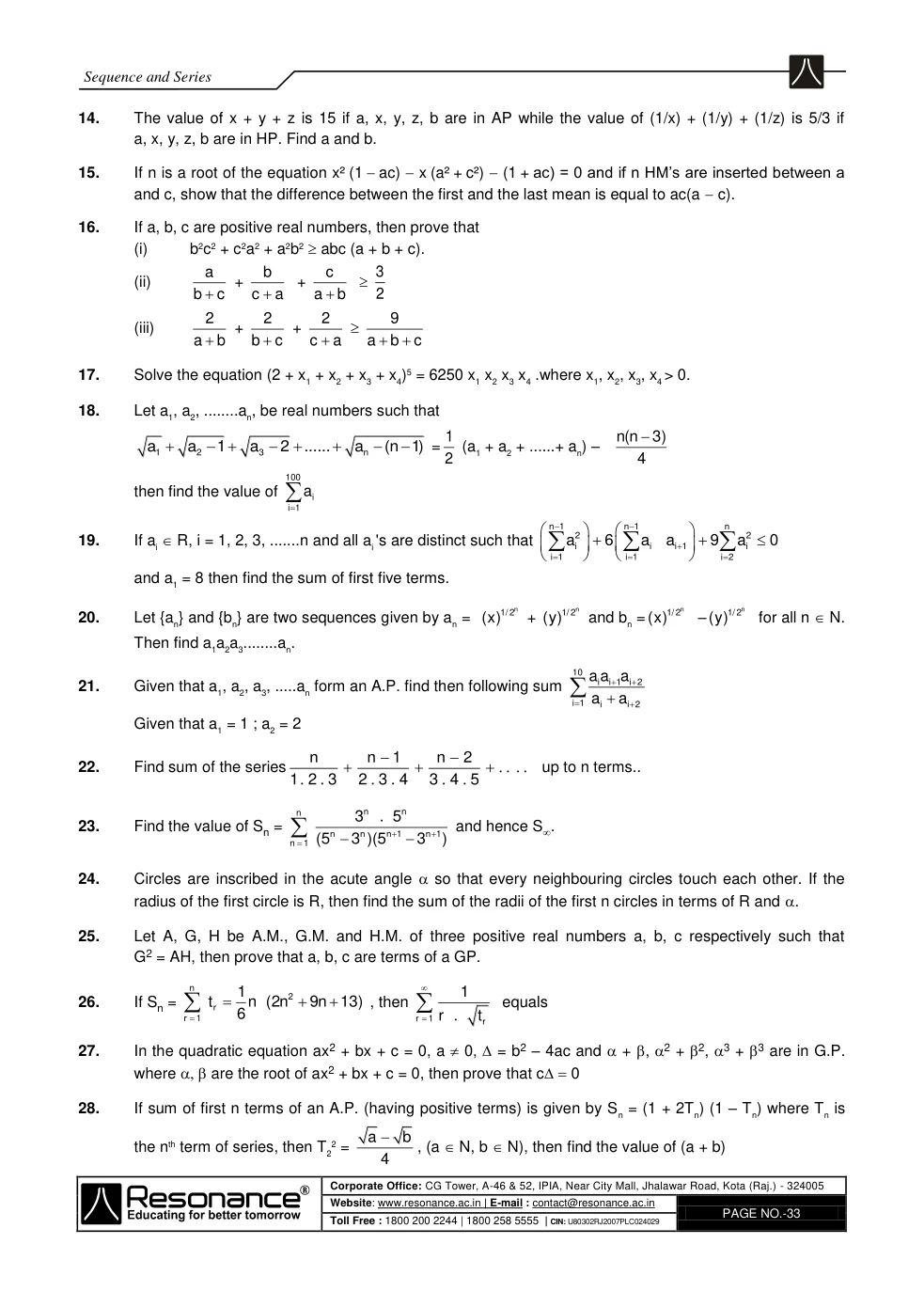
MAASSequence And Series
© MAAS. All rights reserved.Page 33 / 34
Extracted text · page 33
Sequence and Series
14. The value of x + y + z is 15 if a, x, y, z, b are in AP while the value of (1/x) + (1/y) + (1/z) is 5/3 if
a, x, y, z, b are in HP. Find a and b.
15. If n is a root of the equation x² (1 ac) x (a² + c²) (1 + ac) = 0 and if n HM’s are inserted between a
and c, show that the difference between the first and the last mean is equal to ac(a c).
16. If a, b, c are positive real numbers, then prove that
(i) b2c2 + c2a2 + a2b2 abc (a + b + c).
a b c 3
(ii) + +
b c c a a b 2
2 2 2 9
(iii) + +
a b b c c a a b c
17. Solve the equation (2 + x1 + x2 + x3 + x4)5 = 6250 x1 x2 x3 x4 .where x1, x2, x3, x4 > 0.
18. Let a1, a2, ........an, be real numbers such that
1 n(n 3)
a1 a2 1 a3 2 ...... an (n 1) = (a1 + a2 + ......+ an) –
2 4
100
then find the value of a i i 1
n 1 2 n 1 n 2
ai 019. If ai R, i = 1, 2, 3, .......n and all ai 's are distinct such that ai 6 ai ai 1 9
i 1 i 1 i 2
and a1 = 8 then find the sum of first five terms.
20. Let {an} and {bn} are two sequences given by an = (x)1/ 2n + (y)1/ 2n and bn = (x)1/ 2n – (y)1/ 2n for all n N.
Then find a1a2a3........an.
10 aai i 1ai 221. Given that a1, a2, a3, .....an form an A.P. find then following sum i 1 ai ai 2
Given that a1 = 1 ; a2 = 2
n n 1 n 2
22. Find sum of the series . . . . up to n terms..
1. 2 . 3 2 . 3 . 4 3 . 4 . 5
n 3n . 5n
and hence S.23. Find the value of Sn = n n n 1 n 1 n 1 (5 3 )(5 3 )
24. Circles are inscribed in the acute angle so that every neighbouring circles touch each other. If the
radius of the first circle is R, then find the sum of the radii of the first n circles in terms of R and .
25. Let A, G, H be A.M., G.M. and H.M. of three positive real numbers a, b, c respectively such that
G2 = AH, then prove that a, b, c are terms of a GP.
n 1 2 1
t r n (2n 9n 13) , then equals26. If Sn = r 1 6 r1 r . t r
27. In the quadratic equation ax2 + bx + c = 0, a 0, = b2 – 4ac and + , 2 + 2, 3 + 3 are in G.P.
where are the root of ax2 + bx + c = 0, then prove that c 0
28. If sum of first n terms of an A.P. (having positive terms) is given by Sn = (1 + 2Tn) (1 – Tn) where Tn is
2 a b the nth term of series, then T2 = , (a N, b N), then find the value of (a + b)
4
PAGE NO.-33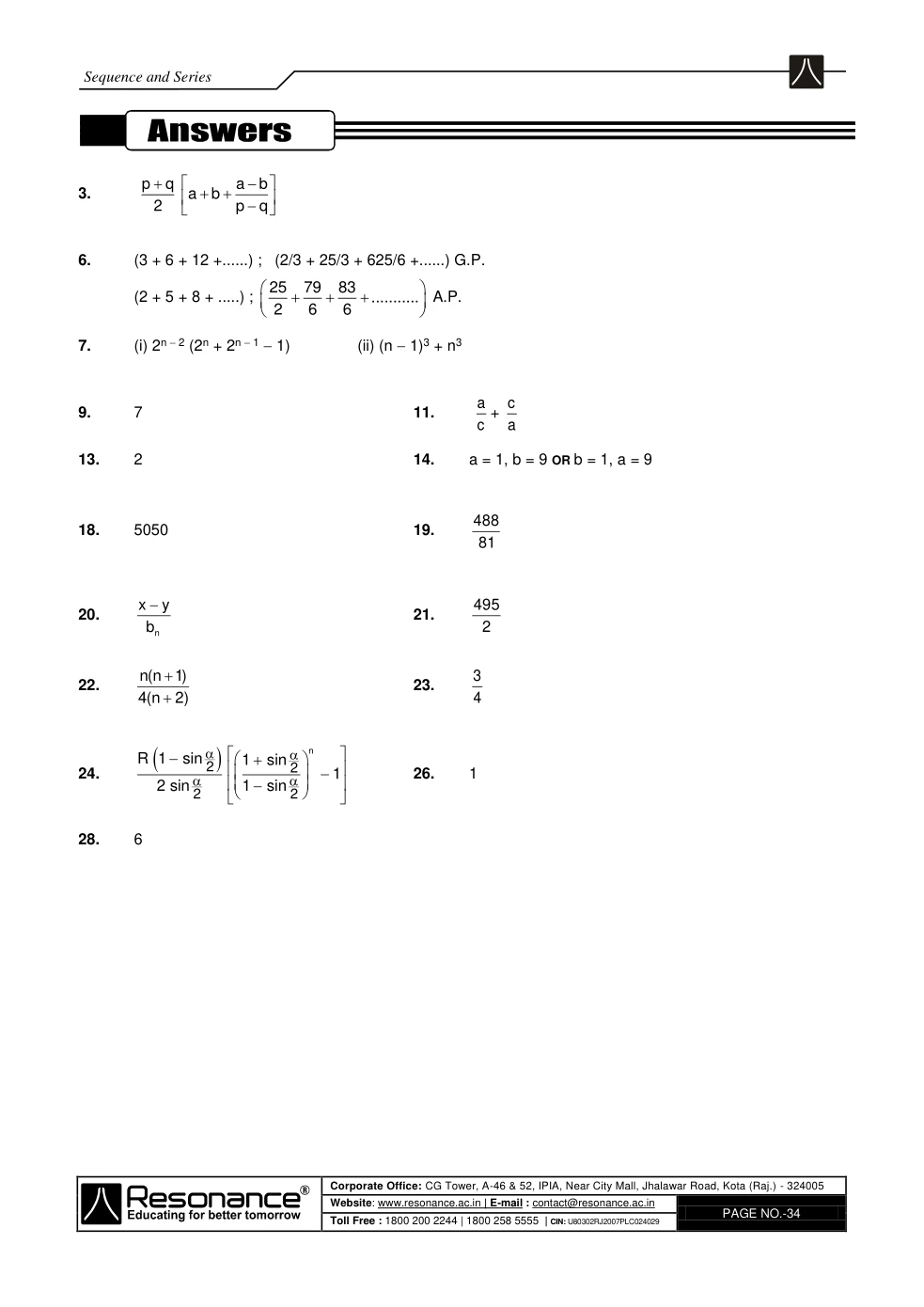
MAASSequence And Series
© MAAS. All rights reserved.Page 34 / 34
Extracted text · page 34
Sequence and Series
p q a b
3. a b 2 p q
6. (3 + 6 + 12 +......) ; (2/3 + 25/3 + 625/6 +......) G.P.
25 79 83
(2 + 5 + 8 + .....) ; ........... A.P.
2 6 6
7. (i) 2n 2 (2n + 2n 1 1) (ii) (n 1)3 + n3
a c
9. 7 11. +
c a
13. 2 14. a = 1, b = 9 OR b = 1, a = 9
488
18. 5050 19.
81
x y 495
20. 21.
b n 2
n(n 1) 3
22. 23.
4(n 2) 4
n R 1 sin 1 sin 2 2 24. 26. 1 1
2 sin 1 sin
2 2
28. 6
PAGE NO.-34